







Abstract
In the past decade, before the onset of the Covid-19 pandemic, rates of childhood vaccination against diseases such as measles, diphtheria, pertussis, and tetanus declined worldwide. An extensive literature examines the correlates and motives of vaccine hesitancy—the reluctance or refusal to vaccinate despite the availability of vaccines—among individuals, but little macrosociological theory or research seeks to explain changes in country-level vaccine uptake in global and comparative perspective. Drawing on existing research on vaccine hesitancy and recent developments in world society theory, we link cross-national variation in vaccination rates to two global cultural processes: the dramatic empowerment of individuals and declining confidence in liberal institutions. Both processes, we argue, emerged endogenously in liberal world culture, instigated by the neoliberal turn of the 1980s and 1990s. Fixed- and random-effects panel regression analyses of data for 80 countries between 1995 and 2018 support our claim that individualism and lack of institutional confidence contributed to the global decline in vaccination rates. We also find that individualism is itself partly responsible for declining institutional confidence. Our framework of world-cultural change might be extended to help make sense of recent post-liberal challenges in other domains.
In January 2019, nearly a year before the first documented case of Covid-19 (Roberts, Rossman, and Jarić 2021), the World Health Organization (WHO) identified vaccine hesitancy as a top-10 threat to global health (World Health Organization 2019). By then, vaccine hesitancy—the reluctance or refusal to vaccinate despite the availability of vaccines—had been on WHO’s radar for about a decade, prompted by a worldwide decline in vaccination rates. Figure 1 documents this decline. The percentage of children immunized against measles, diphtheria, pertussis, and tetanus across a constant-case sample of 162 countries began to decrease in the early 2010s, reversing a steep upward trend in vaccine coverage over the previous two decades.
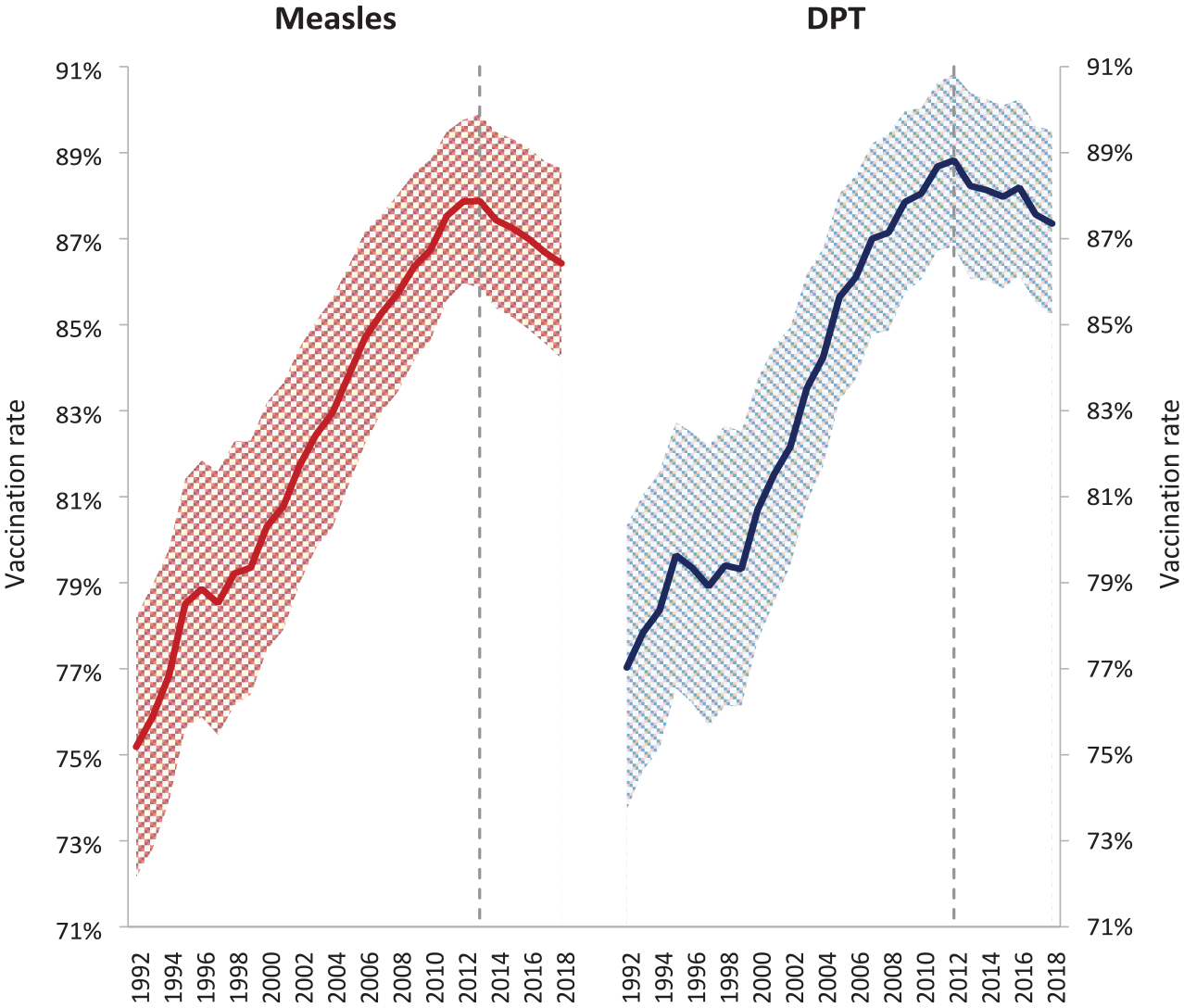
Average Measles and DPT Vaccination Rates for a Constant-Case Sample of Countries, 1992 to 2018
What accounts for this striking cross-national reversal in vaccination rates? Many commentators trace the recent decline to the infamous “Wakefield study” (Wakefield et al. 1998), published in 1998 and retracted in 2010, that purported to link the measles vaccine to autism (Conis 2014; Mnookin 2011; Offit 2005). Others point to the spread of misinformation via the internet and social media (Kata 2010, 2012; Pinker 2021; Wilson and Wiysonge 2020). Although such factors likely play an important role, rumors and conspiracies about the alleged risks of vaccines have circulated for decades (Kitta and Goldberg 2017; Larson 2020) and cannot by themselves account for the recent and abrupt downturn in vaccine uptake. In any event, vaccine hesitancy does not appear to be driven primarily by ignorance, as individuals who oppose vaccines tend to be highly educated (Goldenberg 2021; Kitta and Goldberg 2017; Reich 2016; Salmon et al. 2005; Smith, Chu, and Barker 2004; Sobo 2015; Sugerman et al. 2010).
We argue that deeper social and cultural transformations, global in scope, help explain the sudden and widespread decline in vaccination rates worldwide. Contemporary resistance to vaccination forms part of a much larger backlash against the postwar liberal order, one that includes restrictions on civil society organizations (Bromley, Schofer, and Longhofer 2020; Glasius, Schalk, and De Lange 2020), legal and popular reactions against lesbian, gay, bisexual, and transgender (LGBT) people (Hadler and Symons 2018; Roberts 2019; Velasco 2018), declines in women’s status (Lerch, Schofer, et al. 2022), and attacks on science and universities (Frank and Meyer 2020; Schofer, Lerch, and Meyer 2022). These trends reflect an even broader set of illiberal developments: the retrenchment of democracy worldwide (Diamond 2015), the global resurgence of populism (Norris and Inglehart 2019), and mounting distrust of liberal institutions (Kavanagh et al. 2020; Lake, Martin, and Risse 2021). Some observers wonder if we now find ourselves in a post-liberal order (Bromley et al. 2020; Frank and Meyer 2020; Ikenberry 2018; Jepperson and Meyer 2021).
The fact that illiberal reactions occur contemporaneously in multiple domains and across a range of countries suggests that broad cultural and institutional processes may be at work, making world society theory a viable candidate for understanding them. Although world society research typically documents the diffusion of “happy talk” (Bell and Hartmann 2007) and “virtuous” outcomes (Boli 2006; Schofer et al. 2012) such as human rights (Cole 2005; Elliott 2007), environmental protection (Hironaka 2014; Schofer and Hironaka 2005), and educational expansion (Meyer, Ramirez, and Soysal 1992; Schofer and Meyer 2005), the theory can also be applied to recent illiberal and anti-liberal developments, including the rise of vaccine hesitancy.
We contend that illiberal reactions arise endogenously from liberal world culture. Liberalism contains the seeds of its opposition, and perhaps even its own destruction. Liberal institutions emerged in large measure to save unbridled liberalism from itself: from the vagaries of unregulated markets, the rule of tyrannical majorities, and the whims of egoistic individuals. But the rise of neoliberalism during the 1980s brought tensions between individual freedom and institutional constraints increasingly to the fore. The cultural constitution of individuals as dramatically empowered rights-bearing actors, coupled with the erosion of confidence in major institutions that accompanied the neoliberal turn, threatened the liberal order from within. The liberal cultural and institutional order fell victim to its own triumphalist excess.
We use the global decline in vaccination rates to trace these dynamics and illustrate their potential consequences. In what follows, we highlight the conditions of liberalism, and especially of neoliberalism, that set the stage for recent post-liberal reactions. We follow recent scholarship in delineating three periods in the development of world society after World War II: embedded liberal, neoliberal, and post-liberal (Jepperson and Meyer 2021). 1 Using this framework, we hypothesize the relationship between two main features of the post-liberal turn—the hyper-empowerment of individuals and declining confidence in liberal institutions—and vaccination rates.
Fixed- and random-effects panel regression analyses of vaccine coverage in roughly 80 countries between 1995 and 2018 show that empowered individualism and eroded institutional confidence each contribute to declining childhood vaccination rates, net of other key determinants. These findings build on and extend research documenting a relationship between ideologies of individualism and vaccine hesitancy (e.g., Estep and Greenberg 2020; Hornsey, Harris, and Fielding 2018; Reich 2014, 2016), which we link to cultural processes unfolding globally. We also show that individualism is itself partly responsible for declining institutional confidence, consistent with our view that challenges to liberalism are arising endogenously.
Three Eras of Postwar Liberalism
Our analyses begin in the mid-1990s, but an understanding of the post-liberal turn in world society requires a broader purview that extends to the end of World War II. Jepperson and Meyer (2021), building on Ruggie (1982), suggest a division of the postwar era into three periods: embedded liberalism, neoliberalism, and post-liberalism. These periods, we propose, are delineated in large measure by the shifting relationship between individuals and institutions.
The era of embedded liberalism (Polanyi [1944] 2001; Ruggie 1982) lasted from 1945 until roughly 1980. Embedded liberalism refers to a suite of doctrines and policies that sought to “embed” markets in state and multilateral institutions, melding a classical liberal commitment to free trade and individual autonomy with government interventions designed to stabilize markets, reduce unemployment, and ensure basic welfare. More broadly, embedded liberalism produced individuals with “embedded autonomy,” bearers of rights and responsibilities within a highly institutionalized role structure. Individuals did not function as wholly independent self-determining actors, so much as legitimated agents in the service of various structural principals and cultural principles: the state, the professions, science, human rights, democracy, and so on (Frank and Meyer 2002; Meyer 1994; Meyer et al. 1997; Meyer and Jepperson 2000).
Liberal institutions in multiple domains—economic, political, educational—aggregated individual choices into an orderly, highly rationalized society. In economics, self-interested individuals were free to make decisions as producers, consumers, and investors, but state coordination and regulation equilibrated markets and ensured a modicum of welfare. In politics, democracy authorized individuals to select leaders and express policy preferences, but these choices were to be registered in routine elections, mediated through representatives, and constrained by norms and institutions. In education, all individuals were deemed rational and educable, with the capacity to acquire, comprehend, and deploy knowledge. Nevertheless, a liberal education prescribed a regimented curriculum designed to transform individuals into responsible and well-informed citizens (Bendix 1964).
The immediate postwar decades also represented the high-water mark for the legitimacy of the nation-state. The ravages of great depression, the horrors of global war, and the anxieties of nuclear bipolarity strengthened the authority of managerial “Weberian” states (Evans and Rauch 1999), albeit ones shorn of the nationalistic excesses that had ignited the world wars. States grew more active than ever before in planning economic development, regulating markets, ensuring national security, delivering education, managing public health, and performing a host of other functions.
Beginning in the 1970s, embedded liberalism yielded to neoliberal models of state, society, and economy. Standard accounts of neoliberalism emphasize its economic dimensions: market deregulation, privatization, welfare retrenchment, reductions in government spending, and the like. Waves of free-market reforms spread on the promise that they would lift all boats, with the unconvinced “shocked” or “structurally adjusted” into compliance (see Abouharb and Cingranelli 2007; Fourcade-Gourinchas and Babb 2002; Harvey 2005).
Yet neoliberal cultural models reverberated well beyond economics, revising liberal conceptions in other domains as well (Lerch, Bromley, and Meyer 2022). In politics, the victors of the Cold War exported—via economic conditionalities or at gunpoint—a substantively thin model of neoliberal democracy that emphasized popular elections while underplaying minority protections, institutional constraints, and the rule of law. A rhetoric of unbridled “freedom” eclipsed sober liberal notions of citizenship rights coupled with duties and responsibilities. Observers such as Zakaria (1997) began to worry about the looming specter of illiberal democracy, with free and fair elections catapulting would-be autocrats into power.
Changes came in education as well. Higher education expanded rapidly (Schofer and Meyer 2005), and schooled individuals were socialized to become—or at least to posture as—experts in their own right, participating directly in and even contributing to the stock of scientific knowledge (Bromley, Meyer, and Ramirez 2011; Lerch, Bromley, and Meyer 2022; McEneaney 2003). Compared to the previous era, a neoliberal education consists of a dwindling and diversified core curriculum, with wide latitude for elective coursework (Brint et al. 2009; Frank and Meyer 2007; Robinson 2011). Industry logics infiltrated the university (Gumport 2019), denuding it of the sacred mission to discover and bestow transcendental truths (Frank and Meyer 2020). Colleges and universities became an academic marketplace in which “faculty members are producers, students are consumers, and curricula are commodities that reflect changes in students’ interests and proclivities” (Cole 2011:387).
As a cultural ideology, neoliberalism comprises two related elements: anti-elitism and individual empowerment (Jepperson and Meyer 2021). Neoliberalism engenders declining trust in elites and institutions—government elites and state institutions, to be sure, but also science and scientists (Gauchat 2012; Kozlowski 2022; Mooney 2005; Schofer et al. 2022), journalists and the media (Kenny 2020; Moffitt 2016; Mounk 2018), and multilateral institutions (see Lake et al. 2021 and the accompanying papers). For Giddens (1990), declining trust in expert systems is a constituent feature of late modernity.
Alongside and linked to this anti-establishment ethos, the individual actor grew ever more empowered and emboldened. Individuals gained unprecedented rights and capacities as autonomous persons disembedded from communal, corporate, and structural memberships, including membership in the state. Now everyone everywhere—whether elite or commoner, rich or poor, schooled or uncredentialed—enacts the role of an assertive, self-assured, and self-directed “actor” (Hwang, Colyvas, and Drori 2019; Meyer and Jepperson 2000). As actors, individuals seek out, interpret, and act on expertise (Giddens 1994), and even claim for themselves “some kind of quasi-expertise” (Brubaker 2021:77). Such developments are aided by the democratization of knowledge (Mnookin 2011; Reich 2016) and hyper-accessibility of expertise (Brubaker 2021), made possible by the internet.
By simultaneously empowering individuals and enervating liberal institutions, neoliberalism set the stage for the post-liberal turn. The phenomenon of “hyper-empowerment” (Bromley 2016) results when highly agentic individuals, plucked from their structural moorings and cut loose from normative constraints, come to be privileged over and against institutions. The hyper-empowered individual—who comes to resemble Elias’s highly bounded, autonomous, disembedded, and purposive homo clausus—not only acts independently of liberal institutions, but now claims the prerogative to dismiss, flout, or even attack those institutions. Extreme versions of liberal ideology confer dramatic, even godlike, authority and capacities on individual actors (Meyer and Jepperson 2000). The hyper-empowered individual becomes a highly sacralized entity (Mathias 2013), “a god above all others” (Durkheim [1957] 1992:56), a “small god” (Meyer 2000:239), a “deity of considerable importance” (Goffman 1956:499), even a “god who shits” (Becker 1973:58). Seen in this light, individuals are not only viewed as highly capable of making their own decisions; they are also encouraged—indeed expected—to do so. Modern culture obligates us to be persons who make autonomous choices. 2
As with neoliberalism before it, these trends affect multiple domains of social and political life. In politics, we see the revival of populist themes exalting “the ordinary people” while attacking the institutional foundations of liberal democracy: representative institutions, courts, the media, even elections themselves (Norris and Inglehart 2019). More and more people express their political preferences in the streets instead of at the ballot box: voter turnout declines while extra-institutional mobilizations such as occupations, marches, and insurrections increase (see Flegenheimer 2020; World Bank 2017). In matters of faith, a diverse religious marketplace allows individuals to shop for and experiment with beliefs that satisfy their highly personalized and mercurial spiritual needs (Stark and Finke 2000; Wuthnow 1978), while a growing number of religious “nones” reject institutionalized religion altogether. In higher education, more than 900 colleges and universities in the United States alone permit students to design individualized majors (Cargas 2020), giving them “the autonomy they need to pursue unconventional interests” (Kowarski 2010). 3 And in science, the post-liberal hyper-empowerment of individuals no longer encourages lay people merely to enact the role of citizen-scientist, it also authorizes them to reject science itself—including scientific recommendations regarding vaccines.
Post-Liberalism and the Rise of Vaccine Hesitancy
The period covered in our analysis—1995 to 2018—captures the transition from neoliberalism to post-liberalism in world society. Obviously, no clear break demarcates these two periods, although key events in the transition include the 1997 Asian financial crisis, the anti-globalization mobilizations of 1999, the terrorist attacks of September 11, 2001, and the Great Recession of 2007 to 2009 (Jepperson and Meyer 2021; Lerch, Schofer, et al. 2022).
We focus here on two neoliberal cultural shifts that intensified at the Cold War’s end and ultimately produced post-liberal reactions: the hyper-empowerment of individuals and declining confidence in liberal institutions. Drawing on our general theoretical framework and existing research on vaccine hesitancy, we formulate hypotheses relating each of these developments to country-level vaccination rates. We also consider the possibility that these relationships are conditioned by other factors, including societal levels of higher education, fidelity to neoliberal economic models, and the quality of a country’s institutions. Finally, we hypothesize the post-liberal linkage between individualism and declining institutional confidence.
The Effect of Hyper-Empowered Individualism
Neoliberal cultural ideologies dramatically empowered individuals in multiple domains, including healthcare. Neoliberalism undercut the legitimacy of the state and other authorities, medical professionals and scientific experts among them, while instilling in people a sense of autonomy and control in their private lives. In some cases, these developments extend to the rejection of vaccines for oneself or one’s children.
Individualism has been linked to vaccine hesitancy via multiple pathways. The first, which we emphasize, is empowerment. In a series of studies of vaccine-hesitant parents in Colorado, Reich (2014, 2016:155, 2020) documents the ascendance of “neoliberal” ideologies that empower parents “to demand individualization of vaccines” for their children. This approach to vaccines forms part of a larger paradigm shift toward patient empowerment, in which individuals are encouraged to become co-equal partners with their doctors and other medical professionals (Anderson and Funnell 2005; Kata 2012; Reich 2016). Even more broadly, the decision to accept or reject vaccines becomes yet another “sovereign individual choice” available to empowered actors (Frank and Meyer 2002:88).
Many parents insist that they, not doctors, are the experts on their own children. This claim to superior knowledge, grounded in intuition and lived experience, entitles them to modify or even reject medical advice (Estep and Greenberg 2020; Reich 2016; Senier 2008). Individuals also routinely conduct their own medical “research,” often via online sources that make expertise (as well as misinformation) available to people who lack the specialized knowledge to interpret it (Brubaker 2021; Giddens 1994; Mede and Schäfer 2020; Mnookin 2011; Reich 2016). For those motivated to do so, “it’s easy to find data or new research that can be taken (or of course mistaken) as suggesting, or even ‘proving,’ as some would claim, that ‘the experts’ got it wrong in this way or that” (Brubaker 2021:77). Indeed, some criticism of vaccines emerges from within the medical and scientific community itself, lending vaccine hesitancy a veneer of legitimacy (Goldenberg 2021; Hausman 2019). For any given issue—whether the efficacy and safety of vaccines, the reality of anthropogenic climate change, or virtually anything else—one can appeal to “counter-experts” in support of a contrarian position (Brubaker 2021; Schofer, Ramirez, and Meyer 2021). 4
Individual empowerment bolsters vaccine hesitancy in still other ways. Despite the recent worldwide downturn in vaccination rates, clear majorities in most countries continue to get vaccinated, and the decision to delay or reject vaccines is often stigmatized (Carpiano and Fitz 2017; Wiley et al. 2021). Individuals who refuse vaccines must therefore remain resolute amid criticism and pressures to conform (Estep and Greenberg 2020; Reich 2016; more generally and classically, Asch 1951). The propensity to resist social pressures is stronger in highly individualistic societies than in collectivist ones (Bond and Smith 1996). A sense of empowered resolve and self-determination girds individuals as they defy not only medical advice but also prevailing social norms, opinions, and practices.
Another pathway linking individualism to the rejection of vaccines is autonomy. Public health initiatives and interventions such as vaccination programs stand in tension with the principles of personal freedom and empowered choice. As a cultural ideology, neoliberalism supports what Estep and Greenberg (2020) call “opt-out individualism,” the freedom not to receive vaccines. Drawing on an expansive range of entitlements, opponents frame vaccination as an assault on various forms of autonomy: bodily integrity, privacy rights, freedom of conscience, parental rights, and so on (see Attwell et al. 2018; Broniatowski et al. 2020; Reich 2014; Senier 2008). 5 A pair of recent studies finds that a culture of “rugged individualism” and individual autonomy hindered government efforts to control the spread of Covid-19 in the United States (Bazzi, Fiszbein, and Gebresilasse 2020) and Germany (Huang et al. 2022). Similarly, a cross-sectional survey of citizens in two dozen countries concludes that anti-vaccination attitudes were stronger the more respondents valued individual freedom from government interference and social obligations (Hornsey et al. 2018).
In asserting their freedom to opt out of vaccines, “parents seldom express how their personal choice comes at the expense of other children” (Reich 2016:234). This dimension of individualism, egoism, stresses the primacy of one’s own interests and prerogatives over an obligation to the wider community. As Ferguson (2021:709) put it in a different context, (neo)liberal world society gives priority to “individual freedoms over collective duties.” With few exceptions, vaccines protect not only their recipients but others as well, especially vulnerable members of the community who cannot be vaccinated for medical reasons. 6 When a majority of the population gets vaccinated, herd immunity is achieved and the entire community is protected. 7 Successful vaccination programs therefore require individuals to make altruistic decisions (Colgrove 2006; Goldenberg 2021; Leach and Fairhead 2007). Self-interested individuals who reject vaccines for themselves or their children effectively “free ride” on others’ decisions to vaccinate, thereby enjoying the benefits of herd immunity without contributing to its maintenance (Conis 2014; Meszaros et al. 1996; Reich 2014, 2016). Prosocial beliefs and behaviors are weaker—and vaccine intentions lower—in societies with individualistic cultures, due partly to a weaker sense of empathy toward others in these societies (Leonhardt and Pezzuti 2022; Leonhardt et al. 2021).
Finally, individualism can support a sense of individual uniqueness that “easily acquires an anti-liberal tendency” (Simmel 1950:82). The notion that each individual is unique, including the belief that individuals have unique immune systems, renders standardized vaccine schedules and uniform healthcare protocols inappropriate (Reich 2016, 2020). Medical interventions such as vaccinations should instead be tailored to one’s own personal needs or preferences.
For these reasons, we expect levels of empowered individualism in a society to depress vaccination rates:
Hypothesis 1a: As a culture of individualism strengthens, vaccination rates will decline.
We also consider whether two factors—societal levels of higher education and market liberalism—condition the effect of individualism. Studies linking education to vaccination are mixed: some find that education promotes pro-vaccine attitudes and increases vaccine uptake (de Figueiredo et al. 2020; Gilkey et al. 2014), whereas others conclude that intentional under-vaccination is most prevalent among highly educated individuals and communities (Bryden et al. 2019; Estep and Greenberg 2020; Goldenberg 2021; Hak et al. 2005; Larson et al. 2016; Reich 2016; Smith et al. 2004; Sugerman et al. 2010). Our framework helps resolve this apparent contradiction. On the one hand, the “deficit model” (Kitta and Goldberg 2017; Light et al. 2022) attributes vaccine hesitancy to a lack of knowledge on the efficacy, safety, and benefits of vaccines, and therefore expects a positive relationship between education and vaccination. On the other hand, education, and especially higher education, empowers people to mobilize around a wide variety of social, political, cultural, and economic issues (Lerch, Schofer, et al. 2022; Schofer et al. 2021). Universities produce “a distinctive kind of person in history: an autonomous individual with an elaborated and rationalized interior, endowed with interests and the capacity to pursue them. Empowered actors have unprecedented authority to be and do things” (Frank and Meyer 2020:61).
In the context of vaccines, it may be that “education only feeds concerns with vaccination as it empowers individuals to access scientific studies themselves and make their own assessments of vaccine efficacy and safety, not all of which are likely to coincide with professionals’ perspectives” (Hausman 2019:14). Higher education is also a source of status and privilege, affording its recipients the cultural capital necessary to pursue their individualized interests in institutional settings (Lareau 2011; Reich 2016), while also shielding them from negative repercussions (e.g., the unwanted attention of child protective services, for parents who refuse vaccines for their children; see Hausman 2019; Reich 2016). We thus consider whether levels of higher education in a society interact with a culture of empowered individualism to reduce vaccination rates:
Hypothesis 1b: Higher education will significantly augment the negative effect of individualism on vaccination rates.
Although we emphasize the social, cultural, and institutional dimensions of neoliberalism, we also recognize that neoliberal economic ideologies might intensify the negative effect of empowered individualism on vaccination rates. Individuals who endorse free-market principles are more likely to believe that vaccines are unsafe and ineffective (Lewandowsky, Gignac, and Oberauer 2013; Lewandowsky and Oberauer 2021; Lewandowsky, Woike, and Oberauer 2020). It is also possible that a neoliberal aversion to market regulation entails a broader libertarian disdain for government intervention in other arenas, including vaccination policies and programs (Rabinowitz et al. 2016; Reich 2016). Finally, neoliberalism might encourage individuals to pursue their own projects and preferences at the expense of the public good, underwriting the belief that vaccination is a free choice to be made in the interests of oneself and one’s own family (Reich 2016).
Hypothesis 1c: Market reforms associated with economic neoliberalism will augment the negative effect of individualism on vaccination rates.
The Effect of Declining Confidence in Liberal Institutions
In addition to empowering individuals, we suspect neoliberalism’s anti-elitism streak also contributes to vaccine hesitancy. Neoliberalism eroded confidence in core liberal institutions: it undermined the political authority of states, challenged the cultural authority of science, and weakened the moral authority of the professions (Giddens 1990; Jepperson and Meyer 2021). Dwindling levels of trust, in turn, erodes confidence in the safety and efficacy of vaccines (Hornsey et al. 2018). Skepticism extends to the governments that regulate and mandate vaccines, the corporations that manufacture vaccines, the medical professionals who administer vaccines, and the science that makes vaccines possible (de Figueiredo et al. 2020; Gauchat 2012; Goldenberg 2021; Kozlowski 2022; Larson et al. 2011).
We suspect mounting institutional distrust is linked to the anti-establishment populist backlash sweeping the globe, itself an indicator of the post-liberal turn in world society (Bonikowski 2017; Brubaker 2017; Norris and Inglehart 2019). Populists dismiss government officials and scientists as out-of-touch elites not to be trusted (Kennedy 2019; Larson 2020), instead putting their faith in alternative epistemologies such as folk wisdom, personal experience, intuition, and even conspiracy theories (Hornsey et al. 2018; Lewandowsky et al. 2013; Mede and Schäfer 2020). Highly empowered skeptics can now confidently assert, contrary to all available evidence, that vaccines cause autism or implant tracking devices, just as they can insist that climate change is a hoax, government death panels determine who lives or dies, or the Moon landing took place on a Hollywood stage.
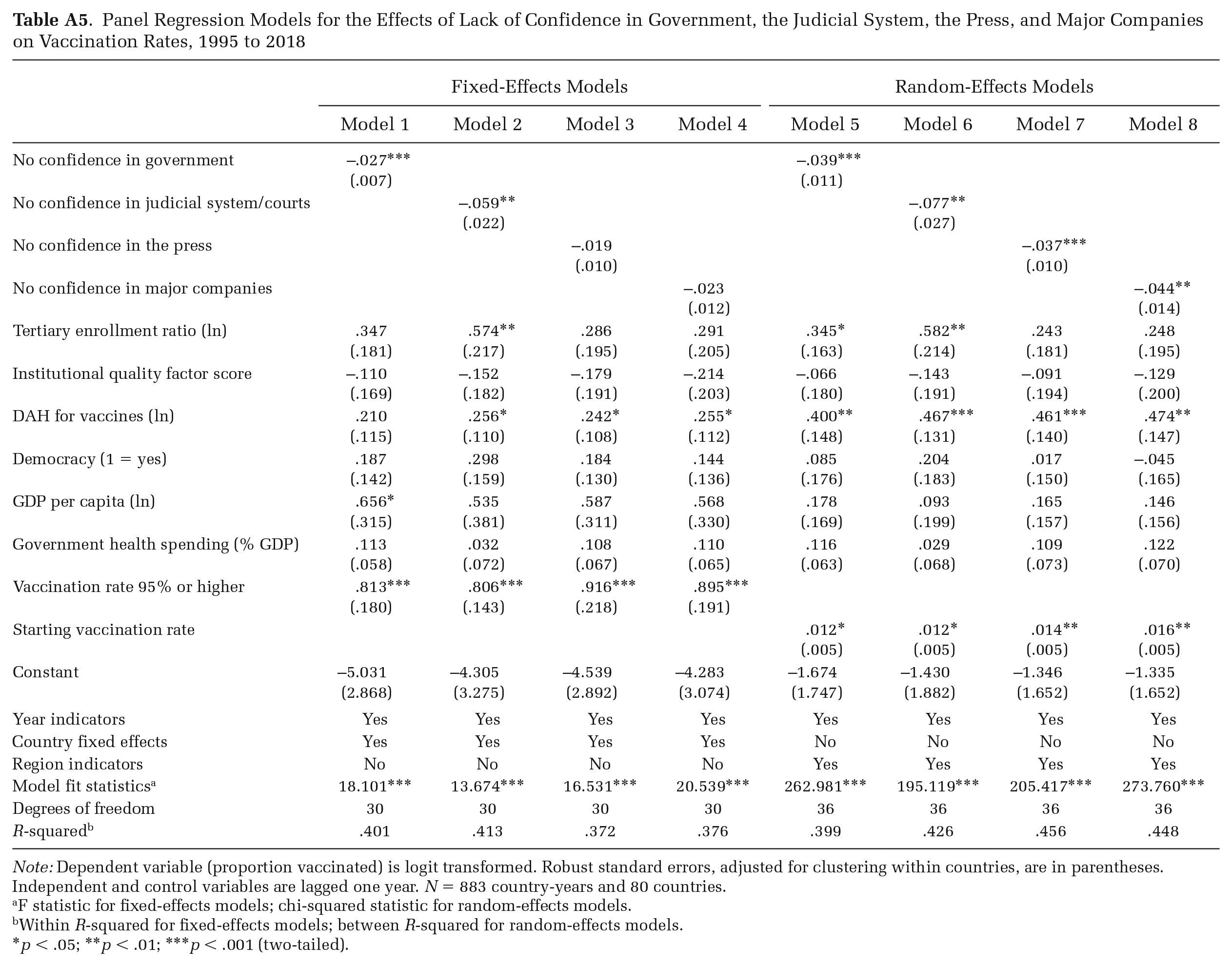
We consider how confidence in government, the judicial system, major companies, and the press affects rates of vaccine uptake. Prior research links declining trust in each of these institutions directly or indirectly to vaccine skepticism. Neoliberal faith in the virtues of market competition severely undercuts state legitimacy, and declining trust in the state and its organs—including a nation’s courts—is a powerful driver of vaccine hesitancy (Gallup 2019; Justwan et al. 2019). The enlarged role of private enterprise in healthcare during the neoliberal era also breeds distrust (Dubé et al. 2021). Lack of confidence in pharmaceutical companies, commercialized healthcare, and corporate-funded science predict anti-vaccination attitudes, stemming in part from fears that the profit motive incentivizes vaccine manufacturers to overstate the risk of vaccine-preventable illnesses while minimizing the risk of adverse vaccine side effects (Goldenberg 2021; Reich 2016; Senier 2008). Trust in government, corporations, and the judicial system are also important predictors of trust in science (Gallup 2019; Pechar, Bernauer, and Mayer 2018), which is itself associated with positive attitudes toward vaccines (Sturgis, Brunton-Smith, and Jackson 2021).
Illiberal attacks on the press in recent years (Kenny 2020; Moffitt 2016; Mounk 2018) have also reduced trust in mainstream media outlets, 8 prompting individuals to seek “information” about vaccines elsewhere—including venues that allow mis- and disinformation to flourish (Kata 2010, 2012). Cross-national evidence suggests an association between social media use and the belief that vaccines are unsafe (Wilson and Wiysonge 2020). Loss of public trust in mainstream media has also been shown to reduce vaccine confidence (Larson et al. 2011). This eventuality is not necessarily unwarranted, at least according to some commentators. Critics accuse mass media outlets of exaggerating vaccine risks and sensationalizing exceedingly rare instances of vaccine-related injuries (Conis 2014; Leach and Fairhead 2007; Mnookin 2011). Others chastise the media for assuming a condescending and supercilious tone toward vaccine-hesitant individuals (Hausman 2019), with potentially counterproductive consequences.
In short, we expect declining confidence in government, courts, companies, and the media to reduce vaccination rates:
Hypothesis 2a: As lack of confidence in core liberal institutions increases, vaccination rates will decline.
As with empowered individualism, we expect the inverse relationship between lack of institutional confidence and vaccination rates to be stronger in highly educated societies. By itself, education may very well increase vaccine uptake, as predicted by the deficit model. But in societies characterized by a widespread lack of confidence and trust, education might have the opposite effect. The phenomenon of “knowledge overconfidence” is one possible mechanism. Highly educated individuals are often overconfident in their scientific knowledge, leading them to dismiss experts and adopt anti-consensus views on scientific issues, including vaccination (Light et al. 2022; Sanchez and Dunning 2018). This dynamic may be especially pronounced in contexts where societal trust is already low. The share of individuals who conduct their own research on the risks and benefits of vaccination, rather than simply deferring to medical recommendations, may also be greater in highly educated societies. This impetus could reflect an antecedent lack of confidence in medical professionals, or it might itself foment doubt: as Giddens (1990:130) argues, “widespread lay knowledge of modern risk environments leads to an awareness of the limits of expertise.” Vaccines are low risk but not no risk. If, in the course of their research, individuals encounter conflicting evidence or recommendations about vaccine safety, their confidence in experts may wane.
Hypothesis 2b: Higher education will significantly augment the negative effect of lack of confidence in institutions on vaccination rates.
Another question asks whether lack of confidence in institutions, where it exists, is in fact warranted. Might the hypothesized negative effect of institutional distrust on vaccination be blunted in societies with high-quality institutions? 9 This possibility acknowledges that perceptions and realities are often loosely coupled. Large numbers of people may lack confidence in institutions that by standard metrics function quite well. Although a long stream of sociological thought argues that perceptions create realities—people who sincerely believe institutions are deficient will behave as if they are—we consider the obverse pattern: that high levels of “objective” institutional quality will effectively neutralize the negative effect of “subjective” lack of confidence.
Hypothesis 2c: Institutional quality will diminish the negative effect of lack of confidence in institutions on vaccination rates.
The Effect of Empowered Individualism on Declining Institutional Confidence
Finally, as suggested by our theory of the post-liberal turn in world society, we expect that empowered individualism will itself be a source of declining confidence in institutions. The cultural constitution of individuals as independent and agentic actors (Meyer and Jepperson 2000) authorizes them to assert their autonomy from, and even reject, all manner of social institutions: the government and its organs, the press, the market, the medical profession, even science itself. We are perhaps witnessing a movement away from the participatory turn (Mede and Schäfer 2020) and toward what might be called the reactionary turn. Many individuals no longer seek to expand or deepen their participation in existing institutions; rather, they see themselves standing outside of and in opposition to these institutions. We consider hyper-empowered individualism an integral component of the illiberal backlash against the political, legal, economic, medical, and scientific “establishments.”
Acknowledging the disruptive potential of (some forms of) individualism is not a novel insight; it has been a central, long-standing, and ongoing concern in sociology: from Tocqueville’s lament that “narrow individualism” results in self-centered isolation; to Marx’s critiques of alienated, “egoistic man” in atomized civil society; to Durkheim’s anxieties about the disintegrating effects of egoism and anomie; to Simmel’s warning that “qualitative” individualism, with its emphasis on uniqueness over equality, can devolve into an anti-liberal force; to Putnam’s more recent concerns about lonely bowlers and their lack of civic engagement. The post-liberal turn again brings these issues to the fore, after a long interlude during which individuals were celebrated as independent, participatory, and highly rational actors.
Hypothesis 3: As a culture of individualism strengthens, lack of confidence in core liberal institutions will grow.
Summary
In summary, we hypothesize that two neoliberal cultural currents—the hyper-empowerment of individuals and the erosion of confidence in liberal institutions—help explain cross-national differences and within-country changes in vaccination rates. We expect individualism and lack of confidence to reduce childhood vaccination rates, and we expect these effects to intensify as enrollments in higher education increase. We also predict that market liberalism will strengthen the negative effect of individualism on vaccine uptake, whereas “objective” institutional quality will blunt the negative effect of “subjective” distrust in institutions. Figure 2 diagrams these hypothesized relationships.
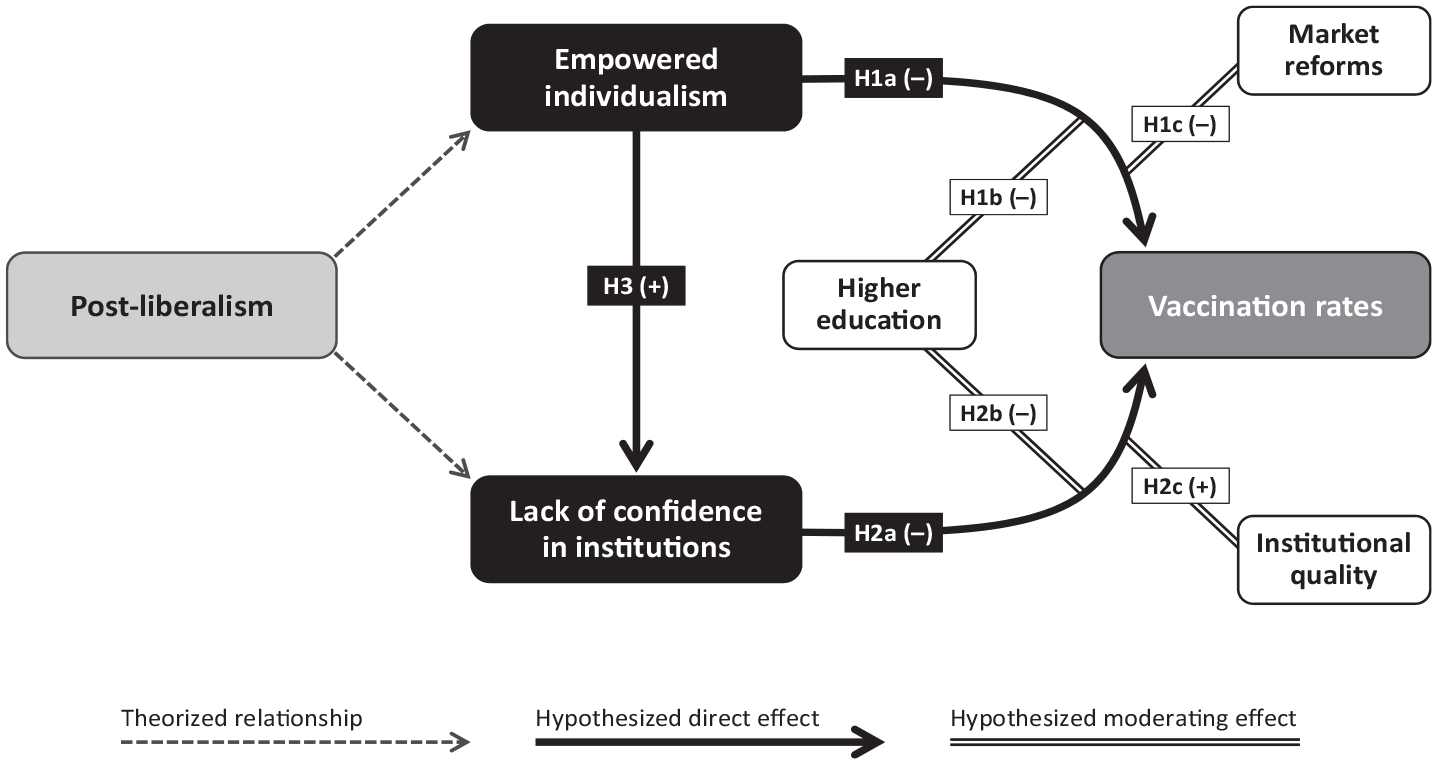
Summary of Hypothesized Relationships Linking Post-Liberalism to Vaccination Rates
Data and Methods
To evaluate our hypotheses, we compiled cross-national data from a variety of sources. Our samples include 80 or 81 countries and 883 or 951 country-year observations, depending on data availability for our measures of individualism and institutional confidence (see below). Appendix Table A1 reports descriptive statistics for the variables included in our analyses, and Appendix Table A2 presents correlations among variables.
Dependent Variable and Method
Our dependent variable averages country-level rates of coverage for two common childhood vaccines: measles and DPT (diphtheria, pertussis, and tetanus). Both measures, sourced from the World Development Indicators database (World Bank 2021), give the proportion of children ages 12 to 23 months who are fully vaccinated against these infections. We focus on these vaccines because they are widely available during the period of our study and because data coverage allows us to address the broadest possible set of countries and years. The two vaccination rates are correlated at more than .90 in our dataset, and they are also strongly correlated with other country-level vaccinations (e.g., polio and meningitis).
We estimate fixed- and random-effects panel regression models, and report clustered standard error estimates that are robust to heteroscedasticity, autocorrelation, and model misspecification (Hoechle 2007). Fixed-effects models incorporate country intercepts that control for all stable but unmeasured characteristics of countries, effectively discarding cross-national variation in favor of isolating within-country changes in vaccination rates over time. Random-effects models take within- as well as cross-national variation into account, allowing us to compare vaccination rates across countries.
Because our dependent variable is a proportion bounded between 0 and 1, we logit transform it before conducting our analyses:
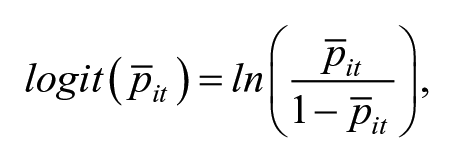
where p– is the average of the measles and DPT vaccination rates for country i in year t.
Independent and Moderator Variables
Our independent variables measure individualism and lack of confidence in major institutions across countries and over time. Moderator variables include levels of higher education, free-market liberalism, and institutional quality in a society. Appendix Table A3 reports country averages for our five independent and moderator variables.
Individualism
To construct a measure of individualism, we conducted a principal-components factor analysis of eight variables. The first variable, Welzel’s (2013:66ff) emancipative values score, measures subjective individualism using 12 items from the World Values Survey (WVS; Inglehart et al. 2020) that rate survey respondents’ attitudes toward individual autonomy (viewing independence and imagination rather than obedience as desired qualities in children), choice (tolerance of divorce, abortion, and homosexuality), equality (gender equality in politics, education, and employment), and voice (support for speech freedoms and giving people more input in government decisions, their jobs, and their communities). 10 We average these individual-level scores by country and year to produce a time-varying societal measure of individualism. Among individuals, emancipative values scores range from 0 to 100; our aggregated score varies between 22.5 (low individualism) and 73.3 (high individualism), with a mean of 42.9. The emancipative values score is available at irregularly spaced intervals, depending on the inclusion of countries in waves of WVS data collection. We use linear interpolation to produce an annual time series (see Appendix Table A4 for country-years with available data).
Remaining variables measure structural properties that correspond to several of the subjective value commitments in the emancipative values score. The Varieties of Democracy dataset, version 10 (Coppedge et al. 2020), provides four of these variables: 11
Power distributed by sexual orientation rates the distribution of political power and influence between heterosexual and LGBT [sic] citizens, 12 with higher scores corresponding to a more equitable distribution (Coppedge et al. 2020:193–94).
Power distributed by gender measures the distribution of political power and influence between men and women, with low scores indicating that men hold a near-monopoly and higher scores representing progressively greater equality (Coppedge et al. 2020:193).
Gender equality in respect for civil liberties quantifies the extent to which men and women have equal access to justice, private property rights, freedom of movement, and freedom from forced labor (Coppedge et al. 2020:199).
Freedom of discussion assesses citizens’ ability to engage in discussions, particularly on political issues, in private homes and public spaces without fear of harassment by other members of the polity or public authorities (Coppedge et al. 2020:290–91).
Three additional variables included in our measure of individualism tap legal and social restrictions on the autonomy of women and lesbian, gay, and bisexual individuals:
An abortion rights index (Forman-Rabinovici and Sommer 2018, by way of Teorell et al. 2021) enumerates seven grounds for granting legal access to abortion: saving a woman’s life, preserving a woman’s physical health, preserving a woman’s mental health, in case of rape or incest, in case of fetal impairment, and for social or economic reasons, on request.
An index of legal recognition of lesbian, gay, and bisexual (LGB) rights (Badgett, Waaldijk, and Rodgers 2019) summarizes eight categories of legal recognition: consensual homosexual sex; equal age limits for consensual sex; explicit legal prohibition in employment discrimination; explicit legal prohibition of discrimination regarding goods and services; legal recognition of non-registered cohabitation; availability of registered partnership for same-sex couples; possibility of second-parent or joint adoption by same-sex partners; and legalization of same-sex marriage.
Modern contraceptive use rate for unmarried women (United Nations 2019) estimates the proportion of unmarried women of reproductive age (15 to 49) using modern contraceptive methods: female and male sterilization, intrauterine devices, implants, injectables, birth-control pills, male and female condoms, vaginal barrier methods, the lactational amenorrhea method, and emergency contraception.
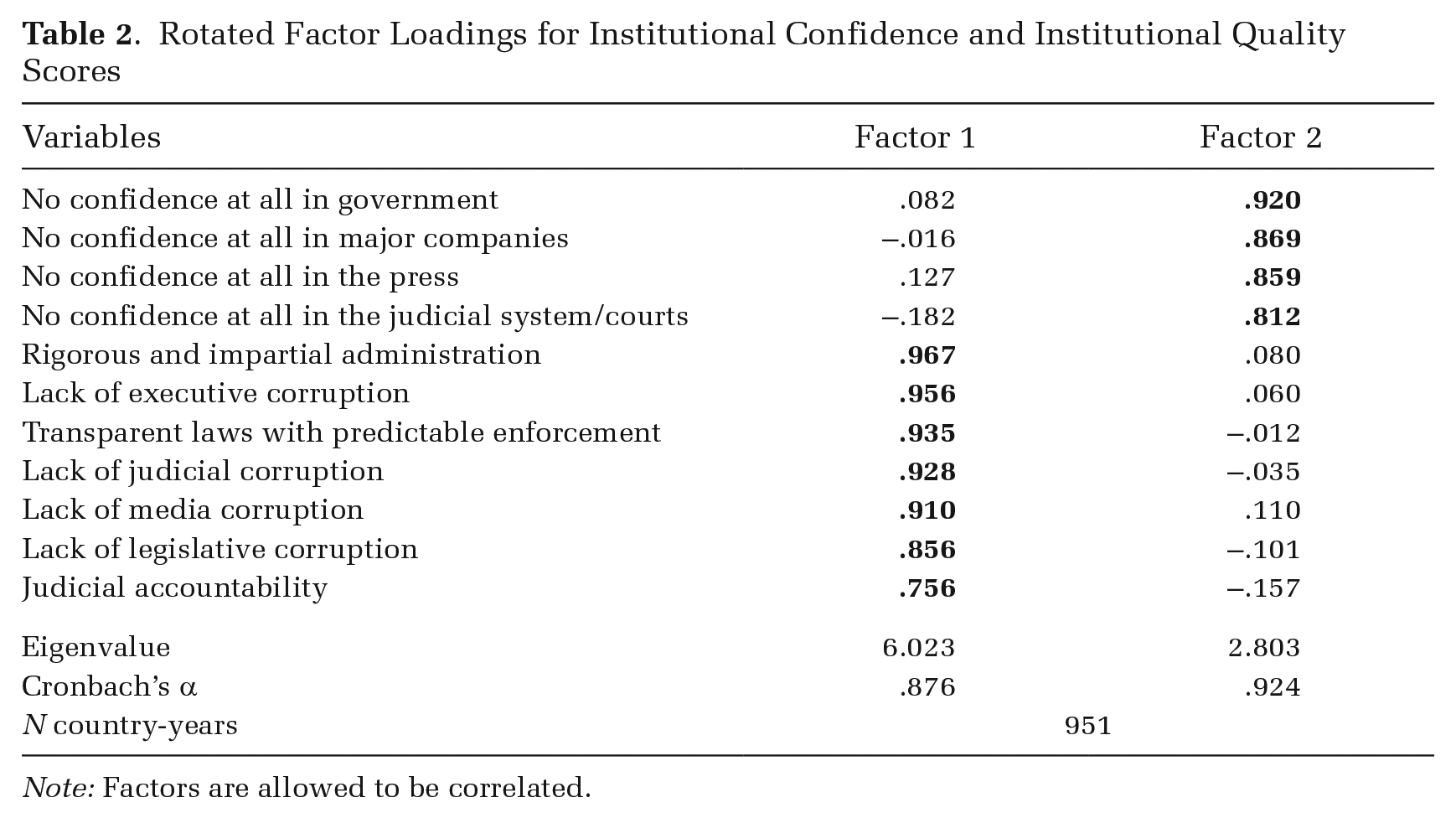
Table 1 reports a factor analysis of these variables. All eight items load onto a single factor (Eigenvalue = 4.881) and display an acceptable degree of internal consistency (Cronbach’s α = .786). With the exception of the abortion rights index, rotated factor loadings among items exceed .75. We extract the resulting factor score as our measure of individualism.
Rotated Factor Loadings for Individualism Scores
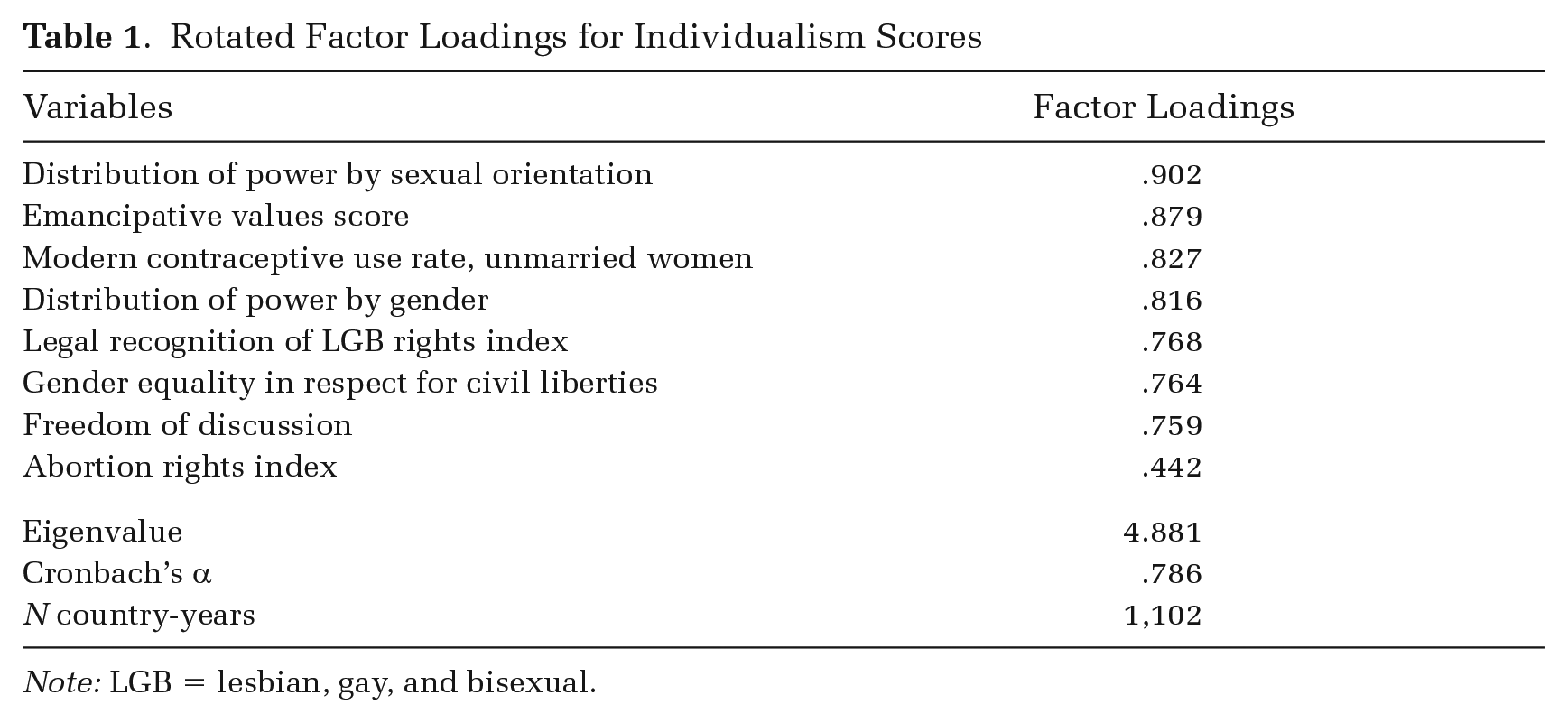
Note: LGB = lesbian, gay, and bisexual.
Institutional confidence and quality
Our measures for lack of institutional confidence and institutional quality also come from a principal-components factor analysis. This analysis includes 11 variables, four of which gauge subjective levels of confidence in the government, the justice system/courts, major companies, and the press using items from the WVS (Inglehart et al. 2020). Survey respondents were asked whether they have a great deal of confidence, quite a lot of confidence, not very much confidence, or no confidence at all in each of these institutions. We computed the percentage of respondents per country-year indicating “no confidence at all” and then used linear interpolation to extend each time series (again, Appendix Table A4 identifies country-years with available data). 13
Seven additional variables, drawn from the Varieties of Democracy dataset (Coppedge et al. 2020), rate dimensions of institutional quality in a society:
Rigorous and impartial administration gauges the extent to which public officials abide by the law and treat like cases alike, as opposed to making arbitrary and biased decisions (Coppedge et al. 2020:164–65).
Transparent laws with predictable enforcement considers whether a country’s laws are clear, well publicized, coherent, relatively stable from year to year, and predictably enforced (Coppedge et al. 2020:164).
Lack of executive corruption rates how frequently members of the executive branch grant favors in exchange for bribes or other material inducements, as well as how often they steal, embezzle, or misappropriate public funds for personal use (Coppedge et al. 2020:193–94).
Lack of legislative corruption rates how frequently members of the national legislature accept bribes, help obtain government contracts for oneself or one’s associates, exchange favors for employment opportunities after leaving office, or steal money from the state or campaign donations for personal use (Coppedge et al. 2020:137–38).
Lack of judicial corruption rates how frequently individuals or businesses make undocumented extra payments or bribes to expedite or delay the judicial process or to obtain a favorable judicial decision (Coppedge et al. 2020:156).
Lack of media corruption asks whether journalists, publishers, or broadcasters accept payments in exchange for altering news coverage (Coppedge et al. 2020:190–91).
Judicial accountability assesses whether judges, when found responsible for serious misconduct, are removed from their posts or otherwise disciplined (Coppedge et al. 2020:155–56).
For all seven measures, higher scores correspond to better quality institutions (e.g., more impartial, more transparent, more accountable, less corrupt).
A principal-components factor analysis of these 11 variables, reported in Table 2, yields two factors. The seven institutional quality measures load strongly onto the first factor, with the four “no confidence at all” items loading onto a second. Each factor displays a strong degree of internal consistency (Cronbach’s α = .876 and .924, respectively). Higher scores on the lack of institutional confidence factor correspond to lower levels of public confidence in government, companies, courts, and the media. Higher scores on the institutional quality factor correspond to “cleaner” (i.e., less corrupt) practices and greater impartiality, transparency, predictability, and accountability.
Rotated Factor Loadings for Institutional Confidence and Institutional Quality Scores
Note: Factors are allowed to be correlated.
Tertiary enrollment ratio
We measure levels of higher education in a society using gross tertiary enrollment ratios, defined as the ratio of total enrollment in postsecondary education, regardless of age, to the population of the relevant age group. The World Bank (2021) is our primary source of data for this variable, supplemented with data from the United Nations (2022). The ratio is logged (after adding a constant of 1) to reduce skew.
Market liberalism index
The Fraser Institute’s Economic Freedom of the World index (Fraser Institute 2019) serves as our measure of a country’s commitment to market liberalism. Higher scores indicate greater adherence to free-market policies in such domains as private property protections, size of government, marginal tax rates, monetary policies, tariffs and foreign trade barriers, and domestic economic regulations.
Control Variables
Given our restricted sample sizes, we incorporate a limited number of essential control variables. First, we adjust for cross-national variation in baseline vaccination rates by including a country’s starting vaccination rate, measured in 1980 or the first year thereafter with available data. This score is time-invariant and therefore falls out of the fixed-effects models; in these analyses, we include an indicator for countries with a vaccination rate of 95 percent or higher, to capture ceiling effects.
Access to vaccines is likely to be greater in high-income countries. We include gross domestic product (GDP) per capita as a conventional proxy for economic development (World Bank 2021). This variable is measured in constant 2010 U.S. dollars and logged to reduce skew.
Another control variable tallies the amount of development assistance for health (DAH) for vaccines received by a country each year (Institute for Health Metrics and Evaluation 2019). DAH refers to financial and in-kind transfers from major health development agencies to low- and middle-income countries, and we focus on assistance earmarked specifically for childhood vaccination. High-income countries that receive no assistance are scored 0. We compute the amount of vaccine-related DAH per 1,000 children age 0 to 4 and log the resulting measure (after adding a constant of 1) to reduce skew. 14
Vaccination rates may also increase as a function of government funding for healthcare, which proxies a country’s health infrastructure. A variable measuring total government health spending as a share of GDP accounts for this possibility (Institute for Health Metrics and Evaluation 2020).
Democracy might also promote vaccination, in part by boosting institutional confidence. National vaccination programs are perhaps most likely to succeed in countries where public dialogue, open inquiry, and evidenced-based policymaking are permitted (Union of Concerned Scientists 2014). Democracy, in other words, increases transparency—and hence trust and confidence—in vaccination initiatives. An indicator for democracy is coded 1 if a country scored 6 or higher on the revised Polity score index, and 0 otherwise (Marshall 2020).
To account for temporal trends in vaccine coverage, all models incorporate (but do not report) t – 1 year intercepts. Finally, our random-effects models include (but also do not report) a nine-category indicator of politico-geographic regions from the Quality of Government Standard Dataset (Teorell et al. 2021): Western Europe and North America (the omitted reference category), Eastern Europe and Central Asia, Latin America, the Caribbean, the Middle East and North Africa, sub-Saharan Africa, East Asia, Southeast Asia, and South Asia.
Results
Individualism and Vaccination Rates
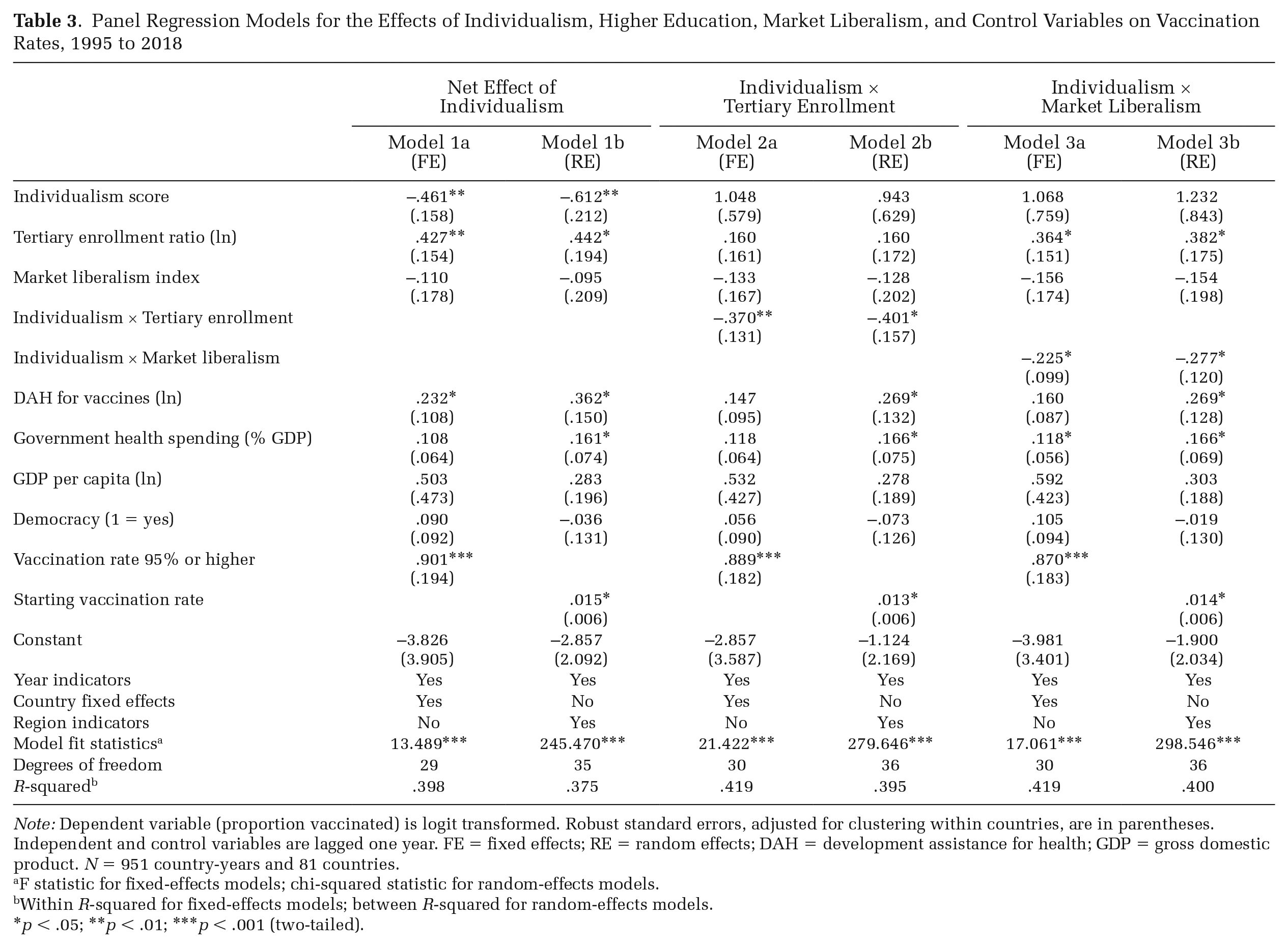
Table 3 reports fixed- and random-effects models regressing vaccination rates on our measures of individualism, tertiary enrollment ratios, market liberalism, and control variables. We first consider the independent effect of individualism on vaccination, and then explore whether this relationship is conditioned by levels of higher education and market liberalism in a society.
Panel Regression Models for the Effects of Individualism, Higher Education, Market Liberalism, and Control Variables on Vaccination Rates, 1995 to 2018
Note: Dependent variable (proportion vaccinated) is logit transformed. Robust standard errors, adjusted for clustering within countries, are in parentheses. Independent and control variables are lagged one year. FE = fixed effects; RE = random effects; DAH = development assistance for health; GDP = gross domestic product. N = 951 country-years and 81 countries.
F statistic for fixed-effects models; chi-squared statistic for random-effects models.
Within R-squared for fixed-effects models; between R-squared for random-effects models.
p < .05; **p < .01; ***p < .001 (two-tailed).
The negative and statistically significant coefficients on individualism in Models 1a, the fixed-effects model (β = −.461, p < .01), and 1b, the random-effects model (β = −.612, p < .01), imply that vaccination rates (1) decline as empowered individualism within countries increases over time and (2) are lower in countries where individuals are more empowered. Figure 3 uses these estimates to plot the substantive effects of individualism across its 10 to 90 percentile range while holding other included variables constant at their mean values. Using these assumptions, estimated vaccination rates decline from 93.3 to 82.3 percent in the fixed-effects model, and from 95.4 to 81.5 percent in the random-effects model. Taking the estimated number of 1-year-olds across sampled countries in 2018 as a benchmark, these declines translate into a reduction of more than 11.5 million and 15.1 million vaccinated children, respectively. 15 The results are consistent with Hypothesis 1a, which predicted that individualism would reduce vaccination rates.
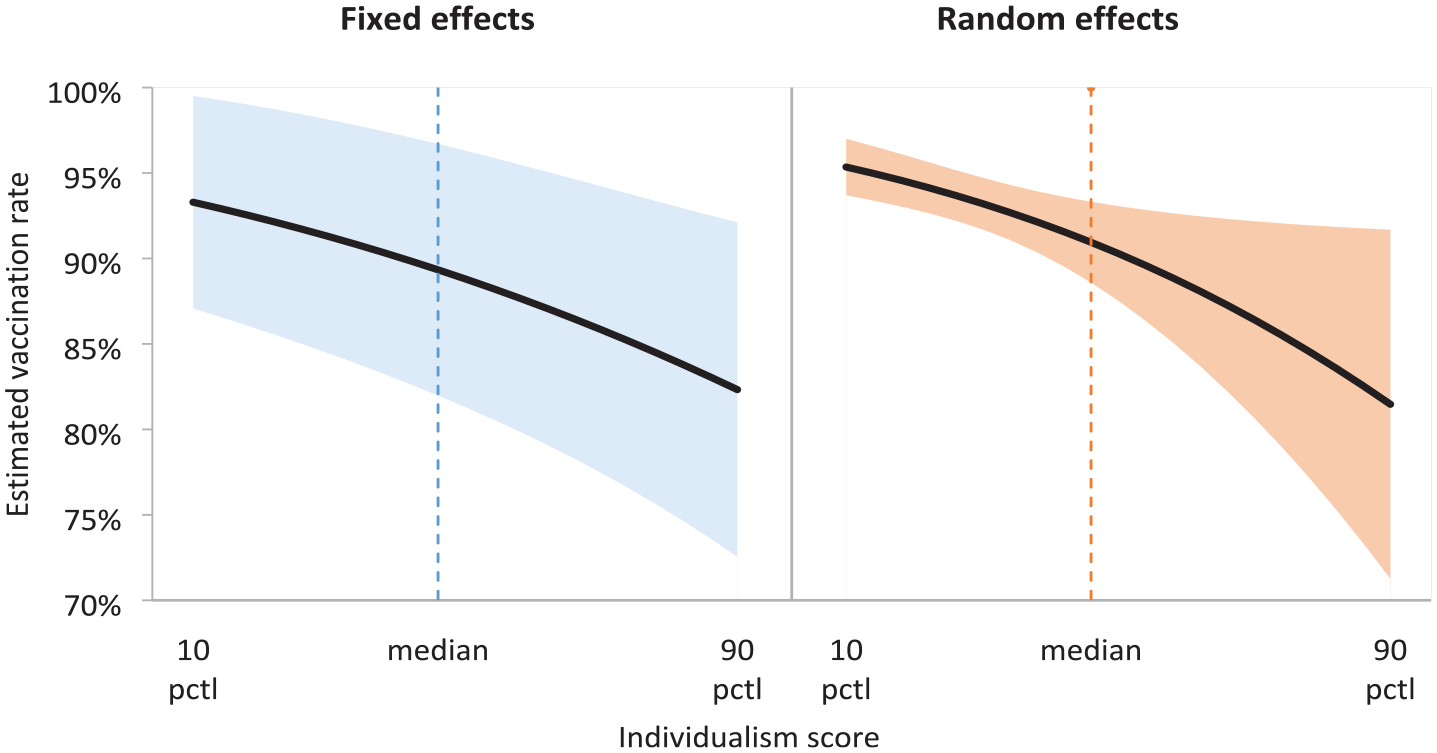
Estimated Independent Effect of Individualism on Vaccination Rates
Next, we consider whether tertiary enrollments and market liberalism condition the effect of individualism. These analyses evaluate Hypotheses 1b and 1c, which predicted that higher education and market liberalism, respectively, would amplify the negative effect of individualism on vaccination rates. The evidence supports both hypotheses. The interaction between individualism and tertiary enrollments is negative and statistically significant in the fixed- and random-effects analyses (Models 2a and 2b); the same holds for the interaction between individualism and market liberalism (Models 3a and 3b). Using these results, Figure 4 traces the marginal effect of individualism across the range of tertiary enrollments and market liberalism scores. As shown in Panel A, the marginal effect of individualism in the fixed- (left) and random-effects (right) models becomes significantly negative at higher levels of tertiary enrollment (specifically, when enrollment ratios reach 44.3 and 30.9 percent, respectively; for comparison, the sample median is 43.0 and the mean is 36.0). Panel B shows a similar pattern for market liberalism: the effect of individualism on vaccination rates becomes significantly negative as countries become more committed to market principles (i.e., when market liberalism exceeds 6.51 and 6.18 in the fixed- and random-effects models, respectively; sample mean = 6.83, median = 6.87, average score for the United States = 8.25).
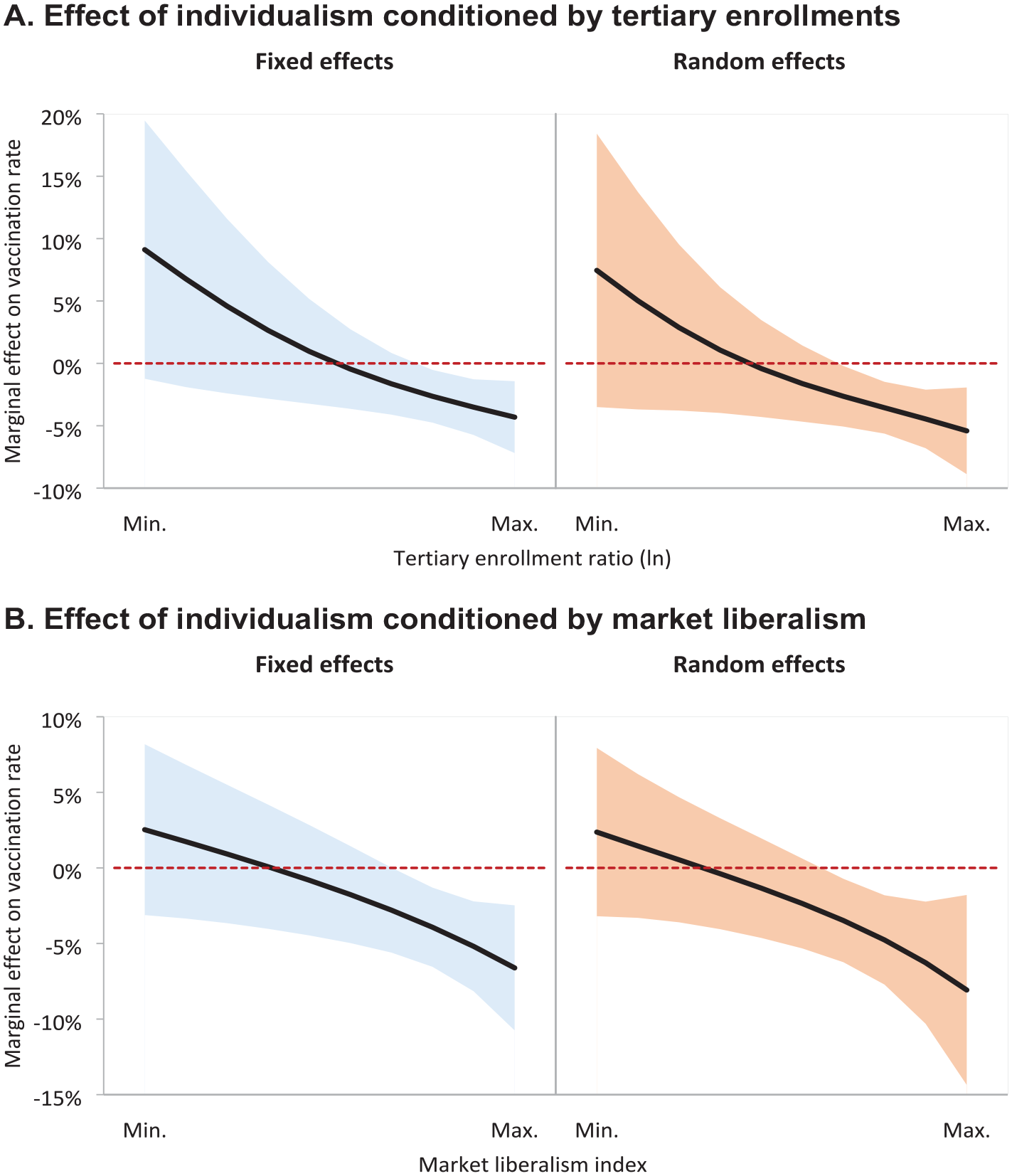
Estimated Marginal Effect of Individualism on Vaccination Rates, Conditioned by (A) Tertiary Enrollments and (B) Market Liberalism
Aside from these effects, few other variables in our analysis bear significantly on vaccination rates. The net effect of tertiary enrollment ratios is significantly positive, consistent with the deficit model (i.e., that higher education improves scientific literacy, which boosts vaccine confidence and increases vaccine uptake). In general, vaccination rates also increase with development assistance for vaccines and government health expenditures. Conversely, neither economic development nor democracy predict vaccine uptake, net of other included factors.
Institutional Confidence and Vaccination Rates
Table 4 considers the relationship between lack of confidence in institutions and vaccination rates. The significantly negative fixed- and random-effects estimates in Models 4a and 4b suggest that vaccination rates decline as lack of confidence in institutions increases (β = −.417 and −.597, respectively, each at p < .001). Figure 5 plots these effects, again while holding other variables constant at their means. Increasing the lack of confidence in institutions score from its 10th to 90th percentile reduces estimated vaccination rates from 93.4 to 85.5 percent in Model 4a and from 95.8 to 85.7 percent in Model 4b. These reductions correspond with a decline of some 8.3 to 10.7 million vaccinated children, using the same assumptions as before (see note 15). Our findings provide strong evidence that vaccination rates decline in countries where institutional confidence is low, as anticipated by Hypothesis 2a. 16
Panel Regression Models for the Effects of Lack of Confidence in Institutions, Higher Education, Institutional Quality, and Control Variables on Vaccination Rates, 1995 to 2018

Note: Dependent variable (proportion vaccinated) is logit transformed. Robust standard errors, adjusted for clustering within countries, are in parentheses. Independent and control variables are lagged one year. FE = fixed effects; RE = random effects; DAH = development assistance for health; GDP = gross domestic product. N = 883 country-years and 80 countries.
F statistic for fixed-effects models; chi-squared statistic for random-effects models.
Within R-squared for fixed-effects models; between R-squared for random-effects models.
p < .05; **p < .01; ***p < .001 (two-tailed).
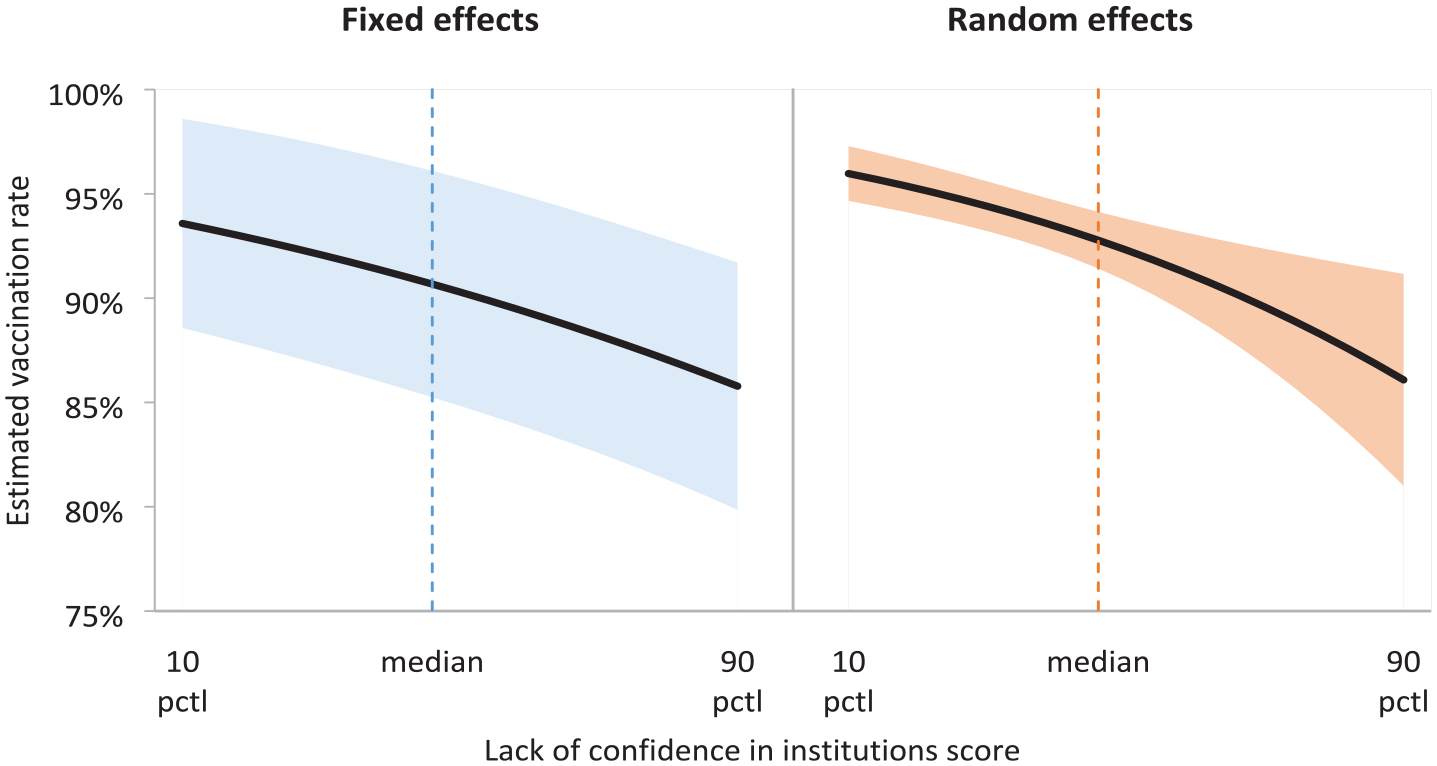
Estimated Independent Effect of Lack of Confidence in Institutions on Vaccination Rates
Turning to the remaining models in Table 4, we see that levels of higher education and institutional quality in a society significantly condition the effects of institutional confidence on vaccine uptake, albeit in different directions. As with individualism, tertiary enrollments amplify the inverse relationship between lack of confidence in institutions and vaccination rates. Panel A in Figure 6 uses the results from Models 5a (left) and 5b (right) to plot the marginal effect of lack of confidence across the range of tertiary enrollment ratios in the sample. The effect of lack of confidence becomes significantly negative when tertiary enrollment ratios reach 27.9 and 20.7 in the fixed- and random-effects models, respectively. These findings support Hypothesis 2b, which predicted that higher education would exacerbate the negative effect of lack of institutional confidence on vaccination rates.
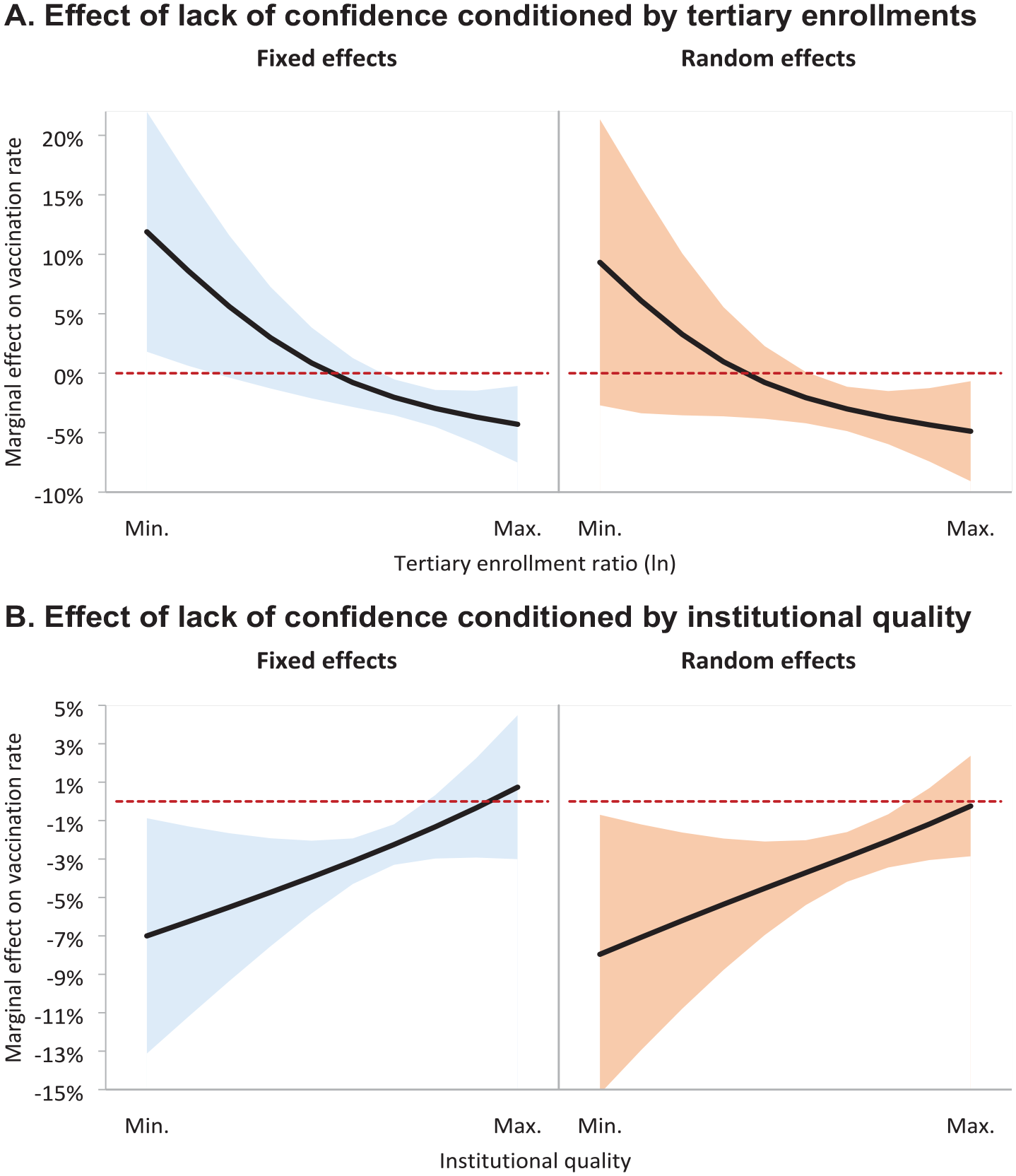
Estimated Marginal Effect of Lack of Confidence in Institutions on Vaccination Rates, Conditioned by (A) Tertiary Enrollments and (B) Institutional Quality
Models 6a and 6b investigate whether institutional quality mitigates the negative effect of lack of institutional confidence on vaccination rates, in accordance with Hypothesis 2c. Both interaction terms are positive and statistically significant, albeit at a marginal level of significance in the fixed-effects model (β = .338, p = .07). 17 When institutional quality in a society is low, lack of institutional confidence predicts lower vaccination rates. (Put differently, when lack of institutional confidence is warranted, it reduces vaccine coverage.) In countries with high-quality institutions, however, the effect of distrust becomes statistically insignificant. These findings are illustrated in Panel B of Figure 6. Institutional quality does not begin to neutralize the negative effect of lack of confidence until a high threshold is attained: institutional quality scores of .65 and .91, respectively, in the fixed- and random-effects analyses (sample mean = .04, median = −.18). Although institutional quality significantly conditions the effect of institutional confidence, it has no reliable independent effect on vaccine uptake in our models. As in the previous analysis (Table 3), tertiary enrollment ratios and development assistance for vaccines continue to predict higher vaccination rates in Table 4. 18
Individualism and Institutional Confidence
A final set of analyses, presented in Table 5, regresses our lack of confidence in institutions score on individualism and select control variables (institutional quality, tertiary enrollment ratio, GDP per capital, and democracy). These analyses test our prediction in Hypothesis 3 that empowered individualism erodes confidence in major institutions. In these models, positive coefficients correspond to a greater lack of institutional confidence.
Panel Regression Models for the Effect of Individualism on Lack of Confidence in Institutions, 1995 to 2018
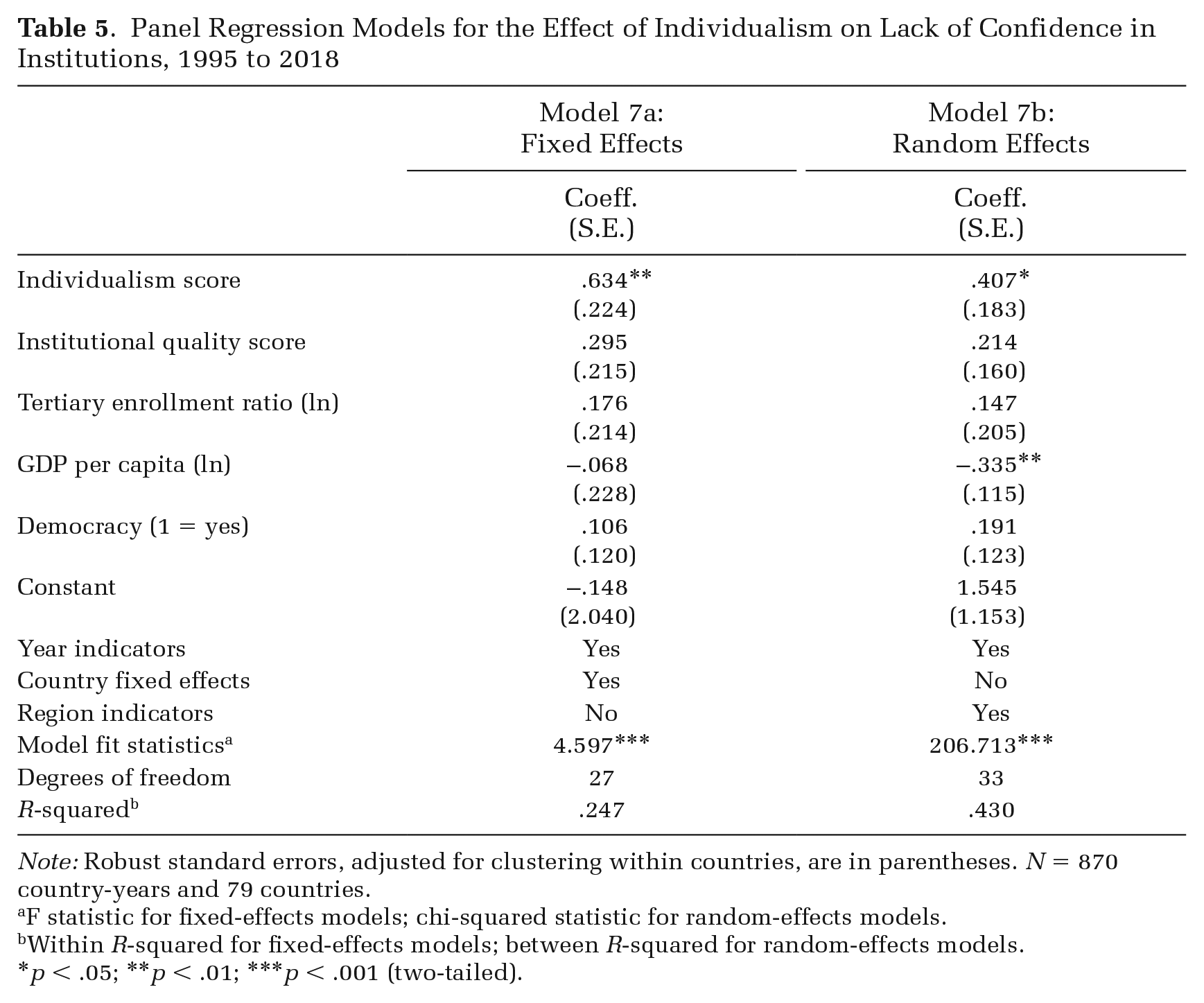
Note: Robust standard errors, adjusted for clustering within countries, are in parentheses. N = 870 country-years and 79 countries.
F statistic for fixed-effects models; chi-squared statistic for random-effects models.
Within R-squared for fixed-effects models; between R-squared for random-effects models.
p < .05; **p < .01; ***p < .001 (two-tailed).
Models 7a and 7b present estimates from fixed- and random-effects analyses. Both models tell a common story: as individualism increases, so too does lack of confidence in institutions. Only one other coefficient is statistically significant: in Model 7b, GDP per capita reduces lack of confidence in institutions (i.e., institutional confidence is higher in more affluent societies). Individualism thus appears to reduce vaccination rates directly as well as via its effect on institutional confidence. These results are also consistent with our theory that liberalism is being eroded from within. Taken to its extreme, one element of liberalism, empowered individualism, undermines another, confidence in liberal institutions.
Discussion and Conclusions
Many observers, the World Health Organization foremost among them, have raised concerns over the global decline in vaccination rates in the past decade. These concerns became all the more urgent with the Covid-19 pandemic, prompting a search for the determinants of vaccine hesitancy.
Global health experts attribute vaccine hesitancy to three broad factors: inconvenience, linked to the accessibility and affordability of vaccines; complacency, based largely (and paradoxically) on the effectiveness of vaccines in curbing targeted diseases; and lack of confidence in the safety and efficacy of vaccines (World Health Organization 2014). Vaccine confidence, in turn, hinges on trust in the scientists who develop vaccines, the corporations that manufacture them, and the governments that regulate them. Although decades of coordinated and targeted efforts have made vaccines more accessible than ever before, a growing number of vaccine-hesitant individuals are opting not to immunize themselves or their children.
Drawing on previous research on vaccine hesitancy, we theorized that two sets of “post-liberal” dynamics—one leading to the dramatic empowerment of individuals as self-determining actors, the other eroding trust and confidence in major liberal institutions—help explain recent cross-national declines in vaccination coverage among children. Individuals feel increasingly empowered to reject vaccines, and they lay claim to an ever-expanding array of rights discourses for framing and legitimizing their opposition. At the same time, neoliberal doctrines that emerged in the 1970s and assumed global hegemony in the 1990s severely compromised the legitimacy of the state and liberal institutions. Even science falls prey to growing attacks (Frank and Meyer 2020; Schofer et al. 2022).
Our panel regression analyses support these theorized relationships. Childhood vaccination rates are significantly lower in countries with highly individualistic cultures, and within-country vaccine coverage declines as individualism strengthens. Levels of higher education and market liberalism intensify these effects by reinforcing and legitimizing individual empowerment. Individualism is also associated with recent declines in institutional confidence, which itself predicts lower vaccination rates. In the post-liberal world, flouting institutionalized authority structures may serve as a contrarian expression of individual empowerment, part and parcel of what it means to be an autonomous, self-determining actor. A fuller understanding of vaccine hesitancy therefore requires a focus on global cultural and institutional trends, over and above national characteristics or economic barriers to access.
More generally, our empirical focus on vaccination rates, while obviously a matter of great intrinsic importance, allowed us to develop a generalizable theory of world-cultural dynamism and change. Evolving neoliberal cultural models weakened liberalism from within by disembedding and dramatically empowering individuals at the expense of liberal institutions—the very institutions that once served to moderate individual excesses and sublimate egoistic tendencies. Our analyses bring the root causes of the post-liberal turn in world society into sharper relief.
These causes run deep. The individual as an abstract social category and locus of ultimate value is the product of a long-term cultural construction and evolution, primarily in the West (Boyle 2002; Frank and Meyer 2002; Lukes 1969; Meyer and Jepperson 2000; Siedentop 2014). Individualism provided a cultural basis for the dramatic extension and expansion of rights and freedoms, and ultimately for liberalism itself. At the same time, individualism also upended existing social orders, which had been built upon corporate groups of different kinds—the family, castes, estates. 19 The rise of the individual turned the world upside down (Siedentop 2014).
Individualism continues to be a disruptive force, even to the point of challenging the liberal order from within. Future research might begin to explore the broader implications of these developments. Our arguments regarding hyper-empowered individualism and declining institutional trust could help explain, for example, why populism accelerated in a remarkable global wave following the Cold War. In populist rhetoric, all legitimate political authority resides in “the people,” who are empowered to govern themselves without constraints or intermediaries of any kind (see Bonikowski 2017; Brubaker 2017; Cole and Schofer 2023; Mudde 2004; Mudde and Rovira Kaltwasser 2012; Norris and Inglehart 2019). (In reality, of course, populist leaders or parties claim to rule on behalf of the people.) Conceptions of “the people” differ across varieties of populism, but peoplehood is always defined in opposition to “the establishment”—elites, experts, and institutional arrangements that are alleged to have usurped power from the people. Populism therefore entails a profound distrust of representative legislatures, courts, the media, and other liberal institutions. In these ways, hyper-empowerment and institutional skepticism can help account for the recent appearance of populist leaders and parties in highly diverse national contexts.
Another shift seems to be occurring in the cultural logics of parenting. In a “neoliberal” parenting model, highly educated and empowered parents intervene directly in schools and other institutions to secure advantages for their children (Lareau 2011; Reich 2014). A new “post-liberal” logic may be emerging in which parents no longer seek to bend standardized institutional procedures to their children’s specialized needs and preferences, but rather withdraw from mainstream institutions altogether—for example, by homeschooling their children or enrolling them in alternative schools (where, we would add, vaccination rates are often abysmally low; see Brennan et al. 2017; Sobo 2015).
In these examples, hyper-empowered individuals reject liberal institutions outright, as when populists attack the media or parents homeschool their children. In other cases, liberal institutions may be co-opted to serve illiberal ends. For instance, while illiberal attacks on universities have increased markedly in recent years (Schofer et al. 2022), other groups have adapted the university model to their own political or cultural purposes (e.g., Liberty University). Likewise, many illiberal interest groups participate actively in the United Nations, a bastion of the liberal international order, in their bid to challenge the system internally (Bob 2012; Buss and Herman 2003; Cupać and Ebetürk 2021). The same dynamic of rejection in some cases and co-optation in others characterizes illiberal attitudes toward international nongovernment organizations (INGOs). Many illiberal or anti-liberal critics on both the left and right dismiss INGOs: the former as trojan horses for neoliberal capitalism (e.g., Wallace 2004), the latter as handmaidens of foreign interests that undermine national sovereignty or challenge traditional values (e.g., Bromley et al. 2020). Others, however, use the organizational architecture of liberal world society to advance illiberal causes: to promote the “natural family” (Buss and Herman 2003; Cupać and Ebetürk 2021), oppose LGBT and abortion rights (Bob 2012; Boyle, Kim, and Longhofer 2015; Velasco forthcoming), loosen gun regulations (Bob 2012), and so on.
We also discern a post-liberal shift in social movements. This shift is most obvious in far-right mobilizations around extreme visions of rights—to carry guns, to deny services to LGBT people on religious grounds, and of course to decry mask and vaccine mandates (see Bob 2019). Yet extreme individual empowerment also affects movements in subtler ways, as illustrated by the Occupy protests of 2011 and 2012. Many activists in the Occupy movement endorsed a form of radical egalitarianism and consensus-based decision-making that empowered individual participants to veto or “block” group decisions. This egalitarian ethos engendered a deep suspicion of leaders and authority figures—even highly respected ones such as civil-rights icon and congressperson John Lewis, whom a lone (and highly empowered) dissenter prevented from addressing the General Assembly of Occupy Atlanta on the grounds that “no singular human being is more valuable than any other human being” (Roberts 2012:758). The related principle of horizontalism or horizontalidad, a form of leaderless direct democracy, reflects “a certain disdain for formal organization and more conventional sorts of politics,” including electoral politics (Calhoun 2013:36). 20 Occupy thus illustrates how a culture of hyper-empowered individualism can undercut liberal organizational and political structures, inspiring people to experiment with new organizational forms and modes of political participation.
In short, our findings suggest that the effects of neoliberalism as a cultural order and not merely an economic doctrine dramatically empowered individuals in multiple domains and undermined confidence in a host of liberal institutions, paving the way for post-liberal reactions. The declining legitimacy and reach of these institutions, in turn, creates ever-more expansive opportunities for unfettered and self-directed individuals to assert their own personalized prerogatives, even at the expense of the safety and health of their communities.
Footnotes
Appendix
Panel Regression Models for the Effects of Lack of Confidence in Government, the Judicial System, the Press, and Major Companies on Vaccination Rates, 1995 to 2018
| Fixed-Effects Models | Random-Effects Models | |||||||
|---|---|---|---|---|---|---|---|---|
| Model 1 | Model 2 | Model 3 | Model 4 | Model 5 | Model 6 | Model 7 | Model 8 | |
| No confidence in government | –.027***
(.007) |
–.039***
|
||||||
| No confidence in judicial system/courts | –.059**
|
–.077**
|
||||||
| No confidence in the press | –.019 |
–.037***
|
||||||
| No confidence in major companies | –.023 |
–.044**
|
||||||
| Tertiary enrollment ratio (ln) | .347 |
.574**
|
.286 |
.291 |
.345*
|
.582**
|
.243 |
.248 |
| Institutional quality factor score | –.110 |
–.152 |
–.179 |
–.214 |
–.066 |
–.143 |
–.091 |
–.129 |
| DAH for vaccines (ln) | .210 |
.256*
|
.242*
|
.255*
|
.400**
|
.467***
|
.461***
|
.474**
|
| Democracy (1 = yes) | .187 |
.298 |
.184 |
.144 |
.085 |
.204 |
.017 |
–.045 |
| GDP per capita (ln) | .656*
|
.535 |
.587 |
.568 |
.178 |
.093 |
.165 |
.146 |
| Government health spending (% GDP) | .113 |
.032 |
.108 |
.110 |
.116 |
.029 |
.109 |
.122 |
| Vaccination rate 95% or higher | .813***
|
.806***
|
.916***
|
.895***
|
||||
| Starting vaccination rate | .012*
|
.012*
|
.014**
|
.016**
|
||||
| Constant |
–5.031 |
–4.305 |
–4.539 |
–4.283 |
–1.674 |
–1.430 |
–1.346 |
–1.335 |
| Year indicators | Yes | Yes | Yes | Yes | Yes | Yes | Yes | Yes |
| Country fixed effects | Yes | Yes | Yes | Yes | No | No | No | No |
| Region indicators | No | No | No | No | Yes | Yes | Yes | Yes |
| Model fit statistics a | 18.101*** | 13.674*** | 16.531*** | 20.539*** | 262.981*** | 195.119*** | 205.417*** | 273.760*** |
| Degrees of freedom | 30 | 30 | 30 | 30 | 36 | 36 | 36 | 36 |
| R-squared b | .401 | .413 | .372 | .376 | .399 | .426 | .456 | .448 |
Note: Dependent variable (proportion vaccinated) is logit transformed. Robust standard errors, adjusted for clustering within countries, are in parentheses. Independent and control variables are lagged one year. N = 883 country-years and 80 countries.
F statistic for fixed-effects models; chi-squared statistic for random-effects models.
Within R-squared for fixed-effects models; between R-squared for random-effects models.
p < .05; **p < .01; ***p < .001 (two-tailed).
Acknowledgements
For their feedback on previous iterations, we thank—and absolve from any errors—John Meyer, Megan Reynolds, Ming Wen, and three anonymous reviewers. We dedicate this article to the memory of Karen Bradley.
Notes
 .
.