







Abstract
How does class affect one’s propensity to trust? Previous research finds higher-status actors express less trust than lower-status actors in interpersonal and institutional contexts. Scholars explain this finding as an outcome of structural dependence—when people have few alternative means for accessing valuable resources. In contrast, I find dependence inadequate to explain the relationship I observe between class and institutional trust among black families whose children were recommended for special education and other remedial program placement in an affluent, predominantly white school district. Drawing on retrospective interviews from a community ethnography, findings show that real-world trust decision processes also involve domination. Empirical studies of trust have overlooked the ways trustees—those being given trust—exercise power to achieve deference in trust exchanges, and how trustors—those placing trust in others—deploy their power to withstand trustees’ influence. I argue that trust might best be conceptualized as a two-part decision process, because class and other status resources affect trustors’ freedom to choose at two key junctures: (1) in weighing options and costs of trust errors, and (2) in communicating distrust in face-to-face interactions, where the potential for domination is high. Focusing on intersecting systems of power in authentic trust exchanges, this study shows how middle-class black trustors use symbolic resources to “go up against” the institutional power of educational experts and refuse placement, whereas working-class trustors consent to placement.
How and why does class affect one’s propensity to trust? In this study, I examine trust decision-making among black parents to shed light on this question by interrogating interacting systems of power. Sociologists describe trust situations as those in which trustees (those being trusted) “have the freedom to choose between multiple options” (Smith 2010:454), including betrayal. Thus, trust is commonly defined as “the willingness to make [oneself] vulnerable to the actions of another party” (Schilke, Reimann, and Cook 2015:12951). But class differences in trust, reported in many studies, indicate that the “willingness” to be vulnerable is not equal across groups.
Findings on the relationship between trust and class are mixed, however, with some studies reporting a negative relationship and others reporting a positive relationship (Kim et al. 2022). Yet consistent patterns emerge across different literatures regarding the relationship between trust and status more broadly (e.g., class, race, power). Notably, studies reporting on trust decision-making under experimental or real-world conditions often find a negative relationship, with higher-status actors expressing less trust than lower-status actors in interpersonal and institutional contexts. Scholars conducting research in schools and health settings, for example, find that working-class parents are more likely to trust institutional experts than are middle-class parents (e.g., Calarco 2014; Lareau and Calarco 2012). I bring these studies, which do not explicitly focus on trust, into conversation with trust scholarship.
This study examines trust decision-making among black parents from different class backgrounds who received recommendations for their children’s placement into special education (SPED) and other remedial programs in an affluent, predominantly white school district. Like some others writing on trust (Bryk and Schneider 2002; Ward 2006), I did not set out to study trust, but trust turned out to be a critical factor shaping participants’ school-related decisions. Trust plays an important role in SPED decision-making because “valid consent requires trust” (Davies 1997:201) and, indeed, participants invoked trust language often, implicitly and explicitly. Yet class differences emerged among the parents, countering considerable literature suggesting that black Americans are uniformly distrusting.
Researchers point to dependence to explain such findings, arguing that differences in access to resources, knowledge, or expertise between advantaged and disadvantaged individuals provoke different trust responses (Lareau and Calarco 2012; Schilke et al. 2015). As trust scholars explain, when people have few alternative means for accessing valuable resources—a situation of structural dependence—they are more likely to trust (Farrell 2004; Schilke et al. 2015). However, I find dependence insufficient to explain the complexity of the trust–class relationship.
Material resources and experience in the district were key dimensions of black parents’ decision-making—possessing more of both almost always resulted in refusal of placement—but these factors do not fully capture the dynamics of real-world trust decision processes. They fail to capture, for example, the influence of trustees (educational professionals) or how trustors (parents) respond to perceived pressure—especially in face-to-face interactions. A focus on material resources and networks alone misses interpersonal status dynamics between parties. It does not capture how power operates as action in the moves that trustees make to inspire trust or achieve compliance and that trustors make to refuse. These moves remind us that power is not only the cards one holds (i.e., one’s position vis-à-vis another) but how they are played. Closer attention to power dynamics, particularly when and where trustors perceive agency and constraint, is needed. Examining both class and race status processes, which few studies of trust do, exposes more of the dynamics at play and calls attention to nonmaterial dimensions of class in trust decision processes. Exploring the circumstances under which such resources are deployed reveals clear points of domination, where trustors’ vulnerabilities can be and often are exploited.
This study illustrates an important mechanism by which class affects authentic trust decision-making. The district’s SPED referral meetings, featuring mostly white institutional experts, were by all accounts “intimidating” (see also Harry, Klingner, and Hart 2005; Ong-Dean 2009; Rogers 2011). Yet while black parents across the class spectrum expressed distrust of the district, recalling its history of mistreating black students, parents who held professional and managerial positions were more likely to act on those feelings by refusing the experts’ recommendations. They did so by asserting their class status and drawing on symbolic resources—that is, skills (e.g., authority, confidence) acquired from their professional work experience—to push back against and weaken the district’s influence. Parents lacking such resources had few defenses to “go up against the administration.” It was, as one parent said, “a battle” they could not “win.” My analysis reveals how status affects trustors’ ability not just to activate their resources to mitigate errors in trust decision-making, but also to communicate and act on distrust through refusal.
Real-world trust decision-making is best conceptualized as a two-pronged process. Status differences between parties increase vulnerability, and thus constraint, for socially disadvantaged trustors at two key junctures of the process, each involving a different set of resources: (1) assessing options and the potential cost of errors and (2) communicating distrust. Assessment involves material resources, and communication brings symbolic resources into play as people must convey their decision. Each set of resources affects available options and the freedom to select among them, as previous studies show, but my analysis suggests that symbolic resources might be of equal or greater import, particularly in face-to-face interactions where power dynamics are especially salient. Here, I find middle-class black parents engaging in what I call reverse signaling, as they assert their competence, trustworthiness, and status to push back against domination and effectively communicate refusal. 1
Because existing studies of trust decision-making and class focus primarily on white adults, and studies of trust among black individuals focus almost exclusively on lower-income adults, we know little about the trust–class relationship among black Americans. Studies overlook how the intersection of class and race (or other systems of power) produce different interpersonal status dynamics in trust decision processes that call for trustors to marshal resources to pursue different ends. The current study sheds light on this underappreciated dimension of the trust-status relationship by looking closely at how black adults describe their actions and interactions in real-world, institutional trust situations.
Patterns in the Research on Trust and Class/Status
The trust–class relationship has received considerable attention, particularly among survey researchers, but results have been inconsistent. This undoubtedly reflects the complex and highly contextual nature of trust, as well as differences in how trust is conceptualized and studied. Trust has been variously described as a feeling, disposition or personality trait, attitude, cultural value, and behavior, and defined on different levels, including moralistic, institutional, generalized, interpersonal, social, and particularistic—sometimes interchangeably. 2
Kim and colleagues’ (2022) research attempting to elucidate mixed findings on the trust–class relationship gives insight into some of the complexity. Using U.S. and South Korean surveys, they show that findings vary depending on whether they examine social or institutional trust and the measure of class they use. They find positive relationships between social trust (e.g., “most people can be trusted”) and both subjective (one’s perception of “rank within their society”) and objective (education and/or income) measures of class, but mixed results for institutional trust (“confidence” in institutions). Whereas the subjective measure of class shows a positive relationship with institutional trust, the objective measures show a negative relationship: the higher the education and/or income, the lower the trust.
Seemingly contradictory findings on the trust–class relationship across studies, therefore, should perhaps be expected (Oskarsson, Svensson, Öberg 2009). However, amid the mixed findings in the literature, there are some notable patterns. Two patterns highlight what might be described as a difference—with class implications—between trust in theory (feelings) and trust in practice (decision-making).
Generalized Trust and Class/Status
The positive relationship between social trust and both measures of class that Kim and colleagues (2022) find is consistent with a large body of survey research showing socially and economically disadvantaged groups reporting lower generalized trust (abstract trust in unknown others) than do more advantaged groups. This finding is robust across countries and groups. Globally, researchers find Indigenous, immigrant, and racially and ethnically marginalized groups are relatively less trusting (Hwang 2017; Wilkes and Wu 2018). In the United States, racially minoritized groups report lower levels of generalized trust than do white Americans, and black Americans exhibit the lowest levels of trust (Uslaner 2002; Wilkes 2011). Individuals with lower levels of education and income are also less trusting than more advantaged individuals (Uslaner 2002; Wilkes 2011). Among black Americans, however, class indicators are less salient for generalized trust (Wilkes 2011). That is, regardless of income or education, black Americans express significantly lower levels of trust than do white Americans. Surveys show more than two thirds of black Americans agreeing that most people are untrustworthy (Alesina and La Ferrara 2002; Uslaner 2002; Ward, Mamerow, and Meyer 2014).
Scholars point to discrimination to explain why African Americans and other socially disadvantaged groups express lower levels of trust. As research shows, trust is responsive to experience (Paxton and Glanville 2015). But trustors base their beliefs about others’ trustworthiness not only on their history and familiarity with partners; they also consider partners’ reputation and the degree to which they believe partners have their interests at heart (Bryk and Schneider 2002; Dinesen and Sønderskov 2015; Hardin 1993; Smith 2005; Yamagishi and Yamagishi 1994). This “relational” framework is widely used to explain assorted trust outcomes, including why co-ethnics tend to trust one another more than outgroup members (Nunnally 2012; Smith 2010), and why distrust of schools is sometimes strong among African Americans (Lareau and Horvat 1999; Schultz 2019). However, to my knowledge, no research explicitly examines the trust–class relationship among black individuals in real-world contexts.
Trust Decision-Making and Class/Status: The Role of Dependence
Real-world situations call for people to move beyond abstract feelings of trust and decide how to act, that is, whether to place their trust in others. Yet as Rotter (1971) explains, trust involves uncertainty about whether trustees will make good on their promise. Thus, actors must weigh the costs and benefits of trusting. 3 Scholars argue that risk and vulnerability are therefore central to understanding trust (Möllering 2006). Indeed, the “willingness to be vulnerable” is one of the most widely used scholarly definitions of trust (Adams and Forsyth 2009; Baier 1991; Giddens 1990; Lewis and Weigert 1985).
Although research explicitly examining the relationship between real-world trust decision-making and class or status is scant (Schilke, Reimann, and Cook 2021), studies investigating class processes in interactions between parents and institutional experts provide evidence of a link. Unlike studies investigating generalized trust, however, this research shows a negative relationship between institutional trust and class or status more broadly. These studies address questions about how parents navigate institutions like schools or healthcare settings, focusing on cultural and social capital, including networks and cultural knowledge (Calarco 2014; Gage-Bouchard 2017; Gengler 2014; Lareau 1989, 2002; Shim 2010). But as Alfred Marshall is credited with observing (Möllering 2006:2), trust “permeates all life; like the air we breathe” and is often “taken for granted.” Thus, although researchers may not name or explicitly study trust—and therefore not engage trust scholarship—trust is inherent in many of the social interactions we investigate. By focusing on trust, we illuminate the shared but taken-for-granted underlying aspects of much everyday decision-making: risk and uncertainty.
Studies examining the effects of class in schools often report that working-class parents express greater trust of experts than do more advantaged parents (Cucchiara and Horvat 2009; Lareau 1989; Lareau and Calarco 2012). To explain this finding, researchers point to less advantaged individuals’ greater dependence on institutions and their experts (Bryk and Schneider 2002; Calarco 2014). Studies of decision-making in healthcare settings show similar findings, with privileged adults more likely than working-class adults to question and challenge experts’ advice and opinions. Exemplifying dependence, in a study examining parents’ experiences managing healthcare for a sick child, a working-class parent said: “I had to put my trust in them, I had no other choice” (Gage-Bouchard 2017:158; see also Gengler 2014). Upper- and middle-class parents, in contrast, tended to engage in “vigilant advocacy,” which involved critically questioning doctors (see also Hernandez and Calarco 2021, who find a similar class pattern in women’s decision-making about alcohol consumption during pregnancy).
Scholars explicitly studying trust decision-making—using experiments or interviews—also explain the negative trust–class relationship in terms of dependence (e.g., Meyer et al. 2008; Schilke et al. 2015; Ward 2006). They argue that people are more likely to trust when they have few alternatives for accessing a valuable resource. Conceptualizing this situation as power, Schilke and colleagues (2015) test the argument in a series of experiments manipulating actors’ structural power; they find that actors who perceive themselves to be high in power trust less than those who perceive themselves as low in power. When people have alternatives—access to other resources, expertise, knowledge—researchers argue, they do not need to trust.
Despite seemingly contradictory findings on the trust–class (or status) relationship, two consistent patterns emerge. First, surveys show socially and economically disadvantaged groups are more likely to express feelings of distrust than are more advantaged groups. Second, with respect to trust decision-making in both institutional and interpersonal contexts, dependence prompts greater trust among disadvantaged individuals, as people often feel compelled to trust when they lack alternatives. These findings highlight an important distinction between trust in theory and trust in practice, calling attention to the demands and contingencies of people’s circumstances and the significance of risk in trust decision-making.
The studies cited above, like other research examining decision-making in institutional contexts, focus primarily on white adults, leaving open questions about whether dependence similarly shapes black Americans’ institutional trust decision-making, leading to class differences. Lareau’s research (Horvat, Weininger, and Lareau 2003; Lareau 2002) examining class and parents’ engagement with schools and other institutions suggests it does, as she finds comparable class differences among black and white families. But findings of low outgroup trust and generalized trust among black Americans across class in other research suggest that class differences in institutional trust decision-making might be less pronounced than among white Americans. Although decades of research document distrust of schools among black parents (Bryk and Schneider 2002; Hoy and Tschannen-Moran 1999; Lareau and Horvat 1999; Schultz 2019), few studies of real-world trust include a class analysis to assess intragroup differences or the role of dependence. 4
Trust and Status in Interpersonal Interaction
In addition to open questions about how dependence affects black Americans’ trust decisions, the foregoing review suggests other potential mechanisms by which status might operate in authentic trust situations. Studying this relationship in real-world contexts thus seems critical to fully understanding how status operates. Schilke and colleagues (2015), in additional experiments conducted to understand the mechanism by which dependence leads to increased trust, found that dependence increases low-status actors’ “hope” that exchange partners will be trustworthy, and people act on that emotion. They argue that trustors primarily consider their own power (i.e., need) in trust decision-making, in contrast to Hardin’s (1993) proposition that actors focus on the perceived interests of their exchange partners.
Studies examining trust decision-making in real-world contexts, however, show other emotions besides hope at play. In Gambetta and Hamill’s (2005) study of how taxi drivers in New York and Belfast assess hailers’ trustworthiness, drivers described looking for “signs” of potential threat in hailers’ race, gender, disability, dress, and other factors. Such assessments, based on drivers’ experience, “specialized knowledge,” and “gut feelings” suggest fear as another emotion shaping trustors’ decisions. So, too, do drivers’ reports of being cautious about exhibiting distrust, concerned that passengers might “feel bad” or become upset. Such concerns counter Luhmann’s (2000) claim that when you distrust you run no risk. Yet unclear from the study (because it was not the focus) is whether or how dependence and fear operate simultaneously, or how actors’ identity markers matter. Experimental studies of trust miss important aspects of these status dynamics in interpersonal interaction and the ways people feel constrained or empowered in their decision-making. Arguably, in real-world situations, identity markers may shift power dynamics, and the stakes or risks associated with trust may feel different than they do in mock scenarios (Wu and Wilkes 2016).
Indeed, considering research in other areas showing that status hierarchies influence interpersonal interaction, we might expect similar processes in trust situations. Ridgeway and Nakagawa’s (2017) research examining status hierarchies and cooperation among group members, for example, finds that when low-status group members defer to higher-status group members, they are accorded respect for being “reasonable,” which, the authors argue, might influence their actions. Gage-Bouchard’s (2017) research on parents’ cultural knowledge and experiences navigating healthcare reveals similar status-based processes at work in interactions between doctors and parents advocating for their children. Although doctors were accepting of upper- and middle-class parents’ critical questioning, which they perceived as justified and reasonable, they were less accepting of a more confrontational style of questioning displayed by some working-class parents. Doctors were more approving of working-class parents who exhibited “trusting advocacy.” Similar work by Gengler (2014) suggests that doctors’ responses might reinforce the advocacy of parents whose questioning they find acceptable and curb that of parents whose questioning they disapprove. Also instructive on the question of status hierarchies in doctor–patient relations is West’s (1984) study showing that power dynamics shift based on the doctor’s gender. Using videotaped interactions, West observed that doctors interrupted patients more than patients interrupted doctors, except when the doctor was a woman. With women doctors, patients were just as or more likely to interrupt doctors.
These studies show how status hierarchies shape interpersonal interactions and suggest factors other than dependence (e.g., acceptance, approval/disapproval, fear) might encourage deference or trust (see also Gengler 2011). That is, they demonstrate different ways power is exercised and experienced. Luhmann (1979:107), who has written extensively on trust and power, defines power as a type of influence that “caus[es] outcomes despite possible resistance.” However, few empirical studies of trust consider power in terms of race (or gender) status hierarchies to understand how dynamics associated with these social arrangements might differentially affect trustors’ freedom to choose actions. 5 Furthermore, no research examines these processes among black actors. Although Bryk and Schneider’s (2002:28) study of trust in Chicago schools addresses power asymmetries, exposing the “microdynamics of trust relations” between school professionals and the schools’ largely poor and working-class black parents, they do not explore class differences among black parents, nor address race in their qualitative analysis (although it is prominent in the survey analysis). 6
Distrust and Power
Some research on real-world trust decision-making, focused mostly on economically disadvantaged adults, shows that, under certain conditions, status hierarchies motivate distrust rather than deference among this group. These studies suggest that disadvantage produces a heightened sense of risk for trustors, because they fear that trusting the wrong person will leave them even worse off (Burton et al. 2009; Smith 2005). As Levine (2013:36) explains, “When one lives in tight financial circumstances, any false move that results in a loss of income or similar setback is devastating.” Thus, although disadvantage increases the need for assistance—and therefore trust—it also increases the potential for exploitation and coercion. Participants in Levine’s (2013) and other studies—often low-income women—are aware of this conundrum and their vulnerability vis-à-vis higher-status exchange partners such as employers, social service workers, and male partners (Burton et al. 2009; Edin and Kefalas 2005). Consequently, the women use trust strategically in some situations despite skepticism, and in other cases they use distrust to protect themselves from mistreatment and abuse. Levine (2013) contends that distrust allowed her participants to maintain a sense of power in hierarchical relationships.
Although studies commonly report distrust of social service workers and other higher-status actors among economically disadvantaged individuals (e.g., Fong 2019), it is unusual for researchers to frame lower-status actors’ distrust as power. After all, researchers conceive of power as the capacity to influence, which is not usually associated with disadvantaged groups. By framing distrust as power, Levine highlights instances in which disadvantaged actors establish their autonomy by following their “gut feelings,” like Gambetta and Hamill’s (2005) taxi drivers. In trust scholarship, distrust is framed as constraining action and impeding progress for socially and economically disadvantaged groups, who are often criticized for sacrificing opportunities to improve their condition (Fukuyama 1995). Distrust among privileged groups receives less overt scrutiny—in any literature. For example, some studies of vaccine refusal among highly educated, white, middle-class families frame parents’ distrust of health experts positively, describing their refusal as reasonable, a “promise to one’s child” (Sobo 2016:347). 7 We do not know whether working-class parents’ refusal would be similarly characterized, as vaccine refusal is more prevalent among privileged parents (Sobo 2016; Wei et al. 2009) and comparative studies are rare. Still, scholarly characterizations of distrust are another example of ways higher-status individuals seem to be afforded unique freedom in trust decision-making.
To summarize, although findings on the trust–class relationship are mixed, clear patterns emerge in the literature. First, social disadvantage is associated with lower generalized trust but higher trust in decision-making. Researchers have attributed the negative relationship between trust decision-making and class to dependence, but evidence from studies examining either trust or class/status in real-world exchanges suggests interpersonal status dynamics may be another important mechanism. However, no research explicitly examines the trust–class relationship in real-world situations to understand how interpersonal status dynamics affect trustors’ decision-making. Second, the literature consistently shows high levels of distrust among black Americans, but there is insufficient attention to class. Thus, we know little about whether or how class affects black Americans’ freedom to trust or distrust, or the status processes that affect their institutional trust exchanges—even though their interactions are much more likely to be “complicated” by race, as Bryk and Schneider (2002) suggest.
Institutional experts in many major U.S. organizations are overwhelmingly white. In U.S. schools, over three-quarters of teachers and principals are white (National Center for Education Statistics 2020). Consequently, in trust situations in schools, black parents will likely be interacting with outgroup rather than ingroup members, unlike white parents. Empirical studies of trust have not addressed how this additional system of power affects institutional trust decision-making. This study of black parents’ decision-making on special education recommendations attempts to fill these gaps. This article provides an opportunity to assess the role of class in trust decision-making, as well as how power asymmetries between black and white exchange partners structure the exchange.
Special Education Decision-Making and Trust
The overrepresentation of black students in special education has been the focus of scholarly debate for decades. Disproportionality in SPED is well documented (Dunn 1968; Hosp and Reschly 2004; Losen and Orfield 2002). This disproportionality is most often found in affluent schools and schools with high proportions of white students (Hibel, Farkas, and Morgan 2010; Oppenheimer 1993), which makes the predominantly white, affluent school district at the center of this study especially appropriate for this investigation. Some scholars contend disproportionality is evidence of discriminatory school practices (Blanchett 2006; Fish 2019, 2022; Sullivan and Artiles 2011). Others explain it through racial differences in test scores (Hibel et al. 2010), social class (MacMillan and Reschly 1998; Shifrer, Muller, and Callahan 2010), or a combination of factors (Skiba et al. 2008).
Concern about the overrepresentation of black students in SPED makes this study’s focus on black parents’ decision-making on a critical placement pathway especially valuable. We know that teachers assess student difficulties differently based on children’s race and gender, leading to more black children placed into special education for behavioral issues, for example (Fish 2019, 2022). Yet research on special education, and disproportionality in particular, rarely distinguishes between pathways (e.g., parent request, school recommendation) into SPED to investigate these differences (for an exception, see Owens 2021), and we know little about how parents assess recommendations. Research has focused on estimating students’ deficits or assessing the role of school staff. Such analyses recognize little agency or say among black parents. 8
This study provides an opportunity to hear how black parents—whose voices are largely missing from the debate on disproportionality—make sense of and respond to school assessments. Prior work has examined parents’ experiences with SPED (e.g., Harry, Allen, and McLaughlin 1995; Harry et al. 2005) and how parental intervention affects the incidence of certain diagnoses (Owens 2021), but to my knowledge, no study examines class and parents’ response to recommendations for placement. Questions about black parents’ decision-making on SPED recommendations are especially imperative considering significant research documenting stigma, segregation, and other negative consequences of SPED placement, especially for black and socioeconomically disadvantaged students (Brantlinger 1994; Ferri and Connor 2010; Fitch 2003; Losen and Welner 2002; Morgan et al. 2010; Owens 2020). For example, in certain disability categories, black SPED students are more likely to receive services outside of the regular classroom, and for longer periods of time, than are white students (Skiba et al. 2008). Therefore, we might expect black parents to be wary of recommendations for placement. 9
Data and Methods
This study draws on interviews and field notes from an ethnography of Sampson Hills (a pseudonym), a first-ring suburb outside a diverse but segregated metropolitan area in the Northeast. 10 I selected Sampson Hills for study after learning about the school district’s history of disproportionality in special education through a lawsuit. 11 In this study, I sought to investigate how black Americans in a “good” suburban district understand racial disparities in schools in the twenty-first century.
In 2014, Sampson Hills School District (SHSD) served under 10,000 students, nearly three-quarters of whom were white. Asian American, African American, and Hispanic students were approximately 10, 8, and 5 percent of the student population, respectively. Like other small elite districts, SHSD spent over $20,000 per pupil and served fewer than 10 percent poor or low-income students. SHSD schools have long been considered among the best in the nation. The district’s generous pay (the highest in the state, residents claimed) and high-achieving students make it a highly desirable place to work. As one white teacher I interviewed explained about her excitement at joining the staff: “Everyone wants to teach in Sampson Hills.”
With approximately 60,000 people spread across about two dozen square miles, Sampson Hills has a coherent and stable identity as a very affluent area, even with a few working-class-identified neighborhoods. In 2014, when I moved there to begin ethnography, the median household income was above $110,000 annually, and the poverty rate hovered around 5 percent. Over three-quarters of the adults held a bachelor’s degree or higher-level credential, including nearly 50 percent of black residents. In Creighton, home to the well-known historically black section of Sampson Hills where I settled, the median household income was well above the national average at over $75,000, and the median home price was approximately $300,000 (compared to over $500,000 for Sampson Hills, the highest in the county). Although an economically diverse community, one of Sampson Hills’ few low-income areas is in Creighton. Some residents refer to “south” and “north” Creighton—perhaps denoting a class or racial divide—but some black residents balk at the attempt to differentiate.
The largest segment of African Americans in Sampson Hills resides in Creighton, which is 13 percent black. Many of these families have roots in the community dating to the early twentieth century, when black southern migrants worked in the area as domestics and day laborers. Creighton’s most storied street among black residents is lined by small row homes built by employers once seeking to avoid transporting domestic workers to and from the city. Black families’ long history in SHSD sets the district apart from other suburban districts in which black families are relative newcomers, making this a compelling site for study.
Data Collection
In 2013, I began visiting Sampson Hills to review historical documents, including local newspapers, yearbooks, and school board meeting minutes. I used these archival sources to identify residents 60 and older with historical knowledge for initial interviews. I recruited other participants at local public gatherings and through snowballing. I informed residents that I was “conducting research on school and suburban life in the twenty-first century with a focus on African American families.” In 2014, I moved to Sampson Hills and immersed myself in community life, attending town meetings, community forums and celebrations, SHSD school board meetings, cultural proficiency workshops, and graduations, as well as events at churches, senior centers, and other organizations.
As a middle-aged black woman, I blended in relatively easily, but in Creighton’s small, closely connected black community, I was an obvious newcomer. I got to know residents by talking to people at public events, accepting invitations, and following up when residents connected me with others. I often attended events as a lone observer, but I eventually began attending with residents who extended invitations. For five months, I volunteered at an afterschool tutoring program in Creighton, assisting black and Latinx elementary and middle school students with reading, math, and homework, and adults with snack preparation and clean up.
To capture a full range of experiences, I recruited additional interviewees across generations, connection to area (e.g., newcomers, former residents, longtimers), and race (see Table 1), seeking at least 10 people in each category. While the study was not intended to be comparative, I selectively interviewed a small group of white residents, including longtimers with historical knowledge of the district, newcomers, students, and school staff. Some respondents I met at events and some were referred to me by others. These residents provided additional insight on SHSD’s racial dynamics and the broader community experience. For their time, adult participants in the second wave of interviews received $50 and minors received $25. 12
Interviewee Characteristics
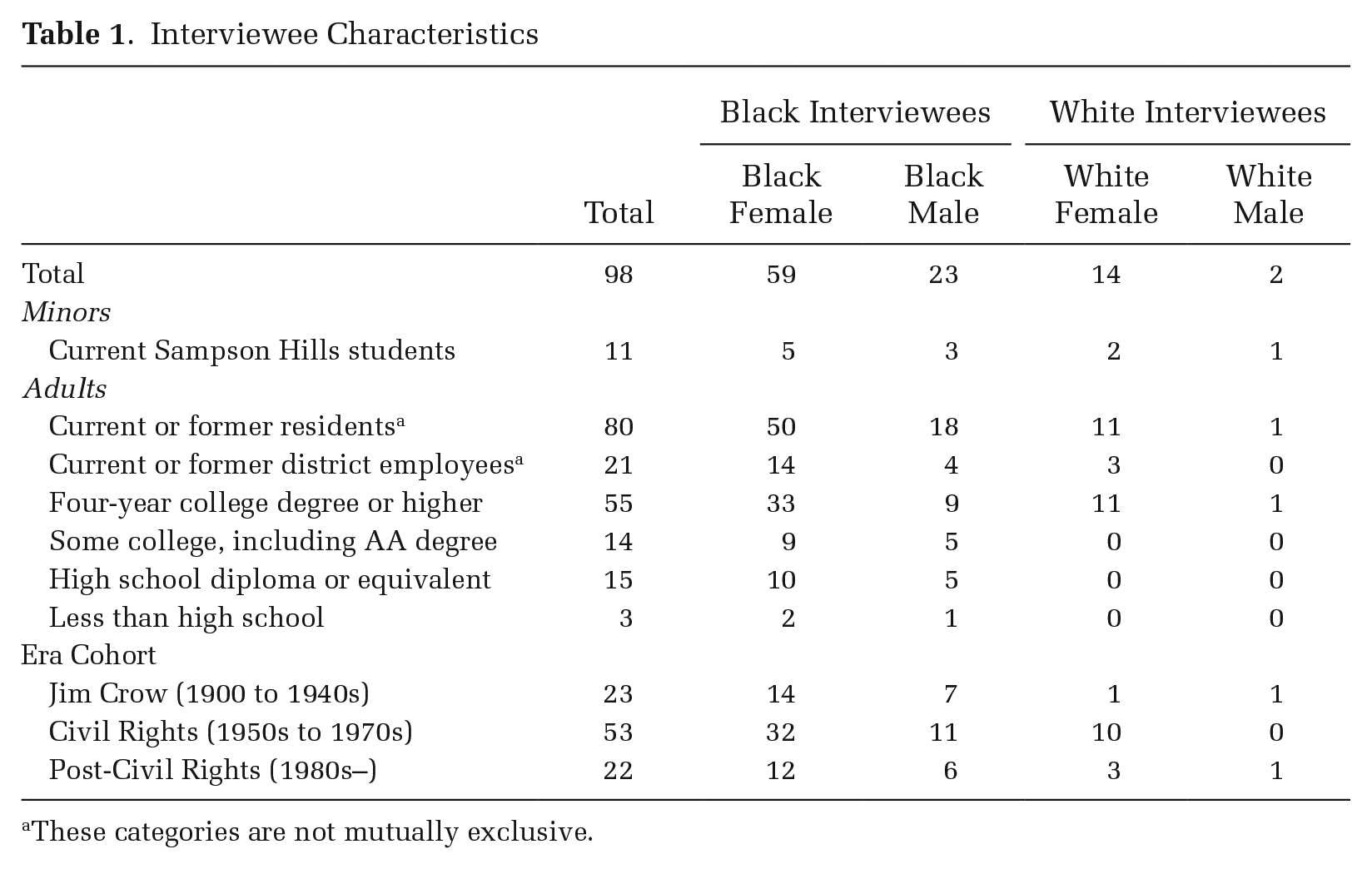
These categories are not mutually exclusive.
I conducted interviews at libraries, coffee shops, participants’ homes, and churches. Interviews lasted between 45 and 200 minutes and were semi-structured with questions constructed for different roles. 13 Current and former longtime and legacy residents answered questions about family history in Sampson Hills, community and school life, friendships, black–white relations, and concerns as a student or parent in the district. I asked newcomers about moving to Sampson Hills and their concerns and expectations as residents and parents. I asked students and parents whether they or their children had participated or had ever been invited to participate in any special programs and about their decisions.
Participants
Between 2013 and 2015, I formally interviewed 98 people, ages 9 to 99 (see Table 1). Most were born or raised in Sampson Hills (legacy or longtimers) or had moved in as adults after the 1960s (newcomers). 14 Twenty-one participants were current or former district employees (mostly teachers), over half of whom lived in the district during their employment. About half the adult participants, including all white interviewees, were college-educated professionals (defined as middle class), although some were retired. Most African Americans in this group were first-generation middle class. Participants with high school or some college education who held unskilled or lower-level white-collar positions (e.g., nurse’s aide, server) are defined as working class. More than 50 adults currently or previously had children in the district, and half were themselves products of the district.
Data Analysis
I transcribed and coded interviews inductively first, exploring themes as they emerged. Codes were descriptive (trust, safety), capturing the essence of statements, events, or episodes, and more conceptual or interpretive (e.g., perceptions of risk, signaling). A team of trained undergraduate and graduate students then coded interviews in Atlas.ti based on the initial code list I prepared, adding codes as necessary. After about half the transcripts were coded, I reviewed code reports to identify dominant themes. Trust and distrust generated the most coded excerpts.
Consulting the trust literature in an iterative process, I used inductive and deductive codes and refined categories to distinguish sub-categories (e.g., police, racial), expressions (implicit, explicit), and types (interpersonal, institutional) of trust and distrust. I reduced the list of over 300 codes to about 75, dropping rarely used codes and merging others. I created co-occurrence tables in Atlas.ti to examine patterns among the codes, then created new analytic codes (e.g., vulnerability) and returned to the data for additional coding, applying more stringent rules for trust and distrust.
A final round of coding focused on trust and distrust. For reliability, I reread and recoded every transcript to identify and understand participants’ exposure to SHSD and special education and expressions of trust and distrust. This analysis was not restricted to discussions of SPED, as that strategy would miss other possible factors affecting trust. Drawing on participants’ full transcript, I generated hypotheses (e.g., parents familiar with SHSD are more likely to reject SPED recommendation) and charts to assess relationships. When cases did not fit the hypothesized relationship, I returned to the data and literature to refine the hypothesis, a process Timmermans and Tavory (2012) refer to as abduction.
Thirty-five families reported experience in SHSD with special education or other remedial programs like Title I, either requesting services for a child (15) and/or receiving placement recommendations (21). 15 For the in-depth analysis of trust decision-making, I focus only on black families (excluding two white parents 16 ) and on adults involved in the decision-making (excluding four black participants reporting on childhood memories of parents’ actions). Table 2 lists the 15 black adults who provided first-hand retrospective accounts on the decision to refuse or accept a remedial placement recommendation.
Parents’ Responses to Remedial Placement Recommendations by Class and Resident Status
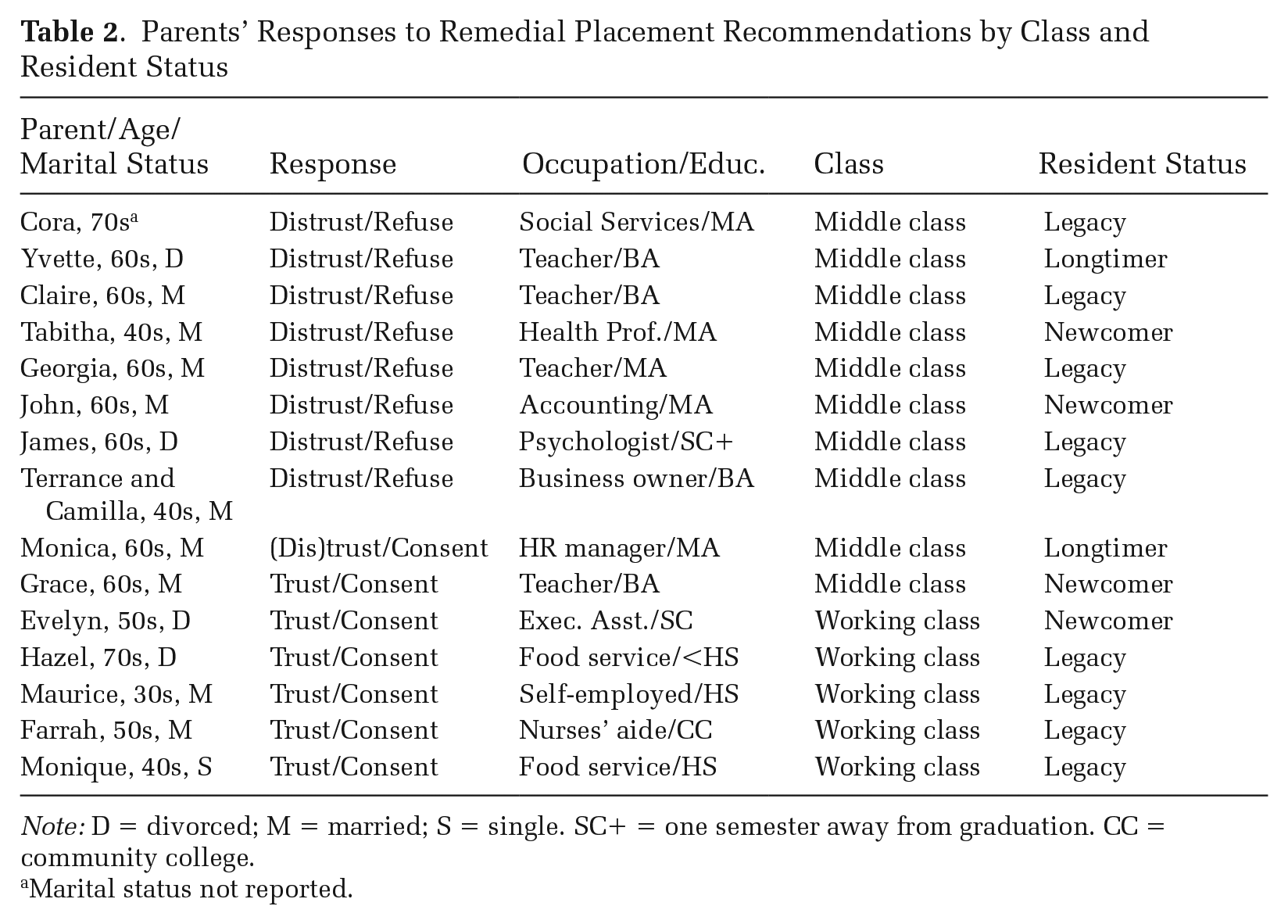
Note: D = divorced; M = married; S = single. SC+ = one semester away from graduation. CC = community college.
Marital status not reported.
Black participants implicitly or explicitly invoked trust language in explaining their decision on SPED recommendations. However, contrary to what some trust studies suggest, black parents were not homogeneously distrusting; in fact, there were differences even among parents who as students had had negative experiences in the district. Comparisons within and across cases revealed decisions patterned by social class, with middle-class parents less likely than working-class parents to trust the district’s recommendation and accept placement. As Table 2 shows, among the 15 black focal families, eight refused the school’s recommendation and seven accepted. All who refused were middle class, and five of the seven who consented were working class. To understand the pattern, I examine how parents retrospectively describe and judge their decisions and interactions with school officials, focusing on explanations offered, language used, and emotions displayed (in the past and during the interview). Whether parents’ assessments of SHSD’s recommendations were accurate or best for their child is beyond the scope of this analysis. The aim is to understand their decision-making.
Because experience is relevant to trust, and black residents’ history in SHSD is prominent in participants’ storytelling, I use all interviews to “consider the broader social setting” in which trust interactions occurred (Schilke et al. 2021:246). After the wide-angle view, I zero in on the 15 cases. With a small number of cases, I can better keep each case in mind and conduct more fine-grained analysis (Crouch and McKenzie 2006) from which to draw inferences about the relationship between trust, class, and race. To complement the analysis of the 15 cases and assess inferences, I incorporate other interviews that suggest contradictory or confirmatory evidence.
Black–White Relations in Shsd: Sowing the Seeds of Black Mistrust
Entering Sampson Hills driving west from the city, large stone homes on stretches of perfectly manicured lawns announce the suburban changeover. Heading north, up curving roads, leads to neighborhoods that frequently appear on lists of the most expensive zip codes in America. Sprawling, multimillion-dollar homes set back from the road can be glimpsed through wrought iron fences or thick privacy hedges. Less ostentatious homes (e.g., smaller structures with brick or vinyl siding, on smaller tracts of land and closer to the sidewalk) in other communities have charming curb appeal. In working-class communities like the historically black section of Creighton, the housing stock is a mix of stately brick or wood framed homes, colonial twins, row houses, and multi-unit dwellings, some in better shape than others.
What Creighton’s historically black section lacks in grandiosity, the community more than makes up for with verve, with multiple black churches and well-equipped playgrounds, walkability, and proximity to downtown shops, restaurants, and public transportation. Its energy also comes from its storied past of intergenerational and deeply rooted black families. It is a place where “everyone knows everyone” and community events seem like family reunions. Once known as the servant belt, it remains home to many legacy Creightonites, black residents who can trace their roots back generations. Creighton’s oldest residents and those whose families have resided there since the early 1900s tell stories of themselves or family members working as chauffeurs, cooks, maids, seamstresses, and the like. A bemused Grace Atkins (black newcomer) recalled that as late as the 1980s, white residents were still calling Creighton’s black churches inquiring after domestic help. She was happy to tell callers they would have to look elsewhere. Such slights aside, longtime and legacy Creightonites reveled in stories about a childhood surrounded by family and friends.
Explaining the community’s “family-oriented” character, black high school senior Paris gushed, “I love Creighton”: Everyone is either related, if they’re not related, they know each other. It’s intergenerational. So, like my friends, I know their grandparents, they know me. . . . So like you know all my friends, my mom trusts their parents. For the most part my friends’ parents are my mom’s friends, like real friends, so we all grew up together. . . . I can go on and on.
Black residents young and old were effusive about growing up in Creighton. To 80-year-old Ruthie, Creighton is “God’s little acre.”
For younger black residents, the south side of Creighton had always been a black space. But the oldest black residents remembered when the area was “still mixed,” as 75-year-old Melvin said. “Up until 1949,” he recalled, black and working-class Italian and Irish residents lived, worked, played, and were educated together. Melvin and other black elders remembered friendly and cohesive relations between groups. But in the 1950s, things were changing. Opportunities opened up for working-class white families who gradually moved out or sent their children to Catholic school. By the 1960s, during Geoff’s childhood, “there wasn’t much intermingling” between black and white residents, except on select blocks where some Italian families remained.
By then, Creighton Elementary School (CES) had become the “black school.” At 80 percent black in the years before it closed in the early 1960s, it reflected district zoning decisions and changing neighborhood demographics, a result of informal and formal discriminatory employment and housing policies. District leaders regularly denied suggestions of segregation, though. In newspaper and other accounts, they pointed to CES’s 20 percent white population to deflect such allegations. But among residents it was widely known that CES’s white students, schooled in the basement, were “students with mental disabilities and all the special needs students,” as one elderly white former resident said.
Black alumni joyously reminisced about attending a black neighborhood school. But they also remembered substandard conditions and inferior education, inequities corroborated by school board records showing nonexistent library and activity funds, an extensive need for repairs, and below-capacity enrollment at a time when other schools were overcrowded and the district was debating building additional schools. Such factors prompted parents and the local NAACP to petition the board to close the school.
CES alumni also recalled physical, verbal, and emotional abuse and degradation. Stories proliferated about being told by white teachers “we wouldn’t amount to anything,” as I heard one black man share publicly at a forum. A story told repeatedly, with horror and incredulity, was about black students made to sit under a teacher’s desk as punishment. Monica, whose family moved to Creighton when she was 8 years old, expounded on the experience in a joint interview with her mother Ella, who listened in silence: There were teachers there that would abuse kids, they would hit the kids, they had a paddle. There was an art teacher who would stick the kids under her desk. . . . A lot of black kids were humiliated . . . called dumb and stupid. . . . It was clear if you had a goal, if you had ambition, it was really mentally beaten out of you.
Erika, a black legacy of Creighton, described the “grief and unresolved pain and anger” among CES black alumni. “Who has teachers put you underneath a desk like you’re nothing?” she asked rhetorically. “It took a toll on us.” When CES finally closed, it did not mark the end of racial inequality in SHSD, but rather opened a new chapter.
No one felt the brunt of the closing more than the first cohort of bussed students, including Erika, Geoff, and Elijah, who separately described their experiences as “traumatic” or “horrific.” SHSD divided Creighton’s black students across its other elementary schools so “only a handful” attended any one school, a plan that left black children feeling isolated and scared. Elijah, just 7 years old at the time, said that to cope, black children “held onto each other. . . . Somehow you realized things had changed so you gravitated towards your childhood friends, your recognized world. You stayed as close to them as possible.” Geoff recounted that on his first day at his new school, white students stared at black students, telling them their parents said black people had tails and they were not allowed to touch them for fear of contamination. The “negativity directed towards black folks” at the school, Geoff said, left him feeling “ashamed” and “embarrassed of being black.” Erika, then 9 years old, recalled the terror of arriving at school to a sea of white faces with “signs” telling black children that they “weren’t welcome there.” Now in her 60s, she poignantly compared herself to 6-year-old Ruby Bridges, the first black student to desegregate a Southern elementary school. But Ruby, she noted, had U.S. marshals to guide her past the angry crowd. It was “the most traumatic thing I had ever been through in my whole life,” Erika added.
Constructing Risk: Desegregation and Special Education in SHSD
The move to white schools in SHSD brought new educational challenges and setbacks for black students. For Erika and others, that meant retention and special education, which she reported was entirely black with “one or two whites.”
We had to go back a year.
A whole class?
Just about the majority. Some of the white kids didn’t and a few blacks but the rest of us were held back. So, we had to do 4th grade again when we went to [Archer]. . . . Yeah and we had to go to special ed.
In [CES], you were not in special ed?
No. [Archer] we were in special ed.
And did you know it was special ed at the time? Did you know what it was?
I knew I didn’t go to class with the other kids. And that was hurtful. . . . It was called the zoo. Zoo monkeys.
Nearly every black adult over 50 mentioned the “zoo” in interviews. No one knew the exact origins of the insult, but even as that label died out, the pattern of mostly “the black kids” being pulled out for remedial programs remained a familiar, taken-for-granted sight into the twenty-first century. As Francine said, “I guess back then [1960s] I figured that was where we were supposed to be.”
Students, parents, and teachers all mentioned seeing a mass of black students in special education, although explanations for the pattern varied. According to Jayla, a black former teacher hired through one of SHSD’s “minority fairs” in the early 2000s, black children in the district were more likely to start kindergarten unable to read, which led to their placement with reading specialists or in special education. Some residents, however, offered federal funding as an explanation for black children’s heavy presence in remedial programs. Tia, a black current SHSD parent and 1970s graduate, explained that the district had a practice of putting “as many black kids in special ed” as they could to receive state funds. She quipped, “I mean, I always knew my friends were being thrown into special education just because that’s where they put all the black kids.”
Even white parents, like Reeva, who entered the district in the 1990s to access SPED services for an autistic child, recognized the “very disparate” pattern. Observing that most of her son’s friends were black “because most of the kids in special ed were black,” she said, “it was very clear to me that there was something wrong, because like 8 or 9 percent of the district is black.” An attorney, and later an advocate for families with children in special education, Reeva contacted another lawyer to investigate. She explained: There was a pattern of assuming that black kids were not as capable and putting a lot of them into Title I math, reading automatically when they came into the system, just because it was there. They needed to have kids in the program in order for the federal monies to come in, so they just put them there. A lot of kids were put into special ed from there.
Paulette, a 1990s SHSD black graduate and current parent, recalled noticing students being separated in 5th grade. By junior high school, she said, “a lot of my black friends were being put in special classes,” called “resource.” 17 Asked if white students were in resource, Paulette responded: “I’m sure there were a few. But predominantly, it was black.” Mia, 26 (Creighton legacy), recalled her “friends all went” to special education, which confused her because they seemed to be learning things they already knew. Nineteen-year-old Zoe (black newcomer) claimed that in her elementary school SPED classes “you will not see one Caucasian person.”
Parents were perplexed by the spectacle of segregation and troubled by what some described as a downward trajectory in remedial placements. These placements contributed to feelings of distrust among black parents already questioning the educational value of remedial programs for their children and white educators’ moral commitments to black children.
Feelings of distrust tied to past experiences in SHSD pervaded the Creighton community and undermined parents’ sense of safety for black children. When I asked 1970s SHSD black alum Amber about where her children attend school, she replied solemnly, “that’s an area that I don’t tread very much is to deal with the school district. . . . I saw what [SHSD] did to others even though I didn’t have the same experiences, so when it came time for my son to go to school, I didn’t want that for him.” Amber sent her son to private school because she “didn’t want him to be labeled.”
For black alumni parents who were circumspect about the district’s commitment to black children, the alternative to private school was hypervigilance. For Paulette, that meant being “all CSI [Crime Scene Investigation],” with her daughter, “asking very specific questions” about her day at school. If parents are not “aware of what’s going on,” she explained, the school can “use their opportunity to do their little experiments,” such as “putting the child in resource room” or “taking the child out of the classroom to do testing.” Although neither happened to her daughter, Paulette exclaimed, “I told [her] from the very beginning, ‘If at any time, once, somebody comes to the classroom and takes you out for any reason, you better let me know!’ I told her that in kindergarten.” Public and private statements conveying mistrust of SHSD were always connected to specific events and observations, reflecting knowledge-based (dis)trust.
Class Differences in Black Parents’ Trust Decision-Making
Considering black families’ history in SHSD, we might expect black alumni parents to express distrust, and they generally did, but only some acted on those feelings in response to remedial placement recommendations. Others expressed more trust. These differences fell mostly along class lines, with middle-class parents expressing distrust through refusal of the district’s recommendation more than working-class families. Whether we see these decisions as acquiescence, deference, or trust (or intertwined), it is significant that parents describe their actions as trust (or distrust), either explicitly or implicitly, as will be clear below. Scholars looking at decision-making in institutional contexts often examine how cultural resources are deployed and overlook the implicit element of trust in these interactions. I present the analysis by trust decision to illustrate the class differences and highlight the outliers in each trust decision group.
Refusal as an Act of Distrust
Eight families reported refusing teacher recommendations for a child’s placement in special education or remedial (Title I) reading or math. These accounts come from mothers/godmother (6) and fathers (3), 18 and mostly legacy Creightonites, although the group also included two newcomers (see Table 2). At the time of the decision-making, these adults held professional jobs, and all but one had a college degree. The similarities among the group—who are no more connected to one another than they are to their working-class neighbors (to whom some are related)—are striking. The pattern shows previously unexamined ways that status is used in trust decision-making and different stages of the process.
How Middle-Class Black Parents Assess and Mitigate Risk in Trust Decision-Making
Like his mother, James was born and raised in Creighton. The divorced father was known to be “outspoken” about racism. As a high school student in the 1960s, he challenged a white teacher who spit on him and called him the “n word.” In protest over his suspension, black students had staged a school walkout, casting James as a community hero. During our interview, James recalled how the school apparently retaliated by withholding recruitment mail from colleges where he had ambitions to play basketball. He had played ball at a historically black college (HBCU), but family finances had caused him to leave one semester before graduation. Still, he became a successful leader of a community enterprise and later worked as a psychologist at a state facility.
When I asked James, now almost 70, whether the daughter he raised in SHSD was in any special classes or if they had been recommended, he answered forthwith, “Oh yes . . . I said, ‘That’s crazy. No way’”: This happened in elementary school. “Well, we think your daughter would be better off if she was in this class. And she’ll spend more time—” pretty much she’ll spend more time in one room, which brought back memories. And there would be more of an emphasis on her behavior and this and that. A few things like that. “No. She’ll track through the regular. She doesn’t have an issue. She doesn’t have an issue when it comes to discipline. There’s no issue there.”
Throughout his secondary school years, James recalled that “the majority of my buddies”—other black students from Creighton—“went to the ‘self-contained’ class,” called “the zoo.” The class was “95, 96 percent African American,” he said, and they did not switch classes for subjects like the rest of the school: “once you went into that classroom, that’s where you were for the rest of the day.” Decades later, James’s distrust of SHSD persisted, and he refused their SPED placement recommendation for his daughter.
Claire, a 60-something-year-old woman with roots in Creighton extending back at least two generations, lived in the Creighton neighborhood where she was raised, with her mother, siblings, and extended family close by. Recalling her SHSD experiences, Claire praised the district, recalling a counselor who “kept pushing” her to consider college although she was “cutting classes” often to go to work. “Claire, just think how bright you would be if you applied yourself,” she recalled the woman saying. Claire graduated, went to college, and had a career as a teacher. Still, although she cited mostly respectful interactions with school officials as a parent, her tone grew indignant as she discussed her children’s experience in SHSD: But I remember one of my daughters, in middle school, they tried to talk her into going into a reading program, like one of the title reading programs. . . . I told them, “No way.” . . . My daughter came home and told me about it and they would tell them all this fun they’re going to have, and you can do this, and I’m like that sounds like playtime. Where’s the education part? I’m like, “Oh, no. You’re not doing that to my child.”
Distrust and perceptions of risk are evident in Claire’s recollection of events. Although her own schooling experiences had been “really good,” Claire said she “knew about the other side” from students from “single-family homes” at her church, many of whom were in Title I programs, including her relatives. The parents, Claire explained, “felt like they were not able to go up against the administration in school.” She, however, “was up there all the time.” Claire insisted: “They knew, you ain’t messing with my child. I’ll go up there in a minute.”
Asked whether school officials pressured her after she refused placement, Claire replied matter-of-factly, “No, I just told them that I taught school. I said if she needs a tutor, I will get her a tutor” or “work with her at home.” As a teacher (as was her husband, although neither were in SHSD), Claire felt confident she had the resources and knowledge to pursue other options to aid her daughter if necessary. But Claire also explicitly referred to her status in refusing the recommendation. This suggests a distinct part of the trust decision process, what Claire referred to as “going up against the administration.” I return to this point below.
Similarly, John invoked his class resources in rebuffing the district’s recommendations for special education for his children. A white-collar professional, John had moved from the city in the 1980s with his wife and two small children to assume a leadership position in Creighton. He knew little about the area, other than “suburbia, nice community, nice people, a blue-ribbon school district.” For his first few years, he recalled, “it was wonderful, beautiful.” His experience changed, however, when his first child started kindergarten and “the challenges . . . with racism” began. John, now in his 60s, described learning that his daughter played “shadow” because none of her classmates would play with the “lone” black child. He portrayed the teacher’s response as indifference, as when his daughter “came home with the ‘n word.’” Upset, John contacted the school: “And they said, ‘Well maybe she heard it in your house,’” a memory that made him shake his head, laughing incredulously.
By the time John received recommendations to test his daughter for special education, he was wary. “Well, they wanted to,” he explained, but I didn’t let them test my daughter. . . . I think she was in elementary when it started, and I wouldn’t let them test her. . . . Because at that point I was very uncomfortable with anything they did. I felt as though whoever gives the tests determines the results.
When he received a recommendation to test his son, John was even more circumspect: He’s . . . in [middle school]. Okay. [He sighs.] They’re “concerned” [his emphasis]. “We want to test your son.” Okay. “No. If he needs to be tested, guess what? I’ll have my son tested. What? If you have to pay? I’ll pay to have my son tested. I have a very good friend who’s a school psychologist at [local university],” and they had arranged to test my son.
Although still distrustful of SHSD and unyielding in refusing the recommendation, John did not dismiss the school’s concern. Instead, he invoked his financial resources and network of trusted professionals.
Familiarity with SHSD figured prominently in middle-class black parents’ decisions, but the ability to pursue other options likely emboldened them to act on their distrust, as dependence arguments suggest. If these parents were making a mistake by not trusting the school’s recommendation, they could use their financial and professional resources to reduce uncertainty and mitigate any consequences. But these parents relied on more than their material resources and networks in trust exchanges. They also deployed what I call symbolic resources (e.g., authority, fortitude, confidence), acquired through their professional roles and status, in communicating their decisions to school officials. This communication, as I will show, is a distinct part of the trust decision process.
Using Symbolic Resources to Communicate Distrust
Black middle-class parents evinced a sense of ease communicating their distrust of the school’s referral, especially parents who were teachers, all of whom asserted their class position. When I inquired about Yvette’s experiences as a parent in the district, for example, the longtime Creightonite immediately recalled the time she was told by her daughter’s kindergarten teacher that she “should consider a special class”: There was no way. Because I knew she was bright, really bright . . . so, I said, “Oh no! No, no!” So, I went to the school and talked [to them] and that was changed real fast [her emphasis], cause they found out I was a teacher.
Perceiving risks she was unwilling to take, Yvette, like Claire, validated her decision to refuse the recommendation by asserting her professional status and expertise. In essence, professional parents were signaling to school officials that they, too, were experts and competent to make good decisions for their children.
Signaling competence in the act of refusal was not limited to SPED referrals. For example, when told that her son would be held back in 1st grade, Francine, an SHSD black alum and teacher at the time, said “all I could see was red.” But she kept her “cool,” she said, and went up to school “suited down” with an “attaché case” filled with his work. “They didn’t know that I was a teacher,” she said, emphasizing “didn’t” to indicate that she let them know. “When they think a black parent, especially a single parent, is coming up to the classroom,” she said, they expect them to “act out of character, not being professional.” Laughing, she quipped about the incident, “You met your match here!” After Francine met with the superintendent, her son was switched to a black teacher’s classroom at her request, where he excelled.
Whereas prior research on signaling in trust situations has focused on how trustees signal trustworthiness (Gambetta and Hamill 2005), here I find trustors actively engaging in signaling, which I argue is a response to domination, a distinct phase of the trust decision process. Middle-class black SHSD parents seemed to think they had to prove their status and competence, to avoid negative stereotypes about black parents and challenges to their decisions. Signaling status through clothing, titles, or other status markers allowed black parents to assert their right to refuse, helping to reduce the power imbalance with the school’s mostly white authorities. Signaling almost always surfaced in discussions of face-to-face interactions, where the power imbalance was most keenly experienced.
Referral meetings were a primary site of this imbalance. As many parents spontaneously mentioned, these meetings involved “a team” of experts. In recalling the time “they wanted to put my godson in special ed,” Georgia, an SHSD black alum and retired teacher, explained why the child’s mother, her aunt, requested she accompany them to the meeting: “You sit around the table and it’s very intimidating. I mean you have all these people [and] there you are, you know, by yourself usually. And you listen to them go over this and that and the other.” Exuding confidence, Georgia explained how she refused the SPED recommendation for her godson, asking, “What can we do to get him back to where he should be? We don’t think he belongs in special ed.” Georgia never alluded to status signaling in the meeting as other teachers did. But it was probably less necessary, as the assembled team likely recognized her as a co-worker.
Many black parents—regardless of class—indicated that referral meetings were “intimidating.” John, who refused SPED recommendations for both of his children, referred to the assemblage of experts as “craziness”: And I remember at one of the meetings I went to there was a social worker, a psychologist, the vice principal. I think it was five, six people in the room. And I remember one of the meetings, I called the day of the meeting, I said, “I need to know who’s going to be here before I come.” “Oh, just your teacher, your child’s teacher.” When I walked in the room there were five people there. And I said to them, “You know, I should leave. . . . ” And I said, “The reason why I wanted to know who was going to be here was because I had contacted some of my friends, I was going to bring with me a psychologist and a counselor and a social worker.” I said, “But let me tell you. I’m not intimidated.”
Explaining his resolve to me, John cited prior experience as one of a handful of black inspectors working for a federal agency: “I learned the techniques of not being intimidated.” Middle-class black parents believed their work experience accorded them the fortitude and confidence to withstand the pressure of the face-to-face institutional interactions, and they acted on the decision they felt most appropriate. Nonetheless, John, a well-respected, college-educated man, would rather not have faced the group of experts alone. Georgia’s aunt apparently felt the same and thus asked Geogia to accompany the family to the referral meeting. It is noteworthy that neither John nor Georgia’s aunt was content to simply draw on the knowledge or expertise of their professional contacts; instead, they sought their presence at the meeting. This suggests something more unfolding here than the typical network story about social influence or access to information. As John’s earlier comment implies, having high-status family or friends accompany him not only signaled status, but also buffered against the potential “intimidation” of the team of experts. The interpersonal dynamics at play in face-to-face trust exchanges, especially when and how trustors experience domination and what they do to combat it, deserve more attention, as they indicate a unique phase of trust decision-making.
Trust Outliers: The Freedom to (Dis)Trust
Monica Jones’s account provides another opportunity to explore class and the dual phases of trust decision-making. Monica is one of two exceptions to the middle-class pattern of refusal. Newcomer Grace Atkins is the other, but her account of her initial decision-making so closely parallels the trust of working-class families that I discuss her story with theirs below. Monica’s account, however, reveals distrust similar to that of parents who refused placement. Although she accepted the SPED recommendation, Monica also drew on her experience in the district and symbolic resources to manage the process and protect against a trust error.
Monica was the oldest of five children in a working-class black family when they moved to Creighton in the 1950s. Reflecting on her schooling experiences, she acknowledged not realizing until junior high school that, we weren’t taught what the other kids were taught. And they tracked us into the bottom tracks. And I mean, no matter how smart you were [or if] you had good grades, you begun to realize that they were talking about things in class that you were never taught.
Monica recalled black students being split across three classes in junior high school, and in high school they “had no contact with the white students who were college bound.” She knew there were advanced classes, but she was not allowed to take them. Although she had good grades, “teachers literally came out and said, ‘You’re not college material.’. . . I can’t tell you how many times teachers, going through the system, told me I didn’t have the ability to go to college,” she lamented.
After high school, Monica worked for a few years before taking college courses. She soon realized that she was college material. Eventually she graduated from an in-state university and then left the state for work. After having a child, she returned to Creighton for work and to enroll her son in “a good school district.”
Despite her own experiences, Monica knew that SHSD was “ranked one of the best.” But for her son to get a good education in SHSD, she said, “I was going to have to fight for it.”
I decided early on when my son went to [SHSD] that I was just gonna be a [white] mother.
What does that mean?
They’re just very entitled. They’re in the school’s face. They’re demanding stuff for their kids, they’re always there to push their kids ahead and it’s a sense of entitlement.
When her son was in middle school and “[school officials] talked about special ed” because they said “he was a troublemaker,” Monica “researched it” and consented, mimicking what she thought white mothers would do. She explained: I mean you have white kids in [SHSD] that are really, that are smart, that have a, what is it called, EIP? . . . IEP,
19
so that they can take untimed tests. Their mothers have thought through that and they track into the system and they’ll pay themselves for a psychological report to get them the status so that they can get extra help during SATs.
Once Monica “researched it and found out that all these kids had them in their folder and the advantage of it,” she agreed to placement. “Fine, test him,” she said. She acknowledged that “a lot of people I know they refuse to do it because they were afraid of the label,” but Monica turned what other middle-class black parents saw as a liability into an asset. Consenting to placement meant her son was allowed untimed tests: “That’s it. That’s all I wanted out of it at that point. Yeah, once I realized why they were pushing these with white kids. I thought, okay. Okay.” Monica insisted, however, that her son not be removed from the classroom for services.
Monica described annual meetings “with probably four or five people around the table,” and when I asked how the meetings were for her, she said, “I was fine with it.” Seeming to intuit where my questions were headed, she offered: “I had friends that were really intimidated and would take the minister or something” with them. She, however, went alone: “I mean, I was the director of benefits [at my job], used to negotiating, sitting at a table with all white folks. It didn’t bother me.” Here, too, we see the importance of nonmaterial or symbolic resources. Armed with managerial experience in a white firm, Monica felt equipped to handle the pressure of the SPED meetings. She was also prepared to manage the SPED process in a way that allowed her son to benefit from placement without incurring the kinds of costs (e.g., segregation, falling behind academically) that other black children had. Rather than forgo the resources the school offered, she opted to take advantage of them by dictating and closely monitoring the services her son received.
But Monica’s actions to limit the possibility of institutional betrayal, some scholars might argue, did not demonstrate trust. Indeed, Monica appears no more trusting than the other middle-class parents I interviewed who refused placement after considering how institutional actors would likely behave, given past behavior. Her consent was based on the belief that white children were benefitting from SPED in a way that black children were not, because SHSD did not have black children’s best interest in mind.
Trust Decision-Making among SHSD Working-Class and Newcomer Black Parents
Surprisingly, among legacy and longtimer working-class families, familiarity with SHSD figured less prominently in their trust decision-making. Although most of these parents acknowledged some childhood difficulties in the district, they accepted the recommendation for their child’s placement in SPED or other remedial programs. Newcomers across the class spectrum with limited and only positive experience in the district also accepted placement recommendations. To illustrate the factors shaping the decision-making of black parents who expressed trust in agreeing to placement, I spotlight the narratives of the two newcomers and two legacy families.
Evelyn was in her early 50s when we met, shortly after I interviewed her daughter Zoe. The divorced mother of two had been unemployed for a few years, and without a college degree, her job prospects were limited. She had left her job as an executive assistant after less than a year and filed a complaint alleging discrimination in the all-white office environment. Evelyn grew up near Sampson Hills, where she attended school in another small, predominantly white school district. Living so close to SHSD, she knew the district’s fabled reputation: “I was told that it was a good school district and it was one of the best school districts and that’s why I said, ‘Oh, yeah, well this is what I want for [Zoe].’ Yeah. I wanted the best.” When Zoe was a toddler, Evelyn moved to Sampson Hills.
By the time Zoe was in 1st grade, Evelyn was summoned to her school. “There was a team of people there in one of those meetings”: They talked about putting her in special education, talked about her behavior. Her test scores. . . . They mentioned she was low for her age, she needed to come up and in order to do that, they wanted to put her in these programs.
Thinking it was temporary, Evelyn agreed: I was kind of shocked and didn’t really understand the whole process. I wasn’t familiar with any of this. So, I was just taking their word for what she needed because they were with her all day at school and I’m thinking they know her. I thought it was going to be something that she’d enter into and then it would help bring her up to speed and then she would come out of it. I didn’t think it would continue on and on.
Although she had not noticed problems with Zoe’s behavior or schoolwork, Evelyn gave no indication that she challenged either the school’s assessment or their prescription for Zoe’s alleged deficiencies, refusing only the suggestion that Zoe “needed to be put on medication.” Her response sharply contrasts with most middle-class parents’ reaction, but this could be because, unlike those parents, she had no experience in the district. Therefore, the suggestion that SPED would “bring [Zoe] up to speed” sounded reasonable. Evelyn consented, taking the teachers’ “word for what [Zoe] needed.” Interestingly, Evelyn never mentioned intimidation. In fact, in contrast to her experiences at her last job, where she recalled being “treated terribly,” “talked down to,” and “discriminated against,” about SHSD she said, “When I would come in for meetings, I would always be treated with respect.”
Grace, another newcomer, gave a similar account of being swayed by the district’s recommendation. Grace and her husband had moved to Creighton from the city as newlyweds in the early 1970s. He was starting a new leadership position in Creighton and she was completing a bachelor’s degree. Afterward, she taught preschool in SHSD before accepting a job in another industry. When her oldest child was in 4th grade, counselors recommended that he “go into the resource room . . . to teach him how to study and all these little things”: It sounded real good. It’s 4th grade. It sounded real good, really, really good. It sounded like this was something that he would need to help build self-confidence and to have a positive attitude towards learning.
Reflecting on her family’s thinking, Grace explained: When I had [my son], I was 22, so and even though I had education courses in [college] . . . I was still naïve, because I believed [drawing the word out for emphasis] that the educators were giving me the best possible information that I could have for my children. I didn’t question them. . . . And we were in Sampson Hills School System, and I probably—if I were in the [city] school system with my kids I would be questioning everything, but because we were in Sampson Hills School System and it was—had the reputation of being such a wonderful school system . . . and putting out these wonderful, professional people and being here in Sampson Hills, and my husband kept saying to me, “Well you’re in Sampson Hills, so what they’re saying must be correct.” And I went along with the program, you know, cause I didn’t know any different.
As Grace admitted, she would have been “questioning everything” if her children were in the city school system, given its notoriety, but she knew SHSD had an outstanding reputation.
Until that point, Grace’s experience in SHSD was positive. Each of her children had an “excellent, excellent, excellent, excellent” African American teacher for 1st grade, she said. Unlike black families for whom the mere mention of the resource room, special education, or Title I sounded alarms, Grace’s middle-class family had no prior basis for skepticism or fear, and thus they consented to SPED.
It is not hard to understand why black newcomers, with little familiarity or mostly positive experiences in the district, would rely heavily on its reputation in assessing risk to SPED placement. As Smith (2007:38) writes, “Reputation acts as a signal. All else being equal, the greater one’s reputation, the lower the perceived risk” to trust. Nor is it hard to understand why black parents with longer histories in SHSD might draw heavily on their knowledge of the mistreatment of black children in their trust assessments. Unclear, however, is why that same logic did not apply to working-class families with long histories in SHSD, like Farrah or Maurice, both of whom consented to placement and were at least second or third generation in Creighton. I explore this puzzle next, illustrating how trustees’ power renders working-class parents’ familiarity with SDSH of little value.
Maurice was part of one of the oldest and largest black families in Creighton. He graduated from SHSD in the 1990s, but with a baby on the way and the unrelated loss of a scholarship, college “didn’t pan out.” He settled in Creighton with his girlfriend, eventually married, and had another child. When their son was in elementary school, the family refused a recommendation for an IEP to address his “problem paying attention,” shrugging it off as typical for kids. But they took more seriously educators’ concerns about their son’s (and later their daughter’s) reading and math skills and consented to IEPs for both children in elementary school. Maurice’s son protested being pulled out of the classroom and “separated from the rest of his classmates” (sometimes for as many as four days a week), but he maintained an IEP until 10th grade. When I asked Maurice why, he answered: “Because they kept telling us that he needed support, and his grades weren’t reflecting it, but you kind of listened to the administrators because you want what’s best for your kid.” This response contrasts with that of legacy middle-class parents who did not believe SHSD administrators knew or wanted what was best for black children.
Farrah seemed to make the same calculation when presented with a recommendation to place her daughter in a Title I reading program. Like her mother, Farrah was born and raised in Creighton and attended SHSD. She described having trouble in school, including repeating the 2nd grade and confrontations with teachers she thought rude and disrespectful. After high school, Farrah attended a local community college. Her husband, raised outside Sampson Hills, did not attend college. After briefly moving away, the family returned to Creighton with their infant daughter. “I knew that the neighborhoods were safe, things were walkable, and there were playgrounds,” Farrah said.
Farrah recalled another black parent telling her to “stay involved with your kids and have that connection so your kids will do okay in the system.” Black parents in Sampson Hills understood that their children were not assured success in SHSD. Farrah detailed her daughter’s entry into Title I programs in the late 1990s: When [she] got to 1st grade, they asked me or said to me that she needed some extra reading support. So, I was like okay, if you say she needs it, I’m going to trust you, you’re the expert, give it to her. And I never really asked any questions; I just know that they were giving her reading support. . . . So, it was when she got into 4th grade is when I really began to ask a little bit more questions. When she was in the earlier years, I just trusted them to do whatever they were doing and I really didn’t ask them a whole lot. And they really didn’t offer a whole lot.
Farrah and Maurice, like other working-class legacy Creightonites, did not ascribe the same meaning to remedial recommendations that their middle-class counterparts did, even with information that could have diminished their opinion of SHSD. Never suggesting intimidation, they expressed respect for the judgment of the district’s “experts” and heeded their advice. Even when skeptical, they seemed to perceive distrust as the riskier choice.
The Cost of Trust Errors
Black parents understood that their decisions about SPED placement could have serious consequences for their children’s educational success and well-being. No one understood the stakes better than Stephanie, an SHSD educator, whose son “suffer[ed] greatly” because she “discounted” his school’s assessments of him:
20
The counselor says that [my son] has ADD. I was like—“white people are all the same [laughing] everywhere you go. ‘Your kid has ADD.’” I didn’t trust those white people when they were saying—because they’re always saying our kids got ADD . . . damn them white people and their labels.
All parents feared this dilemma—refusing a recommendation for services that a child might really need. But middle-class parents like Stephanie, with financial and other resources, were better able to mitigate the consequences of that error.
Drawing on the family’s resources, Grace later erred on the side of distrust and withdrew her older son’s IEP. After observing his experience in the resource room and hearing his complaints that “all they sit around and do is just talk; they really don’t help me academically,” Grace explained that she no longer “believed the hype” about the district or that what they thought “was best for my children” was right. The family refused subsequent recommendations, but they had to be resolute: And so when I said no, he’s not having an IEP, he’s not going to resource room, and they said, “Well, let us [help] with speech,” I said no. And so, again, I had to fill out all these forms about how they would not be responsible if my child did not succeed academically. So, and we had him tested, cause I said to my husband, I said, “I’m not comfortable with the testing that is being done,” so we got an outside school psychologist to test all three of my children.
Grace’s distrust was coupled with action. Although the family doubted their son had problems, they nonetheless had him and his siblings evaluated externally, ensuring none of them would pay for their parents’ distrust. 21 At this point, like other middle-class families, they used their financial resources to guard against potential trust errors. Second, and no less important, is Grace’s ability to stand firm in her refusal, despite what might feel like coercion with “all these forms” to sign. Such institutional moves, also described by other parents, are less effective with families able to bear the pressure of “going up against the administration” and deploy resources to pursue alternative means to ensure their children’s success.
Looking back, Grace did not regret the decision to refuse placement, but like other parents who had accepted recommendations, she regretted her initial decision to consent. Grace’s son, like other children, complained about not learning anything, being separated from and falling behind their peers, being thought “stupid,” and feeling demoralized. Nearing graduation, many, like Zoe, also had difficulty getting into college. As Evelyn said, Zoe’s “life was pretty much betting on that [a good education] and it didn’t happen.” Reflecting on her decision to “sign off on” Zoe’s placement, Evelyn disclosed somberly, “Thinking back, going back, I wish I never did it.” Maurice said his wife “felt there was more we could have done to keep our son out of the IEP.” When I asked whether they regretted the decision, citing his son’s diminished academic confidence, he replied, “I do and I believe she does too.” Regret underscores the trust dilemma working-class parents faced. At the time, they had few options to guard against errors in decision-making. But their children did not have the immediate post-high school outcomes they had hoped for. If special education was supposed to help their children be successful, working-class black parents were not convinced that it did. Instead, most felt it hurt their children’s progress.
Middle-class black parents who distrusted the district did not regret their decisions to refuse placement. Their children had the outcomes they had hoped for. They attended college (including Ivy League universities and elite private colleges) and graduated. Some also earned graduate and professional degrees. Given their success, the parents did not question their decisions in retrospect.
Deciding whether to trust SHSD’s recommendations for SPED placement was fraught with risk for black parents. However, differences in parents’ decisions were not due entirely to access to material resources or professional contacts (i.e., networks). Even when working-class families like Maurice’s had access to such resources, like free tutoring or nearby family members who were teachers or other professionals, they still consented to SPED. This suggests that even when dependence on schools is reduced, working-class families may still be more likely to err on the side of trust. SHSD referral meetings, which participants’ accounts suggest are a site of domination, may offer clues about working-class parents’ decisions.
Domination: Power and Status Dynamics in Real-World Trust Situations
Assembling a team of “experts” and requiring parents to sign multiple forms acknowledging the risks of refusing placement, as parents described, were two ways black parents experienced intimidation. Families with the means to obtain external testing could mitigate the potential risks of refusal, but the nature of these meetings was intimidating to many participants, irrespective of class or gender. If college-educated, professional adults like John found the situation off-putting, it is not surprising that working-class, single mothers “were afraid to speak” and felt unable “to go up against the administration,” as Claire claimed was the case for some SHSD parents.
Jay (age 68), a black former SHSD student, parent, and employee, made this point, drawing on the experiences of Grace’s middle-class family: [Grace] used to be a teacher there. Now if they struggled with all that education, how does the average family that don’t have a college degree survive in the [Sampson Hills] School System? When you sit down to a meeting about your kid and you’ve got five people sitting on that side of the room looking at you, you’re out of your element. It’s a battle you can’t win. You can’t win the battle and your kids are going to suffer.
Jay’s analysis of the power imbalance that is key to black parents’ trust dilemma is astute. Non-college-educated parents are no match for SHSD’s credentialed experts. These encounters were “battles” that Creighton’s poor and working-class black parents—even longtime residents armed with information—often lost, as they succumbed to the experts’ influence.
Working-class black parents rarely volunteered feeling intimidated during school meetings, but evidence suggests otherwise. For example, Farrah and Reeva (the white parent advocate) separately described an incident in which the two met with a school official about the test scores of Farrah’s son, which showed he qualified for the gifted program. When the official attempted to deny he qualified for placement, Reeva challenged her but Farrah did not. Still sounding incensed, Reeva explained: I went with her—and the gifted teacher said, “Well, he’s not profoundly gifted.” And [Farrah] said, “Well, then I guess we should leave.” And I grabbed her and said, “You sit down here.” And I said, “He doesn’t have to be profoundly gifted to be eligible for this program. Look at his numbers. He’s gifted. He’s solidly in the gifted range.” And we met with [district administrator] at some point and I said, “This child is gifted and this district”—I said, “How dare they? They should be thrilled to have this child. They should be doing everything possible to enrich this child, and instead they’re saying ‘Well, he’s not profoundly gifted’?” . . . Nobody would ever have done that with a child who was white.
The difference in the women’s responses is noteworthy. Having worked as a lawyer, Reeva said: “I learned negotiating skills. I learned a lot that’s helped me in this [advocate] work,” including, she said, “not to be intimidated by anybody.”
Reinforcing Reeva’s point about race in SHSD, some white middle-class parents I interviewed had very different experiences in SPED and other meetings to discuss their children’s difficulties. A few young white mothers I interviewed had children identified as having “behavioral issues.” Rather than recommending special education or medication, teachers saw them as “candidates” for the gifted program. As one mother explained, her son was acting out because he was “a little bored at school.” By framing behavioral problems positively, SHSD was more likely to elicit parents’ trust than distrust or fear. Another white mother, Martha, in describing an IEP meeting for her son, rattled off a list of administrators in the room just as black parents did: “the principal, the vice principal, the head of this, the head of that.” So often had I heard black parents discuss how “crazy” and intimidating these meetings were, that I was prepared to hear the same from Martha. Instead, she decried the experts’ deference to her: So, it’s like a whole bunch of people around the table. I remember them saying to me, “Well, what do you think we should do?” And I go, “I do catering. I teach cooking. I have a degree in accounting, but, you know, like you all have PhDs in education.” It was mindboggling.
Martha’s bewilderment at the invitation to participate in the SPED decision process suggests that, just as SHSD’s experts trusted and welcomed her input, she trusted them. Whereas the “team of people” assembled for referral meetings offered Martha reassurance, black parents often experienced intimidation. This is not to suggest that white families never experienced intimidation in school meetings or that black families never experienced reassurance. The point here is to show that, as Reeva suggested and black families believed, black and white families did not always have the same experiences.
The racial differences in parents’ experiences also suggest that the interpersonal status dynamics of institutional trust exchanges differed for black and white parents. Unlike Martha, no black parent recalled being asked for input at IEP meetings. As SHSD black alum and current parent Tia told me, with black parents, district officials more often “made those decisions for them.” Tracey, a single, working-class black mother, had precisely that experience, even as she “actually wanted [her daughter] to have an IEP.” Yet, she said, when it was time for the IEP meeting, they had already had the IEP written without any of my consent. I hadn’t—didn’t have a chance to review anything. We didn’t talk about anything. They had the whole IEP written.
Knowing that SHSD “was in the habit of putting black people in special ed without any knowledge of the parent,” Tracey had Reeva accompany her to the IEP meeting. Black community leaders and other advocates eventually began accompanying black parents like Tracey to referral meetings, giving them access to the kinds of symbolic resources middle-class parents possessed. As Tracey recalled with a sense of triumph, Reeva’s response to the pre-written IEP was: “‘We’re not signing anything. We’ll see you. We’ll see you later.’ And we turned around and walked out.” Having practiced law, Reeva could communicate refusal with great confidence, and with little fear about being judged as an unreasonable or incompetent parent.
The power dynamics of the face-to-face trust exchanges meant that poor and working-class black families were less well equipped to withstand the pressure to accept the school’s recommendations for remedial placements, lest they appear unreasonable or negligent. Like other parents, they wanted what was best for their children. They trusted the experts not solely out of need but, the evidence suggests, domination. But these families often felt they paid a price for their trust. As Zoe, who spent nearly a decade in SPED, stated when I asked if her mother could have signed her out sooner than she did: “African American parents, they assume that our teachers have the best interests for us and that they wouldn’t lie to us and tell us something that’s not true. So that’s kind of what happened. My mom was fooled all these years.”
Discussion and Conclusions
This research contributes to trust scholarship in four significant ways. It is one of the first studies to examine trust and class among black Americans in authentic trust situations. It shows differences in trust by class, exposing two distinct phases in which status affects trust decision-making. Whereas existing studies have focused on dependence, highlighting the role of material resources and knowledge or networks to explain the negative trust–class relationship, this study reveals the role of symbolic resources, which trustors use to withstand domination. Class matters not only because trustors need what exchange partners have to offer, but because trustees can act to influence outcomes in ways that some actors have little defense against. Middle-class parents deployed symbolic resources, including reverse signaling, to counter domination, and they used their material resources to mitigate trust errors, but working-class families had fewer resources available to them to undercut exchange partners’ power or guard against trust errors. Findings also show that distrust, at least among the middle-class, does not stifle action, contrary to what existing theories of trust propose (Hardin 1993; Luhmann 2000).
The analysis of the relationship between trust and class/status in this study focused on 15 cases, providing a deeper analysis of decision-making and the contexts in which it occurred. However, this analysis allows for only inferences about how class resources and race affect trust in real-world interactions. That status affects real-world trust processes in significant ways other than dependence is evident from participants’ narratives, but more research, using larger samples, is needed to establish more firmly how class, race, and other status hierarchies collectively and individually shape trust exchanges. Although researchers caution that people do not always understand their own motives (Small and Cook 2021), looking closely at how people describe their own experiences and feelings can offer insight into factors influencing their actions.
I found that black parents experienced intimidation in trust decision-making, but their responses differed by class. The idea that in trust situations people are “deciding to whom to make themselves vulnerable,” as Schilke and colleagues (2015:12950) put it, while theoretically useful, misses the realities of real-world situations and the ways status affects trustors’ freedom to decide. Whereas researchers have been overwhelmingly concerned with establishing the social benefits of trust and understanding why and how it breaks down, this study highlights what some scholars refer to as the “dark side” of trust (Gargiulo and Ertug 2006), revealing how socioeconomic disadvantage leaves individuals more vulnerable at two stages of real-world trust decision processes: assessment of risk and communicating distrust in face-to-face interactions. Scholars define and study trust in terms of the outcome—whether people rely on and therefore make themselves vulnerable to the actions of others. My findings suggest that, in real-world hierarchical trust situations, that outcome is not just about trustors’ need, but also about domination.
Existing studies of trust focus on what trustors do in particular situations but not so much what they are up against. Research rarely teases apart trust processes to consider the trustor’s ability to communicate their decision or the conditions under which communication occurs in authentic situations. While we know there is power in the ability to say no, refuse, reject, or decline (Hernandez and Calarco 2021; McGranahan 2016; Nichols et al. 2006; Reich 2014; Ridgeway and Nakagawa 2017; Sobo 2016), this idea has rarely been applied explicitly to sociological theories of trust to understand how trustees wield power to influence partners’ decisions or when and how trustors exercise their own power by refusing to confer trust (for an exception, see Levine 2013). A more expansive theory of trust, one that considers the interpersonal power dynamics involved in many everyday trust situations, is needed to better understand how status affects trust decision-making. This study, focused on black parents from different class backgrounds in real-world institutional contexts, shows why such rethinking is necessary.
Most black families that received recommendations for SPED and other remedial placements in this study had long histories in SHSD and personal knowledge of ongoing patterns of mistreatment of black students. This knowledge, and their relationship with SHSD in general, was critical to parents’ decision-making, but only among middle-class parents did it consistently lead to placement refusal—with one exception. In that case, the parent consented but attempted to make institutional betrayal impossible by closely monitoring and overseeing the process, which does not convey trust (Baier 1991; McLeod 2020). Overall, familiarity factored less in working-class parents’ decision processes. But neither did dependence (or need) adequately account for the class differences in trust decision-making.
To be sure, material resources and professional connections were significant to trust decision-making. Black middle-class parents who refused services had the freedom that comes from knowing they could find alternative forms of support for their children and mitigate the possible consequences of errors in judgment. As previous research on decision-making in other contexts indicates, these parents’ networks and material “resources give them independence” (Hernandez and Calarco 2021:2). Equally important, however, were the symbolic resources—skills and dispositions acquired from their professional and managerial positions—these parents drew on when communicating their distrust (as refusal). In communicating refusal, black parents who were teachers, especially, were quick to inform school officials of their profession, flaunting their class credentials to indicate their own knowledge and expertise, and their right to refuse. These parents were engaging in what trust scholars (e.g., Gambetta and Hamill 2005) call signaling, but in these cases, it was the trustor signaling to the trustee. This reverse signaling attempts to offset perceived status and power imbalances between black parents and white institutional actors, allowing black parents to act more freely on their distrust. As one black parent, a teacher, said of her actions to refuse school officials’ attempt to retain her 1st-grader, “You met your match here!” Symbolic resources, unexplored in existing studies of trust, appear to be a crucial part of the power dynamic affecting trust decision processes—especially in face-to-face interactions.
Black middle-class parents’ communication of distrust of white educators’ recommendations is an exercise of their power. Empowered by their status, know-how, and financial means, they challenged the district’s power to label their children. However, distrust did not stifle action or eliminate risk, as scholars writing on distrust contend (Hardin 1993; Luhmann 2000). Armed with material resources and social capital, middle-class parents attempted to ensure their children’s educational needs were met in other ways. Put differently, black parents seemed to be aware that trust errors can get people “into serious trouble” (McLeod 2020; Rotter 1980). No middle-class parent who acted on distrust reported any regrets about their decision, however, because their children fared well.
For working-class parents, trust seemed more of a burden. Although these parents also had the ability to refuse placement, they acted with greater constraint, erring on the side of trust to secure opportunities for their children and leaving it to the experts to do “what’s best.” Lacking the same resources as their professional neighbors and family members, they were more cautious. They knew that the consequences of trust errors could be costly for them (regret) and their children (failure). However, as participants explained, working-class families were also less well equipped to “go up against the administration.” They consented not just because they needed what SHSD offered, but because they had few defenses against the influence or domination of the team of (white) educational experts in the affluent district—no professional credentials or race or class status to cast their decisions as prudent and themselves as parents who care about their children’s educational success.
Communicating distrust, like saying no, is difficult in any context, but especially to higher-status others and in face-to-face interactions where the potential for intimidation is high. As taxi drivers in Gambetta and Hamill’s (2005) study explained, showing distrust could offend passengers and lead to confrontation. While the possibility of physical confrontation is unlikely in the school context, the potential to offend is no less consequential for black parents in SHSD. To refuse the experts’ recommendation is to challenge their authority and credibility, and “to refuse to grant someone credibility . . . is often to insult that person” (Stroud 2017:90). Refusing school officials’ recommendations communicates distrust, thereby impugning their expertise and reputation. This might be especially difficult for working-class or poor black parents in a place like Sampson Hills, where black families strive to assert belonging in the tony community. The importance of this power dynamic is perhaps best captured by Ridgeway and Nakagawa’s (2017:132) finding that when low-status members of a group defer to high-status members, “the group responds by granting the deferrer a modicum of respect: the dignity of being seen as reasonable.”
However, my findings suggest this is only one part of the power dynamic in school meetings between black parents and SHSD officials. As black parents in this study described, the district’s power to intimidate parents, with multiple experts telling them “what is best for your child” and bureaucratic paperwork obliging parents to accept blame for children’s potential failure, was no match for black families in the district “without a college degree.” These findings should caution researchers studying disproportionality to consider alternative explanations for the overrepresentation of socioeconomically disadvantaged children in special education. Environmental factors may not in fact explain why more poor and working-class black students end up in SPED compared to students from higher social class origins.
Finally, these findings suggest that being too trusting (Gargiulo and Ertug 2006; Rotter 1980) is not the only situation in which people are exposed to manipulation or exploitation. Even when trust is low, institutional actors can more easily exert their influence when trustors have fewer or less effective means to ascertain the accuracy of institutional advice, pursue alternatives, or withstand intimidation. By highlighting the oft-neglected role of power, my findings demonstrate that, like other assets, the benefits of trust are not evenly distributed. More research is needed to investigate the ways class, race, and other status categories provide people freedom to decide and to communicate distrust, and in which situations.
Footnotes
Acknowledgements
The author wishes to thank Annette Lareau, Ingrid Banks, Kenneth Andrews, Charles Kurzman, Lisa Pearce, Karyn Lacy, Michele Berger, and multiple audiences for feedback on earlier drafts of this paper. This work also benefitted tremendously from the thoughtful comments of three anonymous reviewers; the research assistance of Josh Green, Karen Kozlowski, Abigail Newell, Blaque Robinson, Mirabai Sinha, and Ellen Wang; and the editorial assistance of Rachel Kravitz.
Funding
This research was supported by a grant from the Spencer Foundation.
