







Abstract
Despite long-standing evidence linking higher unemployment rates to increased suicide rates, a puzzling trend emerged in the United States after the Great Recession: suicide rates continued to rise even as unemployment rates declined. Drawing on theories of social networks and reference groups, we advance the concept of “sameness”—in this case, the extent to which an individual’s employment status aligns with the fate of others in one’s community—to clarify how unemployment rates influence suicide. Constructing a multilevel dataset of U.S. suicide deaths from 2005 to 2017, we find that while unemployed individuals face a higher risk of suicide compared to the employed, this gap diminishes in communities with high local unemployment rates. Moreover, the “sameness” effect extends beyond geographic contexts to temporal ones, as national unemployment spikes reduce suicide risk among the unemployed and diminish the importance of local sameness. Together, these findings suggest a mechanism of “situational awareness,” whereby local and national economic contexts shape the meaning of unemployment, shifting its interpretation from personal failure to system failure and reducing its stigma. Our article offers a novel framework for examining the effects of cross-level interactions in suicide research, highlighting the crucial role of culture as deeply intertwined with social network mechanisms in shaping contextual influence.
“When men are employ’d, they are best content’d; for on the days they worked they were good-natur’d and cheerful . . . but on our idle days, they were mutinous and quarrelsome.” — Benjamin Franklin (2005:137)
Work matters for life chances. From Marx’s notion that human beings’ essential nature lies in productive activity to Durkheim’s conclusion that only reinvigorated occupational groups can reintegrate modern society, the nature of work stands front and center to understanding individuals’ lives and deaths. Marx and Durkheim both celebrated work, but they were concerned that the transition to industrial society would destroy its potential. Sociological research continues to make clear that work provides more than access to material resources and social position. As Terkel (1974:xi) famously noted, even for individuals in low-wage jobs, work represents a search for “daily meaning as well as daily bread.” Work defines social and cultural relations, which are fundamental for phenomena from social cohesion to the self (Casey 1995:25). Employment affects friendship ties (Fine 1986), marital satisfaction (van Steenbergen, Kluwer, and Karney 2014), risk of divorce (Jalovaara 2003), and social exclusion (Unt et al. 2021).
Most plainly related to our concerns, work has implications for health and healthcare. Canonical research in medical sociology and sociomedical sciences ties problems in individual work status and aggregate market conditions to poor physical and mental health, including cardiovascular disease and depression (Brenner and Mooney 1983; Kessler, Turner, and House 1989; Marmot et al. 1997; Tausig and Fenwick 1999; Turner 1995). Moreover, in the United States and other countries that followed the German health system model, critical access to treatment through health insurance is tied to one’s job (Beckfield, Olafsdottir, and Sosnaud 2013). Of course, formal employment and meaningful work are not the same, but being unemployed has important ramifications for individuals, communities, and societies.
Unemployment has been considered one of the most important variables that affect suicide (Jin, Shah, and Svoboda 1995; Kawohl and Nordt 2020; Stack 2021). However, despite the general consensus that worsening economic conditions increase suicide, the body of empirical evidence is decidedly mixed, both for the effects of unemployment and economic crises (Barr et al. 2012; DeFina and Hannon 2015; Fountoulakis 2016; Iglesias-García et al. 2017; Lin and Chen 2018; Mattei et al. 2014; Norström and Grönqvist 2015). In particular, the effect of work, and unemployment specifically, came into question most recently following the 2008 Great Recession. During the post-recession period, Americans were less likely to be unemployed but more likely to die by suicide. 1 Of course, these inconsistencies, for the effects of unemployment and economic crisis, may arise due to different study samples, time periods, and levels of analysis, which routinely raise concerns about generalizability and ecological fallacy (Agerbo, Sterne, and Gunnell 2007; Blakely, Collings, and Atkinson 2003; Catalano et al. 2011; Nordt et al. 2015; Platt 1984; Stack 2000a). 2 Yet, one of the most critical challenges in understanding how worsening economic conditions affect suicide is the failure to account for cross-level interactions, particularly due to factors unique to suicide (Pescosolido 1994). Consequently, it remains unclear whether aggregate economic conditions affect suicide risk differently for the unemployed versus the employed.
This article aims to fill this gap while addressing critical methodological challenges that result from the problem of rare events and data barriers to multilevel analyses. Understanding how unemployment rates shape suicide risk requires us to reconsider the mechanism by which unemployment increases suicide. Unemployment may lead to suicide through financial strain, social disintegration, and stigma. In a context in which many individuals are unemployed, an unemployed individual is more likely to be aware of others who are in the same situation. This awareness cannot change the financial conditions of the unemployed, yet social psychological research on health disparities suggests that bridging “upstream concerns” with “downstream mechanisms” allows an exploration of the meso-level of analysis which, to date, has received little attention (Schnittker and McLeod 2005).
In this article, we begin by outlining the key methodological challenges encountered in research examining the relationship between unemployment and suicide. Addressing these challenges necessitates the introduction of a theoretical concept, which we term “sameness,” highlighting the protective role of sociodemographic homogeneity in health under economic contexts. We advance the theoretical framework initially proposed by Pescosolido, Lee, and Kafadar (2020), specifically by drawing on the social psychological concept of reference groups and their effect on self-evaluation. Methodologically, we construct two novel multilevel datasets using data from the CDC’s National Violent Death Reporting System and the U.S. Census Bureau’s American Community Survey microdata. First, we use cross-sectional data with extensive state coverage (37 states from 2016 to 2017) to examine how individual-level unemployment status interacts with community-level unemployment rates to influence individual suicide risk. Second, we use longitudinal data from 16 states from 2005 to 2017 to trace how this relationship changes with national economic conditions over time. Finally, we discuss the implication of our findings for theory, research, and policy regarding the role of unemployment and economic crisis in suicide prevention, in health more broadly, and in sociological theorizing on complex systems.
Theoretical Background: Unemployment, Economic Fluctuations, and Suicide
Prior studies document multiple pathways—economic, relational, and social-psychological—through which unemployment increases suicide risk. Not having a job translates into fiscal instability, financial strain, and, often, a loss of social status and social protections such as health insurance. Unemployment may also challenge individuals’ sense of accomplishment and threaten their social basis for activities, reputation, and social connections (Kalleberg 1977; Morse and Weiss 1955). In essence, past research typically follows one of two main hypotheses when examining the potential effect of unemployment on suicide risk.
The Fiscal Stress/Strain Hypothesis
According to the classic Brenner (1973) hypothesis, the economy is central to health because fiscal instability represents a persistent and pervasive stress. Structural economic decline, individual misfortune, and sharp fluctuations translate into differential employment possibilities, which, in turn, have a direct and deleterious effect on suicide and other health problems (Brenner and Mooney 1983; Houle and Light 2017; Strully 2009). From the 1980s to the present, suicide researchers have found that unemployment increases suicide; scholars often note its singular importance and more stable association than other economic forces (Kposowa 2001; Milner, Hjelmeland, et al. 2013; Stack 2000a). Recent research deploying individual-level data on suicide deaths reports an association between external circumstances, including the economic strain of unemployment, and the risk of suicide, especially for individuals age 40 to 65 (Hempstead and Phillips 2015). Aggregate-level studies that rely on national data over time also suggest a strong, positive, and relatively stable association between economic strain and suicide (Milner, Hjelmeland, et al. 2013; Rehkopf and Buka 2006).
The Social Integration/Stigma Hypothesis
From the earliest studies, sociologists have argued that the implications of economic fluctuations extend beyond individual-level financial stress. This hypothesis proposes effects of a very different, tangential, emotional, and relational character than those typically described under the financial stress/strain hypothesis. Unemployed individuals are more likely to face discrimination in their job search because they may be perceived as lazy and incompetent (Eriksson and Rooth 2014; Omori 1997). Unemployment raises questions of legitimacy, worth, and hopes for the future, often carrying a stigma of failure and multiplying the shaming and blaming that have been implicated in anomic suicide (Karren and Sherman 2012; Muller et al. 2020). Additionally, individual-level economic shocks alter people’s daily social connections and loosen their regulative bonds to society (Brand 2015; Rözer et al. 2020), thereby predisposing them to suicide. On the aggregate level, disruptions in the economy translate into disruptions in the social order, shattering existing norms and social network structures. As such, material and psychosocial concerns reverberate into the moral sphere with the loss of cultural and social capital that has been tied to poor physical and mental health (Durkheim 1951; Kawachi and Berkman 2000; Pescosolido 1994; Stack 2000b).
Persistent Problems in the Unemployment–Suicide Association
As noted above, the empirical relationship between unemployment and suicide is viewed as among the most consistent, with a recent meta-analysis of cohort studies concluding that this association is durable (Jin et al. 1995; Milner, Hjelmeland, et al. 2013; Milner, Page, and LaMontagne 2014). However, discrepant findings are not uncommon, with some studies showing only periodic or specific group or country effects (Barr et al. 2012; DeFina and Hannon 2015; Lin and Chen 2018; Norström and Grönqvist 2015). More importantly, concerns are routinely raised regarding fundamental methodological problems that question the routine interpretation and translation of findings on suicides for theory, policy, and programming (Fountoulakis et al. 2013; Kerr et al. 2017; Phillips 2013; Platt 1984).
On the one hand, the reliance on rate-based data in large-scale cross-sectional and longitudinal studies faces the classic ecological fallacy, warning against the interpretation that individual behavior mirrors aggregate-level associations (Robinson 1950). For instance, the observation that higher suicide rates coincide with higher unemployment rates does not specifically indicate whether individuals who die by suicide are unemployed, employed, or outside the labor force. This is not to say that unemployment rates are irrelevant. However, without individual-level data, developing theories about why and for whom unemployment rates matter for individual suicide becomes challenging. Raising this is not a mere trope. It matters because the slip into individual theorizing from rate-based analyses continues, proving to be somewhat unavoidable in practice, shaping discussions of policy, programming, and the very utility of sociological approaches. While sociologists have routinely called for individual-level analyses to complement or replace rate-based research (Firebaugh 1978; Hammond 1973; Robinson 1950; Thorlindsson and Bjarnason 1998; van Poppel and Day 1996), this prominent, long-standing critique finds voice in some outside sociology who suggest aggregate characteristics are unlikely to have any effect on suicide above and beyond individual-level attributes (Agerbo et al. 2007; Mäkinen 1997).
On the other hand, individual-level studies often raise generalizability issues that similarly call findings, disciplinary approaches, and translational potential into question. Even in case-control studies, until recently, data from hospital records or limited geographic areas likely produced a problematic sample because a significant number of individuals who die by suicide do not make contact with the healthcare system. 3 A typical strategy (i.e., matching controls from other patient populations or comparing individuals who die by suicide with individuals who die by other causes) is also suspect on the meaning of the control group, and this work rarely has access to data on accepted confounders (e.g., health, education, veteran status [see Cleary 2017]). Finally, as sociological and public health critics of individual-level suicide studies argue, macro-economic conditions have a proven record of impact over and above individual circumstances. These conditions may serve as an antecedent in the causal chain of events that lead to suicide or as a contextual effect with demonstrated significance in mortality research (Diez-Roux 1998; Link and Phelan 1995; Phelan, Link, and Tehranifar 2010).
Conceptualizing Theoretical and Methodological Solutions to Persistent Problems
Margerison-Zilko and colleagues (2016), among others, conclude that multilevel studies linking aggregate conditions to individual-level health outcomes provide one obvious solution for suicide research (for an early call to action, see Pescosolido 1994). Multilevel studies have been routine across the social and sociomedical sciences ever since the Jackson Heart Studies (e.g., Robinson et al. 2016), and research on attempted suicide or suicidal ideation has deployed multilevel analyses, pushing our understanding further (Maimon and Kuhl 2008; Peng, Yang, and Rockett 2019; Thorlindsson and Bjarnason 1998). However, this approach has not been obvious for research on suicide mortality, especially targeting the effect of unemployment. Because suicide and unemployment are two relatively rare events, even if researchers use linked mortality studies, the statistical models have an insufficient number of cases to generate stable estimates of associations at the individual level (for successful efforts in countries with data registries, see Norström 1995; van Tubergen, te Grotenhuis, and Ultee 2005). 4 Research on suicide deaths in the United States faces the unique conjunction of low base rates, high geographic dispersion, absence of appropriate comparison groups, the lack of comprehensive registry data, and the well-known conclusion that the correlates of attempted suicide are often vastly different than the correlates of suicide deaths (Clark and Fawcett 1992; Murphy 1984; Van Orden, Merrill, and Joiner 2005). 5
Theoretically, the appropriate comparison group for multilevel studies of suicide research is not difficult to state: it is everyone else in the population who did not die by suicide during the same period and in the same area. Practically, constructing such a dataset on suicide in the United States has only recently been successful (Pescosolido et al. 2020). Drawing on this approach, described in detail in the Methods section, we offer a path to theorizing both a cross-sectional and a dynamic micro-macro link in suicide. While still having limitations, without this pathway, multilevel theorizing would be neither grounded in the traditional sociological meaning of “the individual in context” nor straightforwardly operationalizable in empirical analyses.
The Role of Sociodemographic Homogeneity in the Unemployment–Suicide Association
The idea that aggregate conditions matter for individual outcomes across neighborhoods, groups, organizations, and even larger geographic units such as counties, states, and nations is part and parcel of the sociological imagination. Research on contextual influences is now standard, consistently documenting utility, especially in the health area (Diez-Roux and Mair 2010; Diez-Roux et al. 1997; Harding 2007; Lee and Lee 2020; Liu, King, and Bearman 2010). This approach aligns closely with sociological research on suicide that draws heavily from the Durkheimian focus on the state of the social structure and on the twin concepts of integration and regulation (Bearman 1991; Pescosolido 1994). However, a lack of theoretical clarity has led to decades of debates about the differentiation of the twin concepts from each other, or from their theoretical cousins, including social connectedness, social support, social cohesion, and social capital (Johnson 1965; Mueller et al. 2021; Pope 1976; Stack 2000b).
Among the efforts to add theoretical and methodological precision to these debates is a social network approach (Abrutyn and Mueller 2014; Bearman and Moody 2004; Mueller et al. 2021; Pescosolido 1990; Pescosolido and Georgianna 1989). Meaningful social ties lessen social isolation and provide guides for behavior. A social network approach, like Durkheimian theory, has the added advantage of embracing nonlinearity and the contradictory effects that social ties can have. That is, while being surrounded by a densely or loosely connected community has proven to have salubrious effects on mental health (Almedom 2005; Kawachi and Berkman 2001; Leigh-Hunt et al. 2017), social ties are not always beneficial. Too many or too tightly knit ties can prove harmful to life chances, including suicide (Pescosolido 1994; Wray, Colen, and Pescosolido 2011). Furthermore, social contagion theory contends that connections to individuals who have suicidal attempts, ideation, or death translate into emotions, attitudes, and behaviors that spread through social networks and influence similar outcomes (Abrutyn and Mueller 2014; Baller and Richardson 2002; Bearman and Moody 2004; Mueller and Abrutyn 2015, 2016).
A social network perspective also has the advantage of providing a theory that can translate into an operational definition for large-scale suicide research that depends on secondary data. This is crucial because, as the methodological challenges detailed above suggest, it is unlikely that any direct measures of the connectedness concepts listed above and used in primary research are going to be available in suicide studies based on official data sources. However, we expect that the extent to which an individual’s situation is aligned with the fate of others in their community, or their cross-level sociodemographic homogeneity (or sameness), is critical for understanding how social surroundings protect the unemployed from suicide for two reasons. First, the network theory of homophily, derived from one of the fundamental law-like patterns repeatedly observed in social network research, contends that individuals with similar attributes are more likely to form social ties (Centola 2015; Lee, Lee, and Hartmann 2023; McPherson, Smith-Lovin, and Cook 2001). Unemployed individuals in a community where more people are unemployed are more likely to be connected to others with whom they can spend time together, console, or help, and, in turn, are less likely to feel isolated (Young and Lim 2014). We see this as a social integration mechanism.
Second, it is critical that in official statistics, individuals are defined as unemployed only when they actively seek employment for a prolonged period (Brand 2015). Because they must look for a job in order to be unemployed under the official definition and qualification for benefits, people are likely to be aware of others who are unemployed in a community, especially where the unemployment rate is high. Certainly, social psychological theory, whether reference group or identity theory as two of many plausible examples (Hyman 1942; Stryker 1980), suggests that individuals’ self-evaluations are linked to the networks or groups they see as their frame of reference.
Furthermore, the awareness of the economic fate of similar others in one’s social surroundings is likely implicated in a person’s understanding of their own unemployment status. If people observe that they appear to be relatively alone in their unemployed status, they may be more likely to interpret this status as an individual failure. However, if individuals perceive their status-similar friends, relatives, and even strangers to share the same status loss, they may be more likely to ascribe the cause to a larger system failure (Furåker and Blomsterberg 2003). As Simon (1995:20) points out, the reference group can be either an individual or a social organization (and we would add a social network), which individuals use as a basis for self-knowledge, self-worth, and feelings of self-inadequacy. In other words, as more unemployed individuals are visible, the stigma attached to undesirable statuses, like unemployment, may lose its influence as people become aware they are in similar company, surrounded by others in the same precarious position (Brand, Levy, and Gallo 2008). We refer to this as a situational awareness mechanism.
In fact, sociological and psychological research reveals that influence need not be direct (Goldberg and Stein 2018; Lee and Lee 2020; Sotoudeh, Harris, and Conley 2019; Suh, Shi, and Brashears 2017). This is precisely what Lee and Lee (2020) reported in their examination of depression among high school students. Exposure to highly depressed peers in the same grade increased the level of adolescents’ depression even when they were not best friends, clubmates, or classmates. More specific to suicide research, using a population-based dataset of 1.4 million adults in the Stockholm area in the 1990s, Liu (2017) reported that suicide risk among social welfare recipients and immigrants was lower in neighborhoods where larger shares of social welfare recipients and co-ethnics reside. These results suggest the presence of similarly disadvantaged neighbors may help mitigate the negative effect of stigma and discrimination by providing a reference group in similar situations (Crocker and Major 1989; Festinger 1954).
Complexity and Context: Cross-Sectional Expectations on Sameness and Suicide
Building on the long tradition of social network literature, we elaborate on whether and how sameness—in this case, the extent to which an individual’s employment status is aligned with the fate of others in one’s community—can shape individual suicide risk. Initial, exploratory analyses of these ideas on sociodemographic homogeneity were suggestive (Pescosolido et al. 2020), highlighting the protective effects of sameness for racial, ethnic, married, and divorced groups, for example. However, a consideration of additional contextual levels, as suggested by Ostrom (2009) and others, represents a more realistic picture of the multiple and nested layers of society that affect individuals (see Pescosolido et al. 2016). We expect that the macro, structural effect of sociodemographic sameness, suggested by network theories of homogeneity, has implications not only for unemployed individuals, but also for those who are employed and those not in the labor force, as demonstrated by Pescosolido and colleagues (2020). The social integration mechanisms by which sameness influences suicide will work for any group or category as long as they are used for identification of self and others in social interactions, enhancing the process of network homophily (Leszczensky and Pink 2019).
Nevertheless, “unemployment” status is different from other statuses such as employment or not in the labor force. The additional consideration of meso-level socio-emotional effects of comparison as mechanisms suggested by social psychological theories of reference groups and identity translates into expectations that the sameness effect on suicide would be bigger for unemployed individuals than for people who are employed or not in the labor force. Unlike the latter, unemployment is stigmatized. In other words, although we anticipate that the sameness effect will shape suicide in general across all employment statuses through social integration mechanisms, we can identify situational awareness mechanisms that are unique to unemployment status by comparing the sameness effects between individuals who are unemployed versus those who are employed or not in the labor force.
With a different but shared emphasis on the interface of socially structured arrangements and intra-individual processes (Schnittker and McLeod 2005), “situational awareness” of sameness provides the next step in understanding suicide from a complex science perspective. Existing research supports this direction. For example, Brand and colleagues (2008) found that more men reported a significant increase in depression when they faced layoffs but not when they faced plant closings. In the former, unemployment translated into internal blame, whereas in the latter, blame was attributed externally. Shared fate may lessen the stigma attached to unemployment and ease the burden of social comparison, thereby reducing suicide risks. Even in the early status integration theory of suicide, Gibbs and Martin (1958) argued that unemployment is the only deviation from typical status or role configurations that increases suicide risk as a result of stress. The meaning of unemployment, and the extent to which it is stigmatized, are strongly shaped by awareness of how many others face the same situation, for example, the number of people unemployed in the local or national job market.
Yet, job status is more than whether one has a job or not, and “unemployment” is a social label. Furthermore, people who are “not in the labor force” are too heterogeneous to be considered a meaningful category for awareness. This category may include people who have chosen not to work (e.g., students and homemakers), are retired, are unable to work due to disability or other circumstances, and those who have given up searching for jobs. This does not imply that social comparison does not operate among individuals who are not in the labor force, but it suggests the sameness effects may be weaker for them. Similarly, the sameness effect may be weaker for people who are employed, given that their “worker” identity is not stigmatized. However, as in other statuses, having more workers in one’s local community provides greater opportunities for social connections and social support.
At this point, we can state a general proposition and test specific hypotheses regarding unemployment that derive from a network-based complexity framework:
Proposition 1: Sameness conditions the influence of known risk or protective factors for suicide.
Hypothesis 1: Individuals’ probability of suicide will be lower when more people who have the same employment status live in their community of residence, ceteris paribus.
Hypothesis 1a: The sameness effect for an unemployed individual will be greater than that for an employed individual, ceteris paribus.
Hypothesis 1b: The sameness effect for an unemployed individual will be greater than that for an individual out of the labor force, ceteris paribus.
Longitudinal Expectations for Sameness and Suicide
Both suicide and unemployment have experienced substantial changes during the period we consider here. The suicide rate has been rising in the twenty-first-century United States, from 10.5 per 100,000 in 1999 to 14.5 per 100,000 in 2019. Since 1999, this trend, which has been accompanied by other “deaths of despair” (e.g., opioid overdoses), has been labeled the “new public health crisis” (Case and Deaton 2015; Rosenberg 2012). In addition, during this period, the economic shock of the 2008 Great Recession produced a rise in unemployment and fiscal problems. The unemployment rate increased by 5.3 percentage points in November 2007 and peaked at 10.0 percent in October 2009 (Cunningham 2018).
Not surprisingly, both speculation and research attempted to link the two changing conditions. For example, Modrek and colleagues (2013:18) reported “strong, consistent evidence” that the Great Recession increased suicide risk, especially for young men. Similarly, Reeves and colleagues (2012) concluded that the increasing suicide trend in the United States accelerated during the economic crisis (see also De Vogli, Marmot, and Stuckler 2013). However, as Fountoulakis (2016) documented, the increase in suicide often preceded the increase in unemployment during the economic crisis, calling into question the causal relationship between aggregate-level unemployment and suicide. Similarly, Nordt and colleagues’ (2015) cross-national trend analyses suggest that unemployment trends, not the Great Recession, were more consistently associated with suicide trends. Finally, other analyses report the effect of the Great Recession on suicide was in evidence only for men (Mattei et al. 2014) or suggest that the association between suicide and unemployment actually weakened during the crisis (Iglesias-García et al. 2017).
The discrepancy in these findings, like the discrepancies in the more general research on the suicide–unemployment link, raises skepticism for findings from analyses that do not differentiate the heterogeneous effects of this economic downturn by individual-level employment status. Surprisingly, no U.S.-based study has examined the complex contingency among suicide risks from individual unemployment, community contexts, and macro-level economic fluctuations. Higher unemployment rates translate into greater financial strain for most people, especially given increased job competition. Yet, in line with the hypothesized sameness effect, higher unemployment rates during the economic crisis change how people interpret economic context. Unemployed individuals may become more aware of others in similar circumstances nationally. This shifts the social and cultural meaning of unemployment, likely decreasing the likelihood of associated stigma. As Biewen and Steffes (2010) document, the disadvantage of being unemployed is smaller in times of relatively high unemployment and larger in times of low unemployment.
The national sameness effect can arise mainly because of the situational awareness mechanism. Increasing awareness of others in the same fate reduces the stigma attached to unemployment. This can further promote social integration, although a social integration mechanism is likely indirect at most, given that social ties are generally formed and embedded in local contexts. If this national awareness drives how sameness matters, unemployment rates in local labor markets will likely matter less because people may already be aware that others are unemployed everywhere. As a result, the national sameness effect would mute the local sameness effect. For our purposes, considerations of shifts in the labor market, due to the Great Recession, led to an additional proposition and two corresponding hypotheses:
Proposition 2: National unemployment rates shape suicide as well as the local sameness effect on suicide.
Hypothesis 2a: An unemployed individual’s probability of suicide will be lower when more people are unemployed nationally, ceteris paribus.
Hypothesis 2b: The protective effects of local sameness on individual suicide among unemployed individuals will decrease when more people are unemployed nationally, ceteris paribus.
Ceteris paribus controls
To report adjusted effects, as required for the ceteris paribus hypotheses listed above, we present results after adjusting for characteristics known to be associated with suicide (Pescosolido et al. 2020) while considering the limits on available data. We include the following demographic characteristics: sex, five-year interval age groups, race, ethnicity, and national origin. Where appropriate, we also include education, physical problems, and veteran status to assess the robustness of the unemployment–suicide association and sameness effects.
Data and Methods
To examine these hypotheses, we advance the methodological framework proposed by Pescosolido and colleagues (2020) that addresses the problem of appropriate comparison group by combining individual-level data on suicide cases (“ones”) from the CDC’s National Violent Death Reporting System (NVDRS) and living individuals (“zeros”) from the U.S. Census Bureau’s American Community Survey (ACS) public use micro sample. We extend data coverage from 16 states and 7 years in earlier analyses to 37 states and 13 years, which allows for greater stability in the measurement of suicide rates and for assessing temporal heterogeneity in the association between unemployment, sameness, and suicide from 2005 to 2017.
Here, we construct two different sets of analytic samples: a 37-state cross-sectional sample and a 16-state longitudinal sample (for the list of states included, see Table S1 in the online supplement). The cross-sectional sample enables us to replicate the earlier analysis by Pescosolido and colleagues (2020) with larger samples and higher statistical power, and the longitudinal sample enables us to examine the interactions between spatial and temporal contexts. The resulting Multilevel Suicide Data in the U.S. Version 2 (MSD-US-2) matches all suicide cases with a representative sample of living individuals through their county- or commuting-zone location. As such, the MSD-US-2 dataset eliminates concerns not only about appropriate comparison, but also surrounding the problem of rare events and the ecological fallacy, as MSD-US-2 data contain the complete population of suicide cases and a random sample of living individuals in each county or commuting zone with appropriate contextual data. This enables us to examine the multilevel associations between unemployment, macro-economic conditions, and individual suicide while controlling for potential confounders that may influence the associations.
Selected person-file records were residents of NVDRS states, age 15 years or older, whose death was classified as suicide or intentional self-harm, thereby excluding deaths from homicide, accidental/unintentional factors, legal intervention, and undetermined causes. Because our focus is on unemployment, we consider whether the appropriate contextual level is the county (CY), which is the traditional approach, or a more economically relevant geospatial unit, the commuting zone (CZ), which is a cluster of U.S. counties that form local labor market geographies. Commuting zones are more closely tied to the labor market than counties and can provide a more precise measure of local economic conditions than counties (Tolbert and Sizer 1996). 6 We use both geographic units throughout the analysis separately. For CY-level analysis, we use the existing county FIPS codes for residential location of suicide cases from the NVDRS data. For CZ-level analysis, we use Autor and Dorn’s (2013) CY-CZ crosswalk file to transform county units into commuting-zone units while also addressing the historical changes in county boundaries. 7
We merge the suicide case data with parallel microdata for living persons using the U.S. Census Bureau’s American Community Survey (ACS) 1-year Public Use Micro Sample (PUMS) from 2005 to 2017 (Ruggles et al. 2024). Because the finest geographic unit given by ACS 1-year PUMS is Public Use Microdata Area (PUMA), we adjusted observation weights such that the sum of person weights in each PUMA unit is divided into linked county units or commuting-zone units using the Geographic Correspondence Engine developed by the Missouri Census Data Center (i.e., Geocorr 2014 [MCDC 2014]) and Autor and Dorn (2013). 8 Then, a weight of one was assigned to NVDRS cases. Survey weights in ACS data are initially generated such that the sum of person-weights is equal to the total population size of the representative geographic unit, initially, the PUMA. We adjusted the person weights to represent the corresponding county or commuting-zone units through the geographic matching process. Because the total sum of weights in a geographic unit is sufficiently large, the addition of a small number of suicide cases with a weight of one can recover the official suicide statistics. Formally,
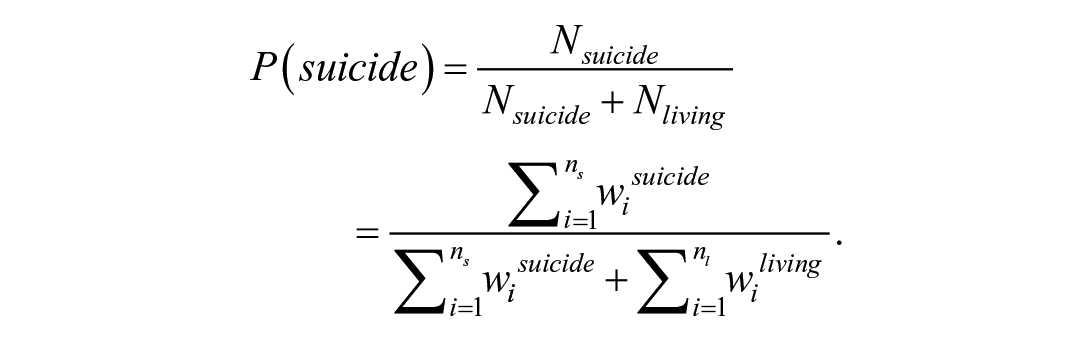
This strategy yields an overall suicide rate almost identical to the suicide rate reported by Multiple Cause of Death (MCD) mortality data from the National Vital Statistics System of the National Center for Health Statistics for the same states and time periods. Specifically, Table S2 in the online supplement reports that state-by-state suicide rates from MCD data between 2016 and 2017 are nearly identical to those from our MSD-US-2 sample for 37 states (less than one per 100,000). Table S3 in the online supplement reports that the gap in year-by-year suicide rates from 2005 to 2017 in 16 states between the two data sources is nearly identical (less than 0.5 per 100,000). Figure S1 in the online supplement shows that, from 2016 to 2017, the marginal distribution of county-level suicide rates across 37 states in the NVDRS and MCD data are also very similar (Panel A), and their differences are very small (Panel B). Finally, Panel C shows that over-time correlations between the suicide rates across 16 states are consistently higher than 0.9 from 2005 to 2017. In summary, our re-weighting strategy allows us to recover population-level suicide rates, given some evidence that some suicide cases in the MCD data were “corrected” in line with the NVDRS data.
We constructed contextual data by aggregating individual-level ACS data to CY or CZ levels using the same weighting schemes. Not surprisingly, comparing aggregated sociodemographic characteristics, including the unemployment rate before and after adding NVDRS data, yields no difference, as the addition of the small number of suicide cases should have a negligible effect on aggregate measures of CY- or CZ-level characteristics. To examine how monthly unemployment rates interact with CY- or CZ-level unemployment rates together to shape suicide among the unemployed, we merged our analytic sample data with data on monthly unemployment rates from the U.S. Bureau of Labor Statistics. In doing so, we randomly assigned a month from January to December to individuals within each CY or CZ each year in the ACS data while using the actual month of death information in the NVDRS data. Finally, we used data from the U.S. Department of Labor Office of Unemployment Insurance to measure the proportion of unemployed receiving benefits and the number of extended unemployment insurance benefits cases across Washington, DC, and 50 states. 9
Measures
We identify unemployment and not-in-labor-force statuses, respectively, if the person was listed as currently unemployed or not in the labor force in ACS data. In ACS, persons were considered employed if they worked at least one hour for pay or profit during the reference period, worked at least 15 hours as “unpaid family workers,” or had a job from which they were temporarily absent. Persons were considered unemployed if they did not currently have a job, were looking for a job, and had not yet found one; this included people who had never worked but were actively seeking their first job. Not-in-labor-force is a residual category (i.e., people who were not employed nor unemployed), including full-time homemakers, retirees, students who had no other occupation, and disabled people who were permanently unable to work.
In the NVDRS data, we identified unemployment and not-in-labor-force from the current and usual occupation text fields recorded on the death certificate following the ACS’s definition of labor force participation status. Searching only for specific keywords (e.g., “Unemp”) resulted in some cases inappropriately omitted (e.g., “Not Employed”) and some cases inappropriately included (e.g., “Part Time Tutor”). Thus, we first examined the entire occupation text fields, then reiterated our search until we resolved all discrepancies (in the online supplement, see Table S4 for example terms we discovered and Figure S2 for word clouds across different employment statuses). Less than 5 percent (4.69 percent) of NVDRS cases were dropped because their occupation information was neither available nor identifiable due to missing data.
As indicated earlier, we included the following demographic characteristics as ceteris paribus controls: sex (male, female), five-year interval age groups, race (White, Black, American Indian or Alaska Native [AIAN], Asian or Pacific Islander, Other), ethnicity (Hispanic, non-Hispanic), and national origin (born in the United States, not born in the United States). CY- and CZ-level characteristics (e.g., percent male) are measured using the same categorical scheme from the ACS data (the only exception is age group percentages, which were created with the following standard intervals: 15–24, 25–44, 45–64, 65+). In additional analyses, we included education degree (less than high school, high school graduate, some college, bachelor’s degree, master’s degree or higher), physical problems, and veteran status to assess the robustness of the unemployment–suicide associations. Physical health problems are identified if an individual case was reported to have physical health problems (e.g., terminal disease, debilitating condition, chronic pain) relevant to the cause of death and if, in the ACS, individuals reported any of the following conditions: cognitive difficulty, ambulatory difficulty, self-care difficulty, or vision or hearing problems. Veteran status is identified if the suicide case ever served in the U.S. Armed Forces and, in the ACS, if they served in the military forces of the United States (Army, Navy, Air Force, Marine Corps, or Coast Guard) in time of war or peace.
We measure sameness for employment status by the proportion of individuals with the same employment status in a CY or CZ each year (i.e., percent unemployed individuals for the unemployed, percent employed for the employed, percent not in labor force for not-in-labor-force participants). To account for the unequal distribution of the percentages of employed and unemployed individuals across time, we standardize the sameness measures by subtracting means and dividing them by their standard deviations each year. The standardization procedure enables us to compare the average marginal effects of sameness across different employment statuses, given that the meaning of a percentage-point increase in unemployment rates is different from that of a percentage-point increase in employment rates.
Analytic Strategy
Our analytic goal is first to identify the effect of unemployment on suicide, and second to investigate how local and national sameness effects shape suicide among unemployed individuals. While we acknowledge it is nearly impossible to identify the causal effect of both unemployment and sameness due to the nature of observational study designs, we address potential endogeneity issues on the effects of unemployment and sameness in the following ways.
First, we account for major potential confounders in regression models. Appendix Table A1 shows how sociodemographic characteristics differ across individuals with different employment status in the MSD-US-2 data from 2016–17. We compute the weighted mean and proportion for variables using geographic matching weights at CY or CZ levels, as described earlier. The table shows the unemployed are more likely to be younger, Black, born in the United States, less educated, have physical problems, and to be non-veterans than the employed. Individuals who are not in the labor force tend to be older, less educated, have physical problems, and to be veterans. In contrast to stark differences at individual levels, all CY- or CZ-level characteristics are very similar across individuals with different employment status, which suggests people who are unemployed and not in the labor force live in typical communities where employed individuals also reside. Because these individual-level differences are also known risk factors for suicide, we account for these variables in the following statistical models.
The MSD-US-2 data allow for the specification of cross-level interactions, assuming that no ACS individual appears as an NVDRS death by suicide. Given the low suicide rate, contamination is likely to be low. We use the constructed observation weights to estimate survey-weighted logistic regression models for a binary outcome (1 = suicide death, 0 = living individual):

where p is the probability an individual dies by suicide, Eic is employment status for individual i in county or commuting zone c, Sic is the sameness measure (i.e., the fractions of residents in county or commuting zone c with the same employment status as individual i),
Here, β3 captures the extent to which the sameness effect among the unemployed would differ from that among individuals who are employed and not in the labor force. When we estimate models only among the unemployed, β2 captures the sameness effect among the unemployed, as the model omits Eic and EicSic terms. Because a source of variations of the sameness effect arises from differences across counties or commuting zones, we calculate cluster-robust standard errors using Stata’s cluster option. 10 Additionally, because odds ratios are known to be problematic for comparison across models and not easily interpretable (Breen, Karlson, and Holm 2018), we present the average marginal effects of employment status at the individual level, and the average marginal effects of the employment sameness at the CY and CZ levels. For cross-level interactions, the predicted suicide rate of people who are employed, unemployed, and not in the labor force across different levels of sameness are plotted to improve interpretability.
Second, we conduct a robustness test with CY and CZ fixed-effect models that uses over-time variations within CYs or CZs in our longitudinal sample, which allows us to compare people who are unemployed in the same CY or CZ across different moments when the unemployment rates were low and high. Because this CY or CZ fixed-effect model alone cannot address time-varying factors across all CYs or CZs that affect the unemployment rate as well as the probability of unemployed individuals dying by suicide, we also control for year dummies in the regression models to rule out year-specific factors (e.g., the national economic condition). However, causal inference from these fixed-effect models is still limited. 11 We should thus carefully interpret these results and not assume they provide direct causal evidence.
All data and codes to replicate analyses (except for the NVDRS data) can be found at the following repository: https://dataverse.harvard.edu/dataverse/bk. Federal guidelines for acquiring and merging these data required special permissions, careful file construction, statistical corrections, specialized analyses, and federal agency cooperation. IRB approval for the present study is held at Indiana University.
Results
Suicide Levels and Trends by Employment Status: Descriptive Analyses
How is employment status associated with suicide? Overall, the suicide rate is highest among unemployed individuals (32.9 per 100,000), followed by the employed (19.1 per 100,000), and then individuals who are not in labor force participation (7.5 per 100,000). Here, the gap (13.8 per 100,000) in suicide between the unemployed and employed is striking. All pairwise differences in suicide rates across the employed, unemployed, and those who are not in the labor force are statistically significant based on Welch two-sample t-tests (p < 0.001). Figure S3 in the online supplement presents the bivariate association between employment status and suicide rates across 37 states from 2016 to 2017 at the CY- and CZ-levels by aggregate employment status, where the continuous aggregate-level employment condition measures were collapsed into 20 intervals. We find that the associations between aggregate-level employment status and suicide rates are more likely to be driven by people who are not in the labor force or are employed than by the proportion of unemployed individuals. 12 In summary, our data support the standard individual and aggregate analyses of suicide where employment protects and unemployment increases suicide, although we find a stronger association of individual-level unemployment than aggregate-level unemployment with suicide risks.
How does suicide risk among unemployed individuals trend before, during, and after economic crises? Panels A and B in Figure 1 present the trends in unemployment rates and official suicide rates from the government sources (i.e., BLS and CDC). Panel C presents the trends in suicide rates for individuals who are employed, unemployed, and not in the labor force from our MSD-US-2 longitudinal sample across 16 states from 2005 to 2017. In each panel, the gray region denotes the official economic recession period (December 2007 to June 2009) defined by the National Bureau of Economic Research. Panel A shows that unemployment rates peaked in 2010 following the 2008 Great Recession and have continuously decreased since that time. Panel B shows a very different pattern, routinely reported in other studies. However, unpacking suicide trends by individual employment status reveals more nuanced patterns in Panel C. Suicide rates are higher among the unemployed over the entire period compared to individuals who are employed or not in the labor force. The probability of dying by suicide is notably more volatile over time for unemployed individuals. This is not the case for the probability of suicide among the employed and those who are not in the labor force, where only a slight, increasing trend is in evidence. Importantly, suicide did spike among the unemployed in 2008, even before the unemployment rate reached its peak during the Great Recession, as reported earlier (Lundin and Hemmingsson 2009), and returned quickly to rates lower than before the crisis, hitting a low in 2013 (25.5 per 100,000).
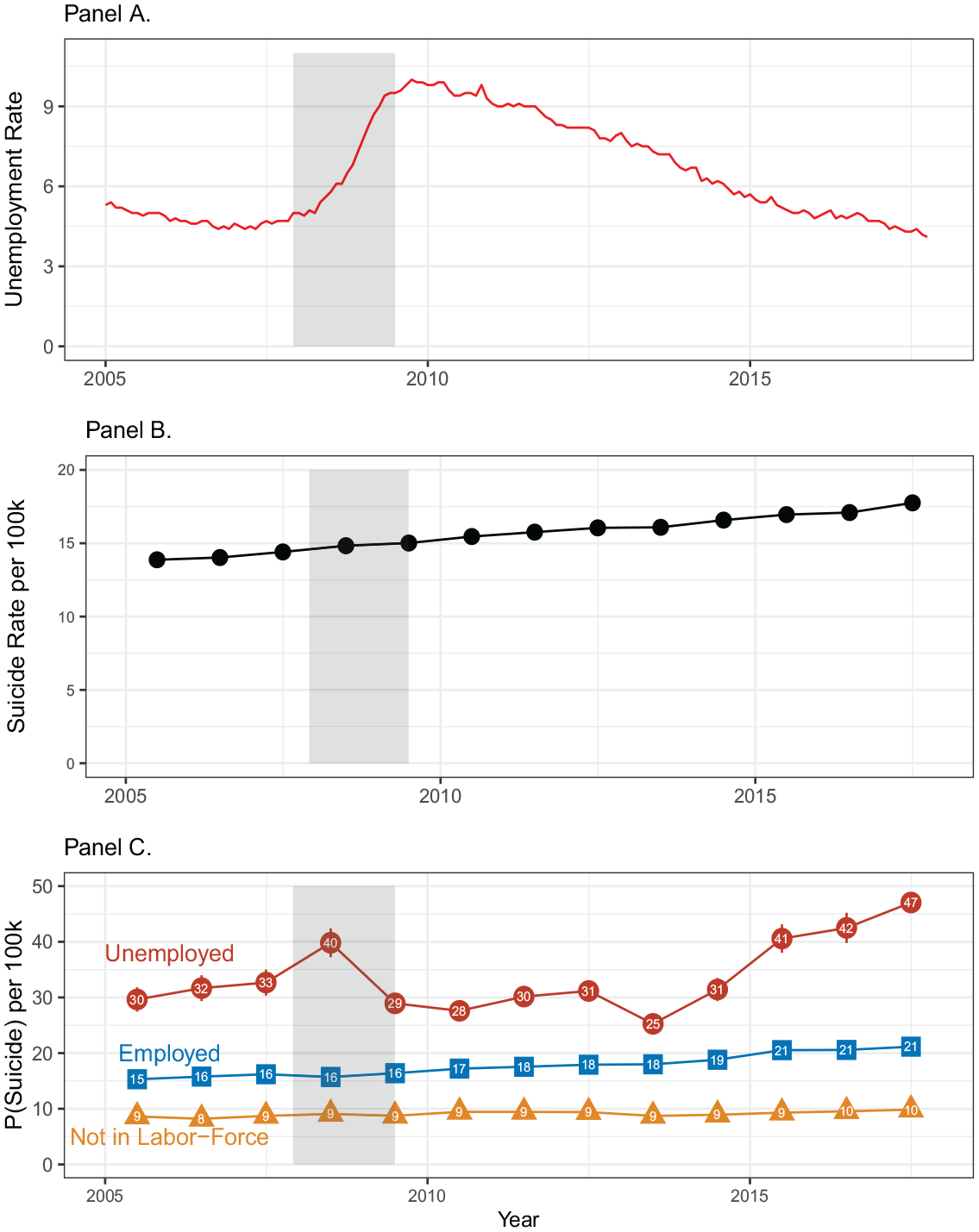
Trends of Unemployment, Overall Suicide Rate, and Suicide Rates by Employment Status across 16 States from 2005 to 2017, US-MDS-2 Data
Cross-Sectional Results on Sameness and Suicide
Does the probability of an unemployed individual dying by suicide depend on context, represented here by both the county (CY) and commuting-zone (CZ) unemployment level? Figure 2 displays results from logistic regression models to examine how aggregate conditions affect individual suicide within each employment status at CY and CZ levels. Logistic regression models (in the online supplement, see Tables S5 and S6, Models 1, 2, and 3 for model specification) account for basic individual- and aggregate-level demographic covariates (sex, age group, race, born in the United States), and population density.
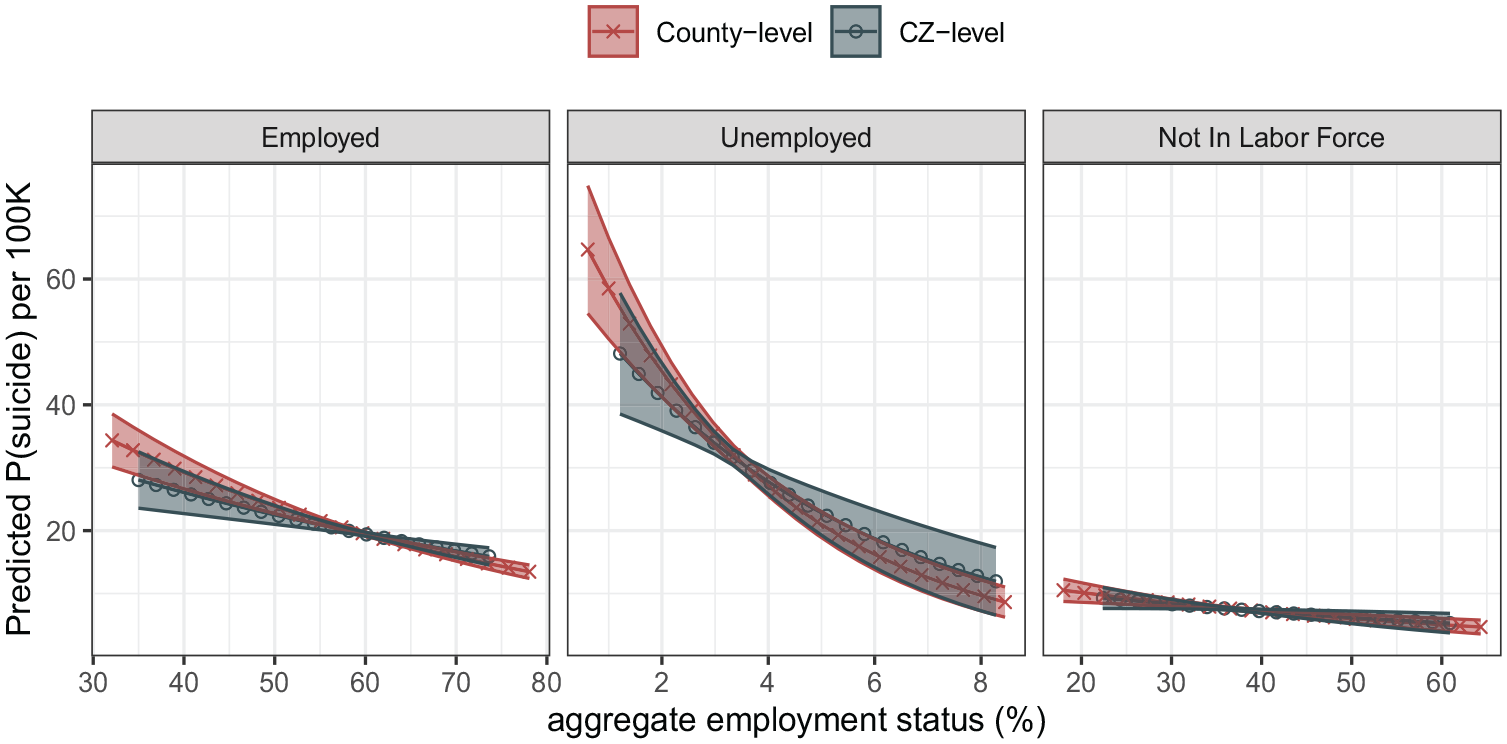
Interaction Effects of Individual-Level Employment Status with County-Level (CY, red x’s) and Commuting-Zone-Level (CZ, gray circles) Counterparts on Predicted Suicide Rate, across 37 States, 2016 to 2017, US-MDS-2 Data
Overall, the socioeconomic spatial context defined by either CY or CZ composition of employed, unemployed, and not-in-labor-force individuals appears to have a critical association with the probability of suicide mortality. In general, the suicide risks for people who are unemployed, employed, and not in the labor force all decrease when individuals live with others who share the same employment status. More formally, Table 1 demonstrates that the average marginal effects of sameness (i.e., the reduction in suicide rates among individuals residing in a CY or CZ with unemployment, employment, and not-in-labor-force rates that are one standard deviation higher) are all statistically significant. The reductions are −20.7, −3.89, and −0.762 per 100,000 people for individuals who are unemployed, employed, and not in the labor force, respectively.
Comparison of the Sameness Effects on Suicide (per 100K) among Employed, Unemployed, and Not-in-Labor-Force Population across 37 States, 2016 to 2017
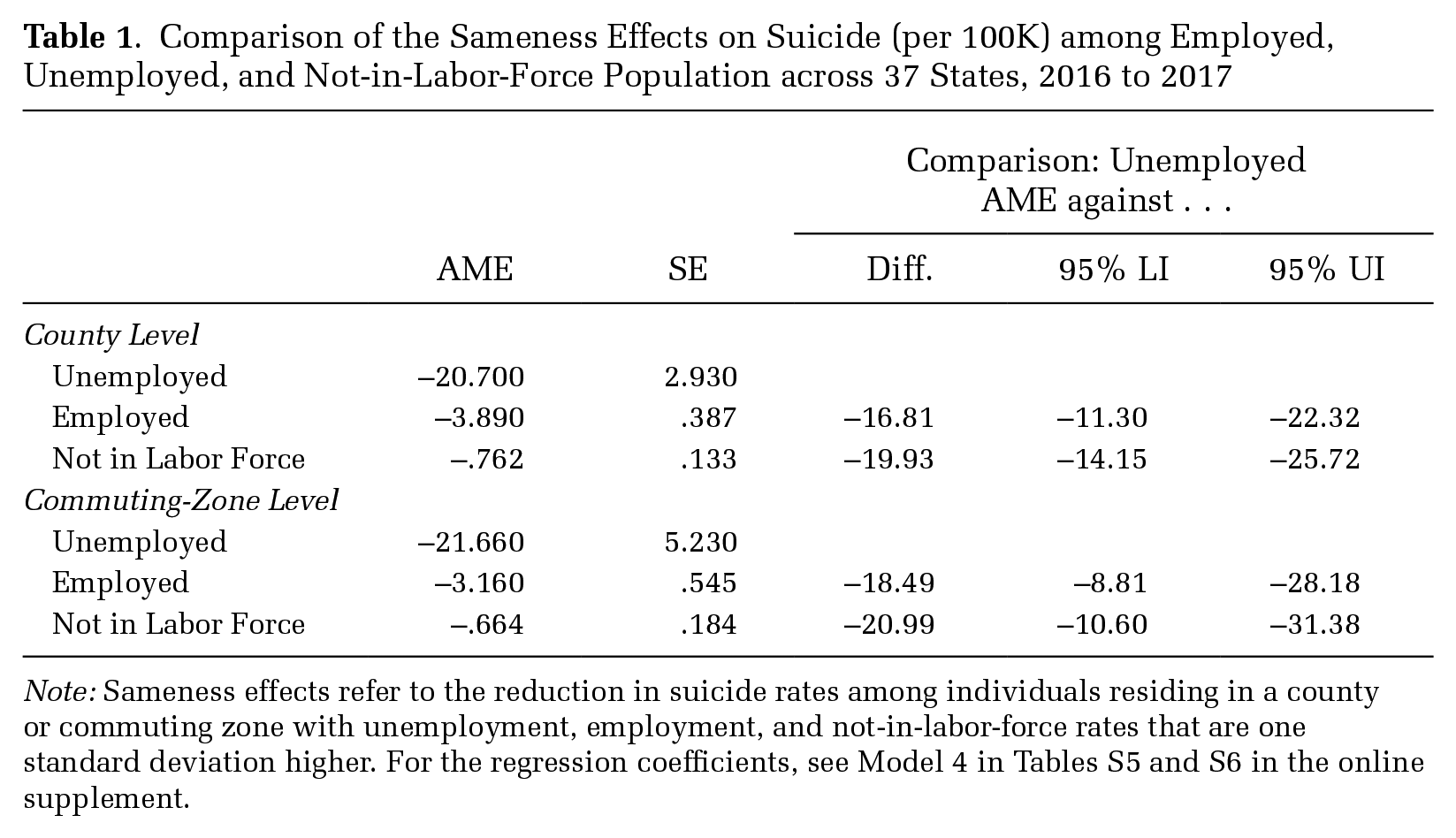
Note: Sameness effects refer to the reduction in suicide rates among individuals residing in a county or commuting zone with unemployment, employment, and not-in-labor-force rates that are one standard deviation higher. For the regression coefficients, see Model 4 in Tables S5 and S6 in the online supplement.
However, as predicted, given the social meaning and stigma attached to unemployment, the effect is much more dramatic among the unemployed than for either of the other two work statuses. That is, when an individual is unemployed in a residential area or economic job market where the unemployment rate is low (i.e., fewer neighbors face the same situation), the probability of suicide is high. As the unemployment rate increases across communities (i.e., more residents are also unemployed), the probability of suicide dramatically decreases, eventually matching the low probability of employed individuals. Although the sameness effect protecting against suicide for those who are employed shows the same pattern, its impact is much reduced. The sameness effect is also evident for individuals not in the labor force, but the magnitude of the effect is the smallest.
We compare the size of sameness effects for CY and CZ across different employment statuses through logistic regression models among all three groups while standardizing the sameness variable within each group. The pattern in Figure S4 in the online supplement (see also Tables S5 and S6, Model 4) shows that the effect of sameness is greatest for individuals who are unemployed compared to those who are employed or are not in the labor force. This continues to provide strong support for Hypotheses 1, 1a, and 1b. Table 1 shows that the sameness effect among the unemployed is significantly different from that among individuals who are employed (−16.8, 95 percent CI: −11.3 to −22.32) or not in the labor force (−19.93, 95 percent CI: −14.15 to −25.72) at the CY level, suggesting unemployed individuals benefit most from sameness. We obtain nearly identical results at the CZ level. These results demonstrate that shared collective experience matters, but it matters in ways consistent with network theories of homophily and awareness. 13
Longitudinal Results on Sameness and Suicide
Does the effect of sameness change under different economic conditions? We examine whether the sameness effects replicate over time from 2005 to 2017, and more specifically, how the 2008 Great Recession shaped the complex association between individual- and aggregate-level employment status. We first repeated the same analysis using the longitudinal sample of the MSD-US-2 (2005 to 2017, 16 states) and verified that the sameness effects protected unemployed individuals from dying by suicide consistently from 2005 to 2017 (Figure 3, Panels A and B). Four results stand out. First, the protective effects of sameness jumped in 2008 when (temporary) job loss and displacement were about to start, but the unemployment rate was still low (Panel A). This coincides with the moment when many unemployed individuals died by suicide. Second, toward the official end of the Great Recession (2010), the effects of sameness among unemployed individuals are not significant and are indistinguishable from those among the employed (Panel B). Third, the magnitude of the effect of sameness among unemployed individuals has increased since 2013; that is, when fewer and fewer individuals were unemployed, more and more unemployed people died by suicide (Panel A). Finally, across all time periods except 2010, the sameness effects among the unemployed are consistently greater than those among individuals who are employed or not in the labor force (Panel B).
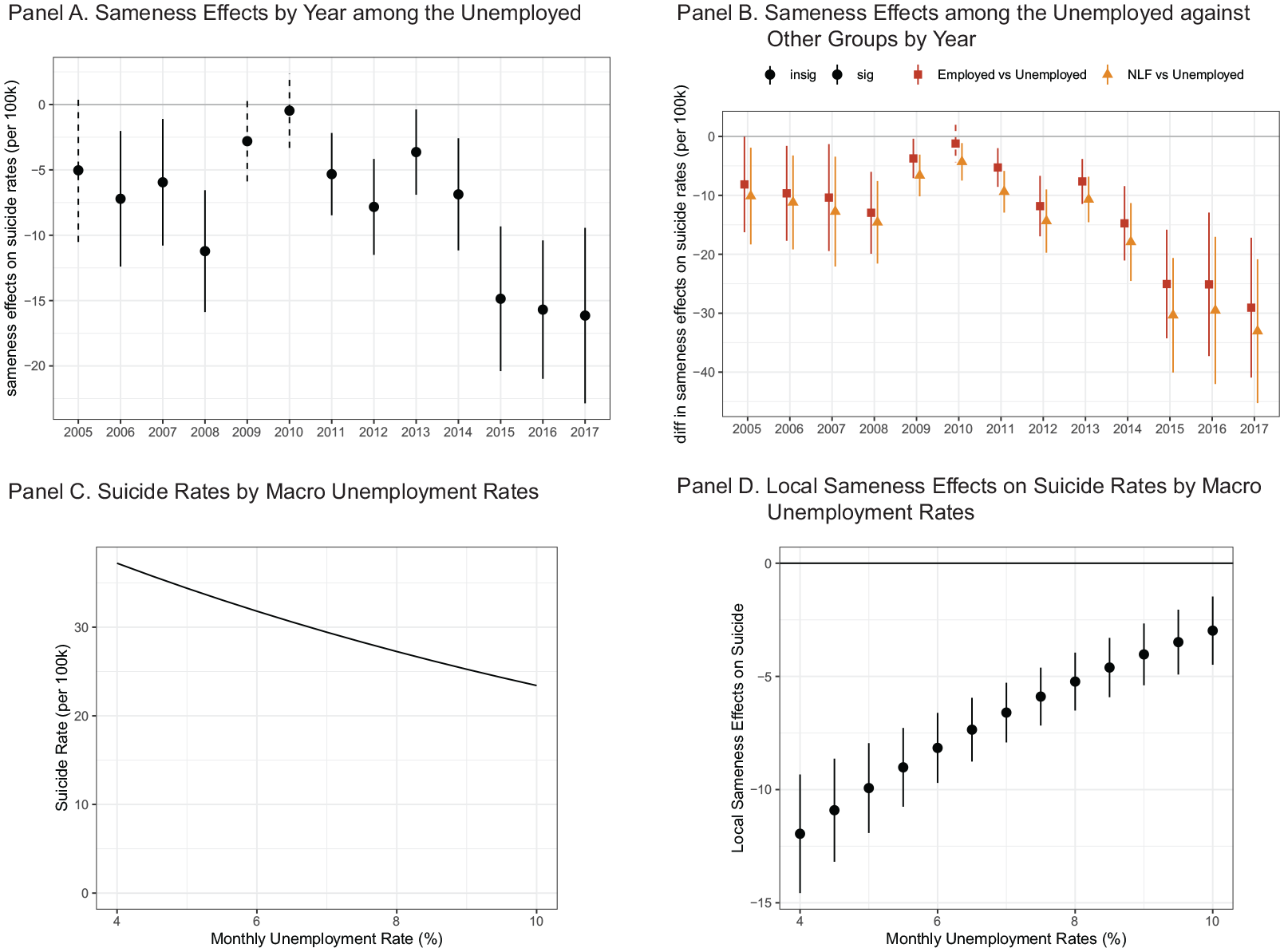
Effects of Macro-Level and Local-Level Employment Sameness on Suicide across 16 States, from 2005 to 2017
To test Hypotheses 2a and 2b more explicitly, we included CY- and CZ-level unemployment rates, national monthly unemployment rates, and their interaction terms in regression models (see Table S7 in the online supplement). Panel C in Figure 3 shows how suicide rates among the unemployed vary across national unemployment rates. Panel D shows the average marginal effects of local sameness across different levels of national sameness measures among the unemployed, which enables us to examine more precisely how the local sameness effects depend on the level of national sameness. Overall, the main effects of local and national sameness on suicide are protective among unemployed individuals, supporting Hypothesis 2a. Namely, a 6 percentage-point increase in national monthly unemployment rates is associated with a 14 out of 100,000 reduction in suicide among the unemployed. Furthermore, local sameness effects are consistently protective across a range of monthly unemployment rates, but they are smaller when national sameness is stronger, supporting Hypothesis 2b. This result suggests that when unemployed individuals are everywhere during a period of high unemployment rates, it matters less how many people are unemployed locally. Individuals are likely aware, by this point, that unemployment can be seen as a system failure.
Sensitivity Analysis
These findings support the idea that situational awareness shapes the association between unemployment and suicide at local and national levels, highlighting a novel mechanism for the sameness effects. This is possible due to the methodological breakthrough made by merging NVDRS and ACS data, which allowed fine-grained examinations of temporal and spatial dynamics among unemployed individuals, eliminating the small N problem. However, it is difficult to prove that the novel associations we report here are putatively causal due to the endogeneity of unemployment and neighborhood selection. In the absence of controlled experiments or randomized instruments, 14 we do our best to assess the robustness of our findings. Namely, we adjust for potential observed confounders and use fixed-effects models to examine how the effects we identified are robust against important observed individual- and community-level confounders and unobserved but constant community-level confounders using both cross-sectional and longitudinal data.
We first use cross-sectional data to examine the robustness of the individual-level unemployment and cross-level sameness effects for employed, unemployed, and not-in-labor-force individuals while accounting for a critical confounder, physical health status (Arrow 1996). The effects of socioeconomic disadvantage on health are well documented (Catalano et al. 2011; Link and Phelan 1995; Phelan et al. 2010; Strully 2009), but ample evidence suggests health status strongly shapes opportunities for socioeconomic attainment and mobility (Conley and Bennett 2000; Lee and Jackson 2017). The health selection hypothesis suggests that poor health affects both unemployment and death, leading to a spurious correlation between unemployment and suicide (Blakely et al. 2003). Other potential confounders include education and veteran status (Horwitz et al. 2019; Kleykamp 2013; Phillips and Hempstead 2017; Steelesmith et al. 2019), which are associated with both unemployment and suicide. Findings from multivariate regression models, adjusting for potential confounders, are summarized in Appendix Tables A2 and A3.
The first set of analyses (Table A2), comparing the baseline effects of unemployment and employment sameness on suicide after accounting for individual demographic and CZ-level population density from the cross-sectional data to those from models adjusting for years of education, physical health status, and veteran status, reveals a negligible effect on the relationship between unemployment/sameness and suicide (Model 2). Further analyses that address potential CZ-level confounders (CZ-level percent education group, percent physical problem, percent veteran status) yield similar results (Model 3). Other models that add all interaction terms between employment status and all CZ-level variables to address potential employment-status-driven neighborhood selection again show our initial results are robust (Model 4). Finally, using linear probability models, the sameness effect gets larger (Model 5), and a jackknife estimation (i.e., a non-parametric way to produce robust estimates that excludes all individuals living in a CZ at a time from the sample) also did not change the results (Model 6).
Next, we compared the baseline effects (Table A3, Model 1) of unemployment sameness on suicide among unemployed individuals (after accounting for individual demographic and CZ-level population density with state fixed effects from the longitudinal data) to all potential post-treatment controls and potential CZ-level confounders (Models 2 and 3). The protective effect of sameness on suicide does not change. Similarly, the results are robust when CZ fixed-effects models or two-way fixed effects (CZ and year) are deployed (Models 4 and 5). The results are similar when we use linear probability models that adjust for all covariates and CZ fixed effects or two-way fixed effects (Models 6 and 7).
Still, one may think of a critical confounder, especially with regard to the finding that the sameness effects for the unemployed were weaker from 2009 to 2011. Rising and persistent unemployment in a community may prompt states to enhance financial support to reduce the economic strain of extended, long-term unemployment (Card and Levine 2000; Farber and Valletta 2015); for example, via the extended unemployment insurance (UI) benefit program. The extended benefits program provides up to 13 additional weeks of benefits when a state is experiencing high unemployment, and a voluntary benefits program pays up to seven additional weeks during periods of extremely high unemployment. To address this concern, we first examine whether the sameness effects change after accounting for the effects of the state-level extended UI benefit programs. First, Model 8 shows the sameness effects are robust against controlling for the quarterly number of unemployed individuals who use extended UI benefits and the proportion of unemployed receiving such benefits in each state. Second, we find that the sameness effects are robust against all unobserved time-varying state-level confounders by adding all state–year interaction fixed effects in addition to two-way state and year fixed effects (see Model 9). Despite these stringent tests, the robustness of the sameness effects suggests our findings are not driven by state-level policy variations or economic conditions but reflect a more fundamental social mechanism at play.
So far, our analysis assumes a linear sameness effect of unemployment status on suicide risk. However, it is plausible that the sameness effect may only operate up to a certain threshold of homogeneity, beyond which it diminishes. To examine this possibility, we created 20 equal intervals of the county-level unemployment rate and estimated the baseline logistic regression models (for the specification, see Model 1 in Table S5 in the online supplement) using the cross-sectional data from 2015 to 2016. Panel A in Figure S5 in the online supplement shows little evidence for a nonlinear effect of sameness. To corroborate this finding from our visual inspection more formally, we regress the minimum unemployment rates across 20 intervals on predicted suicide rates, finding that the linear model explains 77 percent of the variations. In addition, we conducted the Ramsey Regression Equation Specification Error Test (RESET) to test whether nonlinear combinations of the unemployment rate variable help explain the predicted suicide rate, which cannot reject the null hypothesis of linear specification (RESET = 2.58, p-value = 0.11). Repeating the same analysis over time, we find that the linear patterns hold for most years (see Panel B in Figure S5).
Finally, recent methodological literature on difference-in-difference models suggests that effects of continuous treatment (e.g., the unemployment rate for unemployed individuals) are weighted averages of binary treatment effects across different levels of treatment indicators, different treatment years, and different levels of selection bias at those treatment margins (Callaway, Goodman-Bacon, and Sant’Anna 2024; de Chaisemartin et al. 2022). Because there is no ready solution for these potential biases, we tested the effect of a binary treatment indicator (= 1 if the local unemployment rate is higher than the national average each year, otherwise 0). Using this binary indicator in two-way FEs, we find that the sameness effects are robust in the cross-sectional (Model 7 in Table S1) and the longitudinal (Model 10 in Table S2) samples. Overall, the effect of sameness among the unemployed is robust against all these different model specifications.
Discussion
Suicide rates, overall, have been slowly increasing in the United States since the turn of the century. Seeing a similar, but perhaps more dramatic, upturn at the turn of the twentieth century, Durkheim (1951), like others at present, argued that suicides rise with economic crises that threaten individuals’ livelihoods. He saw economic well-being being connected to experiences of social and moral connectedness. Research since that time has demonstrated that unemployment predisposes individuals to suicide because it erodes income, threatens economic welfare, weakens self-esteem, raises stigma, cuts individuals off from many of their friendship ties, and eventually attacks a central source of meaning in their lives (Stack 2000a; Young and Lim 2014). In addition, larger economic crises increase suicide because access to work, even in a precarious labor market, denies the fiscal, social, and personal advantages of work detailed by classical and contemporary social thinkers. However, “closing the book” on the suicide–unemployment link from this body of evidence both ignores contradictory findings, which are not minor, and dismisses a potential multilevel complexity of the influence of individual status in light of community context.
First, a large body of research and the overriding claim of the singular importance of the unemployment–suicide link have revealed contradictory empirical claims, particularly around the effects of the recent Great Recession. Riddled with criticisms surrounding issues of data availability and aggregation, timeframes considered, appropriate controls, and geographic coverage, the robustness of the relationship between unemployment and suicide has routinely been called into question (Agerbo et al. 2007; Blakely et al. 2003; Platt 1984). Second, a factor complicating conclusions about the effect of unemployment on suicide risk has been the long-standing issue of whether and how individuals’ unemployment status versus the unemployment level in the labor market matters. For example, early on, Platt (1984) raised concerns that research using small units of aggregation was more likely to find the suicide–unemployment link than work using larger aggregations (see also Stack 2000a).
At times, these arguments cut across disciplinary lines. Durkheim posited the role of structure over agency and used suicide rate data, and sociologists, privileging generalizability, followed suit. However, sociologists were also the ones to seize on the dangers of imputing individual agency to aggregate data (Hammond 1973; Robinson 1950) and to note that rates are socially constructed (Douglas 1967; Pescosolido and Mendelsohn 1986). For others, more aligned with the sciences that work primarily at the level of the individual, exploring key issues of mental illness, individual circumstances, and psychological predispositions were central, often with less attention to issues of generalizability and context. As these arguments were replaced by a common acceptance of multilevel effects, complex systems, and data merging across many areas of science, suicide researchers were left without a pathway, especially in the United States, to do the same unless their foci moved away from suicide deaths to suicidal ideation or suicide attempts, where important sociological progress was being made (e.g., Thorlindsson and Bjarnason 1998). Yet, pushing our understanding even further, especially in countries without extensive health and population registries, requires data that simultaneously include temporal and multilevel information as well as a rich set of variables that are considered critical controls.
With the advent of data science, harmonizing several datasets into a unique whole allowed us to ask several questions and formulate them into propositions and hypotheses that could be empirically examined. Specifically, using the large-scale, nationwide MSD-US-2 data, we replicated the existing findings (Pescosolido et al. 2020). Across the entire period from 2005 to 2017, individuals who are unemployed have a higher probability of dying from suicide than do those who are employed. Furthermore, with a larger base of suicide cases, the association between unemployment and suicide is robust against the common health and neighborhood selection hypothesis. Critically, we found that the CY- and CZ-level labor market context has important, although complex, effects on individuals’ suicide risk, providing supportive evidence for our first proposition about the role of sameness: namely, individuals’ probability of suicide will be lower when more people who have the same employment status live in their community of residence. While the observational design of our study limits our ability to definitively assert causality for the “sameness” effects, the consistency of these effects even after accounting for several important observed confounders and community-level unobserved yet constant factors strengthens our confidence in the reliability of our findings.
These results suggest we need a more nuanced conceptualization, drawing from the social network perspective, to offer an understanding of how and why context matters for suicide. In our analysis, we conceptualize past the idea that both individual- and contextual-level factors of the same concept, here unemployment, matter. In fact, thinking in this way inevitably runs into issues of shared variance, where one variable is left to explain the residual variance of the other, a finding long known to have problematic, independent interpretations (Allison 1977). Rather, we include both individual and contextual levels of unemployment but focus the interactive factor on the presence of similar others (i.e., sameness) under the theoretical guidance of the homophily hypothesis. That is, we expect the individual risk of suicide from unemployment depends on the number of social others who share the same time schedules due to work and nonwork. This suggests that Young and Lim’s (2014) notion of “schedules” is a fundamental feature shaping social networks, connectedness, and worker well-being. Schedules affect time, which is a “network good” that varies with employment status. When individuals are regularly employed, they have regular and routine interaction with a set of individuals; but when they are unemployed, they lose that social anchor.
Our over-time analysis reveals two important findings that may help us resolve contradictory empirical claims, particularly around the effects of the recent Great Recession. First, unemployment effects change as economic conditions change, especially in response to labor market shocks like the Great Recession, although the pattern is more complicated than generally thought. Overall, the suicide rate continued its gradual rise over the recent period. However, embedded with that overall pattern was a nonlinear response pattern in suicide among individuals who were unemployed: the suicide rate among the unemployed abruptly increased at the beginning of the Great Recession in 2008, when the unemployment rate had not yet increased, and it increased again starting from 2013 while the unemployment rate continued to decrease. The finding on the sudden rise in suicide only among the unemployed just before the recession began, to our knowledge, has not been reported elsewhere. Without access to individual-level unemployment, previous studies could not fully account for this temporal effect on the suicide of economic shock (Harper and Bruckner 2017; Iglesias-García et al. 2017; Norström and Grönqvist 2015). Constructing multilevel data allows us to demonstrate that the Great Recession may have increased suicide only for unemployed individuals, but at different moments during the recession for different reasons.
Second, we found that the protective “sameness” effects on unemployed individuals were higher in 2008, not significant from 2009 to 2010, started to rise again in 2011, and were bigger in later periods. Formally, we showed that unemployed individuals’ suicide was strongly shaped by national economic conditions measured by nationwide monthly unemployment rates, confirming our second proposition. Here, the local sameness effect was less pronounced among unemployed individuals during periods of economic downturn when unemployment rates were high, but this effect was stronger as the economy recovered, and employment rates increased. These results suggest the financial strain hypothesis cannot solely explain why the Great Recession may have increased suicide among the unemployed at a particular moment. Unemployment always increases the risk of having financial hardship regardless of when and where a person loses their job. However, the meaning of unemployment will dramatically change depending on how many other people are unemployed, which shapes individuals’ perception of the meaning of unemployment as a personal failure or system failure. The fact that the sameness effects are driven by a situational awareness mechanism suggests that many unemployed individuals died at the beginning of the Great Recession when few were unemployed because stigma kicked in, and they might have considered their job loss as their personal failures.
In our study, we posit that “sameness effects” can mitigate suicide through two primary mechanisms: enhanced situational awareness and increased social support and interactions. We found that the sameness effect is more pronounced among unemployed individuals compared to those employed or not in the labor force, which indicates that situational awareness may be a key factor driving these sameness effects. However, this finding does not necessarily rule out the mechanism of social integration, especially given that we also found significant and consistent sameness effects among individuals employed and not in the labor force. As culture (i.e., the meaning of unemployment) and networks (i.e., the patterns of social interactions surrounding the unemployed) always interact, it is challenging to distinguish which is the main driver for the sameness effect.
Moreover, alternative mechanisms might be driving the sameness effect. For example, one could conjecture that UI benefits might be greater and more generous when more people are unemployed. Although our sensitivity analysis demonstrates that the sameness effects remain consistent regardless of the extent to which unemployed individuals can use extended UI benefits at the state level, it is important to consider the usage of these benefits at the CY or CZ level, as localized economic conditions may have a greater effect. Nevertheless, the issue is complicated because it is challenging to disentangle the mechanism of stigma reduction from that of reducing economic strain. On the one hand, as more unemployed individuals utilize these social welfare benefits, the stigma associated with unemployment and the use of such benefits could diminish. On the other hand, extended UI benefits may increase unemployment stigma if they are perceived as fostering dependency, or if they lead to the blaming and othering of unemployed individuals. Future work is needed to examine how different mechanisms can explain the sameness effects among the unemployed.
In summary, the sameness effects enable us to understand some of the puzzles that have plagued suicide research. Our findings signal the role of culture as intertwined with structure, returning us to classic and more recent sociological elaborations of suicide tied to social systems undergoing fundamental change. Individuals who are unemployed in places and periods where the labor market is characterized by normative unemployment are less likely to internally ascribe failure to job loss. In times and places where employment is relatively more available, unemployed individuals require more protections from the associated self and public stigma attached to their involuntary job loss. We find consistent support for this mechanism.
Our findings suggest a resolution to the vexing question raised earlier: Why did suicide rates increase when unemployment rates continued to decrease globally in the United States after the recovery from the Great Recession? Our findings suggest that when unemployment is not a norm, risks from stigmatization, social comparison, and social isolation increase, especially in a community where fewer people are unemployed. In other words, when unemployment becomes more of a national rather than a personal failure, local contexts are less important. The national context shapes the meaning of unemployment in these times, with the role of the collective experience mattering. Ultimately, it is the intersection of the contextual network mechanisms of sameness and individual employment status across temporal contexts that may explain the discrepancy between the increasing suicide rates and decreasing unemployment rates.
Our methodological breakthrough, combining NVDRS and ACS data, enabled us to identify a unique dynamic mechanism of situational awareness that shapes suicide culturally and relationally within the U.S. context. We believe this process is not exclusive to the United States and could be examined in other countries that maintain comprehensive registry data that link individuals’ various life domains with their death records (Agerbo et al. 2007; Björkenstam et al. 2016; Liu 2017; van Poppel and Day 1996; van Tubergen et al. 2005). Such extensive data would allow researchers to account for key confounders, including mental health diagnoses and treatments, job history, and the duration of unemployment. Such data would also allow examination of how the sameness effect varies and interacts across multiple organizational contexts, such as schools, workplaces, and neighborhoods. Because countries with complete registries, such as Sweden, Netherlands, and Denmark, tend to have better safety nets and likely lower levels of unemployment stigma, we might expect smaller sameness effects than those reported in the United States. Insights from cross-country comparisons will shed light on how culture and social norms shape the diffusion and impact of the sameness effects, thereby enriching our understanding of situational awareness and stigma reduction on a global scale.
There is an emerging concern that labor-saving technologies will translate into “the end of work” (Rifkin 1996), including recent technological advances in generative AI and large language models (LLMs). Eloundou and colleagues (2023) show that about one fifth of the U.S. workforce may see at least half of their tasks affected by LLM capabilities. Job replacement due to LLM-powered software is likely to occur unevenly, with a select few individuals gaining significant productivity boosts from these technologies. Workers less aware or engaged with these advancements are at a higher risk of job loss. Job loss due to automation is particularly concerning as individuals who are unemployed due to automation may feel they fell behind these technological advances, perceiving it as a personal failure. In line with this expectation, O’Brien, Bair, and Venkataramani (2022) show that exposure to automation measured by the increase in industrial robots led to a substantial increase in suicide mortality. Automation has the potential to enhance overall productivity in society, but it simultaneously poses substantial concerns regarding societal well-being.
Several limitations are worth noting. First, the effects of unemployment and sameness we reported cannot be considered causal estimates. We show that the unemployment effects are robust against potential health selection mechanisms, but this conclusion is based on the use of a single, available measure of having physical health problems, rather than a more targeted mental health measure. Although it is well established in the literature that poor mental health shapes unemployment as well as suicide risks (Milner et al. 2014; Wray et al. 2011), controlling for mental health in cross-sectional studies like ours is challenging because it may induce a collider bias given that unemployment can also increase mental health problems (Elwert and Winship 2014). We have a similar concern for the sameness effect. Although our FE models show the sameness effects are robust against unknown constant confounders at the community levels, it is possible that time-varying confounders (e.g., factory closure) may affect both unemployment rates and suicide rates. Second, despite the extensive and nationwide coverage of suicide cases from the MSD-US-2 data, our inference is limited to 16 NVDRS participating states for the longitudinal analysis and 37 states for the cross-sectional analyses. Future work may expand the coverage of suicide cases, given that as of 2023, all 50 U.S. states participate in the NVDRS system.
Third, our study design only considers an individual’s unemployment status at each point in time, despite research that debates the importance of unemployment duration and effect timing (i.e., treatment heterogeneity) (Milner, Page, and LaMontagne 2013; Vandoros, Avendano, and Kawachi 2019). For example, Yagan (2019) shows the long-lasting effects of local unemployment shocks during the Great Recession on individuals’ future employment, likely via labor force exit. Although it is not possible for us to examine the long-lasting effects of the “sameness shock” on suicide, the temporal patterns of sameness effects suggest they might depend more on the current economic condition rather than the historical one. Fourth, although county- and state-level data have been consistently and repeatedly used to define community context in U.S. suicide research, other geographic units may be useful if low base rate problems can be overcome (e.g., census tracts, neighborhood boundaries).
Last but not least, we need more qualitative research to specify and detail the precise mechanisms for the sameness effects, specifically situational awareness mechanisms. While our findings suggest that situational awareness can play a significant role in mitigating unemployment stigma, only qualitative investigation of how unemployed individuals actually interpret the meaning of unemployment differently across different employment contexts can validate this contention. As we discussed, changing the perception of unemployment from a personal failure to a system failure is one potential pathway through which sameness reduces stigma. However, stigma reduction may occur through different pathways. For example, drawing from in-depth interviews of 100 working-class young men and women, Silva (2013) demonstrates that working-class individuals often continue to blame themselves for their economic hardships despite broader systemic failures. Given these considerations, we look forward to future research using in-depth interviews and ethnographic methods to illuminate how unemployed individuals navigate and interpret their experiences across various economic contexts.
Policy and Program Implications
Unemployment presents a great risk for suicide. Yet, the power of unemployment to lead individuals to take their lives depends on whether individuals share the same economic fate as others in the labor market, not simply whether their geographic area is economically distressed. Being unemployed in an area where others are not is more devastating to individuals than being unemployed where others have also lost their jobs. An individual who is unemployed but living where others are economically active may have a greater sense of personal blame and failure. Yet, if the trauma is collective, that is, individuals and their neighbors are facing job loss together, the risk of suicide is dampened, sometimes to the point where the risk evaporates. Collective trauma may produce a sense that the fault lies not in the individual but in the larger society.
Prevention strategies would profit from considering this kind of cross-systems approach, where the personal and social environment are considered together in stable as well as difficult times (Arcaya, Raker, and Waters 2020; Pritchard et al. 2017). Understanding the role of “sameness” offers a novel perspective for social precision in messaging and in the deployment of resources. While it is crucial to establish social welfare benefits to support unemployed individuals, it is equally important to consider the manner in which these benefits are provided and perceived by others in the community. This support must be designed to mitigate stigma and align with local cultural values to effectively aid those in need. Yet, our results suggest that if we want to move toward personalized or precision medical care, local conditions must also be considered in light of the national context. Drawing on a pioneering perspective from stigma research, considering “what matters most” (Yang et al. 2014) to individuals in crisis may revolve around whether individuals’ social ties have been severed by job loss, cutting them off from their shared, supportive, and meaningful interactions. Cultural conditions, understandings, and meanings of how individuals interpret critical life experiences and events should become part of tailoring the prevention and treatment of suicidal behaviors.
Supplemental Material
sj-pdf-1-asr-10.1177_00031224241288179 – Supplemental material for Misery Needs Company: Contextualizing the Geographic and Temporal Link between Unemployment and Suicide
Supplemental material, sj-pdf-1-asr-10.1177_00031224241288179 for Misery Needs Company: Contextualizing the Geographic and Temporal Link between Unemployment and Suicide by Byungkyu Lee and Bernice A. Pescosolido in American Sociological Review
Footnotes
Appendix
Robustness of Effects of CZ-Level Sameness on the Probability of Suicide among Unemployed Individuals across 16 States from 2005 to 2017, US-MSD-2 Data at CZ Levels

| Model 1 | Model 2 | Model 3 | Model 4 | Model 5 | |
|---|---|---|---|---|---|
| Sameness (i.e., % unemployed) | −.0000594** (.00000982) |
−.0000579** (.00000962) |
−.0000579** (.00000962) |
−.0000717** (.00000911) |
−.0000737** (.00000803) |
| Observations | 631,184 | 615,160 | 615,160 | 591,346 | 591,346 |
| Model | logit | Logit | logit | logit | logit |
| Standard errors | cluster | cluster | cluster | cluster | cluster |
| State-FE | V | V | V | ||
| CZ-FE | V | V | |||
| Year-FE | V | V | V | V | |
| Controls | |||||
| State–Year FE | |||||
| (A) Ind. demographic control | V | V | V | V | V |
| (B) Post-treatment control a | V | V | V | V | |
| (C) CZ-level demographic | V | V | V | V | V |
| (D) CZ population density | V | V | V | V | V |
| (E) CZ-level post control b | V | V | V | ||
| (F) State UI benefit control c | |||||
| Model 6 | Model 7 | Model 8 | Model 9 | Model 10 | |
| Sameness (i.e., % unemployed) | −.0000794** |
−.0000579** |
−.0000597** |
−.0000583** |
|
| Employment sameness (binary) | −.000142** |
||||
| Observations | 615,160 | 615,160 | 631,163 | 631,184 | 631,184 |
| Model | OLS | logit | OLS | OLS | logit |
| Standard errors | cluster | jackknife | cluster | cluster | Cluster |
| State-FE | V | ||||
| CZ-FE | V | V | V | V | |
| Year-FE | V | V | V | V | |
| State–year FE | V | ||||
| Controls | V | ||||
| (A) Ind. demographic control | V | V | V | V | |
| (B) Post-treatment control a | V | V | V | ||
| (C) CZ-level demographic | V | V | V | V | V |
| (D) CZ population density | V | V | V | V | |
| (E) CZ-level post control b | V | V | |||
| (F) State UI benefit control c | V |
Note: Effect sizes are presented as average marginal effects of individual-level unemployment and sameness effects with 95 percent confidence intervals.
Post-treatment controls include education status, physical problem, and veteran status.
CZ-level post controls include percent education status, percent physical problem, and percent veteran status.
State UI benefit control includes the quarterly number of unemployed individuals who use extended UI benefits and the proportion of unemployed receiving such benefits.
p < 0.05; **p < 0.01; ***p < 0.001 (two-tailed tests).
Acknowledgements
An earlier version of this paper was presented at the 2022 Annual Meeting of the Population Association of America, the 2023 National Violent Death Reporting System Conference, the Center for Demography and Ecology at the University of Wisconsin-Madison, the Biosociology Lab at Princeton University, the Department of Sociology at New York University, the 2024 International Network for Social Network Analysis Conference, and the 2024 American Sociological Association Annual Meeting. We thank Alex Capshew for her endless support of this project and Brian Aronson for his early contributions. We thank Peter Bearman, Andrew Halpern-Manners, Anna Mueller, Chaeyoon Lim, Dohoon Lee, and Shawn Bauldry for their helpful feedback. We also thank Dawn McDaniel, Emiko Petrosky, and the NVDRS team at the Centers for Disease Control and Prevention for their assistance in obtaining the data. Finally, we thank Bethany Deeds, National Institute of Drug Abuse, for believing in the potential of this project to improve the health of Americans.
Funding
We acknowledge funding from the National Institute of Mental Health (Grant Number: 5R01MH099436), the NARSAD Fellowship (now the Brain and Behavior Foundation), the Indiana University College of Arts and Sciences to the Indiana Consortium of Mental Health Services Research, and the American Foundation for Suicide Prevention.
Data Note
All data and codes to replicate analyses (except for the NVDRS data) can be found at the following repository: https://dataverse.harvard.edu/dataverse/bk. The NVDRS data are restricted and require an application to the CDC and an approved project-specific Data Use Agreement ( ).
).
Notes
References
Supplementary Material
Please find the following supplemental material available below.
For Open Access articles published under a Creative Commons License, all supplemental material carries the same license as the article it is associated with.
For non-Open Access articles published, all supplemental material carries a non-exclusive license, and permission requests for re-use of supplemental material or any part of supplemental material shall be sent directly to the copyright owner as specified in the copyright notice associated with the article.
