







Abstract
How do wealthy families preserve their fortunes across generations? A historic peak in wealth inequality in the United States has inspired research on how economic elites benefit from markets, tax rates, and legal entities. However, the ongoing practices through which families maintain their fortunes across generations are less understood. Using six months of ethnographic observations at a wealth manager for the top 0.1 percent, as well as interviews with the manager’s clients and a wider sample of managers, I argue that wealthy families adopt what I call “bureaucratic practices”—activities like meetings, presentations, and signing documents—to preserve wealth intergenerationally. After erecting legal entities such as corporations, trusts, and foundations, wealth managers help wealthy families implement bureaucratic practices. These practices, which privilege bureaucratic form over substance, constitute a crucial behavioral layer atop the legal infrastructure, facilitating a greater degree of wealth preservation compared with using entities alone. Thus, preserving wealth at the top should be understood not merely as a set of discrete transfers from parents to children, but as an enduring multigenerational process of professional socialization that introduces new behaviors into family life.
Keywords
Sociologists have long sought to understand how elite members of society maintain their privileges (Domhoff 1967; Mills 1956; Weber [1922] 2019). In the wake of a recent historic peak in wealth inequality in the United States, scholars have identified persistent, high wealth correlations across generations (Killewald and Bryan 2018; Pfeffer and Killewald 2018), indicating that economic privilege today often persists from parents to children. Trends of increasing wealth inequality, which facilitate elite accumulation, have been attributed to low taxation, deregulation, and financialization (Alvaredo 2019; Lin and Tomaskovic-Devey 2013; Piketty 2014) brought about by political maneuvering (Block 2009; Krippner 2012). Researchers studying elites directly, meanwhile, have illuminated many processes by which the wealthy accumulate and distribute their resources using legal entities like philanthropic foundations and family trusts (Farrell 2020; Harrington 2016; Marcus and Hall 1992).
But legal tools are only one part of a larger story of active elite accumulation. Scholars who study elite accumulation by and large neglect the ongoing practices that elite families engage in to maintain the efficacy of legal tools, once erected. Families, conceptualized as individuals related by birth, marriage, or adoption, face threats to their intergenerational wealth from inflation, taxation, litigation, financial missteps, and conflict among family members. Yet, some wealthy families successfully sustain their wealth for long periods. For instance, the three living Walton heirs to the Walmart fortune, now in their 70s, have replaced their father in the Forbes top-50 list, marking striking continuity since his appearance on the first ever list in 1982 (Kilachand 2012), and they are not the only ones (see Fernholz and Hagler 2023; Korom, Lutter, and Beckert 2017; Tisch and Ischinsky 2023). Evidence on ongoing relationships between elites and professionals (Harrington 2016), and elite preoccupation with legal entities (Harrington 2016; Marcus and Hall 1992; Tait 2020), suggests that preserving familial wealth may require continuous upkeep in addition to the initial inception of legal tools. Without understanding the potential ongoing practices through which elites sustain their wealth, we cannot paint a full picture of how the most privileged members of society hold onto their resources across generations.
There are reasons to suspect that elite families in the United States adopt various organizational activities to preserve their resources. A variety of family business studies based on interviews and practitioner accounts mention practices like family meetings and specialized training for children (Gilding 2005; Habbershon and Pistrui 2002; Jaffe and Lane 2004; Rosplock and Welsh 2012). Other scholarship on elites suggests professionals may be key to the adoption of such practices (Harrington 2016; Santos 2021; Seabrooke and Wigan 2022), and extended family members may be involved (O’Brien 2024). However, scholars have yet to systematically assess which practices, if any, come into play and how they are woven into elite family life.
To investigate whether and how elite families adopt ongoing wealth-preserving practices, I conducted six months of ethnographic observations at a family office, a specific type of wealth manager that manages the investments, taxes, philanthropy, and other tasks for a handful of wealthy families. Despite their name, family offices do not by design necessitate the involvement of family members in financial management. Single-family offices cater to a single family, whereas multi-family offices cater to multiple families. For multi-family offices, which are increasingly ubiquitous according to industry reports (Kenyon-Rouvinez and Park 2020), the term “family office” simply means the clientele have substantial wealth. 1 Each client family served by the multi-family office I observed had a net worth above $50 million, placing them in the top 0.1 percent in the United States wealth distribution at the time of data collection. I supplemented my observations with interviews of the office’s clients and a broader sample of 30 family offices from across the United States. Ethnographic observation is not designed for statistical generalizability, but it is especially well-suited to documenting practices in action. Family offices offer many advantages for studying the mechanisms by which elite families sustain their wealth, as elite families’ financial behavior flows through the office, becoming observable through interpersonal communications, paperwork, and computerized tasks. Nothing about the dynamics I observed suggests these processes cannot occur in other family offices or outside family offices between professionals and clients.
I find that beyond helping elite families adopt legal tools to sustain their wealth, as discussed in prior studies, financial professionals also help families preserve their wealth by introducing what I call “bureaucratic practices” into elite family relations. Bureaucratic practices (defined more formally below) are organizational activities like formal meetings, presentations, and written documents. The legal entities that preserve generational wealth by protecting assets from threats like taxation and lawsuits—corporations, trusts, and foundations—also introduce organizational structures that entail formal roles with rights and obligations. To maintain these entities’ legal efficacy by making them legible to state institutions like courts, family members must execute the bureaucratic practices associated with their formal entity roles. Thus, bureaucratic practices emphasize the importance of knowledge gained through practical work (Dienstwissen) as opposed to knowledge gained through formal training (Fachwissen) (Weber 1958:340–41). For economic elites to maintain their privilege over time, benefiting from macro trends of inequality and adopting legal tools is not enough. Elites must also adopt new ongoing behaviors that augment those entities’ efficacy. Intergenerational wealth transfers should thus not be characterized merely as discrete transactions where assets are passed from parents to children. Elite wealth is institutionalized within multigenerational kin networks through organizational structures that require the introduction of new practices.
Literature Review
Elite Families
How the most resourced members of society preserve their privilege has long been at the core of sociological thought (Domhoff 1967; Mills 1956; Weber [1922] 2019). Wealth, as an accumulation of resources, has taken center stage as wealth inequality has reached a historic peak (Piketty 2014). Contemporary sociological explanations for such accumulation at the hands of a few illuminate the importance of high incomes that facilitate greater accumulation. Extreme income bifurcation has been facilitated by processes such as financialization, low taxation, de-unionization, and the rise of powerful firms (Alvaredo 2019; Lin and Tomaskovic-Devey 2013; Wilmers 2018), which have been brought about by deregulation, ad hoc political maneuvering, and conservative political alliances (Block 2009; Krippner 2005; Lachmann 2020; Prasad 2006). Such historical explanations are essential for understanding the overarching growth in wealth inequality between households, but they do not necessarily address how wealthy families sustain economic privilege across generations.
In general, wealth is correlated across generations in the United States, where both parental and grandparental wealth predicts children’s wealth in adulthood (Pfeffer and Killewald 2018). Scholarship that traces rich lists shows that historically elite families are more likely to occupy contemporary privileged positions (Fernholz and Hagler 2023; Korom et al. 2017; Tisch and Ischinsky 2023). 2 Wealth inequality is thus not only enduring in the abstract; it often involves the same family lineages occupying similar structural positions.
Sociologists generally conceive of intergenerational wealth transfers as discrete (i.e., happening at specific moments) and finite (i.e., ownership is fully transferred) transactions from parents to children. Stratification scholars who study wealth tend to focus on inter vivos gifts and inheritance at death (Keister 2000; Munnell and Sundén 2003; Poterba 2001; Tisch and Schechtl 2024), both of which are discrete and finite. However, another line of research demonstrates that for the wealthiest Americans, financial professionals produce enduring legal structures that sustain elite wealth in ways that depart from the dominant schema of discrete intergenerational transfers. Harrington (2016) exposes the role wealth advisors play in minimizing taxation through tools like offshore trusts, showing that professionals may be attached to families over decades (see also Winters 2011). Wealth managers also play a role in preparing inheritors to receive wealth (Higgins 2022; Sklair and Glucksberg 2021). Indeed, elites operate at longer time horizons than do non-elites when thinking about their finances (Hecht and Summers 2021), enabling them to plan years and even generations in advance. In the French context, Bessière and Gollac (2023) refer to wealth-related enduring familial understandings as “family wealth arrangements,” characterizing them as legally-informed perpetual arrangements that often respond to taxation.
The primary avenue through which professionals help elite families preserve their wealth in the United States is through legal entities such as corporations, trusts (both off-shore and domestic), and foundations (Farrell 2020; Hofri-Winogradow 2017; Marcus 1991; Tait 2020), which potentially codify such family wealth arrangements. Recent statistical analyses call into question the prevalence of trusts among elites (Keister, Lee, and Yavorsky 2021), but trusts are but one type of legal entity, and others, like corporations, appear widespread among elites (Keister, Li, and Lee 2021). Legal structures may even matter for non-elite wealth, as the legal terrain shapes wealth inequality writ large (Beckert 2008).
These diverse legal entities, which can preserve wealth from threats like lawsuits and taxation, can last for many decades and facilitate a variety of constellations of shared ownership and management across family members, involving multiple generations. As such, the legal scholar Katharina Pistor (2020) aptly argues in the corporate context that lawyers, with their legal expertise, can “create” capital for their clients, augmenting their wealth through creative use of legal tools. Bessière and Gollac (2023) demonstrate how French professionals achieve this in practice, tilting the distribution of wealth toward sons and husbands at the expense of sisters and wives. Elite wealth does not simply transfer across generations via discrete transactions; professionals use legal tools to distribute wealthy families’ capital across family members over the long run.
Yet, despite a growing recognition of the importance of the family as an “economic institution” (Bessière and Gollac 2023), and the role of extended kin for pecuniary elites in particular (Gilding 2005; O’Brien 2024; Stamm 2016), extant studies on elite wealth preservation typically neglect the ongoing practices multigenerational families use to preserve their wealth. Wealth preservation studies do not fully address how financial capital is preserved across multiple generations in practice. Scholars have more thoroughly traced elites’ intergenerational transmission of other forms of capital, particularly cultural capital. For instance, studies have examined how elite habitus (which has changed over time, see Friedman and Reeves 2020) is transferred intergenerationally through schooling (Gaztambide-Fernández 2009; Khan 2011), how that habitus helps elite children obtain high-paying jobs (Rivera 2015), and how habitus structures elite leisure activities that help families augment their wealth (Farrell 2020; Mears 2017; Ostrander 1986). Yet, elites’ intergenerational maintenance of economic capital has been less directly examined. How do elite families use legal tools to sustain wealth across generations in practice?
Bureaucratic Practices
I use the term “bureaucratic practices” to refer to the kinds of ongoing activities, common in rationalized organizations, that elite families might adopt once erecting wealth-preserving legal entities. These include behaviors such as (1) regular meetings and presentations; (2) specialized training sessions for different roles; and (3) documenting activity in writing, as opposed to oral communication. Bureaucratic practices highlight a distinction between two types of knowledge (Wissen) in Weber’s definition of bureaucracy. The more frequently cited form is specialized knowledge (Fachwissen), which is often gained through formal training. But Weber also writes about knowledge of one’s office (Dienstwissen), which derives from practical experience (Weber 1958:340–41, 1980:128–29). Weber only briefly discussed Dienstwissen in the context of gaining valuable contextual information (“facts of the case”). But as Mangset and Asdal (2019) point out, the term can also apply to tacit knowledge about practices that constitute an office’s functions. Bureaucratic practices invoke this aspect of Dienstwissen, as they require knowledge that is not typically learned in formal settings but is acquired through practice. Although their importance is seldom explicitly acknowledged, bureaucratic practices are instrumental in diverse settings, such as French notaires authenticating documents without undergoing formal training (Suleiman 1988), and senior civil servants learning to write compelling notes for their superiors (Mangset and Asdal 2019). These practices differ from most invocations of “bureaucracy” on its own, which tend to highlight the effectiveness of administration or the abstract principles that underly it (Adler 2012; Gouldner 1964; Walton 2005). Instead, bureaucratic practices describe practical, observable activities that are often pursued in the name of broader bureaucratic principles, regardless of their external efficacy. 3
Several strands of scholarship suggest the use of bureaucratic practices may be key for resource preservation in elite families. Family business scholars mention bureaucratic practices like convening family meetings, reviewing written documents, and conducting training sessions, alongside other more abstract principles, in the context of preparing children of wealthy families to inherit (Rivo-López et al. 2017; Rosplock and Welsh 2012) and creating “dynasties” out of business families (Jaffe and Lane 2004). Some studies explicitly connect such behaviors to legal entities like trusts and corporations (Gilding 2005; Jaffe and Lane 2004). However, these studies rely on data ranging from interviews to practitioner-authors’ personal experiences. They do not systematically document such practices via direct observations. Additionally, Marcus (1991) used the term “family bureaucratization” to denote wealthy families’ adoption of legal structures that fracture management and ownership, akin to the more recent legal studies describing the adoption of such entities (Hofri-Winogradow 2017; Tait 2020). But Marcus did not identify how the centrality of legal entities might translate into observable bureaucratic practices. Thus, studies hint at the importance of bureaucratic practices, but they do not provide ethnographic accounts of how (or whether) legal tools filter into family life to preserve intergenerational wealth in practice.
Studies of elite and business families also indicate that usage of bureaucratic practices may be an extended family affair. Family business scholars persistently argue that corporate decisions in family-owned businesses are better understood by centering the extended family as the unit of analysis, and that legal structures and practices within family units shape business outcomes (Gilding 2005; Gomez-Mejia et al. 2011; Habbershon and Pistrui 2002; Jaffe and Lane 2004). Therefore, bureaucratic practices that shape familial wealth preservation, to the degree they exist, may also occur in extended families. O’Brien’s (2024) sociological study of elite kin networks demonstrates that most Dallas elites in the first half of the twentieth century were connected through kin in a single “family web.” She found the preservation of elite status sometimes hinges on far-flung family members who are not typically characterized as central for family status attainment. Such extended kin may be part of the family status-preservation apparatus in other ways, such as participating in bureaucratic practices. Together, these studies suggest the potential unit of analysis for examining bureaucratic practices should not be the nuclear family, but rather the extended multigenerational family.
Professionals likely play a key role in introducing bureaucratic practices into family life. Elites use sophisticated legal tools (Hofri-Winogradow 2017; Robé 2011; Tait 2020) that have been defined and diffused by professionals whose expertise transcend the boundaries of specific national legal systems (Harrington and Seabrooke 2020). Implementation of entities can be viewed as an interaction of specific legal jurisdictions and expert networks, where an entity’s success depends on an “interpretive community” that includes professionals like lawyers, accountants, and regulators (Seabrooke and Wigan 2022). Thus, any accompanying bureaucratic practices will likely also require professional expertise. Indeed, fiduciaries such as wealth managers play a key role navigating the logics of family and bureaucracy in contexts like family businesses (Harrington and Strike 2018). Santos’s (2021, 2022) interview study suggests professionals introduce bureaucratic practices like specialized training to children as part of their emotional labor with parents. In this article, I further the efforts of earlier studies by assessing whether and how elite extended families work with financial professionals to adopt ongoing bureaucratic practices that preserve wealth across generations.
Despite potential commonalities within and across wealthy families, adoption and usage of bureaucratic practices likely vary across cases. To the degree that families adopt such practices, they likely do so through interpersonal interactions that are dynamically shaped by organizational contexts and broader institutions, as outlined by the inhabited institutionalism framework (Hallett 2010; Hallett and Hawbaker 2021; Hallett and Ventresca 2006). The adoption and usage of a given practice may vary with tax laws, family norms, and interactional dynamics between family members and professionals. Ethnographic observation is especially well-suited to documenting variability across these emergent practices. Just as qualitative research reveals how patrimonial practices filter into organizations (Hodson et al. 2012; Neely 2018), such studies are apt for documenting how organizational activities may emerge in familial contexts.
Methods
To study whether and how elite families adopt bureaucratic practices to sustain wealth across generations, I conducted six months of ethnographic observations at a multi-family office that serves families with a net worth over $50 million—the top 0.1 percent of the U.S. wealth distribution. 4 Family offices vary widely, but many are physical offices set up by one or more families. They tend to employ 1 to 30 professionals who engage in wealth management, taxation, philanthropy, and other financial and non-financial matters (for more information on family offices, see the Appendix).
Family offices are advantageous for studying potential bureaucratic practices in elite families. They facilitate first-hand observation of ongoing behaviors in their local context, instead of relying on potentially biased abstracted self-reports (Jerolmack and Khan 2014). In the context of a family office, one can observe professionals communicating with elite family members and among themselves and follow how client practices and debates change over time. Such direct observations of elite wealth preservation practices are rare. Studying a multi-family office, rather than the more ubiquitous single-family office, has two added advantages: it permits comparison between families that use the same professionals, and it facilitates access to families with different formations, contexts, and attitudes. In this way, analysis is not limited to distinct family–professional dyads. These strengths make family offices an advantageous setting for studying elite wealth preservation practices.
Yet, an ethnographic study of a family office also presents certain challenges for understanding familial financial practices. It precludes observation of debates and practices that take place outside the family office, for example in the home (home observations were not possible). Additionally, ethnographic studies are not designed for statistical generalizability. Family offices may differ systematically in ways an ethnographic study cannot capture. Multi-family offices, for example, generally serve clients with less wealth than do single-family offices. This may limit the applicability of study findings if families at the extreme end of wealth distribution (e.g., billionaires) sustain their wealth in ways that differ from those with assets closer to $50 million. Although family offices are increasingly ubiquitous among wealthy families, not all wealthy families use them. Findings in this article may extend to elites who do not use family offices, but this cannot be gleaned from an ethnographic design. Nonetheless, as direct observations of economic elites are exceedingly rare, an ethnographic study of a family office presents an indispensable start for empirically-grounded theorizing about practices of elite intergenerational wealth preservation.
After one year of searching, a family office I will refer to as FO granted me permission to observe (for more on how I gained access, see the Appendix). FO catered to several families with a net worth over $50 million. It charged each client family an annual retainer using a complex calculation that typically amounted to several hundreds of thousands of dollars. Evelyn, who worked in the finance industry for several decades, founded FO and served as its president. The office had fewer than 15 employees during the observation period; it outsourced a variety of tasks, like accounting and legal work, to external professionals. Beyond managing clients’ finances, FO offered many as-needed services, such as tax filing, regulatory reporting, insurance products, philanthropic donation administration, and “professional coaching” for clients. Evelyn, who informed clients of my research and gave them an opportunity to object, granted me permission to observe the office for six months on the condition of anonymity. Accordingly, I am omitting several attributes of the office, such as the exact number of clients, and I am using pseudonyms for all respondents.
At FO, I undertook the role of a junior employee, assisting with a wide variety of tasks as needed. I compiled tax, compliance, and philanthropic paperwork; took notes in meetings; researched ad hoc topics, such as art insurance; and managed several technological projects, such as migrating data from one software package to another. As my fieldwork progressed, Evelyn increased my access. By the end of observations, I was managing clients’ financial portals directly and tidying Evelyn’s email accounts. Because I behaved as a paid employee but was not remunerated, I helped FO save on salary expenses. I was stationed near the office entrance and saw who was coming and going. At times, I answered incoming phone calls. I observed FO three times each week from 10:00 a.m. to 4:00 p.m. and alternated days to avoid missing events that happened on specific days. During my observations, I met members of every client family and communicated directly with most clients. I also attended meetings and social outings with clients.
During each observation day, I jotted notes on my phone, computer, and notepad and expanded them into extensive field notes within 24 hours of exiting the field. I continuously coded data for themes, looked for disconfirming evidence, wrote analytic memos, and triangulated different sources of information (Miles, Huberman, and Saldana 2019) using the Dedoose software package. I initially expected to barely interact with clients, but from early stages of data collection I was struck by the high frequency of phone calls and meetings with family members—sometimes communicating with the same individual multiple times per week. Familial bureaucratic practices became a salient theme early on. After exiting the field, I combed through all field notes and interviews multiple times, highlighting every mention of a familial practice around legal entities such as corporations, trusts, and foundations.
The COVID-19 pandemic emerged three months into my observations. Fortunately, I had built a strong rapport with FO by then. Evelyn granted me remote access to the office computer and allowed me to continue my work and observations from home. From my one-bedroom apartment, I joined phone calls and meetings with clients over video (Zoom). Indeed, in many ways my data collection improved during lockdown: Zoom calls allowed me to hear both sides of every call, learning more about how professionals and clients navigated tasks around taxation, philanthropy, investments, and regulation compliance, whereas in the office I could typically only hear the FO side of the call. I continued assisting with (virtual) paperwork and conducting technological projects, but I was also tasked with new responsibilities, like cleaning FO’s historical emails, which provided useful context for many of the processes observed.
To overcome some of the limitations posed by observing one family office, I also conducted one formal semi-structured interview with each senior household (the paying individual or couple) of every FO client family, as well as a convenience sample of 30 family offices from across the United States. Formal client interviews complemented informal conversations with family members and professionals around the office and social events. These interviews were conducted in clients’ homes, offices, or over Zoom. Interviews lasted between 40 minutes and two and a half hours and focused on families’ financial practices before and after hiring the family office. The 30 interviews with additional family offices were intended to assess the generalizability of the observed patterns and were conducted similarly. These interviews increased my confidence that FO was not an outlier in the world of family offices. In aggregate, ethnographic observations and interviews inside and outside FO provided approximately 750 hours of exposure (Small and Calarco 2022) to elite financial management.
Context: The Families of Family Office
To gain a deep understanding of the practices used to sustain familial wealth, and the role professionals play in adopting these practices, I focus on two of FO’s client families, the Breshnevs and the Martinos. These two families were FO’s oldest and newest clients, respectively, facilitating an analysis of the office’s role in adopting wealth-preservation practices. They were also the two client families for which I obtained the most data. Barbara and Gerald Breshnev are a White couple in their 70s. Based in Boston, Gerald Breshnev started and sold a company in the technology sector. Gerald and Barbara were born to working-class families in the same small town and have been together since their 20s. They have three adult children—Stephanie, Maxine, and Luke—with four grandchildren from the two daughters. The couple complement one another: Barbara is warm, measured, and affable, and Gerald is laconic and direct, often quipping to test his conversation partners. The couple and their children span three states, and they frequently visit one another.
The Breshnevs have a close relationship with Evelyn. When I first met them over dinner at an upscale Italian restaurant, I noted playful banter between Evelyn and Gerald. When Evelyn, a White woman in her 50s with perfect posture, explained to the couple in a kind tone that she invited me to observe FO because I impressed her with my “fascinating research,” Gerald, who was sloped back in his chair, shirt half untucked, looked at her mischievously and quipped, “So, that’s how he got what he wanted out of you!” Evelyn rolled her eyes with a forced smirk and continued her story.
Frank Martino is also a White man in his 70s with three adult children. He too sold a business, but in the insurance sector, after growing up in a middle-class family. Unlike Gerald, Frank is divorced and has a new romantic partner, Dana, to whom he is not married. His three sons—Chuck, Sean, and Trevor—are from his first marriage. Like the Breshnevs, the Martinos live in three different states. Frank spends most of his time in Las Vegas, working on a variety of business ventures. He has strong convictions and a short attention span, often jumping abruptly from one topic to the next.
Because the Martinos were FO’s newest client family, Evelyn and Frank’s relationship was less stable. When I first met Frank at FO, I had just finished a meeting in a back office and walked to the reception desk to sit under the sleek, shiny, imposing yellow FO logo. Frank and Evelyn were seated across from one another around a long, dark-wood conference table on the other side of a glass door to my right. Evelyn sat upright; her movements controlled as she used a careful professional tone to ask Frank about his financial assets. Frank’s answers were curt, he crossed his arms in front of his polo shirt as he leaned back in his chair. Even when Evelyn used a soothing tone, reassuring Frank that she did not want to “duplicate” another professional’s work (thus imposing greater costs), Frank retorted tersely, maintaining his stern expression. The atmosphere was tense.
The two families each possess more than $50 million spread across a multitude of legal entities and accounts. By the time I joined FO, the Breshnev children were directly controlling many entities, including a family foundation the Breshnevs use to collectively donate money to a wide array of causes. The Martino funds were more concentrated, with Frank maintaining control over most funds. The Martinos give to several religious donor-advised funds, and they also have a family foundation that donates widely. 5 Unlike the Breshnevs, the Martino children only recently undertook family foundation work. All adult children in both families hold regular salaried jobs in either external or family-owned companies.
In the following sections, I show how these two families use legal entities to preserve wealth across generations, and I highlight the novelty of these entities for individuals new to elite financial management. I then show that legal entities introduce new roles that are often filled by family members. Finally, I argue that in the name of increasing legal entities’ capacity to preserve elite wealth, professionals introduce bureaucratic practices into elite family life.
Findings
“Oodles and Oodles of Complexity”: Manufacturing Legal Entities
In line with prior research pointing to the importance of legal entities for the preservation of elite wealth (Harrington 2016; Keister, Li, and Lee 2021; Marcus and Hall 1992; Tait 2020), the Breshnevs and Martinos relied on legal entities. Indeed, even though Frank Martino had not worked with a family office before engaging FO, both families had an impressive number of entities. Table 1 presents a count for each family by entity type—corporations, foundations, and trusts. The table represents a minimum estimate, as I only list entities I confidently documented in my notes. 6
Entities of the Family Office’s Two Families

Each family maintained a different mixture of entity types, but both had over 10 legal entities, exceeding the number of nuclear family members. During my six months at FO, I witnessed the formation of at least six entities: two trusts and one philanthropic foundation for the Martinos, and two corporations and a trust for the Breshnevs.
Professionals regularly suggested that clients erect new entities to meet specific goals, like minimizing taxes, protecting assets from lawsuits brought by family members or outsiders, or adapting to changing government regulations. For example, Vince, a tax lawyer working with a different family office, explained that certain types of corporations can protect families from both litigation and “double taxation,” that is, when an entity and an individual get taxed for the same profit: Why would people put real estate or any other asset in a corporation? To achieve limited liability. . . . Usually, in order to prevent them from being addressed personally if something goes wrong . . . if you have a limited partnership or an LLC you can essentially (also) avoid the double taxation issues.
Professionals offer entities for discrete purposes and assets, which means wealthy families with many assets can accumulate many entities.
A particularly common goal at FO was to reduce the taxable estate, which is the portion of a deceased person’s estate on which estate taxes (currently around 40 percent) are due. Entities can offer diverse ways to reduce the taxable estate. For instance, early transfer of funds into a corporation or trust allows funds to grow outside of the estate for years and thus avoid most estate taxes. A grantor trust allows wealthy individuals to pay the annual income tax on trust gains for the trust beneficiaries (usually family members of the next generation). This enables one household to pass additional wealth to another, potentially tens of millions of dollars over decades, untaxed. Calculating the degree of potential tax savings enabled by any one entity is exceedingly complex and often involves assumptions about different (and ever-changing) tax rates, projections about future income, the rate of inflation, the rate of future consumption, and other factors. Indeed, toward the end of my observations at FO, I worked 30 hours one week trying to produce a convincing estimate for the potential value and tax savings of a new Martino entity. The value estimates ranged between $50 million and $1 billion within a 30-year horizon, depending on different assumptions. Perhaps in part because of this difficulty, professionals often strived to use entities to achieve additional goals while minimizing the estate tax—for example, decreasing liability or constraining family members’ ability to use funds.
The ubiquity of legal entities can surprise even wealthy families. Both the Breshnevs and the Martinos were upwardly mobile; neither family’s senior generation was born into the top 1 percent. As a result, using legal entities did not always come naturally to them and could seem tedious. For example, during our interview, as the Breshnevs sat on their couch in front of their grand piano, they expressed awe at the volume and complexity of the legal entities used to manage their wealth. After Gerald complained that Evelyn can be repetitive in her explanations, Barbara protested: Barbara: But . . . in the beginning she had to because from year to year you would forget, and it was all so new . . . Gerald [jokingly]: Yup, I even forgot who she was! Barbara [chuckling]: Yeah, you had to review all the—the different names for these different things, and where you’re putting money, and where it’s coming from, where it’s going—so she did a lot of repeating but, for some of us it was very helpful.
Barbara felt she needed repetitive explanations to keep up with the volume and variety of legal entities, which can seem overwhelming to these upwardly mobile elites.
Frank Martino expressed impatience toward creating new entities at times, viewing them as unnecessary, even repugnant. After Evelyn suggested a new trust for his IRA account to be passed on to his children tax-free, he voiced his objection in a particularly irate tone over Zoom: “No! You don’t understand! I have no such intentions at all!” Evelyn mumbled in protest and Frank continued incredulously: “Because 99 percent plus don’t have a trust fund. You can still eat, drink, I don’t think they need a trust fund. I want to help the rest of the world . . . ” Evelyn stared at the screen frozen. After a short pause she changed the conversation.
The two families’ responses to legal entities differed substantially at times, but they both expressed discomfort with their usage (“99 percent plus don’t have a trust fund”), signaling they did not see them as natural solutions to issues that arise. On the other hand, the only time I witnessed a second-generation client resist erecting a new entity, he cited a cost-benefit analysis rather than confusion or moral repugnance as the reason. In other words, the second-generation client took issue with a particular entity, rather than new entities in principle. Legal entities can offer a distinguishing marker between substantial wealth and lack thereof, and can therefore seem unnecessary, confusing, or even repugnant to upwardly mobile elite families.
Indeed, wealthy individuals do not necessarily accept professionals’ advice to erect entities at every turn. The proposed Martino IRA trust that provoked reproach is one example. Evelyn mentioned another example one day as we were filing some legal paperwork. I queried her about Breshnev asset ownership structures I did not understand. At first, she explained that every LLC provides “protection from creditors” for family members and their assets, and that a particular transfer we discussed was done in a way that saves taxes. But after a series of probes about why the Breshnevs did not separate their assets further (to provide further protection), Evelyn replied with a hint of indignation: “Right! And we originally recommended—but they did not want—to put it in four different LLCs, right? Then you would have had LLC 1, LLC 2, LLC 3, and so on. But [in hesitant tone]—some clients reach a certain level of saturation for complexity. We advised Gerald, we explained the risk. He said ‘no.’” Later Evelyn straightened up in her chair and added: “Almost all our families follow our advice. But Gerald was like ‘no,’ he just has no appetite for that.”
Evelyn often remarked on clients’ “appetite for complexity,” their willingness to erect entities. Even clients who generally heed professional advice resist erecting new entities at times. Nonetheless, the Breshnevs (and Martinos) had many entities, and in the case discussed above, FO convinced Gerald to purchase an insurance policy that addresses some of the “risks,” particularly litigation, left bare by the smaller number of LLCs.
Organizational Structure
The prior section showed that legal entities are common in elite families. But how do they shape elite behavior? I argue that first, entities require organizational structures that instill new rights and obligations in elite families. Then, to effectively preserve familial wealth across generations, these rights and obligations require activities like specialized training, meetings, presentations, and written documentation. Adopting these bureaucratic practices enables legal entities to protect elite wealth to a greater degree than would be possible without such practices.
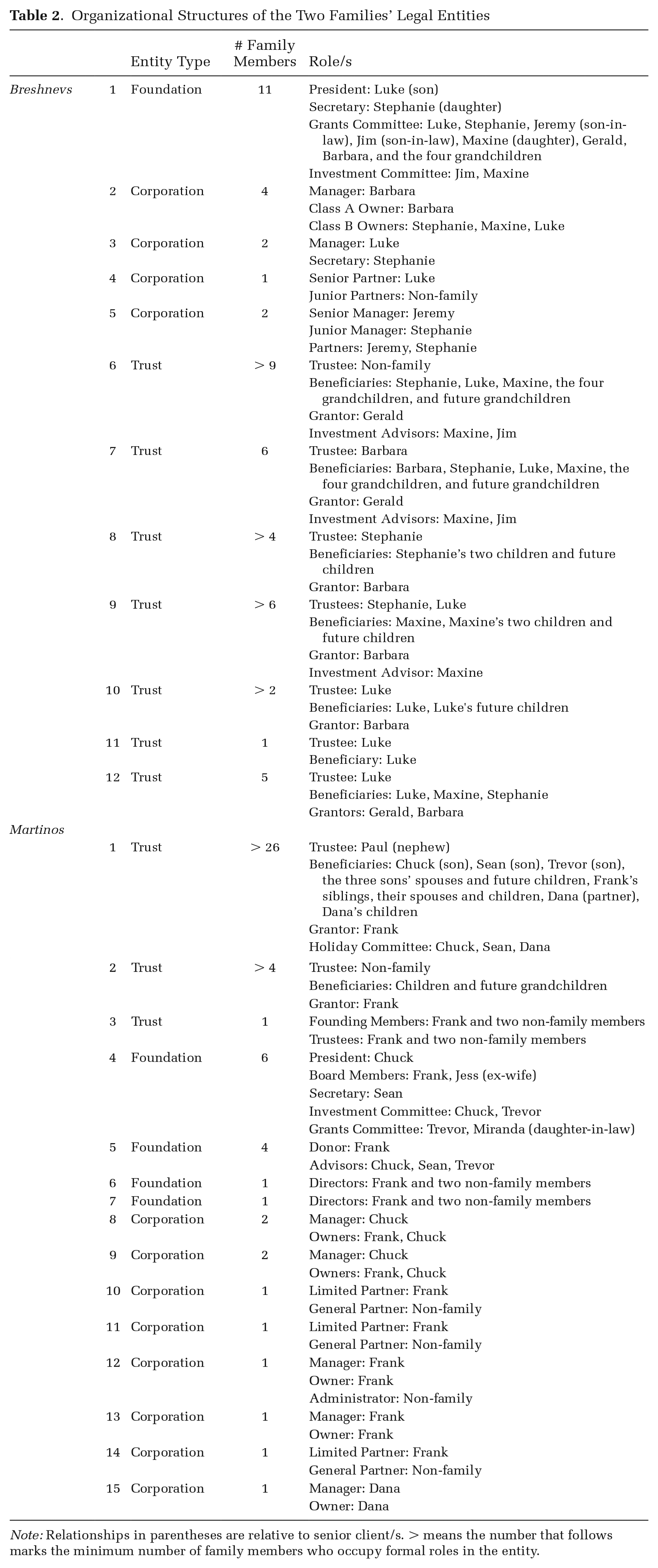
Legal entities bring new organizational structures into elite families. Table 2 provides a comprehensive list of the entities I observed at FO, listing the specific roles each family member occupied in each entity. Some entities are structurally identical but hold different assets; others hold similar assets but are structured differently.
Organizational Structures of the Two Families’ Legal Entities
Note: Relationships in parentheses are relative to senior client/s. > means the number that follows marks the minimum number of family members who occupy formal roles in the entity.
As Table 2 shows, each FO client family member occupied a role in at least one entity, and individuals often held positions in several entities, not to mention multiple roles in the same entity. Indeed, the average Breshnev family member had positions in over seven entities. The familial bureaucratic practices detailed below started with legal entities introducing formal roles into elite families.
Organizational structures, both through the titles they bestow and through the rights and obligations assigned to each title, can introduce new hierarchies into elite families. For example, a new Martino family trust was set up to fund family vacations. Because transferring to the trust would save tens of millions in future estate taxes for Frank Martino, he was legally barred from formal control over the funds, appointing his nephew Paul as trustee. Over a Zoom call, Evelyn first provided Paul with an overview of his new role, and then explained specific obligations. In a grave tone, she cautioned that he would have to approve family-member guests coming to the family vacation: “I got to break it to you—you have to approve it. Say . . . Chuck has a 16-year-old daughter, and she wants to bring her boyfriend. You have to approve it. [Paul chuckles awkwardly.] So if you don’t like him—tough luck.” Evelyn pauses and looks at Paul seriously: “So now that you know what it’s about, do you still want to do it?” Paul retorts hastily, in a good-natured tone, nodding vigorously: “Oh yeah, I’m happy to help.”
In his new role, Paul had to approve guests invited by his parents, aunts, and uncles—even Frank. As Evelyn acknowledged through her repeated verification that Paul is up to the task, this position requires navigating potentially fraught family dynamics; this new hierarchy also challenges traditional age and generational hierarchies. Jettisoning Paul’s obligations as stipulated in the bylaws—for example, if a boyfriend were funded to join the vacation without Paul’s consent—could jeopardize family funds by leaving the entity vulnerable to legal contestation by disgruntled family members and other interested parties.
The Martino trust to fund vacations introduced new hierarchies. It erected a rotating board of three family members to decide on vacation destination options. All eligible family members could vote among three options, but the board selected those options. Vacations discussed hypothetically around the office included renting an entire cruise ship for the family or charting a private jet to visit remote islands. The board also had the prerogative to approve non-family guests, as distinguished from Paul’s role approving funds for guests, highlighting the fragmentation of familial obligations introduced by legal entities. Initially, two of Frank’s children, Chuck and Sean, and his partner Dana, served as board members, influencing vacations for Frank and the extended family. One day I reviewed the trust document drafts in the office, and wrote in my notes: The PDF was 24 pages long. It stated that all of Frank’s children and future descendants, Dana’s children and future descendants, and Frank’s siblings and their descendants, are all beneficiaries of the trust. In order to maintain voting beneficiary status and have a say on vacation location and timing (voting from three options prepared by the vacation board), individuals must be over the age of 25 and have attended at least one vacation in the preceding five years. According to the document, anyone can be invited to the vacation if they obtain the unanimous consent of the board—which will initially be made up of Chuck, Sean, and Dana.
The Martino trust not only created new hierarchies between trustee and non-trustee and board member and non-board member, but it also created a new hierarchy between voting and non-voting family members. Individuals in particular entity roles could curtail the activities of other family members, be they older or higher status. As apparent from Table 2, the Martino trust was not unusual in this sense. I witnessed multiple structures where, in an effort to protect familial assets from litigation and taxation, children were given control over parents’ access to resources, and traditional power dynamics were challenged through new organizational structures.
But formal organizational structures do not always filter down to familial relationships in practice. For example, when Frank Martino first hired FO, Evelyn reviewed his documents and learned that his children, Chuck and Sean, were the officers in charge of grants for the Martino family foundation. But when she met Chuck and Sean, she was surprised to learn they had no knowledge of their foundation roles. Their formal roles did not filter down to familial practices or perceptions. Such deviations between bylaws and practice in Martino entities were of great concern to Evelyn due to the potential risks they posed to the preservation of family wealth through IRS scrutiny and legal contestation. I did not witness equivalent disparities between bylaws and practice in the Breshnev family, and over the following months, Chuck and Sean Martino became increasingly involved in the foundation, as many new practices were introduced into their family life.
Specialized Training
Legal entities require two types of specialized knowledge: expert knowledge (Fachwissen) and knowledge specific to role obligations (related to Dienstwissen). As tools wielded by professionals, entities require expert work from lawyers, accountants, and others to construct and maintain. Family members can hypothetically possess such expertise, but at FO this expertise was supplied entirely by hired hands. Indeed, professionals sometimes regard the ever-growing quantity of tedious entity work as central to their remuneration. Evelyn often referred to additional entity labor as “scope creep,” marking her acknowledgment of the guaranteed compensation associated with each additional entity. One day she compared the Breshnevs and Martinos, remarking that the Martinos may be better long-term clients because of the work (or the “complexity”) their entities will require: Standing behind me in the hallway, Evelyn explained in an upbeat informal tone: “But the Martino’s are probably my typical client—a family with lots of complexity, and lots of need for managing that complexity. The Breshnevs are actually not that typical because they don’t have much complexity. So Frank [Martino] will be a good long-term client.”
Elite families are dependent on professional knowledge for initiating and maintaining legal entities. From Evelyn’s perspective, good long-term clients have even more than the Breshnevs’ 12 entities and the professional labor they require.
Although family members can remain ignorant of much of the professional work associated with entities, labor associated with specific entity roles (Dienstwissen) often requires specialized training. Many role obligations, such as tax filings, annual meetings, and reports, are state-mandated. Other obligations stem from each entity’s idiosyncratic founding documents. In Evelyn’s conversation with Paul above, for example, she trained him on specific obligations associated with the Martino trust for funding vacations. Because many entities are irrevocable, their obligations can influence behavior decades after their formulation. These obligations are not necessarily onerous, but implementing them requires continuous explanation and reminders, and when family members hold seven or more different entity roles, non-negligible new practices are introduced into family life.
To prepare family members with little prior experience for their roles, FO conducted meetings with every household of every client family one to four times a month. These meetings covered a wide array of issues, including non-entity topics like insurance plans, but entity obligations were often the focus. For example, Evelyn explained to Chuck Martino his obligation to file Tax Form 990 as part of his new role as chair of the finance committee of the Martino foundation: Evelyn [focused]: The other thing, too, I wanted to talk to you about quickly—a lot of families will have an administrative committee. And it’s something worth thinking about. The administrative board will make sure the bylaws are up to date. And they’re also responsible for preparing the 990s. So, it might be worth thinking about someone in the family to delegate that to—otherwise, you’ll have to do it [chuckles].
Earlier in the conversation, Evelyn reviewed the obligations of the family foundation for Chuck’s wife, Miranda, and brother, Trevor: Evelyn [excited]: I don’t know if your dad [Frank Martino] told you this, but he has talked to Trevor and asked him to chair the grants committee, and he agreed to do so. And he also asked to serve on the finance committee. So, he and Miranda [Chuck’s wife] will serve on the grants committee. Chuck [eager]: Excellent. [suddenly hesitant] What does that entail? Evelyn [content]: Good question. Basically, the grant committee administers the grants—follows up with organizations and reports back to the board. Now, every family is different. . . . It’s up to the grants committee’s charter. . . . And I’m happy to share with you how some other families have approached this, but it’s up to you. Chuck: Ok, makes sense.
Evelyn’s explanation demonstrates that roles come with specific tasks that can be consequential. Mistakes on foundation tax returns or a failure to submit them, for example, could cost the foundation its tax-exempt status, potentially worth hundreds of millions of dollars over the entity’s lifespan. In the absence of specialized training, Chuck may not have been aware it was his obligation to submit the tax returns, endangering familial wealth. Evelyn’s explanation shows that obligations are flexible but do make demands on elite family members’ time. Indeed, Evelyn’s suggestion to involve other family members—to share the burden—indicates the necessary work may seep beyond family members who hold a given role.
Professionals often pay a lot of attention to specialized training. One striking example was the Rossi family office, where employees of different age groups are tasked with communicating with different generations of client families. As a senior staffer explained over Zoom, “Every generation of the family is being contacted by a different generation of the business, so the questions are more in tune. The [senior] partner is in touch with the patriarch or matriarch, but the junior partner [is] in touch with the second and third generation.” The Rossis believe their segmented training helps family members learn their obligations (through questions that are “in tune”), particularly younger family members. Virtually every family office I interviewed grappled with communicating obligations to client families. However, only around a third of the sample clearly articulated ideas about how to approach specialized training.
Specifically, professionals regard specialized training as important for sustaining family wealth. For instance, auditing Frank Martino’s philanthropic behavior from his activities prior to joining FO, Evelyn was alarmed to find evidence of transactions the Internal Revenue Service (IRS) might consider “self-dealing” as a consequence of Frank’s role as a “director” of a foundation. This could jeopardize millions of dollars in back-taxes that would otherwise go into family entities. Over a shared Zoom screen, Evelyn and I combed through a form over 100 pages long that was submitted to apply for nonprofit status: Evelyn sat upright in her chair, looking intensely into the screen. She scrolled down to the “officers” section of the document, exclaiming alarmed: “Here is what I was looking for—he is one of the three directors.” She continued in a concerned tone, her eyes wide: “He said he was on the advisory board. No! He’s not on the advisors’ board—he’s a director!”
After consulting with several professionals to remedy the situation, Evelyn discussed the matter with several Martino family members, including two of the Martino children. Evelyn trained them to make sure they do not jeopardize the family wealth by repeating their father’s mistake. In a phone conversation with one of Frank’s sons, Trevor, she emphasized in a fretful tone that “setting up a [nonprofit foundation] and doing as you please—that is self-dealing . . . there are a lot of things you can and can’t do and we’ll talk about that in the family meeting.” After noticing behavior she thought could jeopardize family wealth, Evelyn used specialized training to inoculate family members against future mistakes.
Legal Norms
The obligations associated with legal entities’ formal roles often require legal norms like meetings and presentations. For instance, in accordance with formal entity roles, family members must sometimes send emails, sign documents, request others’ signatures, review documents, or make formal presentations in the context of a grant or investment committee meeting. Upon setting up a new corporation, for example, FO asked Luke, the Breshnev son, to review a host of documents. In the same meeting, Evelyn also asked him to review family foundation-related documents emanating from his role as president: Evelyn hunched over her desk, listing to Luke on speaker phone: “So it’s going to be the [General Partnership] operating agreement, the [Limited Partnership] operating agreement, the [financial account] documents, and the [consultant] service agreement. Those are the things we’re going to want to review. . . . Thank you for getting me the foundation meeting minutes. The only thing we got to reach out to Stephanie about is—the other documents signed that night; I don’t have them. . . . And I sent you via Docusign the FO agreement for your review, have you had a chance to review that?”
Luke’s obligations in the different entities are not necessarily equally important, but they all serve to reify the legal standing of entities and thus protect underlying assets from various threats like lawsuits and IRS penalties. Multiple roles in different entities, as in Luke’s case, can come with a host of obligations associated with legal norms around paperwork, communication, and meetings.
Another example of such norms is when one family member submits regular payments to another. The Breshnevs decided to transfer their residential property to their children via a trust to save on future estate taxes; they will thus be required to pay rent to their adult children when the transfer finalizes. Evelyn scoffed as I scanned documents related to the transfer and questioned whether the couple truly understood the repercussions of their decision. She said, “I always tell them, and they never listen, you will have to pay rent to the kids! It will actually happen.” Sometimes legal entities introduce new norms that can feel extreme. In this case, these payments invert traditional familial hierarchies and thus may be hard for family members to imagine as they adopt them for future tax savings.
Some wealthy elites introduce unique norms through idiosyncratic entity bylaws. When Frank Martino set up a new family trust, for example, he decided that family members would be eligible to “sell” the trustees on business ideas through formal presentations. He first explained this new practice in an email to his three sons (and FO), which Evelyn showed me over Zoom while sharing her screen: Evelyn opened an email from Frank that was titled: “an email I sent my boys three days ago” and explained that “Frank said the trust . . . gives to entrepreneurs [within the family] if they come in with a business plan.” . . . Evelyn then slowly scrolled down the email and pointed to a sentence that read: “since most of the income won’t be needed for the immediate size of the family, monies can be set aside for entrepreneurism if members can sell the idea on logical and reasonable grounds.”
After sending the email, Frank began working with FO and a lawyer on phrasing the trust bylaws to define this new norm that was to take shape through the operation of the family trust. This norm was intended to preserve family wealth by introducing a higher bar for expending funds on business ventures. Not only will family members need the approval of their kin for business ideas, they will have to enact the norm of a formal presentation even to be considered. If they do not follow the letter of the bylaw and enact formal presentations to access funds, they subject the trust’s assets to potential litigation from family members and outsiders, jeopardizing family wealth.
Family members can be introduced to entity legal norms from a young age. The Breshnev grandchildren, the youngest of whom were preteens, were slowly incorporated into the family foundation. As I learned from the Breshnev Foundation meeting minutes, the four grandchildren (two younger boys and two older girls) petitioned the foundation through formal presentations for several thousands of dollars each to support specific charities related to causes in which they were interested. Yet, Evelyn feared the grandchildren may not have enacted the norm to a sufficient degree, as my field notes chronicled her reaction to the fact that the four grandchildren petitioned together, rather than on two separate teams: In each meeting minutes, several grants were proposed, and all were funded or postponed for future deliberation. In 2018, the male and female grandchildren proposed two different grants on different teams. This year, 2019, they proposed one grant together. Toward the end of our meeting, Evelyn was surprised when she did not see the boys propose their own charity [while she was there, she must have forgotten]. She exclaimed staring at the document, her eyebrows raised: “The boys didn’t do a separate one?” I shook my head in silence with a somber look, trying to match Evelyn’s affect. Evelyn sighed, and we moved onto the next section.
Every Breshnev household presented causes for the foundation to consider over the course of the two meetings. Evelyn’s disappointment about the pairs of grandchildren not presenting separately suggests she deems such an experience worthwhile. In the future, the grandchildren may be the only family members in a position to present to the foundation, which requires such presentations to maintain its legal status. The boys missed an opportunity to rehearse their bureaucratic practice, which the entity requires for its successful functioning to protect family wealth.
Formalized presentations by young family members can also be a source of pride for adult family members. For example, when I asked the Breshnev couple about differences before and after they engaged FO, the couple reported with admiration on their grandchildren’s presentations, which often involved PowerPoint slides: Gerald: Yeah, we were blown away. Barbara: Yeah, I mean they were probably [as young as] 5 then, but they did a PowerPoint thing . . . Gerald: Yeah. [loud] And all of them were presenting these little PowerPoint . . . Barbara: They knew what charities, you know, you could see where it was coming from—their interest . . . Gerald: So eventually we said, “OK, we’re going to give you a thousand dollars and then you go through this process and”—and they’re making these presentations every year now.
Formal presentations to family members are an important component of some legal entities. Presentations and other norms must be followed to maintain an entity’s legal status, and maintaining charitable status can be worth millions of dollars in tax savings over a foundation’s lifespan. Specialized training to provide instruction on these legal norms can thus be crucial for sustaining family wealth in legal entities and increasing future generations’ ability to control funds.
Written Documentation
The norms established by entities often take place through written documents (electronic and hard copy) that serve as potential evidence for defending legal entities from contestation. These documents are sent back and forth among family members and professionals. They are voluminous to say the least. Chris, a former tech entrepreneur who now manages his own family’s single-family office, described his family’s increasing “complexity” and how it has increased the length of his federal tax returns, which he used to be able to fill out by hand: I wouldn’t show it to you, but if I did you would see that my 1999 tax return . . . you would literally see that it’s filled out in pen by hand. Like literally, I got a calculator out, and I did my tax return myself. . . . Today, if you look at the totality of the complexity of any family office that is of any size, if you look at their federal returns plus their state returns plus their gift tax returns plus their trust returns in totality. . . . I have a hard time believing that anyone you’re talking to has a tax return under 1,000 pages.
Indeed, some tax returns filed at FO amounted to thousands of pages.
Of course, family members do not prepare most of these documents. But even when professionals protect clients from paperwork, this often entails clients dealing with written electronic documents like emails. For instance, Evelyn coordinated Breshnev trust signatures on several contracts with a law firm that managed transfers between several family trusts. Although she used client signature stamps, the contract entailed large payments, so she decided to solicit family members’ explicit consent over email. After asking me to prepare email drafts for her to edit, Evelyn and I discussed the letters in our morning meeting, as I wrote in my notes: The first email was addressed to Luke and Stephanie as trustees of Maxine’s trust, CC’ing Maxine. As she edited the email, Evelyn complained to me muttering that she really needs to create a template for the signature stamp request on Outlook, saying exasperated: “I use it all the time.”
Such written exchanges regarding legal entities and associated legal norms like appropriate signatures were commonplace at FO. When family members must send, receive, and sign many pages annually for multiple entities in which they occupy formal roles, written documents introduce new practices into elite family life.
But written documents are not merely voluminous. They are also crucial as the most tangible evidence that can be used in future legal contestations. Steve, a president of a single-family office, reported erecting a family trust for his client Jeff: So, there’s the family trust now. . . . We have quarterly meetings. We have an attorney there to maintain minutes. I do all the due diligence, maintain the agenda. . . . We have outside trustees, but they’re not professional trustees so they’re family, friends, that sort of thing.
But Steve sensed that Jeff was reluctant to document the trust’s work diligently, so he decided to explain the importance of written documents to Jeff: I said, “These things need to be recorded. We need to have a formal asset allocation. We need to have an investment policy statement,” which he was highly resistant to. And I said, “Look, this is really about protecting your trustees and protecting yourself as grantor from claims that beneficiaries could potentially make, and that’s like your family members.” Good governance in trusts I think is really good family policy because knowing that you’ve dotted the i’s crossed the t’s doesn’t put yourself in a position where you’re worried about . . . large dollars getting between you and a family member. So, keep everything buttoned up and super tight. Document what you do. Write it down. In non-wealthy families, if something goes off the rails, we don’t worry about being sued by each other. But in hyper-wealthy families, it’s always a risk.
Legal norms that are recorded through written documents are meant to increase the efficacy of legal entities in preserving familial wealth. In this case, Steve worried about lawsuits brought forward by family members. In other cases, individuals were more concerned about lawsuits from business partners, creditors, and “predators”—non-family opportunists who use the legal system maliciously to obtain assets. If family members do not adopt these bureaucratic practices, their entities face greater threats from sources like taxation and lawsuits. Additionally, Steve believes written documents (among other bureaucratic practices) are crucial for harmonious (elite) family life (“large dollars getting between you and a family member”). Steve was not alone in this view; I heard the same idea frequently at FO and from other respondents. The proper documentation of carefully executed bureaucratic practices, professionals believe, preserves family wealth and promotes family harmony.
Discussion
Pathbreaking depictions of elite families and their professionals have revealed that beyond mechanisms like extreme incomes and financialization (Alvaredo 2019; Lin and Tomaskovic-Devey 2013), legal entities also play a role in how today’s wealthiest maintain their privilege over time (Harrington 2016; Hofri-Winogradow 2017; Marcus and Hall 1992; Tait 2020). Yet, scholars rarely pay attention to how elite families use those entities to preserve wealth in practice. Using six months of ethnographic observations at a family office and interviews with professionals and clients, I found that to effectively use legal entities to preserve wealth across generations, elite families adopt “bureaucratic practices,” which are concrete activities typically observed in rationalized organizations that do not necessarily achieve bureaucratization’s substantive goals. Specifically, legal entities introduce organizational structures that assign family members into formal roles with associated rights and obligations. These rights and obligations often involve meetings, presentations, and written documents, the application of which must be learned through specialized training. Engaging in these bureaucratic practices enables familial wealth preservation to a greater degree than does erecting legal entities alone. Elite wealth preservation is a purposeful, ongoing project that involves familial bureaucratic practices.
Importantly, wealth preservation and its associated bureaucratic practices occur through a wide array of legal entities. Scholars increasingly acknowledge the utility of a large volume of entities for preserving wealth (Robé 2011; Seabrooke and Wigan 2022), yet much of the literature on elites focuses on one type of legal entity at a time—trusts, foundations, or corporations (Callison 2001; Farrell 2020; Field 2018; Harrington 2017; Hofri-Winogradow 2017; Sklair and Glucksberg 2021; Zucman 2015). By considering multiple types of legal entities simultaneously, commonalities emerge. Namely, familial bureaucratic practices involve similar behaviors legible to the legal system, regardless of entity type, and these similarities highlight the role of professionals who train and coordinate family members’ behavior across an orchestra of entities.
Accordingly, professionals play a key role in elite adoption of bureaucratic practices. As previous research on the role of wealth professionals has demonstrated, professionals offer unique expertise to help elites sustain their fortunes over time (Bessière and Gollac 2023; Harrington 2016; Winters 2011). Professionals even teach elites how to think (Higgins 2022; Santos 2021; Sklair and Glucksberg 2021). This article further demonstrates that professionals help elite families protect their fortunes across generations by educating them on how to implement new practices on an ongoing basis. After encouraging elites to erect new entities, professionals train them in new legal norms, maintaining a high level of documentation. In fact, due to the additional labor introduced by each entity, I found that familial bureaucratic practices deepen elite families’ dependence on professionals, as families require their expertise and assistance.
Bureaucratic practices expose the different types of knowledge (Wissen) required to sustain elite wealth, and therefore depict a more complex image of the professional work that sustains it. Much of the research on elites and professionals invokes the Fachwissen, or expert knowledge, required for labor like erecting legal entities (Harrington 2016; Hoang 2022; Hofri-Winogradow 2017; Tait 2020). But bureaucratic practices reveal that Dienstwissen, or knowledge derived from experience, is also instrumental for preserving family wealth. Professionals who are sometimes conceived of as “transnational” (Harrington and Seabrooke 2020) therefore possess multiple avenues for monetizing their work. Those who help elites adopt bureaucratic practices form an “interpretive community” alongside regulators and other professionals (Seabrooke and Wigan 2022). Such communities define, implement, and interpret norms related to their field; it is only within such a community that legal behaviors like bureaucratic practices are legible and therefore efficacious for preserving wealth. Relevant experts therefore possess a monopoly over crucial Dienstwissen, in addition to Fachwissen, without which their clients cannot pursue their goals. Bureaucratic practices may thus be an under-explored avenue through which transnational professionals guarantee remuneration: beyond compensation for sporadic legal work like erecting new entities, experts can also charge for the ongoing training in behaviors that are legally efficacious. This raises future questions. For example, are interpretive communities segmented such that some experts deal with courts and some with client behavior? And are these potential groups stratified in some way?
Family members can also access Dienstwissen, once taught, and professional work alone cannot achieve the full scale of wealth preservation enabled by its combination with family practices. 7 Consistent meetings, signatures, presentations, and reports rely to a large degree on professional–client cooperation, and client omission of bureaucratic practices jeopardizes family capital. Unfortunately, the degree of wealth preservation enabled by familial bureaucratic practices is impossible to assess with the current study. By their nature, successful bureaucratic practices mean the absence of lawsuits, tax penalties, fees, and fines, which is difficult to observe using ethnographic methods. Preserving wealth from such elements relies on professional work—and the U.S. context that structures legal tools—but familial bureaucratic practices augment the efficacy of professional legal labor.
These behaviors not only require active family participation, but they also involve large family units. Perhaps because of their large volume, legal entities and their ensuing bureaucratic practices creep into extended family life. O’Brien (2024) characterized the full kinship network of Dallas as a “family web,” where even distant family members are involved in the elite social reproduction project. Familial bureaucratic practices characterize some of the ongoing behaviors extended family members engage in to effectively preserve family wealth in practice.
But this does not mean bureaucratic practices, or indeed legal entities, are uniformly adopted across families or even within the same family. Inhabited institutionalism points to the interplay between interactions, organizational contexts, and broader norms as fueling organizational action (Hallett and Hawbaker 2021). This framework seems to apply to wealthy families, as FO’s families dynamically chose whether to erect entities or pursue bureaucratic practices as tax laws, family norms, and interactions with other family members and professionals shifted. Nonetheless, FO’s families erected many entities and continuously engaged in bureaucratic practices.
These practices likely also occur outside family offices. Ethnographic work cannot statistically generalize, but prior studies of wealthy elites and their professionals indicate that other elites also use legal entities and have been doing so since at least the fourteenth century (Farrell 2020; Habbershon and Pistrui 2002; Harrington 2016; Higgins 2022; Jaffe and Lane 2004; Langbein 2004; Marcus and Hall 1992; Rosplock and Welsh 2012; Sklair and Glucksberg 2021). Indeed, there are indications that wealthy families use similar tools in other legal contexts (Gilding 2005; Harrington 2016). Although statistical studies call into question the prevalence of trusts among economic elites (Keister, Lee, and Yavorsky 2021), corporations seem to be widespread (Keister, Li, and Lee 2021). Additionally, elite families may adopt bureaucratic practices outside of entities, for example, through wills, powers of attorney, individual insurance policies, and other legal elements that protect elite wealth (Tait 2020).
The familial adoption of bureaucratic practices may not be limited to elite life. Legal entities like trusts and foundations require funds to create and upkeep and are therefore a path to bureaucratic practices specific to elite families. Nonetheless, non-elite families may adopt such practices in other contexts. For example, non-elite families take up formal roles as “applicant” or “co-signer” when applying for federal loans (Zaloom 2019); learn legal norms such as court appearances when navigating the criminal justice system (Goffman 2015); and acquire specialized training for seeking state-sanctioned retirement programs (Langley 2010). To differing degrees, the successful maneuvering of these legal-economic institutions might depend on the correct adoption of bureaucratic practices. Additionally, as legal work also structures wealth inequality within families (Bessière and Gollac 2023), to the extent that bureaucratic practices enhance one’s legal standing in a given context, they may be utilized by non-elite families with conflicts over wealth. The extent of familial bureaucratic practices for non-elites deserves its own investigation.
Distilling the practical elements of bureaucracy that are typically associated with rationalized organizations seems particularly useful for analyzing a power struggle between elites and the state in a context like the United States. Weber ([1922] 2019:351), using his comprehensive definition of “bureaucracy,” predicted that rationalized organizations would become increasingly bureaucratic to vie with the state for resources. Indeed, elites contend with the state for taxes, incentives, and regulations (Block 2009; Domhoff 2013; Lachmann 2020; Martin 2013; Mizruchi 1989), using legal tools around intergenerational transfers and protection from lawsuits (which rely on the legal system facilitated by the state). It would thus not be surprising if families also bureaucratize. But, Weber’s definition of bureaucracy includes many elements, some of which are irrelevant for elite families in the United States today. 8 Focusing on bureaucratic practices helps us recognize specific ways families vie with the state (and others) to protect their resources—by adopting concrete behaviors.
Familial bureaucratic practices also shape certain aspects of intra-familial relationships. Beyond facilitating the maintenance of capital across generations, legal entities introduce new obligations and interactions for adult family members. They can also introduce unusual experiences into the lives of young family members, such as formal presentations to adults. Author-practitioners who allude to bureaucratic practices in elite families tend to discuss them in the context of family success (Habbershon and Pistrui 2002; Jaffe and Lane 2004; Rosplock and Welsh 2012), often jettisoning their practical implications for elites’ lives. However, many elite family members may not be content practicing bureaucracy in their family life, and involved family members are often not consulted in decisions around adopting various legal entities that generate such practices. Even when family members are included in such decisions, professionals seldom discuss the day-to-day realities of meetings and paperwork when presenting new legal entities. Bureaucratic practices may lessen the enjoyment of interactions within families, and perhaps even affect family relationships with repercussions for future resource transfers. Fully understanding the degree to which bureaucratic practices affect family members and their relationships is beyond the scope of this article, but it is a promising future endeavor. This study demonstrates that en route to preserving capital across generations, bureaucratic practices shape at least some facets of elite family life.
Family bureaucratic practices also complicate sociologists’ prevalent model of intergenerational wealth transmission in several ways. The classic model in stratification depicts parents transferring resources directly to their children (Blau and Duncan 1967). Yet, familial bureaucratic practices can create a broad (i.e., involving larger kin networks) and deep (i.e., multigenerational) infrastructure for sharing wealth, which can operate well beyond parents and children. Additionally, rather than the finite resource transfer implied by the traditional stratification model, legal entities create a continuous apparatus of shared practices that operates atop any discrete transfer to a single household. Thus, at least for elite families, bureaucratic practices present an alternative model of family privilege that does not conform to our dominant sociological schema.
Scholars and policymakers interested in social reproduction and economic inequality should thus pay greater attention to the legal entities and associated practices that sustain elite wealth. Many behaviors, perceptions, and relationships within elite families would be hard to understand without appreciating the role of such practices. Repercussions of legal entities may also provide pathways for policy change. For instance, if the state forbade family members from serving as officers in entities funded by other family members, this might remove pathways for tax avoidance, as well as inadvertently improve the daily lives of elites. Trust between family members may be key to the seamless creation of entities, and so requiring the participation of non-family members may pose a significant barrier. Such a policy might encounter less opposition than others (e.g., tax rate increases). If the state can reduce the use of entities, wealthy elites would be more vulnerable to taxation, litigation, and family conflict around inheritance. As a result, persistent intergenerational inequality may decrease, and social mobility increase. Bureaucratic practices in elite families are not inevitable and are not desirable for society at large; they may not even be desired by elites themselves.
Footnotes
Appendix: Family Offices And Access To Fo
Family offices are increasingly ubiquitous. Precise numbers are illusive, but various reports estimate there are 2,500 to 9,000 family offices in the United States, with a minimum threshold ranging between $50 million and $1 billion for setting up a physical single-family office (Kenyon-Rouvinez and Park 2020). Several national associations connect family offices, and many journalistic and industry papers have reported surges in family offices in recent years (KPMG Global 2020). 9
In general, access is one of the main reasons for the dearth of literature on elite families (Monahan and Fisher 2015). Difficulties accessing elites can be overstated (Ostrander 1993), but ethnographic projects in settings of elite decision-making remain sparse (Rivera 2012 is one exception). I gained access to a multi-family office that caters to between two and ten families after one year of searching. Following my Institutional Review Board protocol, I first searched for family offices through personal ties, alumni boards, and industry conferences. I then searched online, “cold-called” family offices, and requested to interview their presidents in person at their respective locations. After conducting several interviews and mentioning at the end of each that I was searching for a “research internship” to learn about “relationships in family offices,” a multi-family office that I refer to as “Family Office” (FO) expressed interest. 10
Through a short email exchange following our interview, Evelyn, the president of FO, indicated she would be willing to discuss an unpaid internship. During the interview, she showed enthusiasm for helping me with my career and contributing to research in general. I sent flowers to thank her for the interview and followed up over email. We met again one week later to further discuss the terms of the internship. During negotiations, she asked about my administrative skills (e.g., Excel) and what work I would be willing to do. I expressed enthusiasm about every proposed task. We also discovered a mutual hobby (undisclosed to protect anonymity but resembling squash; typically associated with high cultural capital). Then, she asked me to complete a criminal background check and a drug test, and staff at the office contacted the university as a reference. Finally, the office agreed to let me observe and intern without pay for a period of six months.
Before I arrived, Evelyn emailed all client families and informed them of my arrival and my position as a researcher. She also gave them an opportunity to object. None did. When I attended meetings with clients, she often encouraged me to share information about my research and its emerging findings. She also required me to sign a non-disclosure agreement that focused on FO’s proprietary tools and methods, such as software packages, which were unrelated to my research interests. I conducted formal interviews with all client families after completion of observations.
Acknowledgements
I thank Amanda Barrett-Cox, Jens Beckert, Jere Behrman, Julia Behrman, Chas Camic, Ashleigh Cartwright, Estela Diaz, Sherelle Ferguson, Mauro Guillén, Peter Harvey, Katharina Hecht, Michael Kunichika, Annette Lareau, Robin Leidner, Shay O’Brien, Hyunjoon Park, Christine Percheski, Blair Sackett, Leslie Sebba, Benjamin Shestakofsky, Varda Shiffer-Sebba, Jonah Stuart Brundage, and the ASR editors and anonymous reviewers for valuable feedback that significantly improved the manuscript. I also thank Daniel von Brighoff for essential translation assistance. Any errors or omissions are my own.
