







Abstract
Do state Right to Work (RTW) laws unleash economic dynamism, or the ability for local economies to respond, thrive, and grow in changing conditions? Although the specific goals of RTW laws to limit union security agreements appear to narrowly target unionized firms, proponents and opponents alike argue that RTW laws have broad labor market consequences. Union monopoly theories suggest that unions increase labor costs and exert greater worker control over the labor process in ways that distort and dampen firm investment and growth, and hence that RTW promotes economic dynamism. Institutionalist theories counter that unions increase labor productivity and build a stronger local consumer base, and hence that RTW inhibits economic dynamism. We provide a novel test of these divergent hypotheses using 75 years of County Business Patterns data and county-border-pair fixed-effects regression models to address unobserved heterogeneity. We fail to find consistent evidence that RTW passage is associated with meaningful changes in employment or workplace establishment concentration relative to geographically proximate counties in non-RTW states that share a common border. We develop an alternative competitive labor policy mitigation perspective that highlights how policymakers respond to policies in neighboring states to help explain this null result. Consistent with our arguments, we find that non-RTW states made tax and incentive policy more attractive for employers during this period, and that tax and incentive policies have a meaningful association with local economic dynamism. This highlights tax incentives as an alternative policy lever that non-RTW states used to mitigate the competitive advantages of RTW states.
Introduction
Do Right to Work (RTW) laws unleash economic dynamism? RTW has been the focus of political contestation for three-fourths of a century and has contributed to increased geographic inequality in union membership and power since the movement’s peak in the mid-1950s (Dixon 2020; Gall 1988; Hogler 2015; Jacobs and Dixon 2006). Although the content of RTW—removing union security agreements, or requirements of dues or membership as a condition of employment—may appear to be narrowly targeted and thus of little importance to the broader labor market, opponents and proponents of RTW argue that RTW is consequential for wider economic and political outcomes (Dennis et al. 2017; Dixon 2020; Hertel-Fernandez 2019; Rachleff 2017). Research suggests RTW weakens unions, reduces union finances and organizational capacity, and undercuts union influence on wage distributions and politics (Feigenbaum, Hertel-Fernandez, and Williamson 2018; Fortin, Lemieux, and Lloyd 2021; Murphy 2023; VanHeuvelen 2020, 2023; Wallace, Hyde, and Vachon 2022). Union security has proven to be a durable source of political contestation between unions and employers, resulting in continued political entrepreneurship surrounding RTW’s passage, blockage, or revocation (Dennis et al. 2017; Dixon 2008; Gall 1988). Michigan recently repealed its decade-long state RTW law in 2023, and national RTW measures have been perennially introduced in congressional bills.
Most studies of RTW focus on standard inequality outcomes or effects directly tied to union power: wage inequality (Fortin et al. 2021; Kogan 2017; VanHeuvelen 2020), mean wages (Austin and Lilley 2021; Farber 2005; VanHeuvelen 2023), long work hours (Gihleb, Giuntella, and Tan 2024), union wage premiums (VanHeuvelen 2023), union membership (Farber 1984; Wallace et al. 2022; Wallace, Vachon, and Hyde 2021), or union organizing success (Ellwood and Fine 1987). However, these studies sidestep a critical issue held up by proponents of RTW: economic dynamism, or the productive churn and adaptation of businesses and workers that allow local economies to respond, thrive, and grow in changing conditions, including the ability to maintain robust employment and establishment growth in the face of global competition (Hirsch 2012; Lettieri and Fikri 2023). The stakes for the question of whether RTW increases economic dynamism are high, particularly as disadvantaged workers benefit more from the job opportunities, wage growth, and worker mobility of dynamic economies (Newman and Jacobs 2023; Shambaugh, Nunn, and Liu 2018). Indeed, Missouri’s U.S. Representative Eric Burlison provides a concise argument for RTW-related competition over dynamism: “My state of Missouri is a closed union or forced union shop state. Yet, we’re surrounded by right to work states. And you know what I hear every day? The sucking sound of jobs leaving the state of Missouri and going into states where workers have economic freedom” (National Right to Work Committee 2023).
Prior sociological research has provided important insights on the consequences of RTW for inequality and worker power, but questions of economic dynamism have long been central to various subfields of the discipline. Early work on neoliberal industrial policy and shareholder value capitalism (prioritizing stock returns over other goals like employment growth), for example, criticized the failures of U.S. firms to adequately invest in employment expansion (Fligstein and Goldstein 2022; Miller and Tomaskovic-Devey 1983). The early deindustrialization literature focused on the decline of manufacturing jobs as a structural mechanism that reinforced inequalities in poverty, neighborhood disadvantage, and criminal justice involvement (Wilson 1996). Sociologists have also long recognized the importance of structural economic factors, such as economic development and urbanization, for upward mobility opportunities (Blau, Duncan, and Tyree 1978; Lipset and Bendix 1959), and a growing body of work documents the social consequences of job instability (Brand 2015; Damaske 2021; Kalleberg 2011; Rao 2020; Sharone 2024). Thus, the answer to the question of whether RTW laws lead to more dynamic local economies has broad relevance for both sociological theory and labor market policy.
U.S. employers frequently hold antagonistic views toward labor unions (Clawson and Clawson 1999; Dennis et al. 2017), often forming national and regional coalitions to garner support for and pass RTW laws (Dixon 2007, 2008, 2020; Gall 1988; Hogler 2015; Lee 2012; Rachleff 2017). According to union monopoly theoretical perspectives, the broader labor market payoff of RTW laws is a more dynamic economy (Austin and Lilley 2021; Maksimovic and Yang 2023). Insofar as RTW reduces union power and signals a more business-friendly political context (Rao, Yue, and Ingram 2011; Wallace et al. 2022), firms can more freely reinvest profits and adapt to fluctuating economic conditions, increasing competitiveness, and thus retain and hire a larger workforce (Hirsch 2012). Such dynamism increases inward migration of job seekers, enables new firm formation, and incentivizes the relocation of profitable firms from sclerotic contexts. Citing union monopoly theories, RTW proponents often argue that higher employment and firm density will inevitably follow RTW passage, particularly over the long term as local labor markets adjust to a weaker labor movement post-RTW.
Conversely, institutionalist theoretical accounts highlight the productivity-enhancing benefits of stronger unions, suggesting a possibility for negative RTW–dynamism effects. These perspectives synthesize a focus on workers’ bargaining power with an emphasis on the dynamics of firm profitability (Brady, Blome, and Kleider 2016; Western 1997; Wright 2000). Such arguments emphasize that unions may benefit firm productivity, yielding higher consumer demand, and the broader policy, social, and economic benefits of stronger unions contribute to more robust long-term aggregate demand (Ahmed and Mertzanis 2025; Hirsch 2012).
RTW influence on economic dynamism is arguably the most central, but least well understood, component of contemporary U.S. labor policy debates. To address this issue, we assemble seven county- and state-level datasets to examine employment and workplace or business establishment concentration between 1946 and 2019. Then, using modern updates to two-way fixed-effects and event study regression methodologies, we assess the effects of RTW on county economic dynamism. For the full sample of county-years, we find that RTW is associated, at most, with minimal increases in total employment, marginal decreases in manufacturing employment, and no significant changes in establishment counts. Then, to better identify the causal effects of RTW, we match contiguous county-border-pairs across states, situating geographically proximate comparisons in a temporally dynamic framework. We find little evidence that RTW affects dynamism outcomes. Event study models confirm that RTW has few significant effects on total, manufacturing, or service employment, or establishment counts—in aggregate or differentiated by sector and size—even 50 years after passage. In fact, in the rare cases where we find small differences post-RTW, the most sensible conclusion is that such differences are difficult to distinguish from trends that predated RTW (Holmes 1998).
Null findings are hard to reconcile with the union monopoly or institutionalist perspectives, which motivates our third theoretical expectation, one inspired by emerging insights from the policy diffusion literature (DellaVigna and Kim 2022; Glick and Friedland 2014; Karch and Cravens 2014). We focus on the core mechanism of higher firm profits that union monopoly theories claim drive dynamism, but we identify an alternative set of tools policymakers have historically relied on to foster dynamism that are more compatible with local labor power: corporate tax rates and incentives (Chirinko and Wilson 2017; Greenstone, Hornbeck, and Moretti 2010; Slattery and Zidar 2020). RTW may have made a difference in early decades when it aligned with less burdensome corporate tax policy, but competitive activity in non-RTW states may have led to a convergence in tax policy with RTW states that helped counteract, and ultimately mitigate, any meaningful labor policy disadvantages.
Leveraging multiple panel datasets on state and local tax policies spanning the 1960s to the 2010s, we find that non-RTW states rapidly adopted tax and incentive policies that were more favorable to businesses, changes that both predict economic dynamism and blunted modest positive RTW effects that occurred in the earliest decades of our study. Moreover, we find that modest positive effects of RTW on economic dynamism in early decades largely faded by the end of the 1970s, when state tax and incentive programs converged across RTW and non-RTW contexts. Data limitations prevent us from identifying precise historical motivations for these tax policy changes, but the findings are consistent with our theoretical argument that RTW laws did not facilitate the creation of more dynamic local economies because non-RTW states undertook alternative policy strategies to remain competitive with other U.S. states.
Background
Right to Work Laws as Employer Pushback
Employers and business interests often view antilabor laws as a solution to issues of profitability and capital accumulation (Dennis et al. 2017; Hogler 2015). This perspective mobilizes employers across partisan ideologies, large and small firms, geographies, and historical contexts into organized networks and social movements. Anti-union sentiment has thus long been a concrete pillar of class consciousness among U.S. employers (Gall 1988; Lee 2012).
Right to Work (RTW) laws have long motivated organizing and mobilizing efforts against U.S. unions. After decades of struggle and paltry success, unions achieved unprecedented legitimacy and institutionalized rights and protections in the mid-1930s after passage of the Wagner Act (Jacobs and Dixon 2006; Rosenfeld 2014). This federal achievement instigated the “union boom,” with labor ascending to levels of power alongside major corporations, the military, and the federal government (Dixon 2020; Stepan-Norris and Kerrissey 2023). Yet nearly as soon as unions won these protections, antagonistic employer interests organized to push back against the newly ascendant labor movement (Rachleff 2017; Stepan-Norris and Kerrissey 2023). This pushback, including the building of coordinating organizations like the Chamber of Commerce and Business Roundtable, intensified political pressures on policymakers (Dennis et al. 2017; Stepan-Norris and Kerrissey 2023). Perhaps the most prominent and successful pushback was the Taft-Hartley Act of 1947, which curtailed many rights of organized labor and carved out legislative space for states to pass RTW laws (Rachleff 2017).
RTW is a state-level policy that bans union security agreements as a condition of employment, such as requirements to join a union or provide union dues. In RTW states, workers can enjoy the benefits and protections of union representation without having to contribute to organizing efforts. For union advocates, such bans incentivize freeriding, reduce the motivation to actively engage in workplace union organizing, and threaten union effectiveness, membership, and finances (VanHeuvelen 2020, 2023). RTW builds additional fragmentation on top of the United States’ already fragmented industrial relations system (Bhuller et al. 2022; Visser and Checchi 2009). Thus, firms in RTW states have lower likelihoods of unified bargaining and higher risks of employees enjoying union benefits without providing material support for union activity.
A small but growing literature focuses on RTW’s influence on employment and other measures of economic dynamism. One strand of research uses county- or plant-level data from the 1990s onward and leverages county-border comparisons to identify causal effects (Austin and Lilley 2021; Bloom et al. 2019; Holmes 1998; Makridis 2019; Maksimovic and Yang 2023; Rao et al. 2011). This work finds that RTW increases employment (especially in manufacturing) and flexible managerial practices, positively predicts firm location decisions, and leads to more favorable perceptions of local economic conditions and activity. Another strand of research uses state-level data over a longer time horizon, typically finding null or negative RTW effects on employment. Ozkan and Ozbeklik (2016) use data from 1983 to 2007, focusing on Oklahoma’s 2001 RTW passage. They find that overall employment and manufacturing employment were unchanged post-RTW in Oklahoma relative to a synthetic control group. Mengano (2023) uses RTW as an instrument for state-level worker power, finding an RTW-induced decline in labor force participation between 1960 and 2019. And Ahmed and Mertzanis (2025) use accounting and market data for firms listed in the S&P 500 Index during the 2000s, finding RTW reduced total factor productivity, which they interpret as reflecting reduced worker engagement, especially among firms that used innovation-driven business strategies.
These contrasting findings suggest the question of RTW and economic dynamism is far from settled. Most studies examine a narrow time frame, well after most states passed RTW laws. This is an important limitation given that two-thirds of RTW laws were passed in the 1940s and 1950s. Some studies focused on more recent periods have relied on time-invariant measures of RTW state status (e.g., Austin and Lilley 2021), potentially obscuring how the adoption of RTW might shift dynamism trajectories. Moreover, a full understanding of the RTW–dynamism relationship necessitates a long-run view, as local labor markets may adjust gradually to policy changes (Austin and Lilley 2021; VanHeuvelen 2023). This lack of a long-term historical perspective has been a central limitation of prior research, given that relying on recent data alone cannot account for potential RTW consequences that may surface several decades later.
The Case for a Positive RTW Effect: The Union Monopoly Model
The union monopoly model is commonly used to link RTW to economic dynamism (Austin and Lilley 2021; Bloom et al. 2019; Friedman 1951). From this perspective, unions work to increase the share of the organizational surplus going to the unionized. Productivity and growth are, at best, peripheral goals. While beneficial for union workers and individuals in adjacent industries (Rosenfeld 2014), higher labor costs and restrictions on managerial control over the labor process without productivity gains cut into profits, reducing resources that firms can reinvest, including in expansion and productivity-boosting technologies (Bloom et al. 2019; Hirsch 2012). Underinvestment dampens firm performance and employment growth, placing firms at a competitive disadvantage relative to nonunionized firms, leading to job cuts, business closures, and firm relocations. For example, Kini and colleagues (2022) find that unionized manufacturing firms had higher product recall rates, especially in non-RTW states. They interpret this finding as being driven by unions raising costs, which redirects funds away from investment in product quality–enhancing technologies, reduces flexibility, and undercuts organizational strategies to improve managerial and workplace culture. Such distortionary effects are likely prominent in manufacturing and tradable industries, where many firms cater to a national or even global customer base, and thus face stronger competition from weaker union contexts.
The prospect of lowered labor costs and greater flexibility from RTW in this account prompts business and worker relocation to RTW states (Austin and Lilley 2021; Holmes 1998; Rao et al. 2011). This theory assumes that, through greater discretion in capital allocation and competition among less sclerotic firms, more efficient firm-level investments prevail, resulting in higher productivity and thus improved firm performance that leads to employment growth and higher earnings. As worker mobility is partly responsive to employment conditions, workers also choose to relocate to RTW states. These RTW effects should intensify over time, as the disruptive capacity of unions weakens in the decades following RTW passage.
In support of the union monopoly perspective, several older studies of U.S. firm profitability found that unionization is associated with lower profitability. Doucouliagos and Laroche (2009) conducted a meta-analysis of unionization and profits, finding a straightforward negative association in the United States. Hirsch (2008, 2012) summarizes the literature and finds a profitability gap between firms, especially after accounting for the possibility that successful unionization tends to occur among otherwise more profitable firms. Over the long run, such profitability differentials are expected to have positive effects on local dynamism.
RTW might also have second-order effects through policy changes. Unions tend to mobilize low propensity voters into formal politics (Feigenbaum et al. 2018; Rosenfeld 2014). These coalitions create political pressures to enact and enforce worker-friendly policies, whereas RTW passage is associated with more business-friendly policy regimes (Feigenbaum et al. 2018; VanHeuvelen 2023). Residents of RTW states may thus face a policy environment with fewer worker protections, such as minimum wage laws, unemployment insurance, and paid sick leave, along with more stringent work requirements for safety net benefits, resulting in greater labor force attachment (Esping-Andersen 1999; Hatton 2020; Marinescu and Rosenfeld 2022; Soss, Fording, and Schram 2011). RTW states might therefore incentivize or coerce employment of any form, even at otherwise unacceptably low pay rates, thus raising overall employment.
The Case for a Negative RTW Effect: Institutionalist Perspectives
The union monopoly model has been central to the development of expectations regarding the economic consequences of RTW, but there are reasons to anticipate the opposite result: that stronger unions and protective labor policy contexts may promote economic dynamism. The extensive literature on institutionalism, when applied to the same logic used by the union monopoly model, would predict greater economic dynamism in non-RTW states (Frege and Kelly 2020; Korpi 2018; Wallace et al. 2022; Western 1997). Whereas institutionalist perspectives typically focus on issues of social protection and egalitarianism (e.g., Brady et al. 2016), we extend insights from this literature to questions of economic dynamism and growth.
Several studies since the 1980s have found that unions boost productivity by increasing worker tenure and on-the-job training (Freeman and Medoff 1984). Lower turnover creates firm success via more stable workforces, stronger networks, and greater worker engagement (Ahmed and Mertzanis 2025; Ballinger and Holtom 2019; Hodson and Roscigno 2004). Dean, McCallum, and Venkataramani (2023) found that union presence in nursing homes reduced staff turnover, and Sojourner and colleagues (2015) found higher productivity among unionized nurses. Dustmann and Schönberg (2009) found that unionized firms tend to provide more training through apprenticeship programs (see also Waddoups 2013), and Hirsch (2012) summarizes findings from a range of U.S. studies, suggesting a modest improvement to productivity following firm unionization. Institutionalist arguments highlight the downsides of labor flexibility: the costs of job churn, the loss of difficult-to-measure firm culture, and the decline of firm-specific human capital (Kuhn and Yu 2021). Lower labor costs and higher flexibility may in fact disincentivize firms from pursuing productivity-enhancing technologies and managerial practices, reinforcing a low-road business strategy that treats workers as costs to be minimized.
If unions boost labor productivity and firm performance, the logic of the union monopoly model would predict greater economic dynamism. In a static economic model, increased labor productivity would, by definition, reduce employment in both RTW and non-RTW contexts. However, if improved productivity and firm performance also increase consumer demand through lower prices or improved product quality, then employment responses to increased consumer demand may more than offset any productivity-induced employment losses.
Institutionalist arguments also expand the focus from microlevel firm processes to more aggregated effects of labor on the broader economic and policy landscape, all of which may contribute to increased aggregate demand and, therefore, economic dynamism. Unions tend to expand political engagement and work to pass a broad system of wage protection policies that apply beyond union members themselves. These broader effects help explain lower poverty rates and higher median incomes among nonunion households in more unionized states (Brady, Baker, and Finnigan 2013; VanHeuvelen and Brady 2022; Western and Rosenfeld 2011). Labor strength also tends to be associated with a variety of development-enhancing features, including educational opportunities, family stability, and enhanced job quality (Rosenfeld 2014; Schneider and Reich 2014). VanHeuvelen (2023) shows that state policy contexts tend to change after RTW passage. The combination of these second-order economic, policy, and social effects may result in greater aggregate demand in non-RTW states stemming from a more robust economic foundation among a more financially secure and solidly middle-class workforce that has more disposable income. In such a context, one might expect responses of greater employment and establishment growth.
The Case for a Null Association: Competitive Labor Policy Mitigation
We argue that there are reasons to be skeptical that RTW has any meaningful effect on economic dynamism, and we outline a case for a null association based on an alternative perspective we term competitive labor policy mitigation. The union monopoly model assumes that policymakers face a simple decision in response to RTW competition: either pass or block RTW and observe the settling of a new competitive equilibrium. In contrast, institutionalist theories suggest that policymakers are not bound to consider a single policy to provide protection and support to workers. We take up this core insight of institutionalist theories and develop it alongside findings from the policy diffusion literature. However, we depart from standard institutionalist theories by making the case for temporary, rather than persistent, RTW effects, with non-RTW states turning to alternative policy levers to mitigate RTW competition.
Policymakers tactically and creatively respond to policy decisions made in other states (DellaVigna and Kim 2022; Glick and Friedland 2014; Karch and Cravens 2014), and they learn from other political jurisdictions (Carollo et al. 2022; Fording and Patton 2020; Glick and Friedland 2014). Policymakers also compete to retain economic advantages (Chirinko and Wilson 2017; Glaeser 2001; Heimberger 2021). The policy diffusion literature convincingly demonstrates that policymakers do not simply mimic the content of other states’ laws (Karch and Cravens 2014) but identify fundamental issues and adapt policymaking to local constraints. 1
A null association could indicate non-RTW states responding to perceived competitive threats from RTW states (Glick and Friedland 2014). Yet contra the binary choice assumed by the union monopoly model, it is unlikely that policymakers rely exclusively on RTW to respond, as research has documented a significant rebalance of political power post-RTW (Feigenbaum et al. 2018). Given the well-known importance of unions for left-leaning political parties (Korpi 2018; Rosenfeld 2014), direct challenges to unions may be a political nonstarter in some states, leading non-RTW policymakers to opt for alternative ways to enable firm profitability.
This leads to a broader question: what is the most common policy tool used by legislators to increase the profit-potential attractiveness of their state? The answer is state and local tax incentives. A large body of literature documents tax incentive programs for economic development as a significant source of interstate competition (Chirinko and Wilson 2017; Greenstone et al. 2010; Moretti and Wilson 2017; Slattery 2025; Slattery and Zidar 2020). Bartik (2019) estimates that in 2015 alone, spending on state and local incentives totaled $46 billion, accounting for nearly 80 percent of all non-federal spending on economic development programs. Slattery and Zidar (2020) describe the explicit goals of economic dynamism via increased profitability that are used to frame tax incentive programs passed by state and local policymakers. And incentives such as job training may lower firm expenses and raise productivity, indirect paths to increased firm profits. Corporate tax rates, the range of the corporate tax base, and discretionary firm-specific tax incentives are all frequently modified to create local conditions that mimic those that the union monopoly model attributes to RTW contexts: to reduce noncompetitive burdens on business, freeing up profits to increase forward-looking investments and, ultimately, increasing competitiveness and firm productivity (Glaeser 2001; Heimberger 2021).
During our study period, as greater proportions of the country began to operate under state RTW laws (VanHeuvelen 2020), we expect that non-RTW policymakers responded in ways that may have mitigated potential increases in competitive pressure from RTW states. More precisely, we expect that the burden of state and local taxes on employers positively predicts economic dynamism outcomes, and that non-RTW states converged on tax and incentive policies that led to rates found in RTW states over time. In contrast to both the union monopoly and institutionalist perspectives, we argue that any detectable effects of RTW would have been transitory, fading over time due to alternative mitigating policy action by non-RTW states.
We describe this mechanism of shifting competition to alternative policy sets as competitive labor policy mitigation. Competitive borrows from the union monopoly model the perceived threat to profitability and ensuing reshuffling of the interstate competitive landscape, and it draws from the diffusion literature’s focus on processes that lead states to compete in the domain of corporate tax rates (Chirinko and Wilson 2017; Davies and Vadlamannati 2013; Greenstone et al. 2010; Heimberger 2021). Mitigation identifies the alternative tactics used to address firm profits as the core driver of economic dynamism. Our concept is related but distinct from what scholars have described as a “race to the bottom” (e.g., Chirinko and Wilson 2017; Davies and Vadlamannati 2013), as it refers to how policymakers shift to alternative policy levers to address the same underlying problem of profitability. Even if both strategies conform to a pro-business agenda, the movement to tax policy addresses business interests without pushing back on labor, whereas standard “race to the bottom” arguments assume a unidimensional process where all states eventually adopt RTW. We also borrow insights from the policy diffusion literature that policymakers can, and often do, make surprising, unpredictable, and countercyclical responses to perceived competitive threats (Chirinko and Wilson 2017; Kim 2025). More broadly, this perspective highlights how attention to nullification and contamination, long recognized by sociologists and policy scholars as a methodological challenge to causal inference (Lieberson 1985), can be substantively insightful, enabling us to identify mechanisms producing null effects. When considered from a policy diffusion perspective, contamination of control units by treatment units may be less of a statistical nuisance than an agentic response by policymakers to reestablish a competitive equilibrium.
Data and Measures
Data and Construction of Samples
The primary data for this study come from the U.S. Census Bureau’s County Business Patterns (CBP). The CBP include county-level counts of employment and establishments (i.e., workplaces) tabulated from administrative records on the universe of private, non-agricultural establishments with employees. 2 The CBP is currently available annually from 1946 to 1951, triennially from 1953 to 1962, and annually from 1964 to 2019. The CBP includes information on employment and establishments for each industry and county, and by establishment size category. For 1946 to 2016, we use the digitized, cleaned, and harmonized CBP files constructed by Eckert and colleagues (2020; 2022). 3 Our establishment counts for 1974 to 1985 come from the IPUMS NHGIS repository (Schroeder et al. 2025). 4 For 2017 to 2019, we downloaded the CBP files from the Census Bureau’s website. The CBP is ideal for this study, as it is the longest-running U.S. employment and establishment dataset with fine spatial detail at the county level and annual or semi-annual observations. These unique features of the CBP allow us to measure employment and establishments stretching back to the 1940s, providing, to our knowledge, the most comprehensive assessment of RTW laws and economic dynamism to date.
We constructed two separate samples for our analyses. First, we used an unbalanced panel of all U.S. counties in the 50 U.S. states plus the District of Columbia, hereafter the “all-county” sample. The all-county sample includes all county-year observations with non-zero and non-missing employment and establishment data. 5 This sample consists of 3,132 unique counties, contributing 192,127 county-year observations. We used the all-county sample to assess within-county changes in dynamism post-RTW, relative to non-RTW counties across the United States.
The second sample consists of all contiguous counties in the lower 48 states that share a common border with counties in another state and have data on employment and establishments, hereafter the “county-border-pair” sample. We constructed this sample using the list of county pairs compiled by Dube, Lester, and Reich (2010), which pairs all border counties with all counties in neighboring states that share a common physical border. Of the 3,108 counties in the lower 48 U.S. states, 1,139 are border counties. We have CBP data for 978 of these counties, yielding 822 unique county pairs. Of these county pairs, 495 varied by RTW state status at some point during the study period (we retain pairs without RTW differences in the analytic sample).
Figure 1 maps county-year observations for border counties with an RTW difference. Many counties share borders with multiple counties in neighboring states. Thus, following Dube and colleagues (2010), counties in our sample have (
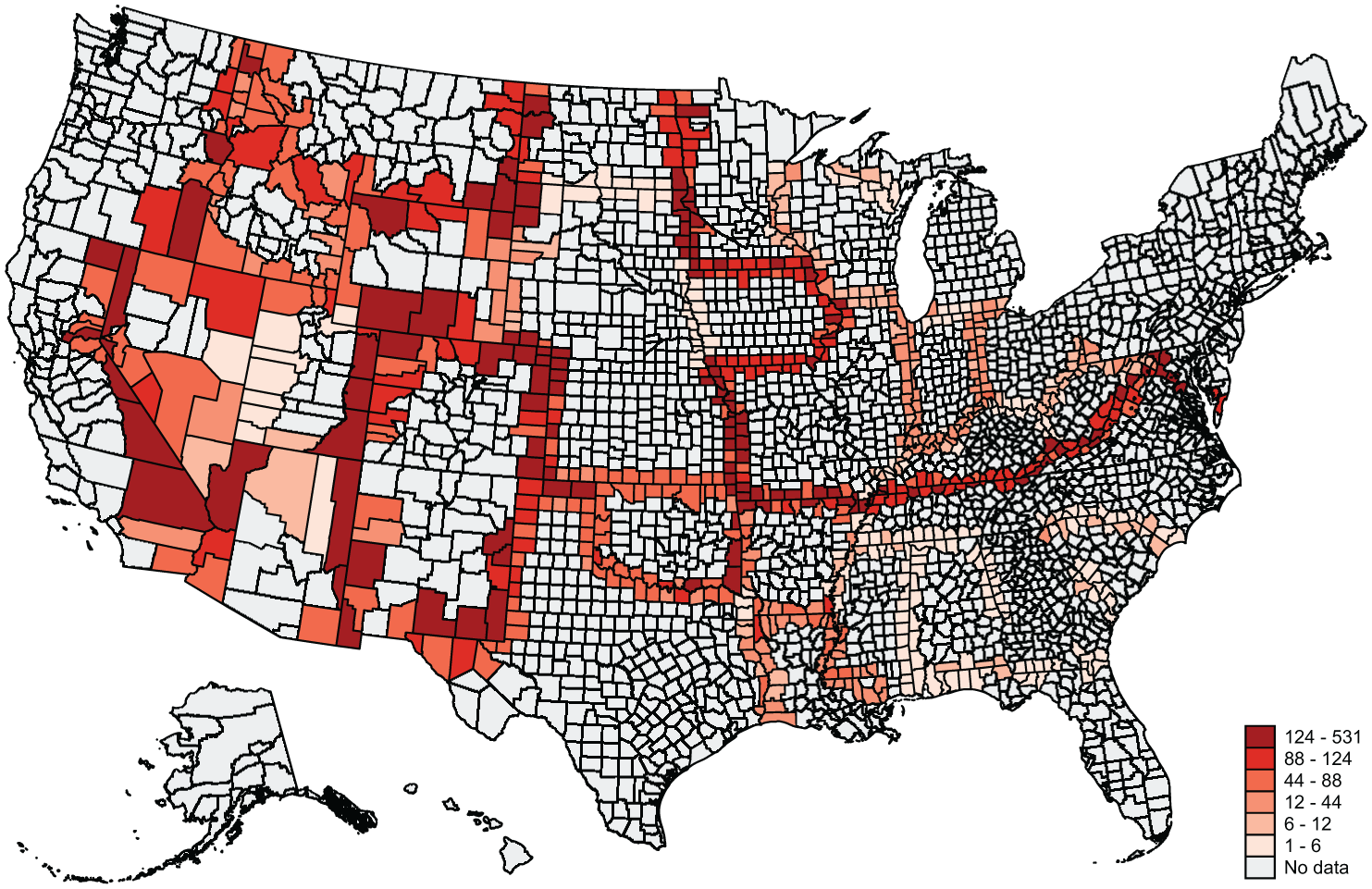
County-Year Observations in the County-Border-Pair Sample with an RTW Differential.
Employment and Establishment Outcomes
We use employment and establishment counts as proxies for economic dynamism; later, we assess this decision alongside several alternative measures from different data sources. Employment is the total number of mid-March employees working in private-sector, non-agricultural, employer establishments in the county. Employees who are part-time or are currently on sick or parental leave, holidays, or vacations are included. Because the employee counts refer to the same time of each year (March), the measure adjusts for seasonality. To protect confidentiality, the raw CBP data suppress employment counts for county-industry cells with few reporting establishments. In most years, the CBP includes a flag with ranges for suppressed values. Eckert and colleagues (2020) used these flags and the hierarchical nature of the data to impute suppressed employment count cells. We use these imputations when available. Around 3 percent of county-year observations for total employment are imputed in our final samples. 7 We log transform all employment measures to adjust for the skewed distribution. 8
Establishments are defined as singular physical locations where business is conducted, services are rendered, or industrial tasks are performed. Establishments are thus similar to workplaces. Note that an establishment is not identical to a company or firm, as many firms have multiple establishment locations. Establishments with paid employees at any point during the calendar year are included in the CBP. Nonemployer (i.e., sole proprietorship) and public-sector establishments are not included in the counts. We log transform all establishment measures to correct for skewness.
Given that RTW consequences might vary by industry, we examine manufacturing and service employment and establishments separately. We focus on broad manufacturing and service industry categories (e.g., collapsing durable and non-durable manufacturing) to limit the frequency of imputed employment cells. The CBP data use Standard Industrial Classification (SIC) codes before 1998, and North American Industry Classification System (NAICS) codes thereafter. We use the industry concordance file provided by Eckert and colleagues (2020) to harmonize the codes so that comparable industries are categorized consistently throughout the panel.
We use CBP information on establishment counts by establishment size category. The size categories in the CBP vary over time. From 1946 to 1973, the largest category was firms with 500 or more employees. A category for firms with 1,000 or more employees was added in 1974. For consistency, we collapse the establishment size categories into small (1 to 49 employees), medium (50 to 499 employees), and large (500 or more employees) establishments.
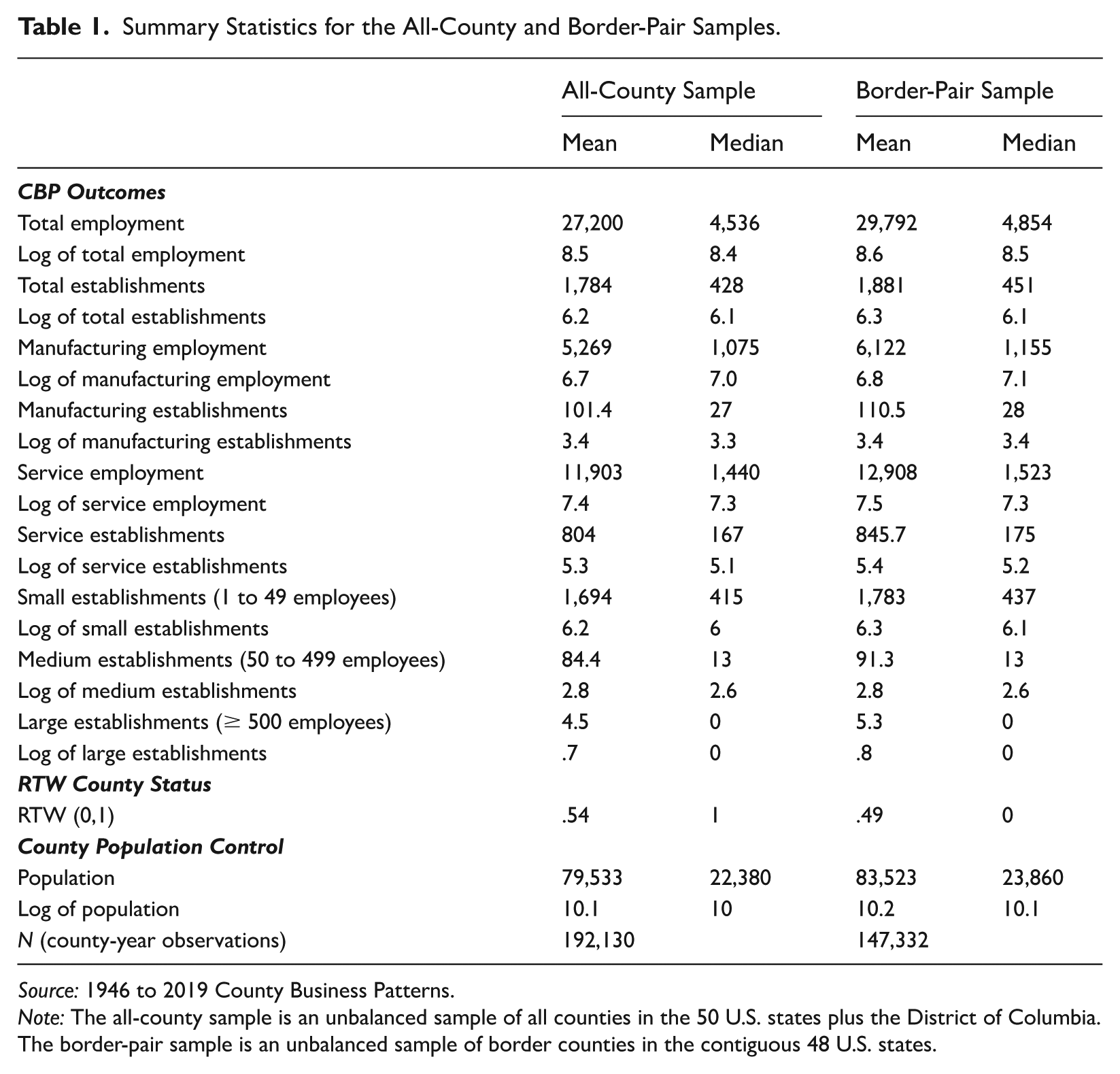
Table 1 presents descriptive statistics for the all-county and county-border-pair samples. Median counts are similar across both samples for all employment and establishment outcomes.
Summary Statistics for the All-County and Border-Pair Samples.
Source: 1946 to 2019 County Business Patterns.
Note: The all-county sample is an unbalanced sample of all counties in the 50 U.S. states plus the District of Columbia. The border-pair sample is an unbalanced sample of border counties in the contiguous 48 U.S. states.
State RTW Laws
We draw from data used in prior research to measure RTW laws (VanHeuvelen 2023). We code a county-year as being in an RTW state in the year of and all years following passage of a state RTW law. Around half of county-year observations are RTW in both samples (see Table 1).
Corporate Tax and Incentive Data
Data on state tax and incentive policies come from the Bureau of Economic Analysis (BEA) (Slattery and Zidar 2020) and the Upjohn Institute (Bartik 2017). The BEA data cover 1964 to 2017 and contain state-by-year fiscal policy measures of total tax credits and budgets allocated to economic development programs for businesses (Slattery and Zidar 2020). The Upjohn data include state-by-industry-by-year measures of incentive programs (property tax abatements, customized job-training grants, job-creation tax credits, investment tax credits, and R&D tax credits) and business tax programs (property taxes, corporate income taxes, and state and local sales taxes paid on business inputs) for 33 states and 45 industries from 1990 to 2015.
The Upjohn data are based on a simulation model that projects liabilities and credits that would accrue over 20 years for a new facility opened in a given industry, city, state, and year. The BEA data are presented in raw, inflation-adjusted dollars, and as a percentage of state GDP, and the Upjohn data are available as a percentage of the industry-by-year’s value added, or the value of the industry’s products above and beyond the value of the materials that go into making those products. Positive values on incentives are discounts to total taxation. We examine total incentives, total taxes, and taxes net of incentives. Higher values of net taxes indicate a greater tax burden on business (for descriptive statistics, see Tables S4 and S5 in the online supplement). We focus on state tax and incentive policies to match our theoretical focus on RTW laws as a state-level policy, and because spending on state tax and incentive programs tends to be larger than spending on local tax and incentive programs (Bartik 2019; Slattery and Zidar 2020).
County Population Control Variable
We include a time-varying control for county population in all models to adjust for the mechanical relationship between population and employment/establishment counts. Population data come from Decennial Census estimates (Schroeder et al. 2025). We use linear interpolation to fill in gap years between Censuses. 9 We log transform to adjust for the skewed distribution.
Analytic Strategy
Fixed-Effects Models
We answer our research questions using a series of two-way fixed-effects models. Our analytic strategy resembles a difference-in-differences design, commonly used in policy evaluation research, with the addition of variable or “staggered” treatment timing (Goodman-Bacon 2021; Jakiela 2021; Sun and Abraham 2021). All models include year and county fixed effects. We present three different model specifications to provide a range of estimates in an effort to determine the likely universe of potential RTW effects on local economic dynamism. We begin with a standard two-way fixed-effects model estimated using the all-county sample, to which we add state-specific linear time trends to control for time-varying unobserved state factors:

where
Thus, our preferred approach accounts for this potential heterogeneity by leveraging county-border fixed effects identified in the border-pair sample. Because this model is estimated using a different sample, we first estimate Equation 2 to establish a baseline comparison:

where
We refine this approach by restricting the control group to non-RTW counties that share a common geographic border by including county-border-pair-by-year fixed effects (

Here,
We can estimate Equation 3 because we allow each county to have
Event Study Models
Equations 1, 2, and 3 estimate the relationship between RTW and county economic dynamism by pooling the within-county differences across all study periods. Such pooling across time has two limitations. First, we cannot test if changes leading up to RTW passage are consistent with the parallel trends assumption. The parallel trends assumption, critical for causal identification of two-way fixed-effects models, means the treatment and control groups had similar trends in employment and establishment growth in the periods before the law change. Second, it is theoretically possible that the effects of RTW on employment and establishments in counties might emerge gradually over time, as local economies adjust to weakened labor unions post RTW passage. Indeed, both the union monopoly and institutionalist models suggest RTW effects should grow stronger over time as local labor markets adjust to labor policy changes.
We therefore also present dynamic estimates from event study models. These models assess trends in employment and establishments in the periods before and after RTW passage. Following standard approaches, we construct categorical indicators for the years leading up to and following the RTW law, which we cap at 30 years prior to- and 50 years post-RTW, to ensure sufficient cell sizes. We use the year before RTW as the omitted reference period (T – 1). We include counties that never became RTW, which we code as being in T – 1. We present event study estimates for each of the fixed-effects specifications discussed above (Equations 1, 2, and 3).
Addressing the Shortcomings of Two-Way Fixed-Effects Models
Even if the results are consistent with the parallel trends assumption, standard two-way fixed-effects models can still produce biased estimates when treatment timing varies across states (Baker et al. forthcoming; Jakiela 2021; Sun and Abraham 2021). This is because the standard two-way fixed-effects estimate is a weighted average of all potential two-by-two comparisons (Goodman-Bacon 2021). In some cases, earlier treated units problematically serve as control cases for later treated units. These cases have “negative treatment weights,” meaning their residual treatment status is negative. Negative weights are more common for units that are treated earlier in the study period and have few pre-treatment observations. These cases can severely bias treatment effect estimates, in some cases yielding opposite signs (Jakiela 2021). Without adjustments, two-way fixed-effects coefficients should thus be interpreted with caution.
Following Jakiela (2021), we adjust for negative treatment weights by estimating “trimmed” two-way fixed-effects models that exclude negatively weighted treatment observations from the estimation samples (for comparison to other methods of dealing with negatively weighted treatment observations, see VanHeuvelen 2023). For both the all-county and the county-border-pair samples, we first estimate a linear probability model predicting RTW status as a function of year and county fixed effects and calculate residuals. We then identify observations in each sample that are post-RTW and have negative residuals. Finally, we remove all negatively weighted treatment observations from both samples and all analyses. 11
Findings
Descriptive Trends
Figure 2 shows state-level average growth rates in total and sectoral employment and establishments, calculated as the percentage change relative to the prior year, among states that became RTW in the early years (before 1976), states that became RTW in the later years (after 2000), and states that were never RTW during the study period. 12 We see a general declining trend in the rate of employment and establishment growth across all measures and groups of RTW states, consistent with a secular decline in economic dynamism documented in prior research (Lettieri and Fikri 2023). For all employment measures, growth rates are consistently higher in early RTW relative to never RTW states, particularly in the early years. However, later RTW states tend to exhibit slower total employment growth than both early RTW and never RTW states, although later RTW states had higher manufacturing employment growth than did never RTW states after the 1990s. The patterns are similar for establishment growth. While these descriptive trends suggest more dynamic economies in RTW states in early decades, we observe a convergence in growth rates that does not fully align with a competitive advantage of RTW.
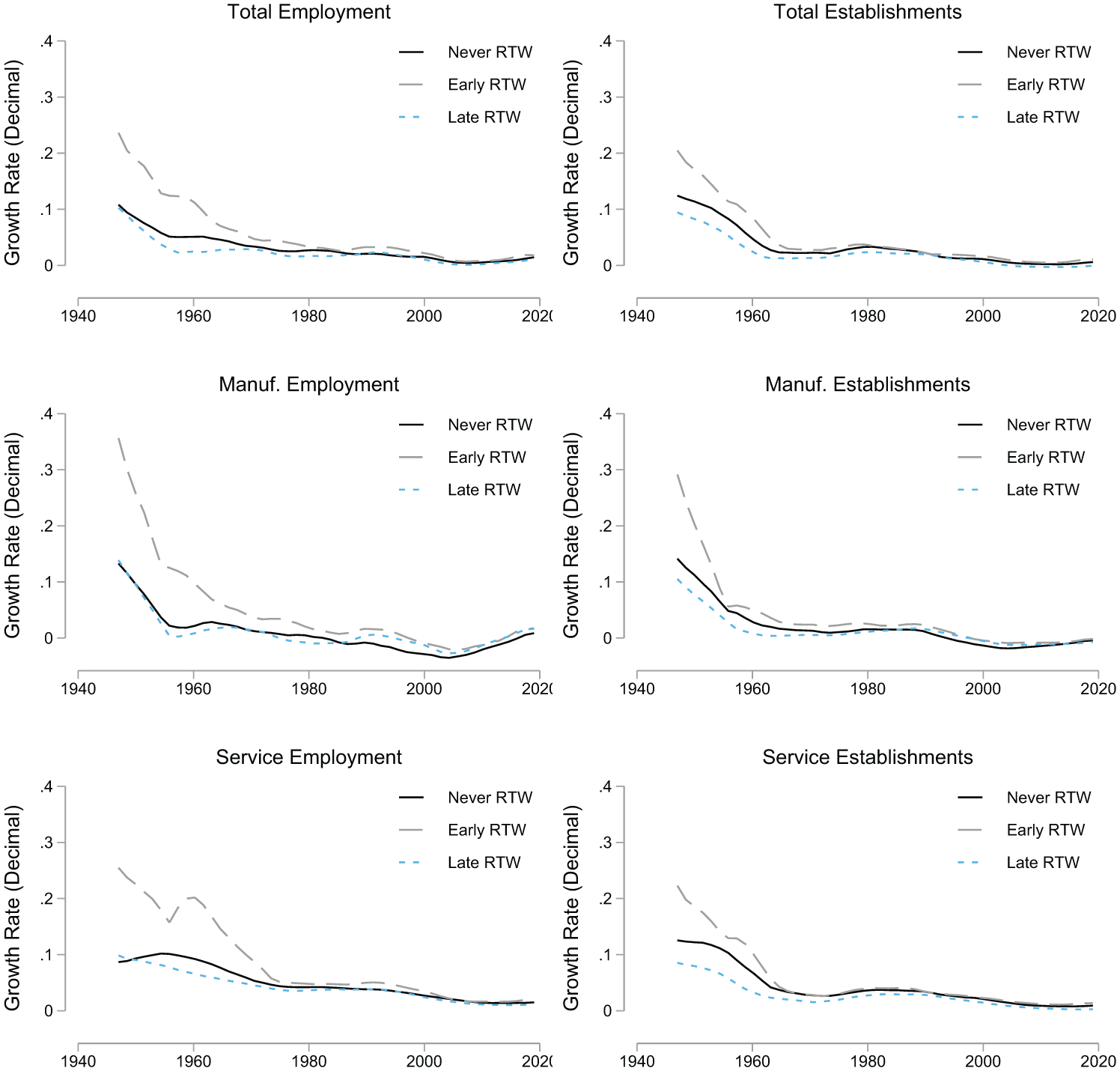
Trends in Employment and Establishment Growth Rates by RTW State Status.
Fixed-Effects Models Predicting Employment and Establishments
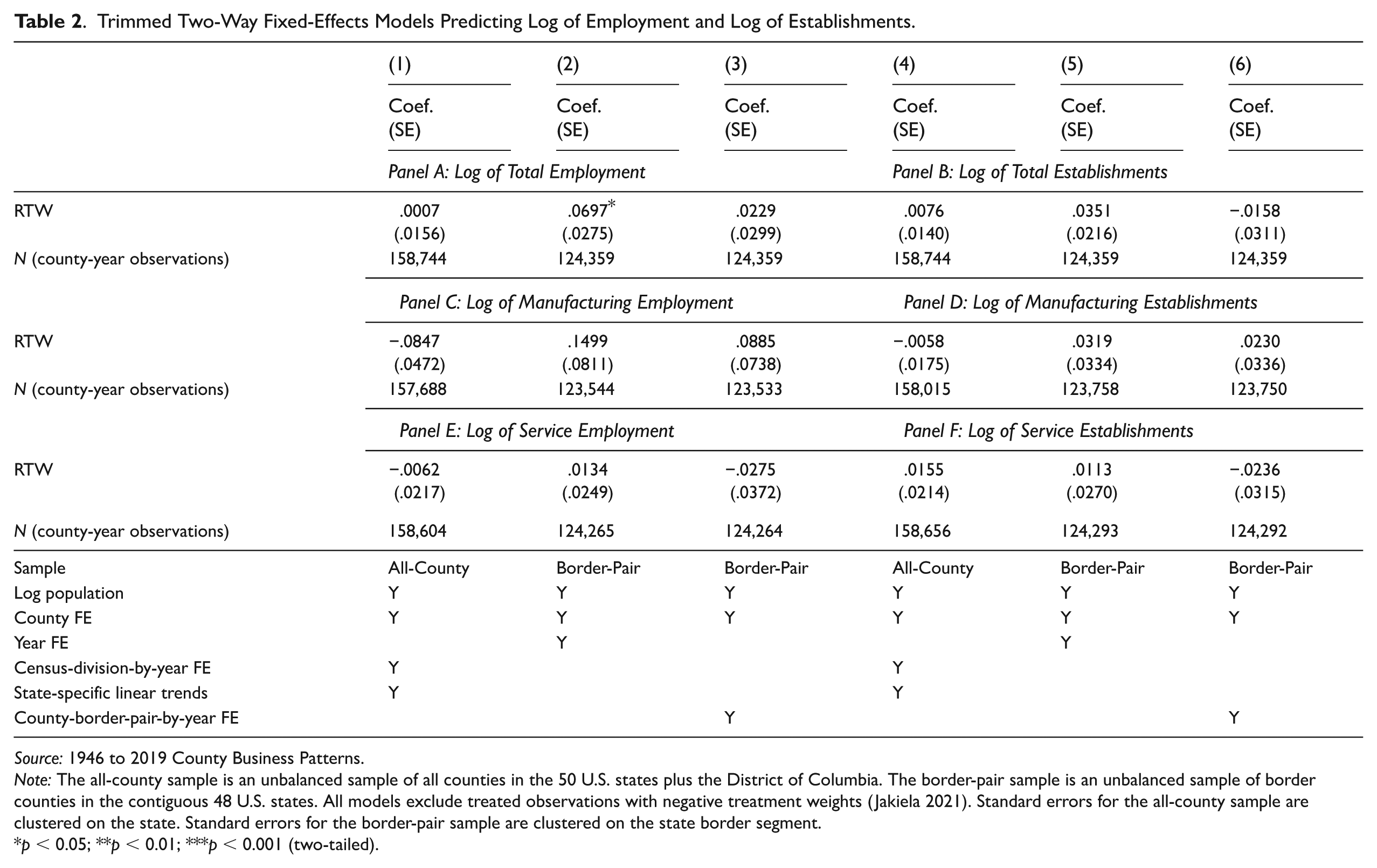
Table 2 presents results from the fixed-effects models predicting total employment and establishments from 1946 to 2019. Column 1 of Panel A shows estimates predicting logged total employment using the all-county sample. Column 1 shows that RTW passage is associated with no significant change in total employment, statistically or substantively, in the model that includes state-specific linear time trends. This stands in sharp contrast to the main expectations of both traditional union monopoly arguments and institutional perspectives. Column 4 of Panel B presents the results for logged total establishments. For establishments, the sign is also positive, but the magnitude is not statistically or substantively meaningful, consistent with the results for employment in the all-county sample.
Trimmed Two-Way Fixed-Effects Models Predicting Log of Employment and Log of Establishments.
Source: 1946 to 2019 County Business Patterns.
Note: The all-county sample is an unbalanced sample of all counties in the 50 U.S. states plus the District of Columbia. The border-pair sample is an unbalanced sample of border counties in the contiguous 48 U.S. states. All models exclude treated observations with negative treatment weights (Jakiela 2021). Standard errors for the all-county sample are clustered on the state. Standard errors for the border-pair sample are clustered on the state border segment.
p < 0.05; **p < 0.01; ***p < 0.001 (two-tailed).
Moving to our preferred models, Columns 2–3 and 5–6 in Panels A and B present results for total employment and total establishments using the county-border-pair sample. Columns 2 and 5 present reduced-form specifications. Column 2 suggests RTW is associated with a significant 7 percentage-point increase in employment. However, Column 3, adding county-border-pair-by-year fixed effects to localize the control to non-RTW counties that share a common border, reveals no significant effect of RTW on total employment. The coefficient is not only insignificant; it is also reduced in magnitude by over two-thirds. This association is substantively small, corresponding to about a 2 percent increase, or less than 1 percent of a standard deviation, that, relative to the pre-RTW baseline sample mean, amounts to just 376 additional employees in the county in the post-RTW period. The general pattern of results is substantively similar for total establishments in Columns 5 and 6. This more precise identification strongly counters union monopoly model expectations of a positive RTW–dynamism association.
Columns 1–3 and 4–6 of Panels C and D present results for manufacturing employment and establishments. Here, we see a similar pattern to total employment and total establishments, albeit with stronger associations of RTW, consistent with arguments that RTW matters more for industries like manufacturing. In support of the union monopoly model, Column 2 suggests RTW is associated with a 15 percentage-point increase in county manufacturing employment. However, the magnitude of this estimated effect is reduced substantially in the preferred specification that includes the county-border-pair fixed effects (Column 3). Once the control group is restricted to counties that share a common border, the coefficient on RTW is reduced by half and the association is nonsignificant. The results are similar for manufacturing establishments, albeit the associations are generally weaker across all specifications presented.
Columns 1–3 and 4–6 of Panels E and F present the results for service employment and service establishments. The patterns for service industries are similar to those for total employment and total establishments; RTW has no meaningful association, one way or another.
Does the lack of consistent evidence for the RTW–dynamism link in Table 2 mask heterogeneity across establishment sizes? Table 3 presents results for the fixed-effects models predicting establishment counts by size category as a function of RTW status. Across all specifications, there are no significant estimated effects on the log of small, medium, or large establishments. This suggests RTW laws do not meaningfully increase the number of large establishments in counties, counter to arguments that RTW laws attract large firms.
Trimmed Two-Way Fixed-Effects Models Predicting Log of Establishments by Establishment Size Category.
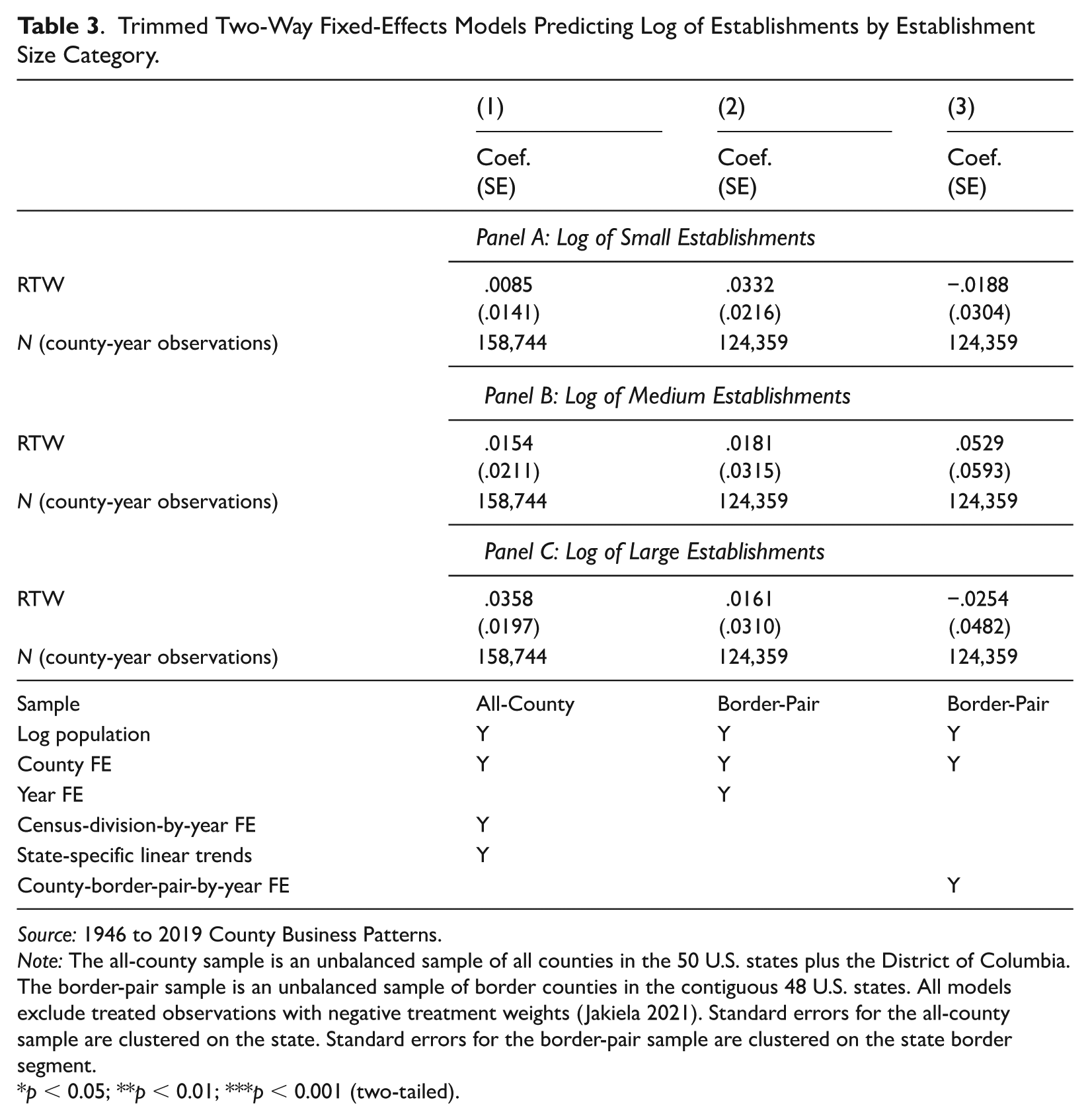
Source: 1946 to 2019 County Business Patterns.
Note: The all-county sample is an unbalanced sample of all counties in the 50 U.S. states plus the District of Columbia. The border-pair sample is an unbalanced sample of border counties in the contiguous 48 U.S. states. All models exclude treated observations with negative treatment weights (Jakiela 2021). Standard errors for the all-county sample are clustered on the state. Standard errors for the border-pair sample are clustered on the state border segment.
p < 0.05; **p < 0.01; ***p < 0.001 (two-tailed).
The results thus far challenge the core mechanisms highlighted by the union monopoly model. We also see few significant negative associations, in contrast to standard institutionalist accounts. Our most common finding is a null estimated effect of RTW on economic dynamism, which is partially consistent with our competitive labor policy mitigation hypothesis.13, 14
Event Study Estimates Predicting Employment and Establishments
Does RTW foster dynamism many years after its passage? Our comprehensive historical panel of county-level data allows us to contribute new evidence on this question by estimating the long-run consequences of RTW via event study models. Event study models also allow us to assess parallel trends, a key assumption of difference-in-differences models (Baker et al. forthcoming).
Figure 3 plots event study coefficients predicting logged total employment and establishments with 95 percent confidence intervals for each model specification. In the all-county sample with state-specific linear trends, we see no significant changes in employment or establishments even 50 years after an RTW law was implemented. For the border-pair sample, standard fixed-effects specifications suggest an increasingly positive effect of RTW on total employment and total establishments over the long run. In the border-pair sample, relative to the year prior to RTW, total employment is 10 percentage-points higher 10 years post-RTW, and 20 percentage-points higher 50 years post-RTW. However, when county-border-pair-by-year fixed effects are included, long-term estimated effects are substantially weakened in magnitude, and statistically nonsignificant, even 50 years after RTW passage, in these more stringent tests. 15
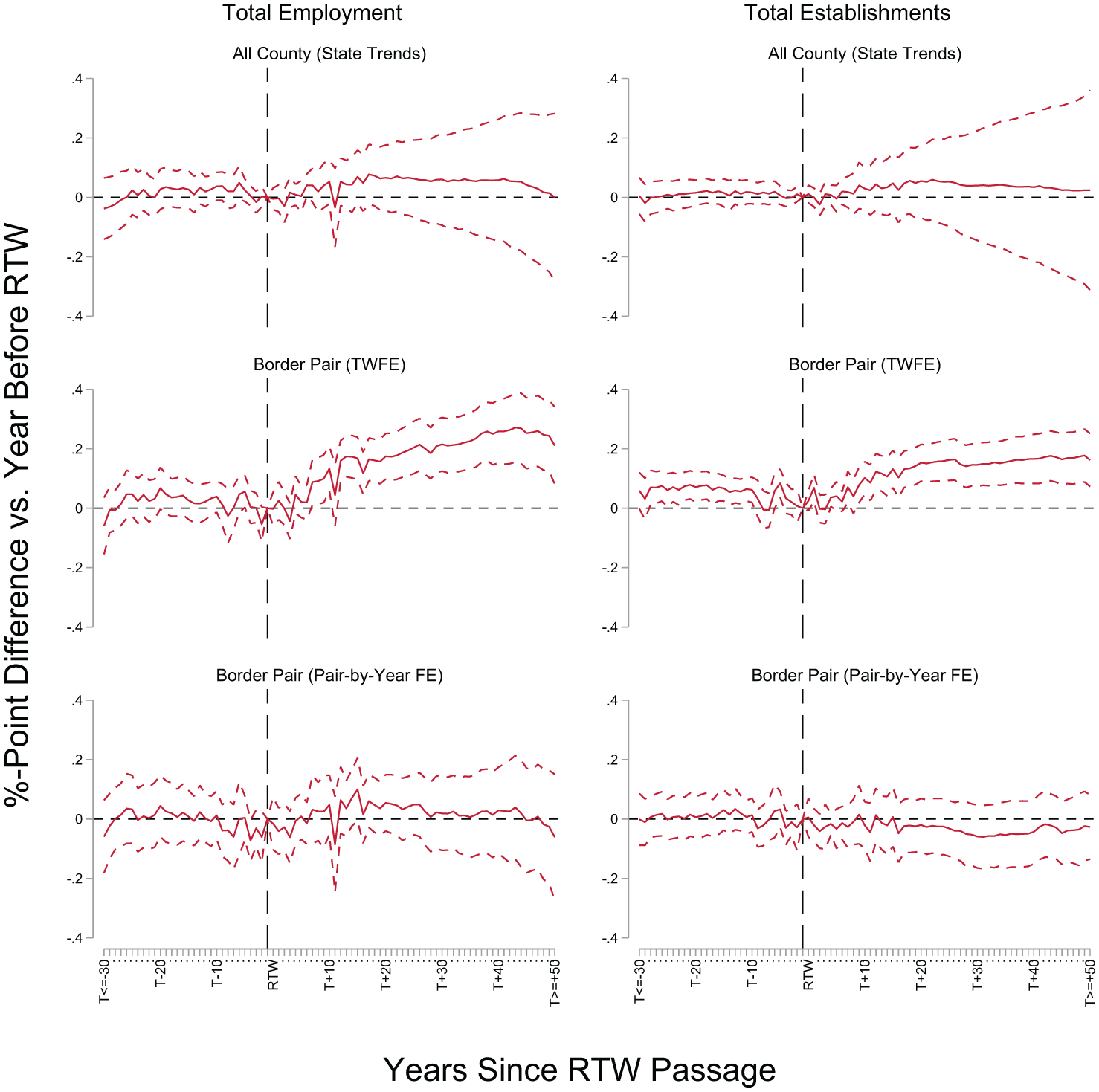
Trimmed Two-Way Fixed-Effects Event Study Models Predicting Log Employment and Log Establishments.
What about manufacturing? Figure 4 presents the event studies for manufacturing employment and establishments. We see no significant changes in manufacturing employment in the post-RTW period for the all-county sample with state-specific time trends. For the border-pair sample, we see a similar pattern as above, where the models without county-border-pair-by-year fixed effects suggest increasingly positive associations for manufacturing employment; in the models with simple county and year fixed effects, manufacturing employment is 20 percentage-points higher 20 years post-RTW and almost 50 percentage-points higher 50 years post-RTW. When border-pair fixed effects are included, however, we see few significant long-term differences. Moreover, all models show evidence that manufacturing employment was significantly lower in RTW counties in the periods leading up to RTW passage. This suggests RTW counties experienced divergent trends prior to RTW, challenging the parallel trends assumption. Thus, even if RTW counties had higher levels of manufacturing employment, the pre-trends cast doubt on a causal link between manufacturing dynamism and RTW. In addition, we find null associations in the long term for manufacturing establishments in both all-county and border-pair samples (results for service establishments and establishments by size category are in Figures S3 and S4 in the online supplement).
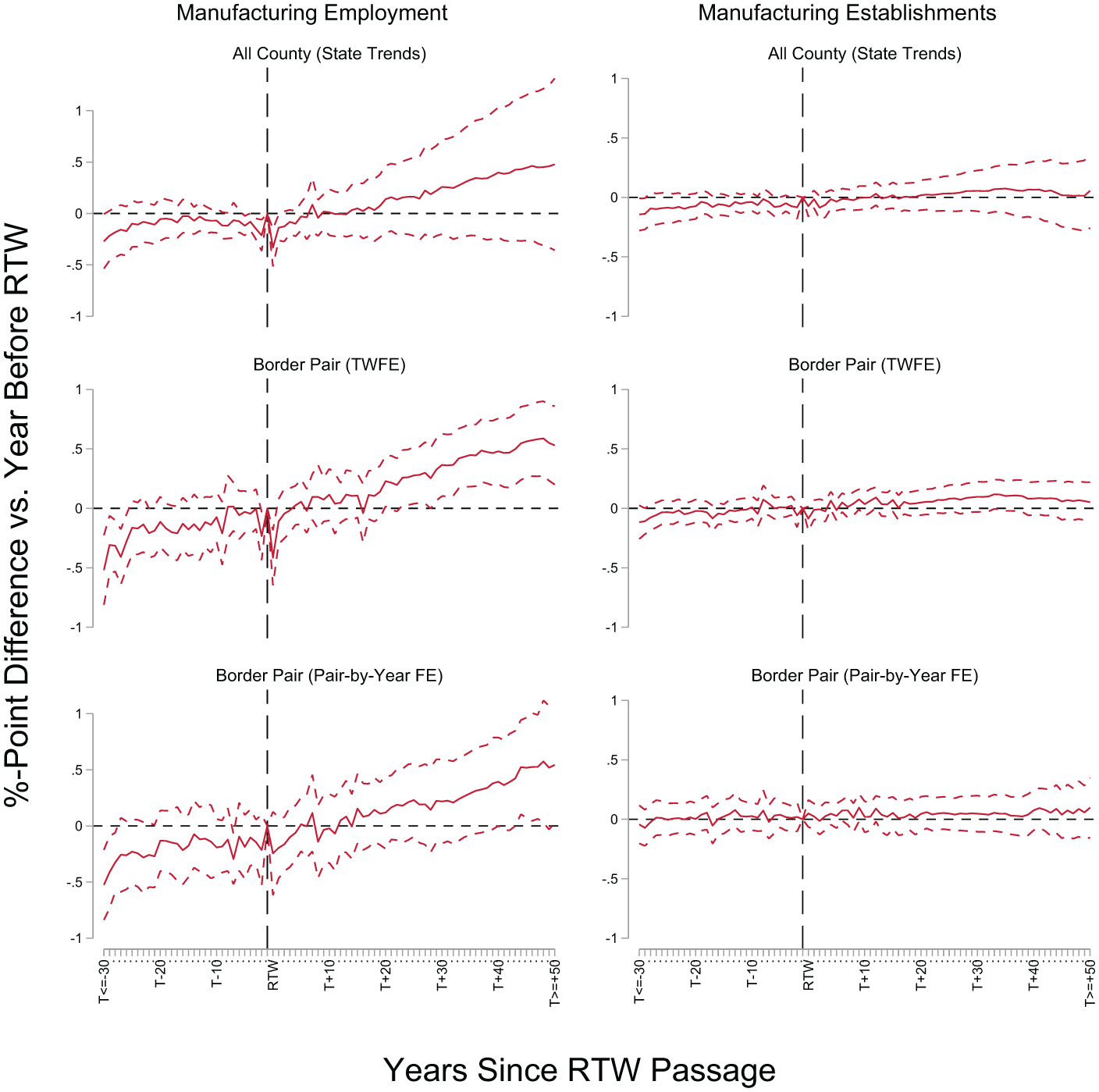
Trimmed Two-Way Fixed-Effects Event Study Models Predicting Log Manufacturing Employment and Log Manufacturing Establishments.
Alternative Specifications and Robustness Checks
We tested several alternative specifications and sensitivity checks to assess the robustness of our results, including alternative constructions of the dependent variables and more direct measures of economic dynamism, such as labor productivity from the Economic Policy Institute and establishment formation and start-up employment from the Census Bureau’s Business Dynamics Statistics. We also tested for potential effect heterogeneity bias by re-estimating our models excluding cohorts of treated RTW states. Assessing sensitivity to particular RTW cohorts addresses questions about potential variation based on differences in union power and the industrial structure of early- versus later-RTW adopting states. In addition, we re-estimated the core models including controls for state policy liberalism (Caughey and Warshaw 2016), to account for potential confounders on state economic policy changes. Finally, we tested for a key potential source of bias in the county-border-pair fixed-effects models: that any substantial spillover effects between geographically proximate locales will tend to downwardly bias RTW effects (Dube et al. 2010; Jardim et al. 2022). We directly tested for potential spillover effects by examining how border counties in non-RTW states change after RTW is implemented in a neighboring county, relative to counties located in the same non-RTW state that do not share a border with the new RTW county. The results, discussed in greater detail in the online supplement, generally support our conclusions (see Tables S1 to S5 and Figures S1 and S2).
Evidence for Competitive Labor Policy Mitigation
The competitive labor policy mitigation perspective suggests the null findings presented above may partially reflect a dynamic response of non-RTW states to remain competitive relative to a growing number of RTW states via alternative policy levers that do not directly challenge unions. To empirically examine this possibility, we first assess changes in state tax and incentive policy generosity between RTW and non-RTW states from the 1960s to the 2010s. Specifically, we estimate fixed-effects regression models predicting tax and incentive policies, including an interaction between time-varying RTW status and a linear time trend.
Results are presented in Figure 5. Across all measures, we find trends consistent with our expectation of convergence. At the beginning of the period, non-RTW states had higher or similar net tax rates than RTW states. Between 1960 and the 2010s, non-RTW states converged to the lower net tax rates of RTW states. This convergence was driven by two factors. First, non-RTW states reduced their taxes on businesses, whereas RTW states maintained consistent and lower taxes. The total dollar amount of net taxes on production grew in both types of states during this period, but it grew faster in RTW states, such that RTW states collected more in net taxes than did non-RTW states by the 1990s. Second, non-RTW states maintained higher incentives than RTW states for most of the period. Although incentives declined in both state types as a percent of GDP during this period, the gap between non-RTW and RTW states increased. 16
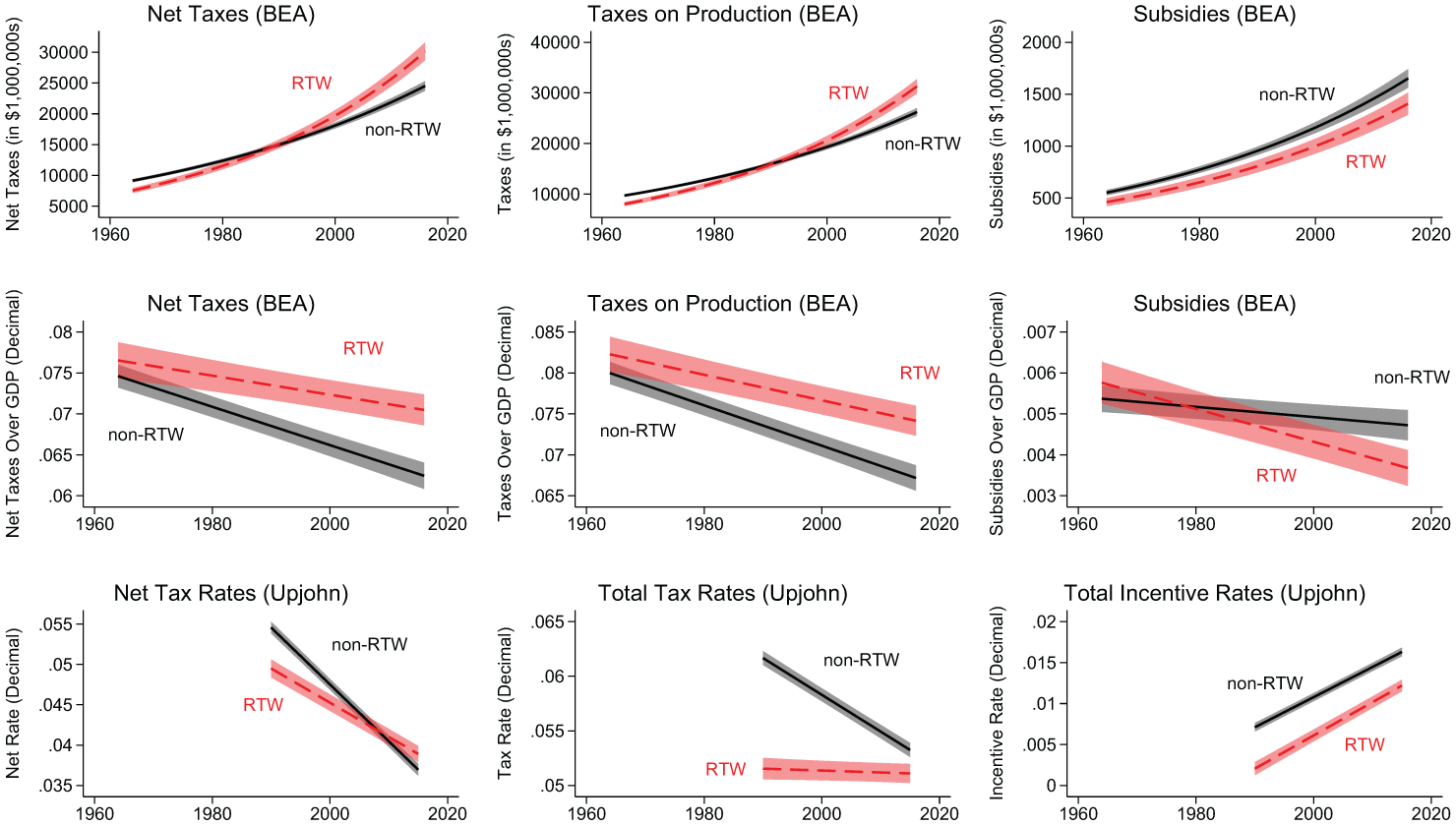
Trimmed Two-Way Fixed-Effects Models Predicting State-Year-Industry Tax and Incentive Rates.
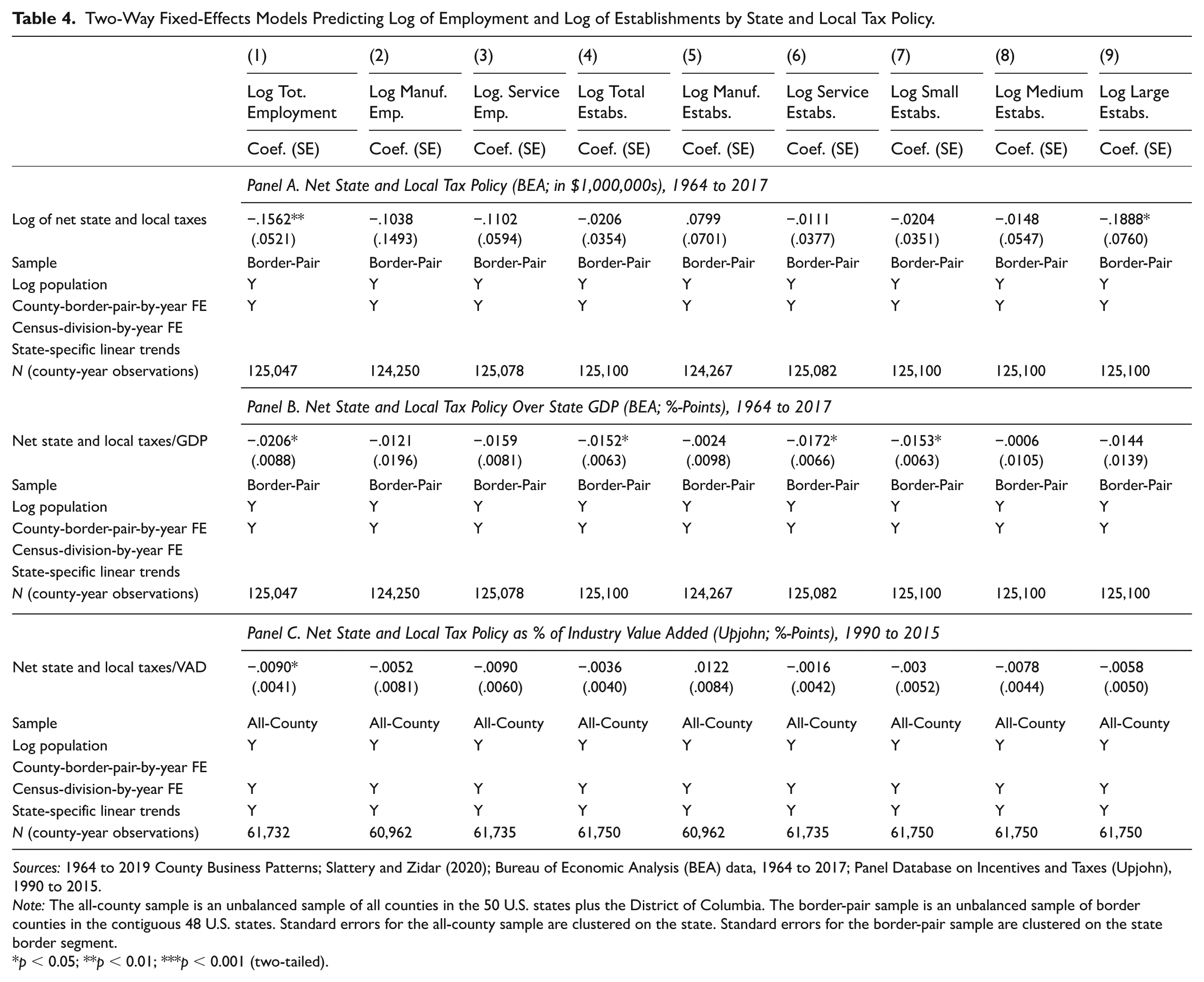
Next, we examine if changes in the burden of state tax policies influence economic dynamism. We merged the BEA and Upjohn data with the CBP dataset and predicted county-level employment and establishment counts for the years tax data are available. We collapsed the Upjohn data to the state level, such that it measures the sum of taxes paid relative to the sum of value added across all industries in the state-year. We estimated county-border-pair-by-year fixed-effects models for the BEA measures; for the Upjohn data, we estimated models using the all-county sample with state-specific linear trends, because the tax data are not available for all states, which makes border-pair analyses infeasible. We focus on net taxes as a comprehensive measure of the burden of taxes on business in the state, where negative coefficients indicate that making tax policies more burdensome for business is associated with decreased dynamism.
Table 4 presents the results. Across all measures of tax burden, we find consistent evidence that making taxes less burdensome for businesses is positively associated with county economic dynamism. We find the most robust evidence for total employment, where decreases in net tax burdens are associated with significant increases in employment, in both the county-border and all-county samples. Column 1 in Panel A, for example, indicates that a 1 percent increase in the burden of taxes is associated with a 0.16 percent decrease in total employment. Decreases in net taxes as a percent of state GDP are also associated with increases in total establishments, service establishments, and small establishments, but these findings are not replicated when the log of net tax policy burden or the net tax rate as a percent of value added are used as predictors. 17
Two-Way Fixed-Effects Models Predicting Log of Employment and Log of Establishments by State and Local Tax Policy.
Sources: 1964 to 2019 County Business Patterns; Slattery and Zidar (2020); Bureau of Economic Analysis (BEA) data, 1964 to 2017; Panel Database on Incentives and Taxes (Upjohn), 1990 to 2015.
Note: The all-county sample is an unbalanced sample of all counties in the 50 U.S. states plus the District of Columbia. The border-pair sample is an unbalanced sample of border counties in the contiguous 48 U.S. states. Standard errors for the all-county sample are clustered on the state. Standard errors for the border-pair sample are clustered on the state border segment.
p < 0.05; **p < 0.01; ***p < 0.001 (two-tailed).
Finally, we include state tax policy burden measures in models from the first stage of our analysis. The dynamics of policy diffusion imply that non-RTW states responded to previously established RTW threats. Thus, the changes in non-RTW tax and incentives may have been in response to effects of RTW dynamism in earlier periods, when there was a greater tradeoff between RTW and non-RTW states in terms of tax policy, compared to more recent periods. We test this expectation by re-estimating our models for the all-county and border-pair samples, adding interactions between RTW and decade, with unit-specific linear time trends. For the periods we have tax and incentive policy data, we also include interactions between each of the tax policy variables and decade, to assess tax policy as a potential explanation. Although data limitations prevent us from conducting formal mediation analyses, especially as we lack historical information on motivations for tax policy changes, this triangulation of evidence allows us to establish the viability of the competitive labor policy mitigation explanation.
Figure 6 presents the results for employment (for similar results for establishments and establishments by size, see Figures S5 and S6 in the online supplement). Across all outcomes, the left column shows consistent evidence that RTW had modest, although in many cases significant and positive, associations with county-level economic dynamism in early decades. These associations tend to be strongest during the 1950s to 1970s, fade by the 1980s to 1990s, and in some cases, become negative during the 2000s and 2010s. However, when controls for decade-specific tax policies are included in the models, for the years these data are available (both middle and right columns), the RTW coefficients are reduced in magnitude, and, in nearly all cases, nonsignificant.
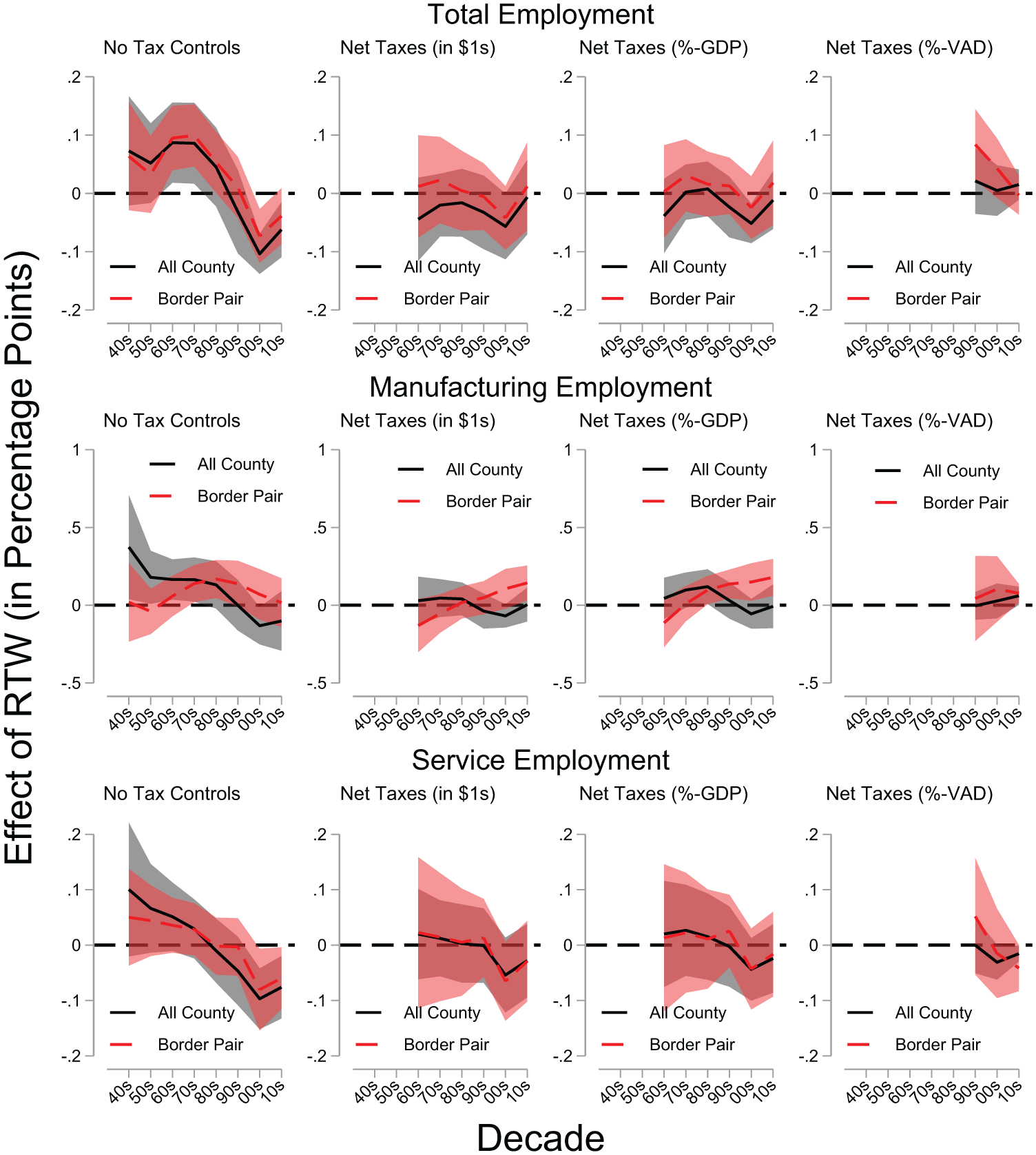
Trimmed Two-Way Fixed-Effects Models Predicting Log Employment by Decade.
The triangulation across these conclusions—that taxes and incentives are predictive of employment, that non-RTW states reduced their tax burden in the decades following the initial wave of RTW laws, and that early-period positive RTW associations are detectable and accounted for by tax burden variation—provide suggestive evidence for the role of non-RTW policy action to mitigate RTW-induced dynamism and reestablish a competitive equilibrium across RTW contexts. Together, these findings are consistent with the theoretical mechanism of competitive labor policy mitigation: non-RTW states converged with RTW states in recent years to create tax environments that are more competitive, and, at least for employment, there is evidence across three distinct data sources that making taxes more generous for employers is associated with payoffs for local economies. Moreover, while we observe relatively modest RTW–dynamism associations during the 1950s, 1960s, and 1970s, these effects faded over subsequent decades, when non-RTW states shifted tax policy toward more business-friendly climates. We argue that these findings may explain the lack of a long-term dynamism payoff. Although we are unable to document the specific motivations for tax policy changes in non-RTW states, the results are at least consistent with the theoretical argument that mitigative policy action in non-RTW states may have blunted anything but a fleeting payoff among early RTW adopters, resulting in a more durable and long-term null effect on economic dynamism.
Discussion and Conclusions
A growing literature on the consequences of state RTW laws documents effects on commonly studied inequality and political outcomes (Dixon 2020; Feigenbaum et al. 2018; Jung and VanHeuvelen 2024; VanHeuvelen 2020, 2023; Wallace et al. 2021), yet critical questions of how RTW affects economic dynamism have been largely sidestepped. This is surprising as a key argument raised by proponents of RTW is that such laws loosen the grip of harmful union monopolies, allowing businesses to make more productive investments, adapt to changing conditions, grow, and hire more workers, thereby increasing employment and establishment concentration. Institutionalist theories alternatively suggest that unions may have first- and second-order beneficial effects on firm performance and local economic conditions, with RTW creating relatively worse conditions for economic dynamism. The lack of knowledge on this topic is surprising given broad interest in questions of economic dynamism across several sociological subfields (Brand 2015; Fligstein and Goldstein 2022; Wilson 1996).
We contribute new evidence on the relationship between RTW laws and economic dynamism by drawing on various data sources to construct a comprehensive county-level dataset spanning almost a century. Using a sample of all U.S. counties and “trimmed” two-way fixed-effects models, we find that RTW is associated with small, and highly uncertain, increases in total employment counts and total establishment counts at the county level. However, we also suggest that these estimates may reflect problematic comparisons that lump together treatment and control counties that were exposed to unobserved local trends correlated with, but distinct from, RTW passage. At most, we find that the few modest positive effects of RTW on local economic dynamism had become substantively insignificant by the 1970s.
Leveraging county-border-pair fixed effects to more convincingly isolate the causal effects of RTW on counties that share a common border, we continue to find few significant overall effects of RTW on employment or establishments. County-border-pair event study models further suggest that RTW passage does not significantly affect the number of employees or establishments up to 50 years following the law’s passage, indicating any early associations had little durable or long-run effects. We find some evidence for long-term positive effects on manufacturing employment, but we also find these effects predated law changes. This means we cannot rule out the possibility that factors other than RTW passage might be driving these associations. We also observe no significant long-term effects on manufacturing establishments, service establishments, or establishments employing 500 or more people.
Building on insights from the policy diffusion literature (DellaVigna and Kim 2022; Karch and Cravens 2014), we suggest these null associations likely occurred through competition on alternative policies by non-RTW states to mitigate any RTW threats. Policymakers may respond creatively to potential competitive threats from RTW without undercutting labor, often a core political ally (Feigenbaum et al. 2018; Rosenfeld 2014). Tax incentives are perhaps the most widely deployed policy response to attract and retain firms to local jurisdictions (Bartik 2019; Greenstone et al. 2010; Moretti and Wilson 2017; Slattery and Zidar 2020), and they provide similar opportunities to boost local firms’ profits as RTW’s theorized negative effect on labor costs. We find that non-RTW states made drastic tax cuts to achieve parity with RTW states and had consistently higher rates of incentives. We also find consistent evidence that as states enacted more business-friendly tax and incentive policies, local employment grew. RTW may have worked as advocates expected prior to the 1970s—decades with starker differences in tax incentive policies across RTW state types—but by the 1980s and 1990s, non-RTW and RTW states converged on corporate tax rates and incentives.
The finding that non-RTW states may have used tax policy to partially neutralize the competitive threat of RTW states without directly challenging labor makes important contributions to the literatures on states as political environments and spatial inequality across states and regions. A robust stream of research highlights the utility of the subnational scale for understanding the effects of policy environments (Berger et al. 2024; Brady et al. 2013; Montez et al. 2020), but interstate mechanisms are rarely a primary theoretical focus (Lobao, Hooks, and Tickamyer 2007). Our competitive labor policy mitigation theory, wherein non-RTW states use alternative pro-business policies rather than adopting RTW, suggests it is unrealistic to posit states as static actors on either side of a binary choice of policy adoption. We argue instead for a broader perspective that focuses on how states learn from, and creatively adapt to, choices made by policymakers in other states. This argument, developed from the insights of the policy diffusion literature, opens a new line of research for subnational inequality scholars to consider such dynamic policy responses across state actors and across various spatial scales.
More generally, our competitive labor policy mitigation perspective weds the rationalistic focus on profit maximization from the union monopoly model with the broader policy perspective of institutionalist theories. It is reasonable to expect policymakers to focus on the profitability of local firms, as the union monopoly model emphasizes. Yet institutionalist theories demonstrate that unions and labor power produce a broader system of policies, regulations, and practices that can ultimately result in robust, dynamic local economies. These insights suggest policymakers can focus on profits but not get locked into a narrow set of policy levers to remain competitive. This claim has substantive and methodological implications. Substantively, our core theoretical innovation situates states within a dynamic framework that allows policy responses to be borne out of local social and political conditions, rather than based on the static and unrealistic assumptions of binary choice over whether or not to adopt a singular policy. The shifting of policy responses to alternative levers is what differentiates competitive labor policy mitigation from existing theoretical perspectives, such as the “race to the bottom” (e.g., Chirinko and Wilson 2017; Davies and Vadlamannati 2013), which emphasize a coherent movement by all states or other political territories toward a uniformly antilabor policy framework.
Methodologically, our results also confirm a basic point that has long been recognized, although perhaps insufficiently appreciated in applied research: that policy treatments can contaminate untreated areas. For example, as Stanley Lieberson (1985:53) famously argued, “taxpayer revolts” do lower property taxes, but because policymakers in states without taxpayer revolts may respond by voluntarily lowering taxes or reducing government spending, the straightforward comparison fails to detect any effect. While the treatment provoking a counter that nullifies the treatment is a classic problem for counterfactual causal inference, our case study of RTW laws and state tax incentive policy suggests scholars should consider such nullification as providing a potential window into important underlying social and political mechanisms.
The current study has several limitations. First, while we construct a more historically comprehensive dataset than most prior studies, our use of county-level data means we are unable to follow individual firms as they exit or enter RTW contexts. Thus, we cannot speak to the potential effects of RTW on the same businesses before and after the law passage. Second, while we focus on economic dynamism across counties located in the United States for theoretical and methodological reasons, we recognize that non-RTW states might have been more vulnerable to offshoring to countries with fewer labor protections in later decades. For example, it could be that the few positive RTW effects we observed disappeared by the 1970s because, during this period of increased relocation of manufacturing jobs to the Global South, unions were more engaged in concessionary bargaining and give-backs (Cowie 2001; Rosenfeld 2014). Future research on the potential global effects of RTW would follow pathbreaking cross-national research on labor law, unions, and inequality (Kerrissey 2015; Mahutga, Gao, and Pandian 2025). Third, and related, while our county-border-pair fixed-effects models leverage spatial proximity to account for potential unobserved confounders, they do not fully account for all possible mechanisms, including prospects of domestic capital flight (e.g., firms moving from the industrial Midwest to the Sunbelt) and potential foreign investment in non-border RTW counties (e.g., foreign auto manufactures building plants in the Southern states). Although our all-county analyses capture some of this, we emphasize that the potential for time-varying, regionally specific confounders makes it challenging to attribute a causal effect of RTW for all possible sources of domestic and international capital flows. Finally, while we find evidence suggestive of competitive labor policy mitigation, data limitations mean we are unable to conduct a formal mediation analysis, identify specific motivations for the tax policy changes, or estimate a precise treatment effect of tax and incentive changes targeted at specific firms. Future mixed-methods research using a longer time-series of tax policy and archival data is needed to provide a more comprehensive study of tax policy changes in response to state RTW legislation.
Despite these limitations, the current study has important policy implications. First, the evidence fails to support claims of a tradeoff between strong labor market institutions and economic dynamism. Stratification scholars have convincingly shown that stronger labor market institutions reduce poverty and many types of inequality (Brady et al. 2013; Montez et al. 2020). Our findings suggest these benefits are not necessarily offset by costs to economic dynamism, a finding consistent with cross-national research (Bradley et al. 2003; Kenworthy 2019; Kerrissey 2015). Yet by the same token, we also fail to find that RTW laws are necessarily harmful to local economies. Instead, divergences between dynamic and sclerotic regions of the United States were more likely driven by factors beyond state labor policy context.
Second, our findings highlight policies that do not directly challenge organized labor as alternatives to boost economic dynamism. Tax and incentive policies are commonly used by policymakers, and while we emphasize that this approach is potentially costly and does not always lead to sustainable long-term growth (Bartik 2019; Partrick 2016; Slattery 2025), it does make a consistent, although relatively modest, difference in employment growth, potentially avoiding a “race to the bottom” on labor policy. Our study also contributes to a growing fiscal sociology literature that focuses on subnational fiscal policy, or the system of local taxation and spending, as a key driver of inequality (Manduca, Highsmith, and Waggoner 2025; Martin and Prasad 2014; O’Brien, Schechtl, and Parolin 2025). This work highlights the caution that generous corporate tax incentives may come at the cost of other important public investments, such as education, the social safety net, and infrastructure (O’Brien et al. 2025).
We conclude by underscoring the main takeaway of our study, and the necessary research agenda we point toward: simply put, across more than three-quarters of a century, we find little evidence that RTW unlocks economic dynamism, despite such arguments being a common justification for RTW laws (Dixon 2020; Hertel-Fernandez 2019; Jacobs and Dixon 2006; Wallace et al. 2021). At best, RTW cannot be differentiated from a broader system of changes, including the rise of indoor air conditioning, federal investments in transportation infrastructure (Holmes 1998), and, as we point to here, state corporate tax policy differences, that produced economic growth in the American South and Southwest. It is more reasonable to conceptually bundle RTW laws into the broader policy toolkit used to unify employers against labor (Clawson and Clawson 1999; Dennis et al. 2017), or, perhaps in the contemporary historical context of a weakened American union movement, a partisan project aimed at defunding a key Democratic Party base of support (Hertel-Fernandez 2019). Nevertheless, a triangulation of descriptive and model-based findings suggesting that non-RTW states made strategic responses to remain competitive with RTW states opens the possibility of real economic dynamism having been thwarted by the counteraction of non-RTW states. Future research on the policy foundations of inequality should situate policy effects in their dynamic contexts.
Supplemental Material
sj-pdf-1-asr-10.1177_00031224261433186 – Supplemental material for State Right to Work Laws and Economic Dynamism in U.S. Counties, 1946 to 2019
Supplemental material, sj-pdf-1-asr-10.1177_00031224261433186 for State Right to Work Laws and Economic Dynamism in U.S. Counties, 1946 to 2019 by Alec P. Rhodes and Tom VanHeuvelen in American Sociological Review
Footnotes
Acknowledgements
Previous versions of this manuscript were presented at the 2024 Association for Public Policy Analysis and Management Fall Research Conference in National Harbor, MD; the 2024 Annual Meeting of the American Sociological Association in Montreal, QC, Canada; and the RC28 Summer 2024 Meeting at Brown University in Providence, RI.
Funding
The authors received no financial support for the research, authorship, and/or publication of this article.
Declaration of Conflicting Interests
The authors declared no potential conflicts of interest with respect to the research, authorship, and/or publication of this article.
Data Availability Statement
Replication materials including the analysis dataset and code can be accessed online at the following GitHub repository:  . The raw CBP files that we used to construct the analysis dataset are publicly available from Eckert and colleagues (2020, 2022) and the NGHIS repository on the IPUMS website (Schroeder et al. 2025).
Notes
Author Biographies
References
Supplementary Material
Please find the following supplemental material available below.
For Open Access articles published under a Creative Commons License, all supplemental material carries the same license as the article it is associated with.
For non-Open Access articles published, all supplemental material carries a non-exclusive license, and permission requests for re-use of supplemental material or any part of supplemental material shall be sent directly to the copyright owner as specified in the copyright notice associated with the article.
