






Abstract

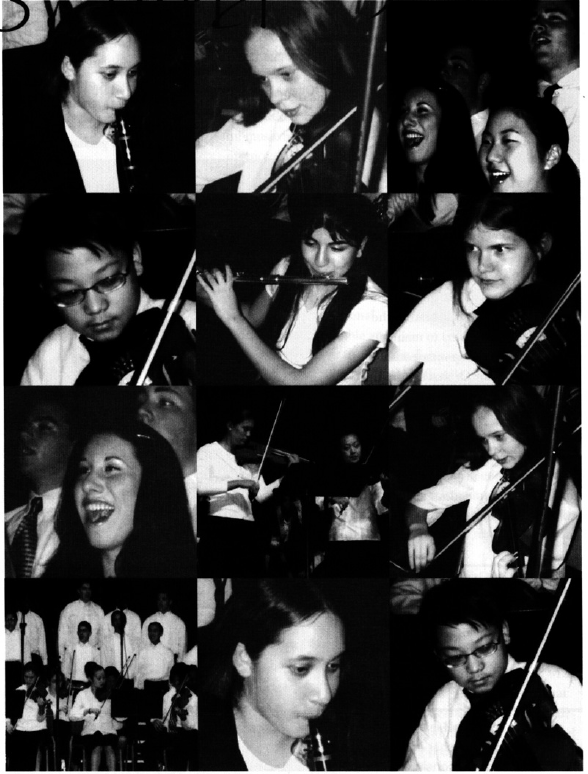
It wasn't your typical high school band or orchestra concert
Oh yes, the beginning groups performed, followed by selections of standard repertoire by the symphonic band and the string orchestra. But the high point for many in the audience was still to come. Within minutes after the closing of the Hornpipe from Handel's Water Music Suite No. 2, the stage was transformed. The piano was wheeled in, the choral risers were locked into place, the drum set was hauled out, the microphones were set in place, the guitars were plugged in, and the school's top wind and string players took their seats. The teacher called out the beat and the show was on.
The jazz/pop orchestra, complemented by selected singers from the vocal ensemble and the school's top dance team, put on a fast-paced, energetic revue of Broadway hits. The performance featured costume changes, jazzy violin duets, trombone solos, screaming saxophones, slithering clarinets, beautiful vocal moments, and quiet flute passages. At Taft High School in Woodland Hills, California, the world of music education had met the world of commercial music—in the jazz/pop orchestra.
A jazz/pop orchestra, also called a studio orchestra, is defined by its unique instrumentation, but mostly by the music it plays. Just about every style of music in films, television, or on the radio makes some use of a studio orchestra—including pop, rap, hip hop, country, straight-ahead rock ‘n roll, and jazz. The studio orchestra is the backbone of the daily work world of the music business in the major music cities in America.
Resembling the real world of commercial music more than any other type of school music group, a jazz/pop orchestra is a very simple adaptation of what already exists in most high school music departments. The studio orchestra can perform on its own or with the school's show choir and dance ensemble, adding a higher degree of sophistication than a performance with a cassette tape or simple rhythm section. A school can produce a musical the way musicals are produced on Broadway— with a real orchestra rather than a couple of synthesizers and a drum set. Even alone, the jazz/pop orchestra is in demand for performances at school functions, community events, and even at other schools.
A jazz/pop orchestra gives string players the opportunity to participate in styles of music that in most schools are usually the exclusive domain of the jazz band. Learning and applying musical concepts used in jazz and pop music will open up new doors for string players and make more students want to stay in the string program. The jazz orchestra is the most coveted music performing group at Taft High School. The competition to get in has helped raise the overall level of competence in the performing arts department of our school.
Elements Needed to Get Started
Most schools already have the elements in place needed to develop a studio orchestra, namely a jazz band with a rhythm section. In addition to a few of the best players from the jazz band, bringing in a couple of flutes and clarinets from the symphony orchestra or concert band gives the jazz orchestra a very classy touch. Without strings, of course, there is no orchestra, no matter what someone may wish to call it. Strings open up the dynamic range from whisper quiet to full-bodied fortissimo and provide the needed contrast to the wind and rhythm sections with those high, soaring passages, the quick runs up the scale, driving repeated sixteenth notes, and all the nuances that strings are capable of. The jazz/pop orchestra at Taft High School consists of two trumpets, two trombones, alto and tenor saxophones, two clarinets, two flutes, strings, and a rhythm section.
The strings in a jazz/pop orchestra will probably have to be amplified. If the group has too many string players then it may not fit into some performance venues, especially if the orchestra is backing up the dance team or show choir. With fewer players, the strings will have a tough time being heard in balance. Our string section for the jazz orchestra has fourteen to sixteen players.
A sound system represents a sizable investment, so it shouldn't be purchased without considerable thought. My group uses six microphones on the strings, one for the flutes, one for the clarinets, one for the piano, and three to six for the singers. Your school may already have a sound system that could be adapted to your needs, at least until the ensemble is established enough to justify the expense.
Adding about a dozen singers from the school's vocal music department is worth the extra work. To really make the show visually appealing, see about getting a dance team together. A drill team or color-guard instructor at your school can help with choreography.
When, Where, and How
Most high school students don't have room in their schedules to take any more than one fine arts class at a time. Therefore, the studio orchestra at Taft High School is not a separate class, but rather meets once per week after school. As performances approach, the after-school practices increase.
I try to lay some of the ground-work during the regular string orchestra class. We don't actually play much of the studio orchestra music in the regular string class, but because we cover some jazz basics as part of our daily warm-ups, the students are more prepared to play the music in the after-school rehearsals. For example, we play swing scales accompanied by the “rhythm section” in my computer. I have MIDI files playing a basic twelve-bar blues progression in twelve major keys. These scales help string players learn to swing. Example 1 (on the next page) provides examples of swing scale and arpeggio exercises.
Rhythm practice consists of taking a two-bar jazz rhythm that might be found in a standard jazz band piece and playing it to different scale tones. (See Example 2.)
The string music we play in our jazz orchestra is not too difficult. I keep it on the easy side for two reasons. First, we are only into our third year with a string program, and most of our string players started out in high school (although in the first two years I had some experienced violinists who were part of our group but have since graduated). Second, because we only meet once a week, we don't have time to work out difficult passages. I try to make parts easy enough to learn quickly. If you're using a computer to write out your parts, it's easy to make MIDI files of the parts so the students can hear them on their computers at home, and play along. This practice cuts down on the learning curve.
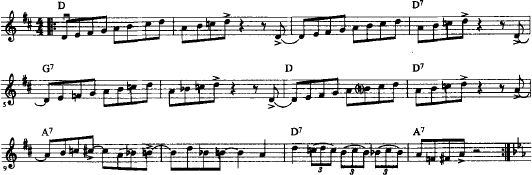
Practics Swing Scale | ©Steve Burch 2001
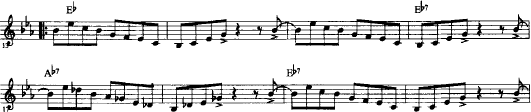
Blues Exercise for String | ©Steve Burch 2001
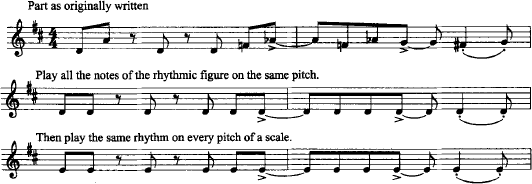
Rhythm Exercise
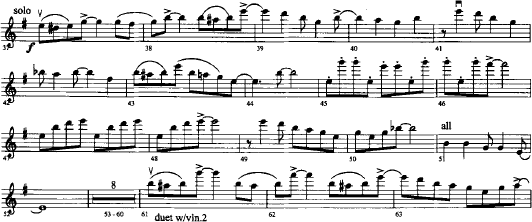
I Violin Solo written by Burch for forty-second Street by H. warren & A. Dubin
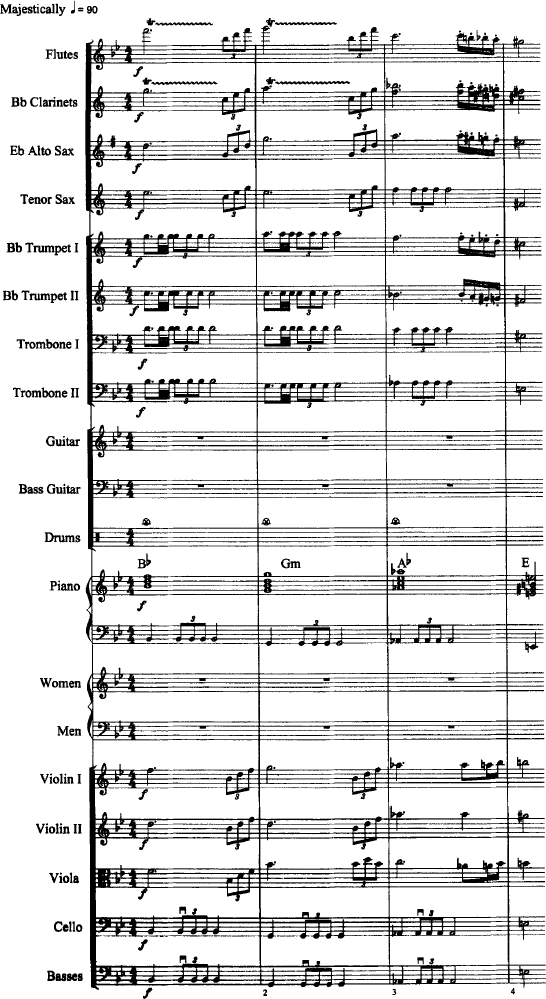
I Broadway Medley (Cabaret, One. Somewhere, Forty-second Street, Little Shop, All That Jazz) I arranged by Steve Burch; arrangement ©Steve Burch 2001
Getting the Music
Admittedly, the most troublesome part of developing a jazz/pop orchestra is the lack of published music. The large music publishers don't publish for it because there is no real market for it—at least not yet. Decide on what songs you want to play, then buy an arrangement that is close to the instrumentation you need. Some arrangements for show choir already come with limited instrumental arrangements, usually for a few horns and a rhythm section. Another place to start is with traditional jazz band arrangements.
The next step is to adapt the arrangement for your group. Write string parts that complement the arrangement. To avoid copyright infringement, be sure to contact the publisher for permission to arrange the work for educational use. When writing string parts to an existing arrangement, try to have parts that sound like they were written for the strings rather than merely following the lines of the wind instruments.
Example 3 is the first violin part of “Forty-Second Street” with a solo about halfway through the song. The music for the first violin section is relatively easy, while the solo section is more challenging.
Once you have some experience adding string parts, the next step is to write an arrangement in which the strings are prominently featured, rather than an addition. The best arrangements are usually those that use strings as an integral part of the music rather than as an after-thought. If you find the task a little too daunting, consider challenging some students to do it for you. Students who already have an interest in writing or arranging may also already have a good music notation program. You could also contact your local community college or university music department to find a student who is interested in doing some arranging for you. Example 4 provides some ideas for instrumentation.
A Fun Recruting Tool
Developing a studio orchestra can be the ticket to broader concert attendance and the community support that comes with it. String teachers sometimes struggle to keep string programs alive in schools, especially at the high school level. String programs in high school often suffer when compared to wind and percussion programs for a variety of reasons. In most school districts, survival is dependent on numbers. Developing a studio orchestra that reflects practices in the world of commercial music is a good way to attract and keep students in the strings program in high schools. Besides that, the music is fun to play and perform. The elements are already there in many schools. All that is needed is someone to bring those elements together.
If your school already has some sort of studio
orchestra, or if you know of publishers who specialize in arrangements for jazz/pop orchestras, the author wants know about it! Please email Steve Burch at
To hear how the musical examples sound
you can download a sample MIDI file by going to the ASTA website. Click on JAZZ STRING ORCHESTRA to download some free swing scales and MIDI files.