Abstract

ASTA WITH NSOA has perceived a string teacher shortage for many years now, based on anecdotal evidence. But now, the association has statistical evidence of such a shortage, thanks to a study completed by the ASTA WITH NSOA National Research Committee consisting of Donald L. Hamann, chair, Robert Gillespie, and Louis Bergonzi. In addition, the recent study helps to confirm previous studies on the status and nature of string and orchestra programs in the public schools.
To date, at least seven studies have been conducted to assess the status of string instruction in American public schools. (See the sidebar on page 75.) In general, what was reported in these studies was that:
Orchestral enrollment has increased each year.
About 25 percent to 30 percent of the string teachers are not string players.
The majority of string programs are found in suburban settings and larger schools are more likely to offer string instruction than smaller schools.
String instruction generally begins in the fourth and fifth grades.
Beginning string instruction classes are usually heterogeneous.
The ASTA with NSOA Study
The focus of the most recent ASTA WITH NSOA-funded study was to assess information pertaining to orchestral programs in the following five areas:
Orchestra Teacher Profile
Orchestra Program Profile
Orchestra Program Support
Staffing and Hiring Practices in the Orchestral Program
Orchestral Students
All fifty states were represented in the survey returns. Of the 2,139 surveys sent out, 920 were returned for a response rate of 43 percent.
Orchestra Teacher Profile
Fifty-eight percent of the orchestra teachers were female and 42 percent male, with 54 percent holding a masters, 43 percent a bachelors, and 3 percent a doctoral degree. The average number of years a teacher taught strings was fourteen. About 80 percent of the teachers were string players. Seventy-nine percent of the teachers indicated their primary teaching area was strings. About 78 percent of teachers said they would probably not retire in the next five years, while 22 percent said it was somewhat to extremely likely they would retire within five years.
Teachers tended to teach at more than one level. About 45 percent of the teachers taught at the elementary level, 74 percent at the middle/junior high level, and 60 percent at the high school level; only 59 percent of the teachers indicated their teaching assignments were completely in strings.
Orchestra Program Profile
The average number of students taught at any given elementary school was about sixty-four students; at the middle/junior high, sixty-seven students; and at the high school, the average was fifty-one students. Twelve percent of elementary string students were taught by teachers who were not string players, while 16 percent of students at the middle/junior high level were taught by non-string players. An even greater percentage of students, 21 percent, were taught by non-string players at the high school level.
About 95 percent of the string classes were held during the regular school day, and about 88 percent of those classes were heterogeneous. Full orchestra was taught at 65 percent of the high schools, 30 percent of the middle/junior highs, and 5 percent of the elementary schools. The most common program enhancements offered before and after school were chamber orchestra and chamber music, followed by fiddle, guitar, strolling strings, and mariachi.
The most popular grade to begin strings was the fourth (31 percent), followed by the fifth (30 percent) and sixth (23 percent) grades. High school tended to present an average of six concerts per year, with middle/junior highs giving five and elementary schools three per year. About 30 to 50 percent of these concerts were presented off school grounds.
Orchestra Program Support
Only 58 percent of the teachers believed their teaching space accommodations were adequate or more than adequate, while 42 percent thought their accommodations were less than adequate. Sixty-seven percent of the teachers share a room with band, choir, general music, academic or other fine arts classes, or teach on a stage, cafeteria, closet, or hallway. About 62 percent of the teachers said there was an orchestra curriculum, and of those with a curriculum, 73 percent said they used it. In general, orchestra teachers feel strong support from their music teaching colleagues, parents of students, building principals, private teachers, school counselors, district administrators, and non-music teaching colleagues, respectively. The vast majority of teaching evaluations are conducted by a building principal (82 percent), with the remainder of evaluations being conducted by a music supervisor, music coordinator, or other individual. Financial support increased for 25 percent of the programs, decreased for 20 percent, or stayed about the same for 55 percent of the programs.
There will be a
Starting and Hiring in the Orchestral Program
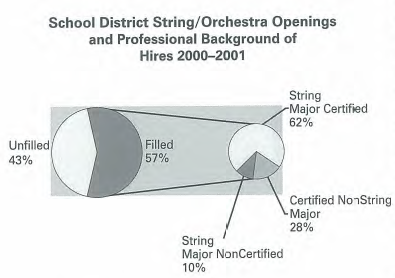
Forty percent of the respondents stated that the number of string teachers increased in their district, 50 percent said the number stayed the same, and only 10 percent said there was a decline in the number of string teachers in their district. Twenty-four percent of string positions went unfilled in 1999–2000. In 2000–2001, 43 percent of the districts had strings positions that were not filled. Of the filled positions, 62 percent were filled with certified teachers whose primary instrument was strings, and approximately 28 percent of the positions were filled with certified teachers whose primary instrument was not strings. The remaining 9 to 10 percent of teachers whose primary instrument was strings were not certified.
More than half of the districts indicated that they anticipate string openings in 2001–02, 2002–03, and 2003–04, suggesting there will be more than 5,000 string/orchestra positions in the next two years. More than 5,000 programs will be in need of string teachers in the immediate future.
Orchestral Students
The ethnic breakdown of students participating in orchestra was as follows: 72 percent Caucasian, 10 percent African-American, 9 percent Hispanic, 7.5 percent Asian, 1 percent East Indian, .5 percent Native American. About two-thirds of the orchestra students were female and one-third male.
About 22 percent of the orchestra students study privately. Of those receiving private lessons, 4 percent receive them during the school day, and 18 percent receive them outside of the school day. The number of string students has generally increased at all levels (elementary, middle/junior high, and high school). About two-thirds of the schools had increases in student participation within the last five years (1995–2000). While some districts indicated they had declines in participation at one or more of these three levels, the declines ranged from 9 percent to 16 percent. About 22 percent of the districts indicated their participation rates stayed the same during this time period. Orchestra student retention rates were high from first to second year of instruction, elementary to middle/junior high school, and middle/junior high to high school. The average retention rate at each of these points was approximately 73 percent.
Summary of Findings and Implications
What was found in this study is similar to trends found in previous studies. Orchestral enrollment continues to increase. About 25 percent to 30 percent of the string teachers are not string players. Suing instruction generally begins in the fourth, fifth, and sometimes sixth grades, and beginning string instruction classes are usually heterogeneous.
status of orchestra programs in the public schools > previous research efforts > by robert gillespie
Data collected in the Leonard study indicated a substantial increase in string enrollments in schools during the 1980s. Data revealed a 43 percent enrollment increase in orchestra classes between 1987 and 1989 in large middle schools and a 41 percent increase between 1984 and 1989 in large secondary schools.
To describe 1990 string student enrollment and string program status in high schools, Bergonzi analyzed transcript data from 7,171 high school students gathered as part of the 1990 National Assessment of Educational Progress: Basic Math Assessment (NCES, 1994). String programs were offered in 31 percent of public, Catholic, and other private high schools. String instruction was more likely to be offered in high schools located near or in urban locales. School size was the most important predictor of the existence of string programs, with larger schools (greater than 1,500 students) being most likely to offer string instruction. In schools that offered strings classes, about 4 percent of high school students were enrolled in them. String students were typically female, but the racial/ethnic breakdown of string students was comparable to that of the general high school population.
Camille Smith conducted the next national study on school orchestra programs, published in 1997. During the 1994–95 academic year 14,183 school districts across the country were surveyed. Smith sought to determine the number and characteristics of districts offering string instruction and when the instruction occurred. Results indicated that 16 percent (2,268 districts) of districts surveyed offered string instruction. Of those districts, 71 percent included string instruction at the elementary level, 79 percent at the middle school level, and 80 percent at the high school level. Socioeconomic level was found to be the most reliable predictor of the existence of elementary string instruction: the higher the socioeconomic level, the more likely string instruction was offered.
In 1995 Robert Gillespie and Donald Hamann surveyed school systems to gather descriptive information of orchestra programs nationally. Nine thousand four hundred and fifteen middle schools and high schools that offered string instruction were identified. A randomly stratified sample of schools from all fifty states was selected. A questionnaire was sent to string teachers at those schools. A profile of orchestra programs and string teachers was developed based on data collected and published in 1998.
Most string instruction was found to occur in large suburban schools, as in the 1997 Smith study. Most teachers considered their teaching facilities inadequate. Forty-six percent reported declining financial support for their orchestra programs. Beginning string classes were offered in either the fourth (26 percent), fifth (30 percent), or sixth (28 percent) grades. One out of every five teachers also taught band classes.
Teachers reported that between 1990 and 1995 the number of string students in their schools had dramatically increased, similar to the findings in Leonard's 1989 survey. Most string students were Caucasian, lived in suburbs, and were leaders in their schools. More than two-thirds of students who elected to enroll in beginning string classes continued their orchestra involvement through high school. The majority of teachers were female, Caucasian, highly educated (four out of every five had masters degrees), had been teaching for more than ten years, played a stringed instrument principally, and currently performed in some type of an ensemble. One-third of teachers indicated that they did not play a stringed instrument principally when they were undergraduates.
Paul Doerksen and Judith Delzell surveyed instrumental music coordinators in 1,385 school districts. Analysis of data collected indicated that 18 percent of U.S. school districts offered string instruction, a finding similar to Smith's. The geographic region offering the most string instruction was the Northeast. The least instruction was found in urban school districts.
Doerksen and Delzell determined that beginning string classes were offered most frequently in the fourth, fifth, or sixth grades, as found in the study by Gillespie and Hamann. Most school systems offered beginning string classes one year before beginning band classes. Students were most often pulled out of their other classes to participate. Instructional time for beginning classes involved once per week meetings at the fourth grade level for less than an hour, twice weekly meetings for a total of one to two hours of instruction at the fifth grade level, and met daily for a total of three to four hours weekly for sixth grade classes.
related statewide studies by robert gillespie
Abel surveyed school districts in Virginia. Results showed that approximately 25 percent of districts offered string instruction, with the majority of beginning classes occurring in either the fourth or fifth grade. As in Ohio, most string teachers were itinerant, teaching in three different schools. Sixty-seven percent of teachers reported increased student enrollment in their classes, attributed to increased program support, student recruiting activities, and population growth.
See the Bibliography on page 78 for more complete information about each of these studies.
While programs are growing, only about 60 percent, of the positions in strings involve full-time string assignments. While more students are entering the existing string programs at all levels and increases in string participation were noted by more than two-thirds of the programs, between 24 percent and 43 percent of the string positions are going unfilled. While string teachers generally feel above average to strong moral support from administrators, colleagues, parents, and students, only 58 percent of the teachers felt their teaching accommodations were adequate or better than adequate. For more than one-half of the programs, financial support stayed the same for the last five years; only one-fourth of the programs received more money during this five-year period, while 20 percent actually saw a decline in financial support.
String teachers have always been needed for school string programs. But with the continuing growth of string programs, and with about 22 percent of current string teachers planning to retire in the near future, there will be a need for as many as 5,000 string teachers in the next two years. The implications of this finding are staggering. School districts currently have difficulties filling string positions. Will we be able to produce enough string teachers to fill the needs of our schools?
Certainly, recent efforts by ASTA WITH NSOA to create string teacher training programs in university settings, known as String Projects, will help provide for some of the needed future string teachers, but will the National String Project Consortium be enough? In order to continue string program growth in the United States, we will continue to need many kinds of support. One of the most important facets needed for continued growth will be the profession's ability to generate interest in and produce well-trained string teachers for these programs.