






Abstract

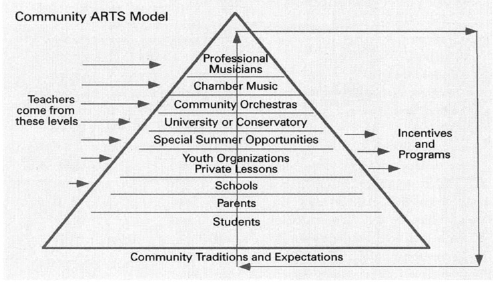
In order that we may understand the greater conceptual significance of these changes, I suggest the following sociologic model. It has been my privilege to observe, work with, and receive information from many communities all across America, which has helped me develop this conceptualization. While this model functions within many regions, it is not specific to any town or city. The principle resources and patterns of dialogue that are essential to the development of “The Artistic Engine” are illustrated above.
Culver has been one of the most sought after consultants, clinicians, and conductors, having been asked to forty-seven states and eleven countries in the last decade. He has served on the faculties of the National String Workshop, Madison, Wisconsin from 1984 to 1990, the International String Workshop since 1980, and was the founder and director of the American String Workshop. As a conductor, he has been active in thirty-nine All-State Orchestra Festivals and many more regional activities. He served on the National Executive Board of ASTA as publications chair and was voted president-elect in 1988, assuming the presidency in 1990. While originating and serving as artistic director of the Banff International Festival, he was also the Festival chairman of music education.
This model functions when each level supports the neighboring levels. We especially need to have professional performers be of value to the entire community. Schools, community music schools, youth groups, college or conservatories, or professional musicians cannot function without the support of every other level. They must function within a purposely formed design to develop opportunities through acting as resources for each other. When interaction between the levels from students up through professional musicians is perceived as value, the base line of community traditions and expectations will reflect this value. The most essential are the teachers who contribute to the community as a conceptual whole. This concept provides the framework for program support and development nationally through auricular development, activities, projects, performances, conventions, and programs at all levels and the various networking projects that would hold it together.
The levels of the community that will be affected in various ways by developing strong music programs involving strings are:
Students Parents Institutions Service Organizations Movers and Shakers Politicos Senior Citizens
The developmental human values springing from having access to high-quality instruction, activities, and opportunities are well documented within research and anecdotal writings from many sources. The most comprehensive collection of writings is Spin Offs published by United Musical Instruments of Elkhart, Indiana. The purpose of this article is not to reiterate these writings but to combine their influence into an understanding of the forces at work in the evolutionary growth of stringed instrument achievement and support.
We must be doing something right because there are more students playing stringed instruments than ever before, as shown by the growth of the import data from the National Association of Music Merchants (NAMM). In recent years there has been 12 percent growth in the importing of instruments. In the Midwest and beyond, many districts have added strings to their curricular offering in the last decade. Several music stores have reported large gains in the numbers of rental instruments out in various communities. This phenomenon does not occur within a vacuum.
The number of community music schools not affiliated with the traditional school setting has risen dramatically as noted in this journal. Each organization has registered an urgent need for teachers. Most of the community music schools have grown from strong community interest and have included youth orchestra functions in their offerings. While these organizations have traditional studio teaching offerings, many have group teaching as well.
… teacher-training programs must adequately prepare Students to effectively contribute to our overall culture.
The thirtieth International Workshops held in Brisbane, Australia had participants from thirty-one countries. The workshop series includes piano, art, general music, choral conducting, string pedagogy, and orchestral conducting hosting 450 participants. People from nations whose teacher-training programs were of the conservatory model were intrigued, excited, and motivated to change the curricula in their nation's colleges and universities. The model most attractive to them is listed below.
It is easy to point to successes but it remains necessary to keep these matters in perspective. Many communities have lost their opportunities to participate in orchestral music through political actions, lack of support in the ballot box, and funding emergencies. The opportunities to make a living by performing on a stringed instrument have dwindled even though many more people than before are attempting to do so. Teaching is an obvious answer. However obvious, teacher-training programs must adequately prepare students to effectively contribute to our overall culture.
The National Association of Schools of Music (NASM) has recently recognized the need for colleges and universities to adjust their curricula to more adequately meet the needs of training teachers of stringed instruments. Many colleges and universities have created new positions for the teaching of string pedagogy especially in groups. The numbers of students attracted to this potential career is rising.
ASTA with NSOA has initiated, fostered, and supported these changes through many actions reported in AST. Contributing to this change have been symposia, convention offerings to make successful programs visible, information regarding successful programs made available through ASTA publications, financial assistance to facilitate new programs, and the phenomenon of ASTA string workshops promoting the sharing of information.
The more successful university-level string teacher training curricula have included several components:
Instruction on all four stringed instruments within a group process A specific String Methods class offered after initial instruction Laboratory experiences with peer and school age students Additional opportunities to gain experience within the community
The content of the most successful Siring Methods class includes:
Modeling and non-verbal instruction process Ear-to-hand instruction Rote-to-note instruction Delivery skills and class room management Rehearsal and conducting effectiveness Chamber music skills Strategy and teaching device development and use Skill-based curricula including assessment process Community development information including advocacy strategies
So what do we know? Great change appears to be occurring and is affecting the entire community. The products of effective teaching are more accomplished than ever before. The landmarks of change—NASM, ASTA, college and university schools of music, public, private and community music schools—are showing strong levels of accomplishment and development. Are we reaching our potential? No, we have not yet and are a long way from that moment. Until the concept of “The Artistic Engine” representing our national culture reflects these successes, our job remains only partially done. Now, the question must be asked “What do we do now?”