Abstract
eight years ago Jenny opened her violin case at her lesson and I heard “oops!” There was no violin in the case. I told her that was actually a good thing, and she gave me a puzzled look. I said that meant she had been practicing at home. We laughed and found a violin and had a lesson.
One week ago my five-year-old reluctant violinist expressed the fact that she didn't like the violin. Period. I asked her to join me in making a list of the things she likes and then the things she doesn't like. We started with the things she liked. She said “inkle.” I had to guess what that word meant; it was Twinkle. She said “ickers,” and that was stickers. Then it was “er”; I was stumped. By this time I wasn't feeling all that great about her and her insistence on playing this game. I finally gave up and she looked up at me with her beautiful big eyes and said “teacher.” Well, of course I melted (and felt extremely guilty for any ill feelings I had about her). She couldn't remember any of the negative things about the violin, and she actually played a tune or two.
I do not believe I would have had this approach without Dr. Shinichi Suzuki's philosophy. Certainly when I was growing up I would have been given a lecture about making sure I had my violin for my lesson. The nurturing that the Suzuki approach has as its root brings out imaginative and creative ways of approaching teaching the violin. It doesn't exclude anyone—from my most interested students to the ones who are reluctant; from those who catch on quickly; to Laura, who has Down's Syndrome and in her fifth year of study, is able to slur for the first time.
I often think of the article in the American Suzuki Journal that stated, “The worst student is the one that quits.”
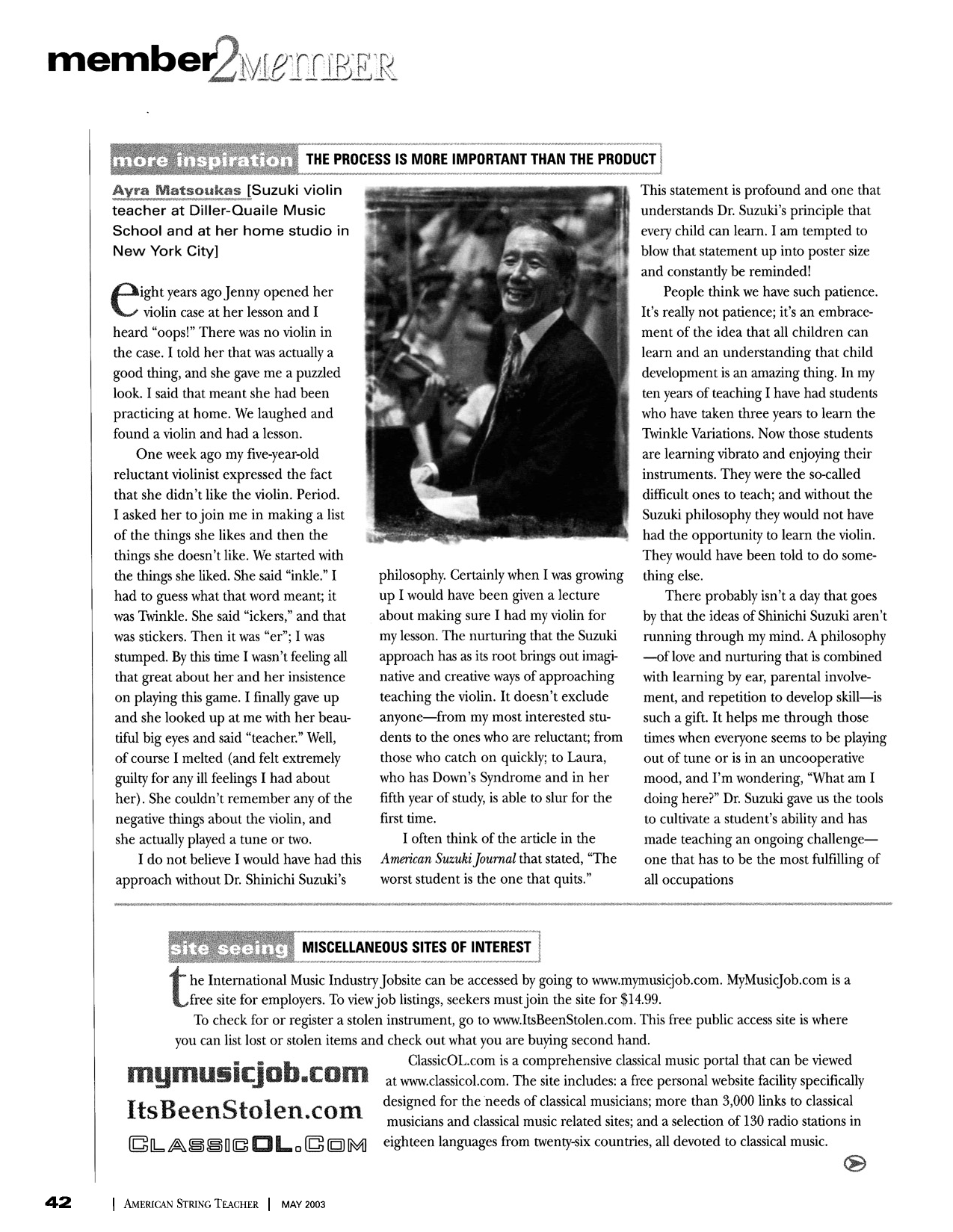
This statement is profound and one that understands Dr. Suzuki's principle that every child can learn. I am tempted to blow that statement up into poster size and constantly be reminded!
People think we have such patience. It's really not patience; it's an embracement of the idea that all children can learn and an understanding that child development is an amazing thing. In my ten years of teaching I have had students who have taken three years to learn the Twinkle Variations. Now those students are learning vibrato and enjoying their instruments. They were the so-called difficult ones to teach; and without the Suzuki philosophy they would not have had the opportunity to learn the violin. They would have been told to do something else.
There probably isn't a day that goes by that the ideas of Shinichi Suzuki aren't running through my mind. A philosophy—of love and nurturing that is combined with learning by ear, parental involvement, and repetition to develop skill—is such a gift. It helps me through those times when everyone seems to be playing out of tune or is in an uncooperative mood, and I'm wondering, “What am I doing here?” Dr. Suzuki gave us the tools to cultivate a student's ability and has made teaching an ongoing challenge—one that has to be the most fulfilling of all occupations
Site Seeing MISCELLANEOUS SITES OF INTEREST
the International Music Industry Jobsite can be accessed by going to www.mymusicjob.com. MyMusicJob.com is a free site for employers. To view job listings, seekers must join the site for $14.99.
To check for or register a stolen instrument, go to www.ItsBeenStolen.com. This free public access site is where you can list lost or stolen items and check out what you are buying second hand.
ClassicOL.com is a comprehensive classical music portal that can be viewed at www.classicol.com. The site includes: a free personal website facility specifically designed for the needs of classical musicians; more than 3,000 links to classical musicians and classical music related sites; and a selection of 130 radio stations in eighteen languages from twenty-six countries, all devoted to classical music.