Abstract

It's coming very soon—This national conference event is selling fast!
If you have not yet registered for the 2004 national conference, there is still time. You don't want to miss this exciting new event that encompasses five tracks: National Studio Teachers Conference, the Alternative Styles Conference, K-12 Focus Seminars, the National Solo Competition, and the new National Orchestra Festival—plus the Exhibit Hall, where attendees will be able to view more than 100 exhibits showcasing the latest products and services from a variety of music industry professionals. Be sure to stop by the ASTA bookstore white you're at the conference. All of the latest publications will be on display—and possibly some special conference-only sales!
Schedule at a Glance
Thursday, March 11
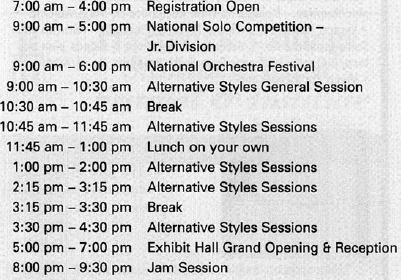
Friday, March 12
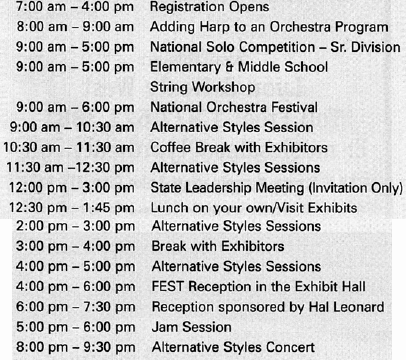
Saturday, March 13
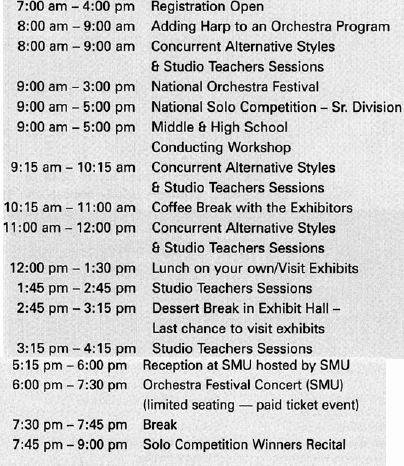
Sunday, March 14
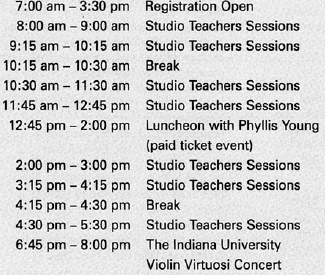
Monday, March 15
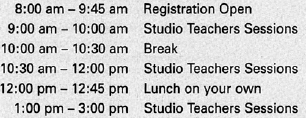
Important Conference Information
The Alternative Styles, National Studio Teachers Forum, and K-12 Focus Seminars all will be held at the Adam's Mark Hotel in Dallas. The National Orchestra Festival and National Solo Competition, along with the Orchestra FEST Winners Concert, Solo Competition Winners Recital, and reception sponsored by Southern Methodist University will be held at Southern Methodist University (SMU). Public transportation is available between the hotel and SMU.
Tickets to the Orchestra FEST Winners Concert are available for $10 each. Seating is limited, so please order early. The Solo Competition Winners Recital and the reception sponsored by SMU are open to all conference attendees and their guests.
The conference fees are based on a per-day rate. Choose the sessions you would like to attend and sign up for the corresponding days. If you pay for four days you will get the fifth day free! See page 85 for the registration form. Avoid paying on-site rates – register today!
For Example
Jane Doe has registered and paid for Saturday, Sunday, and Monday attendance with primary focus on the Studio Teachers track. Jane also may attend any of the events happening within those days (Alternative Styles Sessions, K-12 Focus Seminars, and/or the Solo Competition Winners Recital).
Comprehensive Listing of Scheduled Educational Sessions
Subject to change without notice.
Thursday, March 11
9:00 am – 10:30 am |
A helpful guide and overview of all Alt-Style Sessions and a musical demonstration by the clinicians. Yes, there are more sessions than you can possibly attend, but here's the (extremely) short version of our offerings.
10:30 am – 10:45 am |
10:45 am – 11:45 am |
This nationally known clinician and author will discuss various methods to get your students fiddling right away. Good technique starts from the beginning and fiddle styles will help your students get a running start.
Presenter|Andrew Dabczynski
Learn a Miles Davis solo step by step and discuss phrasing, transcribing, and keeping logs of your favorite ideas. Examine how string players can listen to instruments from any family to understand the “mechanics” of the style, and look at what it takes musically and technically to make solos work.
Presenter|Nicole Yarling
The author of “Past the Print” leads a workshop with an emphasis on creativity and phrase development. The focus will be on “Experiences in Creativity” via specific artistic activities.
Presenter|Julianna Waller
*
Put fire in your bowl Learn the secrets behind how to wake up your bow arm, dip into the primal rhythms of your soul, and make everyone within ear's distance frolic, cavort, and dance! (Repeated on Saturday at 9:15 am.)
Panelists|Tracy Silverman
Richard Greene
Julie Lyonn Lieberman
11:45 am – 1:00 pm |
1:00 pm – 2:00 pm
Inspire string students by playing contemporary styles on classical instruments. This session will include an overview of right-and left-hand techniques, a survey of available materials, plus ideas for successful lesson planning.
Presenter|Daryl Silberman
The cello can play the tune, accompany with chords, and play the bass lines too. Come learn some fiddle tunes (music in bass clef provided) and bring your instrument.
Presenter|Renata Bratt
Learn rhythmic, harmonic, and stylistic secrets from the slippery, funky, skunky, smokey, swampy, steamy, and sometimes greasy side of rock and roll, where jazz and blues meet with continental, tribal, and ethnic elements to form a truly American Gumbo.
Presenter|Geoffrey F. Perry
A hands-on workshop featuring the beautiful fiddle styles from the land of the plaid and the Emerald Isle. Bring your instrument.
Presenter|Crystal Plohman
2:15 pm – 3:15 pm |
*
Many methods cover how to improvise on one scale, but how do you move on from there? This clinic will demonstrate methods for introducing improvising on chord changes involving more than one scale. This approach is applicable for advanced middle school, high school, and adult students. (Repeated on Saturday at 11:00 am)
Presenter|Martin Norgaard
A multicultural fusion of traditional fiddling and early jazz, Texas-style contest fiddling represents a highly virtuosic, improvisetional string tradition, which launched the careers of Mark O'Connor and Alison Krauss, (Repeated on Saturday at 9:15 am.)
Presenter|David Wallace
Fun techniques and games to introduce improvisation and composition to string students of any level.
Presenter|Katrina Wreede
Learn the percussive bow technique that can turn you and your students into rhythm aces from the master of the style. Richard Greene invented this technique while playing with the father of bluegrass, Bill Monroe. Bring your instrument.
Presenter|Richard Greene
3:15 pm – 3:30 pm |
3:30 pm – 4:30 pm |
Simple steps for teaching improvisation to beginning and intermediate string players. Even if you are a totally paper-trained teacher, you will learn how to implement this national standard in a way that will create enthusiasm and musical skills in your developing string players.
Presenter|Bob Phillips
Ms. Willis is the author of Gypsy Violin and Eastern European Duets for Violin. Learn hands-on the tricks and techniques of this exotic and exciting music!
Presenter|Mary Ann Willis
Most string players are unaware of the role the violin played in the evolution of the blues, and the rich contributions made to the instrument by the earliest jazz violinists. This clinic will be an eye-opening, ear-opening experience.
Presenters|Martin Norgaard
Richard Greene
Julie Lyonn Lieberman
Explore the unwritten areas of groove and musical style. Ideas for meeting the challenges inherent when string players make the leap to performing the music of nonclassical genres, whether professionally or for fun.
Presenter|Ed Willett
5:00 pm – 7:00 pm |
8:00 pm – 9:30 pm |
Fiddling led by Crystal Plohman. Music provided. Bring your instrument and lets play!
Friday, March 12
8:00 am – 9:00 am |
This workshop will focus on how to add beginning harp students to a school orchestra program. Topics will include recruiting, repertoire, and acquiring the resources needed to teach beginning harp students.
Presenter|Robbin Gordon Cartier, East Orange School District
Sponsored by Lyon & Healy Harps
9:00 am – 5:00 pm |
You put your left arm up, your right arm out, your head up tall, and you shake them all about … NOT exactly! We'll discuss the foundations for body mechanics that assist in developing proper playing position skills in young students, including ideas developed by Alexander, Pilates, and Paul Rolland.
Students can improve their own playing through self-assessment. Ideas will be presented for methods and materials to grade students that establish accountability to students, parents, and administrators. Suggestions for accomplishing these tasks during class time will be included.
Developing musicianship through literature and the technique that supports the literature. Selecting and using etudes, exercises and scales that build the foundation for playing musically. Techniques for developing musicianship through the performance of early string orchestra literature. Understanding the connection between musical literacy and musical performance.
Communicating with students, parents, teachers, and administrators through beautiful music, effective use of words, and excellence in conducting and concert performances. Understanding the importance of body language and general appearance in all phases of teaching and performing. Establishing effective communication that will positively affect and influence a string program.
Presenters|Doris Gazda
Pamela T. Hayes
9:00 am – 10:30 am
Panel Leader|Julie Lyonn Lieberman
Panelists|Renata Bratt
Andy Dabczynski
Bob Phillips
Crystal Plohman
Randy Sabien
10:30 am – 11:30 am |
11:30 am – 12:30 pm |
Electric violinist and instrument manufacturer Mark Wood and director Beth Hankins's high school string rock orchestra, “The Lakewood Project,” demonstrate a cutting-edge program that will excite and thrill you. You too can incorporate the latest modern technologies by accessing the newest hardware available.
Presenters|Mark Wood
Beth Hankins
A significant amount of technical skill is required to perform fiddle tunes including fast string crossings, syncopation, plus very fast and rhythmical left hand technique. All of these skills are transferable from bluegrass to classical music. A lecture/demonstration of a fiddling tune broken down in terms of left- and right-hand technique.
Presenter|Richard Greene
Learn more about the function of the bass. We will survey rhythmic and harmonic variations for the double bass within the context of various styles, including swing, Latin, pop, folk, bluegrass, and funk. Included will be an examination of the traditional and speculative roles of the bass, including when to keep it simple and when to use variations.
Presenter|Jeffrey Eckels
Why don't students care about music theory? We need to create situations where theoretical knowledge is applied to real music. Using improvisation and composition as the main teaching and assessment tools, this clinic demonstrates how to teach standard musical concepts in a fun and meaningful way.
Presenter|Martin Norgaard
12:30 pm – 1:45 pm |
More details are in your conference packet.
2:00 pm – 3:00 pm |
Rock and roll, fiddle styles, and jazz tunes can be a great addition to your string orchestra's tune list. These alternative string styles can help boost attendance and keep your string students playing. Learn how, through a lively discussion from these string education specialists. (Repeated on Saturday at 8:00 am.)
Presenters|Daryl Silberman
Bob Phillips
Beth Hankins
This is a hands-on workshop to help you dive into the world of fiddle music. Learn the difference between old-time and bluegrass, Irish, and Texas fiddling. Bring your instrument.
Presenter|Crystal Plohman
Add chords, distortion, and frets to your technique, as well as the latest technology in amplification, effects, recording, and all things electric.
Presenter|Tracy Silverman
Original arrangements and compositions for double bass quartet. A performance and question-and-answer session about writing, arranging for, organizing, and playing in a bass quartet.
Presenter|Jeffrey Eckels
3:00 pm – 4:00 pm |
You can introduce jazz to your junior high or high school string orchestra. Randy will teach jazz tunes and improvisation to a student string orchestra from Dallas. Come watch his technique and learn tricks and tips for teaching this great American music.
Presenter|Randy Sabien
Three fiddle experts discuss and perform bluegrass, blues, Celtic, Texas fiddle, and more. Are there common roots? Do these styles share any stylistic traits? Find out here. (Repeated on Saturday at 11:00 am.)
Presenters|Richard Greene
Crystal Plohman
David Wallace
See the new generation of instruments being used in rock, country, and jazz bands. A hands-on workshop. Bring your axe and try out some new gear.
Presenters|Tracy Silverman
Reva Kuzmich
Pam and Bob Phillips will lead you through the process of organizing, funding, and selecting guest artist performances and residencies for your students. As the founders and directors of the Saline Fiddlers Philharmonic, they have hosted such artists as Barrage, Byron Berline, Norman Blake, Richard Greene, Molly Mason, Dean McGraw, Peter Ostroushko, Randy Sabien, Bonnie Rideout, Brian Torff, and Jay Ungar. Exposure to these nationally known musicians helped transform the artistic standard and expectations of the Saline Fiddlers Philharmonic. Learn how to make guest artists a part of your curriculum.
Presenters|Bob Phillips
Pam Phillips
4:00 pm – 6:00 pm |
5:30 pm – 7:30 pm |
5:00 pm – 6:00 pm |
8:00 pm – 9:30 pm |
Join the alternative clinicians for a one-of-a-kind concert that is guaranteed to make sparks fly. Something altogether unique will happen when these amazing string players from different parts of the country and from different genres come together to create an evening of music. Even they won't know what's going to happen until after it explodes!
Join Richard Greene, Randy Sabien, Crystal Plohman, Tracy Silverman, Jeffry Eckels, Julie Lyonn Lieberman, Renata Bratt, Martin Norgaard, Mark Wood, David Wallace, Geoffrey Perry, and others for an evening you wont forget.
Saturday, March 13
8:00 am – 9:00 am |
*
Rock and roll, fiddle styles, and jazz tunes can be a great addition to your string orchestra's tune list. These alternative string styles can help boost attendance and keep your string students playing. Learn how through a lively discussion from these string education specialists. (Also offered on Friday at 2:00 pm.)
Presenters|Daryl Silberman
Bob Phillips
Beth Hankins
Expressive, soulful playing in vernacular styles.
Presenters|Richard Greene
Matt Glaser
Improvisation was always a major part of classical music — from the music of church organists to the cadenzas of concertos. It's time to get back in touch with our inner improv. Tracy will demonstrate classical excerpts as well as passages and the cadenza from his Electric Violin Concerto and speak about how much of the concerto is really improvised (and is it still improv if I practice it a lot?); different kinds of improv, and how you get an orchestra to improvise; and how improv makes your life easier as a performer.
Presenter|Tracy Silverman
Have you ever dreamed of creating a music school, a teaching co-op, or going into a retail music business? These panelists will discuss their experiences creating music businesses beyond the typical independent studio.
Presenter|Charles Avsharian
Panelists|Janet Farrar-Royce
Doris Preucil
Moderator|Mimi Butler
This session offers ideas for helping students tap into the heart of studying a stringed instrument.
Presenters|Nancy Lokken
Lyn Ritz
Phyllis Young
Moderator|Leslie Wimsatt
The effects of good and faulty posture on practice and performance examined through a look at basic biomechanics. Techniques for preventing pain and injury will be presented.
Presenters|Lynne Denig
Brenda Johnson
This workshop focuses on how to add beginning harp students to a school orchestra program. Topics will include recruiting, repertoire, and acquiring the resources needed to teach beginning harp students.
Presenter|Robbin Gordon Cartier, East Orange School District
Sponsored by Lyon & Healy Harps.
9:00 am – 5:00 pm |
This presentation is designed to develop awareness of body language on the podium, introducing refinement of gesture skills, developing non-verbal communication techniques, and reinforcing internal musical concepts. The experience will include podium time for participants with an ensemble primarily composed of the participants. Music to be selected will include a variety of styles.
Presenters|Marvin Rabin
Robert Culver
The vision from the beginning was that this workshop should be one where the participants receive as much podium time as possible and play in the teachers’ orchestra. Depending upon enrollment, which will eventually be capped as far as the number of participants who can receive podium time, each participant will have from ten to fifteen minutes on the podium. In addition to providing a helpful critique to each conductor, the clinicians will provide general comments that apply to all conductors. Conductors must choose from the repertoire listed below. Dr. Rabin will provide parts for all the pieces, but all conductors will be responsible for purchasing their own scores to mark. Conductors may also bring their own parts for the pieces they have chosen from the list, if they wish to use their bowings. Please follow these procedures:
Select five pieces from the repertoire list below. Rank them 1–5 in order of preference (1 = top choice). You'll probably have time to conduct and receive a critique on just one piece or two short movements.
Email your ranked list of chosen repertoire and other information to David Littrell at
Bring your instrument. Cellists and bassists: ASTA cannot provide instruments for you. I suggest that you inquire about renting an instrument at a Dallas store if you choose not to bring yours. If you fly, you may wish to bring an instrument of lesser quality.
All conductors are requested to play in the teachers’ string orchestra. If you are not a string player, you may conduct and then observe. ASTA welcomes wholeheartedly ww/brass/perc/band teachers who conduct a string or full orchestra at school.
I'll limit the duplication of repertoire as much as possible, but some duplication is inevitable and certainly acceptable. REPERTOIRE LIST: Handel Concerto Grosso No. 10 in D Minor: Air, 3rd Allegro, 5th Allegro; Corelli Concerto Grosso, Op. 6, #4 in G Major: movements 1, 2, last Allegro; Mozart Serenata Notturno in D Major, K 439: any movement; Eine Kleine Nachtmusik: Romanze only; Tchaikovsky Serenade: Adagio (2nd movement); Sibelius Romance in C, Op. 42; Elgar Serenade (choose one movement); Hindemith 8 Pieces (Acht Stücke), choose two contrasting movements; Britten Simple Symphony: Sarabande Bartók Romanian Folk Dances (choose movements 1/2/4 or 5/6/7/8); string orchestra version Bartók: Ten Pieces, first four pieces only; Leyden Serenade (parts are in print again).
Please return the following information via email by
Name
Address
Work Phone
Email Address
Choice of Repertoire
1st
2nd
3rd
4th
5th
Instrument that you'll play in the teachers’ orchestra
9:15 am – 10:15 am |
Put fire in your bowl Learn the secrets behind how to wake up your bow arm, dip into the primal rhythms of your soul, and make everyone within ear's distance frolic, cavort, and dance! (Also offered on Thursday at 10:45 am.)
Panelists|Tracy Silverman
Richard Greene
Julie Lyonn Lieberman
Randy Sabien
A multicultural fusion of traditional fiddling and early jazz, Texas-style contest fiddling represents a highly virtuosic, improvisational string tradition, which launched the careers of Mark O'Connor and Alison Krauss. Join Dr. David Wallace for this stylistically illuminating lecture performance, which caused a sensation at the Juilliard School. (Also offered on Thursday at 2:15 pm.)
Presenter|David Wallace
Playing great simple solos that swing on standard tunes. Jazz improvisation taught by the head of the string department at Berklee College of Music.
Presenter|Matt Glaser
Traditional beliefs about innate talent can negatively affect teacher expectations and teaching outcomes. This session introduces a compassionate approach for achieving artistic success with every student.
Presenter|Ricardo Iznaola
10:15 am – 11:00 am |
11:00 am – 12:00 pm |
Many methods cover how to improvise on one scale. But how do you move on from there? This clinic will demonstrate methods for introducing improvising on chord changes involving more than one scale. (Also offered on Thursday at 2:15 pm.)
Presenter|Martin Norgaard
Three fiddle experts discuss and perform bluegrass, blues, Celtic, Texas fiddle, and more. Are there common roots? Do these styles share any stylistic traits? Find out here. (Also offered on Friday at 4:00 pm.)
Panelists|Richard Greene
Crystal Plohman
David Wallace
The bass part (on cellos or basses) supports multiple styles. Learn what function the bass part plays, how to teach your bass players, and why it is so important.
Presenters|Jeffrey Eckels
Renata Bratt
A panel discussion of issues, challenges, and strategies to promote understanding, communication, and positive attitudes.
Presenters|Peggy Wheeler, Kenowa Hills
Public School Districts
Melisa Lesniak, University of Miami
Asking students to improvise and compose offers limitless possibilities for musical growth. Curriculum, sample assignments, and student work will be presented.
Presenter|Kristi Manno, University of Hartford, Hartt School of Music
Systematic observations of excellent string teaching may reveal how effective teachers think and what they do to ensure student success. Perhaps we can educate perspective string teachers to think and teach as excellent teachers do.
Presenter|Elaine Colprit, Bowling Green State University
12:00 pm – 1:30 pm |
1:45 pm – 2:45 pm |
Clinician|Kathy Winkler
Rationale and methodology for starting students, aged three and up, directly on viola. Topics include correct sizing of instruments and other challenges.
Presenter|Julia Hardie, Central Texas String Academy
All cellists are always trying to explore ways to play more efficiently. This session will offer some new ideas.
Presenters|Helga Winold, Indiana University
Rick Mooney, National Cello Institute
Carey Cheney, Private Studio Teacher
Presenters|Jeff Bradetich, University of North Texas
Lawrence Hurst, Indiana University
David Neubert, University of Texas, Austin
Paul Robinson, The Ohio State University
This hands-on session will examine issues of movement, alignment, and position to uncover the intrinsic relationships connecting all left-hand procedures on guitar.
Presenter|Ricardo Iznaola, University of Denver
Are you looking for a way to add that something special to your string group that will set it apart from the others and further enhance the music experience for your students? Adding the harp to your program is the perfect solution. Learn how to identify students who would be able to adapt to the harp, add to your arrangements with basic harp writing skills, and understand the steps to take in order to instruct beginning students in harp lessons.
Presenter|Robbin Gordon Cartier, East Orange School District
2:45 pm – 3:15 pm |
3:15 pm – 4:15 pm |
We all want the freshman class to be well-trained and musically intelligent performers. A discussion of the journey from the first lessons to the last in the development of the artist-performer.
Presenters|Charles Avsharian, Michigan State University
Gerald Fischbach, University of Maryland
Kathy Winkler
Brian Lewis
Moderator|Mimi Zweig, Indiana University
This session will discuss techniques of music analysis for isolating practice problems and maximizing practice effectiveness.
Presenter/Michael Palumbo, Weber State University
Clinician|Nathaniel Rosen
Clinician/Adam Holzman
Warm-up routines away from the instrument can have a pronounced effect upon your performing. Explore new ways to enhance your practice, performance, and teaching.
Presenter|Erzsébet Gaál, Harpa Hungarica
5:15 pm – 6:00 pm |
6:00 pm – 7:30 pm |
7:45 pm - 9:00 pm |
Sunday, March 14
8:00 am – 9:00 am |
This session provides attendees with a wealth of string teaching tips for beginning through high school and college-age violin students. Topics range from note reading to technique development, from fiddling to Baroque performance practice.
Presenters|Valerie Arsenault, Florida State University
Janet Farrar-Royce, Private Studio Teacher
Jennie Lou Klim, Beaschside Violin Academy
Janice Wade, Wartburg College
A workshop in the basics of Tai Chi—balance, momentum, anticipation, tension awareness—and how they apply to successful string playing.
Presenters|Ross Harbaugh, University of Miami
Pamela McConnell, University of Miami
Double your pleasure as you see and listen to bass lines for the Bach accompanied suites and learn some new ideas of how to incorporate Baroque performance practice into your studio.
Presenters|Anthony Arnone, University of Iowa
Hannah Holman
Jeffrey Schoyen, University of Dayton
Two new innovative CD-ROMs cover two areas of double bass instruction: fundamental technique and standard performance repertoire.
Presenter|David Neubert, University of Texas, Austin
A discussion of string pedagogy programs in higher education.
Presenters|Susan Kempter
Darcy Drexler
Modern harp repertoire requires performers to use extended techniques or approaches to the instrument that must be demonstrated in order to be performed effectively. Attention must be paid to both the visual and aural aspects of a performance.
Presenter|Ann Yeung, University of Illinois at Urbana- Champaign
9:00 am – 9:15 am |
9:15 am – 10:15 am |
Concert and recording artist Katie Lansdale shares from her extensive experience performing and teaching unaccompanied Bach.
Presenter|Katie Landsale, University of Hartford
Three points of view on how to best prepare a student for conservatory/university study through the use of scales, etudes, and repertoire. A discussion of the pedagogical traditions of Karen Tuttle, Donald McGinnis, and Heidi Castleman.
Presenters|Roger Myers, University of Texas, Austin
Kathryn Steely, Baylor University
Karen Ritscher, Rice University
There are many ways to start a beginning cellist. Here, we'll examine the essential principles that should be taught regardless of the method used.
Presenters|Carey Cheney, Private Studio Teacher
Beth Goldstein, Private Studio Teacher
Helga Winold, University of Indiana
This lecture/demonstration provides ideas and repertoire for creating a successful double bass ensemble. Performance examples are used to demonstrate adjustments to individual skill levels.
Presenter|Paul Robinson, The Ohio State University
An introduction to the evolution of the guitar synthesizer and its potential application in the teaching studio, performance, and composition.
Presenter|Michael Carenbauer, University of Arkansas at Little Rock
Quanta Change offers a refreshing new approach to understanding and dealing with issues of performance anxiety, overuse injury, practice motivation, performance success, and career direction. Quanta Change provides mechanisms to permanently release the source of performance problems, opening the way for musicians to freely enjoy every aspect of a performance career.
Presenter|Sara Avery
10:15 am – 10:30 am |
10:30 am – 11:30 am |
This lecture/demonstration will provide a brief overview of pedagogical concepts for developing intonation based on the teaching and materials of Trott, Dounis, Suzuki, Gerle, Silvay, Kodály, Fischer, Ma, Kendall, Galamian, and others. Key points of discussion will include the development of aural, physical, and intellectual aspects in regards to good intonation.
Presenter|Winifred Crock, Parkway Centra! High School and Private Studio
This innovative viola master class will provide the opportunity to observe how three leading teachers use different approaches to solve the same problems.
Presenters|Roger Myers, University of Texas, Austin
Kathryn Steely, Baylor University
Karen Ritscher, Rice University
Playing the cello comfortably often is not as easy as it looks. Listen to and observe two presenters who have written extensively about this subject.
Presenters|Barbara Thiem, Colorado State University
Cornelia Watkins, Private Studio Teacher
Clinician|Jeff Bradetich, University of North Texas
Digital video and audio technology can be used to help students visually and aurally diagnose and correct performance problems, and prepare audition and portfolio materials.
Presenter|Michael Hopkins, University of Vermont
Harpist Gail Barber and Bruce Wood share their expertise on methodologies for integrating young harpists into secondary string orchestra programs from middle school through high school levels.
Presenters|Gail Barber, Texas Tech University
Bruce Wood, Lubbock Young Symphony
11:30 am – 11:45 am |
11:45 am – 12:45 pm |
A valuable discussion into practice methods, right and left-hand functions, and solutions to problems of all types.
Presenter|Charles Avsharian, Michigan State University
Explore twenty-first century cello techniques that you can use in your studio and discover some fun new cello ideas.
Presenters|K. J. Tischhauser, Fort Lewis College
Sean Grissom, New York Public Schools
This presentation will focus on thought processes and tools that can be used by the teacher and student to improve student practice.
Presenter|Leo Welch, Florida State University
Clinician|Susan D. Pejovich
Incorporating good pedagogy from the other strings into the bass studio.
Presenter|Lawrence Hurst, Indiana University
12:45 pm – 2:00 pm |
2:00 pm – 3:00 pm |
A panel of teachers will discuss key points in working with beginning students.
Panelists|Gerald Fischbach, University of Maryland
Nancy Lokken, Suzuki Talent Education
Doris Preucil, Preucil School of Music
Jim Przygocki, University of Wyoming
Moderator|Edmund Sprunger, The Sprunger Studio
Charles de Beriot composed music ideally suited to prepare budding virtuosi. This session will investigate these little known etudes.
Presenters|William Dick, Southwestern University
Eri Lee Lam, Southwestern University
How to use traditional Scottish fiddle music to develop structural listening, a rhythmic bow arm, and related skills in the beginning and intermediate level player.
Presenter|Bruce Erwin, Beck Center for the Arts
Learn how to make good audio/video recordings, use computers, create/use a website for teaching, cutting edge technologies in music, and legal issues.
Presenter|Hideki Isoda, RIAX Corporation
Presenters|Ann Yeung, University of Illinois, Urbana-Champagne
Gail Barber, Texas Tech University
Moderator|Lynne Aspnes, University of Michigan
A gift for music brings string instruments and instruction to 900 inner city students in central Florida at no cost. Examine the studio teacher's role, teaching styles, and more!
Presenters|Melissa Kraut, Central Florida University
Heather Strayer
3:00 pm – 3:15 pm |
3:15 pm – 4:15 pm |
Musicians are like athletes when we consider that the body is built to move with ease and freedom. This session demonstrates how to set up a student from the beginning, focusing on bow hand and arm fluidity.
Presenter|Nancy Lokken, Suzuki Talent Education
Encouraging and directing a student to use his or her voice during an applied lesson can result in a more productive, fun, and instructive session.
Presenter|Lyn Ritz, Walla Walla College
Strategies for teaching students how to convince their bows to sing, dance, talk, whisper, and cry. Applicable to students of all ages and levels.
Presenter|Phyllis Young
3:15 pm – 4;15 pm
Instruments will be provided for anyone wanting to work on sound production, bow technique, and left-hand facility.
Presenter|Jeff Bradetich, University of North Texas
Anthony Stoops, Bowling Green State University
How does the experienced string player take advantage of his/her expert knowledge and perception to convert a series of “tones” into meaningful mental representations? This session will examine ways in which private studio string teachers can improve the quality of students’ musical mental maps.
Presented Melissa Gerber Knecht, Hillsdale College
The methodology and strategies of the Kodály concept can stimulate joyous and productive music making.
Presenter|Erzsébet Gaál, Harp Hungarica
4:15 pm – 4:30 pm |
4:30 pm – 5:30 pm |
A method to create a bow hand that combines flexibility and connected motion for everyone — from the beginner to the advanced player.
Presenter|Marilyn Seelman, Private Studio Teacher
Clinician|Doris Preucil, Preucil School of Music
Bring your instruments and find out about repertoire suitable for students of various playing levels.
Presenter| Rick Mooney, National Cello Institute
An analysis of the compositions of a pioneer of the twentieth century guitar. These overlooked works will be shown to be masterpieces, deserving inclusion into the standard repertory.
Presenter|Robert Phillips, All Saints Academy
The CPS, in which students earn certificates by playing for an examiner, was developed by members of the MD/DC state ASTA chapter and has been used by four state chapters so far. This session will describe the program and its extensive repertoire lists, plus describe how to set up examinations.
Presenter|Lya Stern, Private Studio Teacher
5:30 pm – 6:45 pm |
6:45 pm – 8:00 pm |
The Indiana University Violin Virtuosi is a unique collection of nine violinists between the ages of 13 and 17 who perform as soloists and as a violin ensemble. Their repertoire includes the music of Bach, Brahms, Bartok, Kreisler, Prokofiev, Vivaldi, Shostakovich, Sibelius, Telemann, Dinucu-Heifetz, and many innovative contemporary compositions that have been written for the ensemble.
The performers are gifted students who study at the Indiana University String Academy. They live in Bloomington and as far away as 350 miles. They are immersed in an intense musical curriculum of weekly private lessons, chamber music, theory, master classes, and Violin Virtuosi rehearsals. The Violin Virtuosi have performed throughout the Midwest and, in June 2003, completed their fourth successful tour of France. The Virtuosi have been featured on the NPR program, “From the Top” and, in June 2002, performed a benefit concert for the Harlem School for Strings-OPUS 118 at Carnegie Recital Hall. Many of the students have won local and national competitions and aspire to be professional violinists. Those that decide to pursue other careers take with them a love and understanding of music developed over many years of study.
Monday, March 15
9:00 am – 10:00 am |
An approach to using Kreutzer Etudes to establish a healthy foundation. This session will focus on physical set-up, establishing a non-judgmental state of mind, refining the martelé, détaché, and legato bow strokes, and the setting up of a flexible left hand using Etudes 2 through 6.
Presenter|Mimi Zweig, Indiana Unviersity
The Wilcox/Lopez duo will present a performance of seldom heard works for viola and piano: a classical sonata by Johann B. Vanhal, the Sonate for Viola and Piano by Jindrich Feld, and arrangements of popular songs from Cuba and Santa Domingo.
Presenters|Laura Wilcox, Lynn University
Jose Lopez
In this information-packed session, David Garrett examines the solo works commissioned by Rostropovich. Carey Cheney will also share her investigation of little-known works for beginning and intermediate cello students.
Presenters|David Garrett, California State University, Long Beach
Carey Cheney, Private Studio Teacher
This session will address various ways to teach our students how to organize and get the most out of their practice time.
Presenter|Benjamin Whitcomb, University of Wisconsin
Find out how research results validate your efforts to improve instruction and learning in your private studio.
Presenters|Gail Barnes, University of South Carolina
Kathleen Horvath
Jane Palmquist
Janet Jenkins
10:00 am – 10:30 am |
10:30 am – 12:00 pm |
This session will focus on four fundamental string playing issues for the beginning stages and beyond, including a couple that often fly right under the teacher's radar!
Presenter|Gerald Fischbach, University of Maryland
This session will examine repertoire and technical material appropriate for the violist from the beginning stages through intermediate and advanced levels. Attendees will receive a sequential list of material designed to bring the developing player up to artist-level building a solid foundation and cultivating the skills needed to play the most advanced solo and orchestral repertoire. We will look at recent publications as well as traditional repertoire and technical studies.
Presenters|Jim Przygocki, University of Wyoming
Barbara Barber
Ninety minutes of tips, strategies, and resources for enhancing student practice habits. Panelists will focus on how to guide parent-coaches, ways to stimulate student motivation, and much more.
Panelists|Lisa Maynard, Baylor University
Benjamin Whitcomb, University of Wyoming
Leo Welch, Florida State University
Eden Vaning-Rosen, Concert Violinist
Discover works for the cello that are seldom played or taught, but are useful in your studio.
Presenters|Barbara Thiem, Colorado State University
Helga Winold, Indiana University
12:00 pm – 12:45 pm |
1:00 pm – 3:00 pm |
Assistant Principal Violist of the Saint Paul Chamber Orchestra, string teacher, chamber music coach, published author, and Certified Professional Personal Life Coach will speak about issues confronting busy string teachers today and the challenges they face balancing work and life. She will guide participants through through helpful and fun exercises to clarify values and goals and gain insight into their present situation, as well as begin to plan steps into the future.
Presenter|Evelina Chao, Saint Paul Chamber Orchestra
This session will explore various ways to teach spiccato on the violin, viola, and cello. Leading pedagogues will explore similarities and differences amongst the string instrument family.
Presenters|Jerry Fischbach, University of Maryland
Jim Przygocki, University of Wyoming
Barbara Thiem, Colorado State University
To register for the conference, please see page 85 of this journal or visit www.astaweb.com. Register before
Publications on sale at the conference include
Getting It Right from the Start
String Syllabus: Volume One 2003 Edition (for Violin, Viola, Cello, Bass, and Ensembles)
A Violinist's Guide for Exquisite Intonation (Revised)
A Violist's Guide for Exquisite Intonation
ASTA Conference Bookstore Hours:
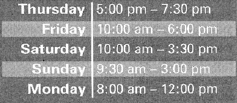
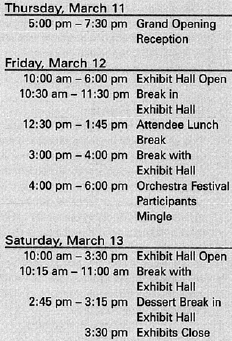
Exhibit Hall Information
In addition to top-notch education sessions, the conference will have a dynamic exhibit hall with social events for attendees to mingle and have fun. See the list of the confirmed exhibitors as of December 2003! The ASTA website has the most comprehensive, up-to-date list and you can access the floor plan to determine your visits. Exhibitors will be available to demonstrate new products and services, provide opportunities for you to try their products, and answer any questions you may have.
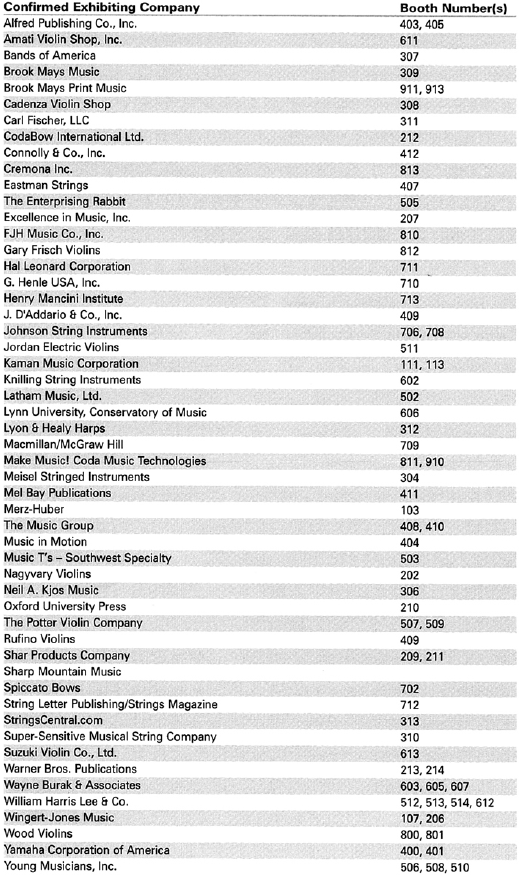
Exhibit Hall Hours
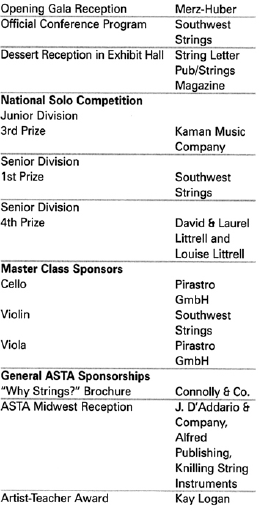
2004 National String Forum & Festival Sponsors
A special thank you goes out to all of our industry sponsors for the National String Forum & Festival and the many other programs that ASTA provides to members.