






Abstract

John Graham: An Adventurer on Roads Less Traveled
“
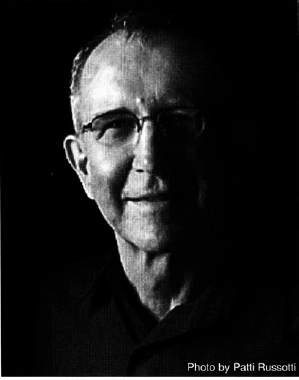
“O am as much a teacher as O am a performer.”
Violist John Graham is an adventurer. His career, spanning more than 40 years of performing and teaching in the United States, Europe, and Asia, identifies an artist who has made a habit of following his instincts, and trusting in them. “I found the whole thing magical,” says Graham, relating a childhood memory of hearing the NBC Symphony. “We had an old Philco radio, they were very big standing models, and I can remember very definitely the patterns on the fabric that covered the speaker. And I would just look into this fabric, and all this music would come out.” His family claimed that he was also transfixed by Phil Spitalni and his all-girl orchestra, featuring Evelyn and her Magic Violin. Whatever the orchestra, Graham heard magic and soon took matters into his own hands by asking for the half-size violin that his grandfather was saving for the first interested grandchild of the family. A teacher was found as well, and very soon Graham mastered “Down by the Sea.” By his early teens, he knew he wanted to become a professional musician, and his teacher, Harriet McNeil, helped him to prepare for his first recital. It was a great success, and the dye was cast.
In the fall of 1954, he enrolled at the San Francisco Conservatory and studied with members of the Griller Quartet. In residence at the University of California, Berkeley (UC Berkeley), and teachers at the conservatory, the British-born Griller Quartet was one of the first quartets-in-residence at a United States college. Graham studied violin with Jack O'Brien and received chamber music coaching from violist Philip Burton; the rapport among the three of them was strong.
Noticing Graham's interest in the viola (he was always picking up people's instruments during rehearsal breaks) and hearing his flair for producing a characteristic viola sound, Burton and O'Brien began a quiet campaign to turn him to the instrument. Like many violinists, Graham thought the viola was fascinating, but was unsure about becoming a violist, as if there was a hidden implication that a violist was somehow a lesser violinist. However, he was entranced by the newness of the experience, and after playing on Burton's Amati, he became hooked. Philip Burton became his viola teacher, and his Amati is the instrument Graham plays today.
Graham also attended the Aspen Music Festivals during the summers of 1958 and 1959, and, exhilarated by the level of musical competence he found among his peers, rose to the occasion. He became principal violist in the Student Orchestra and studied with William Primrose and the Julliard Quartet. He also decided that he wanted to go to New York City one day to become a professional freelance violist. Even though his teachers, sensing Graham's kind nature and high level of intellect, warned him about the fierce competition of the New York music scene, Graham's experiences in Aspen made him want to be anything but careful in his musical career choices. Once again, the dye was cast.
Graham transferred to UC Berkeley in 1958, and upon graduation in 1960, he was immediately called to the draft—as he had previously been deferred—and ended up in the Seventh Army Symphony in Europe. After his discharge from the army, he received a scholarship from the University of California and went to Rome, where he spent a year studying with violist Renzo Sabatini. When Graham returned to the States, it was to New York. Through contacts made at Aspen, he began to freelance—first with the Young Audiences concert series and then, as word got around through colleagues, with bigger jobs, including a chamber orchestra series at the Metropolitan Museum of Art. As well, he was invited to audition for Leopold Stokowski and the American Symphony Orchestra. “In most cases that's something students really need to know,” Graham says. “It all begins with your contemporaries recommending you; they are a really important stepping stone into the profession.” Stokowski hired him, and soon he was promoted to principal viola; he stayed with the orchestra for four years.
Adventure is not found without taking some chances. On first arriving in New York, Graham had two goals in mind: to be in a string quartet and to do solo work. “Imagining who and what you want to become can, in itself, be a risky enterprise,” says Graham, “especially if you are the only person doing the imagining.” Within two years of living there, he decided it was time to give his solo debut. He hired a manager to arrange an engagement in the Carnegie Recital Hall and performed, along with music of Bach and Brahms, works by contemporary composers Milton Babbitt and Henry Cowell. Both Babbitt and Cowell attended the recital.
“You know,” says Graham, “I went out on a limb, and two things happened. A quartet that was in New York for many years, called the Beaux Arts String Quartet (it was not connected to the piano trio), was looking for a violist, and they called me up—one of them had come to the concert to check me out. And so, I began to do the two things I wanted to do. I did my solo thing, and I get an offer to be in this quartet, and I subsequently spent five years in that quartet!” The Beaux Arts String Quartet, with Graham as violist, won the prestigious Naumberg Competition.
Following these beginnings, Graham spent 25 years in New York City, freelancing and performing as soloist, with major chamber music and new music ensembles, and in orchestras for opera, ballet, and Broadway. “It was a privilege Graham recalls, “to play in a great variety of musical venues, to be a musician in so many different ways.” During his early years in New York City, Graham met his wife, visual artist Cinda Kelly. They have a daughter, Caitlin, and currently live in Rochester, New York, where Graham has been professor of viola at the Eastman School of Music since 1989.
For his solo recitals, Graham regularly performs works of contemporary composers in addition to more traditional repertoire. In a recent program, he performed J.S. Bach's D major gamba sonata for viola and harpsichord; a premiere of Christopher Brakel's Deploration, featuring electric viola and amplified harpsichord; Two Songs of John Dowland, paired with Benjamin Britten's Lachrymae, Op. 48; and Luciano Berio's Naturale, based on Sicilian melodies. Regarding his thought process in making programming decisions, he says, “It's all associative. I'm thinking of how I want to move from piece to piece, and then how I imagine the audience moving from piece to piece. And I like cross-references, not so much in an intellectual sense, but in an acoustical [sense]; acoustical cross-references is a good way to put it.”
Regularly performing newly written, current music helps him to connect to older music with the spontaneity that it must have been given when it was first played generations ago. In addition, Graham believes that the viola, having a smaller traditional repertoire than other instruments, is in an ideal position to be a soloed voice in the flow of current music. “Composers can face it more freshly because there are so few antecedents, and the performers tend to face the instrument a little more openly. We are still developing our sense of what our repertoire is, and so we're much freer to go about it.”
In February of 2002, Graham premiered Birches, a piece based on the Robert Frost poem of the same title, written for solo viola and electronic sounds by Kevin Ernste, who was then finishing his doctoral degree. In sharing his experiences while working with Graham on Birches, Ernste relates a compositional process that is similar to Graham's approach to music. “In the 20th century,” says Ernste, “you have to sort of peel away the layers of performance practice to get at what you want. I was striving [in Birches] toward having this balance between what information you give to the player, and what information is left to be communicated. This allows the player to feel his or her own way into the piece.”
John Graham rehearsing Birches at Aspen, July 2002
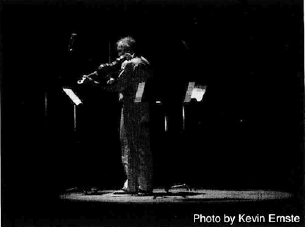
Besides a fresh approach to playing technique, Birches asks that the performer relate to the dynamic of the Frost poem, that of an old man reflecting upon his own boyhood. “What I realized,” muses Ernste, “is that John didn't need to look back, because he's not built that way. From the beginning, it was so natural for him.” Graham has performed Birches many times since, including at the Aspen Music Festival, where he is currently a member of the artist-faculty.
Ernste has been delighted to witness Graham infuse new elements into the piece with each performance. Graham also appreciates the opportunity to collaborate with so many fine composers close at hand: “In recent years at Eastman, having music written for me by people who know my playing has been a very interesting experience. I feel an extra dimension of personalness, because it's come out of a natural sense of community.”
In partnership with his performing, Graham has been active as a teacher since his days with the Beaux Arts Quartet. Teaching and performing is a balance that works well for him. Many performers feel a distinction, even a division, between the two, but a pivotal experience in 1983 of teaching a semester in Beijing, China, confirmed to Graham his identity as a teacher: “It was a very emotional experience, to have people so hungry for it. And that experience, of being a teacher on that fundamental level, turned it for me, and I realized there is no division here. I'm as much a teacher as I am a performer.
“Ever since I started teaching, it would immediately funnel back into playing, and then there's the whole human issue of having an outlet for verbal articulation. To be able to talk to someone and transmit your enthusiasms, to participate in the dynamic of the give-and-take between you and the student—I have gained this through teaching.”
In his teaching, Graham utilizes a natural process of piecing together how he has been taught—in addition to Burton, Sabatini, and Primrose, Graham studied with cellist George Neikrug, and in master class with Pablo Casals—and keying into the student's imagination in a way to facilitate his or her own individual music making. He does not impose his musical interpretations on his students. “It's often as if we both discover things together, or he makes it seem that way,” says John Pickford Richards, a former student of Graham's. “I think the initial thing he tries to do is make the music sound natural to the characteristics of the instrument. But he doesn't necessarily do it by telling me how to adjust my fingers or how I'm moving my arms; first he clues my ear in to what is happening musically so that the impulses are there, and so that I'm hearing the connection of the sound. After we understand where the sound wants to be, and where the rhythmic impulses need to be, then he starts to talk about how physically I can do it.”
“We all have to face that basically, in teaching, we are projecting ourselves, out of our own experience.”
Graham's approach to teaching and learning makes the process come alive for himself as well as his students; in performing as well as teaching, he lives very much in the moment, and is open to discovery. He is also very honest about a teacher's limits: “We all have to face that basically, in teaching, we are projecting ourselves, out of our own experience.” He believes it very important for both teachers and students to understand that there are many choices to make, and there is no one teacher who is ideal for every student.
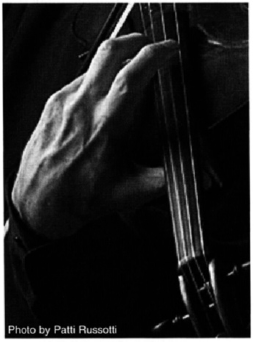
As a teacher, John Graham is a role model of an artist who has found success in trusting his instincts. As a performer, he is a boon to composers interested in exploring the voice of the viola. He is currently on the faculty of the Eastman School of Music and the Aspen Music Festival. Graham's viola is made by Brothers Amati, and his bow is by John Dodd. You can learn more about John Graham's career by visiting his website at www.grahamviola.com.
Footnotes
Laura Rooney currently directs the orchestra program at Pius XI High School, freelances as a violist, and teaches in a private viola and violin studio in Milwaukee) Wisconsin. She is “ABD” toward a D.M.A. in music education from the Eastman School of Music.