






Abstract

Coda Bows for America Awards
Each year, CodaBow International, Ltd., donates approximately $5,000 worth of full-size CodaBow Aspire bows to deserving schools and studios. Violin, viola, and cello bows are awarded. Applications are accepted from ASTA members on behalf of schools or studios that outline the particular worthiness, promise, and need of their program. ASTA is pleased to announce that bows were awarded to:
The Boston Youth Symphony Orchestras, and their Intensive Community Program, will be receiving five PRODIGY violin bows, one PRODIGY viola bow and four PRODIGY cello bows.
ASTA member Erica Lessie, Crete, Illinois, a private teacher with DePaul University, Merit School of Music and Sherwood Conservatory will be receiving two DIAMOND NX cello bows to assist two of her students.
Special thanks to committee chair Anita Pisano, and committee member Matthew Baldwin for their help in judging this ASTA program. And as always, thanks to CodaBows, and their representative, Jef Van Fossen, for their support of this outreach effort.
CodaBows for America Community Outreach Program advances the welfare of public and private music programs through the donation of bows to deserving programs in good standing. We invite you to nominate your program for next year's award. The application deadline is April 1, 2010, and more information is available on ASTAs website.
2011 Alternative styles Awards
The next Alternative Styles Awards Competition will take place in Kansas City, Missouri, March 17 19, 2011. This biennial event is held in conjunction with the ASTA National Conference and seeks to identify, celebrate, and encourage young practitioners of alternative string styles, such as (but not limited to) all folk music traditions, jazz, fusion, and rock music. More information on the upcoming competition will be available on the ASTA website, www.astaweb.com, fall of 2009.
2011 National Solo Competition Finals
The Board of Directors passed the following motions at its May meeting. Motions are effective for the 2011 National Solo Competition.
Potter's Violin Instrument Award Winners
ASTA is pleased to announce that three young musicians were generously awarded instruments by Dalton Potter, owner of Potter's Violins in Bethesda, Maryland, for the April round of the instrument awards for students in need. The winners are:
“These awards really make a difference to an aspiring musician,” says Donna Hale, ASTA executive director. “Students are truly grateful for the instruments that Dalton provides as reflected in this letter from Eunhae Park.”
Applications for the next round may be found at astaweb.com and are due October 1.
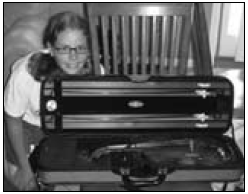
Sarah Wolf poses with her new violin
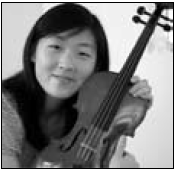
Eunhae Park poses with her new violin.
Dear American String Teachers Association, Thank you immensely from the bottom of my heart for this wonderful opportunity for me to be the recipient of the Potter's Violin Instrument Awards. I am very honored and full of such joy which cannot be expressed fully in words.
I will never forget the moment when my dad told me right after I got home from school that he had received a call from ASTA and that I was one of the three chosen to receive this award. I was so ecstatic and was bouncing up and down all over the place!!
Thank you again and I hope everyone has a wonderful summer! God bless you! Sincerely, Eunhae Park (violin)
Spotlight on the Merle J. Isaac Composition Contest
And the Winners Are…
ASTA is proud to announce the winners of the Merle J. Isaac Composition Contest. Winning in the Junior Division is 17-year-old Zac Lavender for Monadnoc, based on a poem by Emerson. In the Senior Division, the winner is Roger Zare for a Midsummer's Daydream.
In his winning entry in the junior division, Lavender displayed exceptional understanding of form and compositional technique in a very sophisticated work from a young student, which set his effort apart from all the other entries. His writing called for a variety of techniques and styles, and his musical work seemed to be well-related to its poetic inspiration. From a purely technical standpoint, he was able to write effectively for an advanced performance level.
Lavender was born in Barrington, Illinois. He moved to Alpharetta, Georgia with his family when he was 2 years old and later showed a keen interest in music—learning guitar at age seven and studying cello in fifth grade. He was accepted into the North Springs Charter High School music magnet program's Advanced Orchestra.
Lavender has been writing music compositions since his freshman year including sonatas, orchestral overtures, choral pieces, string quartets, concertos and currently an opera based on the presidency of James Madison. He enjoys writing manuscripts by hand and transposing them through music software. He has written over 50 compositions and also writes arrangements for existing pieces (often requested by teachers or students). He has been a principal cellist of the Ludwig Symphony Orchestra and a member of the Atlanta Young Singers (tenor), as well as traveling to Austria to perform with the Sandy Springs Youth Orchestra and conducting his own choral and orchestral pieces.
In his free time, he enjoys composing new music, recording new material with his jam band, Ameri-kush, and practicing his instruments. He will be a senior in the 2009-10 school year, and after graduation, hopes to attend a music conservatory – majoring in music composition with a minor in cello performance.

Zare's winning composition, A Midsummer's Daydream, is a wistful fantasy, written during the summer between two years of high school. It begins as a lilting D-minor barcarolle in 6/8, with occasional hints of a 3/4 hemiola that energizes the rhythmic drive. The middle portion is in major with a broader triple meter, and fragments of a new soaring melody are passed between sections. A return of the opening material builds until the closing bars, where the two main themes are combined for a triumphant close.
Zare, originally from Sarasota, Florida, started composing at age 14, writing a composition for string orchestra premiered by the Pine View School Chamber Symphony in Sarasota. Since then, he has written for a wide variety of instrumental combinations from solo instruments to full orchestra. His music has been performed across the United States. An award winning composer, he has received the ASCAP Nissim Prize, two BMI awards, a New York Youth Symphony First Music Commission, the 2008 American Composers Orchestra Underwood Commission, and many other local and regional honors.
Zare will be pursuing his DMA at the University of Michigan beginning in the fall of 2009. He holds his master of music degree in composition from the Peabody Conservatory, where he studied with Christopher Teofanidis, David Smooke, and Derek Bermel. He holds a bachelor of music degree in composition from the University of Southern California, where he studied with Donald Crockett, Tamar Diesendruck, Frederick Lesemann, and Morten Lauridsen.
Roger is a member of ASCAP as a composer and publisher and maintains his website at http://www.rogerzare.com.
Looking Back After the Dust Has Settled
by Ian Edlund
It was an honor to serve as chairman of the 2009 ASTA Merle Isaac Composition Contest. I found the process interesting, and I was surprised at the breadth and variety of the submissions. We had examples of many musical styles ranging from very traditional “classical” style to very modern. Some of the pieces made use of jazz and fiddling styles in interesting contexts. We looked at entries which ranged in difficulty from first year level to very complex. We also discovered a wide range in the skill sets of the various composers, a few of which were well-known names to in the school orchestra field. This range was especially wide in the junior division, where all contestants were under 18 years of age.
A committee was selected to do the judging of all the entries. This was an outstanding group consisting of some of our most exemplary music educators who have made their reputations working with all levels of players from elementary school through post-graduate study. Besides me, committee members included Ida Steadman of El Paso, Texas; Doris Gazda of Tempe, Arizona; and Charles “Chip” Schooler of Olympia, Washington. The committee decided to evaluate each work using the following general criteria: clarity of form and construction, imaginative use of compositional techniques, playability by string players at the target level, and appeal to audience and musicians. The difficulty of the composition per se was not considered in the judging.
Despite the diverse geographical and musical backgrounds of the committee members, the winning choices were nearly unanimous. Both works have considerable merit. Both show imagination and creativity, and incorporate a fair amount of subtle humor. It's interesting that both works draw to a greater or lesser extent on earlier artists (Emerson and Shakespeare) for their inspiration, a fact which will make the music more readily accessible and interesting to students. Although we did set out to do so, we ended up selecting works which are best played by reasonably proficient high school orchestras. Both works are quite sophisticated in compositional style and contain many contrasting elements which made the pieces interesting to play and listen to. They also provided a wealth of teaching opportunities—not just from a technical standpoint, but for integration with literature and the other arts, which is a valuable attribute in today's education world.
When you get a chance to see and hear these two winning works, I'm sure you will appreciate the talent of these composers and the quality of their efforts. My thanks for the outstanding work by the members of the judging committee.