






Abstract

Vibrato is an essential musical element in string instrument playing that enhances and facilitates expressive performance. However, the acquisition of a beautiful vibrato remains one of the most difficult skills for a young string player to obtain and for instructors to teach. There are many reasons that vibrato is a difficult skill to master. The vibrato motion is complex and only can be executed if the fundamental instrument position and left-hand position are established. Aspects such as appropriate rate, width and purported pitch center are frequently debated (Fischbach, 1998; Gillespie, 1996) and disagreement precludes a universal method for teaching vibrato.
In recent years, a team of researchers, including John Geringer, Michael Allen and myself, embarked on a systematic investigation that explored some of the central issues debated by string pedagogues. Through a series of investigations, we explored elements of string players’ vibrato, including pitch center, continuity, initial direction of motion, finger employed, positions/pitch register, dynamic level, instrument type and performers’ experience level. Although many questions remain, results from these studies provide interesting information to teachers that may be beneficial when describing and designing instruction relative to vibrato. In this article, I will review the research conducted during the last century relative to vibrato performance practice and provide some research-based applications for the studio and classroom.
Pitch Center
Pedagogues and artists hold one of three views relative to the pitch center of string vibrato: (1) the frequency of the vibrato oscillates from the in-tune pitch and below (Applebaum, 1986; Fischer, 1997; Galamian, 1962; Hamann & Gillespie, 2004; Lucktenberg, 1994) (2) the frequency of the vibrato oscillates primarily from the in-tune note and above (Casals, as cited by Applebaum, 1986) and (3) the frequency of the vibrato oscillates equally above and below the conceived pitch (Doscheck, 1968; Joelson, 1964; Mantel, 1972; Rolland, Mutchler, & Hellebrandt, 2000; Young, 1999). Interestingly, there is research that can be found to support each of the above claims. However, only one study found that the vibrato oscillated from the pitch and below (Fletcher & Sanders, 1967). It is important to note that this study measured the pitch of only one violinist, and close inspection of the pitch measurements in the study revealed that the open strings were slightly flat and the pitches were compared to equal temperament, which may explain how the vibrato occurred primarily below the pitch. The majority of research in this area suggests that the frequency of the vibrato oscillates equally above and below the conceived pitch (see Table 1).
Research Results from Investigations of Vibrato Pitch Center
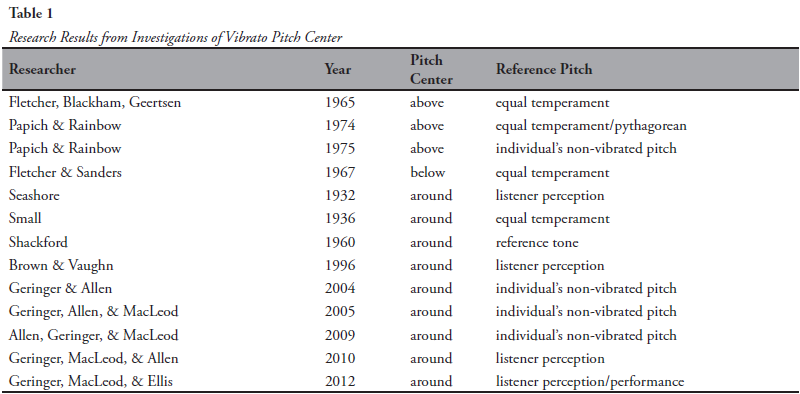
Research Results from Investigations of Vibrato Pitch Center
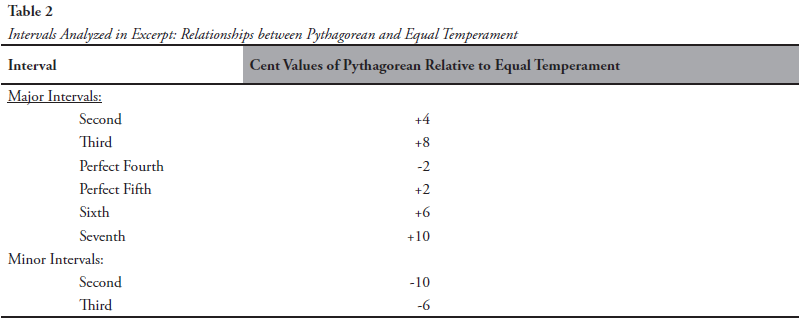
In an attempt to measure vibrato pitch accurately, researchers have used a variety of measurement methods, including comparisons to equal-tempered tuning, Pythagorean tuning, the performer's own non-vibrated tone to the same performer's vibrated tone, and listener perception (see Table 1). Frequently, performers and teachers will question me about the difference between equal temperament and Pythagorean tuning, hypothesizing that the outcome of these research studies is dependent on the tuning system that served as the reference for comparison. It is important to understand that string players do not completely conform to either equal temperament or Pythagorean tuning (Loosen, 1993; Nickerson, 1949). Given the fact that the average width of a vibrated violin tone ranges from 30 to 50 cents, differences that may be attributed to the use of Pythagorean or equal temperament as a reference would be rather small. See Table 2 for a comparison of equal-tempered and Pythagorean tuning.
Intervals Analyzed in Excerpt: Relationships between Pythagorean and Equal Temperament
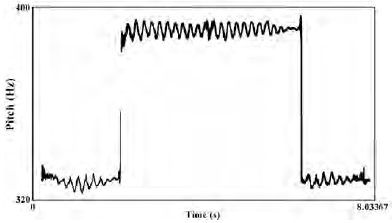
Regardless, in an effort to be precise, researchers have made comparisons utilizing a variety of approaches. Perhaps the most convincing of these methods (See Figure 1a) was the comparison of an individual's straight tone to that same individual's vibrated tone of the identical pitch (Allen, Geringer, & MacLeod, 2009; Geringer & Allen, 2004; Geringer, Allen, & MacLeod, 2005; Papich & Rainbow, 1975). In these four studies, the performers played the intended pitch with no vibrato, then immediately vibrated that same note, eliminating the need to conform to a specific tuning system thus enabling a direct comparison to the performer's conceived pitch. Three out of these four studies found that the vibrato oscillated both above and below the pitch center (Allen, Geringer, & MacLeod, 2009; Geringer & Allen, 2004; Geringer, Allen, & MacLeod, 2005). The mean of the vibrato portion was found to be nearly identical to the mean of the non-vibrato portion.
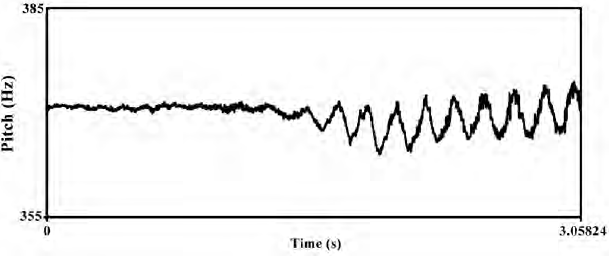
Representation of artist performing F#4 with no vibrato and then with vibrato. Mean frequency of both portions is approximately 370 Hz.
Listener perception has been another means utilized to assess the perceived pitch of vibrato (Brown & Vaughn, 1996; Geringer, MacLeod, & Allen, 2010; Geringer, MacLeod, & Ellis, 2012; Seashore, 1932). Researchers attempted to identify where musicians perceived the center of pitch in the vibrato by comparing non-vibrated tones to vibrated tones in a paired comparison format where listeners heard a straight tone followed by a vibrated tone and were asked whether the second tone was the same, higher or lower (Brown & Vaughn, 1996; Geringer et al., 2010). Listeners perceived examples where the center of the vibrato tone was aligned with the straight tone as the same in pitch. To more accurately measure musicians’ perception of pitch center, Geringer, et al. (2012) conducted a two-part study. In the first portion of the study, musicians manipulated a straight tone using a dial to match a vibrated tone. We found that the musicians in this study tuned the dial to the center of the vibrato tone. In the second portion of the study we allowed string performers to use their instruments to match their own straight tone to the pre-recorded vibrato tone. Again, participants chose to perform a pitch that was close to the center of the vibrato tone (Geringer, et al., 2012).
Vibrato Rate
Vibrato rates observed in empirical research range from 4 Hz to 10 Hz with mean rates falling between 5 Hz and 7 Hz (see Table 3). There are a number of contextual variables that may influence vibrato rate, including pitch register (Allen et al., 2009; MacLeod, 2008), dynamics (Cheslock, 1931; MacLeod, 2008; Reger, 1932), instrument type (MacLeod, 2008) and the experience level of the performer (Geringer, et al., 2005; MacLeod, 2008). Many teachers and performers speculate that vibrato rates may differ between solo and ensemble play, although limited research has directly explored this claim (Papich & Rainbow, 1974).
Research Results from Investigations of Vibrato Rates
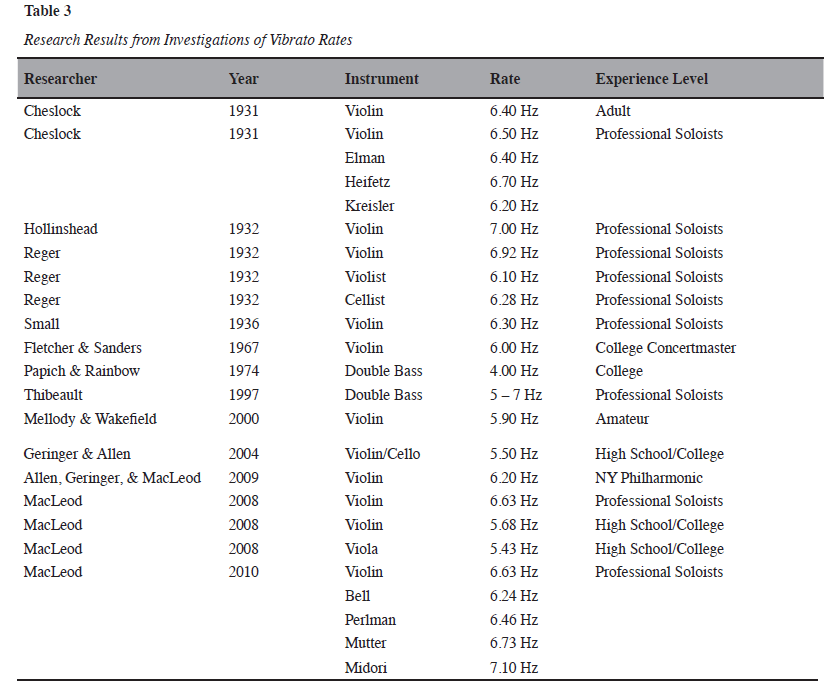
I examined the vibrato of 40 university and high school violin and viola players and found that both university and college students performed with a faster vibrato in seventh position compared to first position (MacLeod, 2008). Given that the performers were musicians in training, we commenced a second study involving a former concertmaster of the New York Philharmonic to verify whether the difference in rate between positions was acceptable or the result of a developing vibrato that lacked control (Allen, et al., 2009). The results of the case study were similar to the results that I found with students. The professional violinist's vibrato was faster in sixth position (6.3 Hz) than in first position (5.7 Hz). However, this study required the artist to perform a range of technical exercises with vibrato limiting expressive musical decisions that may have impacted the vibrato motion. These results prompted yet another investigation to explore whether musical context might provide a different outcome to the same research question (MacLeod, 2010). Recordings of four violin soloists (Joshua Bell, Itzhak Perlman, Anne Sophie Mutter and Midori) performing the opening of the Bruch violin concerto were analyzed to ascertain whether pitch register impacted their vibrato rate. The artists in this study did not increase the rate of the vibrato in higher positions.
Researchers have explored the relationship between dynamic level and vibrato rate, and results have been mixed. A few studies have shown that the vibrato rate increases slightly during forte passages compared to piano passages (MacLeod, 2008; Reger, 1932). In contrast, other research has shown no relationship or change of rate between loud and soft passages (Cheslock, 1931; MacLeod, 2010). It seems that there are additional variables that may be affecting the vibrato rate and it is not possible to generalize the results of these studies to vibrato performance at this time.
Overall, professional artists and soloists appear to vibrate with a faster vibrato than less experienced players and ensemble players. In 1931, Cheslock investigated the vibrato of Elman, Heifetz and Kreisler. The vibrato rates found in that study are similar to the rates performed by Bell, Perlman, Mutter and Midori during the Bruch violin concerto. It remains unclear whether the difference between the rates displayed in Table 3 are due to experience level, musical context or ensemble versus solo players.
Vibrato Width
Most pedagogues agree that an appropriate vibrato width is around one quarter tone or 50 cents (Doscheck, 1968; Fischbach, 1998; Lucktenberg, 1994; Rolland, 2000). Deviations from this recommendation seem to pertain to specific musical contexts. For instance, some research has found that vibrato width varies more than any other characteristic of vibrato to create expressivity. Vibrato is typically wider during forte passages and narrower during piano passages (Allen, et al., 2009; MacLeod 2008, 2010). More experienced players appear to use a wider vibrato than less experienced players (MacLeod, 2010) (see Table 4). Vibrato is generally wider musically when performing in higher positions compared to lower positions (Allen, et al., 2009; MacLeod, 2008, 2010; Papich & Rainbow, 1974) and violin vibrato has been measured as wider than viola vibrato, approximately 4 cents wider in first position and 14 cents wider in seventh position (MacLeod, 2008).
Research Results from Investigations of Vibrato Widths
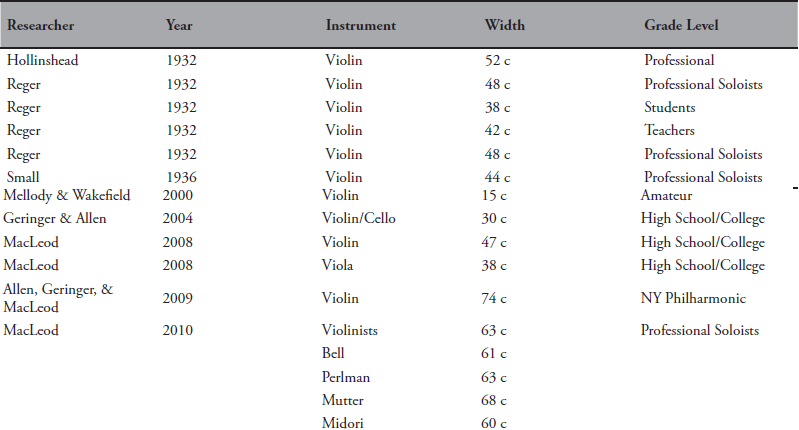
Solo artists’ vibrato appears to be wider than a quarter tone, as seen in Table 4. The four violin artists that I investigated in 2010 varied the width of the vibrato substantially throughout the opening of the Bruch violin concerto for expressive purposes. Interestingly, the vibrato width was much wider in higher positions overall. Notes with a frequency above A5 generally produced a wider vibrato (M = 68 cents) than notes in the lower register (M = 55 cents). The minimum vibrato width performed was 24 cents and the maximum was 129 cents, more than a semitone. Both minimum and maximum widths were performed during tones in the upper register. The results from this study appear to be consistent with the results from the case study involving the New York concertmaster as well as studies from the 1930s.
I Just Want to Know how to Teach Vibrato
At this juncture it seems appropriate to ask how any of this information can have a positive impact on the design of instruction. To answer that question, I would like to direct our attention to the traits of professional and artist level players and compare those characteristics to younger players. What are the main differences between a professional player's vibrato and a young student's vibrato? Further, what are the basic components of a beautiful vibrato?
The case study investigating the vibrato of the former concertmaster of the New York Philharmonic provides some important information that can help us identify the component motions of a violin vibrato (Allen, et al., 2009). In this study, a video-recorded performance of the concertmaster was slowed down so that the vibrato motion could be viewed at one-quarter of the original speed. The slow motion video allowed us to observe the preparatory motion that initiates vibrato as well as other important elements.
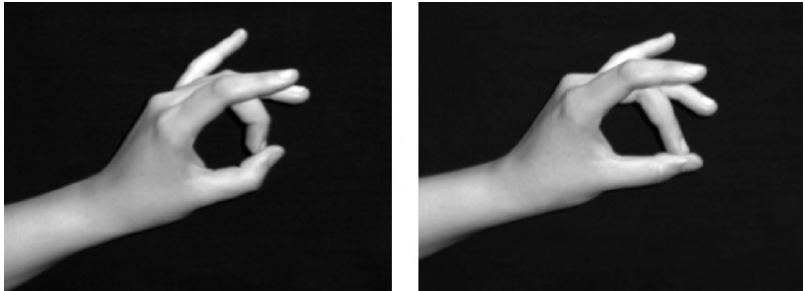
The slow motion video revealed that the first knuckle joint of each left-hand finger was flexible, allowing for a forward and backward motion around the center of pitch (See Figure 2a). Furthermore, the left-hand fingers were placed on the string such that the fingernail faced towards the G-string side of the bridge. The left-hand fingers contacted the string on the “inside,” or thumb side of the finger, not through the center of the pad of the finger. Additionally, there was a preparatory motion that preceded the initiation of the vibrato, where the base knuckle of the index finger was released from the neck of the violin, allowing the hand freedom to execute the vibrato. This preparatory motion is essential to a vibrato that is balanced and free of tension (See Figure 2d).
Flexible knuckles – Have students flex the first knuckle joint of each finger
Preparatory Motion: the base knuckle joint of the index finger disengages from the neck of the violin
In 2005, Geringer, Allen and MacLeod investigated the pitch center, initial direction of vibrato motion and continuity between slurs of high school and university violin and cello players. The results of this study revealed no pattern to the direction by which vibrato was initiated – performers either moved forward or backward in pitch to initiate the vibrato, and university players stopped vibrating during slurs for about .42 seconds while the high school students stopped vibrating for .5 seconds. Elements of this study were replicated in the case study of the former concertmaster of the New York Philharmonic (Allen, et al., 2009). The concertmaster was asked to perform the same exercises that had been performed by the university and high school students in the previous study. Interestingly, his vibrato motion stopped for .33 seconds, less time when compared to the less experienced players in the previous study. Additionally, close inspection of the tones revealed that the concertmaster only stopped vibrating at the end of the tone and immediately reinitiated vibrato at the start of the subsequent tone (See Figure 1b), whereas the less experienced players stopped vibrating on both sides of the vibrato tone as they changed fingers. Exercises that encourage continuity in vibrato during slurred passages are important in developing a more professional vibrato.
Representation of slur pattern using fingers 1 and 3. Duration of non-vibrato portion is approximately .39 seconds for the 1st to 3rd finger transition, and approximately .41 seconds for the 3rd to 1st finger transition.
Teaching Vibrato from the First Year
Much of the research reinforces activities that pedagogues have been promoting for years. Below is a step-by-step approach that promotes the acquisition of a beautiful and artistic violin vibrato:
It is essential for the student to hold the instrument on the shoulder correctly. A proper shoulder position is one where the instrument is supported on the collarbone, is relatively parallel to the floor, and the end button is slightly to the left of the hollow of the student's throat. All the joints are flexible from the shoulder to the fingertip and the instrument can be supported without the help of the left hand for short periods of time. Shoulder rests, shoulder pads or raised chin rests are all helpful tools for establishing the proper shoulder position. Each student is different, so flexibility is required to help find the correct position for each individual.
The left hand must be balanced and free of tension
Violinists’ and violists’ left-hand position has three points of contact or “touch points” that allow for box shaped fingers. Most teachers will identify the base knuckle joint of the index finger on the left hand as the first point of contact. This is an effective starting point. However, hand size and finger length vary from person to person and the ultimate goal is for the fingers to create a box shape. This may require a touch point that is slightly higher or lower than the base knuckle joint. The second touch point is the pad of the finger. The observations from the Allen et al. 2009 study show that the first three fingers should contact the string on the inside or thumb side of the finger while the fourth finger contacts the string through the center of the finger pad. The third touch point is the thumb. Teacher and performer recommendations regarding the position and location of the thumb vary. The most important element is that the thumb is loose through the joints into the wrist. It also is important to establish the appropriate amount of space between the neck of the instrument and the hand.
One strategy that helps determine where the students should touch the thumb to the neck of the instrument is to have them hold their hand naturally without the instrument, mimicking the left-hand position for violin. Have the student create a box with the index finger and draw a line on the base knuckle at the precise location that creates the correct box shape. Then draw a corresponding line on the thumb that is aligned with the mark on the student's index finger. This process will allow for a balanced hand shape on the instrument.
Begin pre-vibrato activities during the first year of instruction
While the left hand is being established, pre-vibrato activities can commence. Students are able to begin developing flexible first knuckle joints during the first year. Figure 2a demonstrates an activity that promotes flexibility in the first knuckle joint of each finger. Have the student create a circle with his or her index finger and thumb. Then ask the student to practice straightening and bending the first knuckle joint. This exercise should be repeated with each finger.
Transfer the flexible knuckles to the instrument
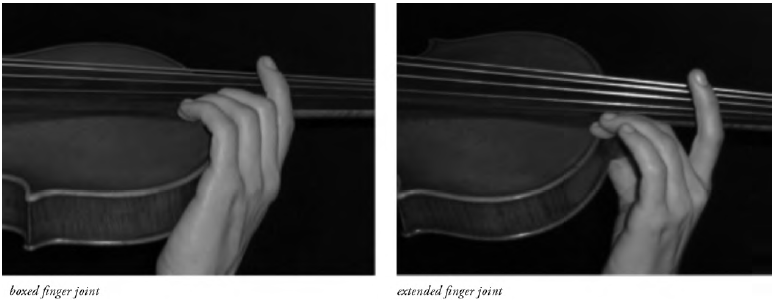
This exercise is performed on the body of the instrument prior to performing on the string. Align the student's left hand on the body of the instrument so that the finger being practiced is lightly touching the neck and the fingernail is facing the bridge. The violin fingerboard will provide a physical guide as the student practices the backward motion with a flexible first knuckle joint (See Figure 2b and 2c). This will reduce the tendency for the hand to have extra twisting motion.
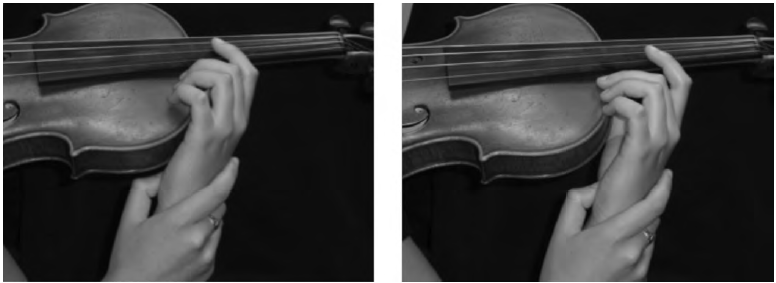
Transferring flexible first joint knuckle to the instrument
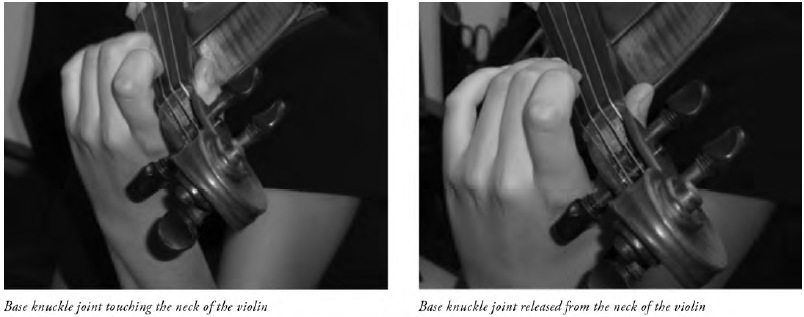
Manual assistance for finger flexibility (arm vibrato)
Although the vibrato pitch does not actually vibrate exclusively from the pitch and below, exercises that promote this motion are very effective when teaching vibrato. Some method books notate an exercise from the pitch to a half-step below and this backwards motion is an excellent activity that promotes flexibility in the left-hand first knuckle joint (Allen, Gillespie, & Hayes, 2000). Pairing this flattening exercise with a forward motion recommended by Rolland in the Teaching of Action in String Playing allows the student to practice both aspects of a correct vibrato motion. Paul Rolland recommends tapping activities on the instrument where the left hand propels forward using a swinging motion from the wrist (See Figure 2e).
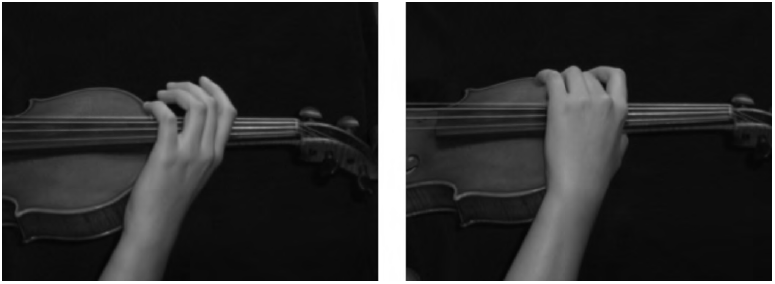
Forward Taps: Place the thumb at the heel of the neck and tap rhythm patterns on the violin
Have students “polish their strings.” With the thumb in the heel of the neck, place the second finger directly over the thumb without any weight in the string and have the students move their second finger back and forth, first with a very wide motion that gets smaller until they are simulating a vibrato motion (See Figure 2f). Repeat this activity with all four fingers.
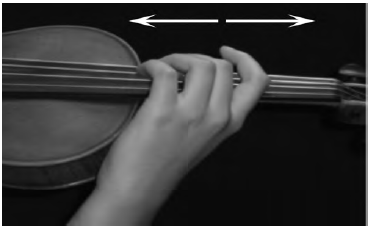
Polish the Strings
Before combining the right and left hand together during vibrato, it is helpful to have the student bow in the air using a vertical motion. Left-hand and right-hand independence are important and younger players frequently have trouble executing a smooth bow arm during initial vibrato activities. Bowing in the air or having students participate in partner activities where one student vibrates the left hand while another student bows for him can be both fun and helpful.
Practice the vibrato motion with a metronome
The final step to achieving a beautiful vibrato is correct repetition with the use of a metronome. Students should set the metronome at 60 bpm and begin vibrating from the pitch and below using eighth notes grouped in two, followed by triplets, sixteenth notes and finally a natural vibrato motion. Careful rhythmic practice will create a vibrato over which the student has some level of control that will enable them to utilize their vibrato for expressive purposes.
Conclusions
Everyone should have the opportunity to learn to vibrate with a beautiful sound. While the research information provided in this article may be helpful in designing instruction and speaking about vibrato with accuracy, many of the activities I recommend have been used by pedagogues for years. In fact, the majority of research reinforces the strategies that we currently use. The most common barrier that students face when attempting to vibrate is improper set up. Careful attention to proper instrument and left-hand position along with a step-by-step approach that is introduced early in the instructional process will facilitate student success in acquiring a beautiful vibrato.
Footnotes
Rebecca MacLeod is associate professor of music education at the University of North Carolina at Greensboro, where she directs the string education program and conducts the UNCG Sinfonia. Prior to joining the UNCG faculty, she was the assistant artistic director and conductor of the Tallahassee Symphony Youth Chamber Orchestra and Philharmonia Orchestra in Tallahassee, Florida. A native of Pennsylvania, she taught elementary, middle, and high school orchestra in Hollidaysburg, Pennsylvania and was orchestra director and chair of music activities in Beaver, Pennsylvania. MacLeod is published in the Journal of Research in Music Education, International Journal of Music Education, Bulletin for the Council of Research in Music Education, Update: Applications of Research in Music Education, Journal of Music Teacher Education, String Research Journal, and the Florida Music Educators Journal. She currently serves on the editorial boards for the Journal of Research in Music Education and the String Research Journal. Her research on working with underserved populations, vibrato technique, music teacher education, and music perception has been presented at the International Conference of Music Perception and Cognition, Music Educators National Conference, National Association for Music Education National Conference, American String Teachers National Conference, Midwest Band and Orchestra Clinic, Society for Music Teacher Education, and several music educators state conferences. MacLeod received her undergraduate degree from Duquesne University in Pittsburgh, Pennsylvania and her M.M.E. and Ph.D. from Florida State University in Tallahassee, Florida. She is a frequent guest conductor and clinician throughout the United States. She currently serves as secretary on the ASTA National Board.