






Abstract

As string teachers we are keenly aware of the importance of quality, goal-oriented practice, but we often struggle to motivate our students to develop this focus in their own work. Practicing between the lessons requires consistent and truthful self-assessment, and that's where iPads and other recording devices can be useful if they are integrated into student assignments. I have never once recorded myself and thought, “Yup, that's pretty much how I thought I sounded!” If that is true for a player in her 40s, that will most certainly be true of younger players. Frankly, we can all stand to hear and see ourselves better — as my teacher used to say, “Eighty percent of practicing is hearing what is actually coming out of your instrument.” What I love about video, as opposed to audio, is that you can actually see why things are sounding the way they are, and not just hear it. My favorite recording device is the iPad. It has instant playback with both decent audio and video quality—no cords, no uploading, and no technology hurdles.
When I first started using recording assignments in my studio at Virginia Commonwealth University (VCU), I tended to make rather vague assignments, such as, “record yourself one time this week and write down some new goals for your piece.” What I learned—the hard way—is that rather than empowering students, recording overwhelmed and depressed them (or they didn't do it!). They often came back with general, negative impressions, like, “It's bad,” or “I'm terrible.” Incorporating recording regularly into the lessons themselves and making bite-sized, structured assignments has helped them get used to the process. Once they get used to it, they can see the full power of the tool. I have found that small snippets of recording are better than large ones, both psychologically and practically. The end goals of the recording process for students are to develop critical listening skills and to fuel their burning desire to become better … all the time. If you are not currently using video in your studio teaching, here are some ideas for getting started, both within the lessons and during the practice week.
In the lesson
In between lessons, at home assignment
These are just a few ideas on how to integrate video in the lesson environment. The main point is just to use it regularly and see where it takes you and your students. When you develop your own ways of using recording regularly, please share by writing an ASTA article like this one!
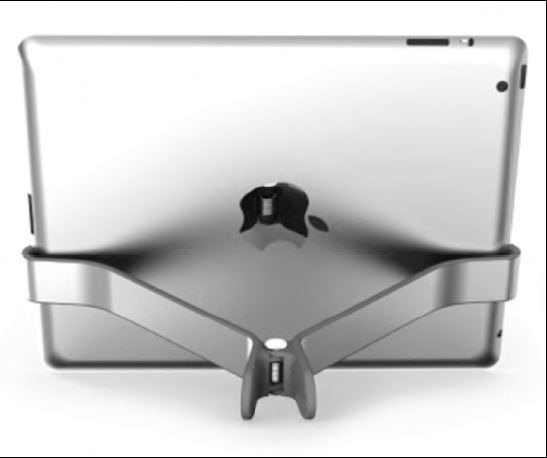
P.S. – Trying to get the iPad set up for easy recording? The Felix TwoHand stand is my favorite gadget. It is cheap (less than $10) and readily available from Staples, Amazon etc. To use it, clip it on the front of the iPad so that the front of the iPad tilts down toward the player. For basses and cellists putting it on a stand will work, for upper strings put it on a piano or shelf on the wall.
Felix TwoHand Tablet Stand, pictured here clipped from the back. For best results, clip it to the front instead so the iPad angles forward, toward the player.
Reprinted with permission from VASTA 2015 Winter Fingerboard.
Susanna Klein is assistant professor of violin and coordinator of strings at her undergraduate alma mater, Virginia Commonwealth University. Before entering academia she was a core member of the Memphis, Colorado and Richmond Symphonies, where she served as principal second. Currently, she enjoys focusing on chamber music through her two trailblazer groups, Atlantic Chamber Ensemble and Trio826. She received her M.M. from Boston University under the tutelage of Roman Totenberg. Read more at susannaviolin.com.