






Abstract

Like all string instruments the timbre of a bass is derived from the placement of the bow. Improving bow holds and angles makes a huge difference for the tone, intonation, articulation, rhythm, and volume of your bass section. Our sought-after default sound is the balanced sound of the pitch fundamental, or “core sound,” blended with resonance and clarity. Placing the bow far from the bridge may lack the clarity, richness, and complexity of sound. A bow placement close to the bridge may have great projection and focus, but may lack the resonance desired in ensemble playing, and be difficult with which to blend and match pitch within a section.
What is the ideal timbre and, thus, bow placement for bass playing? Ask twenty bassists this question and you will hear thirty answers. It is safe to say that bow placement is dependent upon the type of sound and dynamic desired, but that seems a bit like dodging the question. A specific explanation to begin making and exploring sound is to use a bow placement that is 1/8 of the string length of the sounding pitch. Some quick math and use of open strings and fractions can show a student how to divide the string length into halves, quarters, and then eighths. For example, the 1/8 bow placement for an open string would be at the same point on the string as the harmonic that sounds three octaves above the open string. For further clarification, if the string length is 40 inches, the 1/8 bow placement point is 5 inches from the bridge. Therefore, if you play an octave higher, shortening the string length to 20 inches, the corresponding 1/8 bow placement point would be 2.5 inches from the bridge (see fig. 1). This 1/8 bow placement can make a wonderful sound, a balanced mix of the fundamental pitch, resonance, and the upper partials. However, one can imagine that a different sound, both timbre and dynamic, is required for a bassist in order to be heard while playing a concerto compared to our pianissimo statement of the “Ode to Joy” theme in Beethoven Symphony No. 9. Is it safe to say that most young bassists could benefit from learning to bow closer to the bridge? In my experience as a teacher and as a student, “closer to the bridge” is heard more the inverse by five-to-one. However, the solution to better sounding basses is more complicated than that one alteration. Think SWAP!
1/8 bow placement for the open D string
Producing sound with the bow on any string instrument boils down to the aspects of speed (speed of the bow), weight (weight from the arm and muscles), angles (angles of the bow and stick), and placement (placement of the bow, or point of contact, relative to the bridge)—or SWAP. (As well as a favorite topic amongst bassists, rosin!)
The acronym SWAP is a useful device for describing and envisioning the complex and fluid relationship between the four aspects. A change in one component requires changes in the others. Changes in bow placement affect bow speed and weight. Play an open D string using the 1/8 bow placement point, then move closer to the bridge while slowing the bow speed and increasing the weight. Then, try the inverse while moving closer to the fingerboard, faster and lighter. A “good” sound is possible with any bow placement with corresponding changes in speed and weight. Of course the timbre will change dramatically as we move closer or further from the bridge. Great! An infinite variety of tonal colors are derived from manipulating these elements of sound production, but we want the timbre to be an artistic choice, controlled by the player, and produced consistently.
More so than the other string instruments, the elements of SWAP change drastically on the bass as we change register. As we descend, if the placement stays the same, the bow speed should slow and weight increase. Still descending, imagine a gradual transition from horizontal energy of the bow to vertical energy, slowing and getting heavier. As we ascend the opposite is required; the bow speed increases as the weight decreases, if the placement stays the same. To feel and hear this, play in G major from open E to the B in first position on the G string. As you ascend, feel as the resistance from the string lessens and allows the bow to move faster. Otherwise, if you ascend without changing the SWAP, the resonance will become choked by a bow too heavy and too slow. To our shifting variables of SWAP, we can also add the register being played as a determining factor, especially of speed and weight.
Purposefully, I mentioned several times above, “… if the placement stays the same.” Enter the “homemade” solution! Many young players will use a bow speed and weight that sounds great on the D string for the other strings by changing the bow placement. When descending to the A string, the bow moves toward, or over the fingerboard, then even more so for the E string and toward the bridge for the G string. Look at the rosin on your bassists’ strings. Does it follow this diagonal trend? Are the basses losing their core/fundamental sound as they descend, losing volume, and getting “fuzzy,” inarticulate tone? In which register does your bass section sound the best? It would make sense that the D string sounds great for many reasons. One such reason is that young ensembles usually start in D major and young players will first get a good feel for the SWAP needed to create consistently good sound in this middle register. Quickly, the sound deteriorates as we descend or ascend to the adjacent strings when only the bow placement changes while the speed and weight remain the same.
Often, we think of bow angle and bow hold as a problem with sound production. That is, a bow that is not perpendicular to the string will not produce a consistently good sound. The reason behind this thinking is that if the bow is not straight (perpendicular to the string), then the bow placement will not be consistent and will move up and down the string, which requires constant changes in speed and weight to make a “good” sound, albeit one with a constantly changing timbre. A common issue with both French and German bow holds is that the bow angle is “tip low,” meaning rather than having a right angle between the bow and the bridge side of the string, we have an acute angle (see fig. 2). Another common issue with young bassists is that the instruments lean dramatically. As you look at your bassists, the instruments are leaning toward the 10 o'clock position. How difficult is it to have a straight bow with such a leaning set up (see fig. 3)?
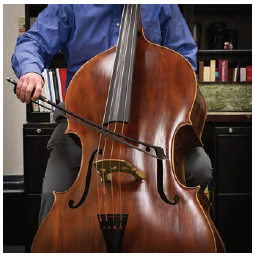
Tip-low bow angle
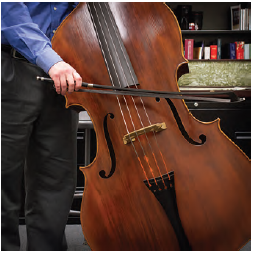
Leaning bass and tip-low bow angle
I labeled the bow angle, bow holds, and leaning instrument set ups as problems. But what if they are actually solutions to a different problem—sound production? Young bassists are smart, inventive, and problem solvers. All are not fortunate enough to see good demonstration regularly, but they will figure out what needs to be done to contribute to their ensemble. This environment can encourage the creation of what I like to call “homemade” technique. It might not be pretty, but it gets the job done. The bow holds, “tip low” bow angles, and leaning instruments allow bassists to make a sound in all registers without changing the speed and weight of the bow. Please notice that I wrote, “make a sound.” We will talk about what kind of sound later. Also, I am not advocating these solutions as recommended best practices, but I want to start the improvement process by explaining to a student, “This is why what you have been doing has been getting pretty good results. And, here is what we can change to make it better.”
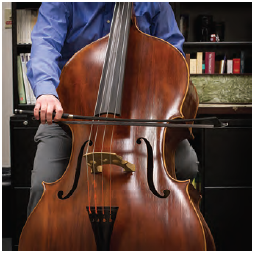
Due to the difficulty of playing with a straight bow with a greatly leaning bass, encourage a more vertical instrument position for seated and standing players that enables a straight bow on each string at both the frog and tip (see figs. 4–7). Even with a more vertical instrument, tip-low bow angles are very common. Often, this imperfect bow angle is not simply a problem, but also can be a symptom of another issue. If your bassists will straighten their bows when asked but in three minutes the problem has returned, look for these culprits—bow holds!
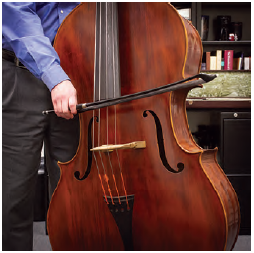
Vertical bass, E string at the frog
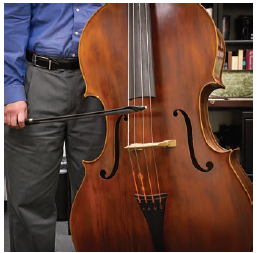
Vertical bass, E string at the tip
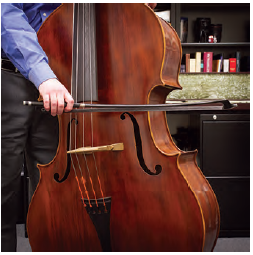
Vertical bass, G string at the frog
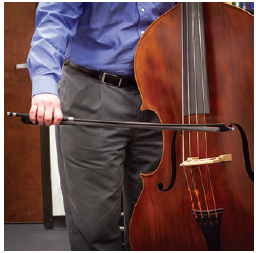
Vertical bass, G string at the tip
Two sources of tip-low bow angles with French bow holds are when the right thumb is curved outward, often called the “banana” or “hitchhiker's” thumb, and the screw of the bow exits the back of the hand in the palm (see figs. 8–9). These two issues usually occur simultaneously. Without a proper shape and contact point of the right thumb, young players hold the bow with their entire hand, including the palm. To improve bow angles, you must improve the bow hold. Otherwise, when young players correct their bow angle without improving their bow hold, it is inevitable that they will return to the tip-low angle.
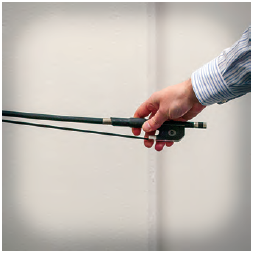
Banana thumb
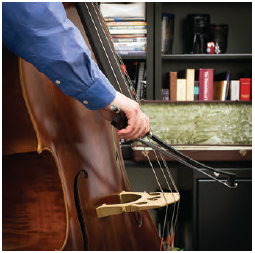
Screw exits at the palm, tip-low bow angle
Similarly to how collapsed knuckles of the left hand can be a symptom of the fingers contacting the string too far from the fingertips, the banana thumb bow hold indicates that the contact point of the thumb to the bow is too far from the tip of the thumb. If your bassists’ thumbs have ever slipped between the stick and the hair, their contact point is too far from the tip of the thumb. Ask your bassists to tap their second fingers and thumbs together as quickly as possible, then notice which part of their thumbs they tapped. Contacting the bow with the tip of the thumb enables a relaxed bow hold, allows the driving of the bow without squeezing the bow hold, and prevents the thumb from slipping (see fig. 10). The banana thumb is responsible for most French bow hold fingers, wrist, elbow, shoulder, angle, and tension issues! When the tip of the thumb contacts the bow, the thumb knuckles are flexible, allowing fingers, wrist, elbow, and shoulder to move together and independently. Instead, if the pad of the thumb contacts the bow and the thumb is bent outward, all of the joints become rigid and all the muscles from the hand through the upper arm are flexed, squeezing the bow, trying not to allow the thumb to slip.
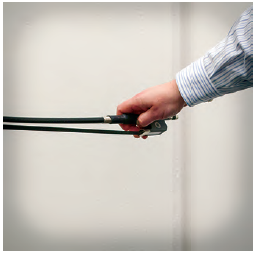
Tip of thumb contacts the bow
Once the thumb is correct, we can improve the bow angle. Have the screw of the bow exit the back of the hand at the middle knuckle of the pinky finger, rather than from the palm, raising the bow tip (see fig. 11).
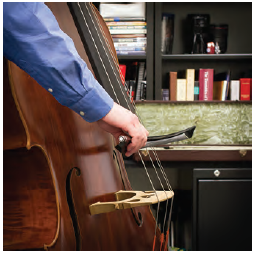
Screw exits at the middle knuckle of pinky, straight bow angle
German bow holds have a similar issue with the bow hold creating the tip-low angle. Often, the first and second fingers of the bow hold are straight and may have collapsed knuckles (see fig. 12). The contact point of the fingers to the bow is too far from the fingertips to allow for flexible and relaxed joints and results in the same locked fingers, wrist, and elbow, allowing the bow arm to only move from the shoulder. A great exercise for improving the straight finger, tip-low bow hold and angle of a German bow while in playing position is to gradually slide the first and second fingers along the stick toward the frog, while the contact point of the fingers transitions from finger pads to fingertips (see fig. 13). The overall shape of the bow arm and hand will shift from an L-shape to a backwards J-shape. The curve of the second finger, its fingertip contact with the bow, and its position on the side of the bow stick is largely responsible for the German bow angle.
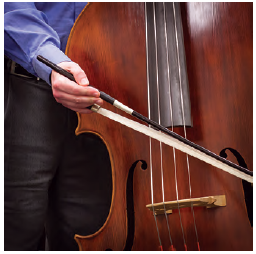
Collapsed fiat fingers, pads of fingers contact bow, L-shaped arm and hand, tip-low bow angle
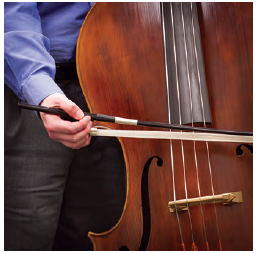
Curved fingers, fingertips contact bow, backwards J-shaped arm and hand, straight bow angle
Improving bow holds and bow angles will only stick if the players internalize how this technique will benefit their playing. They must buy in to the concept that better sound is possible with a more consistent bow placement. With a more consistent bow placement and bow angle, speed and weight need to change depending upon the register and for each string. But what a difference this can make for the tone, intonation, articulation, rhythm, and volume of your bass section!
Open strings and a marker are a great place to start. Locate the 1/8 bow placement point for the open strings and then mark the string with a marker. Mark a second point on each of the strings, a half-inch closer to the bridge. The game is to play the open strings while being able to see one mark on the strings, but not both nor none. The purpose is two-fold: Consistent bow placement is very difficult with a tip-low bow angle, thus reinforcing the previous bow hold improvements to enable a straight bow, and when playing each of the open strings, the necessary changes in speed and weight become apparent, now that the bow placement is consistent from string to string.
Moving from the highest string to the lowest, the bow speed needs to decrease and the weight increase to produce a core sound. Otherwise the bow will no longer engage the string, will float on top, and we will lose the pitch fundamental. Moving from lowest string to highest, the issue becomes resonance rather than core sound. The bow speed will need to increase and the weight decrease. Otherwise the sound will become gritty, choked; the pitch will be pushed flat; and the glorious ring and resonance that attracts all bassists to the instrument will disappear.
Once we are ready to move beyond open strings, keep in mind that as we shorten the string length, continuing to ascend, even while bowing closer to the bridge to maintain the 1/8 bow placement point, the bow speed will still increase and the weight decrease. Think of the bow speed and weight of the violins and their string lengths. As your basses ascend, let every ledger line encourage you to use more bow. Listen to the timbre. A pressed sound, with a bow speed too slow, will lose resonance and, to borrow from our singing colleagues, the tone will change from chest voice “oo”, as in “pool”, to a nasal “eh”, as in “pen”.
I'd like to close with a quick summary of suggestions and tips. Develop consistent sound production with a combination of instrument position, bow holds, and bow angles. Experiment with different combinations of SWAP to expand the artistic tonal palette of your basses. Impart an understanding of the changes in SWAP necessary for sound production in different registers. Beware of asking your basses to “use more bow” when they are in the low register, when you would like more core sound. Likewise, feel free to have the basses use more bows than the other sections, especially when your basses are in the upper register and the timbre is no longer appropriate with slower bow speeds. Recognize tip-low bow angles as a symptom of a bow hold issues, most likely collapsed or flat fingers and banana thumbs.
And finally, if your bassists have been creative and inventive in their construction of “homemade” techniques to get good results, congratulate their ingenuity and experimentation. Those skills will be invaluable for future problem solving.
Footnotes
Jack Unzicker was raised in Juneau, Alaska. He is currently assistant professor of double bass at the University of Texas at Arlington, Artist Faculty at the Texas Chamber Music Institute, and principal double bassist of the Dallas Chamber Symphony and Plano Symphony Orchestra. He is a frequent performer and presenter at the International Society of Bassists, American String Teachers Association, and Texas Music Educators Association conventions and has been featured in articles on playing and teaching the double bass in The Strad and Strings magazine. Unzicker studied Double Bass Performance, Orchestral Conducting, and Jazz Studies at the University of North Texas and Western Washington University.