






Abstract

How many workshops or clinics have you attended in the hope that you would walk away with a toolbox of tricks to teach vibrato to your students? In addition to workshops and clinics, a simple Internet search for teaching vibrato on a stringed instrument will display numerous vibrato videos and tricks that can be added to your vibrato-teaching toolbox. However, to be effective, tricks and exercises for teaching vibrato require a solid foundation of content knowledge, or the basic understanding of skills and principles of vibrato technique.
“To be effective, tricks and exercises for teaching vibrato require a solid foundation of content knowledge, or the basic understanding of skills and principles of vibrato technique.”
The primary goal of using a particular instructional strategy or “trick” would be to introduce and reinforce specific content knowledge for complex skills such as vibrato. Using “tricks” learned at a workshop or online might be helpful as long as the underlying content knowledge is taught in conjunction with the instructional strategy. However, instructional strategies sometimes used to teach a complex skill such as vibrato may or may not have an explicit connection to the content knowledge.
This article focuses on the content knowledge and pedagogical knowledge for vibrato in the heterogeneous string classroom. In our first article, “Pedagogical Content Knowledge for Shifting: More than a Toolbox of Tricks” in the May 2018 issue of American String Teacher, we focused on content knowledge and pedagogical knowledge needed for successfully teaching shifting. Teaching vibrato is similar to the complexity of teaching shifting, which involves a series of muscles, motion, and mechanics. As a result, string educators need to be able to choose instructional strategies that will transform content knowledge in a way that students can understand and apply that new knowledge.
Pedagogical Content Knowledge (PCK)
PCK includes “the ways of representing and formulating the subject that make it comprehensible to others” (Shulman 1986, 9). In other words, a teacher must know the facts and concepts of a subject, in addition to understanding how the principles and structures are organized. Research suggests that teachers tend to acquire PCK through a variety of sources, including their student experiences, teacher education programs, classroom experience, and professional development activities (Grossman 1990; Shulman 1986, 1987). PCK with regard to music has been defined as the “knowledge of music teaching techniques, engaging students with music in a meaningful way, implementing the music curriculum effectively, assessing students’ abilities in the various aspects of music, [and] explaining and demonstrating musical concepts” (Ballantyne and Packer 2004, 302).
Content Knowledge of Vibrato
Vibrato is the oscillation of a pitch. Although the definition is straightforward, vibrato is a complicated skill. Moreover, teaching vibrato in a heterogeneous string class can be challenging. Hamann and Gillespie (2013, 96) provided a few general principles for basic vibrato and basic content knowledge required for the skill: for violins and violas, arm vibrato uses the left forearm as the primary mechanism to generate vibrato, whereas wrist vibrato uses the wrist as the mechanism to generate vibrato. The vibrato motion for cellos and basses is generated by moving the arm and hand as one unit. In addition, the arm or hand can move either as a unit or independently for the violin and viola depending on whether arm vibrato or wrist vibrato is taught. The vibrato motion is measured by speed and width. Furthermore, rolling the fingertip while flexing the first knuckle on the violin and viola produces vibrato. In the case of cello and basses, rolling the finger on the string while moving the arm and hand in a straight line produces vibrato.
Pedagogical Knowledge of Vibrato
String pedagogues offer various pedagogical approaches and philosophies about how to teach vibrato (Applebaum and Lindsay 2005; Fischer 1997; Galamian 1962; Mantel 1995; Potter 1980). There seems to be a general agreement among the various approaches that vibrato should be continuous, initiating at the beginning of the tone and carrying through to the next tone (Applebaum and Lindsay 2005; Fischer 1997; Galamian 1962). In addition to the work of major string pedagogues, there have been systematic approaches developed to teach vibrato technique (Allen, Gillespie, and Hayes 1997; Applebaum and Lindsay 2005; Fischbach and Frost 1997; Galamian 1962; Gillespie 1993; Potter 1980; Rolland, Mutschler, and Hellebrandt 1986).
PCK for Vibrato: A Scaffolding Approach
In the previous article on shifting, we presented instructional scaffolding as an effective process to teach shifting. Scaffolding techniques can also be systematically planned to help students gradually learn. Similar to shifting, new concepts and skills are broken into chunks, providing a concrete structure for the teacher and students. Using specific PCK for vibrato, we present a scaffolding process that includes preparatory vibrato exercises (no instrument and no bow), vibrato exercises (instrument and no bow), vibrato exercises (instrument and bow), and vibrato in context (exercises and string repertoire). Rolland, Mutschler, and Hellebrandt (1986); Hamann and Gillespie (2013); and other pedagogues have provided many useful instructional strategies for teaching vibrato that have been adapted and included in this scaffolding process. We invite the reader to consider with each exercise how both content and pedagogy are incorporated to provide a clear awareness of both what is being taught and how.
Preparatory Vibrato Exercises (No Instrument, No Bow)
Vibrato is a micro-alteration of pitch that involves flexibility in muscles and joints. Therefore, it is critical that students have a good sense of pitch and relaxed posture before learning vibrato. A number of pre-instrument left-hand exercises can be used to promote relaxed and flexible movement, such as dangling and swinging the arm like a grandfather clock, asking students to “jiggle” arm fat like Jell-O, and shaking dice or a small box of candies (see Young 1978).
Beginning vibrato exercises reinforce the necessity for relaxation in the left hand. In addition, vibrato exercises without an instrument or bow allow students to focus entirely on new left-hand movements. The wrist and arm joints can move freely while the student maintains the shape of the hand for real vibrato. For example, have the students hold a shaker softly in the palm of their hand, supinating their forearm and holding it out to the left as if playing their instrument. Gearhart (2016) refers to the violin and viola motion as the vibrato pulse. The “pulse” is a light forward and rebound motion that should be practiced separately away from the instrument so that the motion can be learned kinesthetically without extra complexity and tension of holding the instrument simultaneously.
Shakin’
Provide students with a small container (tic-tac, nerd candy, egg shaker) and have students hold shaker in the same manner as playing an instrument (Hamann and Gillespie 2013). Violins and violas should loosen their wrists so that the hand flops toward the shoulder and then send the wrist in the opposite direction so the hand moves away from the shoulder. Cellos and bass should hold the shaker between the thumb and first and second fingers and the practice an up and down motion of the arm, not from the rotation of the wrist or hand. Turn on a metronome and have the students shake their containers together and gradually increase the tempo of the metronome. The objective of this exercise is to help the students learn to oscillate the shaker back and forth with the wrist in an even, relaxed way.
Flexibility of First Knuckle Joint (Violins and Violas)
Have the students create a circle with their left index finger and thumb. Then have them “flex” their first knuckle joint so that it alternates between a concave and a convex position. This exercise helps students loosen the knuckle joint, giving students a visual and physical sensation of finger flexibility. The exercise should be repeated with each finger so that all fingers receive equal and consistent practice.
Pivot (Cello and Bass)
Have the students place their left thumb in the center of their right palm and lightly close the right hand. Practice the vibrato motion on top of the right hand by having the students rotate the forearm down and back. Note that students should use their full arm to initiate the vibrato motion, not to merely twist the hand or wrist. As Potter (1980, 108) suggested, “it is important . . . that the whole left forearm produce the . . . vibrato, with the wrist functioning only as a part of the total vibrato unit.”
Using the right hand as a gentle “spotting” technique allows students to feel the sensation of a relaxed thumb (i.e., they can feel when they are squeezing their own hand too hard). They are also able to use the shape of the lightly closed hand as a mold for the direction of the left hand, without losing the general full arm movement. Next, have students touch their collarbones with the end of their second finger and rotate their arm while keeping their elbow motionless (Hamann and Gillespie 2013). The movement to the collarbone allows a gradual shift to a more authentic location, but without adding the more challenging step of conducting the exercise on the cello or bass itself. Students may find it useful to begin contact on the instrument in fourth position, with the thumb in the crook of the instrument neck, and fingers hovering slightly over the string (Potter 1980).
Vibrato Exercises with Instrument, No Bow
Vibrato exercises without a bow enables the students to practice the correct movement without the added complexity of the bowing technique, so that students can focus their attention on keeping the left arm, elbow, wrist, fingers, and thumb relaxed. During the exercises, the teacher can monitor violin and viola students to make sure that the first knuckle joint of the finger bends. Cellos and basses will roll the finger on the string while ensuring that the forearm does not rotate incorrectly but moves in a straight line (Figures 1a and 1b).
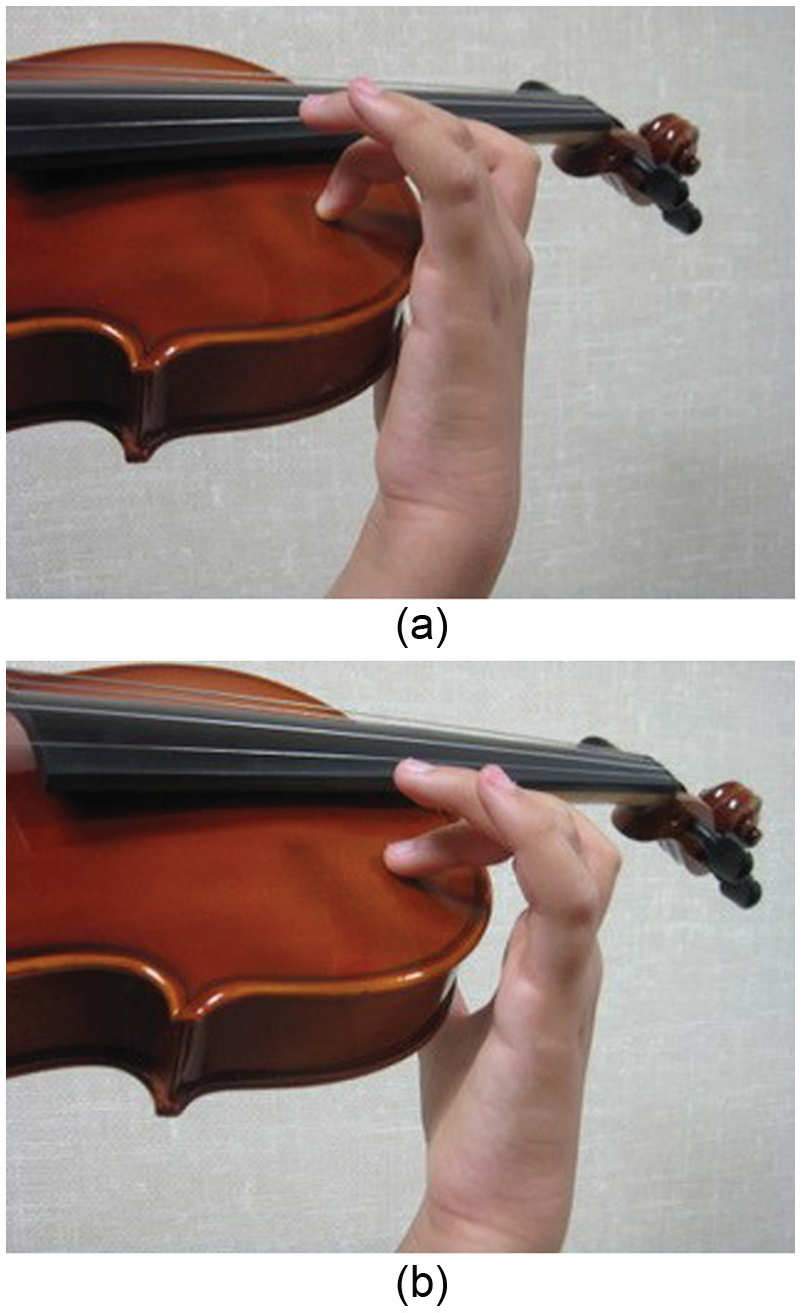
First knuckle flexibility.
Relaxation of Left Arm, Hand, and Thumb
“Swingplop” is an exercise where the instrument is held in playing position and the left arm swings freely and relaxed imitating an elephant trunk. On cue, the arc of a swing is completed by seating or “plopping” the fingers on the neck of the instrument (Fischbach and Frost 1998). This activity promotes a loose arm and large muscle activation, and encourages dropping arm weight down on the string without pressing (Figures 2a and 2b).
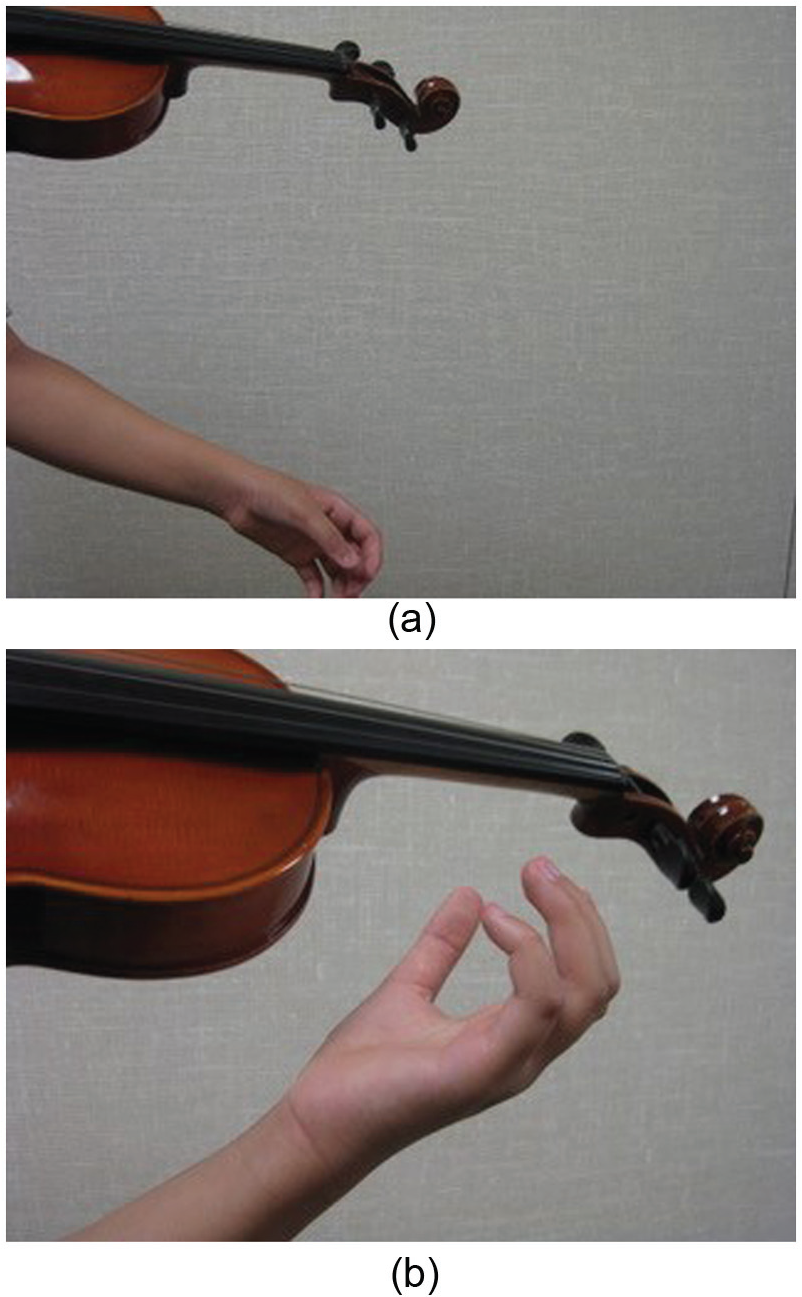
Swingplop in motion.
Tapping Exercises (Violins and Violas)
While the thumb is positioned at the heel of the neck with the fingers curved, the students tap the body of the instrument with their third finger. Have students repeat the same exercise with their other fingers one at a time (Hamann and Gillespie 2013). Practicing this exercise at the shoulder of the instrument prevents students from collapsing the wrist, thereby providing extra support for positioning the hand correctly (Figures 3a and 3b).
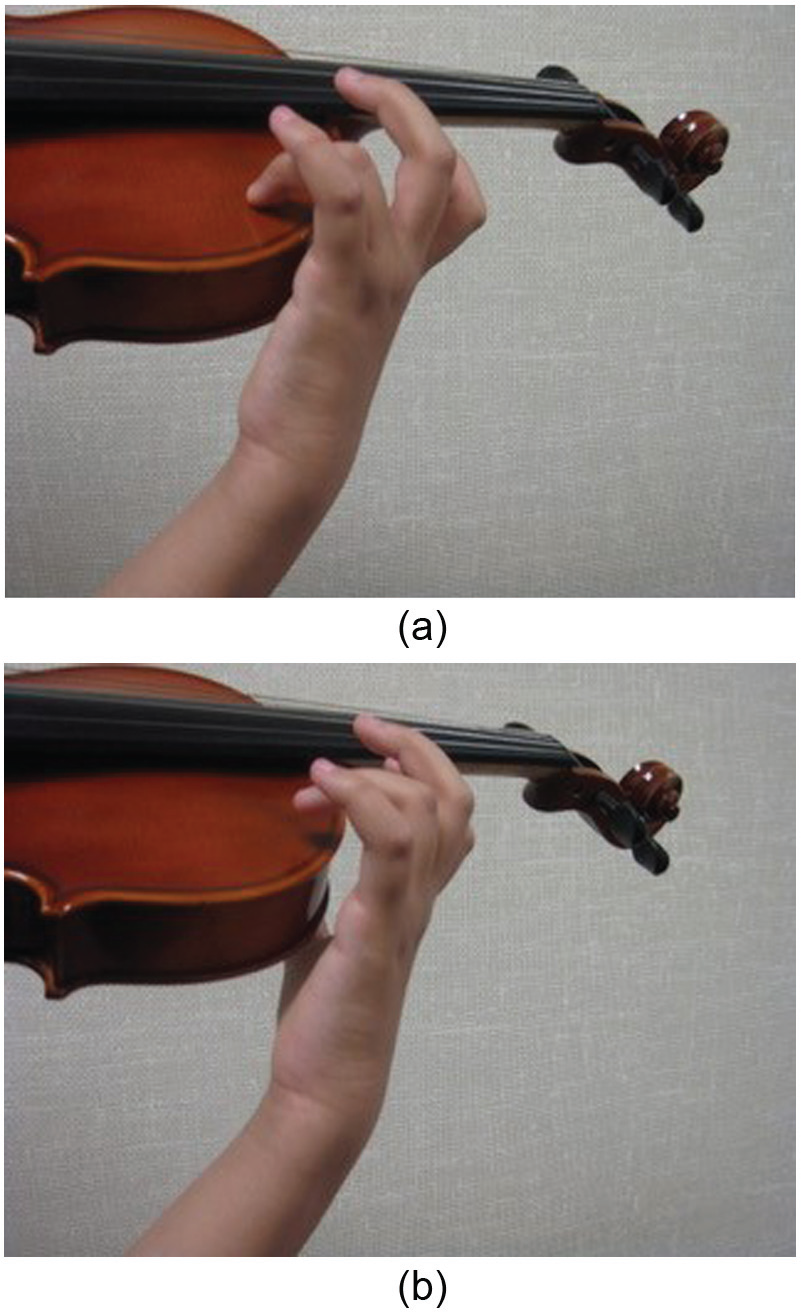
Tapping exercises.
Moveable Bout (Violins and Violas)
Have students simulate the vibrato motion at the bout of the instrument. Place one fingertip on the D or A string and practice the vibrato motion and repeat the same exercise with the other fingers. Gradually transfer the vibrato motion from the bout of the instrument to first position. Practice the vibrato motion in all the intermediate positions between the bout and first position (Gillespie 1993). The gradual movement from the bout to the string allows students to focus attention on the correct technique without the added complexity of playing on the string. Once they have established a kinesthetic memory of the skill, they can then transfer that knowledge to their playing position.
Polishing the String
Have students slide one finger up and down the string, covering the distance of three half steps (Rolland, Mutschler, and Hellebrandt 1986). Repeat the exercise with each finger separately on all four strings, so that the arm has an opportunity to practice the sliding motion at all the various angles and levels that are produced with different fingers and at different strings. Gradually shorten the distance, from two half-steps to one half-step, so that students are able to mimic the actual distance of the vibrato after first mastering the technique at a slower, more visible level. The cello and bass vibrato motion is produced by a combination of sliding and pivoting. Similar to violins and violas (and for the same pedagogical reasons), cellists and bassists can practice sliding their fingers up and down the string, gradually shortening the travel (Hamann and Gillespie 2013).
Pivot and Silent Bow (Cello and Bass)
Have students move the pivot exercise discussed earlier to the string and practice the pivot motion on each string. Students can silent bow while they are practicing the pivot motion, thereby adding another physical element to the skill (as students are ready for more challenge), but without yet adding sound, which may distract the students or cause their attention to focus too much on other technical elements of bowing.
Vibrato Exercises with Instrument and Bow
Right Hand Support (Violins and Violas)
Have students move their left hands to first position and have their right-hand fingers touch their left arm below the wrist. The student’s own right hand becomes a “teacher,” assisting the left hand as it simulates the vibrato motion (Figure 4). Students should practice the vibrato motion with one finger at a time and gradually remove the assistance of the right hand when the left hand is able to move independently without the extra support. After the students are able to continue the vibrato motion without the assistance of the right hand, they can then begin bowing while vibrating (Hamann and Gillespie 2013). This gradual sequencing of skills allows the student to move from dependence on teacher, to dependence on the help of another hand, to independent left-hand movement, and finally to independent movement while introducing an unrelated and additionally complex technique.
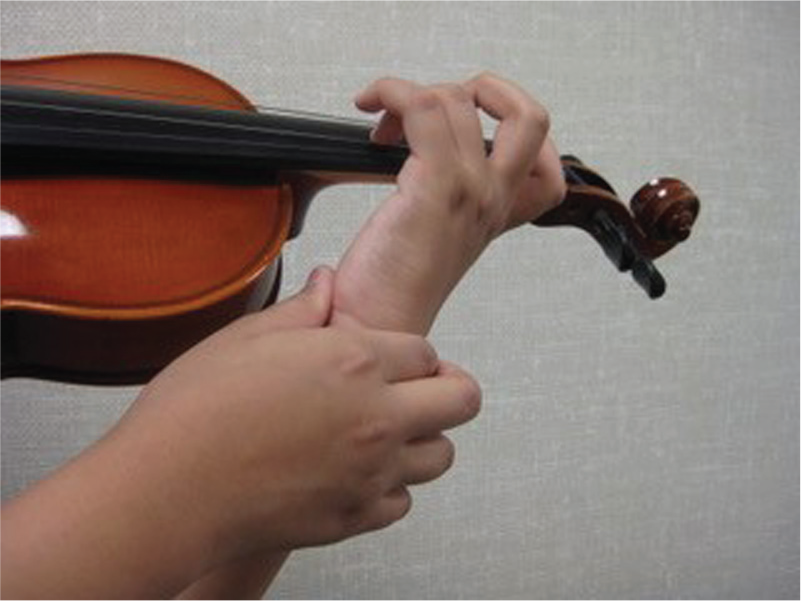
Right hand support.
Pivot and Bow (Cello and Bass)
After students can pivot and silent bow, have the students practice the pivot exercise and bowing on an adjacent string. For instance, the student is practicing a pivot exercise on the D string and bowing an open A string. This activity adds one more level of complexity with the bow while students continue to reinforce a correct and relaxed vibrato with the left hand.
Vibrato in Context: Exercises and String Repertoire
Finally, vibrato opportunities within the context of music are introduced. Combining vibrato with note reading can be difficult due to the complexity of both kinds of knowledge. Therefore, once the teacher has introduced the student to performing vibrato while bowing on the same string, then the student can practice using vibrato while playing songs that are memorized or by simply “improvising” a variety of slow notes in various positions.
When students have fluent and relaxed vibrato across their range of notes and positions, the teacher can purposefully select repertoire and method books that provide students with opportunities to reinforce the vibrato. For example, Viva Vibrato (Fischbach and Frost 1998) and Essential Technique for Strings (Allen et al. 2004) are method books that can help students reinforce key shifting concepts addressed in the classroom when they are at home, and they can also be used as supplemental materials in the classroom. Furthermore, music repertoire such as Jupiter (Holst and Monday 2006) can help students practice vibrato on slow and sustained notes, allowing them to hear the distinct sound difference when they add vibrato to each note.
Conclusion
Vibrato is a complex skill and requires a certain level of string-specific content knowledge before any pedagogical approach should be introduced. The use of certain activities without a connection to foundational principles of vibrato technique might result in teaching faulty vibrato concepts to our students, as we may lack the awareness of what is needed—or why it is needed—and thereby miss or misuse an approach. Often the depth of subject-specific content knowledge will influence a teacher’s pedagogical choices, and a lack of PCK can affect a teacher’s instruction (Grossman 1990). Furthermore, previous research of PCK suggests that teachers need both subject-matter content knowledge and pedagogical knowledge to teach a specific discipline (Shulman 1986, 1987). Based on this premise, we can assume that string educators with a strong foundation in both string-specific content knowledge and pedagogical knowledge will select and use strategies that are most helpful and productive in ensuring long-term student success.
Footnotes
Karin Hendricks is an assistant professor of music education and co-director of undergraduate studies in music at Boston University. A regular presenter of research papers and practitioner workshops, she has served as an orchestra clinician and adjudicator throughout the United States and abroad. She currently serves as national secretary of the ASTA. She conducts research in music psychology, student motivation and engagement, and social justice, and has published papers in professional and peer-reviewed journals and books. She is co-author of Performance Anxiety Strategies and author of Compassionate Music Teaching.
Diane Grieser is currently a string specialist in the Kyrene School District and an adjunct professor at Paradise Valley Community College (Arizona). She completed her Doctorate of Musical Arts from Boston University. She has taught a variety of music classes for the past thirty years that have included college chamber music, elementary string orchestra, and middle school string orchestra. She has served as the Arizona Band Orchestra Directors Association Vice-President for Junior High Orchestra Activities. In 2007, she received the award of “Outstanding Public School String Teacher” from the American String Teachers Association (ASTA) Arizona Chapter.