






Abstract

In the increasingly culturally diverse orchestra classroom, there is a need to provide sequential and applicable warm-up activities that prepare students to play a multitude of different music techniques and styles beyond the classical music genre. If students only ever warm up for rehearsal using Western music scales and rhythm patterns, they may have difficulty learning other performance styles such as jazz improvisation later on. Warm-ups should function to prepare students for a wide variety of rhythmic, melodic, harmonic, and technical challenges present in a diverse range of music genres. This article will focus on warm-ups using Afro-Cuban rhythms with applications for improvisation and Latin jazz styles of playing.
Setting the Stage
The tone and type of warm-up activity set the stage for student expectation and engagement in rehearsal (Hammann and Gillespie 2009; Selby 2016). If treated as a mindless routine, students may miss the connection between the content of the warm-up and the techniques needed in concert music later in rehearsal. Mentally stimulating and engaging warm-ups also can function as a hook to get students focused and actively participating from the beginning of class. Including rhythmic motives or scale patterns from different music styles promotes diversity in the classroom and better prepares students to appreciate and perform other styles of music.
Warming up without sheet music gives students a chance to hone in on personal and ensemble skills such as intonation, articulation, expression, and style. I propose teaching the exercises in this article by ear first, in a call-and-response style. It also is useful to show the exercise visually on a whiteboard, PowerPoint, or sheet music so students learn to recognize techniques in different contexts. All of the following examples can be taught or practiced as individual rhythms or as part of existing scale routines. I recommend having students play the rhythm back first, then play the rhythm on each string, then play the rhythm as part of a scale. Once students are fairly comfortable with a scale, teachers can vary the scale warm-up exercise by applying new rhythms to each note. This can serve as a vehicle for introducing a variety of Cuban, Latin American, African, and jazz music elements, several of which are described below.
Afro-Cuban Rhythm Motifs
Afro-Cuban rhythm motifs are a great way to get students more comfortable with syncopation. Most genres of music have examples of hemiolas and syncopation, so becoming familiar with these rhythms sets students up for success to play a variety of music genres. Consider incorporating each of the following rhythm patterns into scale warm-ups.
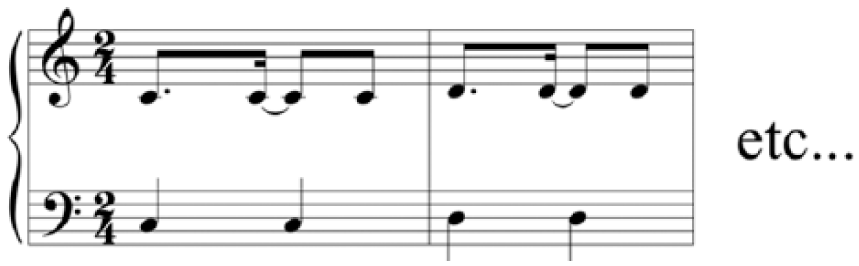
The habanera, or contradanza as it is known in Cuba, is a dance and music style of both Spanish and African origins. Musical elements include a short rhythmic motive in the bass line in the 2/4-time signature with rhythmic emphasis on the second beat. Emilio Grenet called the habanera “the most universal of our genres” due to its influence in the development of other music genres, such as the tango and other Latin American dance forms (Roberts 1999). In classical music, George Bizet modeled his aria “Habanera” after the rhythmic pattern in his 1875 opera, Carmen. In a classroom setting, have students play the habanera rhythm on each scale degree (demonstrated in Figure 1).

The habanera rhythm as a scale.
Spanish for triplet, the tresillo rhythm pattern (Figure 2) functions somewhat similar to a triplet in duple meter. This forms the rhythmic basis of many Afro-Cuban music styles such as salsa, mambo, and clave rhythms. Musicians commonly use this as a rhythm or ostinato pattern in the bass line, especially as a bass tumbalo for arpeggio or chordal accompaniment (Figure 3). Students can practice the tresillo pattern on each note of a scale, or practice a bass tumbao pattern as arpeggios. Both can be performed with steady quarter notes underneath, creating the characteristically Latin jazz three-against-two hemiola (Figure 4).

Tresillo pattern for scales.

Bass tumbao pattern for arpeggios.
Three-against-two tresillo pattern.
The cinquillo is a common variation on the tresillo pattern found both in sub-Saharan Africa and in Cuban contradanza music (Orovio 2004). The rhythm pattern may have originated with African-Americans in Haiti before spreading to Cuba. The syncopated part of the rhythm should be emphasized more than the down-beat (Figure 5).

Cinquillo pattern up the scale.
“A successful balance between structure and novelty in the warm-up prepares students not only for rehearsal, but also for the skills needed for more advanced music-making.”
The son clave rhythm underlays much of African and Cuban music, including rhumba, danzon, and the Afro-Cuban abakuá music (Sublette 2007). The rhythm is frequently played on bells or on the claves, after which the rhythm pattern is named. The son clave rhythm has several different variations shown in Figures 6 and 7: a 3+2 beat pattern and opposite 2+3 beat pattern (Washburne 1997). Both can be played in warm-up scales. Consider playing a backing track of the rhythm while students play the scale to help facilitate the syncopated emphasis.

3+2 clave rhythm.

2+3 clave rhythm.
In the early 1950s, Cuban violinist Enrique Jorrin invented the style of music now known as cha-cha-cha (Schweitzer 2014). Unlike other danzon and mambo styles, the cha-cha-cha is not syncopated. The accompanying dance evolved to have a characteristic shuffle-step on the fourth beat of each measure. Therefore, when playing this rhythm, beats four and one should be emphasized (Figure 8). This is a great way to have students practice counting out loud while playing since it is not syncopated (either saying “one-two-three—cha-cha-cha—two-three” or “one- two- three- four and one …”).

Cha-cha-cha rhythm.
Jamaican rhythms also heavily influenced Latin American music and Latin jazz genres. The music genre known as ska originated in the 1950s and was heavily influenced by jazz, rhythm and blues, calypso, African, and Caribbean mento folk music (Larkin 2016). Ska influenced the rise of reggae music ten years later, which is why both genres have similar music characteristics such as a rhythmic emphasis on the off-beat (Anderson 2004). Reggae tends to be played slightly slower than ska (Bader 2018). Play sample backing tracks of ska or reggae music while practicing the rhythms in Figures 9 and 10 on open strings to help students get the feel for the off-beat emphasis. Note that the night notes in reggae music should be swung.

Ska rhythm.

Reggae rhythm.
Additional Warm-up Ideas
Other ideas for incorporating different rhythms into warm-up routines include practicing the rhythms without instruments. Have students sing or clap the rhythm before playing it on their instrument. Come up with silly phrases or syllables to fit each rhythm. Then transfer the rhythm pattern to the instrument, first on open strings and then as part of a scale.
If students get the hang of different rhythms quickly, try the following suggestions to make the activity more challenging. Have some students play steady quarter-notes while others play one of the new rhythms. Mix and match the rhythms by having half of the students play the tresillo rhythm and half play the cinquillo rhythm. Have students count out loud while they play. This ensures that they are warming up their mind as well as their body for rehearsal. If you have time, let students improvise or compose their own one-measure rhythms for the class to play. Use tricky rhythm measures from concert selections to rehearse isolated rhythms as part of the class warm-up. Be sure to balance the percentage of warm-up time spent on new fundamentals and how much time is spent preparing students for the following rehearsal of concert music. In this way, warm-ups can both advance the student further in their musical ability and physically prepare them for the day’s rehearsal.
Teachers have the difficult responsibility of cultivating both routine and variation in warm-up practices. A successful balance between structure and novelty in the warm-up prepares students not only for rehearsal, but also for the skills needed for more advanced music-making. Variations on scales, rhythms, styles, and genres of music within warm-up activities provide strategies to connect learning in the strings classroom with cultures from around the world while increasing student engagement and musical relevance.
Helpful warm-up resources for scales and bowing variations:
Habits of a Successful String Musician and Habits of a Successful Middle Level String Musician by Chris Selby
Sound Innovations for String Orchestra: Creative Warm-Ups by Bob Phillips
Daily Warm-Ups for String Orchestra by Michael Allen
Resources and lesson plans for alternative styles of music:
Fiddlers/Jazz/Rock/Mariachi/Latin Philharmonic series by Bob Phillips
The Magic of Irish/Appalachian/Light Classical Fiddling series by Larry McCabe
https://thesession.org/ (Irish tunes)
Lesson plans:
Backing tracks to play while warming up on long tones, rhythm patterns, scales, and so on:
GarageBand (comes with many pre-existing backing tracks)
Beatlab.com (have students take turns selecting the squares and making the rhythm backing track)
Youtube.com (type in what you are looking for, e.g. “reggae backing track in C major”)
Footnotes
Tresa Proffitt (