







Abstract

Music by English composers occupies a central position in the repertoire for young performers: works by Vaughan Williams, Holst, Fletcher, and Britten serve as vital touchstones and often provide the first substantial artistic exploration for developing players. One of the most preeminent of these is Edward Elgar (1857–1934), whose Serenade for Strings in E minor, op. 20, offers a wealth of expressive and technical challenges, yet remains accessible to many student ensembles.
“Serenade for Strings in E minor, op. 20, offers a wealth of expressive and technical challenges, yet remains accessible to many student ensembles.”
Origins of the Serenade for Strings
The creation of the Serenade for Strings (1892) spans a significant period in the life of the emerging composer. Many historians cite a link to a three-movement suite for strings dating from 1888 (now lost), the year in which he became engaged to his former piano pupil Alice; marriage and the birth of their daughter Carice followed in 1889 and 1890, respectively (Grimley and Rushton 2004, xii). In 1892, Elgar conducted the premiere performance of the Serenade with the Worcester Ladies’ Orchestral Class (McVeagh 2007, 15). London Publisher Novello refused the Serenade, acknowledging its quality but questioning public demand for the genre; the German firm Breitkopf & Härtel became the distributor (Moore 1984, 160). Elgar credited Alice with assistance in crafting some of the melodies (Anderson 1993, 371). Elgar conducted the Serenade in an August 1933 recording session; together with the Elegy, recorded the same day, it became the final work so preserved (Kennedy 2004, 197).
The Work as a Whole
Comprising three movements, the Serenade is cyclical in structure: thematic material from the first movement later serves as the second half of the finale. Elgar’s gesture was likely inspired by similar restatements in the esteemed string serenades of his predecessors Tchaikovsky and Dvorak. The first two movements of Elgar’s Serenade bear the greatest weight in terms of duration and dramatic substance, while the finale emerges as a more succinct summation (see Table 1). Though Elgar distinguishes the three movements with unique expressive labels (Allegro piacevole, Larghetto, and Allegretto, respectively), the given metronome indications fall within a relatively narrow compass (dotted quarter note = 96, eighth note = 80, and dotted quarter note = 92, respectively). Consequently, contrast between movements relies to a great extent on character and style, while care must be taken to establish and preserve the subtle tempo relationships. In his own recording, Elgar expanded considerably the range of tempi by means of a slow, yet fluid, pace in the Larghetto (eighth note = circa 58) (goodmanmusica 2013).
Structural Comparison of Movements.
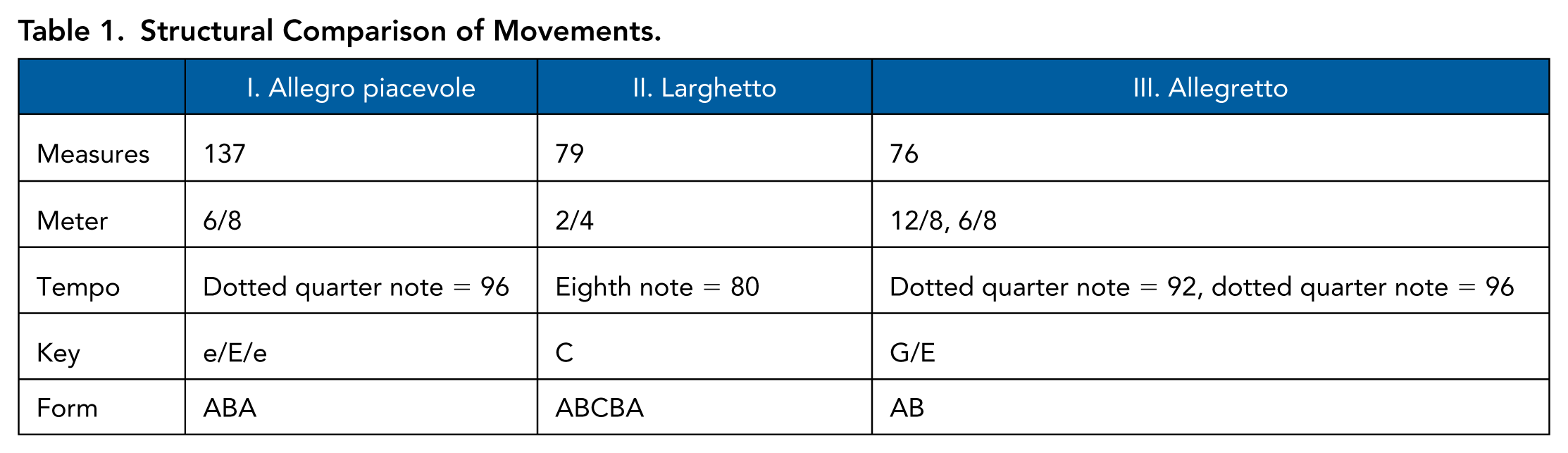
In the simplest terms, the Serenade undertakes a journey from E minor to E major. The opening movement features both tonalities: the ternary structure corresponds with modulation from the minor to the major mode, then back again. The choice of C major for the Larghetto is indicative of Elgar’s predilection for nineteenth-century techniques—chords and keys related by a third were frequently employed by Romantic composers. A similar relationship occurs within the finale, in which G major gives way to E major. Elgar’s harmonic language is rooted in the same style period. Occasional chromaticism colors individual chords yet never obscures the tonal center. Delayed resolutions and brief tonicizations heighten the aspirational quality of the music: while the tonal goal is never in question, Elgar often takes the listener on a circuitous path to the eventual destination.
Elgar’s meticulous approach to the notation of dynamics may have arisen from his extensive work with amateur and student musicians; the vast majority of phrases in the Serenade are subject to some degree of nuance. The overall scope of volume is extensive, traversing a span of ppp to ff; Elgar reserves these extreme dynamic indications for moments of structural importance. Significantly, fortissimo is employed only once in the entire Serenade: in the first movement, it abets a culmination of dramatic tension prior to the recapitulation of the primary material. The dynamic nadir of the first movement distinguishes the final four measures, bringing the Allegro piacevole to a tranquil close. In the second movement, the lone tutti forte serves as the apex of the second statement of the second subject (measure 58); it occurs mid-measure and quickly subsides to piano. More prolonged, the ppp passage in the Larghetto prepares, then initiates, the restatement of the secondary material (rehearsal L) with uniquely hushed intimacy. The dynamic extremes of the finale are close in succession: the forte in measure 28 marks the short-lived climax of the opening section, while ppp, just six measures later, serves as preparation for the reappearance of the initial motive of the first movement.
Given its modest dimensions, the Serenade contains a remarkable array of articulation markings. Elgar modifies note attacks and durations with sforzando, rinforzando, accent, circumflex, forte-piano, sforzando-piano, staccato, tenuto, staccato-tenuto, and accent-tenuto. Moreover, several of these markings—accent, circumflex, staccato, tenuto, and sforzando-piano—are to be realized within a slur. In determining the best technical approach to each articulation, the primary consideration must be context: the optimal execution to enhance the prevailing expressive environment. Consequently, articulations in the Larghetto may be rounded and lyrical to a greater extent than those in the outer movements, where a more rapid attack and decay corresponds with the livelier mood. Regardless, common practice dictates that sforzando would require the greatest intensity of all the markings employed in the piece.
I. Allegro Piacevole
In the first movement, Elgar modifies the Allegro marking with piacevole (“agreeable, pleasant”), instilling a measure of British reserve (and the composer’s trademark emotional restraint) in what might otherwise be a typically bustling and energetic opening. The lucid ternary form (ABA) comprises two subjects: a sweeping theme in E minor heralded by a viola ostinato (see Figure 1) and an expressive, yearning melody in E major (see Figure 2).
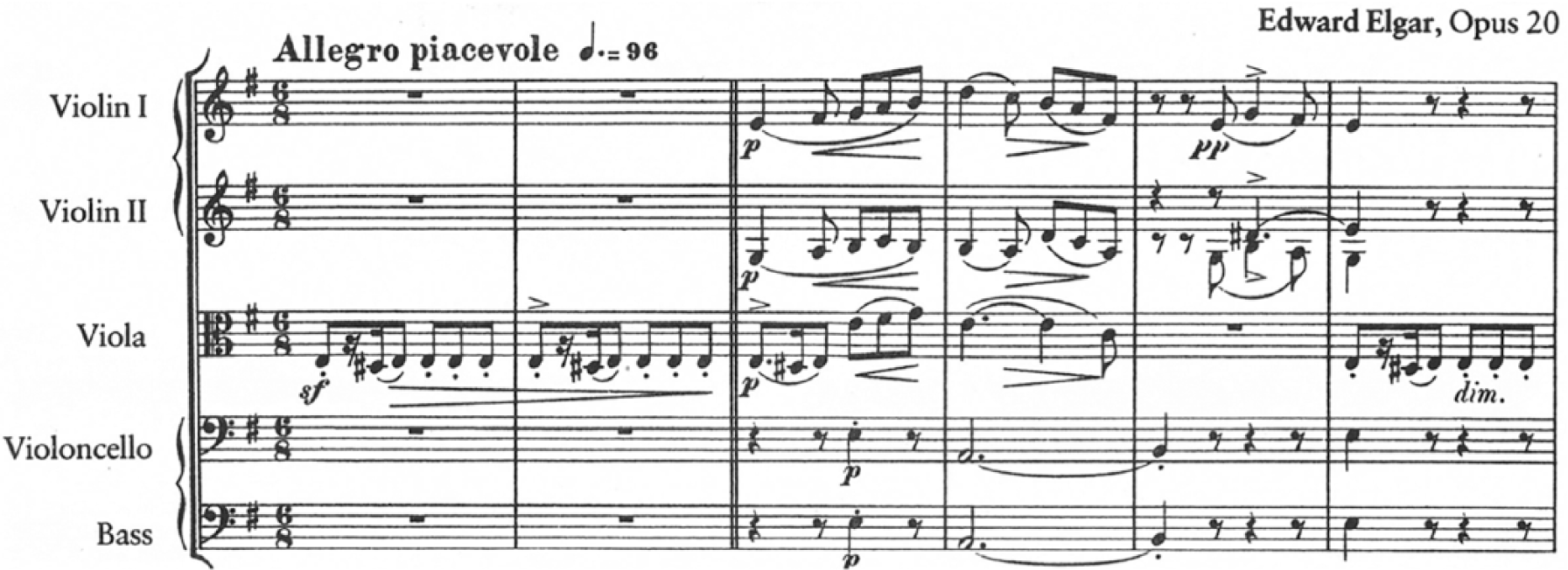
I: Mm. 1–6.
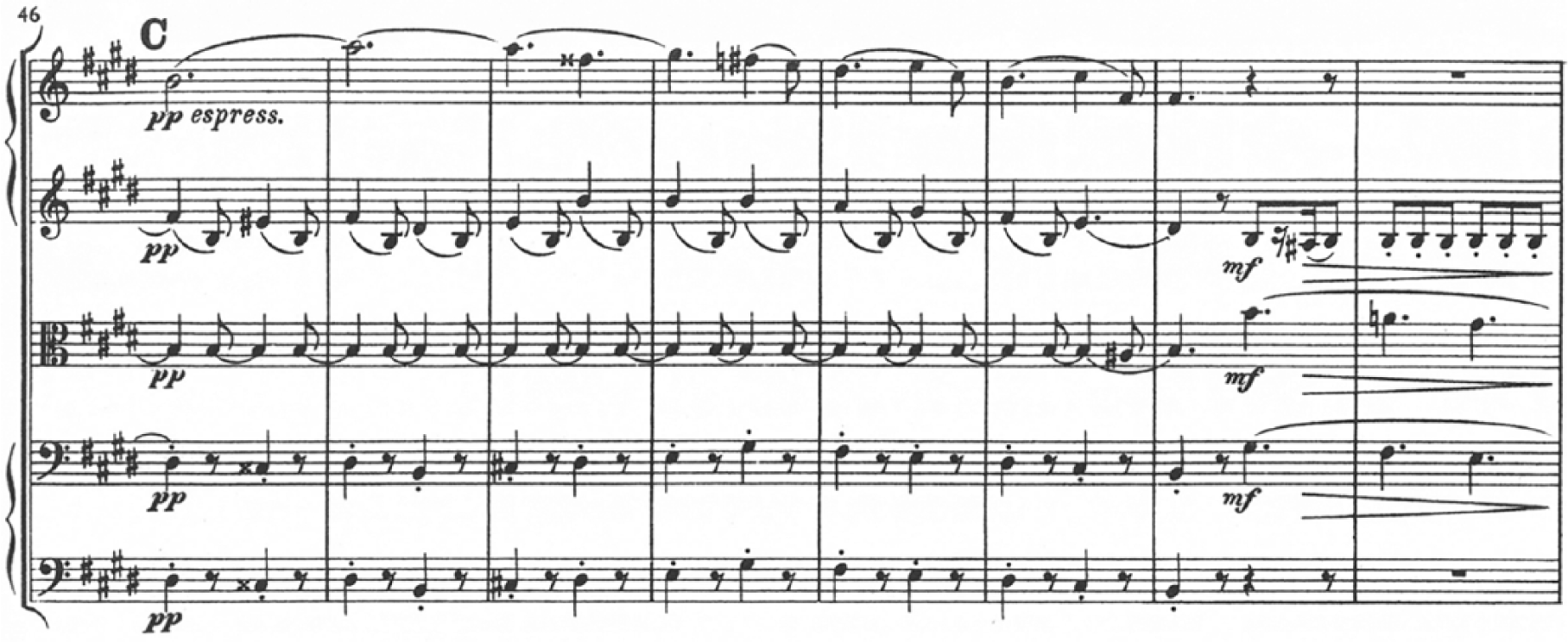
I: Mm. 46–53.
The movement begins with violas in the low register, an appropriately warm and dark timbre (see Figure 1). While Elgar substitutes sforzando for an actual dynamic level, the subsequent two-measure diminuendo suggests an opening volume in the range of mezzo piano to mezzo forte; anything louder would compromise the subtlety central to Elgar’s musical language. The first pitch is notated staccato—separated—but will lose the intensity of the sforzando if played too short; instead, approach with a pointed attack. The accent mark posited mid-diminuendo reveals its subservient relationship to the earlier sforzando. In measure 5, another accent, within pianissimo, requires judicious execution; a surge of left hand color with perhaps a slight increase in bow speed is all that is required. The pianissimo marking in the first violins should extend to the seconds as well: this is how the parallel passage in the recapitulation is notated.
Careful observation of the dynamics in the opening phrases will underscore the horizontal development of the music. The two statements are hardly identical: the second crescendo escalates to a sforzando, requiring greater weight and intensity. The subsequent violin pronouncement, now marked piano, is interrupted by a bold metrical device: Elgar’s surprising half-bar, featuring the viola ostinato, answered by accents is all of the other parts (though without the expected crescendo) (see Figure 3).
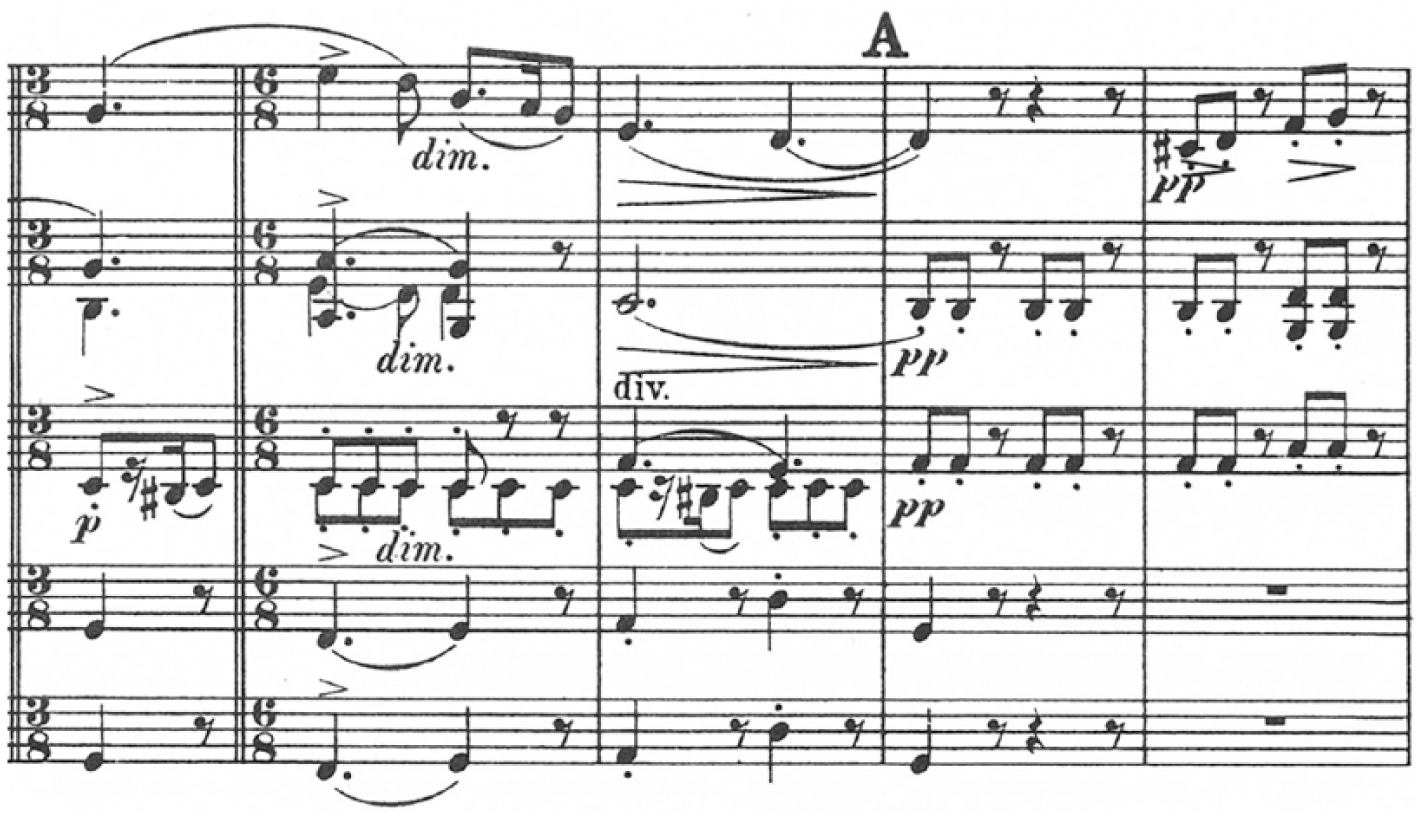
I: Mm. 10–14.
At rehearsal A (this and subsequent rehearsal letters refer to the Breitkopf & Härtel edition), a related idea begins with paired eighth notes. The dynamic contour in the first violins could well apply to all of the upper strings: less intensity on the second note reinforces the natural hierarchy of the meter. Sequential repetition an octave higher will naturally result in increased intensity. The tutti diminuendo in measure 22 must not deter the violas from renewed strength—accented and mezzo forte—in the next bar. A final outburst, combining both accent and sforzando in low register violins, requires significant energy.
Rehearsal B, uniquely posited in the middle of measure 32, marks the mid-bar return of the viola ostinato and heralds the closing paragraph of the opening A section. Here, the printed dynamics require adjustment. While the previous section ended with a diminuendo from pianissimo, Elgar indicates no new dynamic at B. However, additional volume—at least mezzo piano—is required ahead of two diminuendos in the subsequent measures.
Elgar distinguishes the exquisite B section by means of several techniques, including modulation to E major, reduction in volume to pianissimo, and a shift to homophonic texture (see Figure 2). Angular motion in the second violins and pervasive syncopation in the violas make transparency a challenge; placement in the upper half of the bow and poco sul tasto should help maintain proper balance. The expressive climate suggests a more rounded, sustained approach to the staccato bass line. Vibrato will help preserve resonance between pitches, while placement above the middle of the bow will allow for greater bow speed without heaviness.
Balance is a concern at several points. At rehearsal D, violas and cellos will need to impose a subito pianissimo, both to match the volume of the other sections and to permit projection of the melody in the first violins. Measure 70 recalls the texture at the start of the section, though without the underpinning of the cellos and basses. With the melody carried by a single violin, the second violins and violas, still syncopated but now more thickly scored, must play with particular delicacy. In bar 72, the crescendo in the accompanying voices should be minimized in order to maintain balance with the melody, which must preserve strength despite its descending motion. Once the first violins enter (measure 74), the intensification in the accompaniment may proceed unhindered. At bar 78, the solo violin/tutti paradigm repeats.
The emotional surge of the coda requires meticulous attention to dynamics, articulation, and balance (see Figure 4). Despite the diminuendo gestures, the sequential accumulation beginning in measure 116 should lead organically and inexorably to forte; outside cellos, coming from piano in bar 120, are called upon for particular resilience. The seven measures of forte stand as the most protracted forceful passage in the entire work. Despite yet another progressive descent, potency must be maintained up until the notated diminuendo. Projection of the inner voices, which focus largely on the initial syncopation of the opening viola motive, will contribute immeasurably to the vigor of these measures. A spectral vestige of this climax, in the form of an accent within a tie, is found in measure 131 (see Figure 5). Approaching pianissimo, the gesture is best executed via a subtle combination of quickened vibrato and increased bow speed.
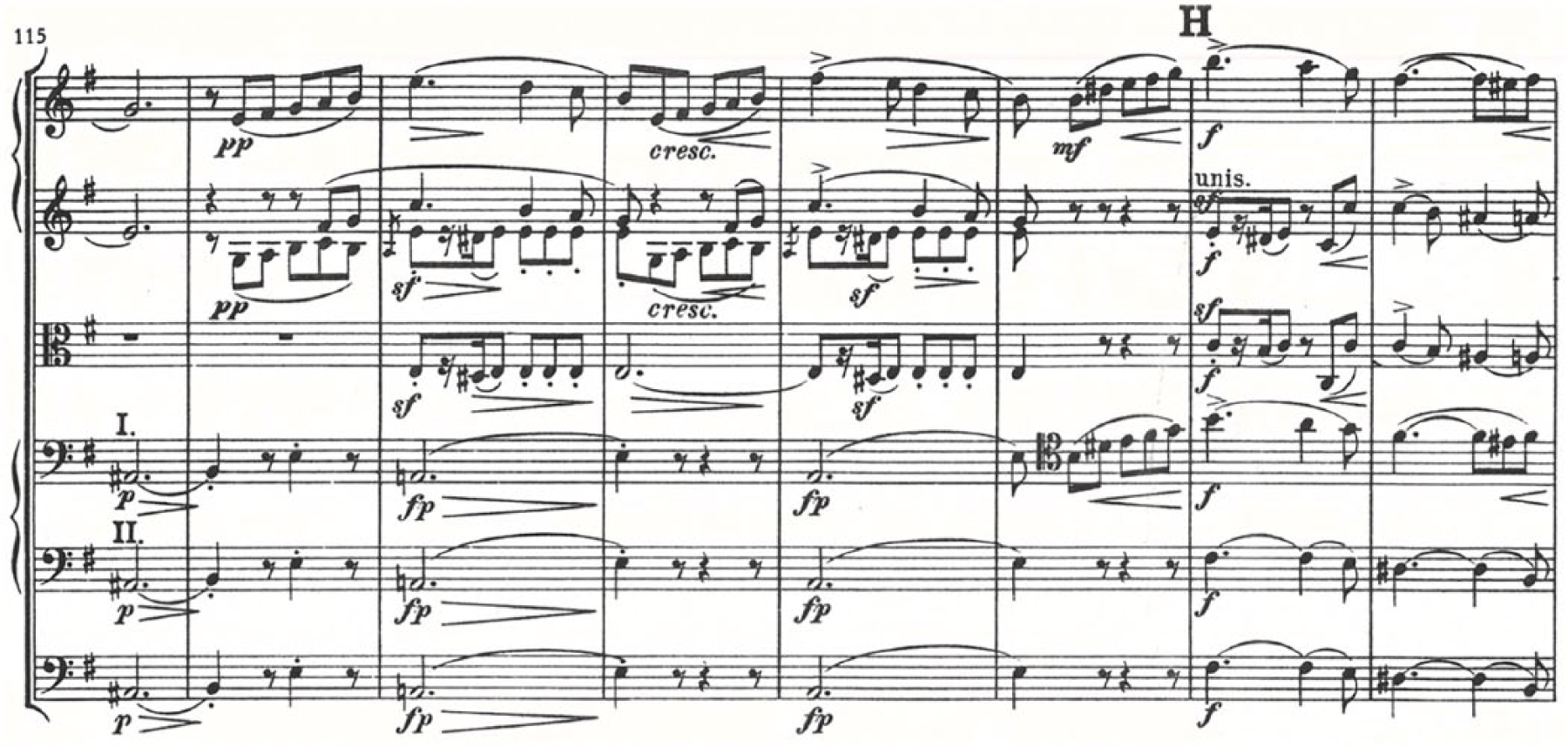
I: Mm. 115–122.
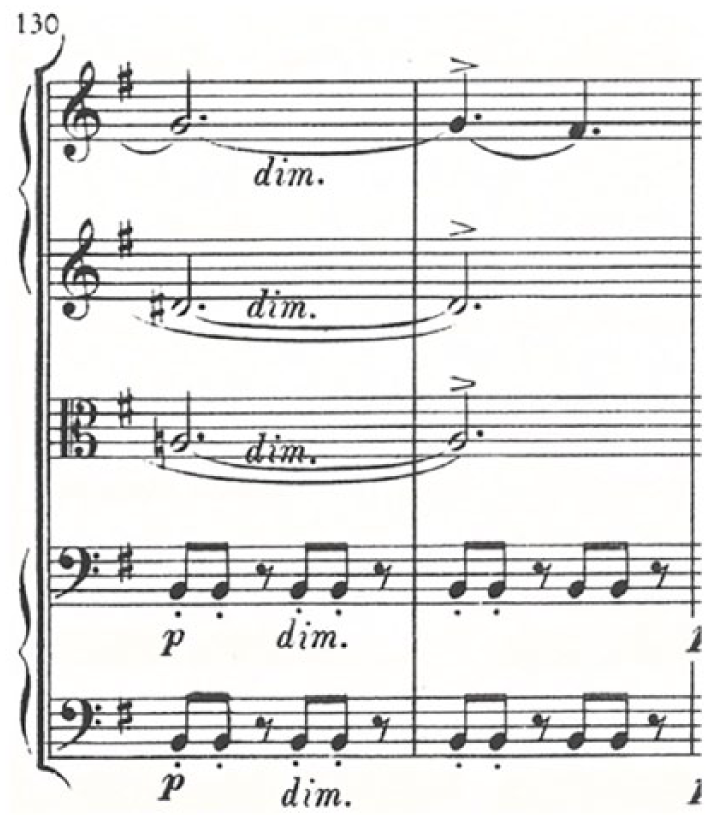
I: Mm. 130–131.
II. Larghetto
The lyrical central movement, marked Larghetto, is cast in palindromic form: ABCBA. A more nuanced approach to dynamics and articulation will heighten contrast with the outer movements. Accent, forte-piano, and sforzando gestures should be warm and rounded; vibrato intensity is crucial in achieving these fleeting splashes of color. Lengthened and tapered phrase ends will further abet expression. Finally, slightly more connection among staccato notes should aid in preserving the overall character.
Elgar’s idiosyncratic combination of longing and pathos is manifest almost immediately: the forte-piano in measure 2 must be realized without accent and with rapid, yet nuanced, decay (see Figure 6). In contrast, the sforzando-piano in the first violins may be initiated with slightly more weight and intensity. The subsequent sequential extension is marked by changes in volume and tempo; of the two, Elgar specifically requests greater emphasis on the crescendo. In measure 12, the violas execute a series of three accented notes within a slur (see Figure 7). A combination of portato and corresponding waves of vibrato should result in an ideal balance between definition and legato.
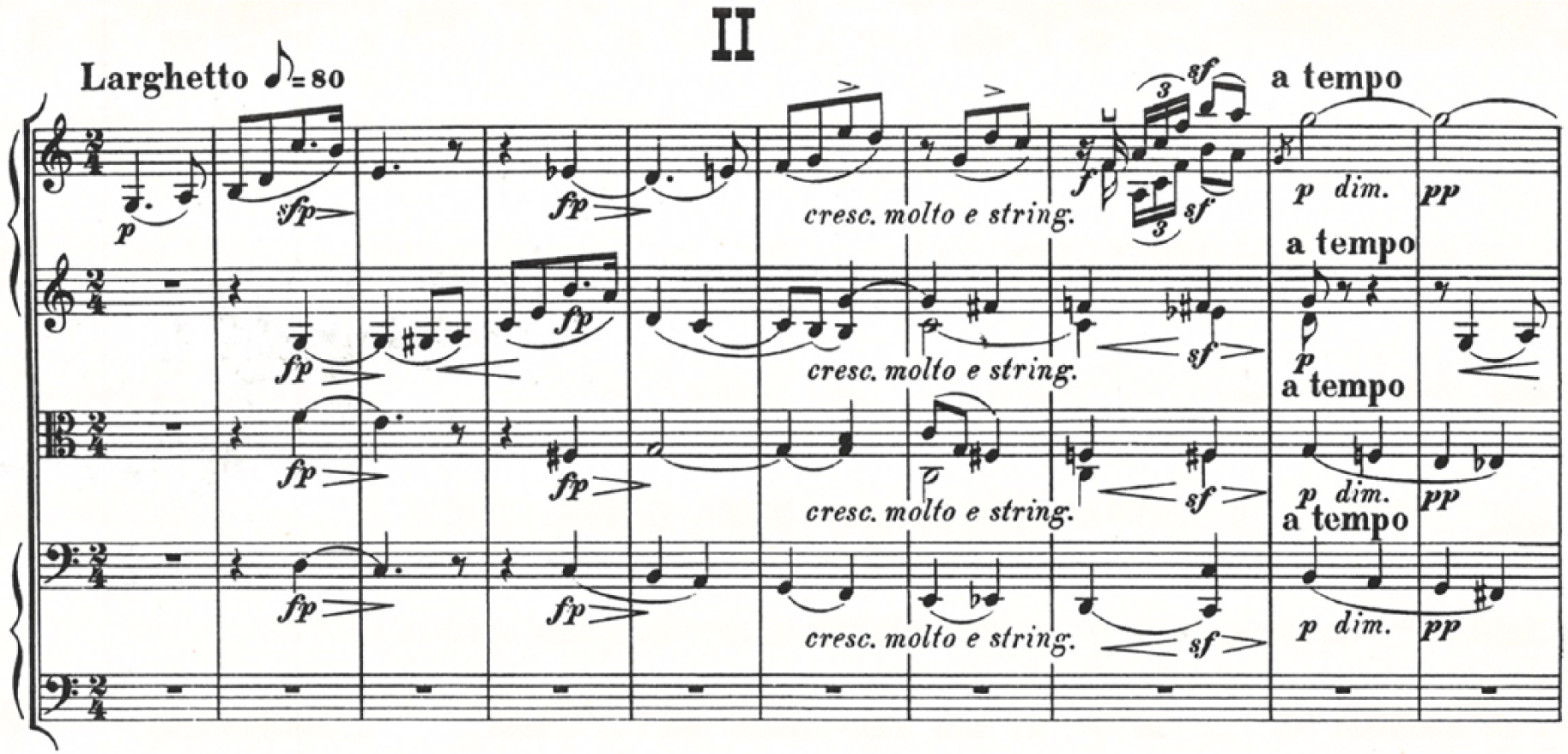
II: Mm. 1–10.
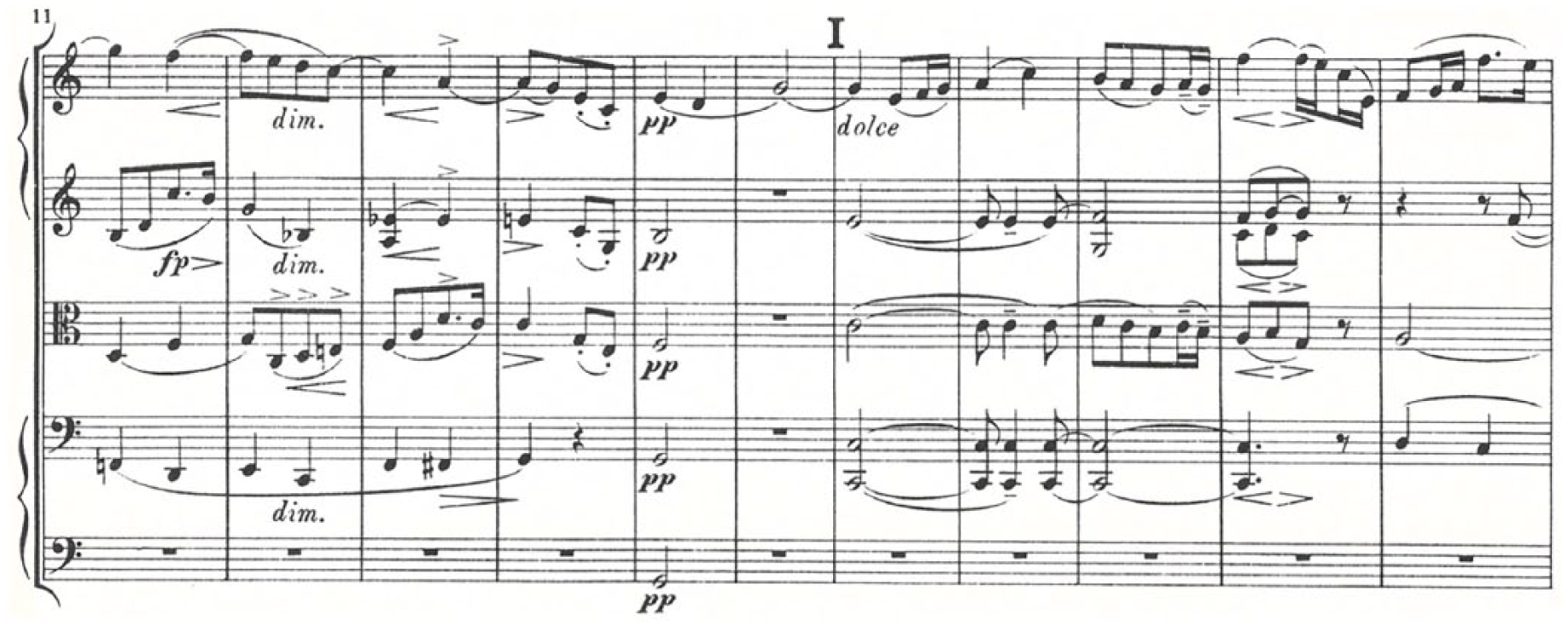
II: Mm. 11–21.
The succeeding B section (rehearsal I) is decidedly less volatile: accents and phrasal attenuations only occasionally modify the prevailing dynamic level of pianissimo (see Figure 7). Elgar denotes the melodic line with the distinction “dolce”; an effective approach is to minimize vibrato in the previous bar—the end of the A section—only to add color to the G as it becomes the initial pitch of the ensuing theme. Phrase shaping must remain within the domain of the indicated dynamic level.
More overt Romanticism returns in the C section (rehearsal K): nearly every measure is influenced by a dynamic or articulation gesture (see Figure 8). The music grows organically as an antiphonal dialogue in the upper strings is developed sequentially; a late outburst in the second violins (measure 40) quickly subsides. The consequent group builds to a more vivid climax, aided by the presence of the cellos. While the tenuto marking is situated at both apexes and indicated only for Violin I, a slight lengthening of the first beat could be justifiable, particularly the second time. The denouement is significant both for its extended length and its more dramatic diminuendo (to ppp).
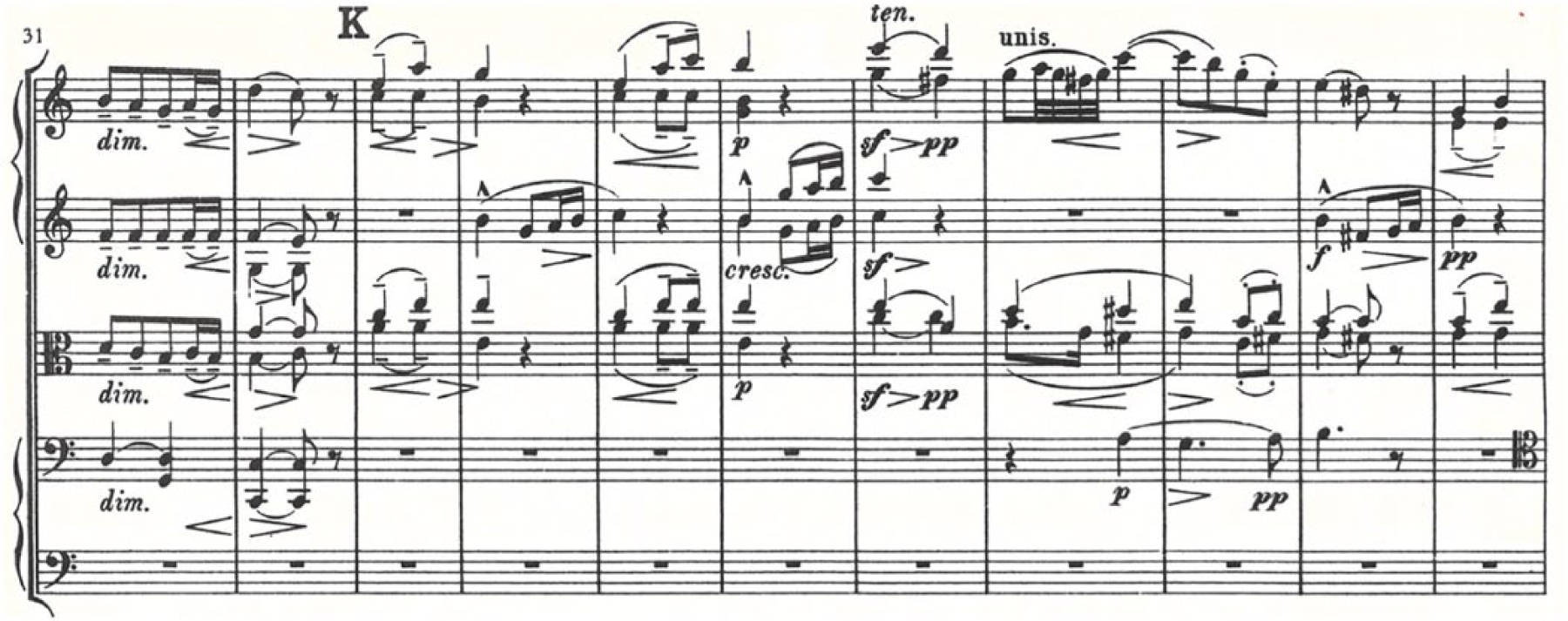
II. Mm. 31–41.
This hushed dynamic level, the softest in the Serenade, persists into the return of the B section (rehearsal L); transparency is a real challenge given the thick texture (see Figure 9). Perhaps the most important voice in the first eight measures is the bottom first violin part: the lower octave of the melody should form the sturdy foundation over which the upper voice is placed. The final two bars, a rare homorhythmic passage, echo the close of the initial statement of the B section (see Figure 10). While Elgar substitutes staccato for the previous tenuto, notes must be of sufficient length to maintain melodic unity; strive for a balance between separation and connection.
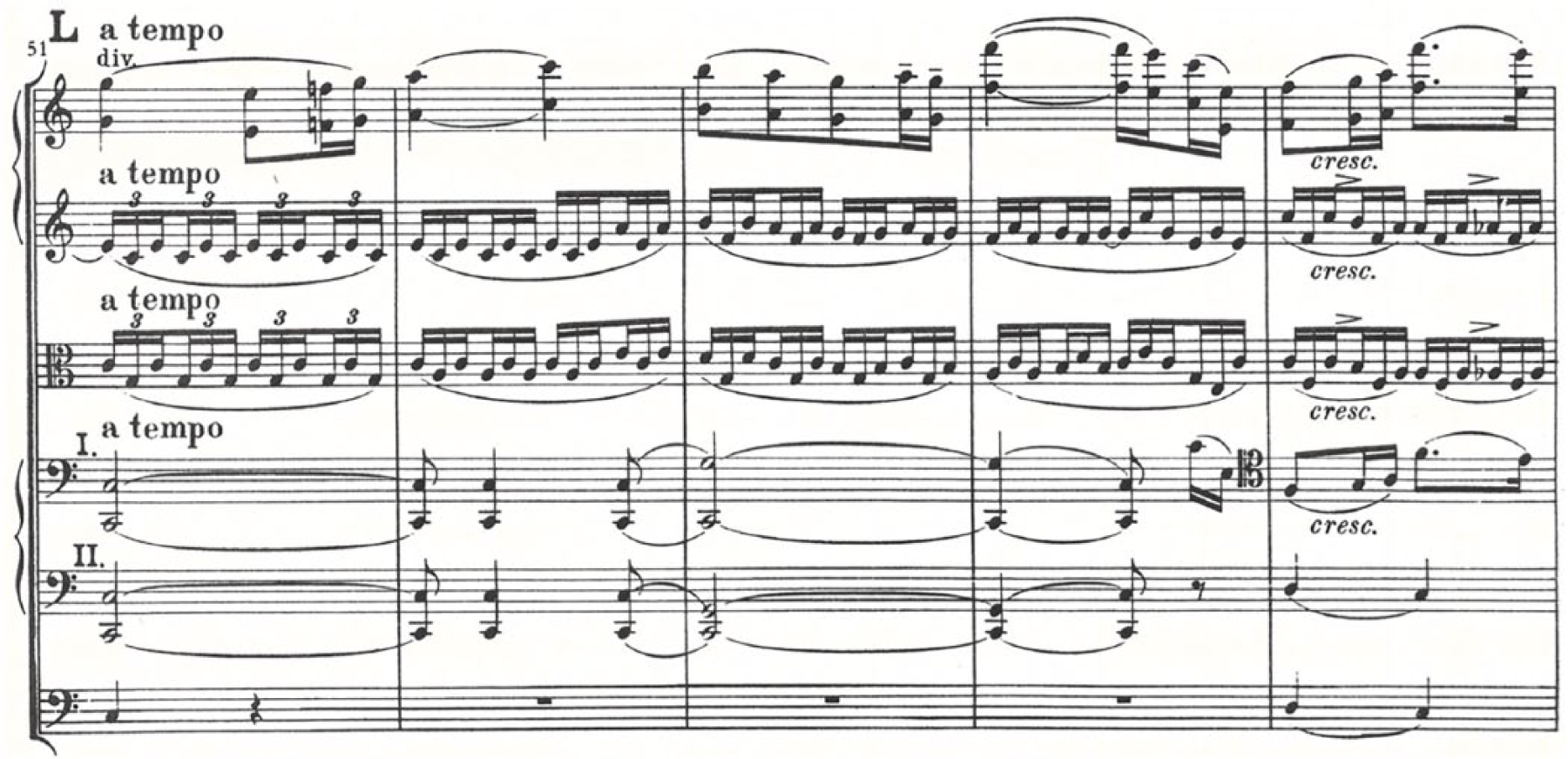
II: Mm. 51–55.
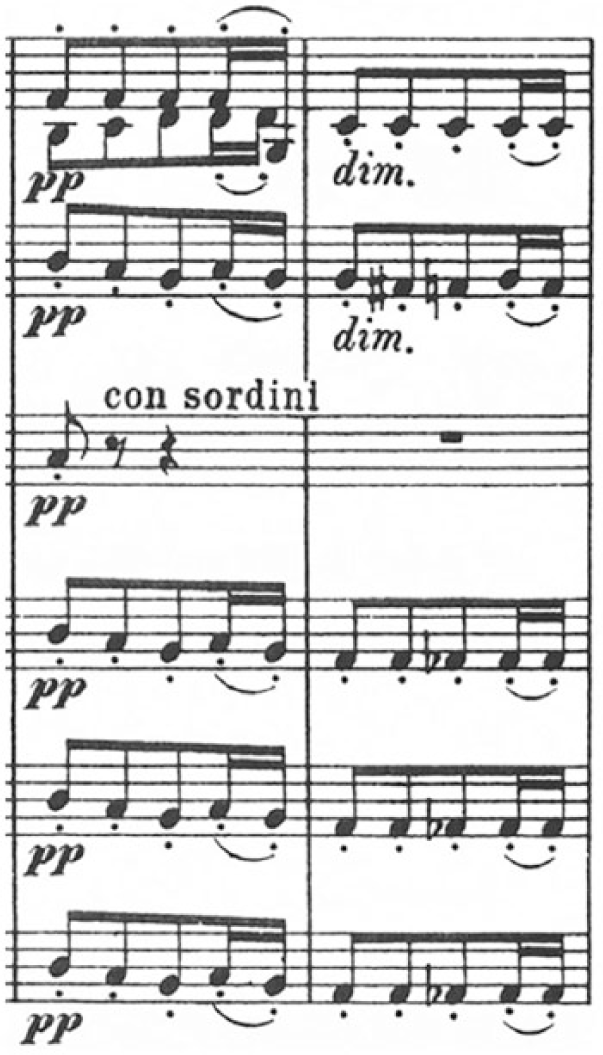
II: Mm. 66–67.
The brief reprise of the A section is much more subdued. The sforzandos and forte-pianos have been reduced to accents, while the molto crescendo has been tempered to poco; the earlier stringendo is absent. Muted sonorities—in all sections except basses—contribute a further element of timbral restraint.
As the sole slow movement, the Larghetto is the best candidate for rubato. Subtle variations in tempo, particularly stretched phrase endings, may be appropriate if incorporated judiciously. The structural importance of the cadence in measure 32, for example, which serves as the transition to the C section, might be underscored if lengthened and tapered (see Figure 8). Eight measures later, a slight prolongation would permit a more organic diminuendo from forte to pianissimo in the second violins while setting up the varied repetition of the paragraph.
III. Allegretto
While the finale (an AB—binary—form) is arguably the least complex movement of the Serenade, Elgar’s craft is still clearly evident. The A section—the G major half of the Allegretto—is in ternary form: aba (see Figure 11). The B section (rehearsal P) begins with a near-verbatim restatement of the first movement passage that linked the primary and secondary segments. The E major section, however, is reworked with greater freedom. The movement’s climactic gesture: a pair of forte, tutti chords ascribed with circumflex accents (see Figure 12). The coda (rehearsal Q) combines the opening viola motive with a legato four-note figure built on a descending fourth (see Figure 13).
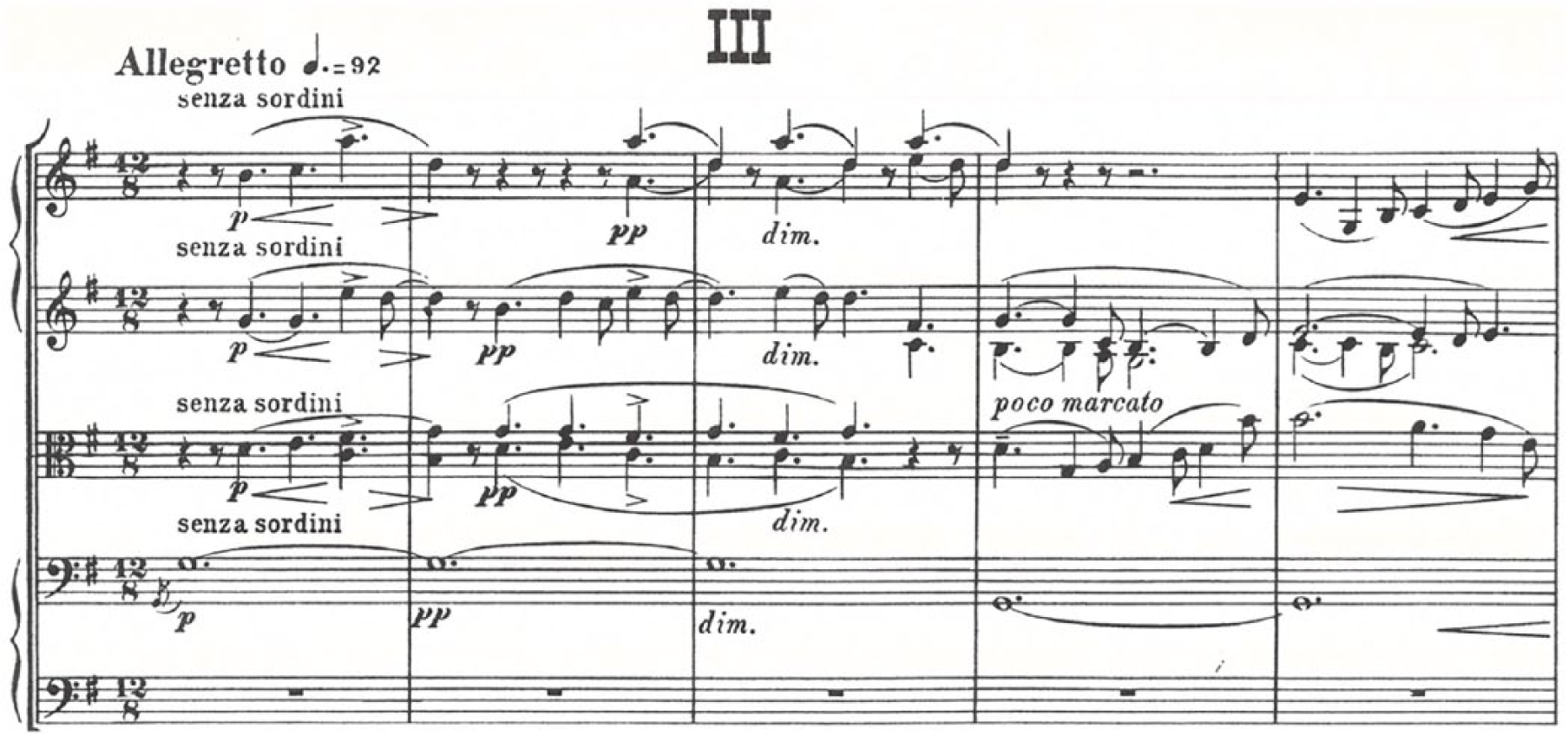
III: Mm. 1–5.
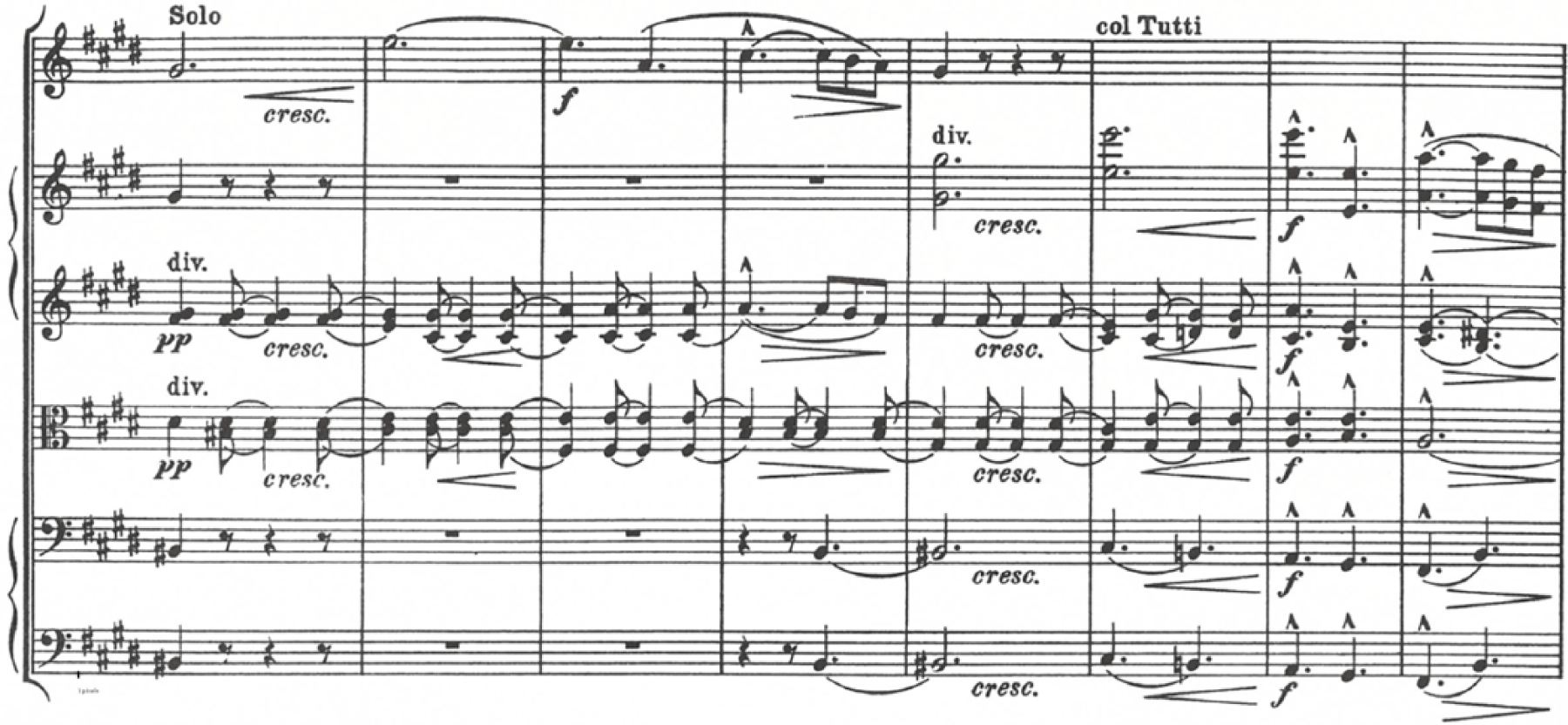
III: Mm. 52–59.
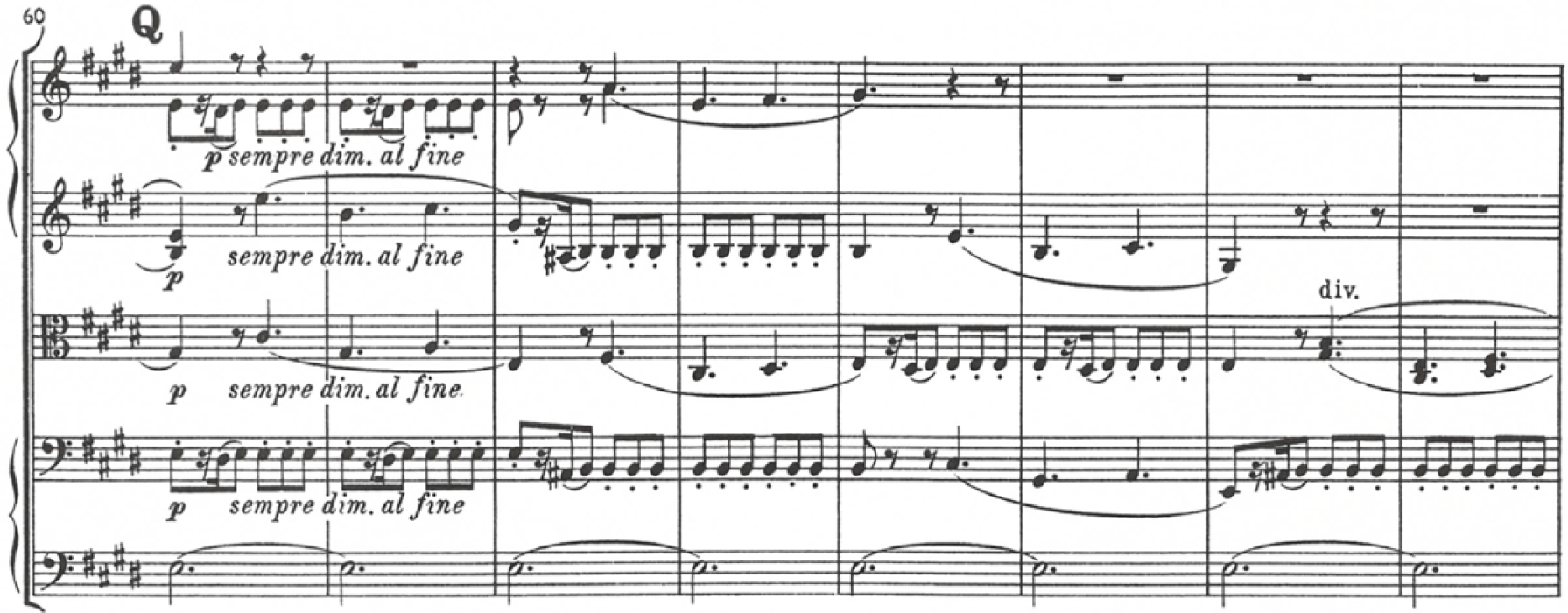
III: Mm. 60–67.
Dynamic shading is particularly crucial in the opening bars (see Figure 11). The initial piano is reduced to pianissimo, while a subsequent diminuendo requires ever more transparency. Note the terraced effect in the cellos as piano becomes pianissimo in the second measure. The violas introduce the primary subject in bar 4. Throughout this first section of the miniature ternary form, phrasal dynamics should remain within the context of piano-pianissimo; the restatement at rehearsal O, with its increased strength, will permit more aggressive swells (see Figure 14).
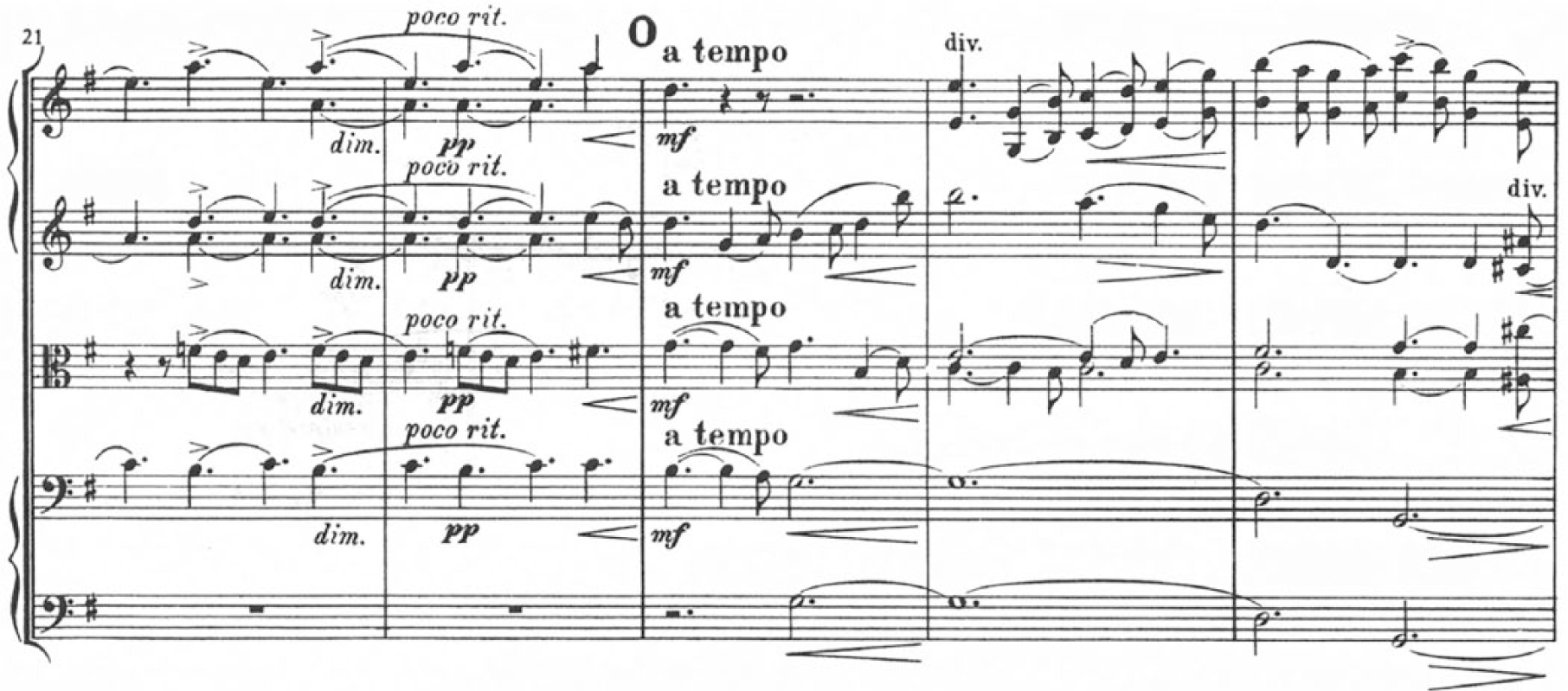
III: Mm. 21–25.
At rehearsal N, the upper strings are the subservient voices; cellos and basses must lead—in terms of both volume and color. Elgar’s addition of the word subito to each forte-piano suggests a somewhat more abrupt change of volume. As the sequence develops, the crescendo occurs earlier, beginning with the note tied over the bar line. In joining the low strings on the melody in measure 19, the violas must increase their intensity considerably. At the transition to rehearsal O, the poco ritardando persists through the crescendo on the fourth beat; delay the a tempo until the ensuing downbeat (see Figure 13).
The increased dynamic activity at rehearsal O requires close scrutiny of notated effects. The basses, whose last volume indication was forte-piano in bar 20, should begin mezzo forte in order to match the prevailing dynamic. Players should also be aware of the contrary expressive gesture in measure 24: as the second violins descend in pitch and volume, the first violins build in strength. In measure 28, the circumflex on the second beat applies only to the lower strings; the violins may actually wish to reduce volume here prior to building a new phrase through the remainder of the bar. As the section concludes, two gestures require sensitivity and nuance. In measure 32, the upper string accent is situated within the slur and pianissimo, while two bars later the second beat circumflex emerges from the same dynamic (see Figure 15). Finally, the accented violin downbeat in measure 36 should be broad and warmed with vibrato; at the same time, violas must sing their top D without undue weight.
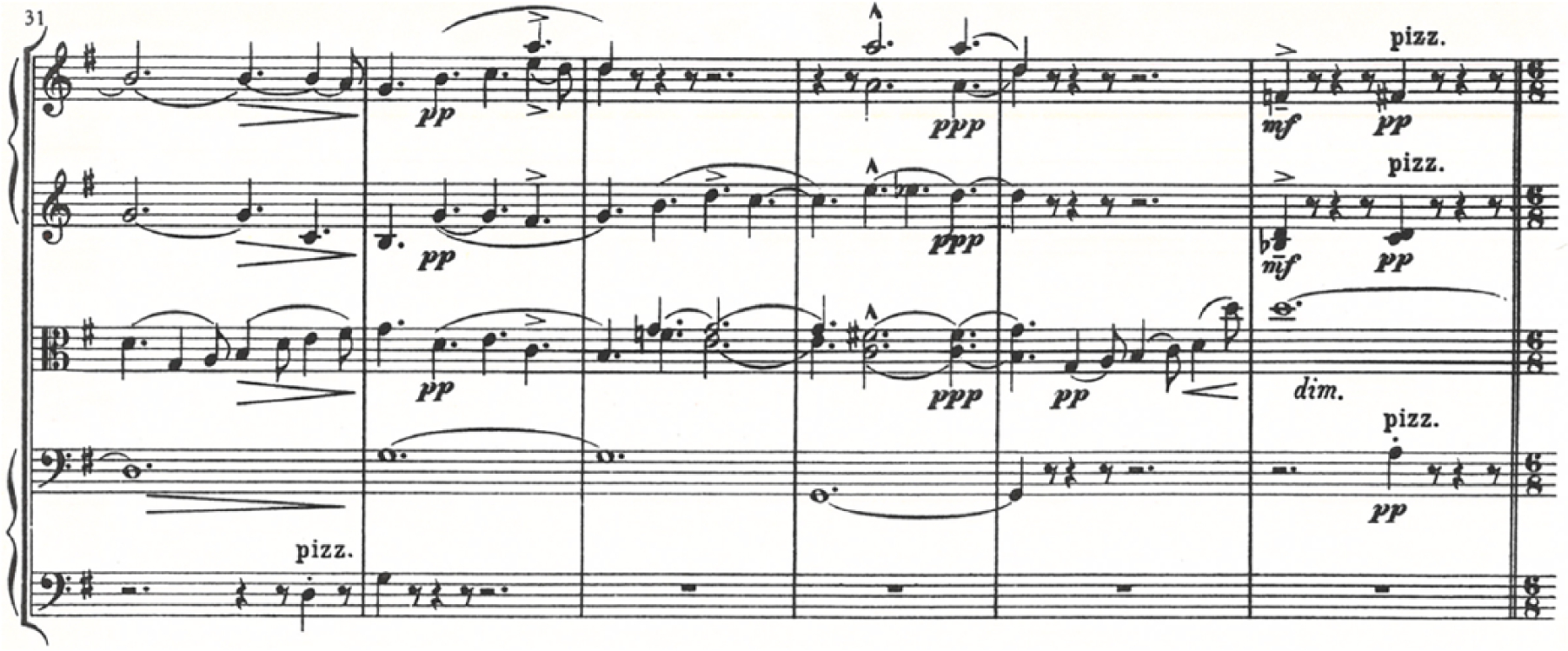
III: Mm. 31–36.
Elgar marks the reprise of the first movement opening material Come prima; consequently, the pace will quicken slightly (dotted quarter note = 96) compared with the first half of the finale (dotted quarter note = 92). One possible approach is to facilitate the transition by means of a subtle broadening in measure 36. From bar 42, Elgar brilliantly encapsulates the evolution of the same material in the first movement. As before, the section begins in a spirit of placid tranquility: a simple espressivo marks an otherwise unperturbed melodic line. However, progressively more turbulent dynamic shifts recall the developmental stage of the subject (cf. rehearsal D in the first movement). Still, the climactic build to measure 58—marked forte—is expressly subordinate to the fortissimo climax in the parallel passage in the opening movement (see Figure 12).
A significant challenge in the coda (rehearsal Q) is pacing and balancing Elgar’s direction of sempre diminuendo al fine, all while maintaining equanimity between the simultaneous lyrical and rhythmic voices (see Figure 13). The bass pedal tone fades as well, eventually reduced in measure 68 to a solo player. The ascending syncopated line in the cello and viola should be continuous in weight and volume; the transition between sections must be as seamless as possible. Elgar nullifies the beat through the imposition of ties, thus demanding utmost rhythmic accuracy through precise subdivision. If needed, the passage may be rehearsed without the ties, then as a divisi combination of tied and untied rhythm. (A misprint in the score omits the tie on the viola G between measures 70 and 71; the tie is present in the viola part.) The closing three chords, marked tenuto and reiterating the same harmony, should be separated slightly.
Conclusion
Elgar’s Serenade for Strings stands as an exquisite gem crafted by a composer who had recently reached artistic maturity; it offers a rewarding and beneficial exploration for musicians prepared for its challenges. Its position in the canon is of great value to the discerning orchestra director: a substantive miniature masterwork whose technical framework, well within reach of moderately advanced orchestras, should permit students to explore fully its expressive potential. With meticulous attention to the myriad details on the printed page, together with interpretive imagination to go beyond the printed text, this timeless work will gratify both performer and listener alike.
Footnotes

Mark Laycock (