







Abstract

The National String Project Consortium (NSPC) is a nonprofit organization whose mission is to
provide an opportunity for children who live in school districts where string programs do not exist to learn to play a stringed instrument.
prepare children in the lower grades for placement in existing public-school string and orchestra programs.
create programs that give undergraduate and graduate music students hands-on, supervised experience in teaching, administration, and leadership as they pursue their degrees.
provide experienced, entry-level teachers for string programs.
facilitate the growth and development of string and orchestra programs in the public schools.
provide a safe environment for children and teachers involved in stringed music education.
support music-making opportunities in an effort to combat stringed instrument program attrition and foster program growth.
provide, by example, a model for stringed instrument program development on local, state, and national levels.
The NSPC provides a viable model for offering stringed instrument music instruction to students in areas that have limited instruction in their schools or provides preinstruction for students in locations that do offer stringed instrument programs in the public or private schools at a certain age level. The NSPC also boasts contributing to the growth of a corps of highly qualified stringed instrument music educators in the public and private sector who have created a legacy of music advocacy within their communities across the United States. In this article, the authors discuss the impact of the NSPC over the past twenty years and what the organization hopes to bring to the field of music education for the future. Specific topics include (1) the history of NSPC, (2) data showing the growth and diversity of students and teachers in String Project communities over the past twenty years, (3) alumni and director quotes regarding the overall influence that String Project has had on their teaching, communities, and musicianship, (4) the 20th Anniversary Virtual Orchestra project, and (5) NSPC’s future impact on string music education.
The Legacy
The String Project model has a long and proud history that precedes the establishment of the NSPC in 2000. In its earliest beginnings, in 1948, at the University of Texas (UT) in Austin, UT viola professor Albert Gillis established a program in which children came to campus three times each week for instruction. The dean of the music school at the time, E. William Doty, saw the value of this program and Gillis became the first String Project director, serving from 1948 until 1958. The program gained national attention under the leadership of long-time director Phyllis Young and continues to flourish with current director Dr. Laurie Scott at the helm (Przygocki 2009).
During the late 1960s, the University of Illinois established a program under the leadership of the great string pedagogue Paul Rolland. Though this program was quite different in nature from the current NSPC model, the laboratory approach that Rolland used remains an important component of String Projects today. Rolland’s String Research Project produced a wealth of information and material that continues to influence and inspire teachers. The goals of instructing young students, training future teachers, and developing teaching methods and materials coexist in String Projects around the country (Rolland and Mutschler [1970] 2000).
An important step in growing the number of String Project sites came in 1981 when cellist Robert Jesselson was hired at the University of South Carolina (U of SC). He inherited a small program that was based on the one at UT Austin. Jesselson modified this to attract and foster the development of undergraduate string players for successful careers in the teaching profession. The U of SC program placed a strong emphasis on building the quality and quantity of public-school programs. When Jesselson became the president of ASTA in 1998, the organization began searching for funding to support similar programs around the United States, based on the U of SC program. The U of SC model consisted of students beginning stringed instrument instruction in heterogeneous and homogenous group classes. As they advanced and began to have opportunities in their local public schools, students also participated in private lessons, theory classes, and orchestras. Undergraduate and graduate students had the opportunity to teach in an authentic teacher education environment while receiving guidance from the director and master teacher.
The NSPC was born in July 2000 when ASTA was awarded the Fund for the Improvement of Postsecondary Education (FIPSE) grant from the U.S. Department of Education. This grant funded ten new string project sites around the country. FIPSE also funded three additional sites in September 2000. This was followed by a Knight Foundation grant for eight additional sites and a grant from the National Endowment for the Arts for three more.
By 2003, there were twenty-four String Project sites in operation at various universities across the United States. At that point, oversight and funding for these programs became challenging for ASTA, so an independent NSPC no longer under the umbrella of ASTA was established. The NSPC incorporated in 2006. Project directors and supporters met at the 2007 ASTA conference in Detroit to form a board, establish bylaws, and plan strategy. The first executive director of the NSPC was Robert Jesselson, who served from 2007 until 2012. David Lusterman, publisher of Strings magazine, served as the first board president from 2007 until 2012.
Over the years, the NSPC has continued to seek support for establishing additional sites. Funding has come from the Clarence E. Heller Charitable Foundation, Dana Foundation, D’Addario, FIPSE, Knight Foundation, Madeline Crouch and Associates, Music Lives, National Association of Music Merchants (NAMM), National Association of Band Instrument Manufacturers (NABIM), National Education Association (NEA), Psaris, Strings magazine, the Yamaha Corporation, Talty Foundation, and William Harris Lee and Company. The generous support of these donors has helped new or emerging NSPC sites establish funding for their first few years along with in-kind funding from their universities. Although some of the sites established with NSPC assistance are no longer operational, forty-five sites are established, emerging, temporarily suspended, or awaiting funding. Of these, thirty-eight are operational and continue to flourish. In addition, many sites have sought their own funding to establish sites at their universities without NSPC funding.
Today’s Relevance
In addition to thirty-eight NSPC established sites, there are currently five emerging sites funded through the NAMM Foundation (San Jose State University, Tennessee Tech University, Texas State University, University of Northern Colorado, and UT at El Paso), three sites awaiting funding (California State University at San Bernardino, University of Tennessee at Knoxville, and Washington State University), and one site that is awaiting funding but has started without outside funding (Arkansas State University) (Table 1). Figure 1 shows a map of all the current and emerging NSPC sites across the United States.
List of NSPC Established NSPC Sites, Directors, and Master Teachers.
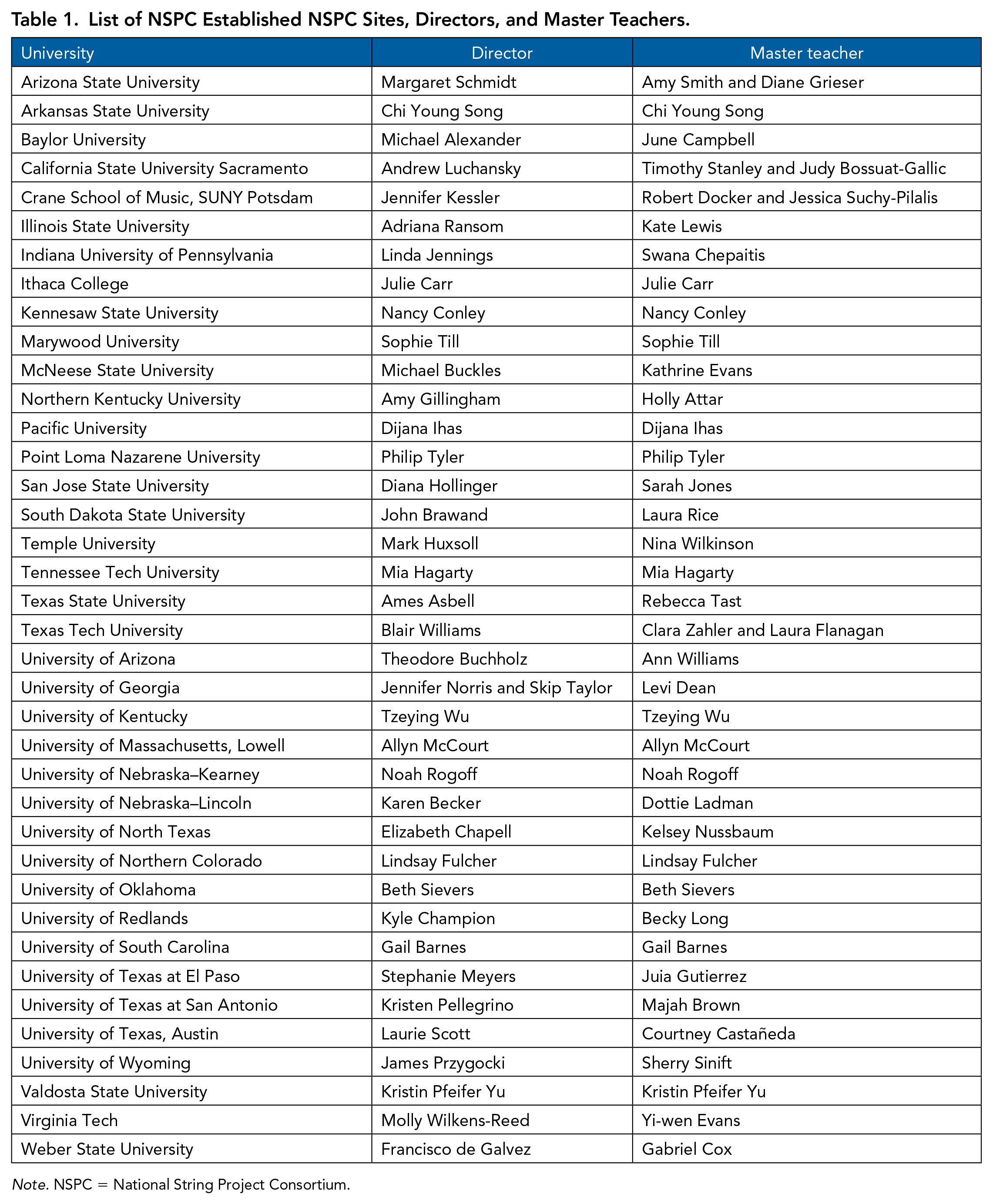
Note. NSPC = National String Project Consortium.
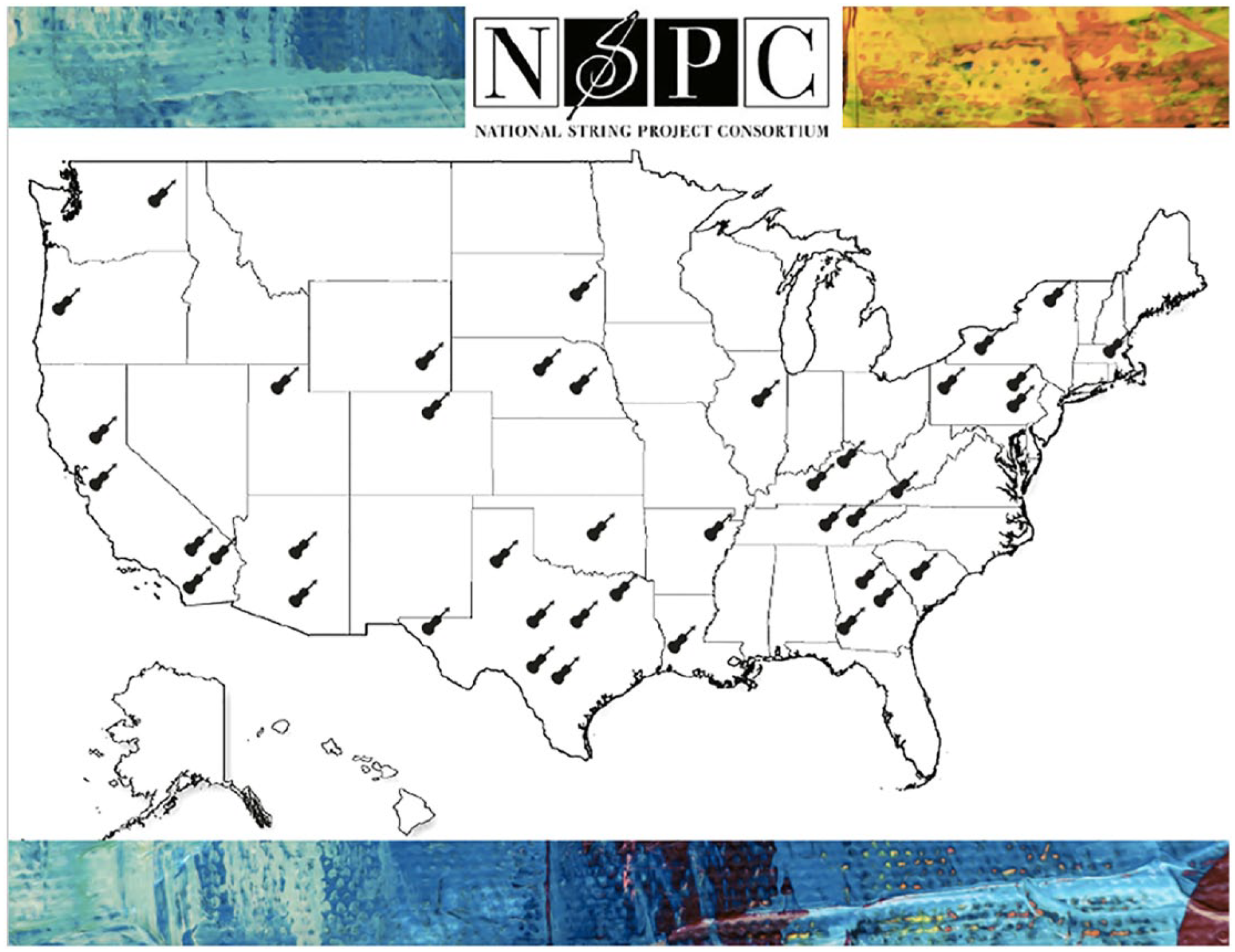
Map of NSPC sites.
The NSPC String Projects’ student population continues to grow across all sites. In 1999, there were two String Project sites at UT Austin and U of SC that included a total of five hundred students. As of last year, there are 3,304 students learning violin, viola, cello, bass, guitar, or harp in group classes, orchestras, and through private instruction (Figure 2). The students’ age ranges from early elementary school children to retired adults. Currently, nine sites teach adult students while most focus on elementary school-aged students to begin instruction to enhance their knowledge of playing before having an opportunity to join their school orchestra, when possible.
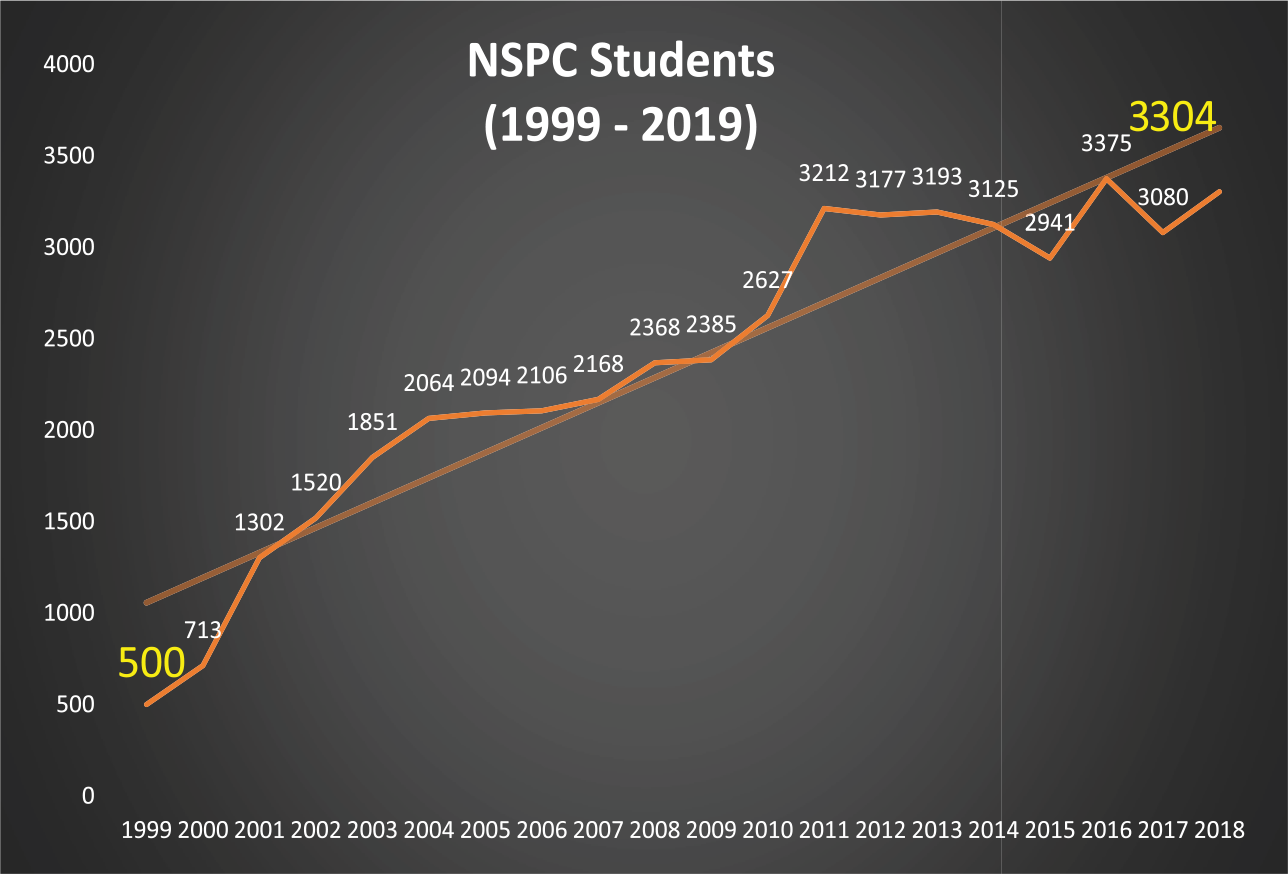
Aggregate of NSPC student population.
The increase in undergraduate and graduate teachers is also significant in the past twenty years. Currently, just over ten times as many teachers staff NSPC sites (Figure 3) than when the program began to flourish with the addition of sites in 2000. In 1999, there were a total of forty-three teachers at UT Austin and U of SC. This past year our site director reported 436 teachers. Of these 436 teachers, 57 percent were string music education majors, 26 percent were performance majors, 9 percent were nonmusic majors, 5 percent were other music majors, and 3 percent were nonstring music education majors. An important factor contributing to these numbers is the reality that some site universities do not offer music education as a major. As undergraduate and graduate students learn how to teach in this authentic environment, they also receive feedback and evaluations from directors and master teachers. Most of the data for evaluation and feedback for teachers from the directors and master teachers are collected through observation (97 percent). Some also use video review (49 percent) and surveys of performance (63 percent) in addition to observation.
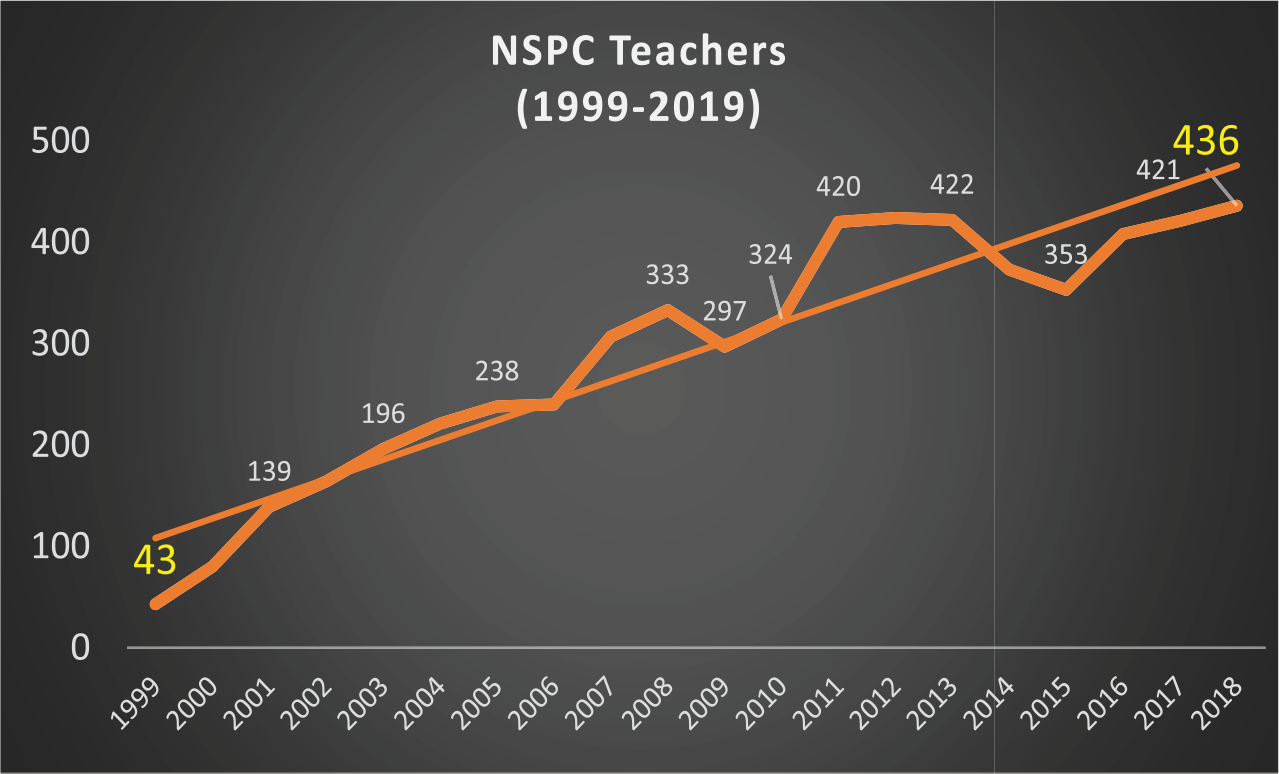
Aggregate of the NSPC teacher population.
As part of the NSPC mission of providing a model for students and teachers to develop stringed instrument program on local, state, and national levels, it is also necessary to be knowledgeable of the diverse population of our students and teachers. Thirty-seven percent of NSPC sites include teachers representing three or four ethnicities with at least 10 percent representation. Likewise, 31 percent of sites include students representing three or four ethnicities with at least 10 percent representation. Although most sites continue to have a majority white student population, seven sites are majority ethnic minorities. Temple University’s student population is 58 percent African American, whereas San Jose State University’s student population is 96 percent Hispanic and South Dakota State University’s student population is 53 percent Asian. While most sites have majority white teacher population, the University of Georgia’s teacher population is 67 percent Asian and the UT at El Paso’s teacher population is 63 percent Hispanic (Figure 4).
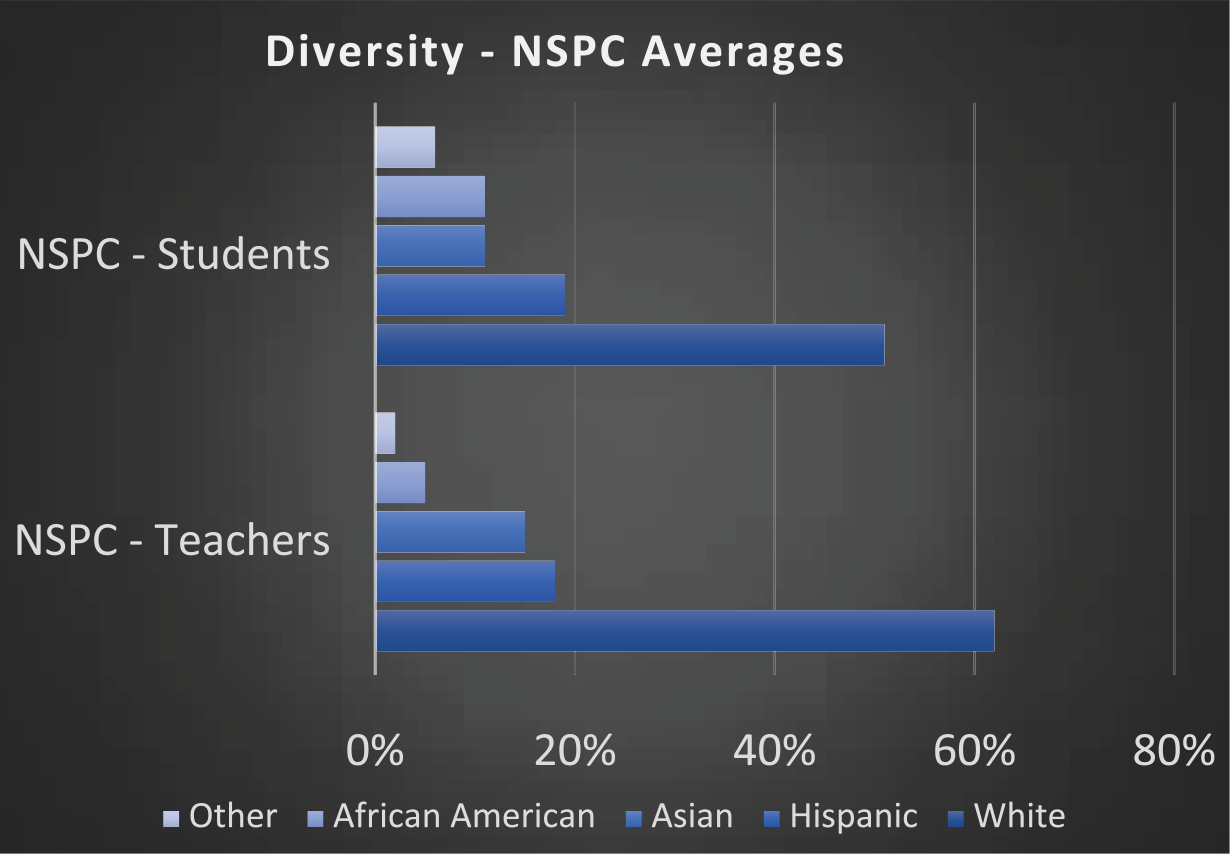
NSPC diversity.
The Voice of the Teachers
How has the experience of teaching at a String Project influenced our NSPC alumni who are teaching within their communities today? The data regarding progression of String Project sites over the past twenty years are telling, but the voice of String Project alumni who are current teachers in communities across the country shares a story of how important NSPC sites are to authentic music teacher education experiences. The NSPC asked former alumni, in a survey, to reflect on their overall String Project experience and how it has influenced their teaching career and musicianship.
One of the overarching thoughts from the alumni was that being a part of the String Project helped them collaborate with other teachers and have “hands-on” experience in a “safe” environment. Many also commented on the helpfulness of feedback and collaboration with colleagues. In many ways, alumni also commented on how it helped them choose their career path. The following is a collection of quotes regarding the overall experience of String Project alumni:
Melissa Brown, U of SC: “My music education classes paired with String Project experiences were outstanding.” String Project “gave me a sense of direction and pride.”
Victoria Hartman, Crane at SUNY Potsdam: “It made the transition from being a student to a teacher seamless.”
Linda Jennings, UT Austin & Indiana University of Pennsylvania: String Project “provided a supportive community of fellow teachers to explore different approaches to teaching strings.”
Sundas Mohi-Truong, UT at San Antonio: “It was not until I started interning with the UTSA String Project that I realized I needed to be a music educator. Working with experienced professors to plan lessons and then receiving feedback before going into the field was invaluable.” String Project “allowed me to gain confidence in front of students and test out ideas . . . I really had the freedom to try anything!”
Ashley Tomei, Crane at SUNY Postsdam: “You learn by ‘doing.’ You gain insight on how to be a reflective educator and you gain so much hands-on experience.”
String Project alumni discussed how their preservice teaching experiences helped with lowering teacher burnout. Knowing the realities of everyday teaching experiences and practicing a variety of teaching methods before they student-taught helped to clarify the reality of the teaching profession. They also discussed how they were able to experiment and find the student age-level appropriate for their teaching. String Project alumni also continue to use lesson plans or pieces that they taught while at the String Project. The following is a collection of quotes regarding alumni reactions to how their String Project experiences influenced their teaching careers:
Stacey Block, Illinois State University: “String Project also taught me that just because something doesn’t work the first time doesn’t mean you can’t try a different way.”
Daniel Galbreath, University of Wyoming: “[String Project] taught me a great deal about professionalism, responsibility, and how to interact with a wide range of stakeholders, including colleagues, supervisors, students, and parents.”
Alberto Macías, University of Arizona: “Teaching in public schools and primarily at-risk students . . . embedded in me an immense sense of gratitude. String Project . . . allows students to really explore string pedagogy. String Project is a program in which I really began to learn not necessarily how strings work, but how people work.”
Catherine Olivier, Texas Tech University: “[String Project] gave me a chance to test out and find my own ‘teacher voice’ and ‘teacher personality.’”
Kaylene R. Pecora, University of Redlands: “[String Project] taught me how to get to know each student individually and find the right teaching strategies to use in order to help students learn.”
Michael Petit, Ithaca College: “[String Project] . . . made me aware of cultural responsiveness and truly knowing your students.”
Jacie Schumacher, University of Wyoming: “Many of my colleagues wished there was a similar program for those in band and choir. My experience made me feel like I had a head start on student teaching, which is invaluable when you are an undergraduate student. I also had the opportunity to be a leader and hone my leadership qualities, which is always beneficial in the teaching profession.”
Ashley Tomei, Crane at SUNY Potsdam: “[String Project] helps you develop the mindset, that even if you don’t have all the answers, you will become reflective enough to work through it and be the very best teacher for your students.”
Dr. Laurie C. Williams, Texas Tech University: “Having the opportunity to continue teaching beginning string players while completing my degree helped me to stay connected to my true passions—teaching kids and setting them up for long-term success and training undergraduates to become quality string teachers equipped with the requisite skills for future success.”
Although String Project curriculum focuses on the pedagogy aspect of teaching a stringed instrument, the teachers’ musicianship is also influenced. The String Project alumni discussed the overarching importance of a musical community and creating various styles of music or performances, whether formal or informal. The following is a collection of quotes regarding alumni influences to musicianship:
Kathryn Balk, Illinois State University: “String project encouraged me to get better at my secondary instruments. I took violin and viola lessons . . . and now I can model correct posture and technique on all of the instruments.”
Michael Folta, Virginia Tech String Project: “Studying architecture didn’t leave me much time to continue my own study of classical violin, but teaching with VTSP allowed me to pass it on . . . [for students to] discover a love for music which in turn kept my own enjoyment kindling.”
Shannon Houston, University of California, Sacramento: “I became a better leader, better listener, and an overall better performer.”
Sundas Mohi-Truong, UT at San Antonio: “Being a part of String Project forced me to think about the how and why of everything we do as musicians in order to be able to teach classes. Having this type of experience before graduating was truly invaluable.”
Kelsey Nussbaum, UT Austin: “At the UT string project, we held an Eclectic Styles Festival every year and had advanced musicianship classes that explored beyond the classical orchestral context. Even though I had limited experience with eclectic styles, seeing these being taught successfully as a young teacher opened up my interest in incorporating these into my teaching and becoming better at playing outside the classical traditional.”
Alejandro Padro-Fuentes, UT at San Antonio: “Working with the students has helped me develop a stronger stage presence in the classroom and on stage.”
Rosa Rezendes, San Jose State University: “As a musician, String Project has assisted my skills by teaching me to slow down and work on one technique at a time.”
Ashley Wright, University of Redlands: “String Project also allows for communities to strengthen their music programs and provide cost effective music lessons in a group setting.”
The directors of the String Project sites also offered insights into the long-term effect of having String Projects in their community and the influence on their universities. The following is a collection of quotes from current String Project directors:
Gail Barnes, U of SC: “The School of Music and University of South Carolina personnel frequently cite [the] String Project as a model of community service. In addition, we believe the experience our preservice teachers receive ameliorates the too-high attrition rate in early career teachers. As Director of the University of South Carolina String Project, I believe it grounds my teaching in reality. I also love seeing the work our grads are doing in serving the musical development of their own students.”
Theodore Buchholz, University of Arizona: “This outreach program is designed to inspire and foster creativity among young musicians and to cultivate a learning environment that enables the development of future string teachers. The UASP helps that problem in several ways: strengthening the UA music education program and enabling future teachers to be more successful once they assume their first job in a school. UASP is particularly focused on developing future orchestra teachers’ classroom management skills and developing engaging teaching presences. 78% of parents reported their students probably would not or definitely would not have access to any orchestra program if not enrolled in String Project.”
Julie Carr, Ithaca College: “Watching their teaching skills and confidence in themselves blossom has been a highlight of my teaching career.”
Blair Williams, Texas Tech University: “The String Projects have helped to secure strings in our local schools and has helped to create new programs in neighboring school districts. Our university staff take the skills they learn in the string project to teach sectionals and private lessons in our local orchestra programs and even have the chance to judge competitions, further elevating their experiences as pre-service orchestra teachers and better preparing them for a strong career in string music education.”
Tze-Ying Wu, University of Kentucky: “Over the last two decades, UKSP has been closely involved with the public schools in Lexington, providing instruction and creating a community for our students to grow, and we strive to help our students develop an everlasting love of playing string instruments. This same community is shared by the UK student teachers, which provides them the platform to polish their teaching skills and engage with the community around them.”
Twentieth Anniversary Special Project
For students and teachers of String Project sites across the country to collaboratively celebrate the twentieth anniversary of the NSPC, the NSPC board commissioned a composition for String Project sites to not only perform for their communities, but also to perform nationally through the NSPC Virtual Orchestra Project. Composer Brian Balmages wrote a multilevel work to include the various levels of developing musicians within String Projects. The work, Greater Than . . ., consists of three different orchestra parts and can be played as a stand-alone advanced part or in combination with the less-advanced parts. The piece also includes optional harp and guitar parts. String Project students and teachers from our members sites will perform Greater Than . . . during the 2019–2020 school year, before it is made available for performance by the general string teaching community. This adds an important and versatile new work to the string orchestra repertoire that encourages collaboration of a variety of levels of performers.
In addition to live performances of Greater Than . . . around the country, NSPC sites are using current technology to engage with and build connections among other String Projects by creating a virtual orchestra. Students record their parts while playing along with an orchestra aptly conducted by NSPC founding board president Robert Jesselson. Students then upload their performance of Greater Than . . . to a Google Drive link where they are added to hundreds of other String Project performers around the country. The virtual performance premiered at the 2020 ASTA National Conference, March 4 to 7 in Orlando, Florida. It is a joy to see and hear the wide range of programs represented in the 20th Anniversary Virtual Orchestra Project, and we look forward to such collaborative projects in the future.
The Future of String Music Education
The NSPC has a responsibility to encourage the growth of emerging sites and the continuation of existing sites across the country to aid in the growing need for stringed instrument music educators. Smith, Mick, and Alexander (2018, 29) projected that there would be “3,027 string teaching positions . . . available from academic year 2016–2017 to 2019–2020.” Based on the NSPC site report data over the course of twenty years and the number of alumni currently teaching in public or private schools across the country, the NSPC would hope that the directors and master teachers of the String Project sites have aided in decreasing the lack of stringed instrument teachers. Growing the number of stringed instrument teachers is still a concern nationally, but the authentic and “safe” teacher learning environment with “hands-on” guidance from NSPC directors and master teachers have helped future educators find success and less attrition in their professions.
What will the next twenty years hold for NSPC and the future of stringed instrument music educators? Priority goals are to have a String Project site in every state, to create a community of string players that require public schools to add additional programs and teachers, and to collaborate as teachers and students within the NSPC. The network of NSPC alumni is a source of great opportunity for research, as these teachers have similar undergraduate and graduate authentic teacher training. Much research in music education lacks a focus on the various teaching stages (Conway 2012; Reed 2018). Focusing on String Project alumni who have taught for many years could offer insights on new pedagogical approaches or maintain the standards of curriculum that are already applied in higher education.
The NSPC is a strong network of stringed instrument music educators who collaborate and offer feedback to teachers, young and old. The sense of teachers’ musicianship is not lost, in that the String Projects help hone musicianship and technique for the art of teaching. String Projects not only have a powerful influence on stringed instrument music educators but also instill the joy of music making for children in a wide variety of settings.
“String Projects help hone musicianship and technique for the art of teaching. String Projects not only have a powerful influence on stringed instrument music educators, but also instill the joy of music making for children in a wide variety of settings.”
For those interested in starting a String Project at their higher education institution, the application process is available online at www.stringprojects.org/apply.html. Applicants should consider whether their institution will financially support and provide space for the String Project, whether there are enough university students to teach children from the community, and whether the surrounding school districts will be supportive. The NSPC board reviews new applications annually. If accepted, emerging String Project sites will receive grant funding for five years, with $10,000 matched in-kind from their higher education institution, with the support to help establish the site for the future. For further information about String Projects and the NSPC, please see Barnes (2013), Byo, Cassidy (2005), Conway (2012), Ferguson(2003), Hurley (1998), National String Project Consortium (2010), Przygocki (2009), Reed (2018), Rolland, Mutschler (1970), Shumaker (2005), Smith, Mick, Alexander (2018), Williams (2019 & 2010).
Footnotes

Elizabeth A. Reed (
James Przygocki (