







Abstract

We are hard-wired for play-based learning. Researchers like Karl Groos wrote about it as early as 1898 (Groos 1898, 75). Contemporary researchers like Sugata Mitra (2010), Daniel Coyle, Sir Ken Robinson (2006), and Peter Gray are doing incredible work writing and speaking on the subject. About ten years ago, I found myself tired of droning on and on in lessons about the technical aspects of playing the cello. I wondered how I could harness my students’ natural affinity for play and direct it into more refined cello technique. I knew there had to be a better way than the didactic teaching I had been implementing.
In the spirit of myelin-building play (Coyle 2009, 32) and in an effort to take myself out of the picture, I started an annual studio event called, “Cellympics.” This past June was our ninth year of having fun, building community, eating cake, and solidifying technique.
What Is Cellympics?
Cellympics is a studio party where students compete in up to fifteen events consisting of highly technical games that polish skills under the guise of fun, socialization, and exploration. These events are a compilation of mini-games I developed from my own ideas as well as ideas borrowed from respected colleagues. Cellists who are seventh graders or younger participate as “Cellympians,” while students in eighth grade or above serve as judges. Cellympic events are geared toward rapid-fire technical development at any level and intentionally add a dimension of free play that other typical string instrument Olympics may not. It values grit. It downplays the value of first place while not abandoning competition altogether. Most importantly, it is light-hearted fun.
About a month before Cellympics, I go over new and old events in lessons, making sure students understand the rules for each event. Some students know only one or two events; others know all of them. Students experiment and conspire to figure out the best ways to compete in each event. They talk about events during group class and between lessons; they time themselves at home; they repeat things over and over again. It is the closest I have come to play-based learning in my studio. I usually only have to tell them the “what,” and they figure out the “how” on their own.
The Day of the Event
After training, everyone gathers for Cellympics, which happens over the course of two hours at my home, a student’s home, or at a local school. Beforehand, I create stations where judges will be stationed. Judges consist of older and former students, studio parents, local musicians, and sometimes even my family. Cellympians arrive wearing that year’s Cellympics t-shirt, carrying instruments, bows, and maybe their small cello chair. Family members bring potluck food to share. Students unpack, socialize, and wander about until everyone arrives. Once the games begin, Cellympians wander between judges until they compete in all the events they know. How the students go from one event station to another is up to them, making it possible to wander freely at their own pace.
“Cellympics is a studio party where students compete in up to fifteen events consisting of highly technical games that polish skills under the guise of fun, socialization, and exploration.”
Each judge selects the top three Cellympians for each event, and I decide from that list who receives a trophy. In a short, chaotic awards ceremony, trophies from a local shop are awarded, while Olympic themes are sung and plucked out on cellos. During and after the potluck meal, the best part of Cellympics begins: the parents talk between themselves while cellists and siblings of all ages interact with one another. As a self-employed teacher, it is sometimes hard to create a sense of community, but during Cellympics, my studio definitely feels like one big family.
The Events

I currently include up to fifteen events. Figure 1 is a list of each event with a QR code linking to written descriptions and video demonstrations for each event.
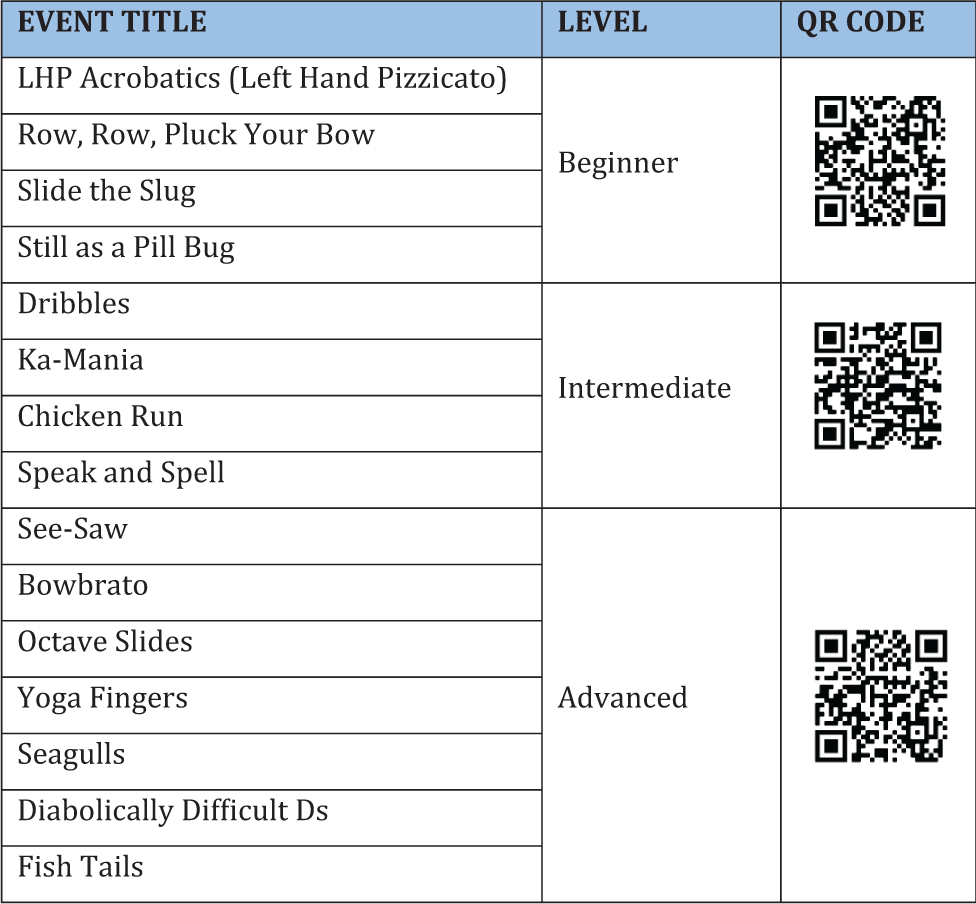
Cellympic events.
The best way to truly understand an event is watch a video of the event (scan QR code). Below is a written description of LHP Acrobatics, one of the first events my students learn. This event was inspired by Carey Beth Hockett.
LHP Acrobatics
LHP Acrobatics is a left hand pizzicato (LHP) exercise designed to engage absolute beginners while challenging the most advanced students. It follows the pizzicato sequence A D G C with the following twists:
LH Pizz A in first position with fourth finger
Clap
Slap thigh with right hand
LH Pizz A in thumb position with fourth finger
Clap
Slap head with right hand
Repeat Steps 1–6 with third finger on the D string
Repeat Steps 1–6 with second finger on the G string
Repeat Steps 1–6 with first finger on the C string
LHP Acrobatics event rules:
Touching cello with right hand = disqualification
Double touch (making a sound on more than one string at a time) = disqualification
Cello should be stable on chest and between knees
Fastest time, best posture, and fullest tone wins
You get two chances
This is a well-loved event. Students celebrate when they get it right, and they find it hilarious when they get it wrong. They feel challenged by the complicated coordination involved, because it is harder than it seems it should be. Students end up wanting to do it over and over again, because they usually think they can do better.
The Pedagogy
Each Cellympic event is designed such that technical challenges can be overcome through repetition of the event without disqualification. LHP Acrobatics addresses:
All other Cellympic events have similar rules for disqualification, and, unbeknownst to many of my students, all target specific technical skills. For example, the event Slide the Slug is designed to give repetition to the movement of the right thumb, thus teaching the thumb how not to squeeze. Yet, in the exercise, students don’t think about releasing the thumb. They are trying to avoid getting disqualified through “slippage,” “banana thumb,” and touching their bow to their leg. When the event is done correctly, students have freedom of the right thumb, which aids a soft bow thumb. What cello teacher doesn’t love a soft bow thumb?
I try to design each Cellympic event so that it is addictive, in the same way Candy Crush or Tetris is addictive. These simple games hook players because, while a player might fail on one attempt, they also truly believe that they can do better the next time. It’s easy, but not too easy. It’s a fine balance to set goals in a game that are hard to reach, but not so hard that they feel impossible to master.
Peter Gray, research psychologist at Boston College and outspoken advocate for play-based learning, wrote in his book, Freedom to Learn, about periods of play that are marked by light, unburdened experimentation: People often think of play as frivolous or trivial, and they are right . . . Play is trivial, but not easy. Much of the joy of play lies in the challenges. A playful activity that becomes too easy loses its attraction and ceases to be play . . . Most forms of play involve repetition . . . The player produces the same action repeatedly in order to get it right. (Gray 2013, 153–155)
And this is precisely what happens in Cellympics. It’s play, easy, repetition, social, and fun.
Once, a ten-year-old student Natalie overheard her mother and I talking about how much students were learning during Cellympics. Natalie looked at us and raised her voice in dismay and betrayal. “You mean we learn at Cellympics? I didn’t know I was learning! I thought it was just for fun!”
The Spirit of Cellympics
What is hard to capture in this article is the spirit of the Cellympics. While it is competitive—there are judges, winners, losers, trophies—my students all cheer for the underdogs, hail the younger students’ wins, and support one another as they roam from judge to judge. (In 2020, due to COVID-19, we held Cellympics online.) If it doesn’t seem fun for most of the kids most of the time, then I know I’m doing it wrong. I love seeing parents and my former students crouching over five-year-old beginners, encouraging them to try it one more time. I love hearing one six-year-old repeat my words to another student, “Don’t worry about not doing well this year. If you work hard, you will probably win next year.” I love seeing my twelve-year-old students waiting in line behind my seven-year-old students, either awkwardly waiting or chit-chatting about whatever comes to mind. Cellympics is filled with chaos and chatter—the kind of playground buzz that I love to see at any student event.
Cellympics is not even fair. My students know that if a five-year-old gets second place to a thirteen-year-old, I will to give the trophy to the five-year-old. They also know that if they win six trophies, they will probably receive just two, because the other four will be relinquished to other kids. And they are okay with that, because it is supposed to be fun, not fair. And in the end, in the brilliant words of my six-year-old student Eleanor, “Don’t worry—if you don’t win, there’s always cake!”
Footnotes

Andrea Yun (