







Abstract

After reading Ulrich Drüner’s article “Das Viola-Konzert vor 1840 [The Viola Concerto before 1840],” I was amazed at the number of unknown works. I began to compile a list of extant eighteenth-century Germanic viola concertos, collecting a list of seventy. Playing through as many as possible, I selected my four favorite movements that best represent high musical quality, idiomatic viola writing, and pedagogical value to examine playability and teachability. The movements selected range in difficulty from ASTA grades 3 to 4, representing the level of Telemann Concerto in G, to Hoffmeister Concerto in D, to pre-Mozart Sinfonia Concertante. The first Wolf piece represents a late Baroque style, while the other three are composed in a classical style.
To fully understand the concertos to be discussed, it is important to understand their historical context. In part 1 of this article, I provide an overview of the Germanic court systems and their influence on the eighteenth-century solo concerto as a genre and conclude with an exploration of factors that impacted how composers wrote for and how performers played the eighteenth-century viola. In part 2, I will explore four movements chosen from this repertoire. These include the following:
Ernst Wilhelm Wolf: Concerto in B-flat, movement 3: Rondo, Vivace
Ernst Wilhelm Wolf: Concerto in F, movement 1: Allegro
Anton Stamitz: Viola Concerto in D major, movement 2: Romance
Josef Reicha: Concerto in E-flat, Op. 2, Nr. 1, movement 1: Allegro
For each movement, I will include a brief biography of the composer, information on the piece as a whole, and an analysis of the pedagogical benefits of the work.
Part 1: Historical Background
Until 1806, Germany was known as the Holy Roman Empire of the German Nation, consisting of many separate territories, each ruled by its own court system. These courts competed to possess the most lavish resources. Each court had its own Kapelle, a group of musicians led by the Kapellmeister, whose duties included selecting music, rehearsing musicians, and composing new music (Owens and Reul 2011, 10). Having a high-quality Kapelle in your court equated to having high prestige (Pelker 2011, 131). This created the circumstances for extensive music-making.
To elevate their status, courts would look to “bring the finest artists . . . as soloists,” 1 popularizing the solo concerto in this era. Although the solo concerto achieved widespread popularity, it was not documented as thoroughly as other genres due to a lack of publishing and lost performance records (White 1994, 24). In the Germanic countries, the primary publishing companies did not issue any violin concertos until the late eighteenth century, so many concertos, existing only in manuscript, were lost or forgotten in archives (White 1994, 24). Even in cities where publishing flourished, “The general acceptance of piracy among publishers seems to have encouraged some composers to guard their creations with special care.” 2 This was especially true for virtuoso performer-composers who would travel with their own concertos: “The violin concerto remained a performer’s piece, and the composer remained its most important performer. Sonatas and even symphonies might make a composer’s reputation without his presence; concertos tended to travel with the virtuoso.” 3
There were two typical circumstances for composing a concerto. The first, as previously mentioned, was the performer-composer who wrote works to feature themselves. The second were those written by court musicians to feature members of the Kapelle: “In addition to the official court composers . . . selected Hofkapelle [court orchestra] members besides the Kapellmeister were also accomplished in this field and could sometimes earn bonuses for their efforts.” 4 Court musicians often needed to supplement their income, some working in positions such as clerks or secretaries, while others performed musical tasks, including composing, as a way to augment their salary (Owens and Reul 2011, 11). For a talented court musician, their patron could reward them with a paid leave of absence to tour as a virtuoso-performer (White 1994, 169).
Although the violin flourished as a solo instrument, the viola did not during this period. Several reasons for this may have included the size of the instrument, the status of the viola, and the lack of skill of the violists. In the eighteenth century, the viola was treated as an “alto violin,” denying the viola its own identity. It was typically played using violin technique on violas that would barely be considered full-sized by today’s standards, averaging 15 to 15¾ inches in length. 5 Partly due to its smaller size and the lack of players devoted to viola techniques, the concept of a “viola sound” was not established until the late nineteenth century. The Paris Conservatoire did not have a program dedicated to the viola until 1894, ninety-nine years after the violin and cello programs began (Stowell 2001, 24). Because of this, the eighteenth-century viola would have had problems with producing the tone quality and volume necessary for the concertante role in a concerto. Hector Berlioz, in his 1843 treatise A Treatise upon Modern Instrumentation and Orchestration, said the orchestral viola was “far from possessing the requisite degree of power; they have neither the size nor consequently the strength of tone of veritable violas—being almost violins strung with viola strings.” 6 One technique used to circumvent the lack of projection of the small violas was scordatura. Most famously used in the solo viola part of Mozart’s Sinfonia Concertante, this technique requires tuning the strings up a half or whole step to increase the tension creating a more brilliant sound (Riley 1991, 139).
Violin virtuosos often played solo or chamber works on viola. For the viola players of this time, Drüner notes the difference between the orchestral violist and the solo/chamber violist. The most well-known violinists who also played viola, such as Carl and Anton Stamitz, Alessandro Rolla, Eugenio Cavallini, and Niccolo Paganini, never appeared as an orchestral violist (Drüner 1981, 153–54).
According to Berlioz, the orchestral violists were . . . always taken from among the refuse of violinists. When a musician found himself incapable of creditably filling the place of violinist, he took refuge among the violas. Hence it arose that the viola performers knew neither how to play the violin nor the viola.
7
Because of this, viola soloists were nearly exclusively violinists playing the viola (Drüner 1981, 153). Woodward shows examples of this with quotations from the correspondence of Leopold Mozart saying, “Concertante violas are played by the violin soloists [on viola].” and “In the absence of a good trombone player, a good violinist can play [the solo] on the viola.” Woodward also points out there are instances where “In isolated movements requiring viola solos, a violinist commonly played the viola. This practice is demonstrated by the existence of such viola solos in first violin parts.” 8
The Stamitz brothers were amongst the first known for championing the viola as a solo instrument. J. N. Forkel, in his 1782 Musikalischer Almanach für Deutschland, says, If [the viola] is to shine forth heroically, if it is to be heard as a solo, then its treatment requires perhaps more taste, more prudence, more clarity in handling than any other instrument . . . But would anyone who had heard a Stamitz play the viola with a taste for majesty and tenderness . . . not then declare himself for the viola, would he not then accept it among his favorite instruments?
9
Because many concerts were undocumented, or performance records were lost, it is difficult to know the exact circumstances surrounding the composition of the seventy concertos I listed in my research. But, with modern resources, these lesser known concertos can make their way back into violists’ repertoire.
Part 2: The Movements
Despite the lack of popularity of the viola in this period, there are many composers who wrote viola concertos. An article by Drüner lists 141 concertos written before 1840 (Drüner 1981, 157–76). I have also discovered seventy viola concertos by forty-one unique composers written in eighteenth-century Germanic countries (Isaacson-Zvidzwa, https://www.ajmnmusic.com/lesser-known-viola-concertos.html#/). In this section, I will explore four selected viola concerto movements, including the title, movement, tempo, length, key, range, form, cadenza, difficulty (using ASTA’s grading system), and the publisher. Because these works are by lesser known composers, to help inform teachers and students of the performance conventions best suited for each movement, I will include a brief biography of the composer. This will be followed by information on the composition as a whole, and conclude with an analysis of the pedagogical benefits of the work.
Ernst Wilhelm Wolf (1735–1792)
Title: Konzert B-Dur für Viola und Orchester Movement: 3 Tempo: Rondo, Vivace Length: 3’30” Key: B-flat major Range: C3–E♭5 Form: Rondo Cadenza: Yes (not supplied) Difficulty: ASTA Grade 3 Publisher: Dohr (Wolf 2006)
Ernst Wilhelm Wolf was a German composer best known for being the Kapellmeister in Weimar working with German poet, playwright, and novelist Johann Wolfgang von Goethe. Wolf joined the Weimar Court as the Konzertmeister in 1761. He became the organist in 1763 and Kapellmeister in 1772, a position he retained until his death in 1792 (Kraft, Bauman, and Funk 2001).
Wolf’s first viola concerto in B♭ was written no later than 1778 (E. W. Wolf 1997). This concerto embodies more of a Baroque style by using the figured bass and having the instrumentation of strings plus oboes.
Concerto in B♭ consists of three movements: Allegro in B♭, Mezzo Adagio in E♭, and Rondo Vivace in B♭. The third movement is a compact rondo perfect for a violist around the level of Telemann’s Concerto in G (Telemann 1956) and would serve as an introduction to playing in flat keys. For an example of Wolf’s writing, the rondo theme is featured in Figure 1. This piece is all in first position going up to E♭5 on the A string. The bowing is primarily detaché, with two instances of staccato (Figure 2). It features some ornamentation, including grace notes and trills. Rhythmically there are many sixteenth-note passages and the piece includes one section of syncopation. Concerto in B♭, edited by Wolfgang Birtel, has space for a cadenza that is not supplied by the composer or the editor.

Wolf Concerto in B-flat, Rondo theme, mm. 1–4.
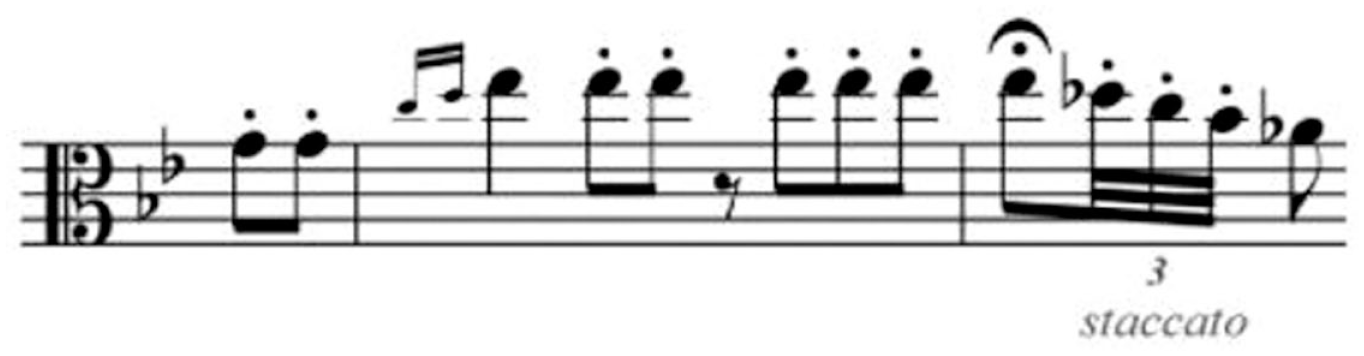
Wolf Concerto in B-flat, example of ornamentation and staccato, mm. 30–31.
Ernst Wilhelm Wolf (1735–1792)
Title: Concerto in F-dur für Viola und Orchester Movement: 1 Tempo: Allegro Length: 8’30” Key: F major Range: C3–G5 Form: First movement concerto form Cadenza: Yes (not supplied) Difficulty: ASTA Grade 4 Publisher: Amadeus (Wolf 1997)
Wolf’s second viola concerto, Concerto in F major, year unknown, is an excellent example of classical concerto writing, perfect for a violist around the level of Hoffmeister’s Concerto in D (Hoffmeister 2003), using first and third positions. It has three movements: Allegro in F, Andante ma moderato in B♭, and Allegro in F.
The first movement, Allegro, follows a standard first movement concerto form and is moderate in length. It contains sixteenth-note runs and bariolage interspersed with tuneful melodies. This work uses classical ornamentation, including grace notes and trills. Rhythmically, it is straightforward with one instance of syncopation. The bowing alternates between detaché sixteenth notes and legato melodic writing. Wolf’s melodic writing can be seen in Figure 3. There is one section with optional octave double-stops. This movement is in the key of F major with a minor section in the development. The entire movement is in alto clef. One thing to note in both of the Wolf concertos is the liberal use of the lower register, as can be seen in the passagework from Wolf’s Concerto in F, featured in Figure 4. Concerto in F, edited by Wolfgang Birtel, features the space for a cadenza that is not supplied by the composer or the editor.

Wolf Concerto in F, A-theme, mm. 38–42.

Wolf Concerto in F, example of passagework in the lower register, mm. 124–127.
Anton Stamitz (1754–1809)
Title: Konzert für Viola und Streichorchester Nr. 4 (D-dur) Movement: 2 Tempo: Romance Length: 5’25” Key: A major Range: C#4–A5 Form: ABA Cadenza: Yes (supplied by Walter Lebermann) Difficulty: ASTA Grade 4 Publisher: Breitkopf and Haertel (Stamitz 1973)
Anton Stamitz, son of Johann Stamitz and younger brother to Carl, was a German composer, violinist, and violist. He grew up in Mannheim being trained on violin by his brother, and the Mannheim teacher Christian Cannabich and likely studied composition as well. Stamitz played in the Mannheim orchestra from ages fourteen to twenty. In 1770, he and his brother moved to Paris to pursue their performing careers. Carl left Paris in 1777, but Anton stayed in France until his death. He is known to have appeared as a soloist with the Concert Spirituel five times between 1778 and 1787, playing his own concertos, but he is best known for being the teacher of Rodolphe Kreutzer (E. K. Wolf, Kaiser, and Wolf 2001).
Concerto number 4 in D, in three movements, namely, Allegro in D, Romance in A, and Rondo in D, is scored for solo viola and strings. The second movement is a simple ABA form romance with the A sections being in A major and the B section in A minor. The beauty of this piece comes in its simplicity. The A sections (Figure 5) have two themes, first stated by the solo viola with violin accompaniment, and then stated in an orchestral tutti.
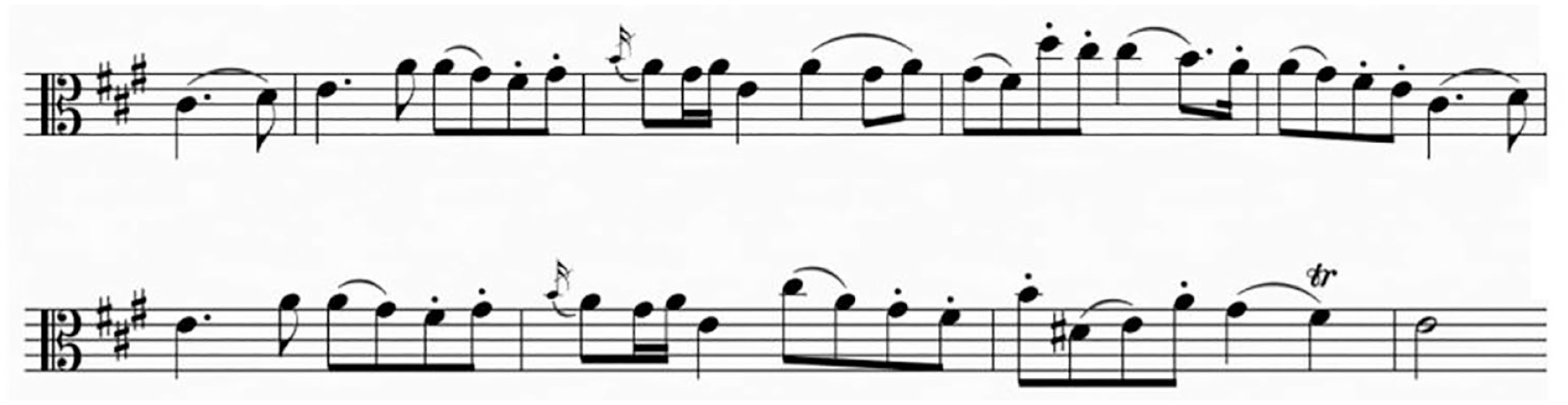
Stamitz Concerto in D, A-theme, mm. 1–8.
The B section begins in A minor, moves to a gentle C major before returning to A minor, extending the range of the viola up to the fourth position to build the tension before coming back down to repeat the A section in A major. The range of this piece is C#4 to A5, requiring the use of first through fourth positions. Musically, this piece is straightforward yet beautiful. It requires the use of vibrato in the left hand, and legato and brushed bowing in the right hand. This work could serve as an introduction to melodic playing, features a key change, and includes treble clef in the B section. There are grace notes and trills. There is space for a cadenza and there is one supplied by editor Walter Lebermann.
Josef Reicha (1752–1795)
Title: Konzert Es-dur für Viola und Orchester, Op. 2, Nr. 1 Movement: 1 Tempo: Allegro Length: 12’0” Key: E-flat major Range: C3–E♭6 Form: First movement concerto form Cadenza: Yes (supplied by Michael Goldstein) Difficulty: ASTA grade 4 Publisher: Simrock (Reicha 1978)
Josef Reicha, not to be confused with his better known nephew Anton Reicha, was a Czech cellist, composer, and conductor. From 1774 until 1785, he was a cellist in the Kapelle of Prince Kraft Ernst von Oettingen-Wallerstein in Swabia, traveling extensively, including a stay as the guest of Leopold Mozart in 1778. From 1785 until his death in 1795, Reicha worked as a cellist and later an administrator for the court orchestra in Bonn. The few compositions Reicha wrote were in a style that Leopold Mozart described in a letter to Wolfgang Mozart as “much in your [Wolfgang’s] own manner.” 10
Concerto in E-flat, opus 2, number 1, was originally published as a cello concerto alongside a version for viola (Lebermann 1984, 115), likely written to feature himself as the soloist. It follows the standard three-movement concerto form: Allegro in E♭, Romance in C minor, and Allegretto in E♭. This is a well-written concerto and any of the movements could be played and performed by an advanced student or a professional.
The first movement begins with a lengthy orchestral introduction lasting seventy-nine measures. This regal introduction begins with what Jan LaRue refers to as a “thematic cliche” using the “pompous” rhythm half note, dotted quarter, eighth, half note, half rest (Figure 6) that, beginning around 1770, presented itself with “tiresome frequency,” most famously, in viola repertory, appearing in the opening of Mozart’s Sinfonia Concertante (Wellesz and Sternfeld 1973, 438).

Reicha Concerto in E-flat, “Thematic Cliche,” mm. 80–81.
This work is best suited for an advanced student and would work as an excellent preparatory piece to Mozart’s Sinfonia Concertante (Mozart n.d.) to teach Mozartian style and technique. There is a significant amount of shifting with a range going up to E♭6, and the passagework is difficult (Figures 7 and 8). This piece features double-stops, chords, cadential trills, and ornamentation. It features character changes throughout, beginning with a stately opening A theme followed by a dolce B theme. Reicha creates a blend of showy passagework and melodious, legato sections.
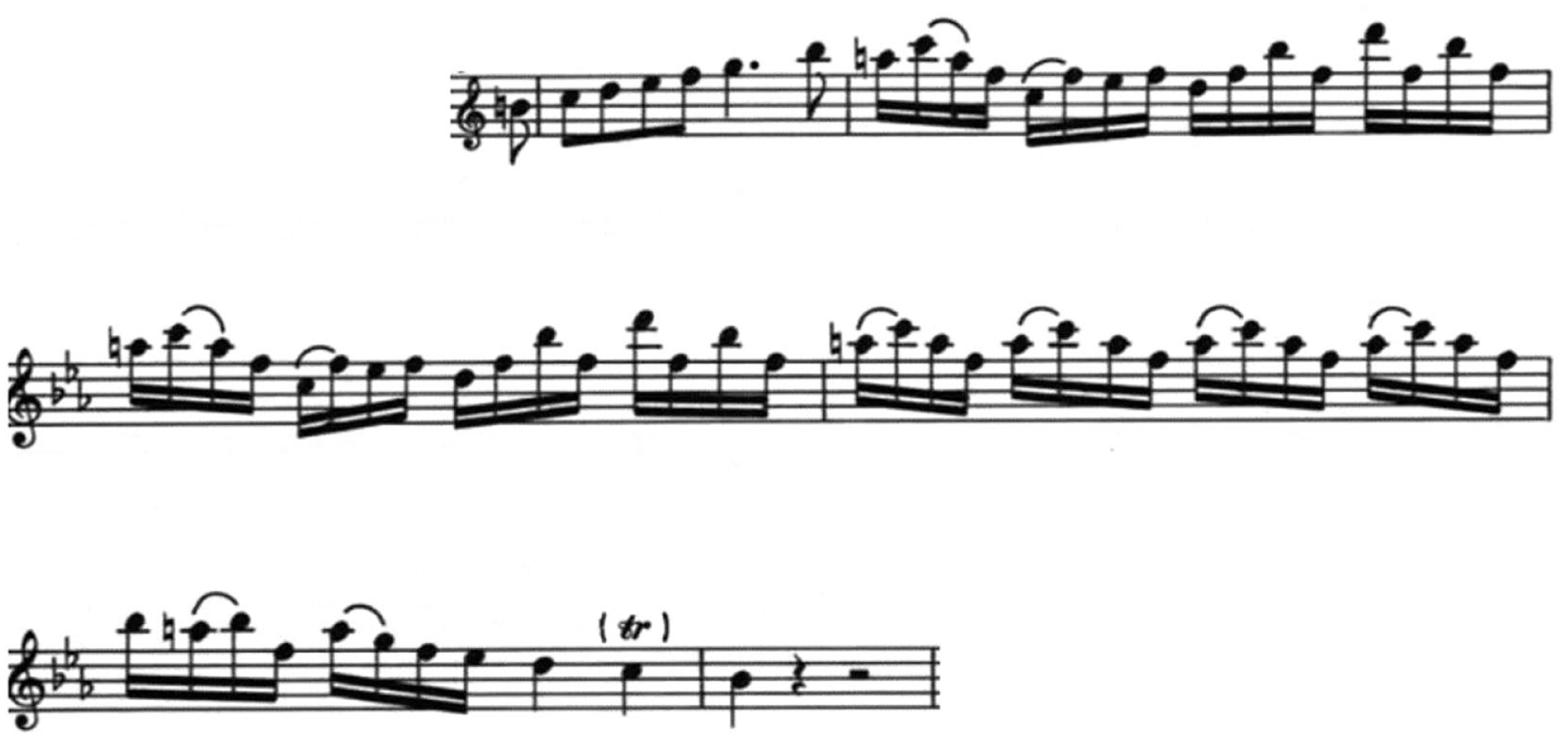
Reicha Concerto in E-flat, example 1 of high passagework, mm. 231–237.
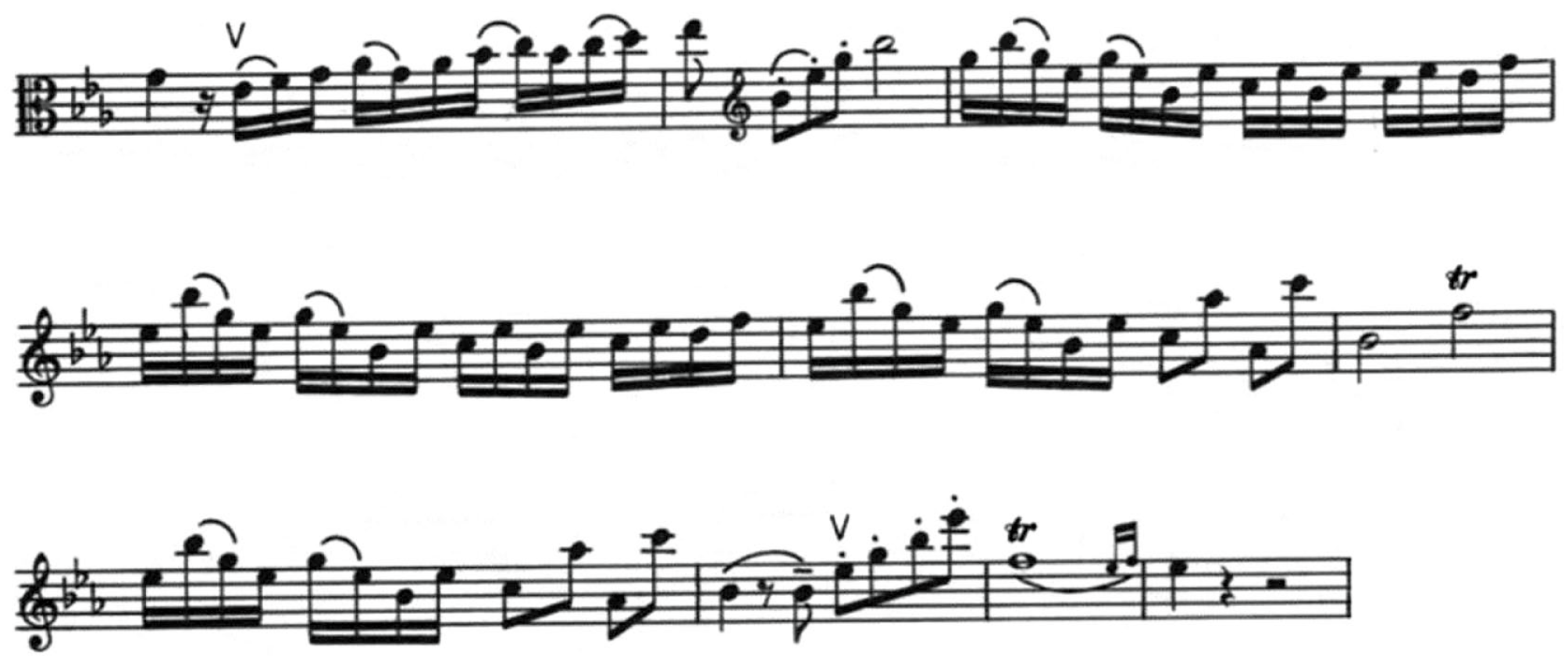
Reicha Concerto in E-flat, example 2 of high passagework, mm. 304–313.
Rhythmically, this piece contains tied notes and dotted rhythms, with brief instances of syncopation. There is a section in the middle that alternates sixteenth notes and triplets. This piece is technically demanding for both the left and right hands. One of the most challenging sections comes at measure 219 with six measures of bariolage (Figure 9). This edition, edited by Michael Goldstein, contains a lengthy cadenza lasting two full pages.
“Play and teach these works and expand the canon of viola repertoire.”
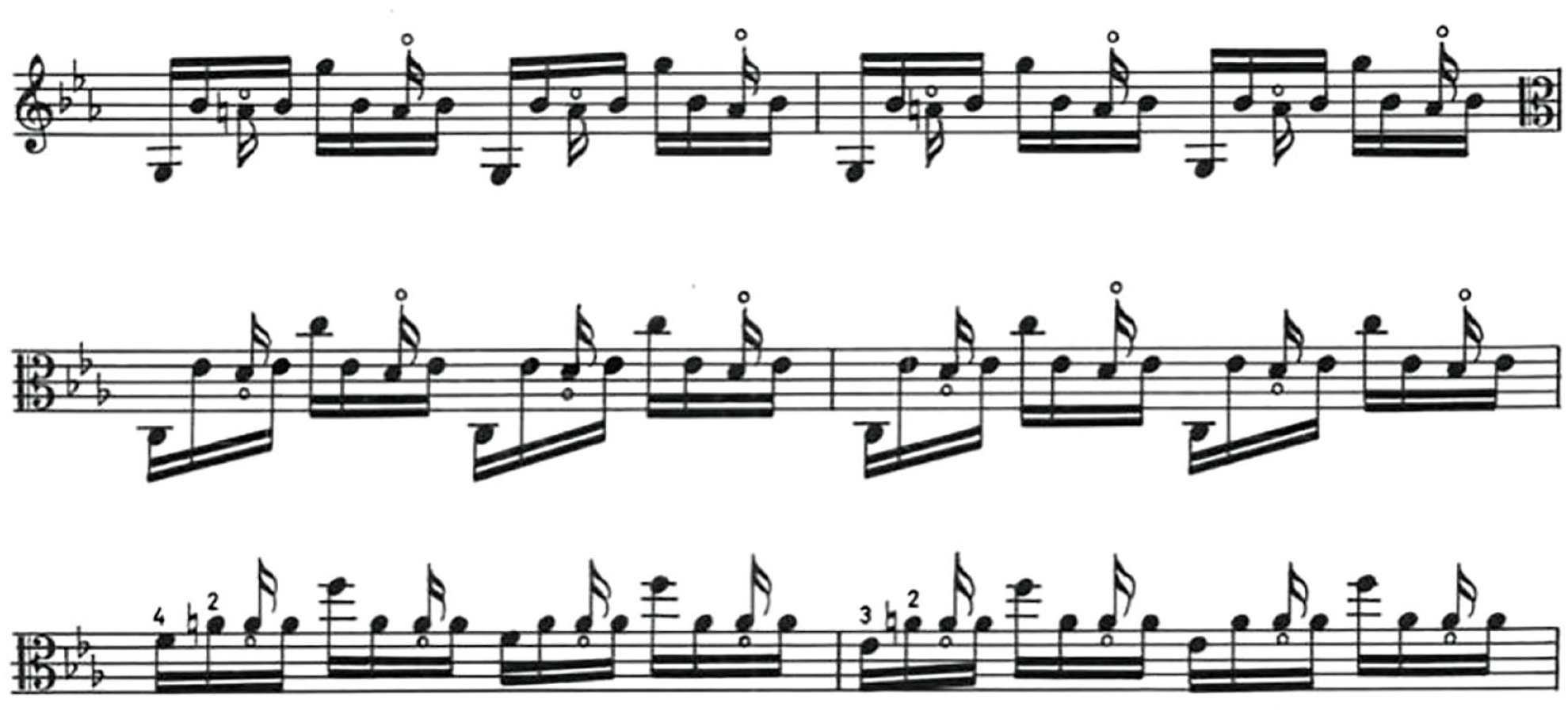
Reicha Concerto in E-flat, example of bariolage, mm. 219–224.
Conclusion
Despite the limitations of the eighteenth-century viola as a concerto instrument, there were many written for the viola in this era. While some were published at the time, most have not lived beyond their eighteenth-century debut, existing only in manuscript form, hidden away in archives waiting to be rediscovered. In recent years, violists have begun to explore these forgotten works and publish them in modern editions. The movements selected, all available for purchase online in modern editions, are quality representations of their time and place. Be bold! Play and teach these works and expand the canon of viola repertoire.
Footnotes
Notes

AJ Isaacson-Zvidzwa (