







Abstract

The Serenade for String Orchestra by Norman Leyden (1917–2014) occupies a rarified place in the string orchestra repertory: accessible to developing instrumentalists, it also possesses the musical substance and craftsmanship to appeal to more advanced players. Its engaging melodies, broad range of styles, and opportunities for musical expression have enchanted performers and listeners for half a century; consequently, the piece can easily withstand the extended rehearsal periods required for concert and contest preparation. Moreover, the work offers a plethora of teaching opportunities, ranging from articulation and style to dynamic shading and expressive nuance.
Overview
Norman Leyden’s Serenade for String Orchestra, comprising four movements, is an amalgamation of Baroque suite (Prelude, Fugue) with more Romantic influences (Nocturne, Cakewalk). The piece mirrors the string serenades of Tchaikovsky, Dvorak, Suk, and Elgar by reprising melodies from earlier movements in the finale. Unlike his predecessors, whose thematic reprises were limited to material from the first movement, Leyden restates the major themes of each of the three preceding movements for his finale.
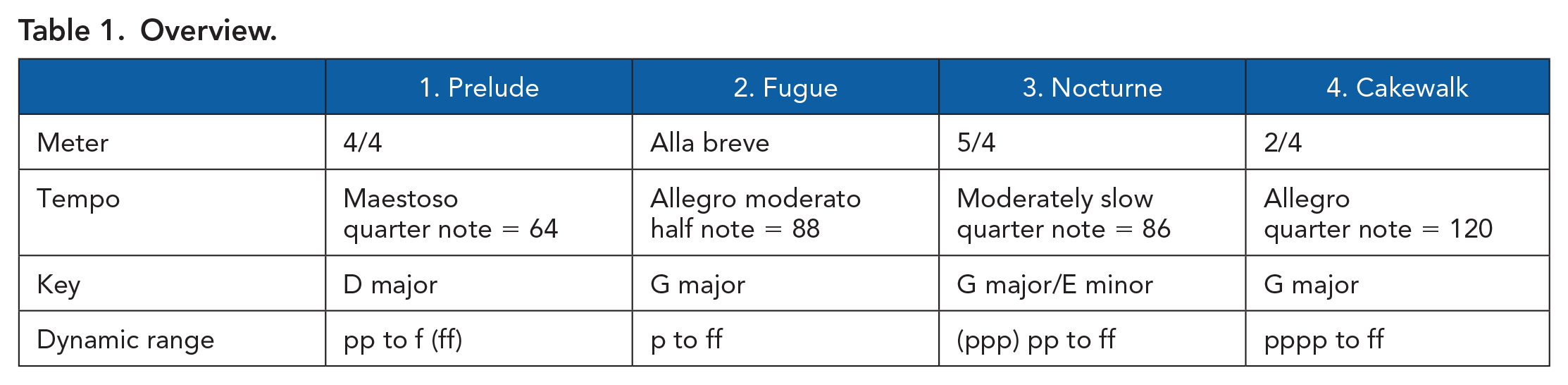
The four movements offer a wide array of styles and tempos (Table 1). A brief Prelude functions as a majestic introduction, while the Fugue sets traditional formal procedures within a more contemporary harmonic context. The agogic and emotional weight of the suite rests in its latter half: Nocturne, featuring solo violin, and Cakewalk, the playful finale that brings the Serenade to a cyclical close. Tempo relationships within the suite suggest a large-scale accelerando, progressing from slowest speed through two movements of nearly identical pacing to an animated finale. Similarly, the dynamic range represents an evolution, reaching ever softer as the piece unfolds. Each movement poses unique challenges in the areas of style and articulation, dynamics and balance, and expression.
Overview.
Prelude
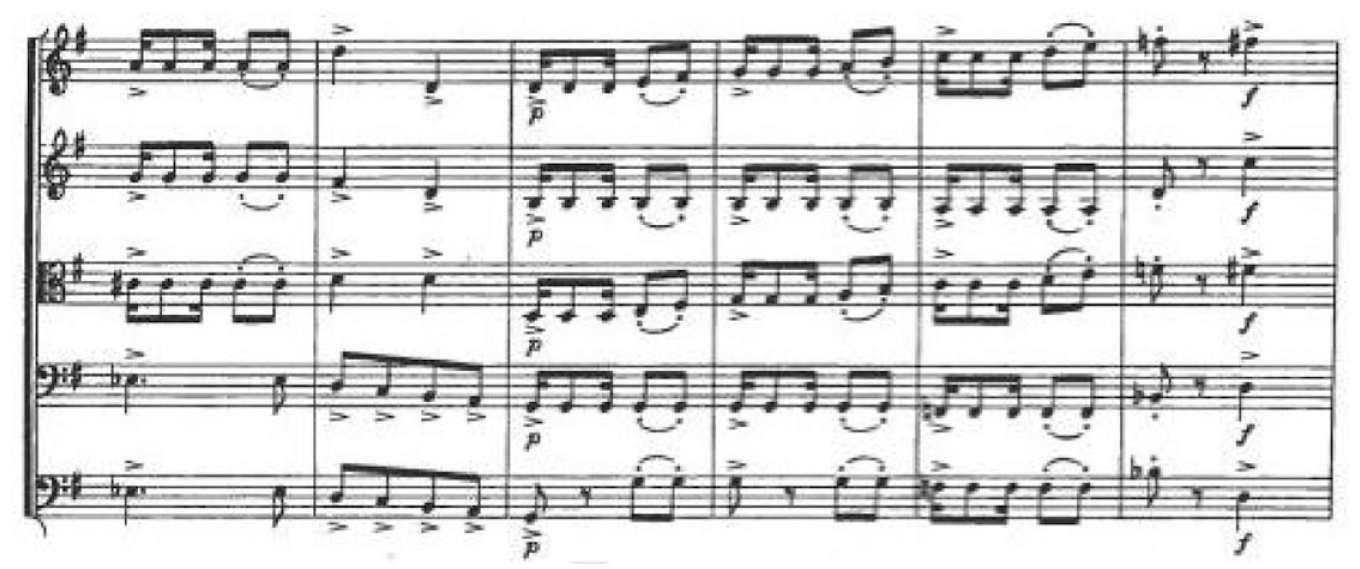
Broad and noble, the Prelude focuses on a single stately theme, transforming it through modulation and stylistic contrast (Figure 1). Following an initial statement in D major, Leyden’s process at rehearsal A typifies his approach throughout the Serenade: restatement of material in a borrowed, flat key. Returning to D major, cellos dominate in a softer, legato iteration of the subject. Rhythm, harmony, and volume are sharply contrasted at rehearsal C in a whispered pianissimo, creating a stark stillness. A strong final declaration of the subject emerges to close the movement.
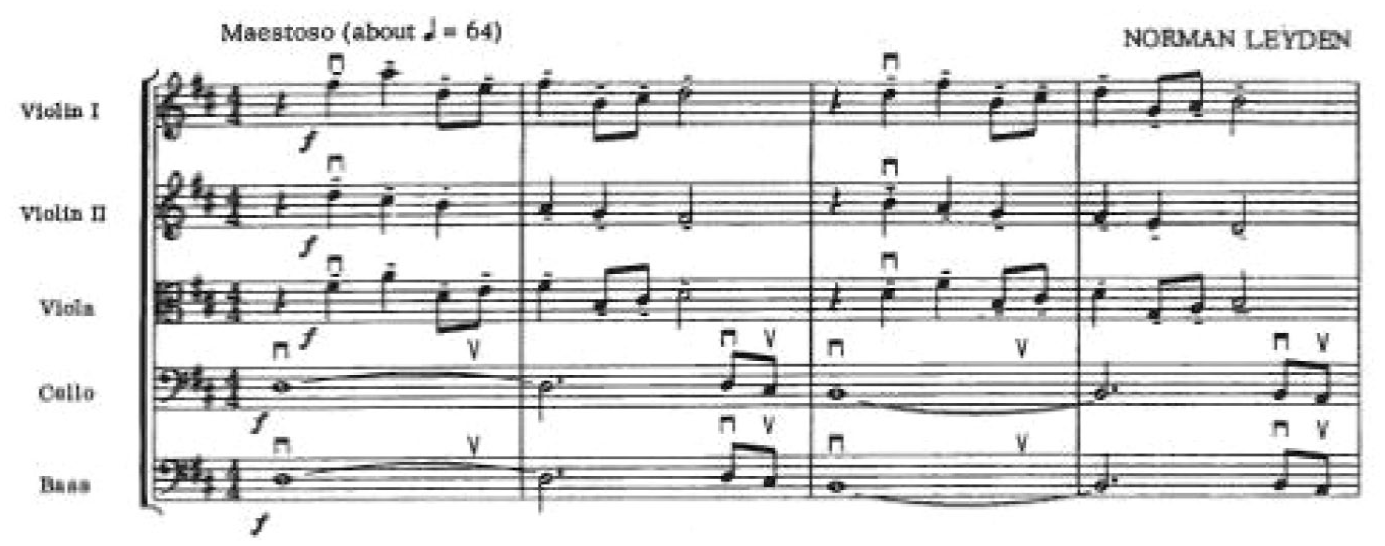
Prelude: Mm. 1–4.
Consistency in style is important for the movement. The upper strings have tenuto markings only in the first four measures; however, this broad, weighted articulation would seem appropriate throughout the Prelude whenever forte detaché is designated.
As they frequently function in tandem, the cellos and basses should share identical articulation; edit the parts carefully to ensure agreement with each other as well as the score. At rehearsal A, the score indicates an accent in the lower strings, an effective device for emphasizing the tonal shift; if desired, this will need to be added to the parts (Figure 2). Significantly, this would be the sole accent in the entire movement. A similar omission in the second violins five measures after rehearsal B, tenuto markings in the score but not in the part, may warrant correcting, given the extra weight needed for the melodic line.
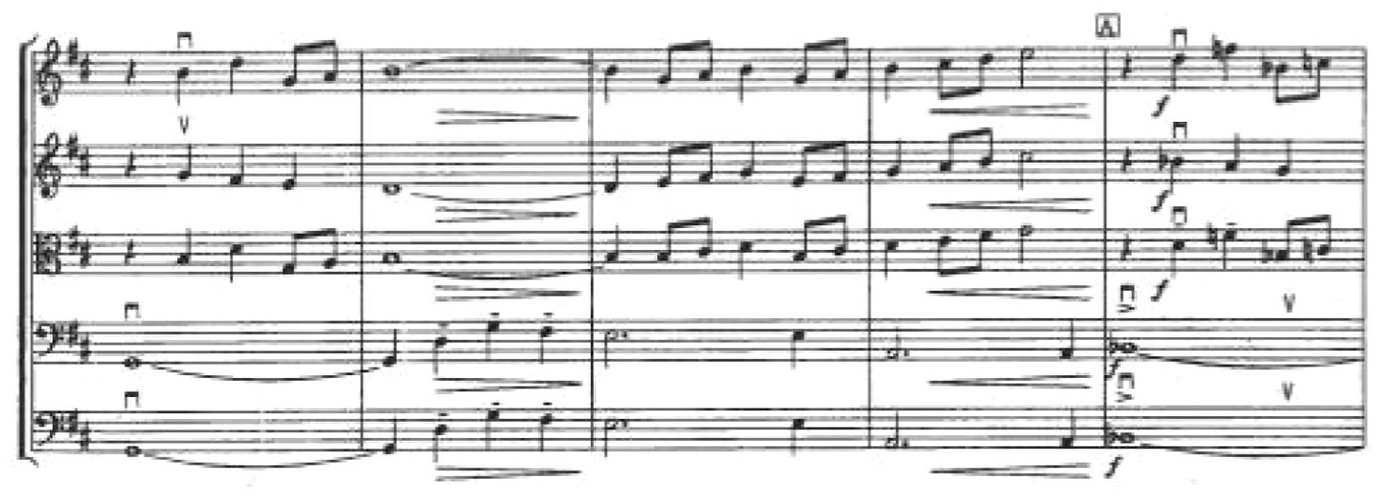
Prelude: Mm. 5–9.
Sustained intensity, particularly in longer note values, is crucial. The release of a note occurs only at the next event, be it a note change or rest. When a longer note is subject to a crescendo, judicious bow management becomes even more essential (e.g., three and four measures after rehearsal C; Figure 3). Here, the increase in volume in the upper strings extends all the way to the subsequent rest.
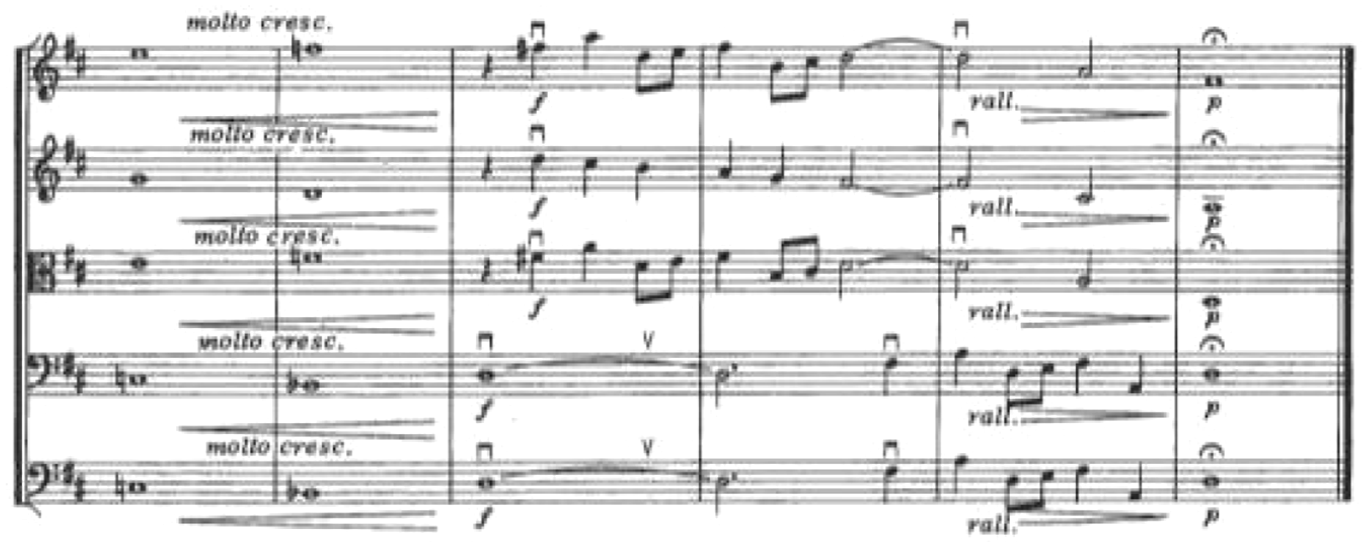
Prelude: 3–8 mm. after C.
Attenuation of dynamics is also a key element in reinforcing the Maestoso character. Unless otherwise notated, crescendos and diminuendos should change the volume to the adjacent dynamic level (e.g., the decrescendo in the sixth measure should extend only to mezzo forte) (Figure 2).
Subtle volume shading will also aid in balancing the various textures. From the beginning to rehearsal B, and again in the final four measures, first violins and violas function in tandem; the unique countermelody in the second violins may need be strengthened (Figure 3). When Leyden repeats this alignment five measures after B, it is now the secondary melody that is doubled (Figure 4). Here, the main theme in Violin II should be emphasized.
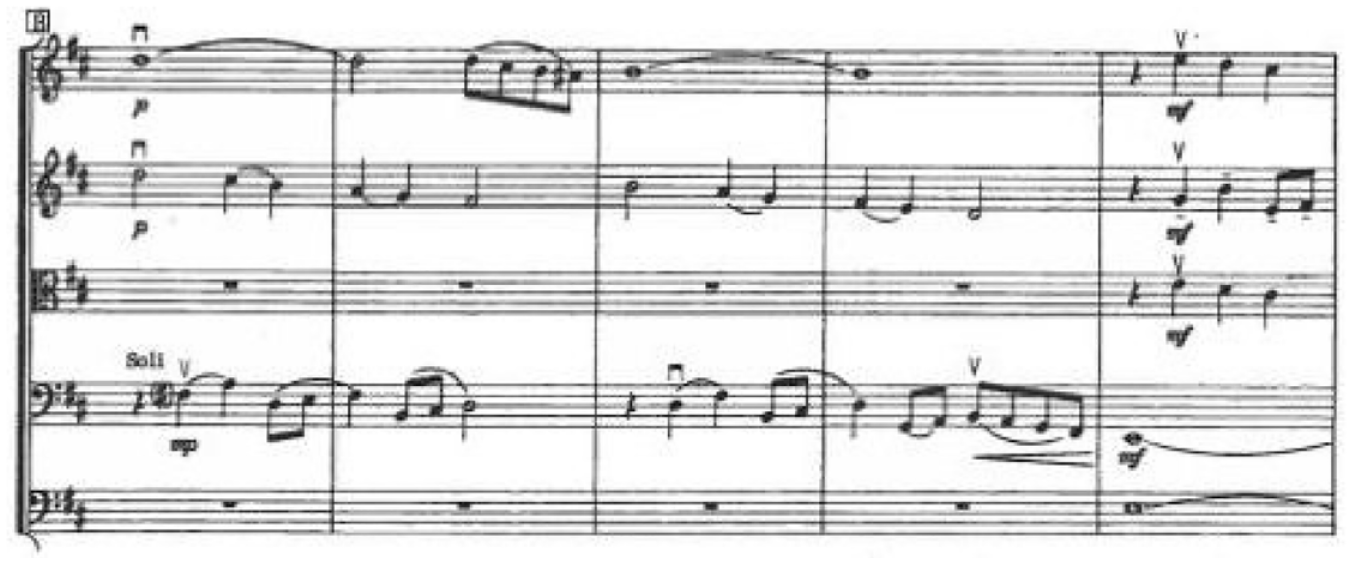
Prelude: 1–5 mm. after B.
At rehearsal B, cellos need to project the melody through the accompanying violins (Figure 4). In the penultimate measure of the Prelude, hastening the diminuendo in the upper strings will help emphasize the final melodic statement in cellos and basses (Figure 3).
At all times, expressive nuance should reflect and reinforce the desired character of the Prelude. Left-hand color, particularly at the outset, undergirds strength and resolve. In contrast, the hushed pianissimo at rehearsal C may benefit from virtually no vibrato; consider poco sul tasto to further distinguish the sonic profile.
Fugue
Leyden’s fugue adheres to traditional formal procedures in several ways. It is dominated by a recurring subject, a distinctive melody heralded by a trio of accented half notes (Figure 5). When the second violins launch the second statement of the subject (rehearsal A), the previous melodic voices introduce a countersubject; this accompanying melody will be present at each subsequent statement of the primary theme (Figure 6). Every entry of the subject is in the form of a real answer, a faithful transposition of the melodic contour of the original statement. At rehearsal C, where the subject is stated at the interval of a sixth, this intervallic fidelity shifts the tonality from tonic to the relative minor (Figure 7). Leyden employs developmental processes in episodic passages that avoid a complete statement of the subject. A culminating coda (rehearsal E), combining the subject’s opening accented figure with its ensuing rhythmic motive, builds to a stirring conclusion.

Fugue: Mm. 1–5.
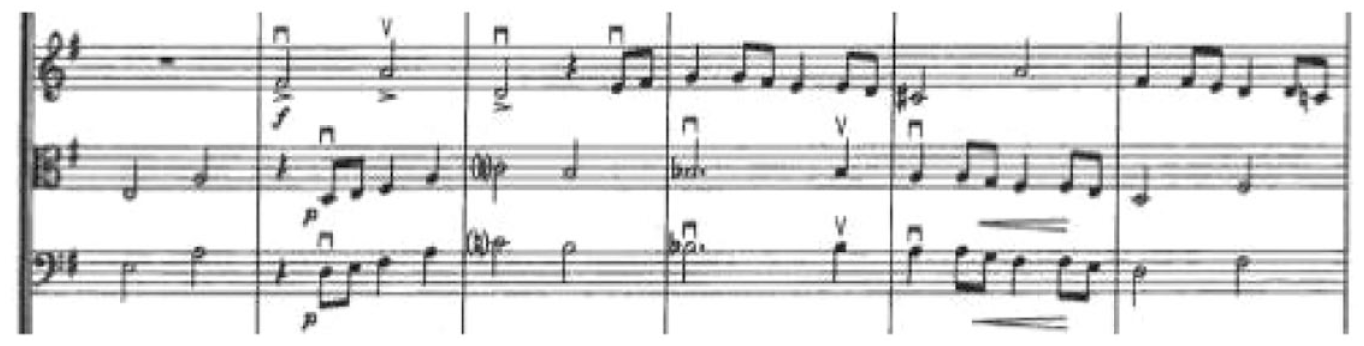
Fugue: 1 m. before A to 5 mm. after A.
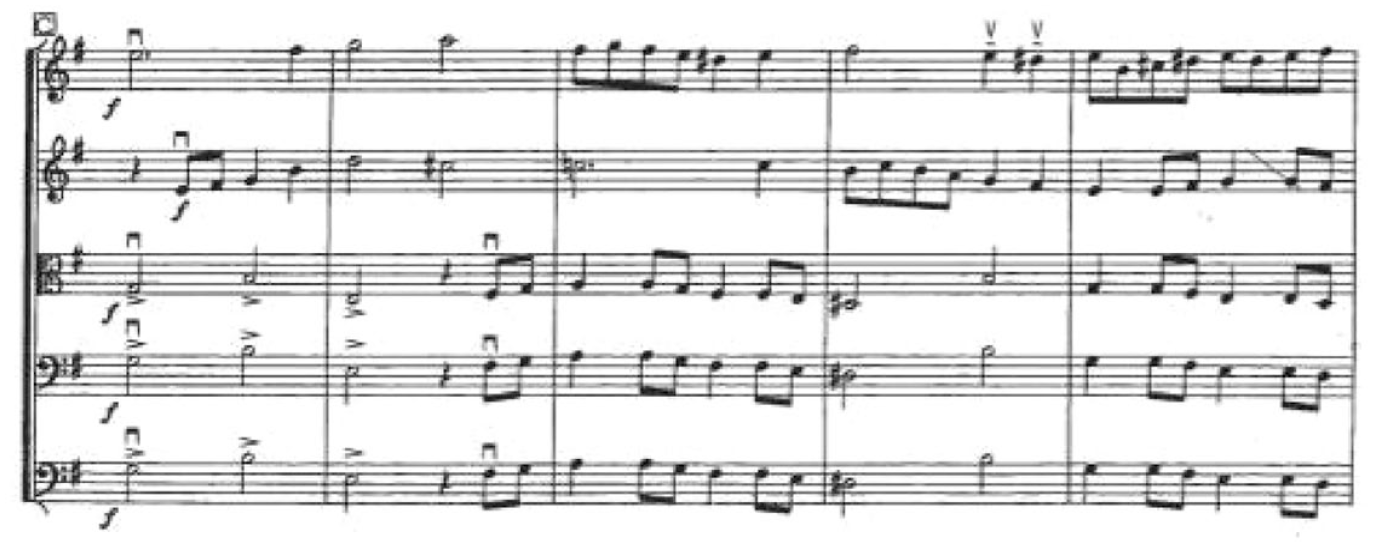
Fugue: 1–5 mm. after C.
In fugal textures, the foremost goal is clarity rooted in Baroque style: a nuanced, deliberate approach to silence between notes. This will not only contribute to the distinct sonic profile of the subject but also help create transparency in accompanying voices. Rhythmic values longer than eighth notes should be separated. In both the subject and countersubject, the stylistic profile must be identical as material is passed among sections of the ensemble. Clarity and spacing are particularly crucial when playing at softer dynamic levels. Consider rehearsing thematic material simultaneously to focus on unified articulation.
Fugal textures require utmost attention to dynamics: the subject must always be readily audible. In most cases, Leyden carefully denotes when a melodic voice yields its primacy (e.g., the subito piano for violas and cellos at rehearsal A; Figure 6). In tutti passages in which all sections are assigned the same dynamic level, adjustments to volume may be necessary. At rehearsal C, for example, the lower strings must be predominant, while the second violin countermelody is of greater importance compositionally than the relatively insignificant first violin line (Figure 7). Letter D presents an even more challenging configuration in which the first violins must project above the rest of the orchestra.
The central fortissimo passage (seven bars after C) should possess a singular intensity; the previous forte sections must have the potential for added volume. Significantly, each of these culminating moments is devoid of accents (Figure 8).
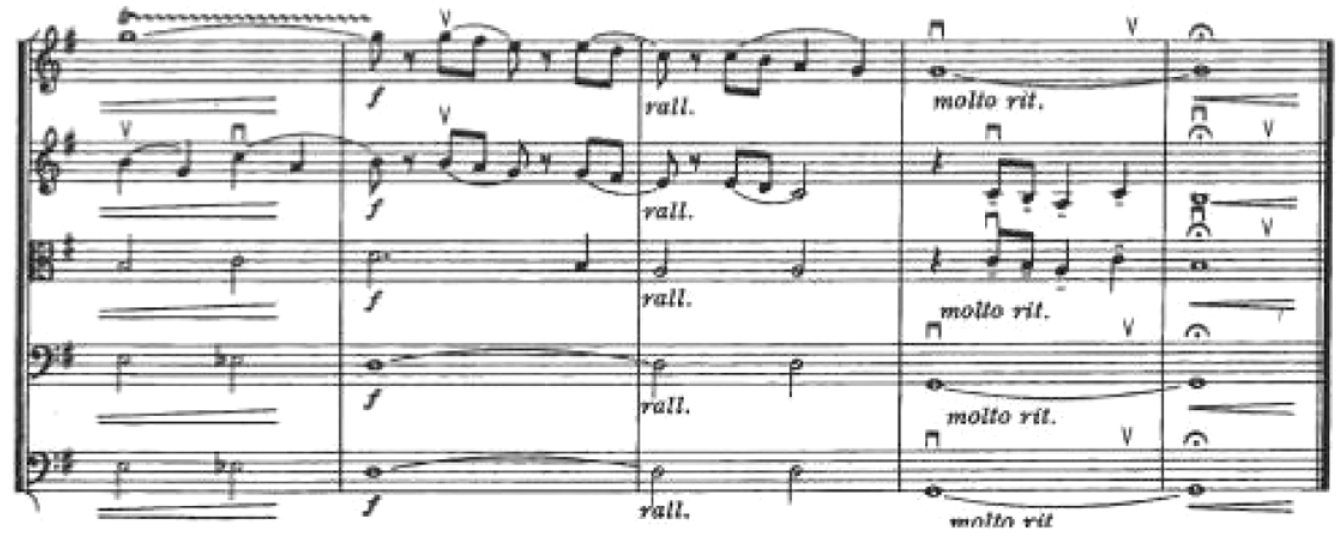
Fugue: 8–12 mm. after E.
Following rehearsal D, an adjustment to the printed dynamic will be needed. This final statement of the fugue subject, marked forte, builds through a two-measure crescendo to . . . forte. A subito softening, to mezzo forte or even mezzo piano, will make possible the subsequent crescendo.
Balance in the final chord requires careful monitoring. Due to contrasting rhythms, the ensemble will be executing two markedly different bow speeds (Figure 8). Switching bow direction in the final measure prevents undue emphasis on the third of the triad.
In the realm of expression, tempo alteration warrants particular attention. At rehearsal E, the a tempo designation implies the possibility of slowing into the previous fermata. Leyden offers more specific guidance regarding pacing at the end of the movement. Here, two separate directives approaching the final fermata reveal the extent of slowing desired, the second even more impactful than the first (Figure 8). In terms of conducting gesture, one solution is to broaden within the two-beat pattern at the rallentando, then transition to a four-beat subdivision for the molto ritardando.
Nocturne
Arguably, the emotional heart of the Serenade, the Nocturne, is cast in ternary form. The placid outer sections feature solo violin, whereas the more agitated central portion is characterized by organic intensification of both pace and volume. From a tonal perspective, Leyden heightens the nighttime atmosphere through harmonic ambiguity.
Perhaps the Nocturne’s pivotal stylistic element is slurred legato (Figure 9). Introduced by solo violin and later incorporated into the orchestra, this dotted motive will benefit from a connected approach in the form of louré or portato. Younger students may need to be reminded not to stop the bow: the gentle, pulsing articulation results from manipulation of bow weight. This connected quality extends throughout the Nocturne. The climactic fortissimo, borne of weight and resonance, is conspicuously unaccented.
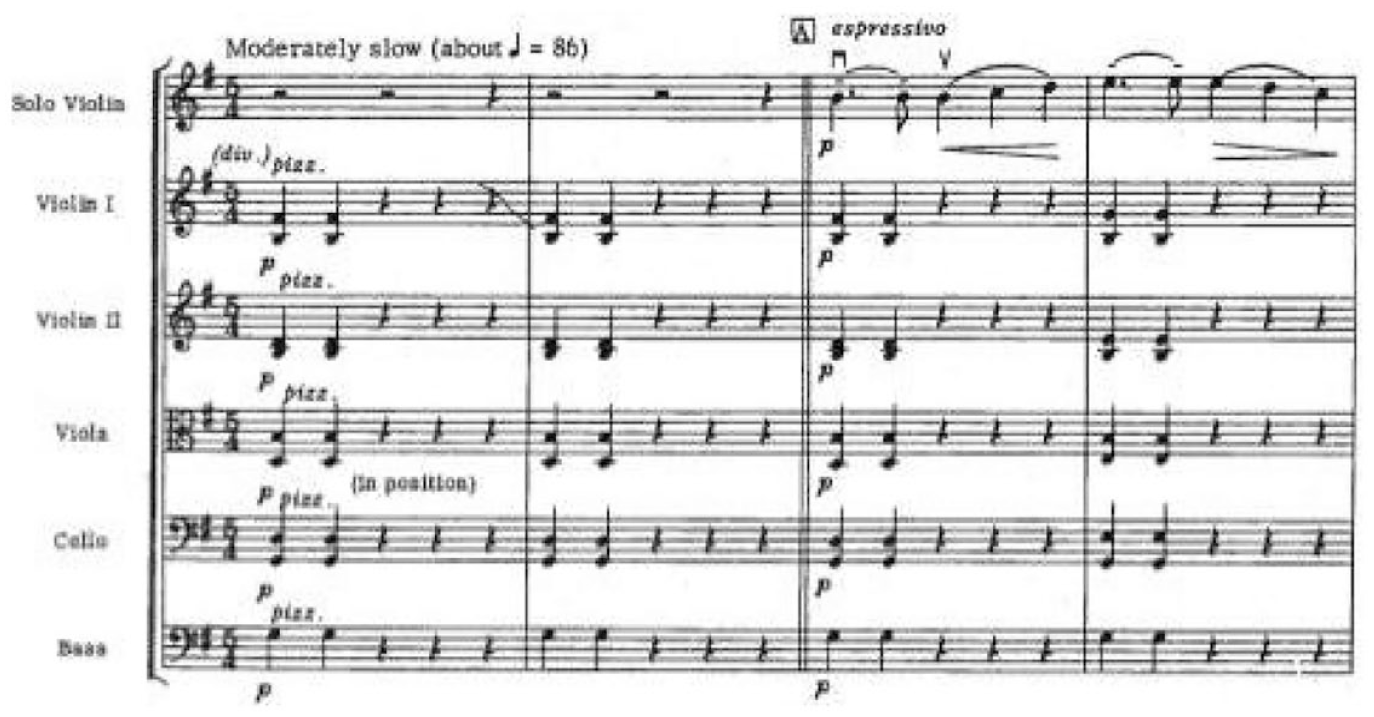
Nocturne: Mm. 1–4.
At all times, execution of dynamics should support the nocturnal atmosphere. Strive for unforced, organic gradations in volume.
In the score, six measures after rehearsal A, diminuendo symbols are missing; the parts have the correct notation. Differentiate the piano at B from pianissimo at C; the latter is the softest dynamic thus far in the movement (Figure 10). Notably, the fortissimo at rehearsal F should be a solitary moment of greatest strength.
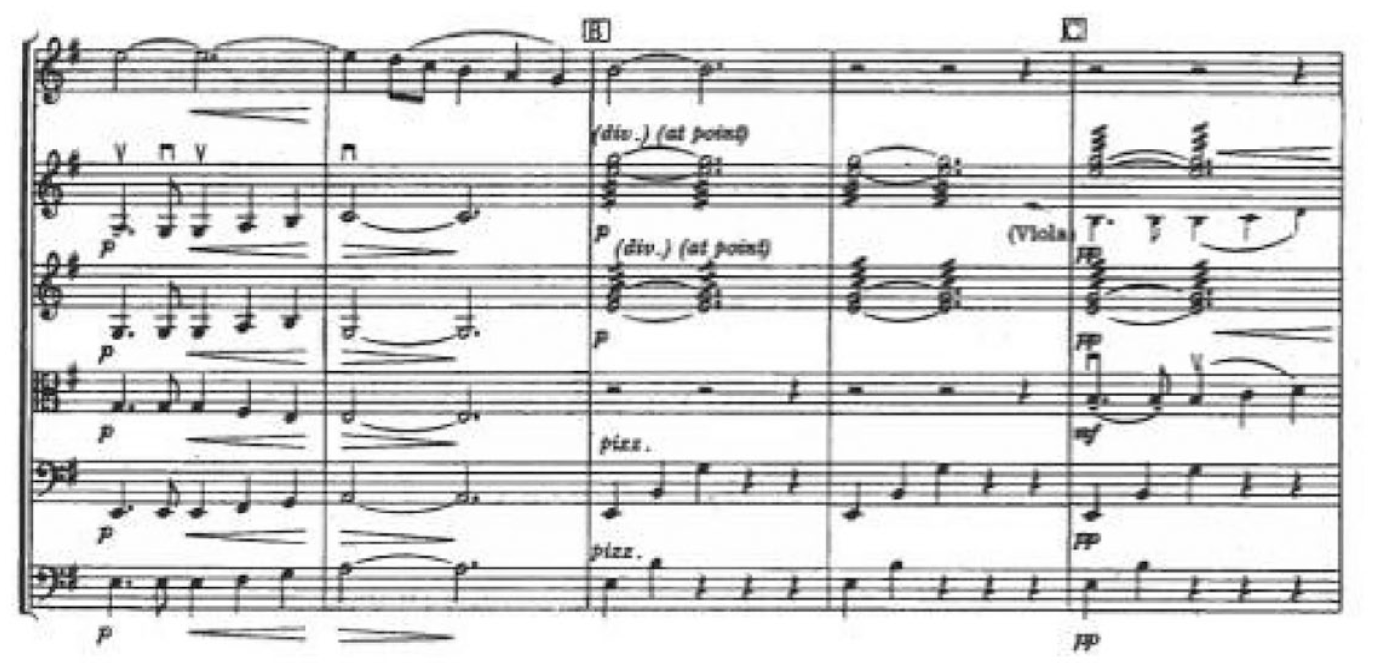
Nocturne: 2 mm. before B to 1 m. after C.
The crescendo, five measures after C, traverses a wide expanse; consider delaying the build slightly—perhaps until the third beat—to facilitate audibility of the cellos’ moving line. (Rehearsal D, missing in the score, is eight bars after C.) The diminuendo in the third measure of D should extend to the end of the section.
Dynamics after F require amending. As printed in the score, the violins’ diminuendo from piano appears logical; however, the tutti melodic statement two measures before Tempo I must surely require an equal contribution (piano) from the violins (Figure 11). While dynamics in the violin parts in this passage disagree, the Violin II notation seems most sensible: the piano designation, shifted to the fifth bar of F, becomes a natural result of the two preceding diminuendos. Consequently, the violins will replicate the dynamics of the violas and cellos, while taking care to maintain a subordinate role three and four measures after F.
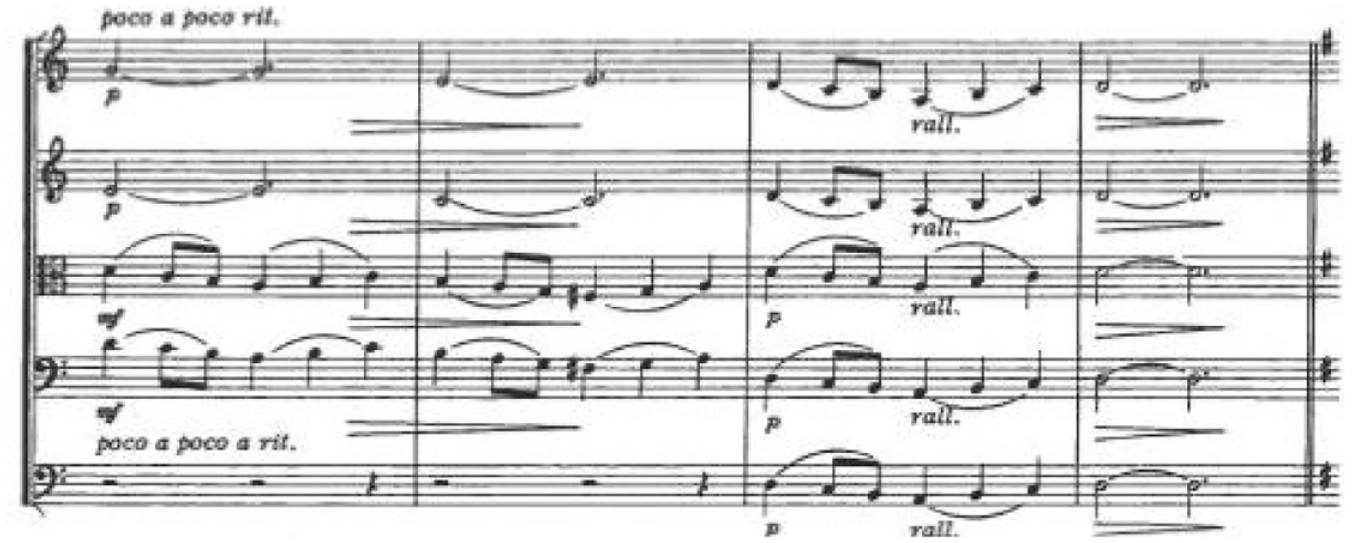
Nocturne: Mm. 3–6 after F.
Although not indicated in the score, a diminuendo three measures before H is found in the second violin and cello parts. Adding it to the other voices, on beats 3–5, will bring this phrase in accord with earlier passages.
Careful attenuation of dynamics will also foster melodic balance. Situated in the middle of the texture, the viola melody at rehearsal C could be problematic (Figure 10). Several factors will aid in preserving audibility of the theme: maintaining transparency in the violin tremolo, executed at the tip; ensuring that the crescendo of said tremolo is accompanimental in scope; observing the mezzo forte dynamic in the viola line, coupled with intense vibrato; and assigning a portion of the first violin section to play the viola line cued in their part. This last-named strategy, resulting in increased volume but with diluted timbre, should be a last resort.
Melodic cues are also an option at rehearsal D, where the cello line is set beneath a forte chord in the upper strings. Before falling back on this alternative, consider imposing a subito dynamic change for violins and violas—at least to mezzo forte—at the outset of their sustained chord. At rehearsal E, a harmonized iteration of the melody is carried by all but one voice (Figure 12). The second violin countermelody, in contrary motion, must be fervently sung; mezzo forte may be a more realistic marking, considering the strength of opposition, particularly if the optional upper octave in the first violins is present. Although not indicated in the score, this elective higher octave ends four bars after F.
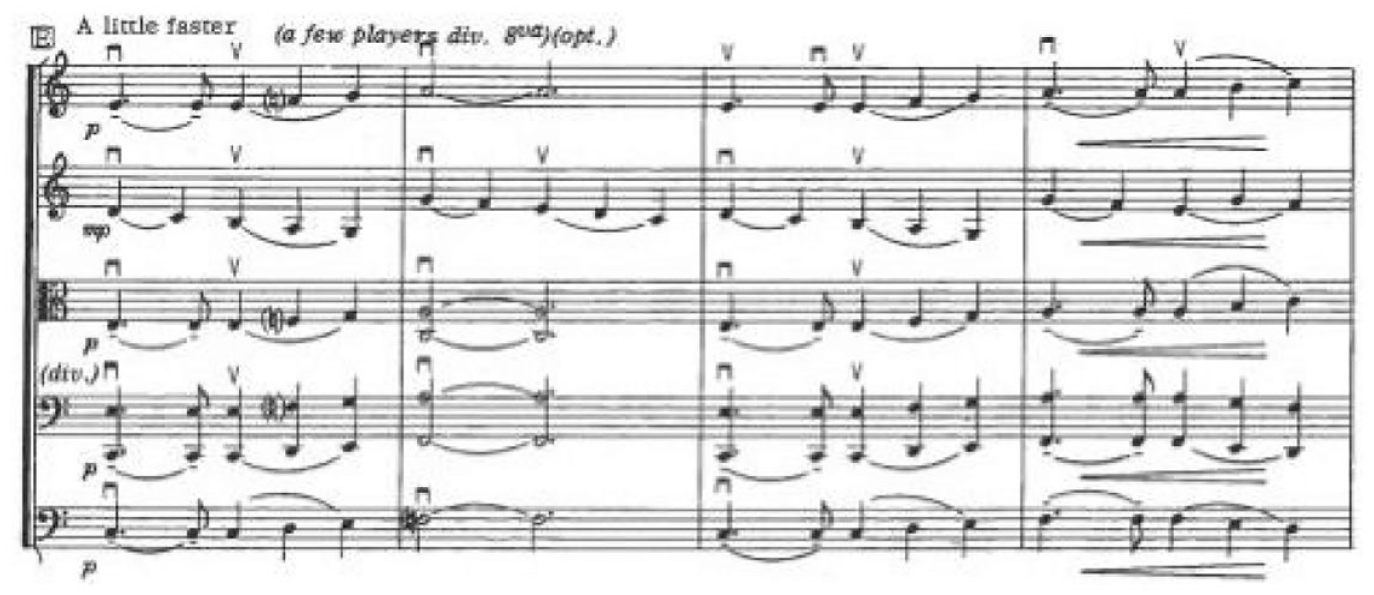
Nocturne: Mm. 1–4 after E.
At the start of the stringendo (five measures after E), Leyden increases tension through dissonance: the violas harmonize the bass line at the interval of a seventh (Figure 13). Be sure the violas are cognizant of their critical role in this dramatic escalation. Although this line is cued in the second violin part, one hesitates to weaken what is now the uppermost melodic voice by dividing the section.
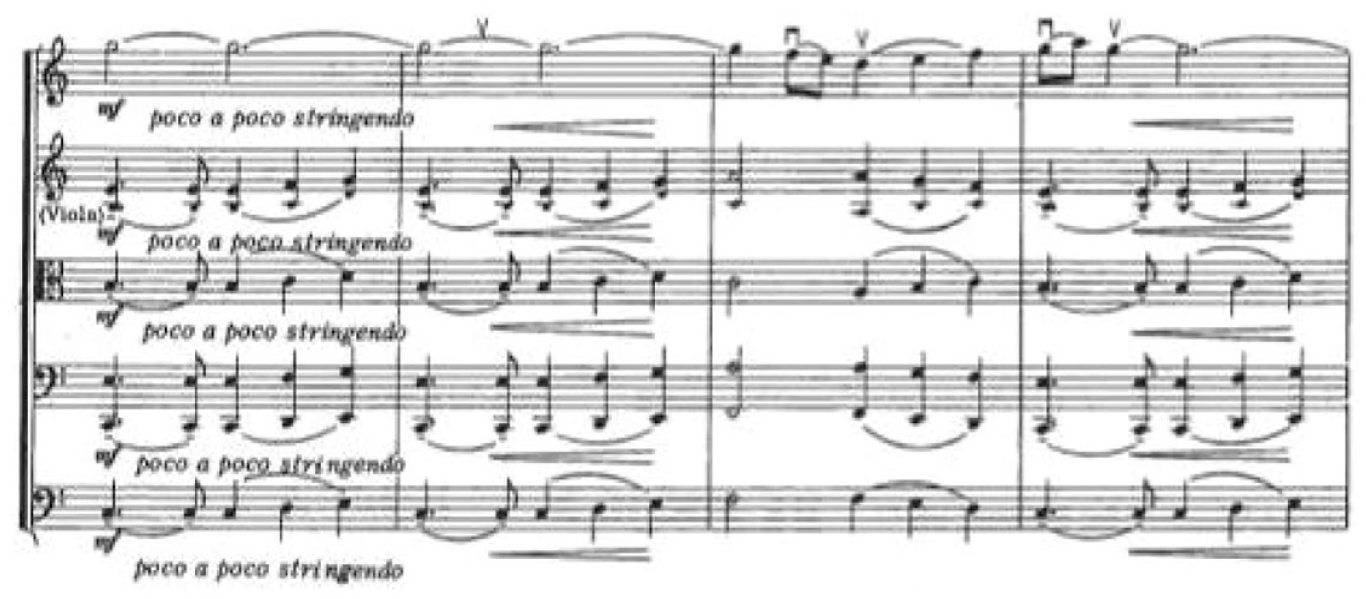
Nocturne: Mm. 5–8 after E.
In terms of expression, note the movement’s three designated tempos: Moderately slow (beginning and Tempo I), A little faster (rehearsal E), and A little slower (H); be sure the music is paced in adherence to these relationships. Respect Leyden’s stasis two bars before E. In lieu of a fermata, he is exerting stricter control over the length of the tonic pitch that closes the opening section.
The heightened pulse at E should be noticeable yet modest; be careful to not compromise the potential for propulsion in the accelerando that follows (Figure 12). The increase in tempo should function in tandem with melodic repetition and the protracted crescendo; all three gestures contribute to an overall intensification. Both tempo and volume peak at rehearsal F.
The valedictory codetta (rehearsal H) merits particular finesse from the standpoint of expression. The slower tempo is approached by a rallentando: decelerating into the slackened pace—rather than past it—may make for a more organic connection. Given the amount of softening in the previous two bars, it may be necessary to increase volume slightly for the piano at H; this will create the space required for the subsequent pianissimo and diminuendo. Consider a well-balanced fade to silence on the closing sonority.
Cakewalk
The spirit of the Cakewalk is neatly summarized in its introductory measures: playful syncopation, energetic accents, unexpected dynamic shifts, and obstinate fixation on a singular rhythmic motive (Figure 14). Meticulous attention to dynamics and articulation will reveal the full palette of color and shading that Leyden demands. Boasting the fastest tempo of the four movements, the Cakewalk is also the only legitimate dance in the suite.
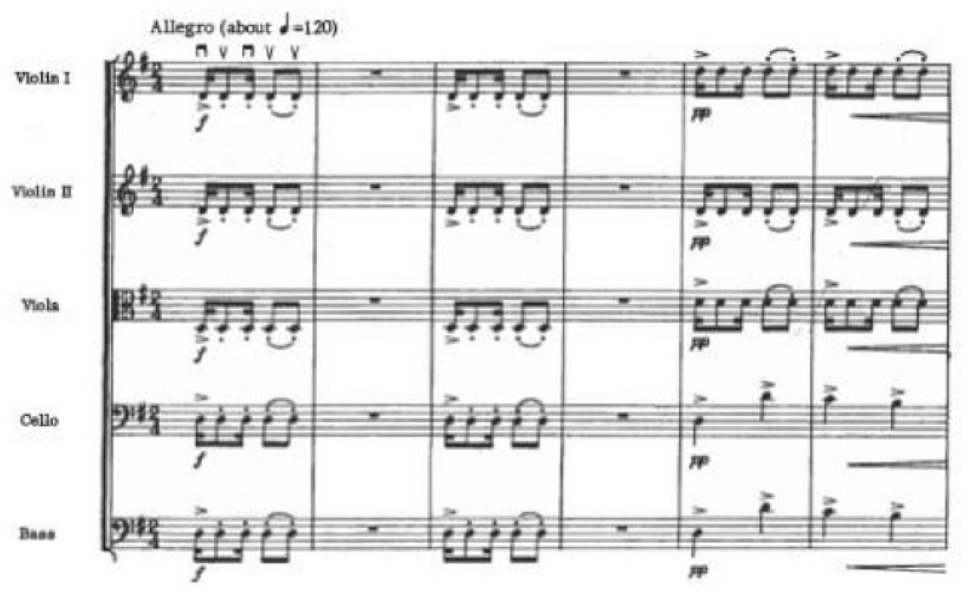
Cakewalk: Mm. 1–6.
The Cakewalk alternates a primary subject (rehearsal A) with thematic material from earlier movements, the recurring theme functioning as a kind of ritornello. Leyden promotes cohesion by accompanying each melodic reprise with the primary rhythmic motive. Material from the Prelude (five bars after B) is the only theme presented in its original order, rhythm, and key in the Serenade. Leyden revisits the Nocturne five measures after E: modulated to Bb major, the subject is transformed metrically by the compression of quarter note pulses into triplets. The Fugue subject, appearing five bars after G, features a slight rhythmic alteration in its second measure. It concludes with a bold passage, homorhythmic and harmonically venturous, reminiscent of a similar gesture near the conclusion of the Prelude (Figure 15).
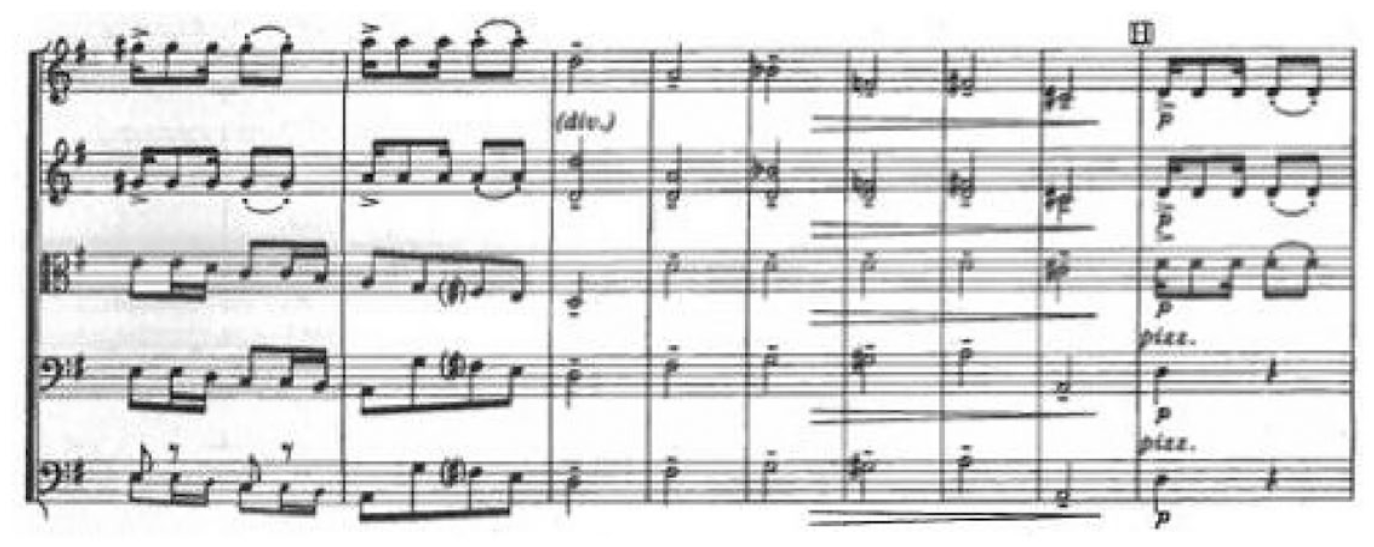
Cakewalk: Mm. 9–16 after G to 1 m. after H.
Leyden’s colorful approach to harmony also distinguishes the Cakewalk theme. Borrowed chords, built on flat keys, challenge the supremacy of G major beginning in the third measure. Altered major triads include F (bVII), Bb (bIII), and Eb (bVI; Figure 16); Eb also forms the basis of a French augmented sixth chord seven bars after A. Although far from traditional jazz harmony, the chromatic inflections may inspire a discussion of musical color as embodied in nonfunctional chords. These underlying sonorities remain consistent for each appearance of the primary subject.
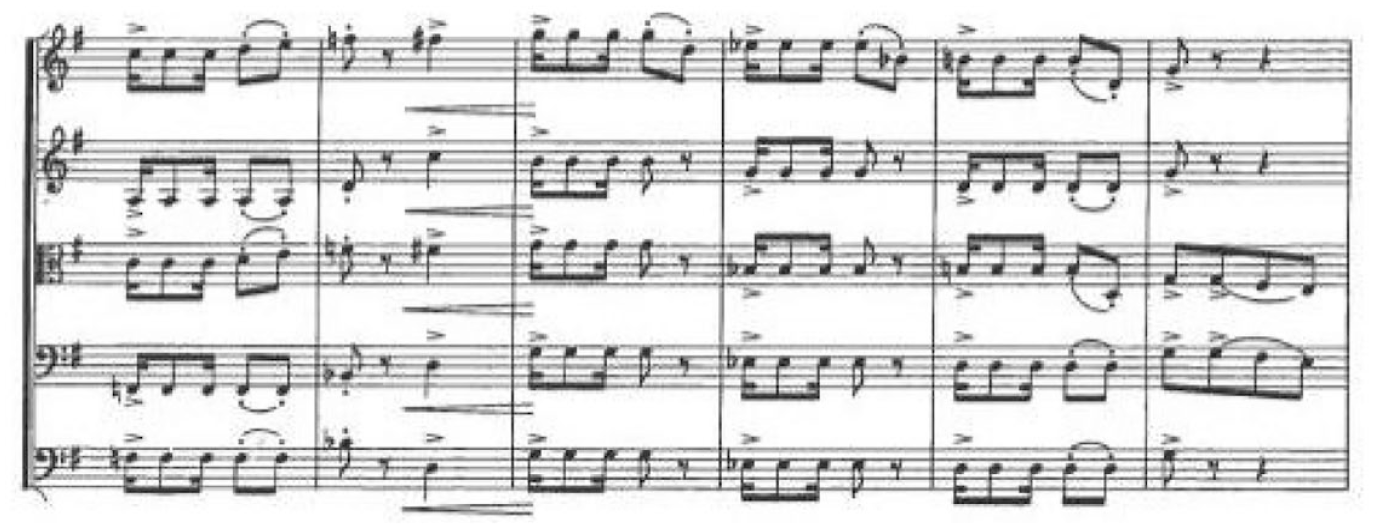
Cakewalk: Mm. 11–16 after A.
The movement requires clean, clear articulation, particularly at the softest dynamic levels. Uniformity of bow speed and placement is crucial in preserving the crystalline purity of the fundamental rhythmic motive. Accents are deployed judiciously: of the five notes comprising the motive, only the first receives special emphasis (Figure 14).
Accented quarter notes should be broad in style. When Leyden desires greater separation, as in the ppp passage at rehearsal F, he amends the notation to eighth notes followed by rests. Restricting accents to the notes so indicated will assist in preserving tempo as well as the dance-like character. Articulation must also be executed in tandem with the given dynamic level.
Dynamic contrast is one of the most striking features of the movement. When written as terraced shifts, these changes should be both sudden and emphatic. Particular attention should be given to the final note of the previous dynamic level: allow no hint of the change to come. Often, Leyden will underscore these shifts through contrasting articulation. Twelve bars after C, for example, sustaining the accented quarter note enhances the subito forte with an agogic emphasis (Figure 17). The terraced recession beginning at H requires nuanced execution.
Cakewalk: Mm. 7–12 after C.
Eight measures after C, there is some discrepancy in the way the piano is approached (Figure 17). While the score indicates a terraced shift in volume, the first violin, cello, and bass parts feature a diminuendo; whichever method is chosen, it must be consistent in all voices. Given the overall character of the movement, surprising the audience with a sudden change of intensity would certainly be appropriate.
Ensemble balance, most challenging in the passages featuring material from previous movements, requires sufficiently transparent accompanying voices to ensure melodic projection. This situation is exacerbated by the relative busyness of the motivic ostinato. In particular, five measures after G, the Cakewalk motive in the violins (marked sempre fortissimo, no less) will likely need to be softened to ensure audibility of the fugue subject in the low strings.
The substantial dynamic range demands scrupulous planning and nuanced execution of volume levels. The movement’s initial forte, for example, must be soft enough to accommodate the ensuing fortissimos. Situated in the latter half of the Cakewalk, these passages of greatest intensity will emerge as climactic, given appropriate restraint earlier in the movement.
Other expressive nuances are concentrated in the passages borrowed from previous movements. The dolce presentation of the Prelude theme (five bars after B) requires a singing legato and nuanced shaping. Conversely, the subject of the Fugue will benefit from a more vigorous approach, particularly in its introductory accents.
“Approaching the piece with careful attention to Leyden’s text—the music itself—together with equal parts logic and intuition will help ensure its undiminished vitality and relevance for years to come.”
A steady, precise pulse will contribute to the dance-like character. Performing at a faster tempo carries the risk of compromising the integrity of the earlier melodies as they barrel past too quickly. Already presented faster than their original incarnations, the themes might lose their fundamental expressive identity if played at too rapid a pace.
Conclusion
For more than half a century, Norman Leyden’s Serenade has served as an outstanding vehicle for developing musicianship and technique in young performers. Crafted by a composer whose long, prolific, and multifaceted career encompassed such a wide range of music making, the work boasts an uncommon combination of substance and accessibility. Approaching the piece with careful attention to Leyden’s text—the music itself—together with equal parts logic and intuition will help ensure its undiminished vitality and relevance for years to come.
Footnotes

Mark Laycock (