







Abstract

If one can immerse themself in Spanish violin repertoire, they will find that it often incorporates pizzicato techniques inspired by guitar and flamenco traditions. There are even pieces, such as the Argentine piece Bolognini: Serenata del Gaucho, that are almost entirely pizzicato (Bolognini, arr. Di Renzo, performed by Cotik, 2024). This repertoire can deepen our appreciation for the technique and reaffirm its pedagogical potential—a topic often overlooked in teaching. Pizzicato requires violinists to explore the direct connection between fingers and strings, bypassing the bow entirely. This tactile relationship reveals nuances and challenges, from mastering various attacks to controlling resonance and tone.
“ Pizzicato requires violinists to explore the direct connection between fingers and strings, bypassing the bow entirely. This tactile relationship reveals nuances and challenges, from mastering various attacks to controlling resonance and tone. ”
The term pizzicato, from the Italian for “pinch,” is better understood as “pluck” when applied to string instruments. Long before bows dominated the scene, strings were plucked—on instruments such as the lyre, kithara, harp, or guitar. Historical references to pizzicato date back centuries, with examples like Tobias Hume’s Captain Humes Poeticall Musicke (1607) and Claudio Monteverdi’s Il Combattimento di Tancredi e Clorinda (1638). When a violin sets aside its bow to embrace pizzicato, it can take on a constrained, mandolin-like quality. Yet this technique also unlocks a rich palette of colors and textures that continue to captivate musicians and listeners alike.
Understanding the Sound
Pizzicato has sonic characteristics that influence our technical approach. It features a sharp attack, with a transient onset nearly three times shorter than that of bowed strings. This produces a crisp, percussive articulation that grabs the listener’s attention. Unlike bowed tones, pizzicato decays rapidly rather than sustaining.
String properties also influence response. Lower-pitched strings like G and D resonate longer due to greater mass, while higher pitched strings like A and E decay faster due to thinner construction and higher tension. The upper strings’ lower mass and increased tension result in a sharper, more immediate sound.
In bowed strings, the stick-slip action of the bow creates smooth, periodic vibrations that generate a harmonic series of integer multiples of the fundamental frequency. Pizzicato, by contrast, involves non-periodic excitation, producing fewer harmonic partials, especially at higher frequencies (Shonle 2005). Most energy remains in the fundamental and a few lower overtones, yielding a drier, simpler sound. Pizzicato also produces non-harmonic partials that result from uneven activation during plucking. In higher pitches, shorter string length and increased tension amplify these irregular vibrations, contributing to the bright, sharp, and distinctive pizzicato tone.
Key Variables in Pizzicato
The location of the pluck affects tone production. Plucking closer to the middle of the string, between the bridge and the nut results in a rounder, more resonant sound (Figure 1). Plucking closer to the bridge produces a tighter, brighter tone. Areas where rosin builds up should be avoided, as they can create an unpleasant sound, make the finger sticky, and leave natural oils on the string.
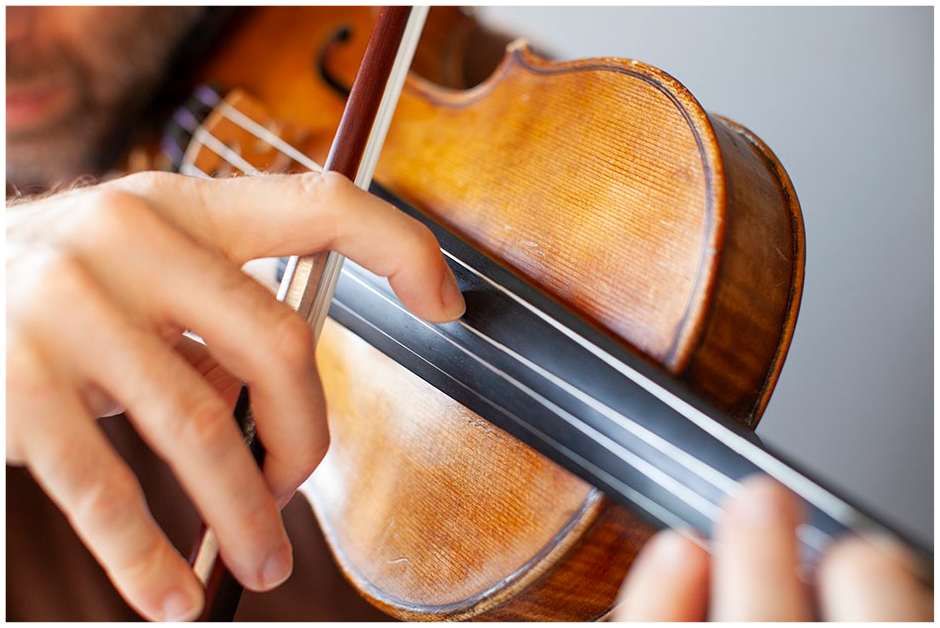
Plucking closer to the middle of the string results in a rounder sound.
Finger choice also influences the tone. The index finger, recommended by Leopold Mozart in Versuch einer gründlichen Violinschule (1756), is the most common choice, offering a quick reaction and a drier sound. The thumb provides a bold but cushioned tone. The middle finger produces a balanced, warmer sound but has less dexterity. Lower string players tend to vary finger choice more than violinists, who often default to the index.
Left-hand pizzicato results in a less resonant sound, as the plucking finger is close to the stopping finger and has limited movement. Beyond finger selection, the force applied affects both tone and volume. The farther and stronger the string is pulled, the greater the projection.
Muscular tone in the distal part of the finger can be adjusted based on the desired sound and speed. For slow chords the finger should remain loose, activating the string gradually with a soft motion driven by the arm. This helps prevent the finger from getting stuck between the strings. For very loud dynamics, a stiffer finger and bolder motion may be required. Pressing the thumb against the index finger can add additional strength and clarity.
The angle of the finger trajectory in chords also plays a role in balance. Angling the pluck diagonally by pushing away from the bridge helps create a more even sound and prevents the higher string from becoming overly strident. A good example is found at the beginning of de Falla’s (2018) Danza Española (Figure 2).

Manuel de Falla, arr. Kreisler: Danza Española. Bar 1 to 5.
In pizzicato, the hand can be anchored or floating. Anchoring involves keeping a finger on the fingerboard during plucking to provide stability and a reference point. The thumb can be anchored when using the index finger (Figure 3), and the middle finger can be anchored when using the thumb (Figure 4).
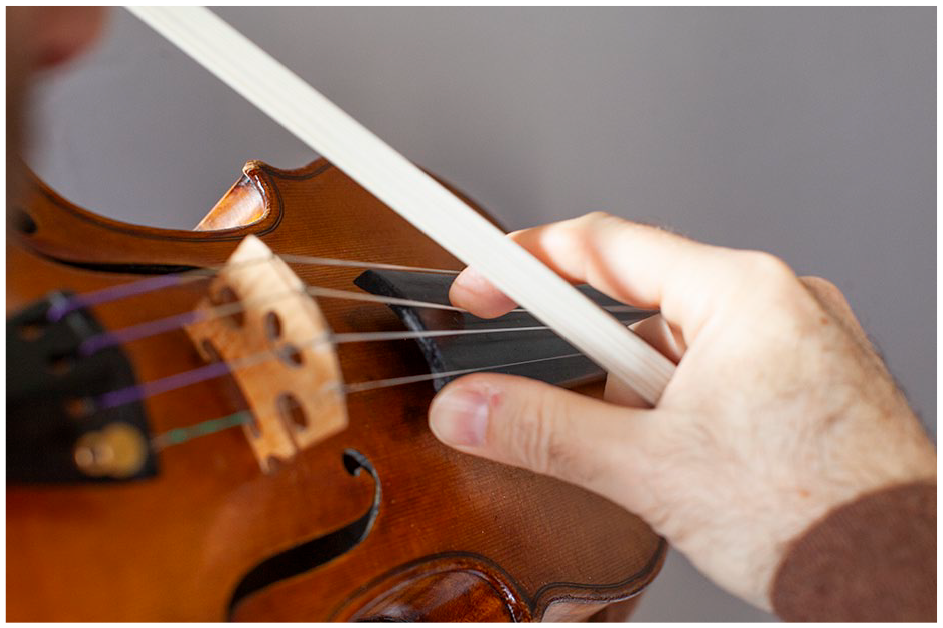
Anchoring the pizzicato finger using the thumb.
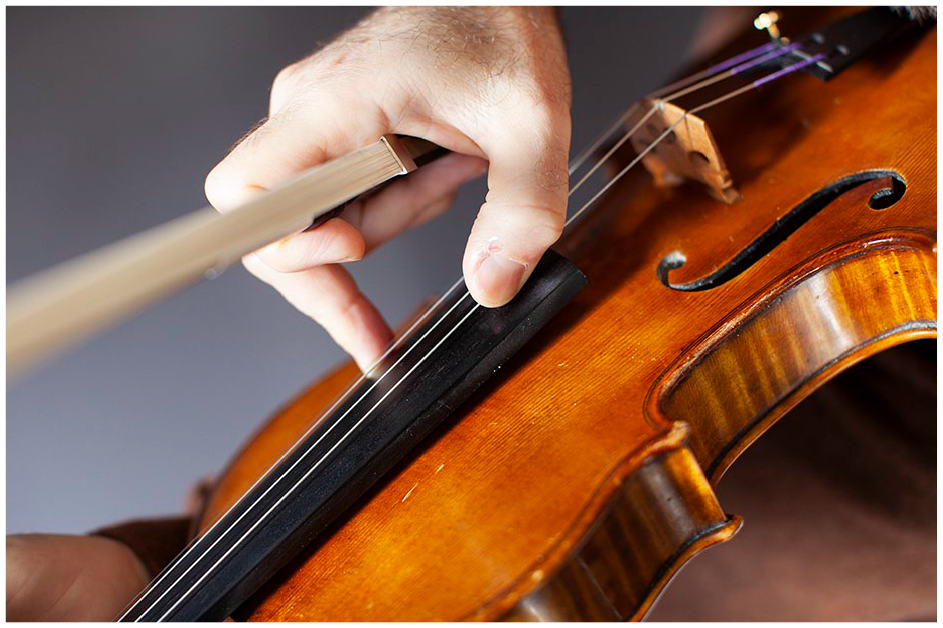
Anchoring the middle finger when plucking with the thumb.
Floating, which allows the arm to move freely from the shoulder, provides greater flexibility.
The decision to hold or set aside the bow during pizzicato also affects execution. Holding the bow in hand limits the range of motion and can reduce the fullness of the sound. However, this position can also dampen excessive movement, leading to a cleaner and more controlled sound, and can be additionally helpful in most passages, requiring quick transitions between arco and pizzicato where there is no time to put down or pick up the bow.
Tips for Mastering Pizzicato
Pizzicato requires the left-hand fingers to fully depress the string to the fingerboard, unlike most bowed playing where we use the principle of “as little pressure as needed.” A clear stop helps the clarity. This is why open strings (limited by the nut) and stopped notes on fretted instruments, often produce a more resonant sound. Vibrato can be incorporated for a slightly fuller sound and resonance.
Finger selection affects both agility and tone. Different right-hand fingers can be used to optimize execution of specific passages. For example, in the pizzicato variation of Schubert’s (1880) Fantasy in C Major, D. 934, the thumb can be used for running eighth and sixteenth notes in bars 410, while the middle finger can be employed for the chords in bar 414 (Figure 5).
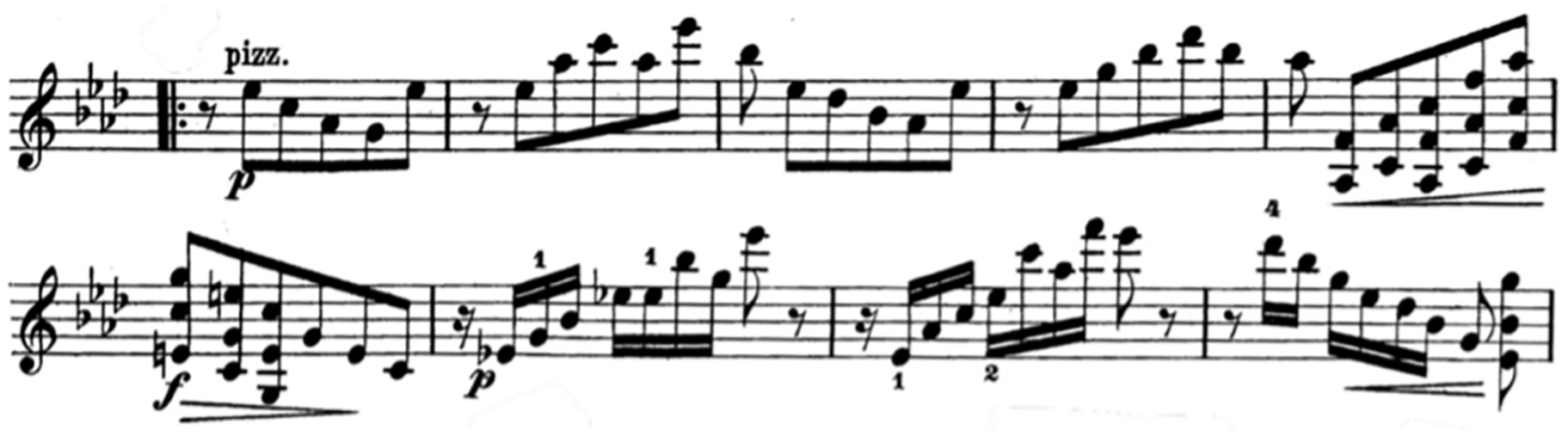
Franz Schubert: Fantasy in C Major, D. 934. Bar 410 to 418. Video: Cotik and Lin (2012).
Pizzicato’s quick decay can create a perception of increased tempo. Awareness of this tendency helps prevent unintentional rushing, similar to adjusting for a dry performance hall. For fast transitions, the index finger allows the bow to remain in its normal position or be held in the palm of the hand. When using the thumb, the bow must be securely held in the palm, which takes a slightly longer time. To help ensure smooth transitions between pizzicato and arco, the first arco note can be initiated from the string. Alternating between the two techniques in practice enhances consistency. Instrument stability is critical. The violin should remain steady, without excessive movement of the scroll, to ensure direct string activation. In forte pizzicato passages, such as those found in the beginning of Ravel’s (1927) Violin Sonata No. 2, Second Movement (“Blues”), subtly opening the chest by moving the violin to the left in the moment of the pizzicato may increase resonance and facilitate the pull (Figure 6).

Maurice Ravel: Violin sonata no. 2, second movement (“blues”). Bar 1 to 6.
Because the space between the strings is minimal, accuracy in hitting the correct string is essential. Particularly in fast passages avoiding unnecessary joint tension and maintaining a visual on the strings can improve precision.
Pizzicato is mostly initiated with the finger started from the string, promoting controlled attacks essential for ensemble precision. The method of initiating pizzicato—either from the air or from the string—affects articulation. For chords requiring a crisp attack and precise timing at fast tempos, such as those in Gershwin’s ([1927] 1942) Preludes No. 3, beginning with the finger already on the string and executing a quick, controlled forearm motion ensures clarity (Figure 7).

George Gershwin, arr. Heifetz: Preludes for piano, no. 3. Bar 1 to 3.
For a rounder sound, such as in Schumann’s (1880) Violin Sonata No. 2, Third Movement, a circular motion initiated from the shoulder that starts the pizzicato from the air prevents premature damping of the preceding (still resonating) note (Figure 8).

Robert Schumann: Violin sonata no. 2, third movement. Bar 1 to 7.
Plucking over the fingerboard minimizes angular changes between strings, which is useful in passages such as the beginning of Albéniz’s (1930) Sevilla (Figure 9).
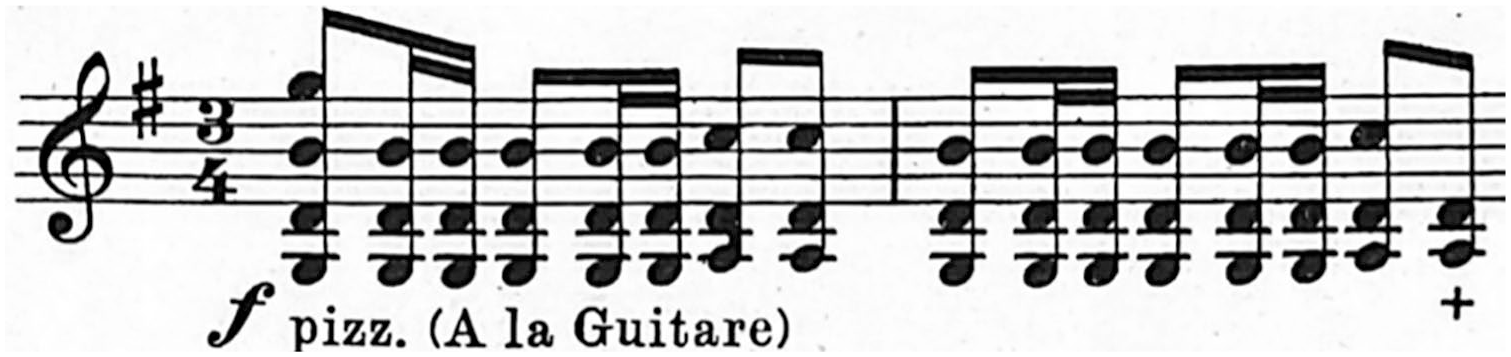
Isaac Albéniz, arr. Heifetz: Sevilla. Bar 1 to 2.
Open strings resonate longer and may sound lower in pitch when plucked too forcefully, as in the beginning of de Falla’s (2018) Danza Española (Figure 2). Excessive force can also cause slight detuning. This is the reason open strings may sometimes be intentionally pulled during tuning for fine adjustments.
For very fast pizzicato, such as in Joaquín Nin’s (1926) Granadina, an unfrozen, fluid motion originating from the shoulder blade improves efficiency (Figure 10). Practicing similar motions using repeated fast downbows at the frog, can reinforce this technique.
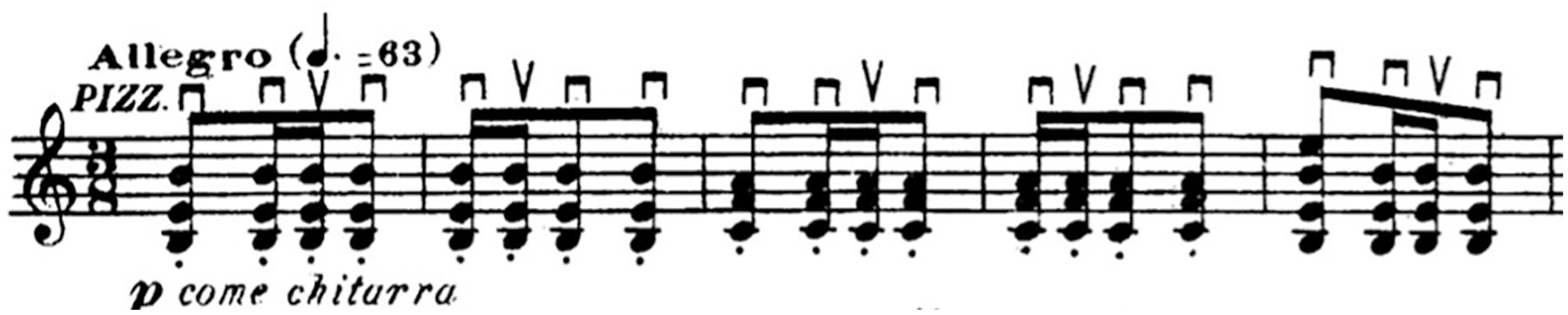
Joaquín Nin, arr. Kochanski: Granadina. Bar 1 to 5.
Pizzicato presents projection challenges in large spaces. Having to play louder than expected may be necessary both in piano and forte passages. When recording, close miking accentuates pizzicato’s percussive nature, sometimes making it sound more pronounced than in natural acoustics. Checking levels and adjusting accordingly not to pluck too strongly helps prevent exaggerated effects.
In orchestral settings, pizzicato’s distinct attack makes ensemble precision crucial. Watching the leader’s right-hand movement or a visible player in front ensures accurate timing. For difficult pizzicato-to-arco transitions in orchestra, staggering the change—such as retrieving the bow or repositioning the violin when playing pizzicato alla chitarra (held like a guitar)—improves clarity and prevents rushed movements within the section.
Tips for Left-Hand Pizzicato
Proper left finger placement is necessary for controlled execution of left-hand pizzicato. The finger should be positioned between the string to be plucked and the next lower string. Given the energy involved, leveraging the finger against the thumb creates pressure, allowing for intentional timing and controlled release. Rotational movement of the forearm from the elbow also enhances the leverage. Keeping the hand at an angle—rather than parallel to the string—facilitates this movement. On the E string, which has the highest tension, a downward push is effective. On lower strings, adjusting the elbow and using an upward pulling motion prevents accidental contact with adjacent strings.
When alternating between left- and right-hand pizzicato, an anchor finger in the right hand provides stability. This support counteracts the force of the left-hand pizzicato, allows freedom of movement for the left hand, and assists with position changes, as in Ravel’s (1924) Tzigane (Figure 12).
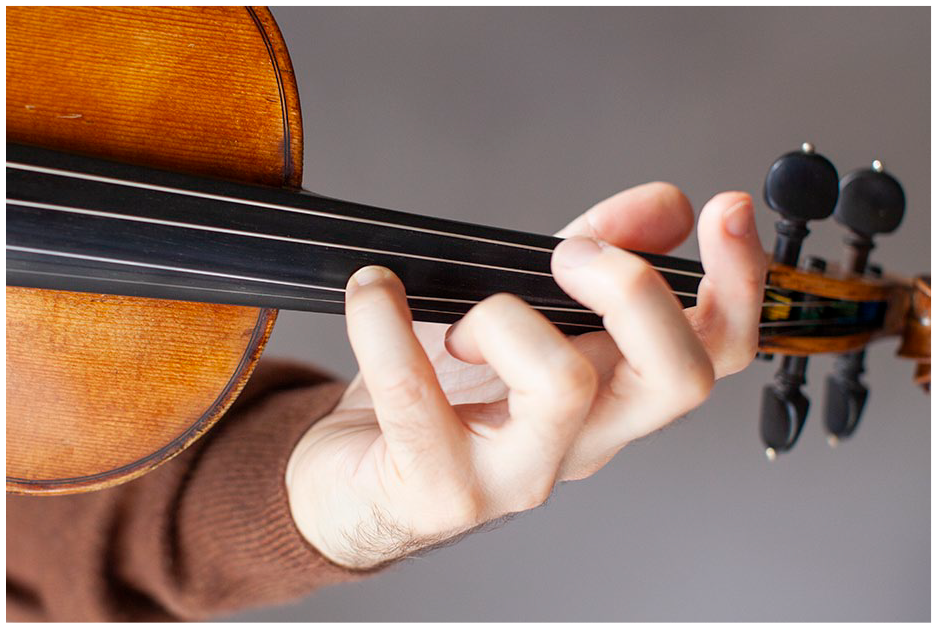
Proper left-hand pizzicato hand position and finger placement.

Maurice Ravel. Tzigane. Bars 134 to 137.
At the same time, avoiding locked joints is essential. Even when the action focuses on the finger, unrestricted movement in the shoulder blades and elbow is needed. In intricate passages where left-hand pizzicato alternates with bowing locked joints hinder fluidity.
Bow action requires precise coordination in passages where the bow is used to strike the string vertically between left-hand pizzicati. Minimal bow usage ensures a crisp articulation that imitates pizzicato. Timing is crucial, as the bow action must begin before the intended note. Keeping the bow close to the string allows for precise execution, with the index finger and pinky helping with control and stability. A firm grip provides control, while leveraging the tip enhances intensity, as in Sarasate’s (1880) Zapateado, bar 54 (Figure 13). Focusing on bow action rather than left-hand pizzicato helps streamline execution.

Sarasate, Pablo de Sarasate: Zapateado. Bar 54 to 57.
Although Paganini (1990) originally calls for right-hand pizzicato in Caprice No. 24 (Figure 14), performers often use the bow instead. Grouping gestures musically (rather than thinking note by note) not only helps phrasing but also helps solve intricate passages. Control over speed and intentional execution ensures clarity and prevents an uncontrolled cascade of notes, similar to a ball rolling down stairs.
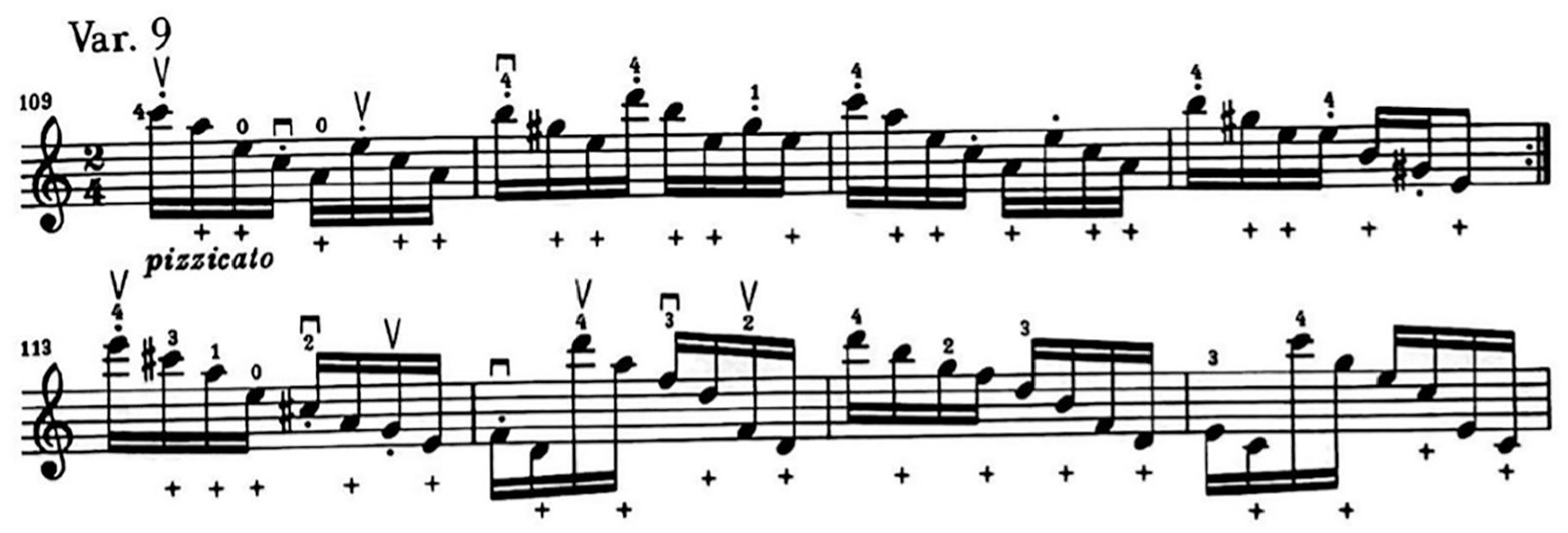
Paganini, Niccolò Paganini. 24 Capricci Op. 1. Bar 109 to 116.
For fast transitions from arco to pizzicato, playing the first pizzicato with the left-hand pizzicato can sometimes be more practical and efficient.
As a final tip, in arco playing for descending intervals with significant string tension differences, particularly before an open string, slight left-hand plucking of the top note can improve clarity.
Practicing Left-Hand Pizzicato
Higher fingers, such as the third and fourth, are often easier to use, as the same rotational angle generates a stronger pull. Begin by plucking open strings with each finger to establish control and coordination. Rotational actions are more efficient when there is greater spacing between the plucking and stopping fingers, as lower string tension improves motion. Practice finger combinations such as 4–1 and 3–1 before progressing to adjacent fingers. Incorporate rhythm grouping exercises to develop control and precision in timing. Train finger lifting action by practicing left-hand pizzicato with a slight push to the left, opposing the usual direction of the pull. Some players pluck the G string away from the D string, as there is no adjacent string on that side, reducing unintended interference.
Exercises and Studies
Ruggiero Ricci (1997) recommended left-hand pizzicato exercises to develop strength and dexterity, particularly in the weaker fingers. This approach naturally reverses the usual order, prioritizing the fourth finger first, followed by the third, and so on, because this order is easier in left pizzicato, in contrast to regular playing where the pinky is typically the more challenged finger (Rugiero 1997).
Ševčík (1905) includes exercises designed to build left-hand pizzicato technique, offering structured drills for control and consistency (Figure 15).
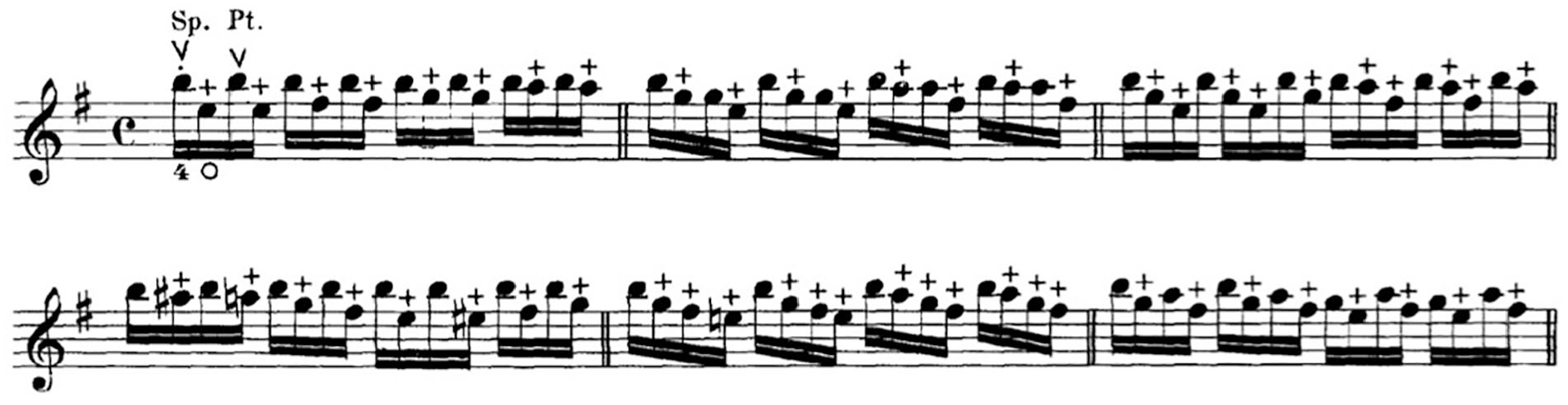
Otakar Ševcˇík: School of violin technics: Opus 1, book 4, exercises in double stops. Exercise 19. Bar 1 to 6.
Dounis (1921) emphasizes finger independence and strength, incorporating exercises that require keeping two fingers down while others execute pizzicato (Figure 16).
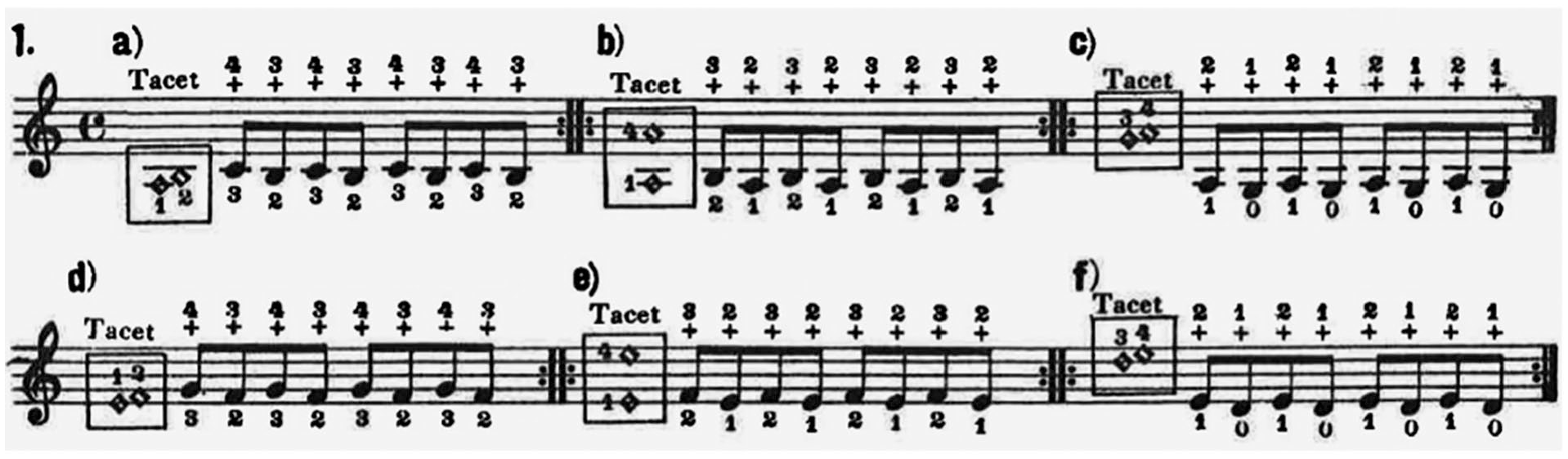
Demetrius Constantine Dounis: The artist’s technique of violin playing, op. 12. Part I, section VII: “Pizzicato.” Bar 1 to 6.
Incorporating real musical excerpts into practice provides contextual application, making technical exercises more engaging and directly relevant to performance.
Teaching Strategies for Pizzicato
Encouraging experimentation helps students internalize complex techniques. Pizzicato (like walking or talking) is best developed through active exploration rather than rigid instruction. Focusing on a few mental directions at a time allows for better control of movements. Body awareness and relaxation contribute to efficient technique. As discussed in the Cotik (2019) article on the Alexander Technique in string playing, identifying unnecessary tension and allowing for free, natural movement enhances ease, clarity, and precision—while also helping to prevent injury caused by misuse.
Concepts from pizzicato can also enhance arco playing. Attention to clear note beginnings, articulation, and precise timing in pizzicato can transfer to bowing technique. Pizzicato can reinforce left-before-right coordination. Placing the left-hand finger before activating the string improves accuracy and timing. Lorand Fenyves recommended beginning students start with pizzicato to simplify their focus and establish the habit early on. In addition, pizzicato’s natural resonance and diminuendo can create an awareness that can help in arco playing in terms of resonance, ensemble transparency, as well as prevent unintended swelling of notes.
Short, consistent practice is effective for skill development. Just a few minutes per day is sufficient for building pizzicato technique. Gradual repetition helps prevent blisters while allowing calluses to develop.
Finally, protecting the instrument is important during pizzicato practice. Beginners or experienced players working on difficult passages can use a handkerchief to prevent scratches from repetitive plucking.
Extended Techniques in Pizzicato
In Bolognini’s (2024) Serenata del Gaucho, we see tremolo pizzicato. This variation of rasgueado (a guitar finger strumming technique) consists of rapid, alternating strokes executed with the middle and index fingers, two downward followed by two upward motions. Inspired by flamenco guitar techniques and used by Roby Lakatos (2009), it can be performed with or without anchoring the thumb.
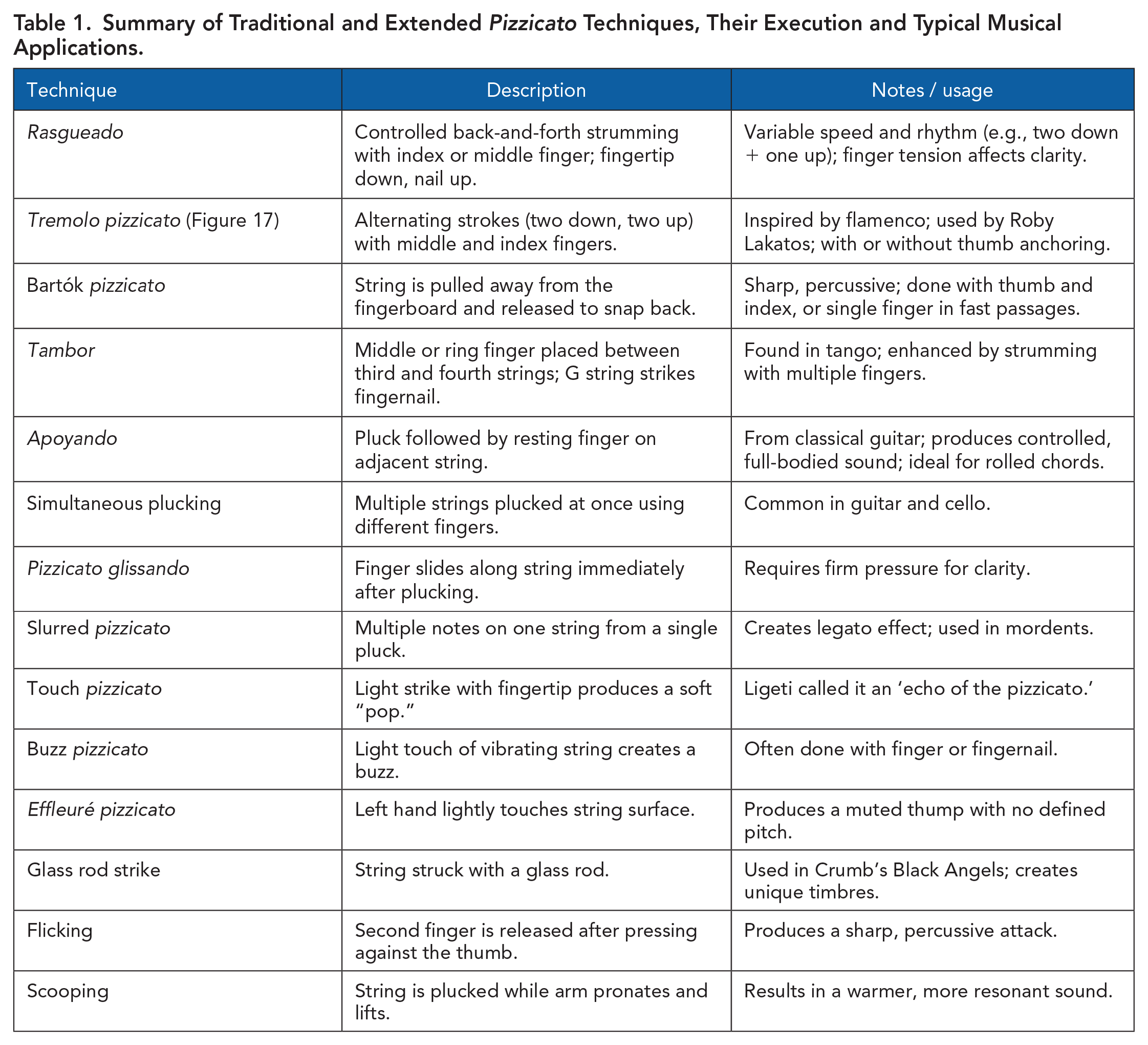
Pizzicato techniques have expanded beyond traditional plucking, offering a wide range of timbral possibilities. While some techniques appear in modern compositions, others have roots in folk traditions or historical styles. Table 1 summarizes selected approaches, their characteristics, and typical usage.
Summary of Traditional and Extended Pizzicato Techniques, Their Execution and Typical Musical Applications.
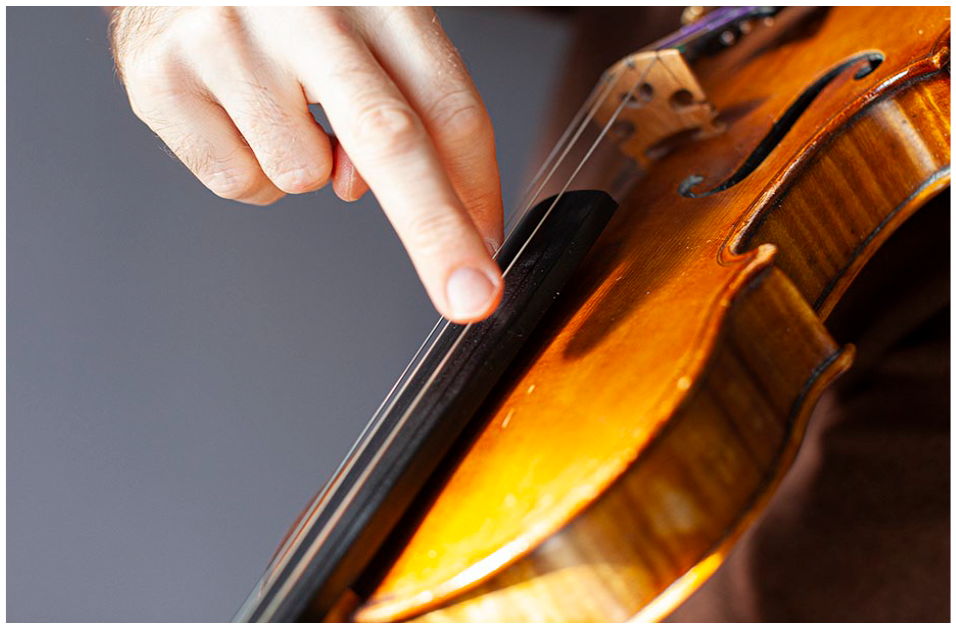
Tremolo pizzicato technique in Serenata del Gaucho.
For further discussion on this and additional extended pizzicato techniques see The Contemporary Violin: Extended Performance Techniques by Patricia Strange, Compendium of Modern Instrumental Techniques by Gardner Read (1993), and Kenneth Sarch’s (2010) Petite Dictionary of Pizzicato in the Dictionary of Bowing and Pizzicato Terms.
Pizzicato extends the violin’s expressive range, offering a diverse spectrum of articulations and textures. Mastery of its techniques enhances precision, adaptability, and tonal control, benefiting both solo and ensemble performance. A deeper understanding of its mechanics and musical applications allows string players to integrate pizzicato seamlessly into their interpretation, enriching their overall artistry.
Footnotes

Tomás Cotik (