







Abstract

Shifting on the violin is initially a challenging prospect for young musicians. While the process of shifting is considered one topic, there are indeed many layers of understanding required to truly master the shifting process. When approached in a select order, however, the process is indeed much easier. The starting point for this process is using 747s (Howard 2024).
“ Shifting on the violin is initially a challenging prospect for young musicians. While the process of shifting is considered one topic, there are indeed many layers of understanding required to truly master the shifting process. ”
On a basic level, 747s refers to the amount of pressure used by the fingertip during the shifting process. First, you hold the fingertip down until it gently touches the fingerboard using approximately “7 percent” pressure. To create a clean shift, reduce the pressure to “4 percent” and slide the fingertip to the correct next pitch, in a motion very similar to a glissando. Once you arrive at the correct new pitch, simply press the fingertip down and return to the “7 percent” pressure to create the new note. 1 This is how I arrive at the term 747s (Howard 2024). These can very effectively be practiced “octave slides” as referenced in Figure 1.
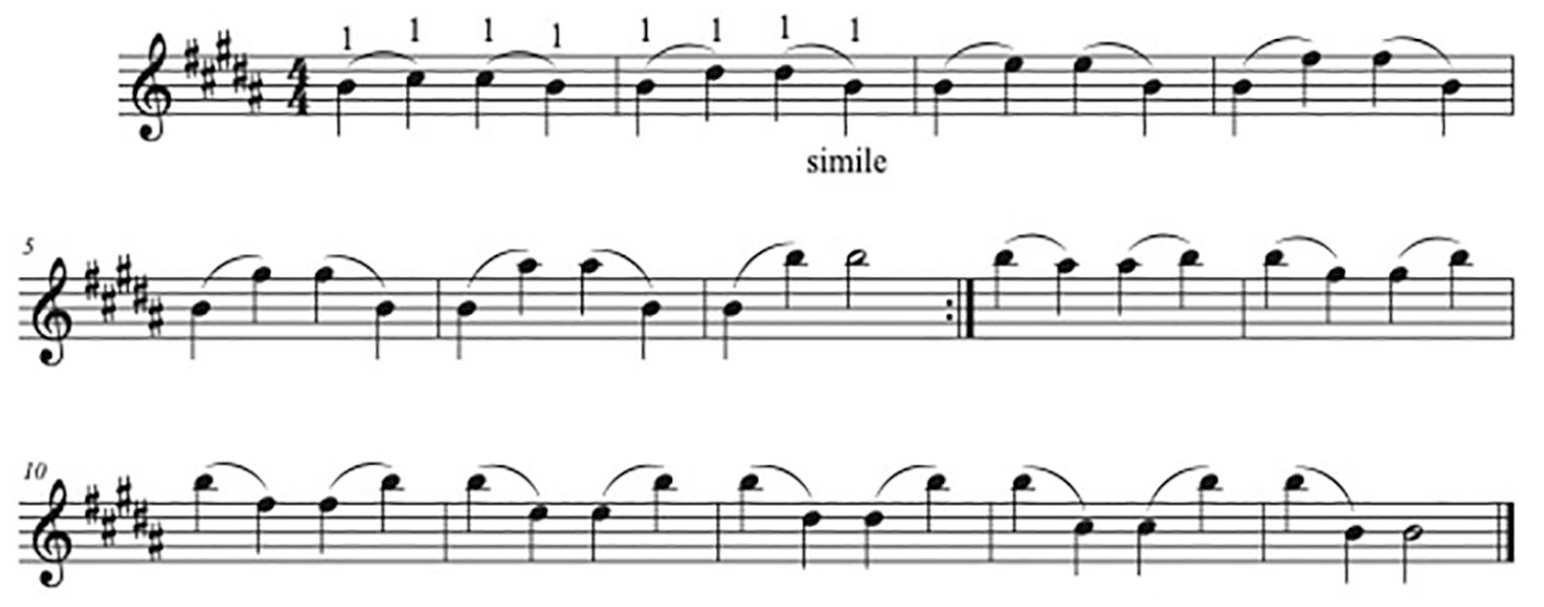
Octave slides in a scale, sul A, by Jeffrey Howard.
These octave slides are an essential part of effective shifting and should additionally be practiced individually on the second finger (starting on C natural on the A string), and on the third finger (starting on D natural). 2
A second important reference is the concept of “ghosting,” a process where the last finger that is played on the string becomes the lead finger toward a new note. 3 This reference to ghosting is part of a shifting process called “prepared shifts.” A shifting example without the ghost note is shown in Figure 2A, and the example with the reference is shown in Figure 2B.

An excerpt from Exercise 14, A Big Step Over a Puddle, from Geringas (1987), original notation without ghost notes, mm. 1–2.

An excerpt from Exercise 14, A Big Step Over a Puddle, from Geringas (1987), with intermediary notes notated in parenthesis, that will later be ghosted, mm. 1–2.
As the previous example demonstrates, these prepared shifts use an “intermediary note” as the preparation for getting to the new note. Once this process is consistent and the hand frame stays balanced, then the player can lighten the finger pressure on the slide to the intermediary note and this then becomes the ghost note. I reference this lighter pressure slide as a 727 because we are now using approximately 2 percent of pressure for the slide rather than 4 percent as we do in the 747s.
Prepared shifts, however, are only one type of shift. Collectively, I like to reference four primary types of shifts, with two additional secondary types of shifts, which will satisfy most shifting options found in traditional violin music. These are:
Shifts Over an Open String.
Shifts Using the Same Finger.
Prepared Shifts—Follows the Rule:
Underfinger Slides—Going from a higher finger to a lower finger going up; or going from a lower finger to a higher finger going down. 4
These shifting options are presented in a very practical and thorough manner in the book by Yaakov Geringas titled Shifting: 30 Progressive Shifting Studies for Violinists. Each shifting exercise is introduced by a letter designation so that students are aware of the expectations of each exercise.
I particularly like the fact that these exercises treat all the positions with equal importance. When there is a hierarchy of position usage (such as when first and third positions are considered more essential than second and fourth positions), students have less flexibility when deciding on fingerings in their pieces.
In addition to these four primary types of shifting, there are two other options. The first is a process I call “crawl fingerings.” In this type of shift, the finger extends to where the new note exists and then the thumb moves to this new location, thus establishing a new position for the hand, as seen in Figure 3.

An excerpt from Exercise 3, Round Dance, mm. 37–40 from Geringas (1987).
As seen in this example, while the hand starts roughly in second position, once the fourth finger gets to the “G,” the thumb can gently move forward to accommodate the new position and then crawl back to reset the first finger on the C-sharp in the second measure of this example. While it is also possible to play this passage as a finger extension, learning crawl fingering patterns is indeed helpful when navigating more challenging repertoire. This shifting method was also very prominent when playing Baroque and Classical music, particularly before the advent of the chinrest in the early 1800s. As an alternate method of description, I sometimes use the term “finger balancing” for this type of shifting mechanism while others, like Galamian (1963, 58), describe them as “creeping fingerings.” Stowell (1992, 124–25) describes them in this manner: Upward shifts tended to increase the instrument’s stability against the player’s neck, but downward shifts, particularly without a chin-braced grip, generally required the left hand to crawl back “caterpillar fashion” from the high positions.
The second type of shift is called a “French slide.” The basic idea of a French slide is that you use the new finger and the new bow to slide to a note. Figure 4A shows the original notation in the Seitz, Violin Concerto in g minor, op. 12, Allegro risoluto without the French slide notation. Figure 4B shows the same example with the French slide notated.

Excerpt from Seitz, Violin Concerto in g minor, op. 12, Allegro risoluto, mm. 20–23.
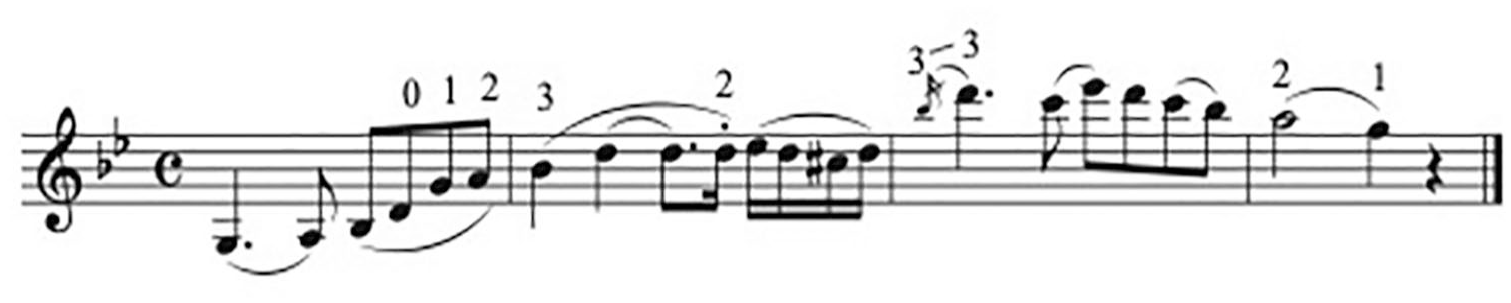
Excerpt from Seitz, Violin Concerto in g minor, op. 12, Allegro risoluto, mm. 20–23, with French slide notation in the third measure.
Notice in Figure 4B how a French slide approaches the top note on a slur from the new bow with the third finger as the lead finger to get to the top D. Care should be taken so that you do not actually play a B-flat out loud. Prepare this shift with light finger pressure (and a light thumb) and the player will create a very expressive slide.
With these four primary shifting methods as a basis, and a secondary consideration of crawl fingerings and French slides, we can then apply these skills directly to shifting exercises and shifting in your pieces.
Figure 5A and B presents Exercise 24 from the Geringas (1987). The original material is presented first, along with an edited version that contains all relevant shifting information. In the edited version, “O” will indicate “open string shifts”; “S” will indicate same finger shifts; “P” will indicate prepared shifts; “U” will indicate underfinger slides; and “C” will indicate crawl fingerings.
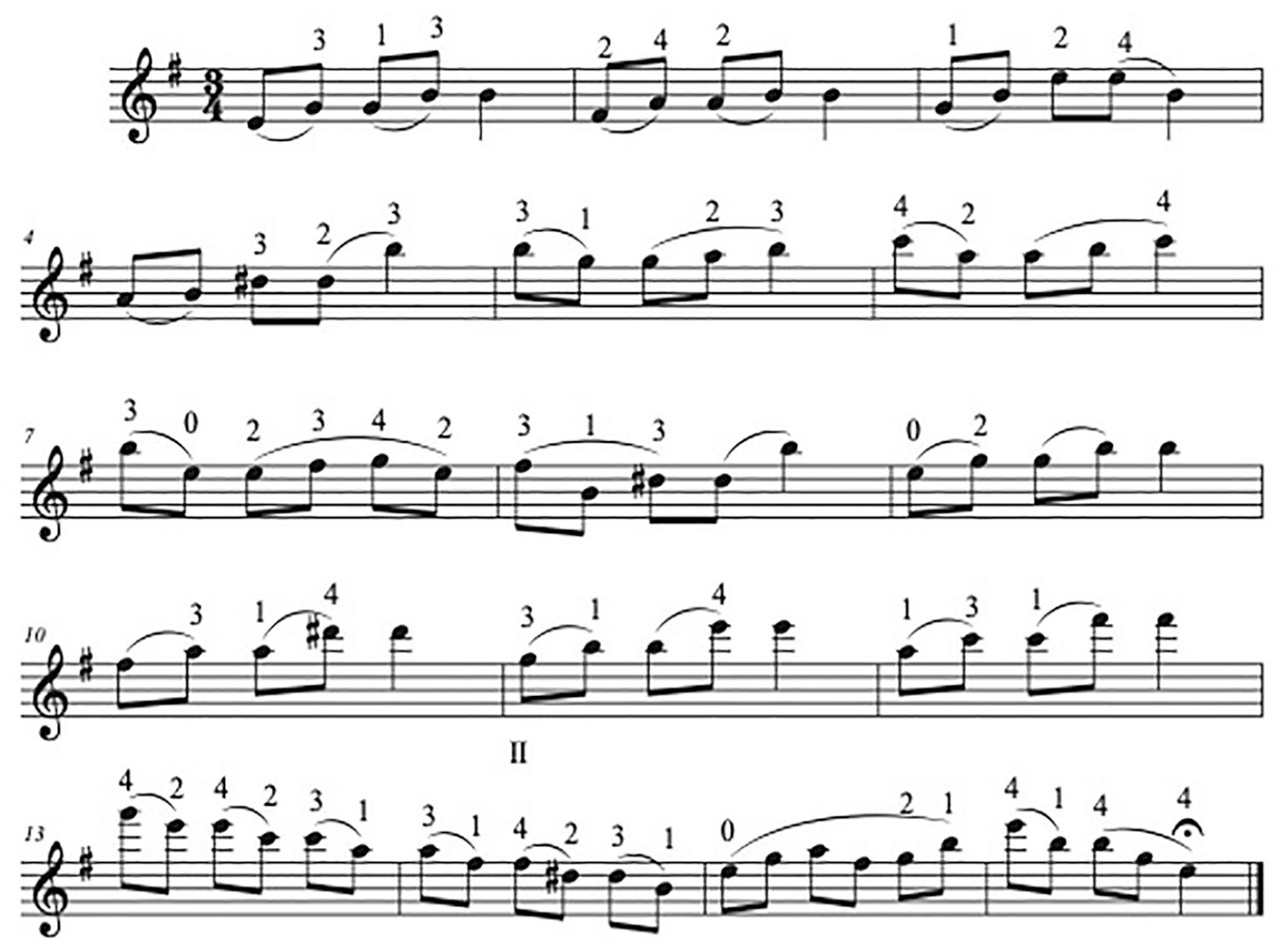
An example from Exercise 24, Melancholic Dance, from Geringas (1987), original material.
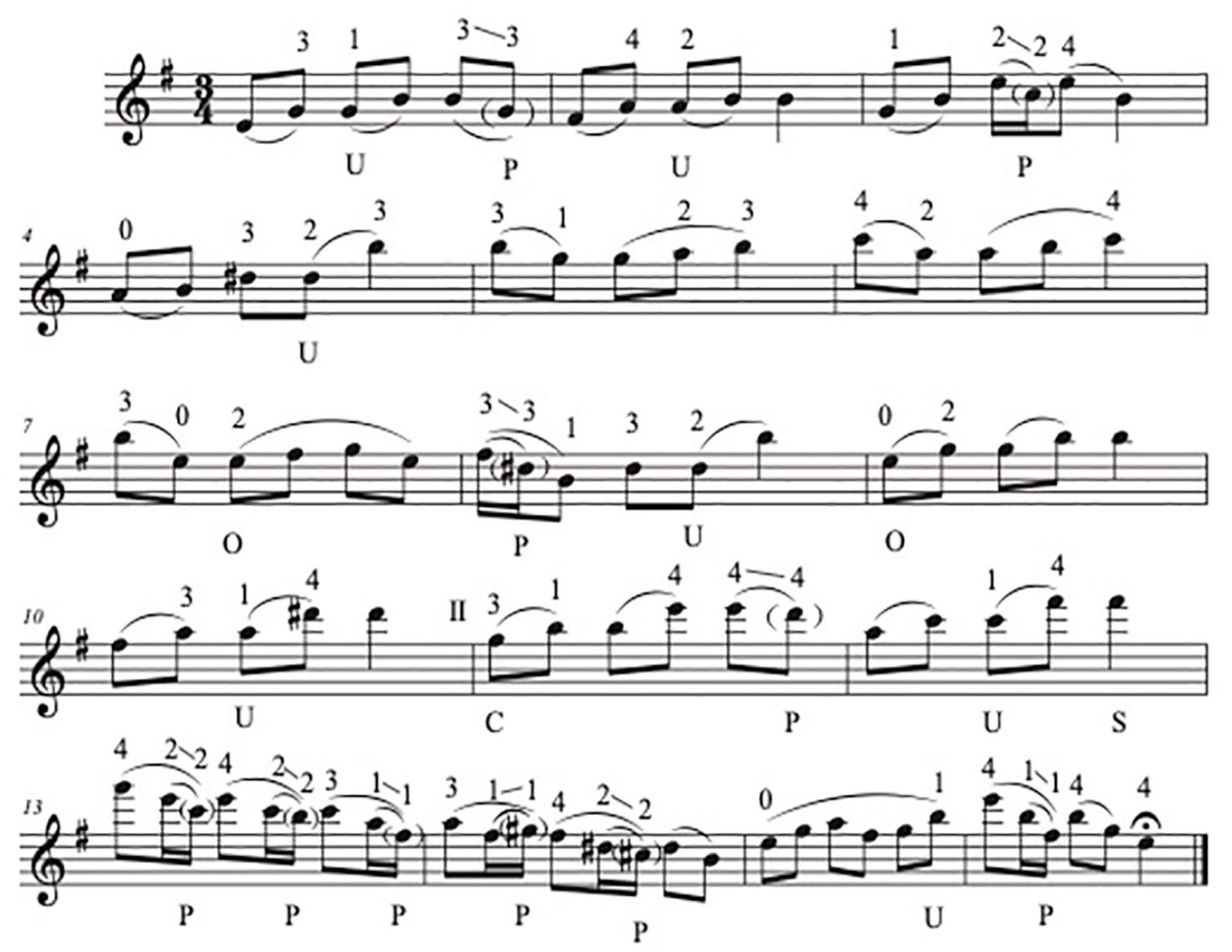
An example from Exercise 24, Melancholic Dance, from Geringas (1987), with shifting type indications.
Once the student masters the printed indications for the prepared shifts, you can easily take the next step by lightening the finger pressure and ghosting these intermediary notes. With this system in place, students have an excellent understanding of how shifting functions and how to use this valuable skill on pieces of all levels of difficulty.
While these markings can seem overly specific, I am reminded of a quote by Otakar Ševčík (1931) as referenced in the Preface to his Analytical Studies and Exercises, op. 21, for the Mendelssohn Violin Concerto. He states: The scrupulousness of the analysis shall not frighten the player, but rather awaken in him a desire for solving further problems, thus enabling him to distinguish the better the nature of the musically beautiful in its subtlest components.
There is great wisdom in this statement. While studious practice can sometimes be cumbersome and tedious, it is through these repetitions that one gains control over the forces that make the violin work effectively. From here, it is much easier to trust this control and truly seek out the artistically satisfying elements of every piece of music.
Footnotes

Notes
Jeffrey Howard (