







Abstract

The need for teaching approaches that are culturally responsive increases as the demographics of 21st century students continue to diversify (Richards et al. 2007). McClellan (2002) asserted that music education must embrace new methods, materials, and teaching styles to effectively cater to the needs of culturally diverse students. Culturally responsive education uses students’ lived experiences and prior knowledge to inform and enrich instruction (Cholewa et al. 2014). A key component of this approach is the curriculum, which incorporates activities that help students understand their own culture and cultures outside their own (Bryan-Gooden et al. 2023). Considering the notion that knowledge is culturally defined (Campbell 2018), a curriculum should acknowledge and embrace cultural diversity. Method books, which are foundational tools for beginning instrumental instruction, play a critical role in this process. However, many standard method books often overlook diverse musical narratives, limiting opportunities for students to engage meaningfully with their own and outside their own musical cultures. To address this gap, string music educators can expand existing method books by incorporating folk songs from underrepresented musical traditions.
According to a recent content analysis of journals from 1990 to 2021, there is a need for string research, particularly for the double bass (Sciaroni et al. 2023). The scarcity of studies on double bass indicates a lack of research interest in this area. This aligns with the findings from 25 years ago, emphasizing the need for further studies in the pedagogy of the double bass (Sciaroni et al. 2023, 74). This article uses George Vance’s Progressive Repertoire for the Double Bass as a representative example to explore how method books can adapt to support culturally responsive education. Widely respected and developmentally appropriate, Vance’s method book has been embraced by many bass teachers for use with beginner bass students (Braun 2020; Crawford 2009; Heath n.d.). This method book was developed in 1984 and incorporates the philosophy of the Suzuki method with the pedagogical principles and fingering system of the Rabbath double bass technique, a significant addition to the double bass pedagogy (Horiguchi 2019). The purpose of this article is to discuss how string music educators can expand method books by integrating supplementary materials that highlight songs from underrepresented musical traditions. This approach cultivates cultural diversity, broadens musical understanding, and creates inclusive learning experiences that reflect the backgrounds of students of all cultures.
George Vance
George Vance (1948–2009) was a performer, teacher, editor, music transcriber, writer, conductor, clinician, and administrator, who earned his B.A. in Music from Arizona State University and pursued an M.F.A. in performance at Carnegie-Mellon University. His primary focus was the double bass and its pedagogy. The Progressive Repertoire for the Double Bass, developed by George Vance and his colleague Annette Constanzi from 1984 to 2000, expanded into a six-book series that played a significant role in revolutionizing the double bass pedagogy (Horiguchi 2019). It has become the standard for beginning double bass studies (Heath n.d.). Francois Rabbath and Shinichi Suzuki were major influences to George Vance (Horiguchi 2019). Rabbath divided the fingerboard into only six positions, which contrasts with the Simandl fingering system that uses more positions, emphasizing incremental shifts (Simandl 1904). This approach is made possible through a technique called “pivoting,” which allows the player to extend the hand without shifting (Wilson 2023). Vance collaborated with Rabbath to adapt his techniques and incorporated them into the Progressive Repertoire for the Double Bass (Pellow 2019). Shinichi Suzuki founded the Suzuki Method of music instruction. He was fascinated by tone production, so he developed exercises designed to achieve basic tonal requirements for string instruments, a process referred to as “tonalization” (M. Thompson 2016). Vance describes the pedagogy for tonalization as a mental and physical warmup for the student before playing a piece (Pellow 2019). This approach is reflected in his method book, where, similar to the Suzuki method, Vance often includes preparatory exercises before each selection.
Vance’s teaching approach for the double bass combines new and traditional materials with a progressive curriculum. George Vance asserted that the selected materials in the Progressive Repertoire for the Double Bass are familiar tunes, such as “Twinkle Twinkle Little Star,” that are suited for beginner double bass players (Vance 2000). The materials are varied folk songs and children’s songs that make the method accessible to young students (Braun 2020). Vance also integrated materials from the Western classical traditions, including compositions by Bach, Beethoven, and Brahms. However, the selections reveal a strong emphasis on Western traditions. While there is some representation of repertoire from the East, specifically a Japanese folk song, the majority of the remaining selections originate from the West. This highlights a critical question: Are our method books providing students with a culturally responsive view of music, or are they simply reinforcing dominant Western traditions? When curricula focus solely on the experiences of dominant populations, they can perpetuate and reinforce ideas that marginalize and exclude.
Culturally Responsive Education
Culturally Relevant Pedagogy (Ladson-Billings 1995), Culturally Responsive Teaching (Gay 2000), and Culturally Sustaining Pedagogy (Paris and Alim 2017) are culturally-informed teaching approaches. Bond (2017) framed these teaching approaches within the term “Culturally Responsive Education” (CRE). CRE uses students’ lived experiences and prior knowledge to inform and enrich instruction (Cholewa et al. 2014). Richards et al. (2007) divided the concept of CRE into three dimensions: institutional, personal, and instructional (Richards et al. 2007). The institutional dimension refers to the educational system that provides political and physical structures for the school such as the school administration, school policies and procedures, and community involvement. The personal dimension emphasizes the importance of teacher self-reflection in examining their own identities, beliefs, and culture. This process enables the teacher to develop a deeper understanding of varied perspectives. Lastly, the instructional dimension highlights tools for teaching such as materials, strategies, and activities that need to be connected with the students’ cultures and experiences.
CRE is an approach to teaching where educators connect their instruction (e.g., goals, delivery) with students’ cultures, languages, and life experiences to increase engagement and improve learning. Students are given the opportunity to learn more about their ethnic roots, their own cultures, and more importantly, cultures unfamiliar to them (Haynes 2021). Although CRE has only begun to take hold in the music education field in the past few years (Bond 2017), music educators are continuously developing pedagogical approaches that incorporate the varied cultural knowledge, identities, and musical practices of their students (Shaw 2012). In CRE, teachers are often required to reshape their curriculum to acknowledge what they learn about their students (Salvador and Culp 2022).
Curriculum
Curriculum is a complete set of learning goals and standards that encompasses units, lesson plans, assignments, activities, projects, books, materials, videos, presentations, and readings used in the classroom. Other examples of curricular materials include textbooks with teacher’s manual, handouts, and books with activities (Bryan-Gooden et al. 2023). Based on this definition, I consider method books as curriculum materials. Curriculum is developed by a wide range of individuals including teachers who assess the needs of their students and often create alternative curriculum that fit with the students’ needs and interests (Schubert 1986). Early American educator John Dewey argued that a child’s experience serves as the foundation of education (Dewey 1902). Dewey posited that it is the responsibility of the curriculum developer and the teacher to begin with the interest of the child and then progress to the knowledge of the humanity, highlighting the inseparable connection between the school and the society. Importantly, the three sources of curriculum—the learner, society, and the subject matter—should be treated as interdependent (Schubert 1986).
Eisner (1979) refers to the “null curriculum” as the content that is intentionally or unintentionally excluded from the instruction. This includes viewpoints, ideas, and skills that the students may not encounter, limiting what they can do and experience. Considering what is taught and not taught in the aspect of learning can help us understand its overall impact (Eisner 1979). In identifying the null curriculum, it is necessary to understand what a complete curriculum should look like. In order to create a supplementary list of null curriculum, it is important to develop a comprehensive list that represents a curriculum universe, and by comparing the null curriculum with the curriculum universe, we can distinguish and address the gaps that exists within a curriculum (Flinders et al. 1986).
In the context of a method book, the null curriculum may refer to musics that are not included in the content. To fully understand what is missing, we first need to have a complete view of what a curriculum should encompass. Since one purpose of education is cultural transmission, it is crucial to recognize that culture plays an essential role in shaping how students think and see the world around them. Understanding this cultural influence is vital to CRE, which aims to connect learning to the students’ culture and cultures beyond their own (McKoy and Lind 2022). For these reasons, I argue that a curriculum universe through the lens of CRE should encompass a wide range of music cultures. With this broader understanding of curriculum, we can work toward incorporating various musical styles from different cultures, enriching learning and cultivating a culturally responsive music classroom.
Expanding the Repertoire: A Practical Application
CRE plays a crucial role in promoting and enhancing student achievement by fostering effective teaching and learning within a student-centered and culturally supportive environment (Richards et al. 2007). The instructional dimension of CRE highlights the importance between the connection of the materials, activities, and teaching strategies employed in the classroom with the students’ cultures and experiences. A culturally responsive instruction ensures that the curriculum is relevant and meaningful to the students’ cultural backgrounds, making the learning process more engaging and effective. By choosing a wide variety of musics, teachers expand students’ repertoire while also learning about their culture and culture other than their own. Using a wide variety of materials not only honors the students’ cultural heritages but also teaches them to know their own and each other’s cultures, which are foundational to CRE (Gay 2000).
“By choosing a wide variety of musics, teachers expand students’ repertoire while also learning about their culture and culture other than their own.”
What Can We Do?
We as a music educators can consider these steps when creating a culturally responsive classroom: start with what we know, give students a choice, balance and blend, and be mindful of authenticity. We can start with what we know by incorporating musics from our own cultural background or that are meaningful to us. Since culture and identity are deeply interconnected, we can also use musics that reflect our own identity—whether it’s about race, ethnicity, gender, religion, and other aspects of who we are. Use this as a meaningful entry point into our teaching. Bringing in musics that hold personal meanings to us create opportunities to connect with students, deepening the teacher-student relationship. In addition, we can give students a choice by asking them what music they listen to outside the school, in their communities, or with their families. By knowing the students’ interests, we can explore ways to bring those musics into the classroom. This cultivates a more student-centered environment where learners see themselves reflected in the music they play. More importantly, CRE does not mean replacing existing materials. It invites us to build on them and broaden our perspective. We can also strive to balance and blend by using existing method books as foundations while intentionally supplementing them with diverse materials that speak to our students’ cultures, identities, and lived experiences. When students engage with musics that resonates with them, it fosters deeper musical connection, motivation, and belonging. Lastly, we should be mindful of the authenticity of the music we incorporate from cultures outside of our own and/or our students’. We should take time to research and consult with culture-bearers to ensure that the musics we bring into the classroom are accurate.
Putting CRE into Practice
To support CRE within the Vance framework, I looked for folk songs from the Association of Southeast Asian Nations (ASEAN) countries, including Cambodia, Indonesia, Vietnam, Malaysia, and the Philippines. While these nations possess a rich collection of folk songs, they are underrepresented in the Vance method book. I started by exploring several of these songs online, analyzing whether their melodies could be adapted to the Rabbath fingering system. I specifically chose six folk songs to correspond with the six positions used in the method book. While melodies of the folk songs are generally in the public domain, I prioritize authenticity, especially when working with the folk songs that are unfamiliar to me. For the Filipino folk songs, which are part of my culture, I reference the melody I encountered from educational materials, specifically from “Antukin: Philippine Folk Songs and Lullabies” (Prudente 1998) and “Filipino Folk Songs” (Cavan 1924). For folk songs outside my own culture, I discovered them through Beth’s Notes (Thompson n.d.), an educational website that offers a collection of resources to support music educators. After obtaining permission from the website owner to use the folk songs as references for my adaptations, I consulted with culture-bearers from each respective country to ensure authenticity of the melodies. Once they were verified as legitimate, I then started working on them. The supplementary materials follow the pedagogical approach of George Vance, ensuring they serve an effective and enriching additions to the method book. These pieces can be used in parallel with the existing Progressive Repertoire for the Double Bass books 1, 2, and 3 or integrated into lessons as standalone pieces.
Sarika Keo Euy is a Cambodian folk song (see Figure 1). Aside from reinforcing first position, this adapted folk song serves as a tool for developing bow-distribution skills. Students are encouraged to utilize the lower half of the bow in measures 1, 5, and 9, promoting control and awareness of bow placement.
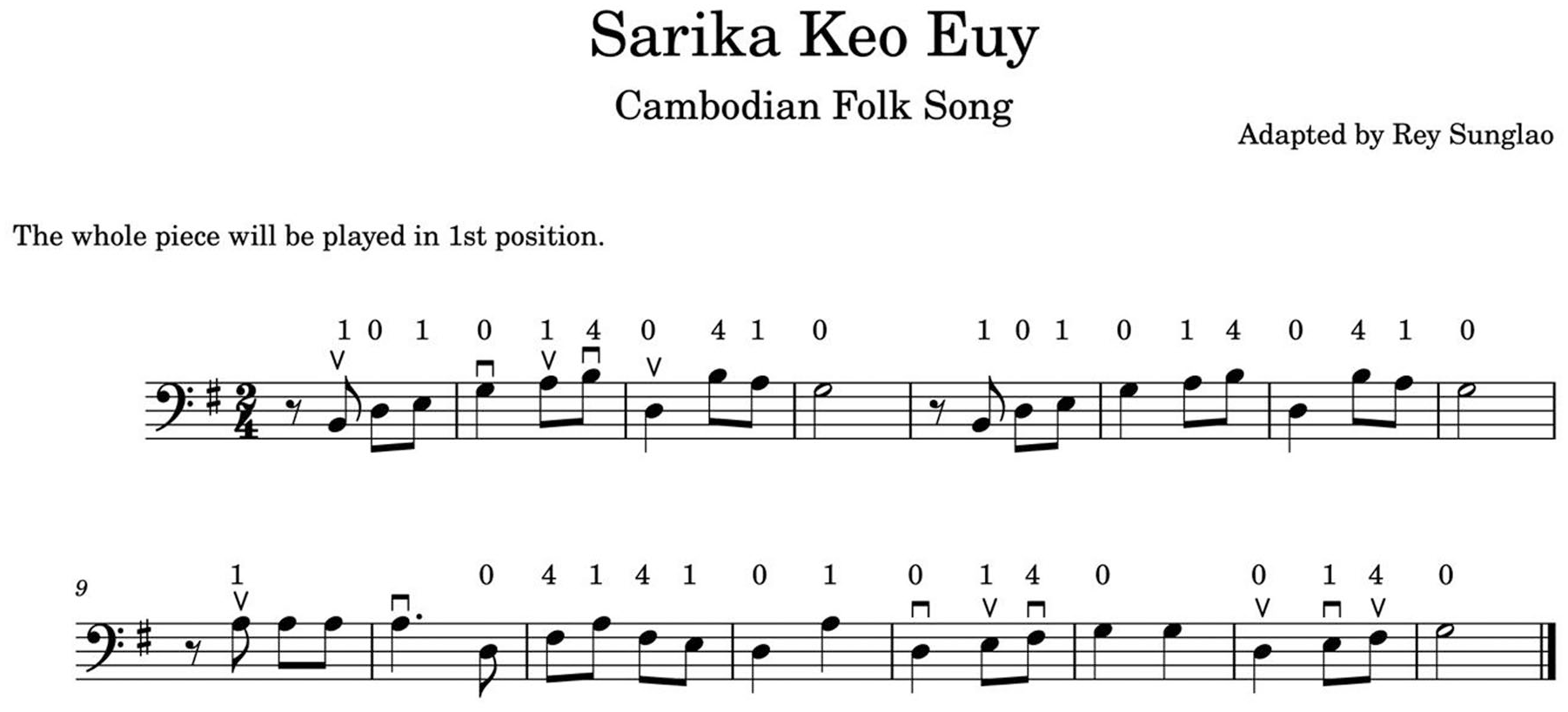
Sarika Keo Euy.
Soleram, an Indonesian folk song (see Figure 2), can be used to develop shifting techniques, particularly from B-natural to C-sharp, a foundational shift associated with the second position that should be introduced early in instruction. In addition, this selection can be utilized to practice bow technique, such as executing two consecutive up-bows to accommodate the syncopated rhythm on measure 8.
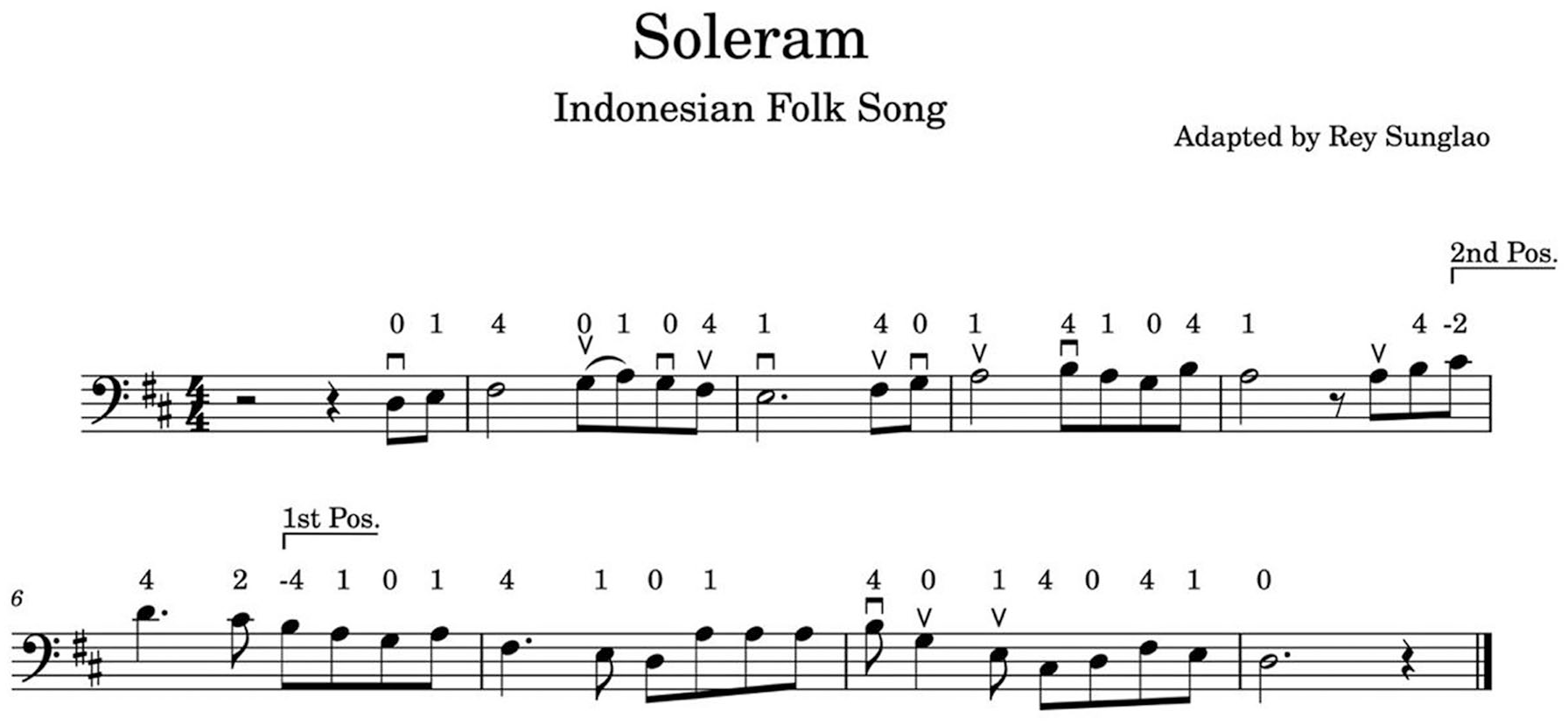
Soleram.
Thằng Cuội, a Vietnamese folk song (see Figure 3), features frequent dotted quarter with eighth notes rhythms, making it an effective piece for developing bow control, particularly retraction/circular motion. In addition to challenging students with slurred notes, it also introduces them to third position while reinforcing first position, as the melody alternates between the two positions.
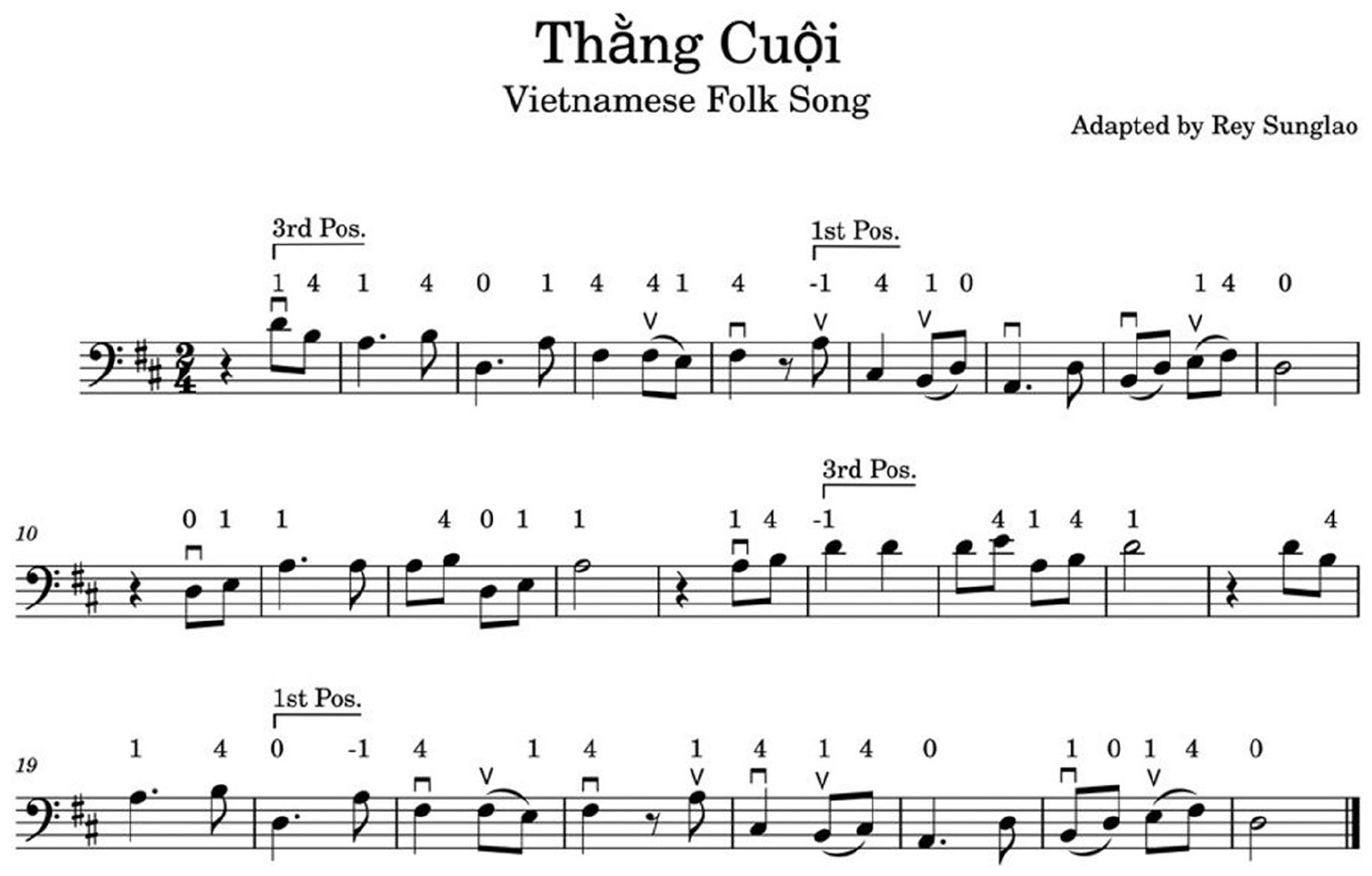
Thằng Cuôi.
Chan Mali Chan, a Malaysian folk song (see Figure 4), supports the development of the thumb position technique, as it features multiple G notes played using thumb harmonics. More importantly, this piece introduces the use of thumb position second finger on B-flat, helping students become comfortable with this fingering in higher positions.
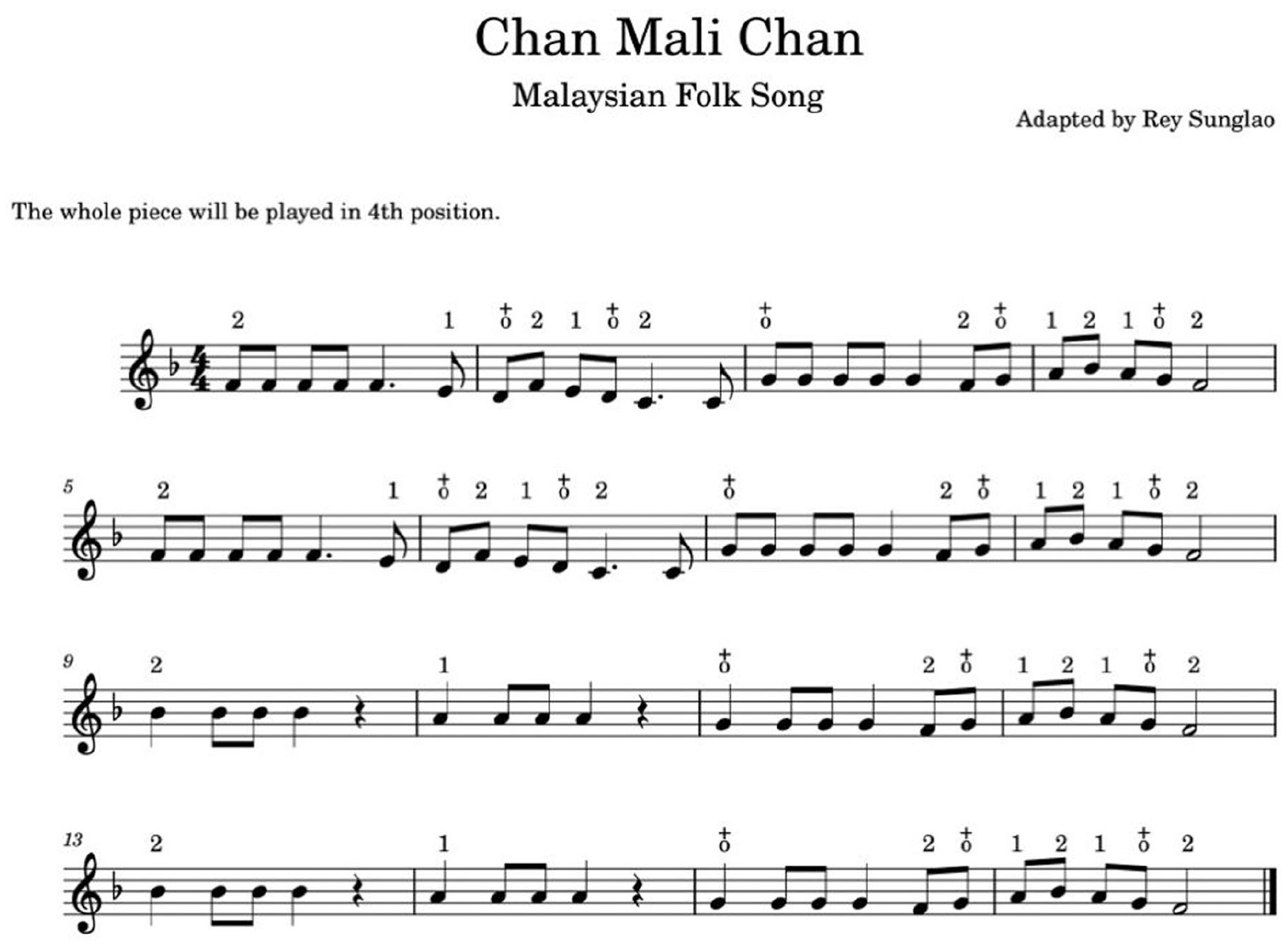
Chan Mali Chan.
Tulo Ka Mga Daga, a Filipino folk song (see Figure 5), introduces students to the 3/8 time signature and reinforces their familiarity with the fourth position. More importantly, the piece concludes in the fifth position, offering opportunity to explore much higher positions on the fingerboard.
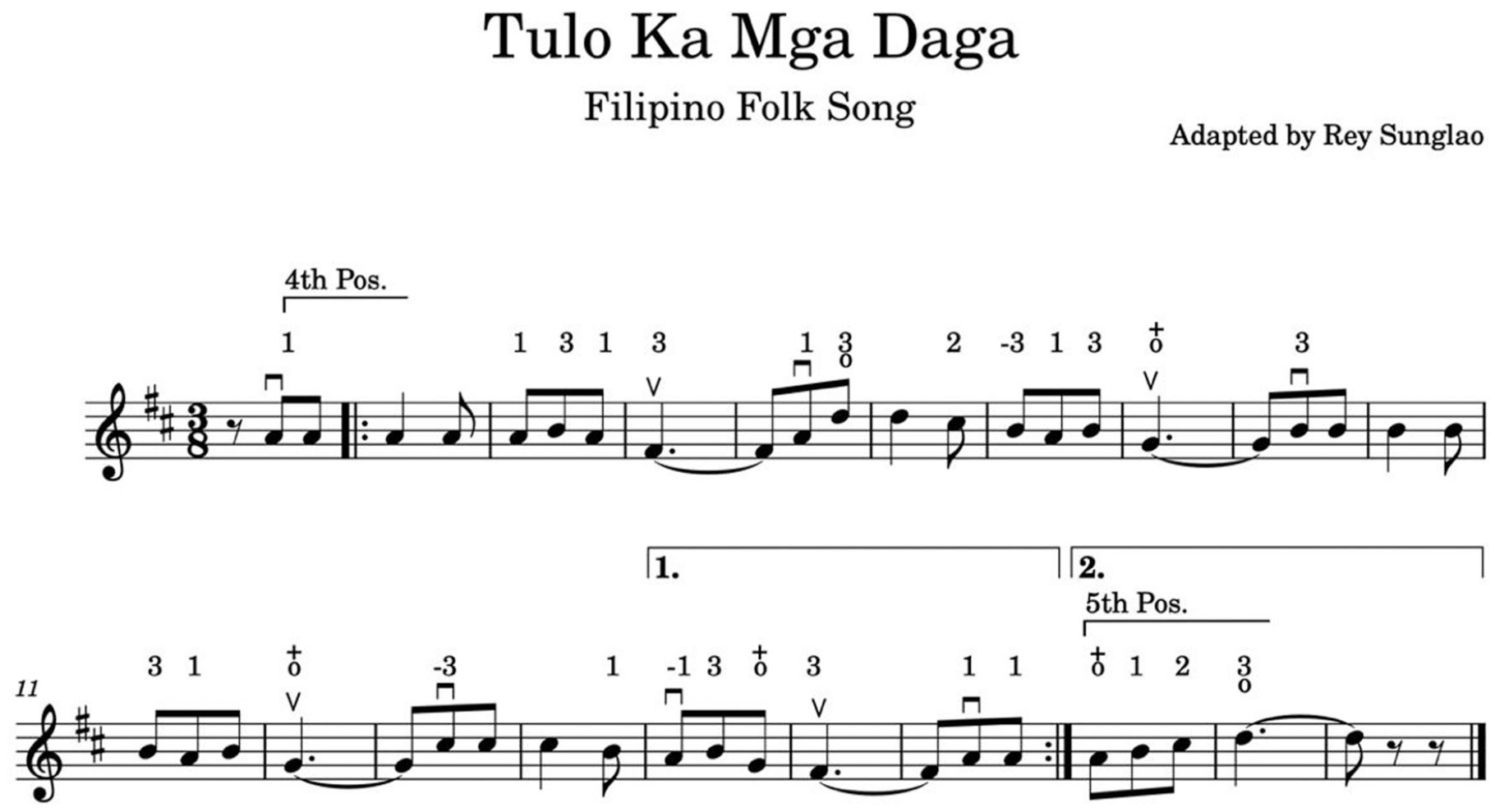
Tulo Ka Mga Daga.
Bagbagto, a Filipino folk song (see Figure 6), is played entirely in the sixth position, giving students the opportunity to practice playing harmonics on the D and A strings. In addition, this piece can be transposed for practice on other string pairs, such as G and D or A and E, to reinforce harmonic familiarity across the instrument.
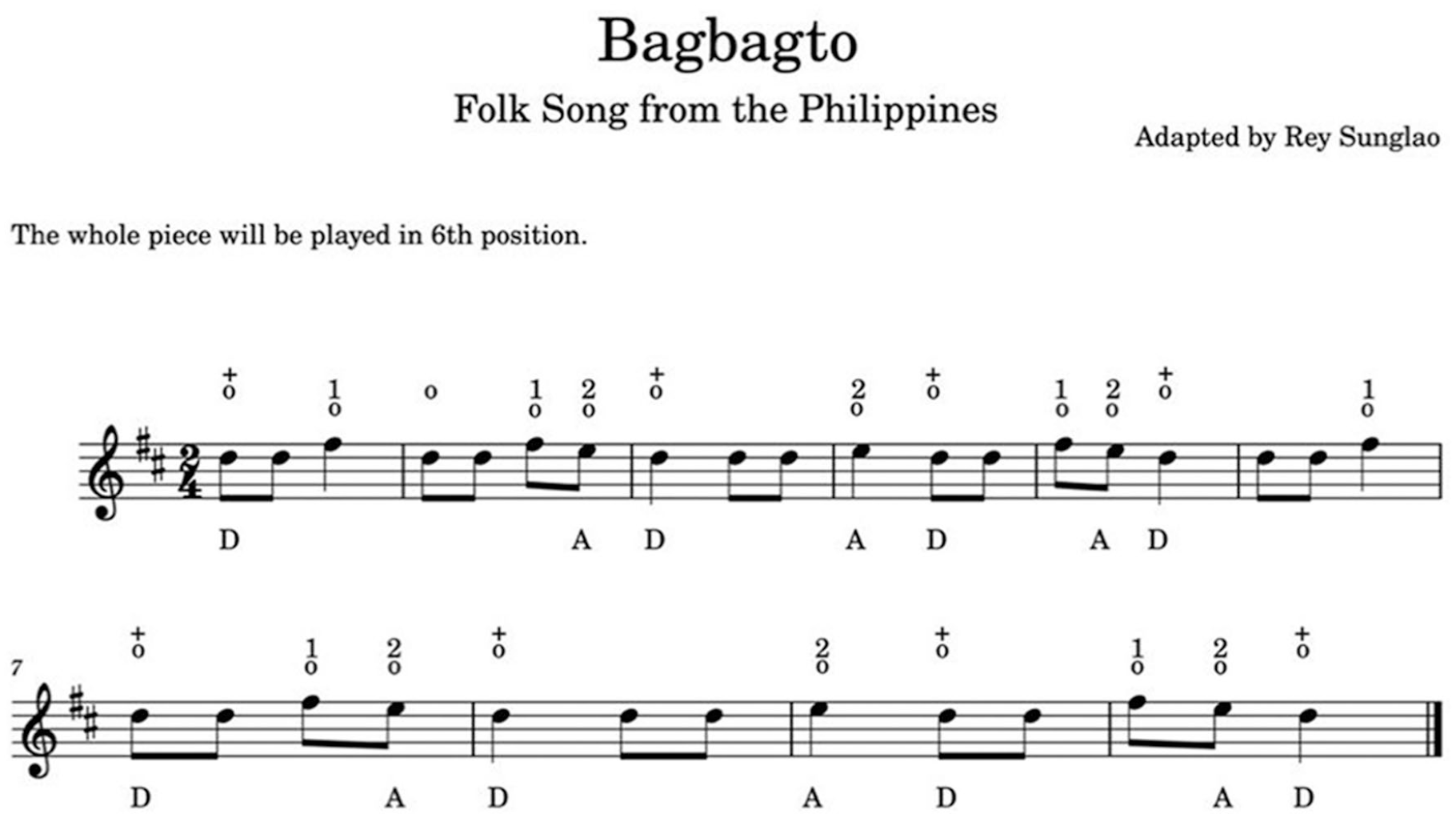
Bagbagto.
Conclusion
This article highlights the importance of cultural representation in music education. Method books that primarily focus on Western-influenced musics may unintentionally overlook the richness of diverse musical traditions, potentially limiting students’ exposure to unfamiliar yet valuable musical experiences. Addressing this gap is essential for fostering culturally responsive instruction. More importantly, reimagining the George Vance method book through the lens of CRE does not mean discarding the method, but rather to extend what is already available and to expand the musical horizons of our students. As music educators, we have the opportunity to enrich our teaching by exploring our own cultural backgrounds, as well as cultures beyond our own, and integrating these diverse perspectives into our teaching practices. In doing so, we can create a more inclusive and culturally responsive learning environment for our students, fostering a deeper understanding of various musics and a greater appreciation for cultural differences.
Footnotes

Rey Sunglao (