






Abstract

After twenty-five years in a professional string quartet and fifty-two years as teacher and ensemble coach, I'm a confirmed chamber music addict. So also are others, it would seem. Amateurs gather at intense ensemble bashes. Schools of music train fine chamber groups of all kinds. Some years ago, an East Coast resident quartet disbanded, whereupon some seventy-five string quartets applied for the post. As judge last spring at a major ensemble competition, I heard impressive performing by players as young as twelve. And there's more where these came from.
This gives hope for our musical future. A chamber ensemble is more affordable than a large symphony. Lively performance, smart programming, and intelligent contact with the public can give a resident ensemble a fruitful career in even our smaller cities and towns. We need this kind of local musical enjoyment, both for its own sake and to counteract the tide of shallow stuff daily thrust upon us by a highly capitalized entertainment industry.
We must continue to nurture chamber music by skillfully teaching it to our students. With this in mind, I want to tell AST readers about a program I organized last summer. The scene was the 1998 session of International Workshops, meeting this time in Biarritz, France. As always, attending teachers could choose the ensemble program from among many Workshop offerings. Gerald Fischbach, IW's director, and his faculty felt that, beyond coaching, we needed a review of the insights and know-how that only long experience can provide. They asked me to write a set of lectures and lead the presentation.
I was joined on stage by outstanding performer/teachers: Ivan Straus, violin professor, Prague Conservatory of Music; Edward Adelson, viola professor, Ohio State University; Evelyn Elsing, cello professor, University of Maryland; and the young Chesapeake Trio consisting of John Fadial, violin, Beth Vanderborgh, cello, and Naoko Takao, piano. With screened images of the music we played, we surveyed important aspects of ensemble technique. Here are salient points we covered and some of the illustrations we used.
Signals
Chamber groups function without conductor; effective signaling from within the ensemble indicates the tempo, dynamics, and character of the musical opening—and allows the players to start together. Signaling involves body language; but among experienced performers, such gestures will be both small and incisive.
Ultimately, the signal stems from the player's breathing. The intake of breath (often hardly apparent to the onlooker) moves the violinist's bow and scroll, the pianist's arm, or the trumpeter's bell, generating the signal. Hold yourself ready to play and say, “Aha!” (brusquely); “Aaaahaaa” (languorously); “Boo!” If you analyze what happens, you'll see what I mean.
Think about the musical event and its requirements before you give the signal, and remember: every signal needs proper lead-in. A loud, strong downbeat entrance can't be introduced by a lazy, slow upbeat. Conversely, don't wind up as though hurling the ball out of the park if you're about to start a slow, dreamy phrase. Act out the temper, not just the tempo, of the musical statement to come.
Who gives the signal?
That depends on the musical event. Consider the start of Schubert's “Death and the Maiden” quartet. Second violin and viola have the thematic, hammering lines in octave. The violin leads this inner-voice pair (and the entire foursome) in the first measures. First violin takes over at the end of measure 4, where the music shifts to a halting stammer. These melodic fragments are paced by the first violin for dramatic effect, rather than with clock-like rigidity.
How many signals must there be?
A lot! Starting a piece effectively is only half the battle. In a well-made composition, events unfold in a logical and dramatic way. Each event, large or small, needs a start of its own, effected by an appropriate signal.
Moreover, there are in-betweens: signals of punctuation as well as of initiation.
In prose, chapters and paragraphs are set off by space; sentences are marked out by periods; parts of sentences, by semicolons, commas, dashes, to suit the sense of the writing. There are also marks of emphasis, excitement, inquiry (exclamation point, question mark). Then come inflections, so subtle that they defy written notation. Throughout, the sensitivity of the reader is essential.
In music too, there are punctuation marks: mostly understood, not notated. The composer relies on the sensitivity of the performer. The signals conveying that awareness vary from aggressive to barely visible. Indications are often given aurally, by the way the melody is inflected. As in speech, subtlety of inflection distinguishes skilled performer from novice.
Play a phrase from your solo repertoire. It speaks to you because you reveal, in sound, the structure of the musical unit. The same is true in ensemble, but there the phrase will often be parceled out to several voices. One player begins, then hands the line over to a partner. Make this transfer by visual signals alone, and your audience will soon see a lot of writhing and facial contortions. Instead, the experienced chamber musician plays with clearly defined inflection; listening alertly, the next player takes up the musical thread so that the shape of the melodic line is faultlessly extended. This give-and-take can even happen with eyes closed, so long as the ears are open.
This kind of interplay is always new and fresh. The melody is constructed on the spot, in away that will never be exactly duplicated. Delight in the unexpected and unpredictable makes the concert experience superior to the unvarying sameness of the recorded performance.
Endings.
The ensemble has to make clear the closings that separate the musical ideas within a composition. Decisions must be made about rounding off sub-parts within a phrase, entire phrases, and phrase-complexes (first theme area, bridge, etc.), sections, first/second endings, and repeats—as in sonata-form movements, variations, minuet/trio, or movements and entire compositions.
Let's look at some endings. As always, we're concerned with the musical context, the composer's notated indication and the perceptions of the performers. For clues to this, see the Mendelssohn D Minor Trio, Op. 49, first movement, mm. 610 to the end. Should the progress be metronomic, or better, swept forward to m. 615, with a slight, dramatic breath before the last fermata? Also, consider the difference between the requisite vigor of ending this held note and the sighing and dying away of the sustained note that closes the second movement. As for the fermata sign over the final silence at the end of both the third movement and the finale of this work, Mendelssohn seems to challenge the theatrical instincts of the performers. How would you handle these silences?
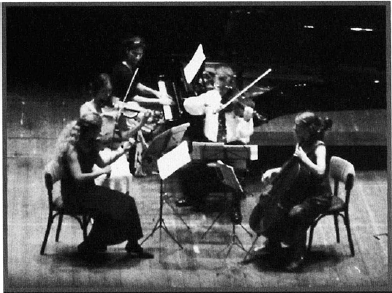
Chamber concert of the 1998 International Workshops (from left to right): Sally Barr, Amanda Huntoon, Cheryl Everett, Edmond Collins, and Ginger Murphy perform the Schumann Piano Quintet. Photo by Abram Loft.
Who leads endings?
The assigned role of the several players in the ensemble governs. Ordinarily, the lead goes to the highest-register voice of the dominant parts in the group. For example, see the end of the first movement of the Fauré Piano Trio in D Minor, Op. 120. In the last twelve bars, the piano is essentially playing arpeggiated down-beats. The violin leads the two prominent melodic lines and, watching for any slight broadening in the piano, three bars from the end, can lead the attack on the last fermata, as well as signal the end of that sustained chord.
Leading and Following
Is there a leader in a chamber ensemble? In a string quartet, the spotlight tends to focus on the first violin. In a piano trio or quartet, on the other hand, the musical highlight will often rest in the piano part; but not always. You have to inspect the music to decide where the target is at any given point in the composition.
If the titular leader of the group insists on dominating the action, he might play too loudly in what is momentarily a subordinate voice. Worse, there might be a struggle of wills between players as to the shaping of the phrase or episode in the music. Look at the finale of Haydn's “Gypsy Rondo” Piano Trio in G, Hob. XV: 25, mm. 35–50. The piano doubles the violin, but the violin has the ornamented, upper-octave version of the line and should lead the duet. The piano, on the other hand, has the rumble that marks each phrase ending (as in m. 38) and it would be too bad to miss out on a bit of insistent drumming on that figure. Let a sense of fun prevail.
How many leaders at a time?
There are often hierarchies within the ensemble. The prominent melodic line(s) dominate, with the remaining voices providing accompaniment. Within the accompanying group, the highest voice leads; that player follows the nuances of the prominent group, keeping the secondary team in flexible synchronization therewith.
An illustration is the second violin part in the second movement of Haydn's Quartet in G Minor, Op. 74, No. 3. In mm. 30–34 the second violin fits the inner voices to the dialogue of the first violin and cello. But from m. 35, the violin molds all three lower voices to the first violin line. And in mm. 39–41, the second has to deduce the actual pacing of the first violin line, so that the solo voice can be free to rhapsodize.
A wonderful example is found in the first thirty-four measures of the finale of Haydn's Quartet in D, Op. 76, No. 5. When the second violin and viola play the eighth-note accompaniment (as in bars 7–16), they have to sit firmly in the saddle, with the stirrups up short. The cavalry is riding full tilt and calls for energy from all. Both inner voices must be alert to the galloping lines in the outer parts. And this raises the next question:
What does it mean to be a follower?
If you've decided you have a subordinate line in the music at hand, do not think you can sit back and take it easy. The better the composition, the more crucial the role subordinate lines play in the performance. This doesn't mean that accompanying eighths should be trumpeted as though the best thing since the invention of rosin. But if they become an insignificant picket fence of sounds way back of the good stuff, then the music turns flat, no matter how beautifully the melodic foreground is played. Moreover, a subordinate part will incorporate within itself moments of special activity that are melodic or harmonic in their own right, adding to the overall effect of the passage. Those active details may, in fact, derive from the composition's central musical ideas.
An example comes from the second movement of Mozart's last quartet, K. 590, in F Major. For the first eight measures, everyone moves together. Let the first violin carry the thought alone, and you kill the music. It should sound as though four minds and eight hands merge into one organism. And in m. 9, when the first violin takes off into quiet, dreamy arabesques, the second violin gets double duty, playing the theme in the upper line of its double stops, and accompaniment in the lower line. Projecting the theme without blotting out the first violin line, the second also leads the three lower voices in following the flitting solo voice. At m. 17, the first violin becomes the accompaniment, while the cello, viola, and second violin, in turn, have their shot at the sixteenth-note thread originally spun by the first.
Again I stress: there is no insignificant voice in fine chamber music writing. Subordinate at times, certainly; but unimportant, never.
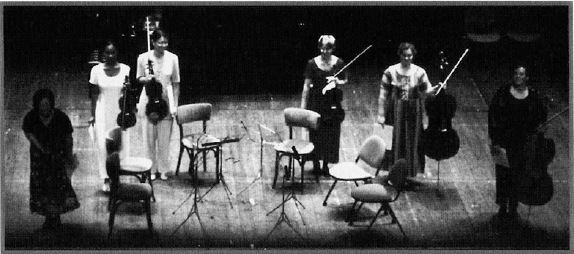
Chamber concert of the 1993 International Workshops (from left to right): Cortney Combs, Tiffany Sammons, Cheryl Ann Logan, Miriam Albin, Linda Jennings, and Christine Crookall perform the Brahms Sextet in G. Photo by Abram Loft.
Tempo, Dynamics, Tone Color
Setting the tempo for a given piece of music is not a cut-and-dried matter. But it is acceptable to say that a work can be played within a narrow range of tempos and still be made to sound convincing.
All rests on the interpretative skill of the performers. Too slow, and things fall apart; too fast, the music turns superficial and glassy. In between, the chosen speed can be justified by the shape, inflection, and stress pattern in the playing. You'll find it worthwhile not only for your ensemble students but also for your individual instrumental pupils to try making the work they are playing sound persuasive at a variety of tempos. They'll learn not to decide on a so-called correct speed without careful appraisal.
And don't neglect that most important aspect of tempo: the subtle pushing and pulling of a melodic line that we call rubato. We use this constantly when we speak, for it contributes to the meaning of what we say. The same holds true in music. To demonstrate this, play a passage at the speed you've determined to be appropriate, as beautifully as you know how. Play it again, this time to the pulse of a metronome. It will immediately be clear that the musical clock has rigidified your performance, robbing it of much appeal. Music without rubato is like food without flavor.
Dynamics.
Look at a typical page of a Mozart score (for example, page 1 of his Quartet in E-flat, K. 428), and note how few dynamic marks he provides. There are such exceptions as his Quartet in G, K. 387, whose opening page shows an unusually high concentration of dynamic marks. Here, though, Mozart is using sudden contrasts in sound level as an integral part of his musical material and can't rely on the performers to supply eccentric shifts between loud and soft. Usually, though, Mozart expects the player to improvise dynamic gradations. Omit them, and you rob the music of luster and direction. Exaggerate them, and you insult the intelligence of the composer. As ever, it's a matter of taste.
To illustrate, have your students play a few lines of music in a Mozart or Haydn movement, restricting themselves solely to the dynamic marks given by the composer. (This assumes you're having them use an authentic edition, whose notation is close to the composer's own intent.) The players will quickly realize that the music is pretty dull without the dynamic gradations.
Something else will emerge: without realizing it, the ensemble will supply not only subtle crescendos and decrescendos that go with the inflection of the melody, but also that push and pull of speed that is rubato. The fact is, it's difficult to eliminate or modify gradation of speed or dynamics without also affecting rubato.
Tone-color.
Bach doesn't specify the instrumentation of his monumental Art of Fugue. As a result, many have made arbitrary settings of the composition, with varying success. Ordinarily, a composer thinks in terms of specific instruments when writing. He knows the range of tone colors available from leach instrument and gives relevant instructions by using words and character markings in his notation. Music is much more varied than words, so it's up to the player to decide on appropriate effects and the techniques needed. There is wide privilege and responsibility in the performer's grasp. String students, for example, should be urged to note the effect of playing near the bridge for sound projection or over the fingerboard for pianissimo coloration; the interrelation between bow speed and pressure; and the importance of choosing the place along the bow's length for effortless playing of a required speed of spiccato.
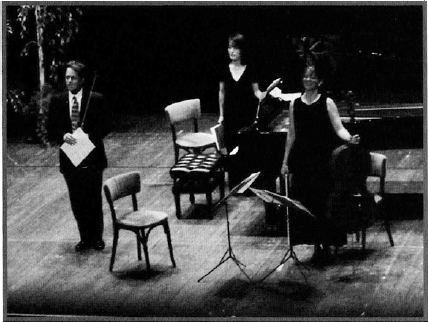
The Chesapeake Trio—John Fadial, violin; Naoko Takao, piano; Beth Vanderborgh, cello—an stage at the Casino Auditorium, Biarritz, 1998. Photo by Abram Loft.
Another very important ingredient of tone color, at least for stringed instruments, is vibrato. This warming of tone by a quick oscillation of pitch around the actual note has been a steady part of our musical diet since well back in the nineteenth century. And the performance practice expert Robert Donington maintained that there was probably never a time when at least some amount of vibrato was not used. Like any ornament, vibrato must be used judiciously; it must be adjusted, both in speed and amplitude, to the spirit of the given musical passage, not indiscriminately daubed onto the sound. There are even times when no vibrato is the proper choice for the required effect.
Here are two very pertinent illustrations: one is the last movement of Bartók's Sixth Quartet, where the sound must vary from deathly cold to incandescent heat—the funeral of the world. The other is the introduction to the opening Allegro of Mozart's Quartet in C, K. 465, “Dissonant.” This slow prelude, seemingly spun from outer space, again needs great variation in tone color, from fairly cold, to a rather intense warming of the recurrent gathering of voices. Only adroit handling will give this music its mystery and atmosphere. In fact, it's so mysterious that several nineteenth-century theorists tried to correct what they considered the bad writing in these measures. Both the Bartók and Mozart passages call for broad gradation of vibrato, bow-placement, speed, and pressure.
Balance
How tedious it is to hear a chamber ensemble whose players vie for loudness! A concert is not an athletic contest. The players' first concern should be that lines of central interest have pride of place. The relative importance of the musical strands can change often, sometimes from beat to beat, in the course of the composition. Performers must constantly gauge the balance between the voices and make necessary adjustments.
An ultimate test of players' ability to balance is the third movement of Beethoven's Quartet in B-flat, Op. 130. There the intertwining of voices and shifts in dynamics and tone color occur at minute intervals, demanding both rehearsal and unwavering alertness.
Other examples we played in this Biarritz lecture were drawn from:
Mozart's Duo in B-flat for violin and viola, K. 424, second movement
Leclair's Duo No. 5 in C Minor for two violas, first movement
Beethoven's String Trio in C Minor, Op. 9, No. 3, second movement
Mozart's Quintet in C, K. 515, second movement (viola quintet)
Brahms's Quintet in F Minor, Op. 34, second movement (piano quintet)
Hindemith's Kleine Kammermusik, Op. 24, No. 2, first movement (woodwind quintet recording)
Mozart's Clarinet Quintet in A, K. 581, first movement (recording)
Schubert's Octet in F, D. 803, fourth movement (recording)
In each case, there was discussion of such matters as: balancing voices of like and unlike timbres; capturing the composer's handling of acoustic and voicing resources in small as well as larger ensembles; and particular challenges in performance of music for mixed ensemble.
Some in our audience had also been admitted to ensembles coached by the several faculty members during the two-week Workshop session. Both in the rehearsals and in the performance by the ensembles on the final day's concert, these participants had a close-up, practical view of the points in our lectures.
Further perspectives were opened in a presentation by Louis Bergonzi, associate professor of music education at the Eastman School of Music, on ways of organizing a chamber music curriculum in school programs, and by Robert Culver, professor of music education at the University of Michigan, on sensitizing students to the pursuit of chamber music in the first place.
I hope AST readers will use or adapt these ideas in their ensemble teaching. They may even want to create similar discussion sessions of their own. Action is urgent, for the future of serious music in America depends in significant measure on chamber music, well played and well taught.
Schoolteachers: Invite Your Students to Follow in your Footsteps. ASTA with NSOA A Career Invitation Brochure Can Help.
This attractive brochure details the benefits and rewards of string teaching as a career option, and includes testimonials from many well-known professional and amateur string performers and teachers. Divided into several sections, the brochure lists in a concise bullet format the characteristics of a successful string teacher, types of teaching positions within the public schools, salaries and benefits, related career opportunities, tips for selecting a music school, and professional organizations and support networks.
Send your requests to the ASTA with NSOA National Office, Suite 300, 1806 Robert Fulton Dr., Reston, VA 20191.
A first step in combating the shortage of string teachers.
Footnotes
Abram Loft earned his Ph.D. in musicology at Columbia University and served on its faculty from 1946 through 1954. From 1954 to 1979, he was member of the Fine Arts Quartet, concertizing throughout America and abroad, and recording almost sixty discs of chamber music, from Bach to Babbitt. From 1963, he was (with the FAQ) professor at the University of Wisconsin in Milwaukee. In 1979, he moved to the Eastman School of Music as professor of chamber music and chair of the String Department, retiring in 1986. His writings include Violin and Keyboard (Grossman/Viking, 1973, repr. Amadeus Press, 1991) and Ensemble! (Amadeus Press, 1992). He received the University of Rochester's undergraduate teaching award in 1984 and ASTA's Distinguished Service Award in 1993. He has been International Workshop's chamber music coordinator since 1994.