






Abstract

Music educators know that most students can learn patterns and songs with great success if they are taught by rote, especially at younger ages. First-year players can prepare thirty songs by the holiday concert through a simple teaching sequence to quickly facilitate ear training and learning rote songs. This sequence consists of only four melodic patterns that:
help to solidify the audiation of specific intervals in the student's inner ear, particularly the perfect fourth;
provide a concise set of notes that utilizes left-hand finger patterns of all four instruments in a typical heterogeneous string class; and
allow students to learn by rote many folk songs in a short period of time.
The four melodic patterns are shown in Figure 1. Sol to Do was chosen as the first pattern so students would recognize the perfect fourth and (except bassists) better set their left-hand shape by putting all fingers down at once. The second pattern then allows the bassists to set the left-hand shape and places the first finger for the other instruments. Because the third pattern also allows for setting bass left hands, the middle patterns are interchangeable. The last pattern sets first fingers in all instruments, and La implies the sound of the resting tone in the relative minor key. Notice that each of the melodic patterns is repeated, allowing the students to adjust their intonation the second time, if necessary. Teachers should stress to the students the importance of adjusting the entire left-hand shape when correcting intonation.

Melodic Patterns
Figure 2 is a suggested sequence for teaching the melodic patterns. Many exercises for correctly shaping the left hand should precede this teaching sequence. The sequence can also be expanded as students progress to accommodate more rote songs and the introduction of scales; Fa to Sol greatly expands the possibilities.
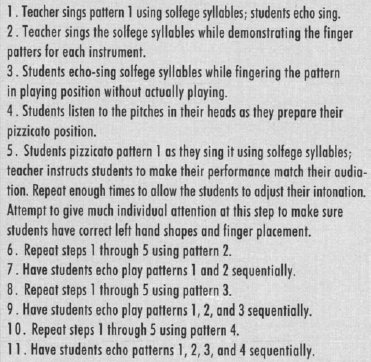
Teaching Sequence
This sequence is specifically adapted for teaching beginning string students using a variety of method books. Teaching it by rote allows the teacher and students to focus more on shaping the left hand without being distracted by written notation. In addition, students can be taught a surprisingly large number of rote songs after learning this concise set of melodic patterns. A sample list of songs that can be taught from this melodic sequence is provided below. Be sure to encourage students to teach themselves these and other rote songs, and many will surprise you with their quick success.
More accurate intonation is one of the most exciting benefits of this teaching sequence. Solidifying the audiation of specific intervals in the students’ inner ears encourages them to listen to determine if they have the correct left-hand shape and finger placement from the very beginning.
The time spent developing students’ inner ears at the beginning also pays off when students learn to tune their own instruments.
Further exercises can utilize alternating the order of the patterns as well as adding new ones. Be sure to alternate group echoes with individual echoes to evaluate each student's accuracy.
Rote Songs Using the Melodic Sequences
After four patterns
Old MacDonald Had a Farm, beginning on open D as SOL
Mary Had a Little Lamb, beginning an B as MI
Hot Crass Buns, beginning on B os MI
Pierrot, beginning on G as DO
God Rest Ye Merry Gentlemen, beginning on E as LA (first phrase only)
All Through the Night, beginning on G as DO
Alouette, beginning on G as DO (first phrase only)
Muffin Man, beginning on open D as SOL
Scotland's Burning, beginning on open D as SOL
Go Tell It on the Mountain, beginning on B as MI (chorus only)
After the fifth pattern (FA to SOL)
Long, Long Ago, beginning on upper D as SOL
Amazing Grace, beginning on open D as SOL
Bingo, beginning on open D as SOL
Alma Mater, beginning on G as DO
Jingle Bells, beginning on B as MI (both verse and chorus)
Snake Dance, beginning on E as LA
Bile em Cabbage Down, beginning on B as MI
Old Joe Clark, beginning on A as RE
Clementine, beginning on G as DO
Carmen, Ohio! beginning on G as DO
Oh, Christmas Tree, beginning on open D as SOL
Dona Nobis Pacem, beginning on G as DO
La Bamba, beginning on C as FA
Reef River Valley, beginning on open D as SOL
Dinah, beginning on B as MI
Ode to Joy, beginning on B as MI
Simple Gifts, beginning on open D as SOL
Erie: Canal, beginning on open B as MI (La is tonic)
Hush Little Baby, beginning on open D as SOL
Twist and Shout, beginning on C as FA
Send your Teaching Tips to: