






Abstract
Cultural history reflects well the sad but true tidings of the French proverb Nul n'est prophète dans son pays (“None is prophet in his own land”), and the polymath, esoteric impressionist composer, philosopher, scientist, inventor and Rear-Admiral Jean Cras (1879–1932) is a shining example of the prophecy. Even within his own country, the composer's stature among the impressionists remains equivocal, but finally, ignored for more than a half century, his wonderfully eclectic works are now finally enjoying a vibrant renaissance. A devout Catholic and devoted family man, Jean Cras composed Quatre petites pièces pour violon et piano (Four Little Pieces for Violin and Piano), presents for his son Jean-Pierre's (1918–1948) eighth, ninth, tenth and eleventh birthdays, as a labor of love. For this very reason, and with apologies to William Shakespeare, the title of one his immortal plays has been usurped for this article's title.
A career Naval officer, Jean Cras's greatest problem as composer was a chronic lack of time to devote to his art. The sea he loved; the Navy, although patriotically devoted to it, he resented. Cras's poignant maritime experiences, which encompassed more than two-thirds of his life, provided him with a profound understanding of the alienation of the human condition. Five volumes of family correspondence attest amply to his perpetual torment, especially as the junior officer struggled to keep alive an entire flotilla in the Adriatic during World War I. 1
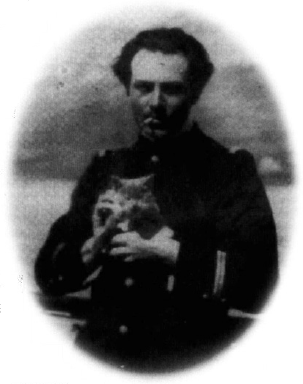
Like father, like son, Jean-Pierre did not quite fancy practicing the violin. In a touching letter to his spouse, the father Cras writes:
I hope. Jean-Pierre will have received his piece this morning. Despite everything, let's not regret having started him on the. violin. If we'd have waited [longer], it would have proven futile [later], and he would have played only the piano all his life. You can believe me when I tell you that I had to be forced to take my violin in hand when I was young. I never studied it enthusiastically. And all that could be asked of me was to work at it a half hour at a time. I was always at the piano. None the less, I did manage to learn a little, and God himself only knows just how grateful I am to Mother for having held her ground and made me practice! 2
Cras's assessment of his abilities on the violin reflect his innate modesty. As the composer's letters reveal, he had played a good number of the most difficult works of the chamber music literature, and with some of the most important performers of his generation. Cras's string writing, from all accounts, is limpid and imaginative, be the context chamber music or orchestral, simple or virtuoso. Behind this musical mind was that of the pragmatic inventor-scientist. 3
Given the paucity of sophisticated violin and piano works for less-advanced students within the French impressionist repertoire, Cras's Four Little Pieces for Violin and Piano are an important contribution to the literature of violin pedagogy, and certainly to the violin literature itself. Jean Cras calibrated quite lucidly the degree of difficulty of each composition, not only technical, but musical, all the while assuring the younger or less-experienced student a measure of fun and discovery as part of the learning process. As a musician progresses through the pieces chronologically, he or she realizes just how carefully Cras has done this; indeed, his harmonies and modulations also increase gradually and proportionally in their complexity and sophistication. With each work sent home from his various postings came a letter of inquiry to his wife, yearning to know how the youngster was faring up with the new composition, the father readily willing to modify the more difficult passages so as not to discourage the child. 4
Air Varié
From his quarters aboard The Lamotte-Picquet, stationed at Lorient (Brittany), the Air varié (1926) was composed. Intentionally designed as teaching material technically accessible to a relative novice, Air varié consists of a theme with five variations. 5 Composed purposely in A major, little of the passage-work crosses over the strings, and much of the melody lies on the open strings, spanning the octave, all in first position. (See Example 1.)
In this work, the student is introduced to many musical devices and elements, such as harmonics, finger pizzicato, subtle dynamic changes, echo effects between violin and piano, and marked rhythmic contrasts. Along with a good variety in tempos, the work demands of the young student a ready attentiveness to shifts between duple and triple meter, albeit subtle and not abrupt.
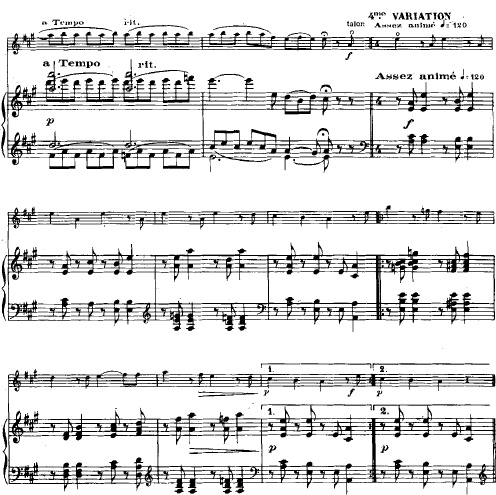
A four-bar structure governs the metric patterns throughout this short work, reminiscent of a Beethovenian approach to variation writing. 6 Essentially, each of the six sections contains eight written measures, two groups of four, the second half repeated; the short codetta contains four measures. As in the majority of Beethoven's variations, the harmonic scheme is consistent throughout the composition. Particularly interesting is the fourth variation, when the partners are quasi-aggressively antiphonal to each other. (See Example 2.)
Example 1: MM. 1–4 OF AIR VARIÉ.
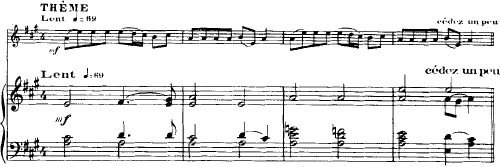
Cras knew how much fun this would be for his, or any, little boy. Within the third variation the student will discover the accelerando and, at cadences, ralentandos. In his fifth variation, scales cross over the four strings. In his correspondence, Cras indicates clearly that Jean-Pierre should learn left-hand pizzicato and harmonics, as found at the close of the piece. 7 With the pianist constantly active and both parts well integrated, the young violinist will feel like an important participant. Ending quietly, the bucolic, prayerful melodic and harmonic content of this work recalls folk melody, and at times reminds one of Dvořák's chamber music.
Example 2: variation 4 of am varié.
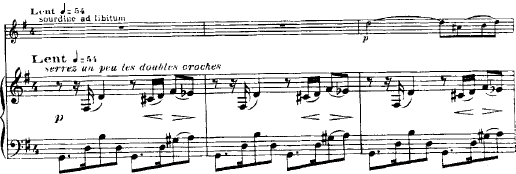
Example 3: mm. 1–6 of habañera
Habañera
For Jean-Pierre's ninth birthday, Cras composed and completed the Habañera (1927) aboard The Provence then docked at Toulon. This composition is obviously impressionistic, evoking the Cuban dance as Cras understood it. In ternary form, the Habañera is both technically and musically more advanced, indicating that Jean-Pierre had made considerable progress within the year. Cras's pedagogical approach changes here, the naïveté of the earlier piece now gone. Habañera exposes the pupil to exoticisms, principally by way of the tritonal properties of the harmonic minor scale traditionally used for Spanish-style melodies. So as to accommodate all that he wished to teach his young son, Cras chose a slower habañera, marking the piece lent and setting the tempo at 54 to the quarter note. The traditional habañera ostinato rhythm is constant.
From the first measure, the violinist is given the responsibility of deciding whether he or she will use the mute, for Cras indicates sourdine ad libitum, though at measure 15 the composer instructs that the mute be removed. Many different bowings are introduced through this work: deep legatos for the suave lyrical passages, portamentos for scherzando-lyrical settings, and staccato for strictly scherzando passages. The Habañera encompasses a broader dynamic and wider range than its earlier counterpart, incorporating at measure 29 a dominant seventh arpeggio that crosses the strings and for which Cras also provides a more difficult ossia, extending the arpeggio over two octaves within the same half-measure. Four measures later, pizzicato is required, as the violin now carries the Habañera's rhythmic ostinato for two measures. Always making sure that the youngster will have some fun, Cras ingeniously includes, at measure 35, in parallel fifths, a double tremolo from the open strings at the interval of the minor second (D and A to E-flat and B-flat).
Example 4: mm. 34–35 of habañera
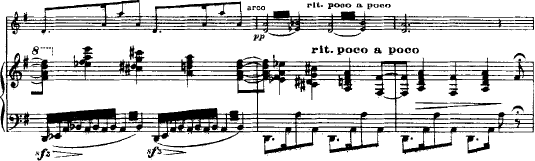
(See Example 4.)
At measure 49, the closing gesture of the piece, a full two measures of harmonics are introduced, delighting the pupil with a new trick.
The composer's attention to expression marks and subtle changes of tempos, including the use of accelerandos and ritardandos, as well as his continuous use of imitation would indicate his desire to evoke the sensuality of this dance. As in the Air varié, all bowings are carefully provided by the composer, both players are equal and meaningful partners.
Evocation
Evocation (1928), Jean-Pierre's present for his tenth birthday, was also completed aboard The Provence, stationed at Toulon. Much of the material in this piece suggests that Jean-Pierre had continued to make great strides in his violin playing. Indeed, the son again seemed to follow in the father's precocious footsteps, Jean Cras indicating in the score that the theme of the work's second section was borrowed from Jean-Pierre's own Danse arabe. 8 The boy had been anxiously anticipating his father's future presents well in advance of his birthday. On January 15, 1926, the composer wrote to his wife stating: “I received Jean-Pierre's nice letter. You tell me that he's been very good. That he's also thinking about the piece I'll have to ‘write for his next birthday'!!” 9
At the technical level, Cras's choice of range would indicate that he deemed his son capable of successfully handling the shifting to and from higher positions. Three new devices are introduced to the young student: the slide, the grace-note octave skip, and bariolage. Artistically, the work is more reflective and subtle, the chamber music idiom far more developed. Principally, Evocation demands careful attention to legato playing. Despite entirely different textures, the violin and piano are much more intertwined than in the two earlier compositions, perhaps indicating that Cras now wished Jean-Pierre to develop his ensemble playing. A somewhat longer piece than its predecessors, this work is in ternary form.
Evocation is founded upon Jean Cras's favorite harmonic idiom, pentatonism, reflecting the naïve world of the child. From the start, the composer's fondness for the superimposition of the perfect fourth and perfect fifth intervals is evident, a technique that, quite ingeniously, also creates the essence of the principal theme and that of its second section, really a variation of the first. Although sounding completely different, both melodies derive from the pentatonic cell heard in the work's opening measure, reflecting Cras's penchant for thematic unity, even in this short piece. (See Example 5.)
Example 5: mm. 4–6 and mm. 37–44 of evocation
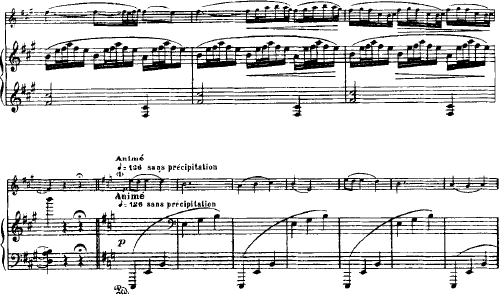
Although entirely playable technically by a gifted youngster, Evocation's emotional tenor might be too advanced for a violinist even in his teens. This possibility is suggested by the work's very title, and the tender, nostalgic, melancholic qualities of the melody require as much the sophisticated interpretation of a consummate master as the naïveté of the child. In these works, Jean Cras has therefore struck the correct technical and emotional balance to bridge the generations, presenting each with designated and appropriate challenges.
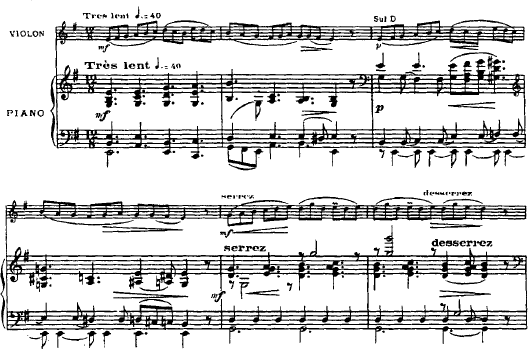
Example 6: mm. 1–6 of eglogue
Eglogue
Jean Cras's fourth and final piece, written for Jean-Pierre's eleventh birthday, in 1929, was his Eglogue (1929), also completed at Toulon on board The Provence. Eglogue is more a literary than musical term, referring to short pastoral dialogues or poems, such as Virgil's Bucolics. The great late-nineteenth century renaissance of the Greco-Roman ethos inspired many composers to imprint their own personalities on this aesthetic; indeed, églogues were composed by Liszt in his Années de pèlerinage, by Joachim Raff, and by Stephen Heller. The most famous musical églogue, assuredly, was composed by Claude Debussy, who, inspired by Mallarmé, immortalized the latter's Prélude à l'après-midi d'un faune: églogue pour orchestre d'après Mallarmé. Later French composers such as Henri Rabaud, Henri Sauguet, Florent Schmitt, and Darius Milhaud continued to be inspired by the églogue; curiously, Ravel did not compose one, though one could consider his Daphnis et Chloë suites as extended églogues.
From Cras's correspondence, evidence emerges that the composer had once again worked very lovingly and diligently for his young son. The technical demands of this work differ from those of the earlier three in that they demand a far greater degree of musical rather than technical sophistication. Though there are few metric changes, numerous changes of tempo are carefully indicated. In fact, at almost every single measure, an indication that the tempo in use should be modified or altered slightly is to be found. Also in ternary form, the work is so narrative in style and so deeply subtle in its poetics that it gives cause to imagine that Jean Cras, the great literary, wished his son to become familiar with the subtlest of expressive techniques, so as to prepare him for the serious appreciation of poetry and the intellectual rigors of his future schooling. In turn, the composer assigns more subtly the technical difficulties that he will present his son. Cras's intention was to transform Eglogue's principal theme into an arpeggiated variation, albeit melodic accompaniment, against the piano's restatements of the melody. Arpeggios, crossing gently over the strings, longer trills and more varied ornaments, and double stops in succession challenge the pupil, and for the first time in these four works, the composer requires an entire melody to be performed on a single string, regardless of registration. (See Example 6.)
On April 13, 1929, Cras wrote to his wife that nothing in the work should trouble their son, as he had already included fingerings; he also expressed a wish that she advise him if the arpeggiated passages pose real problems for the boy, as he would willingly simplify them.10 Once again, the composer adopted the mode on A for yet another of his peaceful settings. This reflective work follows somewhat in the French tradition of the pastourelle.
Jean Cras: A Brief Biography
Jean Cras was born in Brest, one of France's most important military sites on the Breton coast, into a very old and esteemed naval and medical family. His father, a famous naval surgeon, had encouraged all his children toward music, and jean, the most gifted, studied both piano and violin since early childhood. His compositional talents manifested themselves by the age of six, and shortly thereafter, he began composing short piano pieces as well as songs and vocal duets for house concerts with his siblings. At sixteen, the young Jean enrolled at the Naval Academy in I Brest and, following the family tradition, trained for the service. As he matured, Cras realized the limits of provincial Brest's musical resources and decided to educate himself in theory, orchestration, counterpoint, and composition. His dogged autodidactic streak proved fruitful. Yet, at twenty, he once again felt himself at an impasse, and decided to study with the composer under whom he felt he would glean most, master lyricist Henri Duparc.
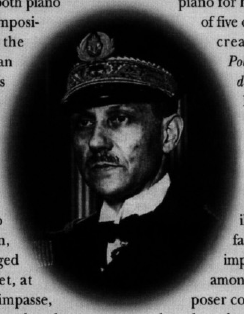
Through his sister, the acclaimed soprano Gabrielle de Fourcauld, contact with the master was established, and within days of their first meeting Duparc declared Cras one of the most gifted musicians he had ever met, A lifelong friendship developed, and the two grew as close as could any professor and student; Duparc would later write to Cras as “the son of my soul.” For three months during the latter part of 1900, when Cras enjoyed a rare break from the Navy, master and pupil worked assiduously, Duparc guiding Cras meticulously through the compositional processes of Bach, Beethoven, and his own teacher, César Franck.
These would be Cras's only lessons in composition; henceforth, the ardent Catholic would continue to grow spiritually and refine his art independently, ignoring current fads and trends. Indeed, an acutely scientific mind abetted his understanding of orchestration and timbre, musical forms and architectures, and a distinct literary penchant enabled Cras to project into song some of the most sophisticated symbolist poetry.
The compendium of his World War I experiences matured Jean Cras into adulthood, making him painfully aware of the sanctity of human life. His letters to his wife, Isaure, and their four children, three girls and a boy, express this, revealing as well the strength of his unflinching faith. Through the nearly 1,000 pages of edited correspondence released by the family, the composer's desolation and isolation from those he loves becomes apparent.
Predictably, Cras's musical productivity was restrained during the war. Yet, he managed to produce three suites for piano for his daughters during this time, his third of five creative periods. From 1910 to 1918, Cras created his magnum opus, the opera Polyphème, which won him the Premier Prix du Concours musical de la Ville de Paris in 1921. This event catapulted him to the zenith of French musical life, and the decorated war hero's name became as much a household word as Maurice Ravel's—whom he had long since befriended through Roussel—and other illustrious figures of the decade. The Cras family was befriended by some of the most important politicians, musicians, and literati, among them André Gide, with whom the composer collaborated on a remarkable song cycle based on the poetry of Rabindranath Tagore, L'Offrande lyrique, published by Salabert and now on compact disc (Tympani Records, France).
Cras's entire output is considerable, including thirty-three published and thirty-two unpublished compositions, including thirty-eight songs. Among the best known during his lifetime were his opera, Polyphème, (1910–1918), the song cycles Fontaines (1923) and Robaiyats (1924), his superb Trio pour cordes (1925), an orchestra) suite Journal de bord (1927), and a major Piano Concerto (1931), His unpublished works include forty wonderful songs, as well as many fine sacred and chamber works.
Current biographical notices for Jean Cras are to be found in all major musical encyclopedias, the most comprehensive of these being Die Musik in Geschichte und Gegenwart, written by Cras's last surviving daughter, Monique (b. 1910). An article on Jean Cras for the Revised New Grove Dictionary of Music and Musicians will be published in the year 2000; a more Breton hue on this composer's life is to be found in Vefa de Bellaing's Dictionnaire de compositeurs de musique en Bretagne [Quest Éditions, Nantes: 1992]. Unfortunately, no complete biography of Jean Cras exists, but within the next few years, the first comprehensive biographies of this remarkable man will be released in both French and English. The only biography in existence is that by Edouard Schneider, Jean Cras, in the series Nos Musiciens (Paris, Maurice Sénart: 1925), and brings us only to 1925.
Example 7: mm. 7–9 of eglogue
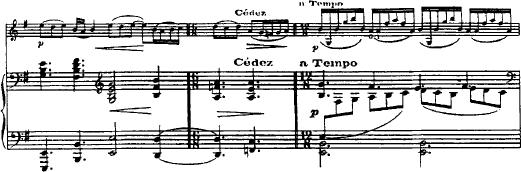
Consciously or subconsciously, Jean Cras's tender affection for his son is heard in his heartfelt transformation of Jean-Pierre's Danse arabe, which he imports from the preceding piece and develops as a secondary motive. (See Example 7.)
An Unsung Hero
Why Jean Cras was forgotten for so many years remains enigmatic. Many factors weighed against him, chiefly the perceived anachronism of his tonal language at a time when the Second Viennese School had begun to conquer the Western musical mind. Now that composers have realized that there is indeed life beyond twelve-tone writing, musicians and audiences have finally begun to appreciate the unsung heroes of the twentieth century. Of these, Jean Cras is certainly one. Yet, popular appreciation of this master—should he indeed gain popular acclaim in the same way as have Fauré, Debussy, or Ravel—will take time. In twentieth century terms, a more tonal musical foundation can hardly be conceived, and a more traditional, cyclical approach to motivic development and architectural construction would also be difficult to envisage. These two elements alone constitute the main ingredients for sheer ennui. Yet, beyond these superficial strictures is an attentively studied, assiduously evolved, sophistically esoteric musical language, rife with perfectly appropriated and proportioned impressionist, exotic, folkloric, and liturgical infusions, not to mention literary allusions. This constitutes the genius of Jean Cras's style, and the sheer variety of styles in his four violin pieces for Jean-Pierre amply attest to the composer's versatility of style and command of timbre and instrumentation.
Maurice Sénart, Jean Cras's principal publisher, released the four violin and piano pieces just as they were submitted by the composer. Later, Sénart was acquired by Salabert, which now holds the copyright for the four, readily available through its international agents. In the United States, this score may be purchased through the Hal Leonard Corporation, 7777 West Blue Mound Road, Milwaukee, WI 53213; tel.: 414–774–3630; fax: 414–774–3259; email:
How extensively these compositions have been studied or performed has been difficult to assess. In Cras's correspondence of June 11, 1930, one of France's most distinguished violin pedagogues, Mme Hortense de Sampigny of Paris, had invited the composer to one of her pupil's annual recitals, on June 22, during which his pieces would be performed; to this event, the composer brought along his Jean-Pierre.11 In 1993, Jean-Pierre Ferey and Marie-Annick Nicolas recorded the first commercially available performances of the group for the SKARBO label in Paris, truly wonderful performances on a highly successful compact disc.12
Footnotes
Paul-André Bempéchat
Paul-André Bempéchat performs as a pianist worldwide in recitals and an recordings. Also a musicologist, he appears regularly as a lecture-recitalist at conferences and at universities. A graduate of the Juilliard School and the Sorbonne, Bempéchat is completing his doctorate at Boston University with his dissertation on Jean Cras. Bempéchat's article on Jean Cras will appear in the forthcoming Revised New Grove Encyclopedia of Music and Musicians.