






Abstract
Background
CD24 is a sialoglycoprotein anchored to the cell surface via glycosylphosphatidylinositol and is involved in intracellular signaling processes. It plays an important role in the early stages of the multistep process of colorectal carcinogenesis. Several single nucleotide polymorphisms in the CD24 gene are reported to exert a diverse effect on cancer risk. We aimed to elucidate whether CD24 TG/del genetic variants are associated with susceptibility to colorectal cancer (CRC).
Methods
The study included 179 subjects, 36 with CRC (prior to surgery) and 143 healthy control subjects. Deoxyribonucleic acid was purified from peripheral blood leukocytes, and by using restriction fragment length polymorphism analysis, the CD24 gene was genotyped for the specific genetic variant, TG deletion. Additionally, CD24 protein expression levels were determined by Western blotting analysis.
Results
The incidence of the TG/del was higher among the CRC patients compared with healthy controls, 14% and 10%, respectively (P = .54). CD24 protein levels were significantly higher among CRC patients. There were no significant differences in CD24 expression between CRC patients at different stages of the disease or between patients who carry the mutation and those who did not.
Conclusions
CD24 genetic variant might be of clinical value for risk assessment as part of cancer prevention programs. Further study on larger populations is needed to validate the importance of this dinucleotide deletion in CRC development. Overexpression of CD24 protein occurs early along the multistep process of CRC carcinogenesis, and a simple blood sample based on CD24 expression on peripheral blood leukocytes can contribute to early diagnosis.
Introduction
Colorectal cancer (CRC) is a major source for morbidity and mortality worldwide, and it is the third most common cancer. 1 It is the third leading cause of cancer-related deaths in the United States. 2 According to the International Agency for Research on Cancer, there were 1.8 million new cases of CRCs worldwide during 2018 and 880 792 deaths from CRC worldwide. 3 In Israel, it is the second leading cause of cancer death with 2519 new cases and 1384 CRC-related deaths during 2018. 4
About 5% of the overall CRC cases are part of hereditary syndromes caused by specific Mendelian-inherited mutations. The most common of which are familial adenomatous polyposis (FAP), Lynch syndrome, Peutz–Jegher Syndrome, and juvenile polyposis. An additional 20% of CRC cases are familial but not as part of a known syndrome. The main genetic processes which take part in those familial cases are not well established yet.
In 1990, Vogelstein and Fearson described for the first time the multistep process in which a CRC is formed. 5 During this multistep process, which spans over many years, multiple genetic changes take place and accumulate within different target genes. Those genetic changes (mutations) cause a functional change that expresses itself either as overactivation of oncogenes or deactivation of tumor suppressor genes that eventually leads to cancer formation.6-8 The CD24 protein is differentially expressed in normal and malignant colonocytes and its overexpression in malignant cells reverts to normal following cyclooxygenase-2 (COX-2) inhibition.9,10
CD24 gene encodes for small mucin-like glycosylphosphatidylinositol (GPI) cell surface protein, which is involved in intercellular signaling pathways mediated by its modifiable glycosylation in a cell type-dependent manner. 11
We have shown that CD24 overexpression is an early event at the multistep process of CRC carcinogenesis and suggested it as an oncogene with important determinant in gastrointestinal (GI) carcinogenesis. Immunohistochemical analysis showed that CD24 is significantly overexpressed in tumors as compared with normal tissues in the majority of GI tumors, 90.7% of colorectal adenomas, and 86.3% of CRCs compared with weak expression in only 16% of adjacent normal epithelium.9,10 In addition, the vast majority of the normal tissues show almost no expression of CD24, as was characterized by Food and Drug Administration-approved normal human organ tissue microarray. Besides its overexpression in cancer cells, higher levels of CD24 were found to be significantly associated with a more aggressive course of disease. 12 The overexpression of CD24 during CRC progression and its downregulation by COX-2 inhibition suggest that CD24 has a significant role in CRC carcinogenesis. Monoclonal Ab to CD24 significantly inhibited tumor growth in vitro and in vivo in a time-dependent and dose-dependent fashion.9,13,14
Human CD24 messenger ribonucleic acid (mRNA) contains a short open-reading frame, 0.24 kb, along with a long 3′-untranslated region (UTR) of 1.8 kb. Several genetic variants of CD24, including single-nucleotide polymorphisms (SNPs) and deletions, have been described. The main functional variant A57V (rs 52812045) has been associated with an increased risk and a more rapid progression of multiple sclerosis and other autoimmune diseases. 15 This SNPs lead to the replacement of alanine by valine, immediately after the cleavage site for the GPI anchor. Other functional CGC haplotype (P-534A/C-492G/C-442C/T) was identified in the promoter region; however, the gene contains other SNPs as well. 16
An additional genetic variant, rs3838646, is a deletion of 2 nucleotides, TG, located at the 3′-UTR. This polymorphism confers significant protection against the risk and progression of multiple sclerosis and the risk for systemic lupus erythematosus (SLE) by destabilizing CD24 mRNA. 17 In addition, the association between the dinucleotide deletion and Crohn’s disease was reported in several studies with contradictory data.18-20
CD24 plays an oncogenic role in the onset and progression of various human malignancies, including CRC. Herein, the TG/del variant is characterized for its role as a CRC risk factor.
Methods
Subjects
The study group consisted of adult patients with recently diagnosed CRC at all stages. The control group consisted of patients with similar demographic characteristics who underwent colonoscopy screening and were proven to be without any colorectal tumor. The study was approved by the Institutional Review Board of Tel Aviv Sourasky Medical Center. Written informed consent was obtained from all eligible participants prior to study entry. Blood samples were obtained prior to the surgical intervention. Patients with known familial CRC syndromes such as Lynch syndrome or FAP were excluded from the study. This study and its subjects are part of a large, long-lasting research being held at the Integrated Cancer Prevention Center at the Tel-Aviv Sourasky Medical Center.
Deoxyribonucleic Acid Extraction From Blood Samples
Genomic deoxyribonucleic acid was extracted from peripheral blood leukocytes (PBLs) by standard methods as described by Miller et al. 21
Polymerase Chain Reaction and CD24 TG/del Genotyping
We searched for the TG/del polymorphism at the 3′-UTR of exon 2 of the CD24 gene by performing 2 polymerase chain reaction (PCR) amplifications and sequencing of the product from each subject. The first PCR amplification was done from intron 1 to the end of exon 2 by using a forward primer (5′-CTA AAG AGA ATG ACC TTG GTG GGT TGA G-3′) and a reverse primer (5′-CACAGT AGC TTC AAA ACT GTT CGA-3′). The first PCR conditions were 94 °C for 30 seconds, 55 °C for 30 seconds, and 68 °C for 2 minutes, for 20 cycles. The size of the predicted PCR fragment is 2017 bp. This product was reamplified in a second PCR (PCR nested) that was based on the polymorphic site using a forward primer (5′-GCA ATT TTG CCT TCA AAA CAG-3′) and a reverse primer (5′-TTT AGG CTT AGG ACC AGG TTC-3′) for the TG deletion at position 1527-1528. The nested PCR conditions were 94 °C for 30 seconds, 55 °C for 30 seconds, and 72 °C for 30 seconds, for 35 cycles. The PCR products were digested overnight with the BsrI restriction enzyme at 65 °C and then electrophoresed on a 2% agarose gel. The validity of the PCR amplification was confirmed by direct sequencing of the products (Figure 1).
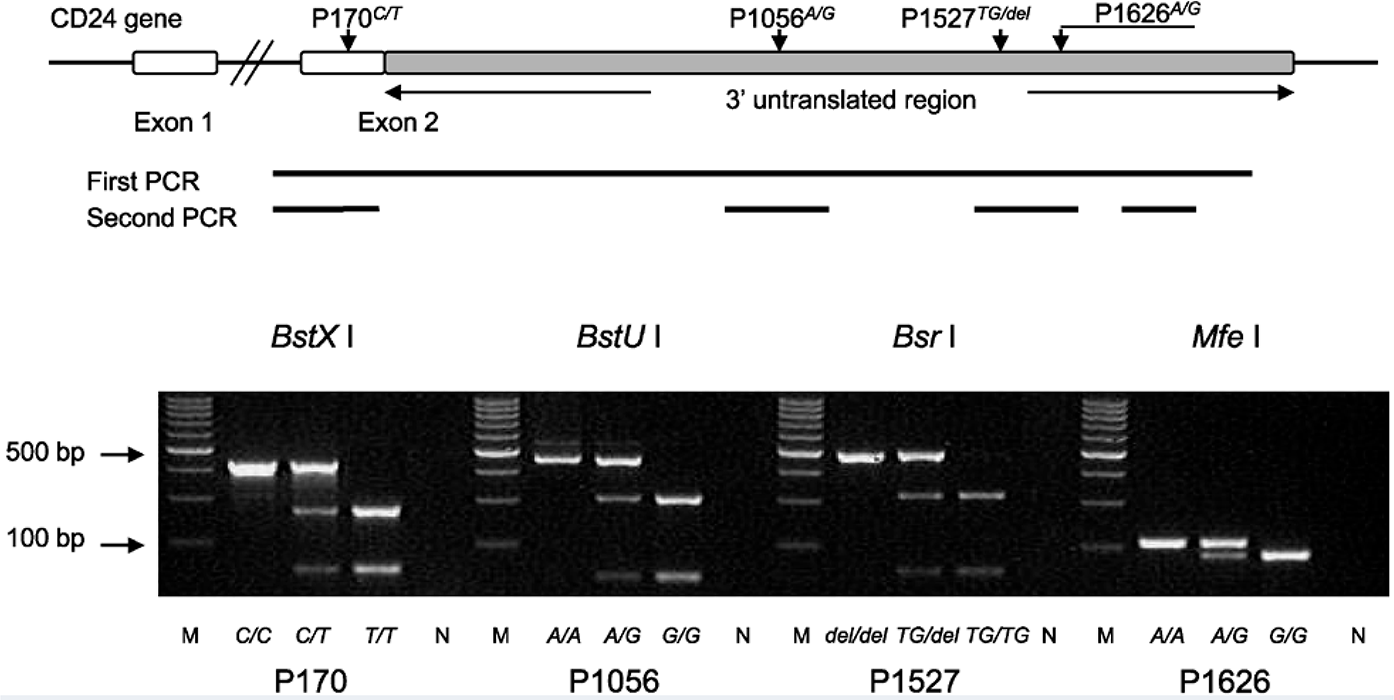
CD24 polymorphism genotyping. Upper panel: CD24 gene and the relative location of the 3′-untranslated region (grey box). The location of each variability is pointed by a downward arrow. The bottom lines illustrate the location of the PCR primers. Lower panel: the genetic profile of the 4 polymorphisms, including the T/G deletion at position 1527. Polymorphism will exclude a restriction site, so the existence of 3 bands indicates a heterozygote subject who carry the polymorphism only in one of his alleles, while the existence of only 2 bands indicates a subject that does not carry the polymorphism in none of his alleles. Numbers on the left side represent the size of a standard deoxyribonucleic acid marker (base pairs). Reprinted (modified) from Wang et al, 17 according to the creative commons of Open Access Publishing, London. M, molecular size marker; N, negative control; PCR, polymerase chain reaction.
CD24 Protein Levels Measurements Using Western Blotting
The blood samples were first centrifugated for 3 minutes at a 3000 rpm. The PBLs were isolated by collecting the buffy coats after discarding the plasma. The PBLs were incubated in an erythrocyte lysis buffer containing 155 mM ammonium chloride, 0.1 mM ethylenediaminetetraacetic acid, and 10 mM potassium bicarbonate in order to lyse the remaining erythrocytes. The pellet was washed a few times with phosphate-buffered saline until it was clean from hemoglobin. The protein extraction was performed by incubating the cells for 15 minutes in a lysis buffer containing 1% Triton X-100 on ice, and then the lysate was centrifuged for 15 minutes at 12 000 rpm. The protein concentration was determined using Bradford assay and protein extracts (20 µg) were subjected to sodium dodecyl sulfate-polyacrylamide gel electrophoresis and Western blotting using anti-CD24 monoclonal antibody.
Statistical Analysis
Data were entered and analyzed in SPSS version 23.0. Descriptive statistics were produced using frequencies (N, %) for categorical variables (eg, gender), means, standard deviations, medians, and ranges for continuous variables (eg, age).
Differences between groups were tested by χ 2 analyses for categorical variables, and Student’s t-test for continuous variables.
The densitometry results were analyzed with MedCalc statistical software.
Results
CD24 TG/del Genetic Variant Association With CRC Risk
A total of 179 subjects were included in the study, with 36 subjects who represent the study group of patients with different stages of colorectal tumors and a control group of 143 healthy subjects with normal colonoscopy.
Only 5 patients (14%) with CRC carried the TG/del polymorphism. That is with respect to a 10% rate of TG/del polymorphism among the control group (P = 0.54). Interestingly, the 5 patients who carried the mutation were those with early stages of disease (Table 1).
Distribution of TG/del Polymorphism Among the Study Group. a

aFive out of 36 patients (14%) with colorectal tumors carry the TG/del variant on the CD24 gene. The table is showing the distribution of those subjects by gender, age group, and stage of disease.
CD24 Expression Levels in PBLs Does Not Correlate With Stage of the Disease
Western blot analysis for CD24 expression was performed on PBLs obtained from individuals with adenomas, CRC (all stages of the disease), and healthy individuals.
The above analysis showed significantly higher levels of CD24 expression among the study group individuals with CRC and colorectal adenomas (average protein levels of 13 464 optical density [OD]/mm2 and median levels of 14 221 OD/mm2) compared with the control group individuals without any colorectal lesion (average protein levels of 5230 OD/mm2 and median levels of 2441 OD/ mm2) (P < .001). No significant differences in CD24 expression have been shown at all stages of the disease, starting from premalignant adenoma up to metastatic stage 4 disease (Figure 2). However, all of them were significantly higher than the expression levels in healthy individuals.
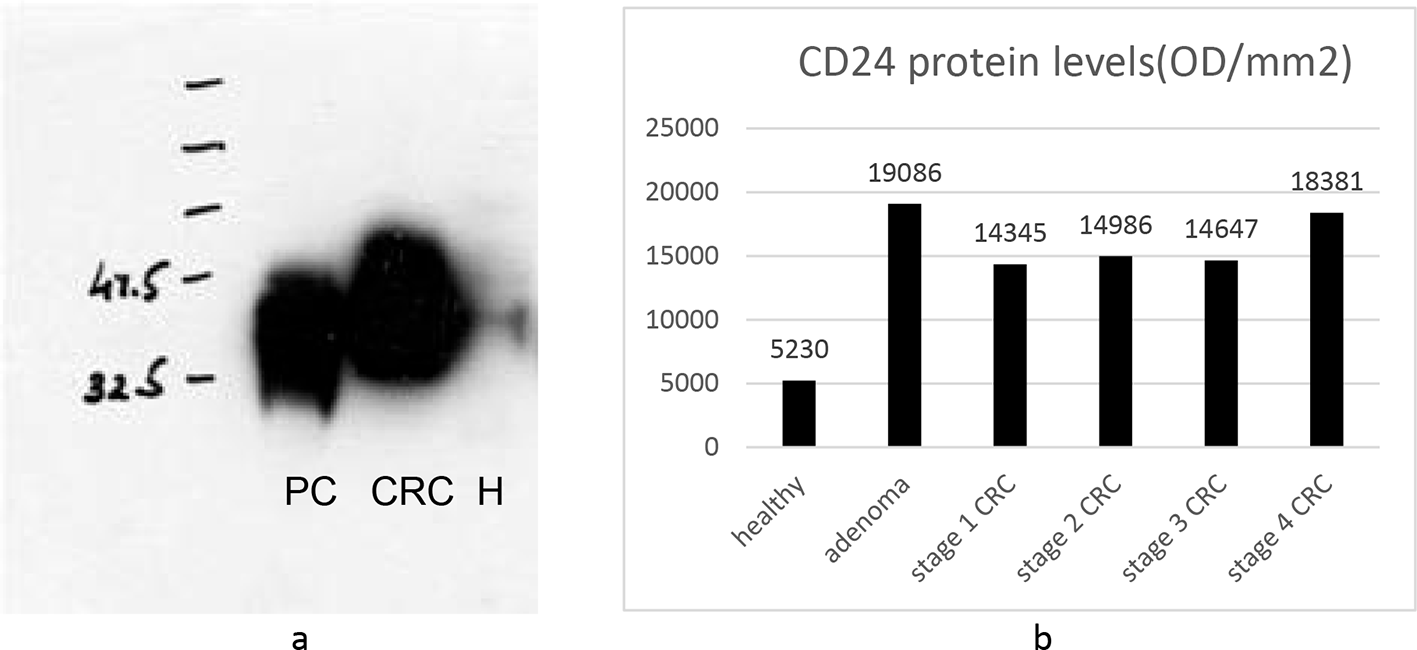
Expression of CD24 protein among study individuals: (A) Western blotting analysis using monoclonal antibody specific for CD24. Numbers on the left represent molecular weight in kDa. (B) CD24 protein levels determined by densitometry. Levels are presented as OD per unit area (OD/mm2). CRC, lysate from colorectal cancer patient; H, lysate from healthy subject; OD, optical density; PC, positive control.
In addition, patients who carry the TG/del polymorphism had similar CD24 protein levels as without this genetic alternation (15 591 OD/mm2 and 15 072 OD/mm2, respectively).
Discussion
At least 20% of all CRC cases are familial, but most of the genetic mutations that stand behind those familial cases are not yet known.
Genetic polymorphism has an impact on prognosis and response to treatment in various malignancies.22,23 Hence, tests that would potentially identify carriers with a specific polymorphism will have tremendous implications in clinical settings.
CD24 expression among CRC patients is enhanced as compared with the healthy population. It is an early event as it is already expressed in adenomas.9,24 Hence, CD24 may serve as a potential biomarker for early detection of CRC. 24 CD24 has a special interest as a biomarker since it may not only be used to predict patient risk but also serve as a potential target in cancer therapy.
Several genetic polymorphisms have been identified within the CD24 gene. In this study, we have chosen to focus on the TG/del at the 3′-UTR. This genetic variant causes instability within the CD24 mRNA and protects from the development and progression of multiple sclerosis and SLE. 17 Studies imply that CD24 has an important role in the function of the immune system, in the autoimmune response, and the progression and the prognosis of various cancerous processes.25-28 Since the TG/del variant destabilizes CD24 mRNA and therefore should reduce the levels of CD24 protein, it was speculated that this specific polymorphism might protect from malignancy.
In contrast to that speculation, in this current study, we found higher rates of TG/del variant carriers among patients with CRC compared with healthy controls (14% and 10%, respectively). Nevertheless, this difference did not reach statistical significance, possibly due to the relatively low volume of CRC patients. In addition, patients with the variant did not have lower levels of CD24 protein compared with noncarriers.
Similar results were demonstrated in breast cancer where no correlation between CD24 3′-UTR (TG/Del) genotype and pathologic complete response of primary breast cancer was observed as well. 29
In summary, this study is part of a comprehensive, prospective longitudinal project evaluating the importance of CD24 in CRC. TG/del polymorphism might be another factor that possesses increased risk for this important cancer. There is a clear need for further investigation and understanding of genetic polymorphism and its relation to cancer risk. Specifically, for the combinations of various genetic changes as we had shown regarding the I1307K in the APC gene and A170V in the CD24. 30 It can help in identifying high-risk and low-risk populations with different screening recommendations.
A large number of cases and controls are required to enable us to make a more precise risk estimate analysis.
Footnotes
Declaration of Conflicting Interests
The author(s) declared no potential conflicts of interest with respect to the research, authorship, and/or publication of this article.
Funding
The author(s) received no financial support for the research, authorship, and/or publication of this article.
