







Abstract

Pemberton’s sign is a physical examination maneuver in which bilateral arm elevation (180 degree anterior flexion at the shoulder) triggers a series of signs and symptoms that indicate the presence of obstruction at the level of the thoracic inlet. On rare occasions, an enlarged thyroid may cause a reversible superior vena cava syndrome and on occasions be associated with compression of the trachea and esophagus that is further appreciated with the execution of this maneuver. There is some debate regarding the dynamics for the characteristic presentation of this sign. We will discuss and review the current literature as we present a brief report of a 56-year-old woman who presented to the office with a classic presentation of Pemberton’s sign from a markedly enlarged multinodular thyroid goiter.
Dr Hugh Pemberton was the first to describe the physical examination maneuver to demonstrate the presence of a reversible obstruction in between the bony structures that compose the thoracic inlet known as the Pemberton’s sign in 1946. 1 A positive Pemberton’s sign consists of marked facial cyanosis and congestion with possible associated upper respiratory obstructive symptoms after having the patient elevate both arms above the head for a short period of time. The provoked obstruction reveals signs and symptoms of a superior vena cava syndrome as well as an external tracheal and on rare occasions esophageal compression by “corking” the thoracic inlet. 2 -4 A retrosternal goiter is usually described as the most frequent cause of a positive Pemberton’s sign. 1 Some authors contribute this to the descent of the thyroid into the thoracic inlet; others describe that the components of the thoracic inlet compress the thyroid during the execution of the maneuver, causing this obstructive effect. Differential diagnoses may enclose enlarged paratracheal lymph nodes, lymphoma, thymoma, teratoma, thyroid pathology, inflammatory processes, and aortic aneurysms that may present with the same obstructive symptoms described by Dr Hugh Pemberton. 4
A 56-year-old woman presented to the office with complaints of a sensation of tightness around her neck as well as facial plethora when she lifted both of her arms like when she put her hair in a ponytail and when she reached up above her head to “grab stuff from her closet” (Figure 1). She also complained of increasing dysphagia, hoarseness, changes in her voice, and a new onset dry cough for the past 6-8 months. On physical examination, she had a palpable enlarged thyroid with a positive Pemberton’s sign. Thyroid ultrasound showed a markedly enlarged heterogeneous multinodular thyroid goiter (right lobe measuring 8.6 × 3.3 × 3.2 cm and left lobe measuring 7.0 × 4.3 × 4.0 cm) with a dominant left lobe nodule measuring 24 × 25 × 31 mm (with thyroid image reporting and data system [TI-RADS] 5 features) and 3 right lobe nodules measuring 14 × 8 × 19 mm, 14 × 12 × 12 mm, and 18 × 16 × 15 mm (all with TI-RADS 3 features), respectively. Initial laboratory studies showed a thyroid-stimulating hormone of 0.812 and free thyroxine (T4) of 1.0. A computed tomography (CT) scan of the chest ruled out a possible substernal goiter. A dynamic vascular ultrasound of the neck and its vessels was preformed and showed partial blockage of venous flow through the internal jugular veins when preforming the Pemberton’s maneuver. After proper health optimization, the patient was taken to the operating room where a total thyroidectomy was performed without complications. On her postoperative examination, she was able to elevate her arms above her head without shortness of breath, and there was no facial plethora or sensation of tightness around her neck (negative Pemberton’s sign) (Figure 1). The pathology report portrayed a final diagnosis of multifocal papillary carcinoma, classic type, with negative margins and negative lymph node invasion (T2N0).
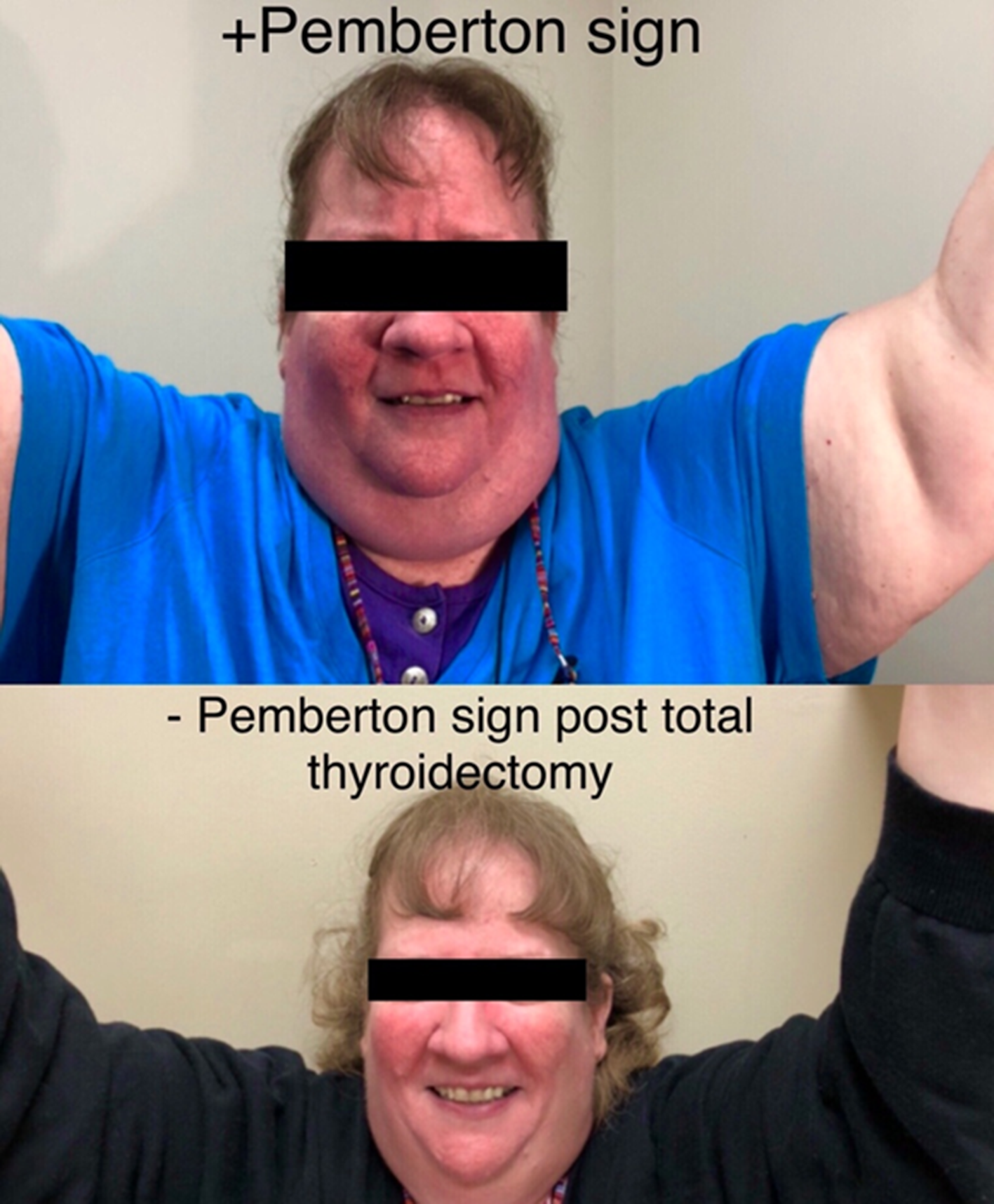
Pemberton’s sign in a patient after having the patient raise her arms above her head (180 degree anterior flexion at the shoulder). Notice the marked facial plethora and venous congestion (top). No evidence of previous Pemberton’s sign after total thyroidectomy for multinodular goiter (bottom).
While most cases of superior vena cava compression are secondary to lung cancers or lymphomas, there is a small percentage of cases where it may present secondary to thyroid pathologies such as thyroid neoplasms and thyroid goiters. 4 Superior vena cava syndrome consists of backflow of venous return resulting in the congestion of vessels that would otherwise physiologically drain into the thoracic inlet and into the right atrium. Other structures that form part of the thoracic inlet that are in intimate relation to the thyroid are the trachea and, behind it, the esophagus. Compression of these structures will present with signs and symptoms of dysphagia, facial plethora, shortness of breath, and tightness around the neck similar to our patient’s presentation. 2,3 Some authors contribute this phenomenon to the descent of the thyroid into the thoracic inlet. This theory may be justified in the case such as a retrosternal goiter in which elevation of both upper extremities causes a downward traction on the structures adhered to components of the thoracic inlet; in this case, the thyroid in relation to the trachea. Others describe the components of the thoracic inlet compress the thyroid. This may be the case in a nonretrosternal goiter where execution of this maneuver elevates the structures that compose the thoracic inlet such as the clavicles and first rib that push against the enlarged thyroid and cause the described temporary vascular, respiratory, and esophageal obstructive symptoms. Further dynamic studies need to take place to further assess the dynamics that take for the presentation of this sign in relation to different types of thyroid pathology.
Pemberton’s sign is a valuable maneuver that may be a key finding on our physical exam and can be done in an office setting. A positive Pemberton’s sign should raise suspicion of an enlarged structure as a cause of this reproducible thoracic inlet obstruction. Even though most cases of positive Pemberton’s sign are described with retrosternal goiters, there are cases, such as our patients, where this sign may be present with a nonretrosternal goiter.
We thank our patient for allowing us to report her case for medical educational purposes.
Footnotes
Declaration of Conflicting Interests
The author(s) declared no potential conflicts of interest with respect to the research, authorship, and/or publication of this article.
Funding
The author(s) received no financial support for the research, authorship, and/or publication of this article.