







Abstract
Background
Twitter at conferences facilitates remote interaction and spread of ideas. Through the use of hashtags, conference information can be gathered, referenced, disseminated, and discussed in 1 electronic location by attendees and nonattendees from remote locations. The aim of this study is to analyze the American College of Surgeons Clinical Congress (ACSCC) Twitter hashtag activities and evaluate its impact on meeting participation and engagement for the last 5 annual meetings.
Methods
Twitter hashtags #ACSCC15, #ACSCC16, #ACSCC17, #ACSCC18, and #ACSCC19 were studied to determine tweets, retweets, users, and impressions. Data regarding top influencers and the most tweeted links were analyzed. Symplur Signals, a software that specializes in hashtags, was utilized for the analyses.
Results
Between 2015 and 2017, there was a consistent increase in tweets from 12 800 to 18 300 to 24 700, respectively. However, in 2018 and 2019, tweets dropped significantly to 19 700 and 19 300, respectively (P < .05). Additionally, impressions dropped significantly by 24 million impressions from 2017 to 2019 (115.1M to 91.1M, P < .05) despite the growth of users from 2700 in 2015 to 4100 in 2016 and ~6500 in 2017-2019. This change occurred despite no change in meeting attendance rates, regardless of specialty (P > .05). The most influential organizations in hashtag use were the American College of Surgeons (ACS) and Association of Women Surgeons (AWS).
Conclusion
Despite the significant reduction in views and online engagement activities in the past 2 years, the use of Twitter at the ACS CC has greatly increased the potential dissemination of information but not meeting attendance rates.
Keywords
Background
Social media has drastically changed the landscape of medical care, education, and communication by facilitating the instant exchange of ideas and dissemination of information. Platforms such as Twitter, YouTube, and podcasting have revolutionized the improvement of health care by engaging providers in worldwide discussion of novel ideas. More recently, Twitter specifically has come to the forefront as a unique tool in enhancing dissemination of new information at surgical conferences.
Twitter is particularly useful for facilitating conversation among health care professionals and organizations because of its “microblogging” format. The 280-character limit allows for a brief statement to which other users can interact; in fact, the character limit may make interaction more enticing to participants, in the often pedantic field of medicine. Twitter has proven useful in regard to engaging conference participants, those attending in presence or remotely, through hashtags, which link common tweets together. Users can like or retweet messages posted by other users, along with commenting to start a conversation. Twitter is uniquely suited for interactions in a conference setting because the format allows the sharing of individual comments along with links, which can range from YouTube videos to scientific publications.
In a comprehensive literature review, data showed an increase in social media use for educational purposes of physicians and trainees from 1990 to 2018. 1 The most popular tools for education on social media include podcasts, YouTube, Twitter, and blogs. Social media has also gained popularity as an educational tool since it facilitates interaction and connection with other learners. 2 This instant connection is beneficial at conferences because it allows participants to give instant feedback and ask questions, even while the conference presentation is occurring.
Most of the published literature regarding Twitter use at conferences is focused on the increasing numbers of users, with tweets and impressions indicating the increased impact conferences can have on people beyond the scope of those attending.3-11 Colloquially called “Tweeting the meeting” reports from a variety of specialties indicate that Twitter use has increased from somewhat modest beginnings of simply a few journals, organizations, and doctors to hundreds or even thousands of participants.
McKendrick and Cumming outlined the logistics of starting, utilizing, and promoting Twitter use at a conference. 12 Each conference should have its own Twitter profile, which should be used to promote and advertise the conference itself, along with a specific hashtag so that tweets from the conference can be easily located. The conferences presentations, speakers, and events should be advertised well in advance, along with supplemental educational information to support the topics that will be presented at the conference. 7
This study aims to evaluate the use of Twitter at the annual American College of Surgeons Clinical Congress (ACSCC) from 2015 to 2019, and determine how usage has changed temporally over the years. No other published studies have looked at the influence that Twitter has had on attendance and engagement at surgical conferences. We hypothesize that increased Twitter activity will maximize meeting online engagement and conference attendance rates.
Methods
This study focuses on the utilization of Twitter at the ACSCC from 2015 to 2019. With Symplur Signals software (Upland, CA), we analyzed the following conference hashtags to gain information on Twitter activity at these meetings: #ACSCC15, #ACSCC16, #ACSCC17, #ACSCC18, and #ACSCC19. Symplur Signals is a software specifically designed to analyze Twitter statistics of health care-related topics. Symplur Signals provided us with the number of tweets, retweets, impressions, users, and links that were part of the conference specific online conversation as identified by the hashtags.
An analysis of the previously stated hashtags was performed to gain information on the use of Twitter from 2015 to 2019. Impressions are defined as how many people viewed the content on their Twitter feed, and Twitter engagement is defined as the number of tweets and retweets. Tweets and retweets were used as a marker of engagement, meaning if a person viewed the information and decided to take action on it. Influencers are defined as a person or organization, identified by their username and profile, with a large number of followers, who were highly active with hashtag use, mentions as well as conversation initiation and participation. Surgeon influencers were identified by specialty and differentiated in alphabetical order. Data regarding the most tweeted links during the conferences were also extracted using a Symplur Signals filter to establish which links being tweeted using conferences hashtags are relevant to the meeting. Data from Twitter and conference attendance were analyzed yearly not cumulatively and then compared by year. Details regarding the specifics of who was tweeting, retweeting, and commenting was not available; however, information in regard to this is captured by influencer analytics. Influencers obtain this title by frequently using meeting hashtags, meaning that they are significant participants in meeting conversation. IBM SPSS statistics software version 22 was used for data analyses. Statistical significance was defined as P < .05.
Data analyses were performed on publicly available information. Twitter users included in the analysis had agreed to their participation per the terms and conditions of general usage of Twitter. This study was reviewed by the Institutional Review Board and deemed exempt.
Results
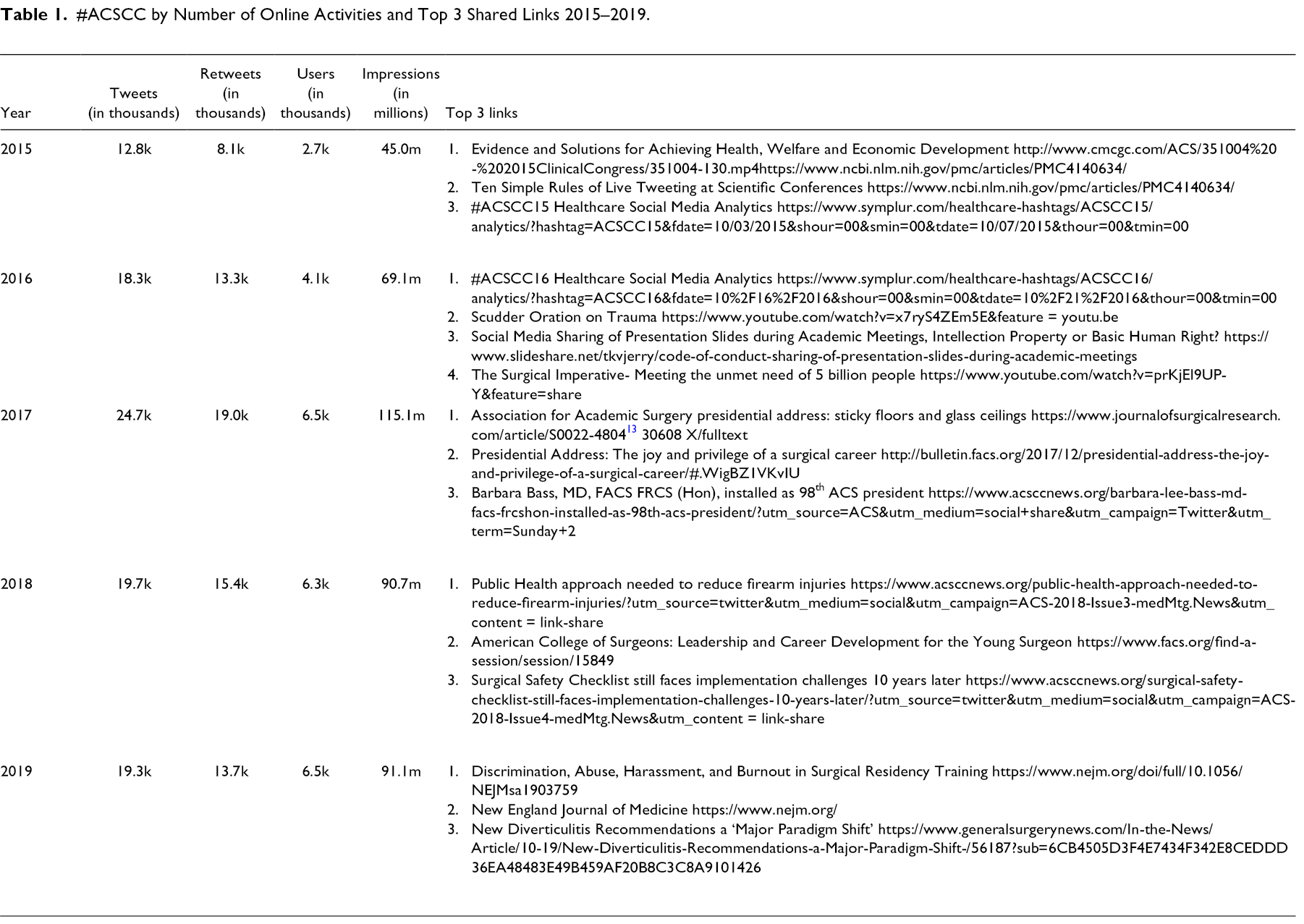
Data collected from the Symplur Software including tweets, retweets, users, impressions, and Top 3 Links tweeted are summarized in Table 1. Between the years 2015 and 2017, there was a consistent and significant increase in tweets from 12 800 in 2015 to 18 300 in 2016 to 24 700 in 2017 (P < .05). However, in 2018 and 2019, tweets dropped significantly to 19 700 and 19 300, respectively (P < .05). Impressions reflected a similar peak and significant increase in 2017 at 115.1 million up from 45 million in 2015 and 69.1 million in 2016 (P < .05). However, impressions dropped significantly by 24 million impressions from 2017 to 2019 (from 115.1 million to 91.1 million, P < .05) despite the growth of users from 2700 in 2015 to 4100 in 2016 and approximately 6500 in 2017-2019 (Figure 1).
#ACSCC by Number of Online Activities and Top 3 Shared Links 2015–2019.
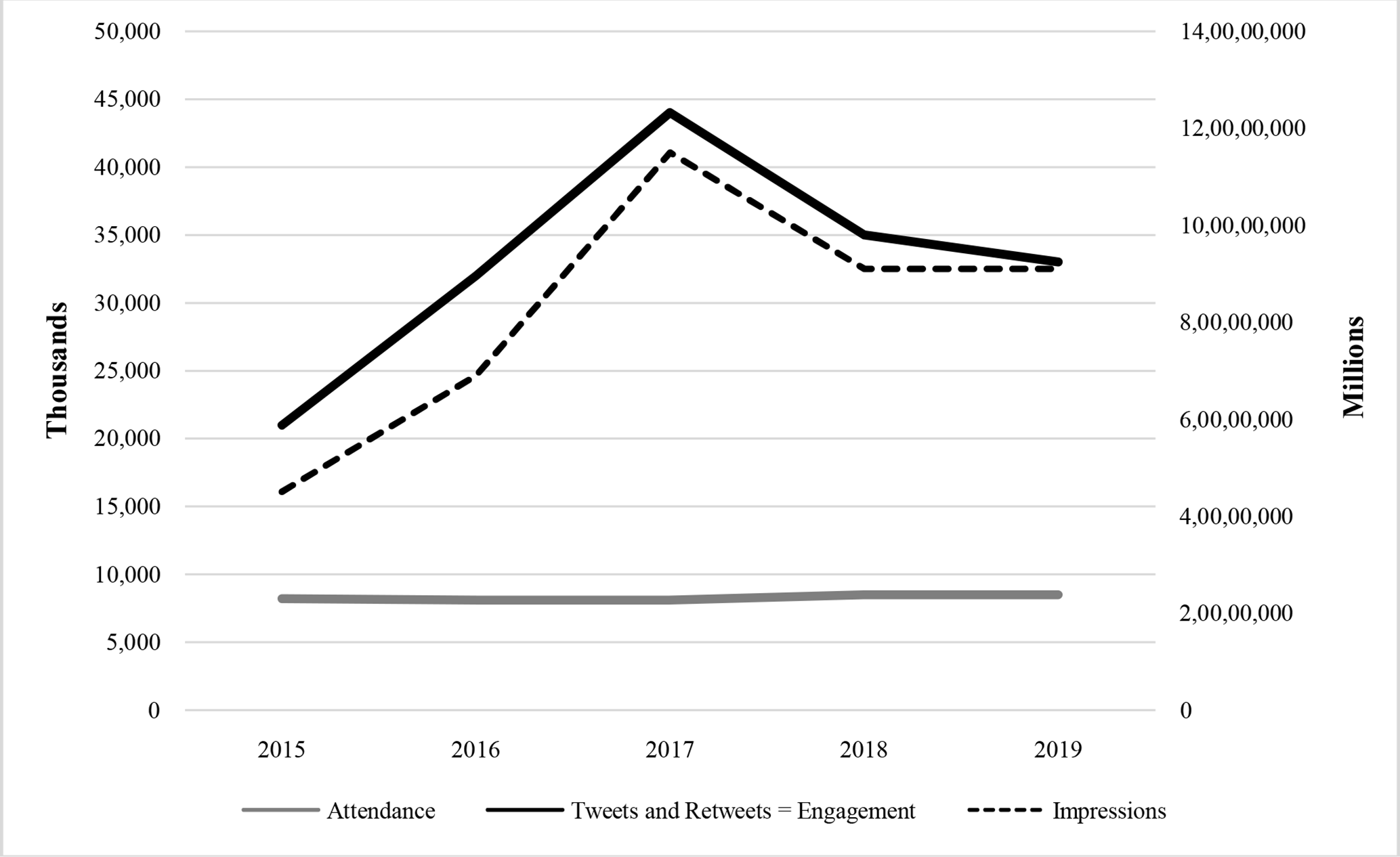
Online engagement, impressions and attendance at the ACSCC 2015-2019.
The most tweeted links tended to represent official presentations from the Presidents of the American College of Surgeons, but did also show links to new research articles presented at the conference. Currently, there are many outdated links that lead to blog posts that have since been deleted or articles that have been archived (Table 1).
Table 2 summarizes the top 10 influencers by specialty for the 2015-2019 ACSCC either represented by an organization or an individual account. By quantitative data, the American College of Surgeons (@AmCollSurgeons) remained the top influencer for 2015-2019. In addition, the Association of Women Surgeons (AWS, @WomenSurgeons), Resident and Associate Society of the American College of Surgeons (RAS-ACS, @RASACS), Society of University Surgeons (SUS, @UnivSurg), American College of Surgeons Council on Trauma (ACS COT, @ACSTrauma), and Cirbosque (@Cirbosque) remained among the top 10 influencers for 2015-2019. The remainder of the influencers were mostly individual surgeons in a variety of specialties and training levels.
#ACSCC Top 10 Influencers by Specialty 2015-2019.
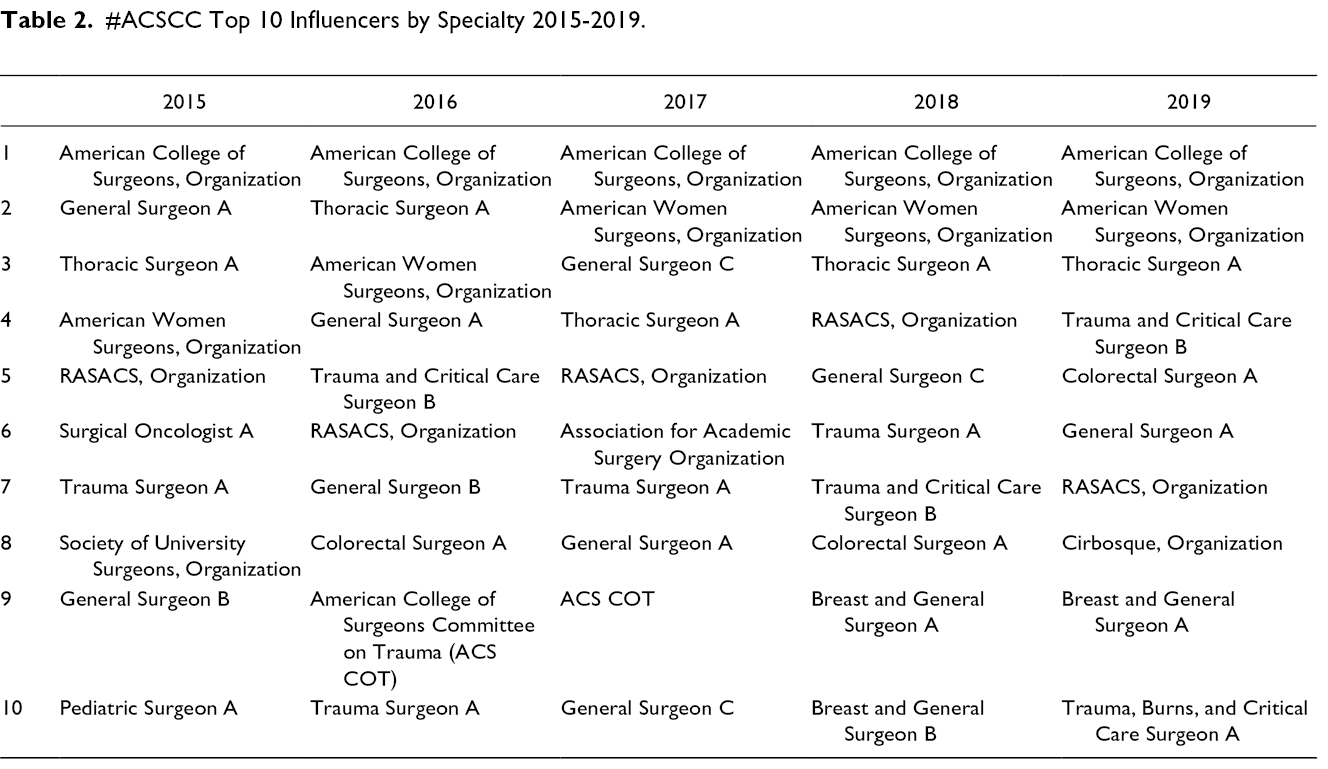
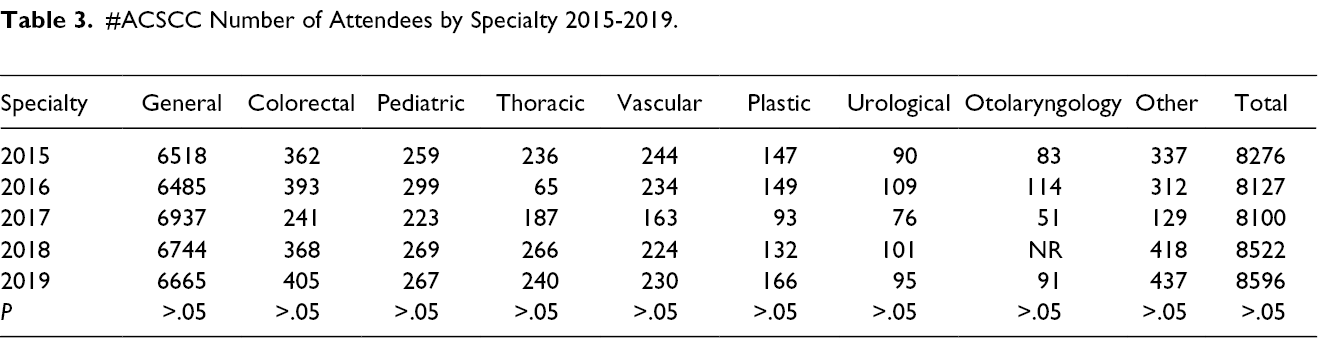
Table 3 outlines attendance at the ACSCCs from 2015 to 2019 by specialty. Attendance at the (Figure 1) conferences did not significantly increase through the years (8276 in 2015 to 8596 in 2019, P > .05). Drops in attendance did occur, to 8127 in 2016 when the conference was held in Washington DC and again to 8100 in 2017 when the conference was held in San Diego, California. In addition, despite the decrease in Twitter activities (impressions, tweets, and retweets) from 2017 to 2018 and 2018 to 2019, impressions, tweets, and retweets remained higher than they were in 2016 (Figure 1).
#ACSCC Number of Attendees by Specialty 2015-2019.
Discussion
Our study found that there was an increase in Twitter activities and engagement at the ACSCC from 2015 to 2017 followed by a decrease in 2018 and 2019. Despite this decrease, impressions and online reachability via Twitter remained high, indicating that conference contents were still heavily viewed despite the decrease in engagement and active participation. A thorough literature review found that though there are many articles on the use of Twitter at medical conferences, there is very little information on the influence of Twitter on engagement in general surgery conferences in the United States.3-11
Twitter engagement indicates active participation in conference-related conversations, including tweeting information from the meeting, responding to someone else’s tweet, or retweeting someone else’s tweet. Impressions is a passive form of involvement, meaning that a user viewed information that was related to the conference on their feed from someone who was actively participating in the conversation. While impressions will usually be higher than engagement (tweets and retweets), it would be ideal to increase tweets and retweets to have more active participation numerically. There is a clear correlation of engagement to impressions. When engagement increased from 2015 to 2017, so did impressions, and after engagement dipped in 2018 and 2019, so did impressions (Figure 1). When discussing engagement in the form of tweets and retweets, it is important to understand where the majority of the tweets are coming from. In 2015, 67.4% of users who participated in conference hashtag use only tweeted once, while only 10.1% of users tweeted more than 5 times. These numbers remained consistent from 2015 to 2019, with the highest percentage of tweeting more than 5 times being in 2016, when it reached 11.8% of users. 3 In 2017, 54.1% of users tweeted 1 time while 10.3% tweeted more than 5 times, 62.9% of people in 2018 tweeted 1 time, and only 8.4% tweeted more than 5 times. In 2019, 71.1% of users tweeted 1 time and 8.6% of users tweeted more than 5 times.
One interesting trend that appeared in our analysis was the relationship between engagement and number of users. Number of users and amount of engagement increased together from 2015 to 2017. However, this trend dissolved from 2017 to 2019 when engagement continued to decrease while users merely stabilized. The concept of social media fatigue may play a role in the decreased engagement. This phenomenon is described as users tending to refrain from active interaction on social media and simply scrolling to view content. A presence on social media requires constant attention, due to interacting with others, creating posts and responding to comments, and users may simply pull back as a response to being overwhelmed with information and demands. 12
Conferences are the primary location of continuing medical education for fully trained physicians, but attendees also include fellows, residents, students, and other health care professionals. In recent years, Twitter has been used as an internet-based modality to increase the scope of audience that conferences reach, including to those in the field unable to attend as well as the general public. Twitter can be used in a wide variety of ways to benefit the medical community—journals or authors sharing their publications, professional societies communicating with their members, advocacy groups sharing new information, and physicians educating the public. 12 One study even showed that after a publication was shared on Twitter, there was a small but significant increase in article page views. 14 Symplur’s identification of links with the highest shares often includes articles of new research presented at the conference, which could potentially lead to increased views of new articles on PubMed even after the conference has ended.
Another study described other noteworthy benefits of Twitter use at conferences, allowing the user to benefit from the educational adjunct of summarizing a presentation into 280-character limit, and using the microblog itself to help build their brand. Twitter allows for networking and mentoring relationships to form, and continue online, especially if connections are made at a conference. The study also described Twitter as being “the great equalizer” stating that the inexperienced participants, or even those not in attendance, had access to communicate with the experienced presenters. 15 These interactions can lead to relationships, associations, and networking, which are particularly critical in the field of surgery, where mentorship and industry connections are invaluable.
Researchers at the 2015 American Urological Association meeting evaluated the relationship between studies that were posted on Twitter from the conference that received at least 1 like or retweet, and the likelihood that they would later be published. Of the 496 studies posted involving new ideas, 45 months later 96 (19.4%) of those studies were identifiable on PubMed. These findings indicated a modest positive correlation between number of likes or retweets and subsequent publication. 16
A study of Twitter use across 14 anesthesiology conferences showed that physician influencers are important drivers of participation. There was positive correlation between the number of physician influencers and the amount of Twitter activity. 7 Between 2013 and 2016, the Spanish Association of Surgeons studied who exactly was tweeting at their meeting. Originally, physician influencers were responsible for 65% of the tweets, which decreased to 35%, indicating a wider population participating in discussion surrounding the conference. 17 Physician influencers set the precedence for Twitter conversations related to surgical topics, in the hope that their leadership will open doors of communication and learning for other Twitter users. This information suggests that if we follow the trend of Twitter use at the ACSCC, the current physician influencers will become less prevalent in the online conversation, due to their followers, physician or not, becoming more engaged in conference topics.
This project aims to document the influence of Twitter in the constantly evolving world of health care and technology as it relates to engagement at the ACSCC. No other published study has focused on the scope of impact Twitter hashtags have on the participation of those attending and remote to the Clinical Congress meetings. By highlighting the many benefits of Twitter use at conferences, the goal is to better promote conference hashtags prior to the meeting to maximize online engagement.
For future conferences looking to optimize online engagement, our recommendation would be to advertise hashtags and programming using Twitter well in advance of the conference. Several studies found that using a designated group of physicians to promote Twitter use at the conference was beneficial in boosting online interactions related to conference materials.13,18 Another novel idea is to put the conference hashtag on all name tags and programs so that participants have convenient access to the information.
This study does have limitations. We believe that Twitter use did not match up in part due to conference locations changing each year. San Francisco is expensive and the weather in Boston can be cold, which could contribute to less attendance and less online engagement. It should also be noted that attendance may not be related to Twitter engagement in the same year, but more so in the following year. In addition, hashtags may not adequately encompass all of the conference-related material that is being discussed on Twitter. On the other hand, hashtags are available for use by anyone and may include information that is irrelevant to the conference or topics being presented. Many of the links presented in the Most Tweeted Links section contained links to websites that were no longer available. Other research studies have found that Symplur overestimates impressions.
The benefits of Twitter use at conferences has already positively affected the ACSCC and its realm of influence should increase in the following years. The number of active Twitter users are growing daily and we postulate that web-based services like Twitter will become increasingly important to promote the dissemination of scholarly knowledge at surgical conferences in the future. It will also serve as a platform to allow users to interact with likeminded individuals, conduct erudite discussions, and encourage scientific progress.
Conclusion
The use of Twitter at surgical conferences has greatly increased the speed, breadth, and scope by which information can reach populations beyond those personally attending the conference. Despite the significant reduction in views and online engagement activities beyond 2017, the use of Twitter at the ACS has greatly increased the potential dissemination of information but not meeting attendance rate. Twitter can be a valuable tool in the dissemination of scientific information among the medical community, and we anticipate that this trend will only increase in the future.
Footnotes
Declaration of Conflicting Interests
The author(s) declared no potential conflicts of interest with respect to the research, authorship, and/or publication of this article.
Funding
The author(s) received no financial support for the research, authorship, and/or publication of this article.