







Abstract

Lawn mower rollover accidents are not uncommon in rural America and can lead to significant morbidity and mortality, especially in the elderly population. The American Academy of Pediatrics recommends a minimum age of 16 years for operating a riding lawn mower, but there are no regulations or recommendations regarding a maximum age, most likely due to the paucity of literature in the adult population. 1
Anecdotally, geriatric patients who are hospitalized from lawn mower rollovers seem to have much poorer outcomes with a high mortality rate than their younger counterparts. To investigate this, we performed a retrospective study to determine the risk factors for mortality and to examine the impact of age on mortality of patients aged 16 years and older who are brought to our hospital due to riding lawn mower rollover accidents. As there are data to suggest that motor vehicle drivers over 75 years of age experience fatal accidents at a higher rate, 2 we also compared outcomes of patients who presented with lawn mower rollovers who were older than 75 years with those 75 years and under.
This study was reviewed and approved by our institutional review board (IRB, Marshall University Joan C. Edwards School of Medicine) prior to data collection.
We retrospectively reviewed our institution’s trauma registry for all riding lawn mower accidents in which patients over 16 years of age were thrown off, or the lawn mower rolled over, between January 1, 2010 and December 31, 2019. Cabell Huntington Hospital is a 303-bed academic medical center in Huntington, West Virginia, which serves as a level 2 trauma center encompassing the tristate region of West Virginia, Ohio, and Kentucky.
Lawn mower accidents which occurred while the vehicle was not being operated by the patient or in which the patient was not riding the lawn mower were excluded. Multiple variables including age, sex, admission vital signs, admission labs, injury severity score (ISS), use of anticoagulation therapy, length of stay (LOS), body mass index (BMI), comorbidities, operative intervention, and mortality were extracted from the trauma registry database.
Patient variables were compared between those who died and those who survived after a lawn mower rollover accident. Mean values were used when the data passed the Shapiro-Wilk Test for normality with a two-tailed t-test to compute P-values. Median values with the Mann-Whitney U test were used otherwise.
Patient Characteristics When Categorized by Mortality (Mean SD or Median 25-75th Percentile).a
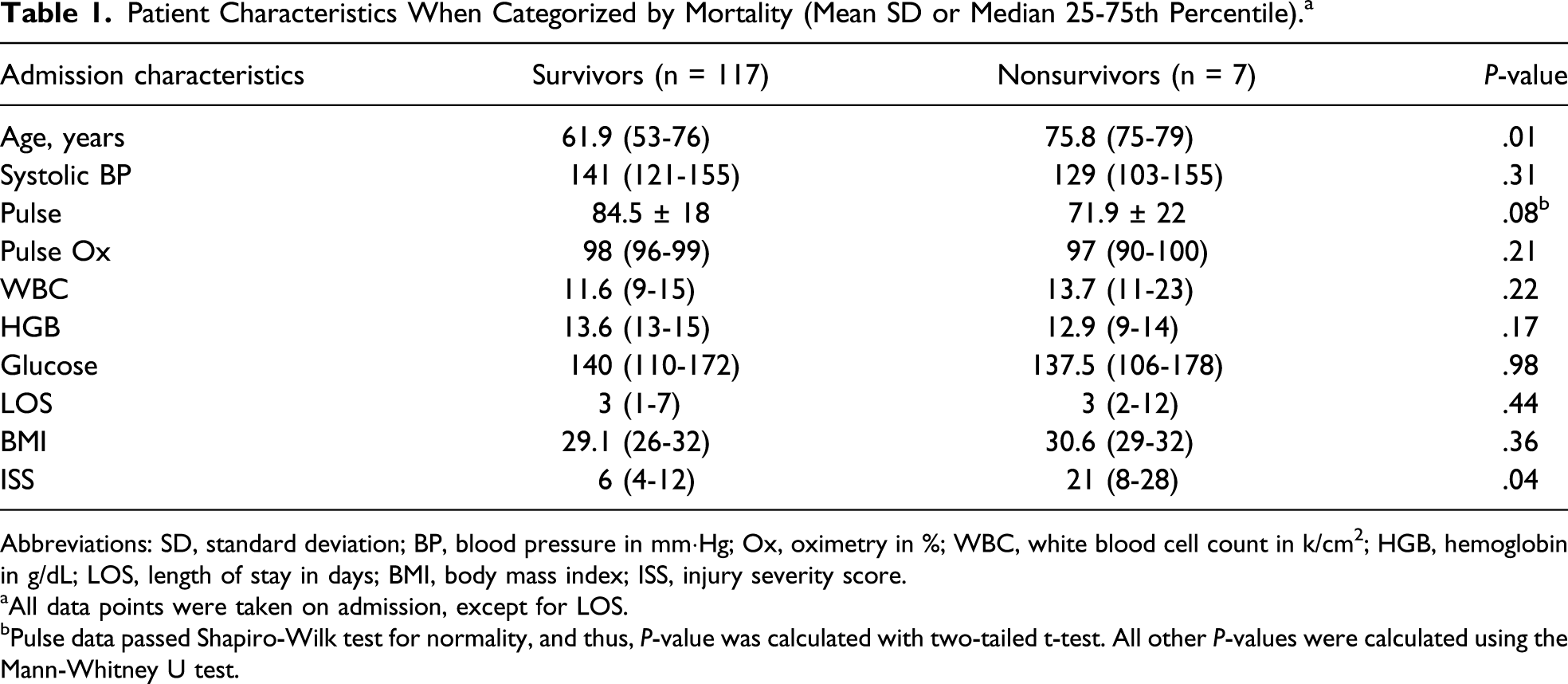
Abbreviations: SD, standard deviation; BP, blood pressure in mm·Hg; Ox, oximetry in %; WBC, white blood cell count in k/cm2; HGB, hemoglobin in g/dL; LOS, length of stay in days; BMI, body mass index; ISS, injury severity score.
All data points were taken on admission, except for LOS.
Pulse data passed Shapiro-Wilk test for normality, and thus, P-value was calculated with two-tailed t-test. All other P-values were calculated using the Mann-Whitney U test.
Patients were next divided into those older than 75 years of age and those 75 years and younger. Patient variables were compared using chi-square test for categorical variables and Student’s t-test for continuous variables. Outcomes between the 2 groups including operative intervention, LOS, and mortality were also compared using a similar method.
Logistic regression was used to analyze mortality adjusting for ISS and BMI. Statistical analysis was performed using R Open 3.6.3 (R Foundation) and SYSTAT 13.2 (Systat Software Inc.).
Patient Characteristics and Outcomes of Patients Aged >75 years Compared With ≤75 years (n% or Median).a
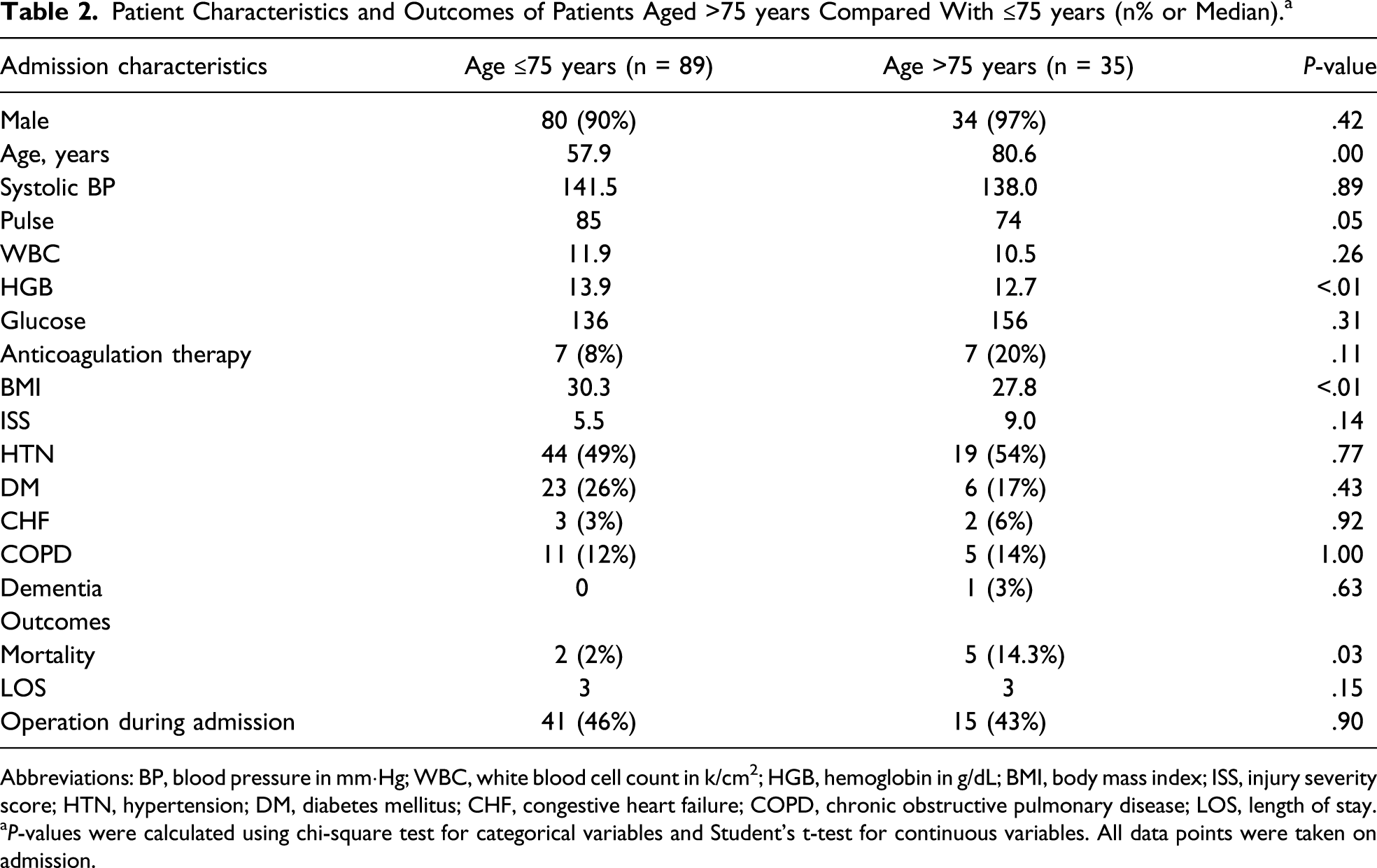
Abbreviations: BP, blood pressure in mm·Hg; WBC, white blood cell count in k/cm2; HGB, hemoglobin in g/dL; BMI, body mass index; ISS, injury severity score; HTN, hypertension; DM, diabetes mellitus; CHF, congestive heart failure; COPD, chronic obstructive pulmonary disease; LOS, length of stay.
P-values were calculated using chi-square test for categorical variables and Student’s t-test for continuous variables. All data points were taken on admission.
There were 35 patients who were older than 75 years of age with 5 deaths within that group, for a mortality rate of 14%. This was significantly higher than the mortality rate of 2% (P = .03) in patients 75 years and younger. Length of stay and need for operation were not significantly different between the 2 groups.
After logistic regression analysis, age over 75 years was determined to be a statistically significant predictor for mortality with an odds ratio (OR) of 7.25 (P = .02). When adjusting for ISS, age over 75 years was a near significant predictor of mortality with an OR of 9.95 (P = .05). When adjusting for ISS and hemoglobin, age over 75 years was not a statistically significant predictor of mortality with an OR of 7.86 (P = .097).
The United States Consumer Product Safety Commission (CPSC) has identified lawn mower accidents as an underrecognized threat to public health with approximately 80-100 deaths per year and 80 000 emergency department visits. Safe operating guidelines are issued by CPSC which include a section that alerts users of hazards to children; however, hazards to the elderly or the adult population are not mentioned. 3
There are an extremely limited number of studies examining lawn mower rollover accidents in adults. 4 None of these studies examine mortality or its association with age. This is the first study to examine the risk factors for mortality in lawn mower rollover accidents in persons aged 16 years and older.
In conclusion, age and ISS were statistically significant factors when comparing survivors with nonsurvivors after a lawn mower rollover accident. Patients with age greater than 75 years had a 14% mortality rate with an OR of 7.25 for mortality compared to those younger than 75 years who had a 2% mortality rate. Based on these findings, and with support from other studies, we may need to educate and caution the elderly with regard to the risks of operating riding lawn mowers into their later decades of life.
Footnotes
Declaration of Conflicting Interests
The author(s) declared no potential conflicts of interest with respect to the research, authorship, and/or publication of this article.
Funding
The author(s) received no financial support for the research, authorship, and/or publication of this article.