






Abstract
Background
Delirium occurs frequently in critically ill and injured patients and is associated with significant morbidity and mortality. Limited data exists on the risk factors for developing delirium in critically ill trauma patients and the effect of antipsychotic (AP) medications on delirium progression.
Objective
The objective of this study is to determine the incidence of delirium in critically ill trauma versus non-trauma surgical patients and determine if the presence of trauma was associated with intensive care unit (ICU) delirium. Secondary outcomes included identifying risk factors for delirium and determining the impact of AP medication use on delirium progression in critically ill trauma patients.
Methods
This retrospective review studies adult trauma/surgical ICU patients admitted between May 2017-July 2018 to a level I trauma and tertiary referral center. Regression modeling was used to determine the impact of AP use on delirium-free days.
Results
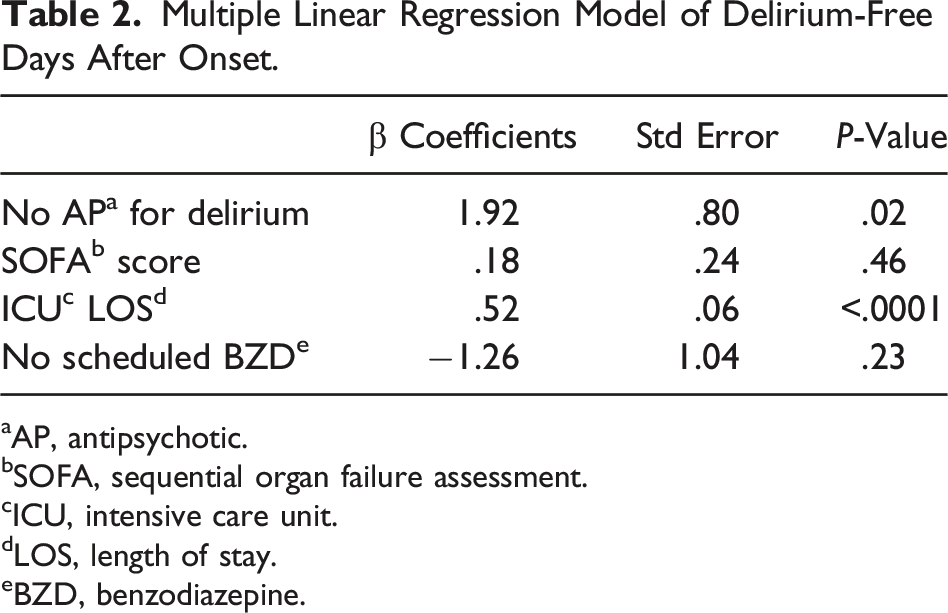
Delirium was more common in critically ill trauma patients versus non-trauma surgical ICU patients [54/157 (34.4%) vs 42/270 (15.6%), P < .001]. Of the 54 trauma patients with delirium, 28 (52%) received an AP medication for delirium treatment and in the multiple linear regression analysis, AP use was significantly associated with fewer delirium-free days (P = .02).
Discussion
Higher admission sequential organ failure assessment scores and increased length of stay were significantly associated with delirium onset in critically ill trauma patients. Use of AP medications for delirium treatment in this population had a negative impact on delirium-free days.
Key Takeaways
Delirium is higher among trauma patients than non-trauma, surgical patients in the ICU. Severity of illness, length of stay, and age are specific risk factors for delirium in this population. When accounting for other risk factors, antipsychotic use was associated with fewer delirium-free days.
Introduction
The Society of Critical Care Medicine guidelines for pain, agitation, and delirium identify delirium in the intensive care unit (ICU) as a syndrome presenting as an acute onset of cognitive dysfunction different from baseline, inattention, and either disorganized thinking or an altered level of consciousness.1,2 Patients with delirium can present with 3 motor subtypes—hypoactive, hyperactive, and mixed. 3 ICU delirium occurs in up to 80% of patients and is associated with increased length of stay (LOS), increased mortality, and excess healthcare costs. 1 Hospital mortality rates associated with delirium have been reported between 25-33%. 4
The pharmacological management of delirium has been a topic for research and debate such that previous guidelines recommended antipsychotics (AP) for the treatment of delirium, but the current guidelines do not recommend the routine use of these medications.1,5,6 Recent studies assessing the impact of haloperidol, quetiapine, and ziprasidone on delirium-related outcomes have shown fewer days associated with agitated delirium and decreased time to delirium resolution with no effect on mortality and ICU LOS.7,8 In contrast, others have shown no difference in delirium onset, duration of ICU delirium, or amount of delirium or coma free days in patients who received AP medications compared to standard care.9-14 Although there are multiple pharmacologic strategies for delirium management, there is a lack of evidence for benefit on significant clinical outcomes; however, APs are frequently utilized in clinical practice for delirium symptom management.1,5
Risk factors that are associated with delirium include patients with dementia, advanced age, prior coma, pre-ICU emergency surgery or trauma, and higher Acute Physiology and Chronic Health Evaluation and American Society of Anesthesiologist scores.5,15 For trauma patients, delirium incidence has been reported in up to 67% of patients with risk factors including lower arrival Glasgow Coma Scale scores, increased blood transfusions, older age in a surgical ICU, deep sedation, mechanical ventilation, and physical restraints.16-18 Additionally, few studies have assessed delirium risks, prevalence, or treatments for critically ill trauma patients, as most focused on those requiring mechanical ventilation or had limited sample sizes.16,17,19 The purpose of our study was to determine the incidence of delirium and risk factors for delirium in critically ill trauma patients, and to compare the effect of AP medications on delirium-free days.
Methods
Study Design
This study was designed as a descriptive subgroup analysis of a retrospective assessment of delirium, approved by the University of Florida Institutional Review Board and granted exempt status from informed consent. Data were collected at a single, 1041-bed academic medical center between May 2017 and July 2018. Patients in the trauma/surgical ICU with an LOS greater than 48 hours, at least 18 years of age, and a diagnosis of ICU delirium were included. Patients were screened for delirium using the Confusion Assessment Method (CAM)-ICU score twice daily and then stratified as trauma and non-trauma patients. 20 Patients with a positive CAM-ICU score at any time during ICU admission were denoted as having delirium, and patients with all Richmond Agitation-Sedation Scale (RASS) scores > or = 0 were further characterized as having hyperactive delirium, all scores < or = 0 with hypoactive delirium, and scores above and below 0 were classified as mixed. 3 Patients who were unable to be assessed with the CAM-ICU, had active malignancy, palliative care or end of life care, pregnant or lactating, or those receiving AP medications prior to the onset of delirium were excluded.
The primary outcome of this study was to assess the incidence of delirium in trauma versus non-trauma surgical ICU patients and determine if the presence of trauma was associated with ICU delirium. Secondary outcomes included identifying risk factors for delirium and determining the impact of AP medication use on delirium progression in critically ill trauma patients. To identify risk factors for delirium in the trauma cohort, patients were divided into 2 groups based on delirium status. Finally, to assess delirium progression the trauma patients with delirium were divided into 2 groups according to the use of any AP medication for treatment (Figure 1). Patient inclusion.
Data Collection
Baseline demographics including age and admission sequential organ failure assessment (SOFA) scores were collected. Information collected regarding the current hospitalization as potential confounders including hospital LOS, ICU LOS, presence of sepsis, and the use of scheduled benzodiazepines (BZDs) and as-needed BZDs. The use of AP medications after delirium onset was also recorded, including the drug, dose, route, and frequency. Delirium-free days were denoted by 2 consecutive negative CAM-ICU scores post-delirium in a calendar day while the patient remained in the ICU. 5
Delirium Protocol
At our institution, management of ICU delirium is multifactorial and includes an assessment of sleep, mobility status, and sedation holidays. Delirium and sedation assessments are conducted and recorded by nursing staff twice daily (once per shift) in the electronic health record. In patients who are CAM-ICU positive, a standardized decision-support order set is implemented which includes pharmacologic agents for both scheduled and as needed medications. Quetiapine, risperidone, and olanzapine are available as oral scheduled options, with olanzapine designated as the preferred choice for patients with a baseline prolonged QTc interval (≥500 msec). Intravenous haloperidol is suggested for patients unable to take oral formulations as a scheduled medication and for breakthrough symptoms. All agents include suggested lower starting and maximum doses for patients >65 years old. However, the ultimate choice of therapy is at the discretion of providers.
Statistical Analysis
Normally distributed continuous baseline characteristics are described using means and standard deviations (SDs), and skewed data are described using medians and interquartile ranges (IQRs). Normality of data was determined by visual inspection of normal quantile plots. Categorical baseline characteristics are described with numbers and proportions.
Risk factors for delirium were assessed with univariable analysis using Chi-squared and two-sample t-tests as appropriate and confirmed with logistic regression modeling. To assess logistic regression model fit, receiver operating characteristic curve was plotted and Hosmer-Lemeshow goodness-of-fit test was performed. Association of delirium free days with AP and BZD use was determined using two-sample T-tests with equal variances confirmed by Brown-Forsythe tests. A bivariate regression was used to determine the correlation between continuous variables and delirium-free days. Variables with P <.2 in the univariable analyses were included in the multiple linear regression model. All statistical analyses were performed using SAS (v9.4; SAS, Cary, NC), with a 2-sided P value less than .05 considered to be statistically significant.
Results
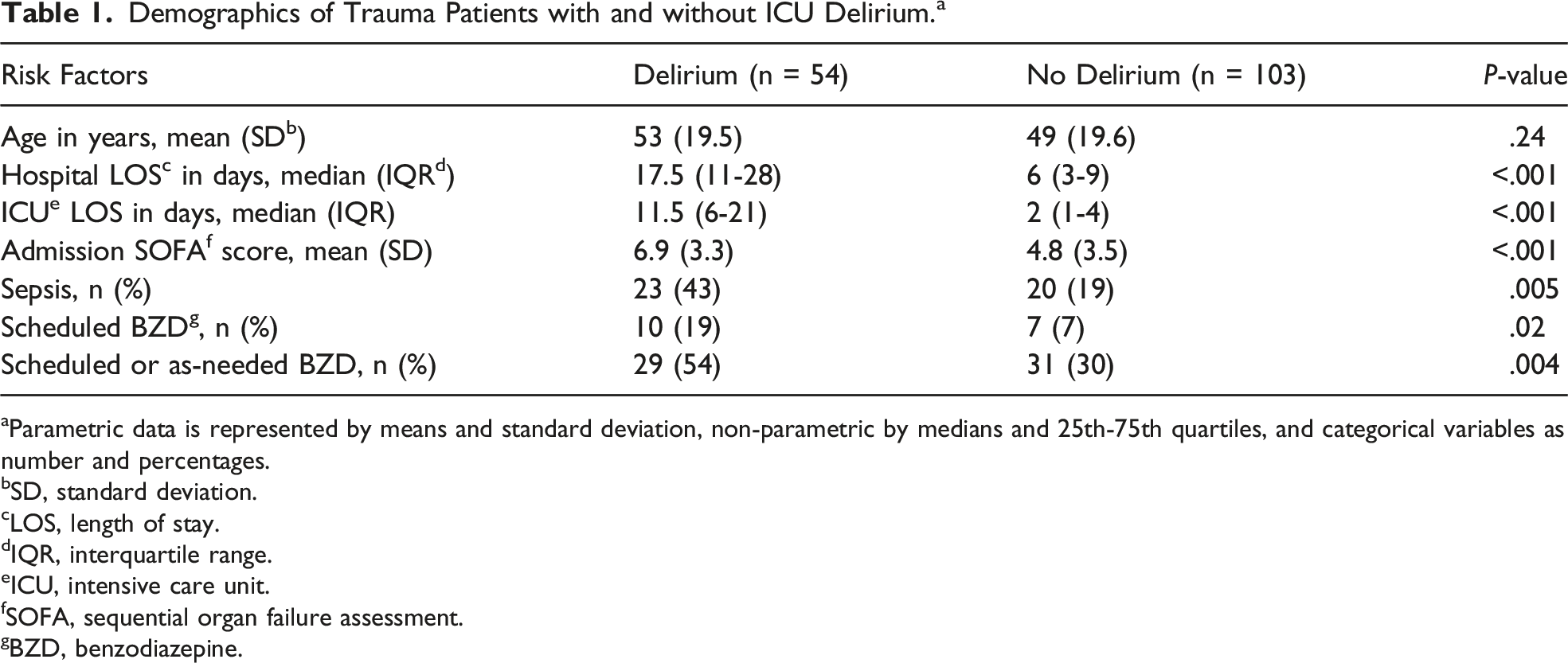
Demographics of Trauma Patients with and without ICU Delirium. a
aParametric data is represented by means and standard deviation, non-parametric by medians and 25th-75th quartiles, and categorical variables as number and percentages.
bSD, standard deviation.
cLOS, length of stay.
dIQR, interquartile range.
eICU, intensive care unit.
fSOFA, sequential organ failure assessment.
gBZD, benzodiazepine.
Multiple Linear Regression Model of Delirium-Free Days After Onset.
aAP, antipsychotic.
bSOFA, sequential organ failure assessment.
cICU, intensive care unit.
dLOS, length of stay.
eBZD, benzodiazepine.
Discussion
Findings of our study support that critically ill, trauma patients are at a higher risk for ICU delirium than other surgical ICU patients. Furthermore, trauma patients with higher SOFA scores and longer ICU LOS are at a higher risk to develop this complication. In our study, most of the patients with delirium (51.9%, 28/54) received APs; of those patients receiving AP with delirium, quetiapine was used and continued for at least 4 days. Univariable analysis resulted in a mean increase in DFD without statistical significance; however, when controlling for severity of illness, length of stay, and avoidance of scheduled benzodiazepines we found that this intervention significantly decreased the number of DFD.
Significant risk factors identified in our analysis included non-modifiable risk factors, such as SOFA score, and modifiable risk factors, including benzodiazepine use and ICU LOS. Higher disease severity scores and benzodiazepine use have been identified by guidelines as risk factors for delirium, but ICU LOS was also found to be significant in our study. Additional risk factors identified by Duceppe et al in a similar patient population, found pre-existing hypertension, diabetes, active sepsis, and use of physical restraints as significant risk factors. 21 Benzodiazepine use, both scheduled and as needed doses, was also a significant risk factor in our univariable analysis whereas traumatically ill patients in the study by Duceppe et al, did not have a significantly higher incidence of delirium despite use of one or more BZDs. Following results of previous studies, minimizing risk factors by utilizing non-pharmacological interventions (early mobilization, sleep optimization, music therapy), and limiting benzodiazepine use should be routine practice.19,22,23 However, we were unable to determine which patients were on started benzodiazepines for either alcohol withdrawal, muscle spasms, or chronic use prior to admission.
Conflicting evidence exists in the literature regarding the use of AP medications for the prevention and treatment of ICU delirium. Previous guideline recommendations for the use of second-generation APs to reduce the duration of delirium were based on earlier studies by Devlin et al and Michaud et al that found use of quetiapine reduced the duration of delirium versus placebo and standard care alone; however, these trials included a broad patient population with limited trauma patients included. Following these publications, several other studies have demonstrated no benefit from the addition of AP medications on days alive without delirium or coma free days or impact on delirium development.13,14 This ultimately led to a change in guidelines, which no longer recommend second-generation APs for either the prevention or treatment of ICU delirium. Despite this change, APs remain a common part of delirium management to avoid BZD medications and treat delirium symptoms. 5
Our study is distinctive in that we did not only demonstrate no change in outcome from the addition of AP medications to treat delirium, but potential association with negative outcomes in trauma patients. Similarly, Von Reuden et al, found AP medications correlated with an increased delirium incidence in trauma patients in the ICU or the intermediate care unit (P = .001). 18 Additionally, another retrospective study by Weaver et al assessing AP use for managing ICU delirium, findings showed a significantly shorter time to delirium resolution (median 36 hours vs 13 hours) for patients who did not receive APs (P < .001). 24 Therefore, these findings bring into question the common practice of AP use for delirium treatment to reduce the number of DFDs or to establish faster times to delirium resolution in the trauma patient population. However, these data are limited to retrospective studies and require further investigation to determine the impact of AP medications in trauma patients with delirium.
The incidence of delirium in our critically ill trauma population is consistent with previous studies ranging from 30% to 70%, with older patients on the higher end of the range.17-19 Additionally, our study consisted mostly of patients with mixed or hypoactive delirium, as denoted by variation in RASS scores. 15 The low prevalence of hyperactive delirium may limit the generalizability of our findings to hyperactive delirium patients; however, this difference in patient population provides an interesting insight into negative delirium outcomes for AP use in a mixed and hypoactive delirium population. Specific delirium subtype stratification was not fully performed due to insufficient data. Finally, misclassification bias is possible because we did not include a quality control for delirium assessment, and patients in the control group with delirium could have screened as negative due to under recognition. 25
As with any retrospective cohort study, challenges involving the control of data quality and potential for bias were present. Additional limitations due to strict inclusion criteria and use of patients from a single center also resulted in a small sample size and reduced generalizability; however, this limitation improved likelihood of adherence to a consistent delirium protocol. Another limitation of this study was a lack of adjustment for potential confounders, such as use of nonpharmacological interventions like music therapy and early mobilization. 5 We were also unable to specify exact indications for AP use and evaluate past medical histories including altered mental status due to dementia or traumatic brain injury. Providers were also allowed to prescribe AP medications at their discretion, and conclusions regarding the class effect of APs are limited as almost all the patients in our study received quetiapine. Furthermore, use of DFDs as the primary outcome may be a limitation, as patients who were no longer in the unit could have been reported with shorter lengths of time. Finally, although ICU LOS has been defined as a risk factor in previous studies, the presence of delirium might also lead to prolonged ICU LOS and further influence the associated with DFDs.
Factors associated with an increased risk of delirium in critically ill trauma patients include increased hospital and ICU LOS, admission SOFA scores, scheduled BZD use, and as-needed BZD use. With less DFDs associated with AP use after onset of delirium, these outcomes support growing evidence against the use of APs after delirium onset.
Footnotes
Declaration of Conflicting Interests
The author(s) declared no potential conflicts of interest with respect to the research, authorship, and/or publication of this article.
Funding
The author(s) disclosed receipt of the following financial support for the research, authorship, and/or publication of this article: This work was supported by the NIH National Center for Advancing Translational Sciences (NCATS) grant number UL1 TR000064.