







Abstract

A port-site hernia is well-known as one of the major complications after laparoscopic surgery.1-3 Because in some individuals, the size of a 12 mm trocar site is too small to suture from the body surface, Endo Close™ (Medtronic plc. Dublin, Ireland) has been widely used to prevent port-site hernias after laparoscopic surgery. Because Endo Close™ is expensive, we have developed a new technique using a 14-gauge plastic intravenous catheter to pass a suture to close the 12 mm trocar site.
Our technique is detailed below
We used a 14-gauge catheter to close the trocar site. First, the needle was inserted into the abdominal cavity through the fascia as well as the Endo Close™ device (Figure 1A). (A). A 14-gauge catheter was inserted into the abdominal cavity through the fascia. After removing the inner needle, a 1-0 PDS® ll (Ethicon, Inc, Somerville, New Jersey, USA) thread was inserted into the abdominal cavity through the outer tube. (B). Under laparoscopic observation, the outer tube was removed when the thread was grasped by forceps in the abdominal cavity. (C). A 14-gauge catheter was inserted into the abdominal cavity from the opposite side of the trocar. After removing the inner needle, the thread was introduced into the outer tube using forceps and then removed from the body through the outer tube using forceps under laparoscopic observation. (D). After catching the thread from the outer tube, the outer tube was removed. Then, the trocar site was completely closed using the thread.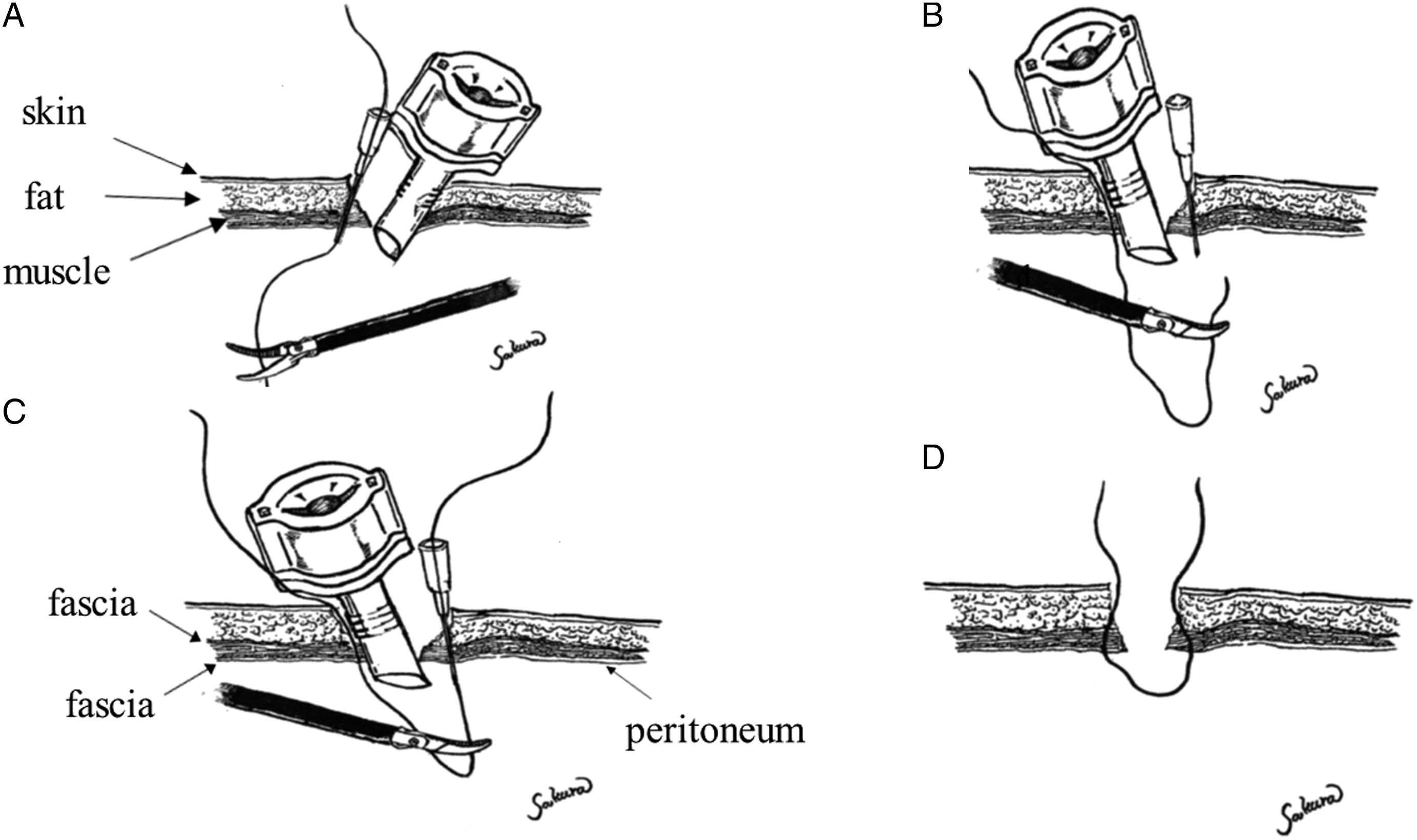
Next, after removing the inner needle, a 1-0 PDS® ll (Ethicon, Inc, Somerville, New Jersey, USA) thread was inserted into the abdominal cavity through the outer tube. Under laparoscopic observation, the outer tube was removed when the thread was grasped by forceps in the abdominal cavity (Figure 1B).
As before, a 14-gauge catheter was inserted into the abdominal cavity from the opposite side of the trocar. After removing the inner needle, the thread was introduced into the outer tube using forceps under laparoscopic observation and then removed from the body through the outer tube using forceps under laparoscopic observation (Figure 1C). After catching the thread from the outer tube, the outer tube was removed. Then, the trocar site was completely closed using the thread (Figure 1D).
There was no significant difference between this technique and Endo Close™ in the time required to close the 12 mm trocar site (data not shown). Because laparoscopic observation has a magnification effect, it is easy to introduce the thread into the outer tube.
It is well-known that Endo Close™ is a very useful device to close the trocar site wound; however, Endo Close™ costs approximately 38 USD, whereas our method costs only .55 USD. The 1-0 PDS® ll thread that was used in both methods costs approximately 5.25 USD. Therefore, our method has better cost performance than the Endo Close™. Based on the above reasons, this new closing technique using a 14-gauge catheter is not only convenient, but also decreases the cost.
Recently, another port site closing method has been reported. 4 In fact, their method is able to close the trocar site completely, especially in obese patients. 4 However, their method is complicated and requires a dedicated device. According to their report, handmade dedicated devices, such as a long trocar sheath with one large hole on the lower one-third on each side, a long needle (20-25 cm), and a loop inside the needle, are required. Compared with their method, our technique is simple and easy to perform. In addition, because a dedicated device is not required for our technique, the cost performance of our method is superior to their method.
After introducing this new technique to close the 12 mm trocar site, we have never had any cases of port-site hernias. Therefore, it is recommended that our innovative technique would be widely used in laparoscopic surgery.
Footnotes
Declaration of Conflicting Interests
The author(s) declared no potential conflicts of interest with respect to the research, authorship, and/or publication of this article.
Funding
The author(s) received no financial support for the research, authorship, and/or publication of this article.