







Abstract
Background
Research has shown that providing surgical exposure and mentorship before clerkship can bolster interest and cultivate quality surgical residents. However, most studies have focused exclusively on programs for 1st and 2nd year medical students. The purpose of this study is to describe a novel undergraduate premedical surgical elective (PMSE) and the interests and perceptions of PMSE participants of the surgical field.
Methods
Undergraduate students applied for a semester long PMSE that included surgical shadowing, mentorship, a research component, attendance at seminars, and hands-on workshops. Post-PMSE completion, participants were invited to complete an online survey about their perceptions of pursuing a career in surgery and their specialties of interest.
Results
Thirty-six PMSE participants completed the survey (21 females and 15 males). More than half (57%) of female respondents expressed interest in a surgical career. Most respondents (78%) agreed or strongly agreed that they are confident in their ability to become a surgeon. A lower proportion of female respondents (33%) believed the atmosphere of the surgical field to be inclusive than males (53%). Males accumulated significantly more surgical shadowing hours than females (P < .05).
Discussion
Findings from this study describe a novel PMSE at a large undergraduate institution. Survey data of PMSE participants revealed a high proportion of female respondents would like to pursue a career in surgery and reported confidence in achieving this. However, females perceived the field to be less inclusive than male respondents. Improving inclusivity may require increased focus and attention by PMSEs and surgical education programs.
Key Takeaways
• The study describes a novel multicomponent premedical surgical elective (PMSE) for undergraduate students and perceptions of PMSE participants. • Female participants showed strong interest in surgery after completing the PMSE. • A majority of respondents perceive the surgical field lacks inclusivity.
Introduction
In the United States, an aging population and stagnant production of surgeons have led to increasing shortages in the surgical workforce.1–3 From 1981 to 2005, the number of general surgeons per 100,000 people declined by 26%. 4 Williams et al estimates a shortage of 29,138 surgical specialists and 2525 general surgeons by the year 2030.5,6 Compounding these concerns of supply and demand, interest in surgical careers has steadily declined in recent years among medical students. 2
In a systematic review, Schmidt (2016) found that the greatest contributors to declining interests in surgical careers include perceived issues about lifestyle considerations, lack of surgical mentorship, and lack of surgical exposure (eg, shadowing, research, and workshops) prior to clerkship. 2 In traditional medical school curricula, students aren’t formally exposed to the field until their surgery clerkship in year 3. Thus, many students’ first surgical experiences are just months removed from when they commit to a specialty and begin crafting their residency application. Those who develop a newfound interest in clerkship are left with limited time for additional surgical experiences, all of which are critical for fortifying interest and strengthening one’s residency application. As many as 59% of students have already chosen a career path before embarking on their third year of medical school. 7 As a result, many, including the American Surgical Association, have concluded that providing surgical exposure and mentorship before clerkship is crucial to bolster interest and cultivate high-quality surgical residents.8,9
Institutions providing surgical experiences before clerkship have reported increases in surgical interest, residency applications, and matriculation.10,11 However, most studies have focused exclusively on programs for 1st and 2nd-year medical students. As a result, there is a lack of focus describing programs focusing on undergraduate premedical students. One study outlined a premedical surgical elective (PMSE) offered to undergraduate students at the University of California. 12 The authors reported that PMSE participation (n = 23) reaffirmed participants’ decisions to attend medical school, and 100% of participants would consider attending the affiliated institution’s general surgery residency program. With the majority of undergraduate students in the US being female (57%), authors of this study highlighted the value this model may have toward reducing gender disparities within surgery, where most specialties, such as orthopedic surgery (6%) and neurosurgery (8%), continue to lack female representation.13,14 Worth noting, this aforementioned study did not investigate the impact the PMSE had on other important factors that may play a role in premedical students decision making, such as participants’ perceptions of pursuing a career in surgery (eg, confidence, foreseeable satisfaction, and inclusivity in the surgical field), nor did it survey participants on what surgical specialties they were interested in pursuing following completion of the elective.
Given the lack of studies describing PMSEs and the limitations of existing literature (eg, minimal information on perceptions and surgical field interest), the purpose of this study is to (1) describe the key components of a novel PMSE implemented at a large undergraduate institution in the US and (2) explore PMSE participants’ interest in pursuing a career in surgery and perceptions of inclusivity in the surgical field.
Methods
Program Overview and Recruitment
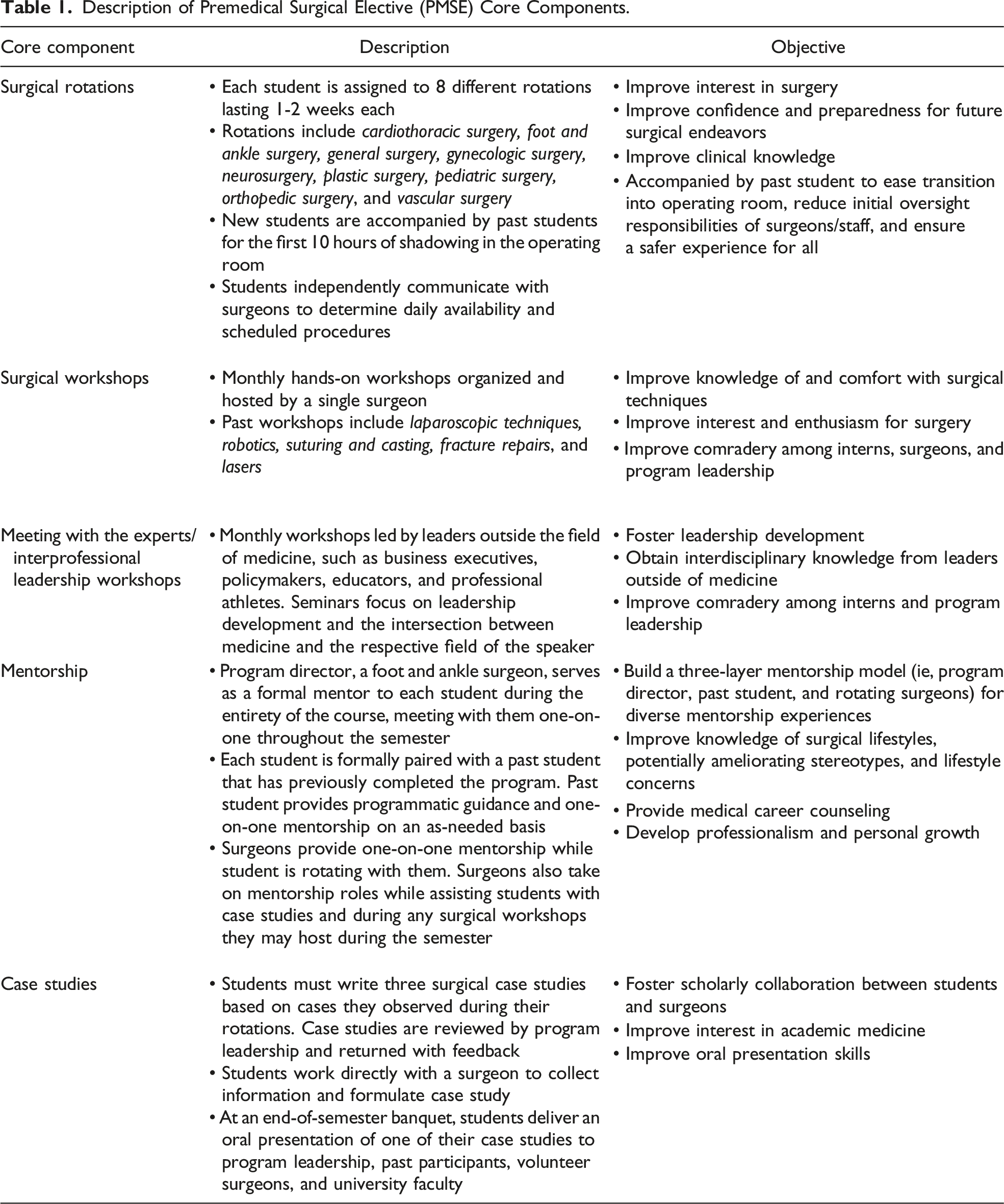
Description of Premedical Surgical Elective (PMSE) Core Components.
Programmatic Components
The core programmatic components of the PMSE are outlined in Table 1. Additional components not listed within Table 1 include an orientation focused on HIPAA and operating room safety as well as optional engagement opportunities for past students (eg, mentorship and joining current students for surgical workshops). To receive a “satisfactory” grade, students are expected to obtain a minimum of 40 surgical shadowing hours by the end of the semester; complete 3 surgical case studies; and give an oral presentation of a surgical case study of their choosing. The goal of the PMSE is to improve participants’ clinical knowledge and overall interest in the field of surgery by way of multifaceted exposures and mentorship.
Survey Data Collection
An online survey was used to capture PMSE participants’ perceptions of a career in surgery. Participants were deemed eligible to complete the survey if they were 18 years of age or older and completed the PMSE. In Spring 2020, an email containing a Qualtrics survey link was sent to a database of 54 past PMSE participants since the program’s inception in 2009. Participants were given one month to complete the survey. An additional attempt was offered via email to those who had not completed the survey after two weeks. Questions inquired about participants’ medical aspirations, shadowing experience, individual and family history of surgery, and perceptions of pursuing a career in surgery (eg, confidence, collegiality, inclusivity, and foreseeable satisfaction). No personally identifiable information was collected from survey respondents. Program participants’ response data were downloaded, and descriptive statistics (means, standard deviations, proportions etc.) were computed in Stata (version 16.1, College Station, TX, USA) exploring results by subgroups (sex and current medical school standing) with an independent sample t test exploring differences in surgical and shadowing hours.
Results
Survey Results From Students (n = 36) Who Completed the Premedical Surgical Elective (PMSE).
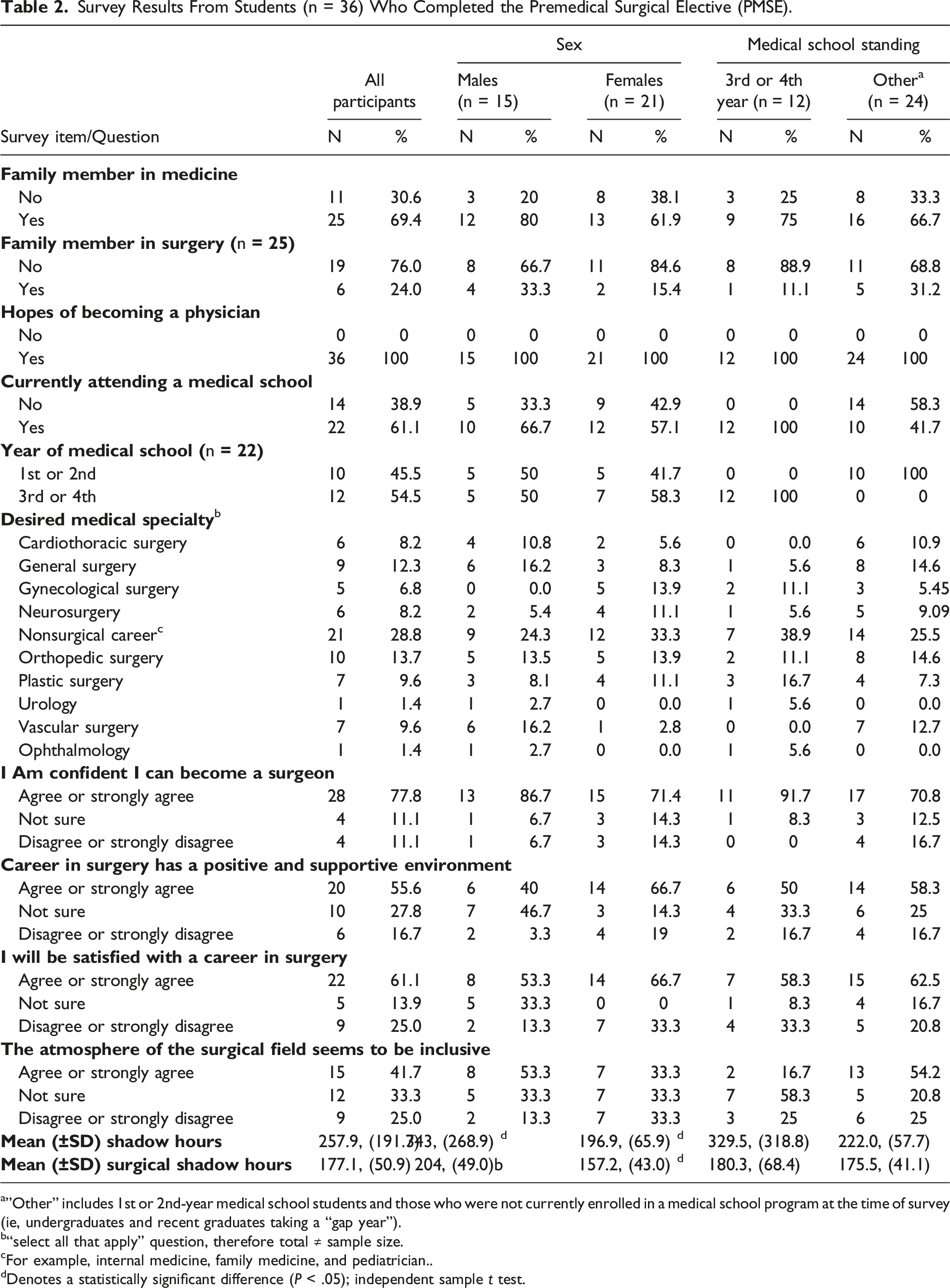
a”Other” includes 1st or 2nd-year medical school students and those who were not currently enrolled in a medical school program at the time of survey (ie, undergraduates and recent graduates taking a “gap year”).
b“select all that apply” question, therefore total ≠ sample size.
cFor example, internal medicine, family medicine, and pediatrician..
dDenotes a statistically significant difference (P < .05); independent sample t test.
Discussion
This study described key components of a novel PMSE that incorporated surgical rotations, workshops and case studies, diverse mentorship experiences, and seminars from leaders outside of medicine. Survey data of PMSE participants revealed a high proportion of female respondents would like to pursue a career in surgery and reported confidence in achieving this. However, females perceived the field to be less inclusive than male respondents. For institutions seeking to develop a PMSE or modify an existing one, efforts should be made to foster diverse and inclusive foundations for PMSEs, such as diverse surgeons and mentors as it relates to gender, race, and ethnicity.
To the authors’ knowledge, there are no existing PMSEs that offer the breadth of experiences and components that the current PMSE does. However, Ourian et al 12 provided details on a PMSE for undergraduate premedical students that allows for certain comparison across components to be drawn. Ourian et al 12 reported their PMSE offered shadowing opportunities in pediatric surgery, colorectal surgery, trauma surgery, and bariatric and minimally invasive surgery. The current PMSE included several additional areas of exposure such as cardiothoracic surgery, foot and ankle surgery, gynecologic surgery, neurosurgery, plastic surgery, pediatric surgery, orthopedic surgery, and vascular surgery. Research shows that gaining early exposure to a surgical specialty improves participants’ interest in that same specialty.9,15 It is important to consider early exposure of underrepresented individuals to fields, like orthopedics and neurosurgery, which may cultivate interest and subsequently improve diversity within each of these specialties. 9
Early mentorship can also play an integral role in medical career decision making. Research shows that one of the greatest barriers to females pursuing surgery is a lack of surgical mentors. 2 While previous PMSEs have paired each student with one surgeon for the entirety of the course, 12 our PMSE facilitated a trifold mentorship model: pairing students with a past PMSE student (most of which were 1st or 2nd-year medical students) and the Program Director (foot and ankle surgeon), in addition to mentorship from each surgeon during their respective rotations. Given the dearth of surgical faculty engaged in undergraduate academia, PMSEs can bridge the gap between surgeons and premedical students interested in surgery, sparking early mentorship relationships that are integral for crafting successful medical careers.
There are several novel components of the current PMSE that must be noted. First, the integration of the hands-on surgical workshops, where students learned to use surgical techniques and devices such as the Da Vinci Surgical System, laparoscopy, and orthopedic drills under the guidance of the hosting surgeon. Existing research has demonstrated that interactive workshops can bolster medical student interest and confidence in pursuing a surgical career. 16 While there is limited research describing the impact of surgical workshops on undergraduate premedical students, Vakayil et al 17 found that workshops can improve premedical students’ perceived confidence in basic surgical knowledge, techniques, and teamwork. This improved confidence may make participants more likely to engage in future surgical opportunities, such as shadowing, research, and interest groups. Second, the “Meeting with the Experts” where leaders from fields outside of medicine joined the students for an intimate conversation on leadership development and how medicine played a role in their respective careers was a novel addition to the current PMSE. Research has emphasized the importance of leadership-building through education and training that is critical to the development of medical providers as health care professionals, yet, few medical school curricula offer formal training in this area. 18
From our survey data, ∼70% of respondents reported a family member in medicine and 24% reported a family member in surgery. All respondents (100%) expressed the desire to become a physician in the future, demonstrating that PMSEs may bolster participants’ interest in practicing medicine, or at the very least, do not deter them from the field at large. This was consistent with other programs designed to provide early exposure to surgery. 12 Although the study sample was small, 43% of our female PMSE respondents reported that they foresee themselves pursuing exclusively surgical careers. This number is higher than the latest estimates of the percentage of active female physicians in surgery specialties (range 6% to 23%). 19 Despite ∼70% of female respondents reporting confidence in becoming a surgeon, only 33% perceived the field to be inclusive vs over 50% of male respondents. This perceived lack of inclusivity may have also contributed to the disparate number of surgical shadowing hours—and total shadowing hours—reported by males and females, in which males obtained considerably more hours than females (P < .05). Female respondents may have observed the field of surgery as more inclusive had the PMSE offered one or more surgeons of their gender. Research has shown that some females are discouraged by the lack of female role models within surgery and that the presence of such role models is important in encouraging them to enter the field.13,20 Thus, improving females’ perceived inclusivity of the field may require increased focus and attention by PMSEs and surgical education in general to include diverse role models—considering gender, race, and ethnicity—and a variety of shadowing opportunities. Despite our PMSE requiring just 40 surgical shadowing hours to receive credit, students exceeded this requirement considerably (mean ∼177 hours), demonstrating a keen interest and dedication to immerse themselves within their rotations. Additional research must be conducted to determine if there are additional motivating factors driving these large numbers. For example, students’ desire to strengthen their medical school application by accumulating a variety of shadowing experiences.
Based on declining surgical interests and a lack of preclerkship exposure to the field, earlier exposure may be necessary to improve interest in pursuing a surgical career. Providing surgical experiences to premedical students can ameliorate stereotypes and lifestyle concerns, foster longstanding mentorship, and cultivate surgical interest that extends into medical school and beyond. Premedical surgical electives may also serve as an effective vehicle for recruiting underrepresented individuals into surgical fields, as they address major factors contributing to poor representation in the field.1,14 The authors offer that many PMSE participants will continue gaining exposure to the field (eg, research and interest groups) and matriculate into surgical residency programs. Premedical surgical elective participants who pursue a career in surgery may also be more prepared surgical residents due to their early training and longer exposure to surgery which allow for the accrual of valuable knowledge, mentorship, and experiences in the field. On this note, there is an opportunity for future research to explore outcomes related to surgical residency (eg, success stories) from past PMSE participants and how this is associated with their past perceptions of the surgical field.
A strength of this study is the presentation of a novel multicomponent PMSE that could be used as a model for other undergraduate and educational institutions to adopt into their own curricula. Second, the current study adds to the scarce body of evidence in this area, with additional information presented on areas of interest and perceptions of inclusivity in the surgical field by PMSE participants. This study is not without limitations. Although the sample size is larger than previous PMSE research, 12 these data only represent premedical students from one US-based undergraduate institution; thus, generalizability of the findings are limited. These data represent PMSE participants from previous years (2009 to 2020); thus, recall bias may be a factor for certain respondents. However, from the data collected on “medical school standing” (see Table 2), we can deduce with confidence that most of the respondents (24 PMSE participants; 67%) completed the program within a shorter period (2017-2020). Further, the survey used in this study to capture PMSE participants’ perceptions of a career in surgery was not piloted in a smaller sample prior to distribution; thus, questions that did not make sense to participants or problems with the questionnaire that could lead to biased answers cannot be ruled out. Lastly, these current data represent the perceptions of PMSE participants who responded to the survey request (67%), and not all PMSE participants. Nonrespondents may have had different perceptions of the surgical field not captured in these data.
There are opportunities for further research in this area. For example, it is plausible that applicants to this PMSE simply have greater interests in surgery than the average medical student. Additionally, the influence the PMSE has on surgical interests and pursuits through medical school years and beyond remains to be seen. Future qualitative follow-up research may allow to explore some of these questions in more detail. For institutions seeking to develop a PMSE or modify an existing one, efforts must be made to not only provide a variety of experiences—including valuable surgical and mentorship experiences—but also to foster inclusive foundations for PMSEs, such as diverse surgeons and mentors as it relates to gender, race, and ethnicity.
Footnotes
Acknowledgments
The authors would like to thank the volunteer surgeons for providing their mentorship and time; the participants who represented the program with the utmost professionalism and character; Dr Alicia Hawthorne for their administrative support of the course; and Dr Matthew Munyon for their assistance with survey development.
Declaration of Conflicting Interests
The author(s) declared no potential conflicts of interest with respect to the research, authorship, and/or publication of this article.
Funding
The author(s) received no financial support for the research, authorship, and/or publication of this article.
