






Abstract
Objective
The objective of this study was to compare in-hospital outcomes and mortality in patients with and without a psychiatric comorbidity that presented to a trauma center with isolated blunt chest trauma and multiple traumatic rib fractures.
Materials and Methods
This is retrospective analysis using the American College of Surgeons Trauma Quality Improvement Program database (2014-2016). Patients ≥18 years with ≥3 traumatic rib fractures were stratified based on the presence or absence of a psychiatric comorbidity. In-hospital complications, length of stay, intensive care unit (ICU) admission, and mortality were assessed. Variables significant (P < 0.05) on univariate analysis were entered into logistic regression models to determine the independent effect of a psychiatric comorbidity on outcomes.
Results
Among the 56,558 patients meeting inclusion criteria, 10.6% (n = 6022) had a psychiatric comorbidity. On univariate analysis, patients with a psychiatric comorbidity demonstrated significantly worse in-hospital outcomes, including higher rates of acute respiratory distress syndrome (ARDS) (1.0% vs 0.7%), deep vein thrombosis (DVT) (1.5% vs 1.2%), pulmonary embolism (PE) (0.8% vs 0.5%), pneumonia (4.2% vs 3.1%), urinary tract infection (2.4% vs 1.7%), and decreased mortality (2.2% vs 3.5%). After controlling for comorbidities, substance use, and demographic factors, psychiatric comorbidity was an independent predictor of ARDS (aOR 1.15, P < 0.01), DVT (OR 1.32, P = 0.017), PE (aOR 1.40, P = 0.004), pneumonia (aOR 1.36, P < 0.001), and decreased mortality (aOR 0.71, P < 0.001).
Conclusions
The presence of a psychiatric comorbidity increases in-hospital complications independent of patient characteristics, comorbidities, and trauma burden in patients presenting with multiple traumatic rib fractures.
Keywords
Introduction
Rib fractures are among the most common injuries sustained after blunt thoracic trauma, occurring in approximately 40% of such cases.1,2 These injuries are associated with significant morbidity and mortality, with in-hospital mortality rates of 5%-6% reported in large U.S. trauma registry studies. 3 Nearly half of the patients with rib fractures require intensive care unit (ICU) admission and aggressive management, and many experience prolonged ICU stays, increased ventilator dependence, extended hospitalizations, and higher risks of pneumonia and death than trauma patients without rib fractures.4-6 The number of fractured ribs is an independent predictor of outcome: patients with >5 rib fractures are more likely to require ICU admission, those with >7 have a higher incidence of pneumonia, and those with >8 face increased mortality and prolonged mechanical ventilation. 2 Rib fractures also impose a substantial economic burden on the health care system, contributing significantly to hospitalization costs in the United States. 7
Psychiatric illness is highly prevalent in both the general U.S. population and among trauma patients. National epidemiologic surveys estimate that approximately 26% of adults are affected by a psychiatric disorder within a 12-month period, and nearly half will experience one during their lifetime. 8 Among hospitalized trauma patients, reported prevalence of psychiatric comorbidity ranges from 10% to 38%, depending on diagnostic criteria and population studied.9,10 Prior studies demonstrate that individuals with psychiatric disorders are at an increased risk for traumatic injury and recurrent trauma, 11 and trauma patients with psychiatric illness experience worse clinical outcomes than those without, including longer hospital stays, increased complication rates, higher likelihood of ICU admission, and elevated ventilator requirements.12,13 Although psychiatric comorbidity in trauma patients is consistently associated with increased complications and longer hospital stays, several large database studies have paradoxically reported lower in-hospital mortality in this population.9,13 This paradox underscores the need to further evaluate the impact of psychiatric illness on outcomes in patients with multiple rib fractures.
While these associations are well recognized, prior studies often include heterogeneous trauma populations or focus on select psychiatric diagnoses. Specifically, a recent study by Kishawi et al 12 found that patients with rib fractures and schizophrenia spectrum or stress-related disorders had longer hospital stays and lower mortality than those without psychiatric illness. While informative, this work was limited to select psychiatric diagnoses and two outcome measures. Our study expands on this work by examining a broader spectrum of psychiatric comorbidities in a larger, nationally representative cohort and by evaluating a wider range of in-hospital complications alongside mortality, providing a more comprehensive understanding of outcomes in this high-risk population. By examining morbidity and mortality in this subset, our analysis provides context that complements broader trauma literature and highlights the unique challenges of managing rib fractures in patients with psychiatric comorbidities. Rather than identifying a completely new gap, our intent is to add nuance and specificity to existing knowledge in a way that may inform more targeted management strategies for this vulnerable patient population.
Methods
This retrospective cohort study was conducted using de-identified data from the American College of Surgeons (ACS) Trauma Quality Programs (TQIP) Participant Use File (PUF) data set for admission years 2014-2016. The 2014-2016 TQIP data set was used, as it is the last iteration to include the “History of Major Psychiatric Comorbidity prior to admission,” which has been retired in later versions. The ACS-TQIP-PUF database is a validated, de-identified incident-based data set maintained by the ACS Committee on Trauma and contains data pertaining to trauma patients from over 700 trauma facilities across the United States (including level I, II, III, and undesignated trauma centers). In accordance with institutional policy and federal guidelines, analyses of de-identified data are not considered human participant research and are therefore exempt from Institutional Review Board review.
The objective of this study was to compare in-hospital outcomes and mortality in patients with and without a psychiatric comorbidity that presented to a trauma center with isolated blunt chest trauma and multiple traumatic rib fractures. Patients 18 years or older with or without a psychiatric comorbidity with isolated chest trauma and multiple rib fractures were included. Isolated chest trauma was defined as (1) Chest Abbreviated Injury Scale (AIS) > 3 and (2) AIS <3 in all other anatomical regions. Prior studies have employed similar AIS stratification to classify severe thoracic trauma.
10
Multiple rib fractures were defined as 3 or more rib fractures.5,12 Patients were excluded if they met any of the following criteria: (1) declared dead on arrival, (2) an Abbreviated Injury Scale (AIS) score greater than 3 in any body region other than the chest, (3) fractures in regions other than the chest, (4) less than 3 rib fractures, (5) a diagnosis of flail chest, (6) penetrating injury, (7) missing data on psychiatric comorbidity status in the TQIP file, or (8) age under 18 years (Figure 1). Patient Inclusion Schematic. Legend: TRF, Traumatic Rib Fracture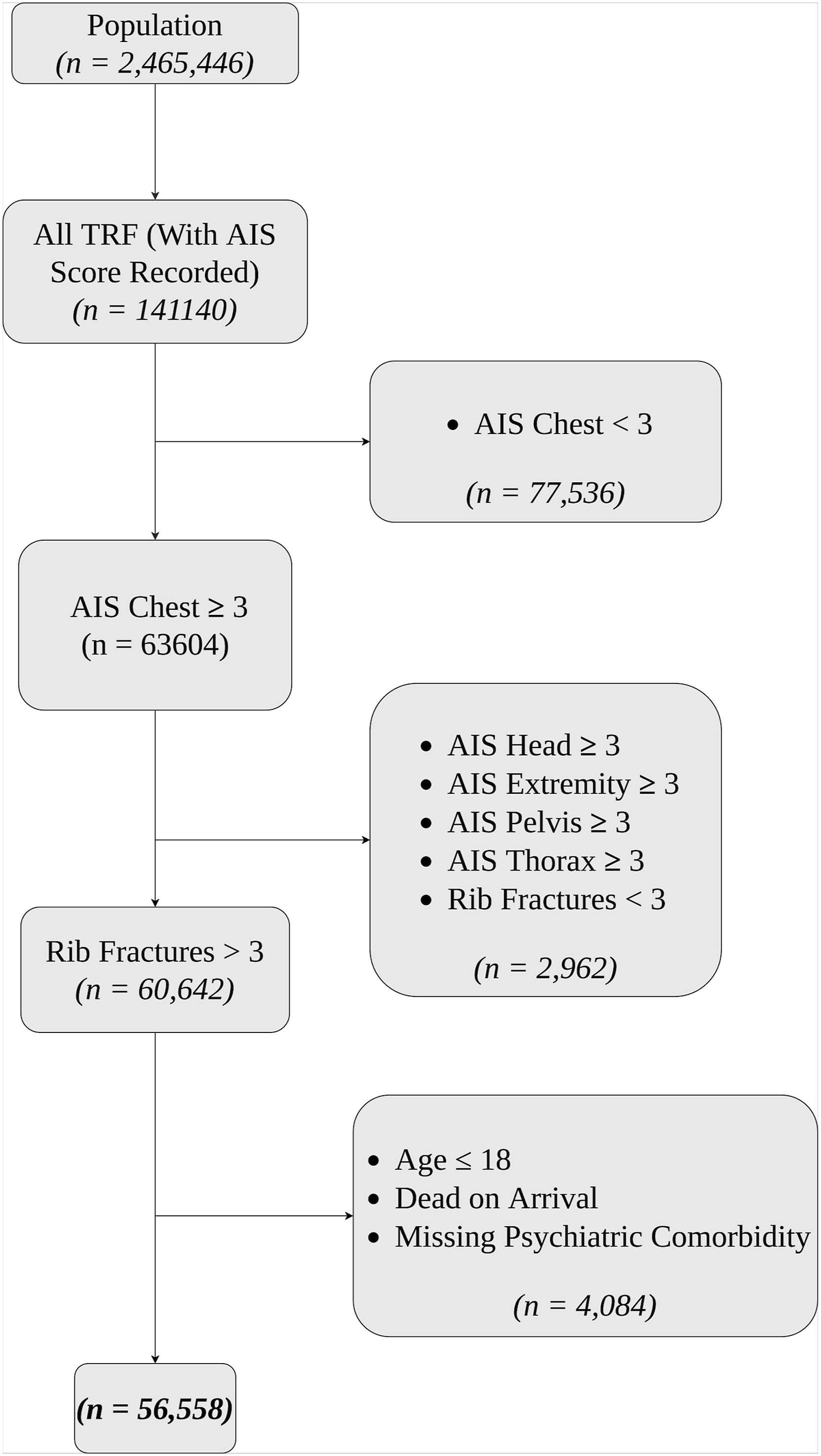
The discrete diagnostic code “History of Major Psychiatric Comorbidity prior to admission” provided by the TQIP database (retired in 2017) was used to stratify patients with and without a psychiatric comorbidity. This code identifies patients with the following pre-trauma comorbidities: major depressive disorder, bipolar disorder, schizophrenia, anxiety/panic disorder, borderline or antisocial personality disorder, and/or adjustment disorder/post-traumatic stress disorder.
De-identified data points that were extracted from the ACS TQIP database included patient demographics (age, gender, race), Abbreviated Injury Score for each body region, Injury Severity Score (ISS), number of rib fractures, and comorbidities including hypertension, diabetes, malignancy, chronic renal failure (CRF), cerebral vascular accident (CVA), coagulopathy, myocardial infarction, dementia, smoking, alcohol abuse, and illicit drug use. Hospital complications that were assessed included acute respiratory distress syndrome (ARDS), deep vein thrombosis (DVT), pulmonary embolism (PE), cerebral vascular accident (CVA), cardiac arrest, sepsis, pneumonia, urinary tract infection (UTI), and mortality. Other variables include hospital length of stay, ICU admission, ICU length of stay, requirement for mechanical ventilation, and mortality.
Statistical analysis was carried out using IBM SPSS 28.0. Unknown data points were treated as missing. Categorical variables are reported as number (n)/percentage number (%), and nonparametric continuous variables reported as medians/interquartile ranges (IQRs). Univariate analyses for continuous data points were compared using the t-test or Kruskal-Wallis test, depending on presence normality. Categorical variables were compared using χ2-test or Fisher’s exact tests. Risks are reported as odds ratios (ORs) with 95% confidence intervals (CIs). A P-value of <0.05 was considered statistically significant. In order to determine if psychiatric illness is an independent predictor of an adverse outcome, variables that were statistically significant on univariate analysis were entered into logistic regression models. These models were controlled for baseline comorbidities with significant differences on univariate analysis, as well as alcohol, smoking, illicit drug use, gender, and age ≥65 years. Variables on multivariable regression were reported as adjusted odds ratios (aORs) with 95% CIs. The accuracy of each of the regression model was assessed by reporting the chi-square value and plotting area under the receiver operating characteristic (ROC) curve graphs with 95% CIs.
Results
Patient Characteristics With and Without a Psychiatric Comorbidity

SD, standard deviation; CHF, congestive heart failure; CRF, chronic renal failure; CVA, cerebral vascular accident.
Outcomes and In-Hospital Complications of Multiple Rib Fractures in Patients With and Without Major Psychiatric Morbidity

LOS, length of stay; ISS, Injury Severity Score; ICU, intensive care unit; CVA, cerebral vascular accident; ARDS, acute respiratory distress syndrome; DVT, deep vein thrombosis; PE, pulmonary embolism; UTI, urinary tract infection.
Multivariate Regression Analysis of a Psychiatric Comorbidity as an Independent Predictor of Adverse Outcomes in Patients With Multiple Rib Fractures

ARDS, acute respiratory distress syndrome; DVT, deep vein thrombosis; PE, pulmonary embolism; UTI, urinary tract infection.
Binary logistic regression analysis was conducted for adverse outcomes that were significant on univariate analysis (ARDS, DVT, PE, pneumonia, UTI, and mortality) to assess if a psychiatric comorbidity is an independent predictor of each outcome. The models controlled for baseline comorbidities with significant differences (hypertension, coagulopathy, CHF, CVA, dementia) as well as alcohol, smoking, drug abuse, gender, and older age>=65. For each adverse outcome, our model outperformed the null model (Table 4). Psychiatric comorbidity was an independent predictor of ARDS (aOR 1.15, P < 0.01), DVT (OR 1.32, P = 0.017), pulmonary embolism (aOR 1.40, P = 0.004), pneumonia (aOR 1.36 P < 0.001), and decreased mortality (aOR 0.71, P < 0.001) following isolated chest trauma with multiple traumatic rib fractures (Table 3). An increased incidence of UTI did not retain statistical significance in the regression model.
Discussion
Our findings demonstrate that psychiatric comorbidities are independently associated with worse clinical outcomes, including prolonged hospital length of stay (LOS), and increased rates of acute respiratory distress syndrome (ARDS), pulmonary embolism (PE), deep vein thrombosis (DVT), and pneumonia. Interestingly, despite these adverse findings, patients with psychiatric comorbidities exhibited a decreased rate of mortality. Demographic analysis revealed that patients with psychiatric comorbidities were more likely to be White and female (50.1%), consistent with prior research indicating a higher prevalence of psychiatric disorders among White women than Black or Hispanic individuals. 10 Recognizing these demographic patterns is essential, as race- and sex-based differences in bone density and injury mechanisms influence outcomes. Patients with psychiatric comorbidities also had higher rates of hypertension, congestive heart failure, dementia, tobacco use, and substance abuse. This aligns with prior research showing psychiatric patients often have multiple comorbidities, substance-use disorders, reduced medication adherence, and difficulty engaging with health care.11,13,14 Such challenges complicate rib fracture management, which depends on incentive spirometry, pulmonary hygiene, and early mobilization, 15 while substance abuse further impairs pain control and adherence. Our results showed that psychiatric comorbidities were associated with higher odds of ARDS, DVT, PE, and pneumonia, complications that rib fracture patients are already prone to due to impaired respiratory mechanics, pain, and immobility. 16 Prior studies have similarly shown higher rates of respiratory failure, sepsis, and thromboembolic events among trauma patients with psychiatric illness.14,17 These outcomes may be partly explained by higher prevalence of alcohol and drug use,12,17-19 the need for restraints or sedation that further limits mobility, 18 and biologic factors. Notably, psychiatric disorders such as schizophrenia, depression, and PTSD are associated with elevated inflammatory cytokines, including IL-6, IL-8, and TNF-α, which are implicated in ARDS pathogenesis. 20 Together, these behavioral and inflammatory mechanisms provide context for the elevated complication rates observed in our cohort.
Patients with psychiatric comorbidities experienced significantly longer hospital stays, which may result from several factors. In rib fracture management, adherence to pulmonary protocols such as incentive spirometry, pain control, and early mobilization is critical to preventing respiratory complications.15,18,19 Psychiatric conditions associated with cognitive impairment, psychosis, or severe depression may limit adherence to these measures, increasing the risk of delayed recovery. 19 Additionally, interactions between psychotropic medications and in-hospital analgesics or anesthetics, which are essential in rib fracture care, can lead to delirium, confusion, or other alterations in mental status that further complicate management.16,18 Discharge planning also poses challenges, as many psychiatric patients require specialized rehabilitation or assisted living, which can delay hospital discharge even after medical stabilization. 14
Paradoxically, despite higher complication rates and longer lengths of stay, patients with psychiatric comorbidities had significantly lower mortality, consistent with prior literature.9,12,13,21 For example, a large TQIP study of over 1 million trauma patients found that those with behavioral health disorders, including psychiatric comorbidities and substance-use disorders, had lower overall mortality despite higher in-patient complications. 9 Similarly, studies of abdominal and pelvic trauma patients and regional cohorts have reported increased ICU admission and complication rates but decreased mortality in patients with depression, schizophrenia, or psychosis.13,21 Possible explanations include closer monitoring and more intensive medical attention, which allow earlier detection and intervention for complications, 13 more frequent admission or transfer to tertiary centers with multidisciplinary care, 12 and selection bias, as these patients may be hospitalized even with less severe injuries.10,13 Differences in outcomes may also depend on specific psychiatric diagnoses and severity, which large databases like TQIP may not fully capture.9,21 Collectively, these findings underscore the importance of individualized, multidisciplinary care tailored to the patient’s psychiatric profile to optimize both physical and mental health outcomes. Our findings underscore the importance of integrated care approaches for trauma patients with psychiatric comorbidities. Addressing both physical and mental health needs may improve outcomes by enhancing pain control, improving adherence to pulmonary hygiene, and optimizing discharge planning. Integration of mental health services into trauma care is critical, not only to address psychiatric symptoms directly but also to support engagement in recovery practices such as incentive spirometry, mobilization, and pulmonary hygiene, which are key in preventing ARDS and related complications. Collaborative care involving psychiatrists, trauma surgeons, and pulmonologists can facilitate tailored interventions, while efforts should also be made to minimize use of restraints whenever possible, as immobilization further predisposes patients to thromboembolic and pulmonary complications. Standardized screening for psychiatric comorbidities at admission and post-discharge mental health support could help identify high-risk patients early and sustain recovery. Future research should explore targeted interventions, such as psychiatric optimization, restraint-reduction strategies, and pain regimens that balance efficacy with safety in patients with substance-use disorders, to reduce complications in this vulnerable population.
Strengths and Limitations
Strengths of this study include a large sample size that incorporates a diverse population derived from a national database. However, this study is not without limitations. The reliance on retrospective data from the TQIP database introduces limitations inherent to retrospective research. We were also limited to using TQIP data from 2012 to 2016, as that was when the “History of Major Psychiatric Comorbidity prior to admission” code was available. In 2017, ACS TQIP underwent a major redesign, which led to the discontinuation of the psychiatric diagnosis variable, and replacement by a non-specific “mental disorder” variable. While the exact rationale is unclear, it appears related to structural changes rather than clinical irrelevance. This limitation highlights the unique value of our study, as it captures the impact of psychiatric comorbidities on trauma outcomes using the last available national data coding for Major Psychiatric Comorbidity. Given that the management of rib fractures may have evolved since 2016, more contemporary data may have changed outcomes. 22 Additionally, we could not differentiate between various psychiatric diagnoses, severity or duration of psychiatric illnesses, or treatment and medication compliance, which could influence clinical outcomes. Patients with flail chest were excluded as this condition represents a distinct clinical entity with different diagnostic criteria, management strategies, and outcomes compared to non-flail rib fractures. 15
With respect to our statistical analysis, ISS was not included as a covariate because restriction to isolated blunt chest trauma produced a narrow, comparable distribution of ISS across study groups. Trauma center verification level was also not incorporated into the final models, as stratification by center level would substantially reduce sample size for several rare outcomes and risk unstable estimates. Trauma center level is also strongly correlated with referral patterns and case mix, complicating interpretation without multilevel modeling. Finally, given the very large sample size and multiple statistical comparisons made, the risk of type I error is increased. This limitation should be considered when interpreting statistically significant findings. Despite these limitations, our study provides insights into the interplay between psychiatric comorbidities and outcomes following isolated blunt chest trauma with multiple rib fractures and identifies several areas for future research and clinical improvement.
Conclusion
Patients with psychiatric comorbidities who sustain traumatic rib fractures have distinct clinical profiles, including higher rates of substance use, medical comorbidities, and increased complications such as ARDS, DVT, and pneumonia. They also experience longer hospital stays but paradoxically lower in-hospital mortality. These findings highlight the need for a multidisciplinary approach to managing patients with psychiatric comorbidities following traumatic rib fractures.
Footnotes

Author Contributions
Conceptualization: DR, KS, and NL; data curation: KR, SM, DR, KS, and NL; formal analysis KR, SM, DR, KS, and NL; funding acquisition: N/A; investigation: DR, KS, VR, LH, and NL; methodology: DR, KS, KR, SM, and NL; project administration VR, LH, and NL; visualization: DR, KS, and NL; writing—original draft: DR, KS, and NL; writing—review and editing: all authors. All authors read and approved the final manuscript.
Funding
The authors received no financial support for the research, authorship, and/or publication of this article.
Declaration of Conflicting Interests
The authors declared no potential conflicts of interest with respect to the research, authorship, and/or publication of this article.