






Abstract
Merkel cell carcinoma (MCC) is a rare, aggressive neuroendocrine form of skin cancer. This case report describes a 70-year-old Hispanic male with stage IIA MCC of the upper back which rapidly progressed during hospitalization for severe COVID-19 infection requiring ventilatory support. After resolution of his severe acute illness, he received one dose of anti-PD-1 therapy and single-fraction radiotherapy to his primary lesion for local control. His tumor then underwent a rapid regression and he completed 17 cycles of immunotherapy with a complete clinical and radiologic response sustained more than 4 years. This case illustrates a possible synergistic effect of radiation therapy and immune checkpoint inhibition after rebounding immune-system hyperactivation from infection with COVID-19.
Key Takeaways
• COVID-19 infection induces immune perturbation and may result in rebound activation that can affect antitumor directed therapy • PD-1 blockade in combination with single-fraction radiotherapy should be considered for locally advanced Merkel cell carcinoma and has been documented to result in complete response after severe acute viral infection
Introduction
Merkel cell carcinoma (MCC) is a rare, aggressive neuroendocrine form of skin cancer arising from dermal fibroblasts or epidermal keratinocytes. Approximately 2000 new cases of MCC are diagnosed in the United States each year, and it is considered 3 to 5 times deadlier than melanoma. 1 MCC pathogenesis is driven by 2 factors: a small double-stranded DNA polyomavirus called Merkel cell polyomavirus (MCPyV) and ultraviolet (UV) signature mutations. 2 In the United States, a majority of MCC cases are positive for MCPyV. MCC presents most frequently on UV-exposed skin, with 42.6% of cases presenting on the head and neck. Along with UV exposure, fair skin is a risk factor with 90% of cases occurring in white patients. Additional risk factors include advanced age, male sex, and immunosuppression. 1 In the initial stages of MCC, lesions rarely cause pain but are characterized by their rapidly growing nature.
Locally advanced and clinically node-positive MCC can be treated with systemic immune checkpoint inhibitors (ICI) and/or locoregional radiation therapy.3-6 In recent years, improved solid tumor response to immunotherapy has been associated with infectious disease and oncologic vaccinations, promoting investigation into synergistic mechanisms between antiviral and antitumor immune responses.7-9 Severe infections with SARS-CoV-2 induce lymphopenia with reflexive increased activation of both CD4+ and CD8+ T cells in the acute phase.10,11 Aberrant monocyte and neutrophil activation have also been implicated with COVID-19 disease severity. 12 This report describes a case of MCC that rapidly progressed after severe COVID-19 infection and had a complete response to immunotherapy and single-fraction radiotherapy. Informed consent for participation in this report was obtained from the patient.
Case Presentation
A 70-year-old Hispanic male with chronic hypoxic respiratory failure after a severe COVID-19 infection presented to a large academic medical center for evaluation of a large, rapidly growing lesion on his back. He had noticed the lesion prior to his hospitalization for COVID-19 and assumed it was an insect bite, which failed to improve with topical antibiotics. Before he could seek further evaluation for this lesion, he was admitted to a local hospital with acute respiratory failure. He was found to have an acute SARS-CoV-2 infection and had a prolonged hospital course where he suffered acute respiratory distress syndrome requiring mechanical ventilation and prone positioning. At this point, the mass on his back was noted to be rapidly growing. Upon recovery from his critical illness, this lesion was biopsied and returned as Merkel cell carcinoma: positive for pankeratin, keratin 20, and synaptophysin and negative for MART1 and P40. His MCPyV status was not tested. He was referred to our institution for treatment. At the time of presentation, the lesion measured 8.9 cm × 3.8 cm × 8.3 cm on computed tomography with satellite lesions measuring 1.1 cm and 7 mm. (Figure 1A). A PET scan did not show evidence of distant metastasis and the patient was staged as stage IIA (cT3, cN0, cM0, AJCC 8th edition). (A) (top left): Biopsy-proven Merkell cell carcinoma at time of presentation, measuring 8.9 cm × 8.3 cm × 3.8 cm, (B) (top right): Lesion at time of immunotherapy initiation, (C) (bottom left): Lesion 2 weeks after radiation and one cycle of pembrolizumab, (D) (bottom right): Resolving lesion taken 7 weeks post-radiation and with 3 cycles of pembrolizumab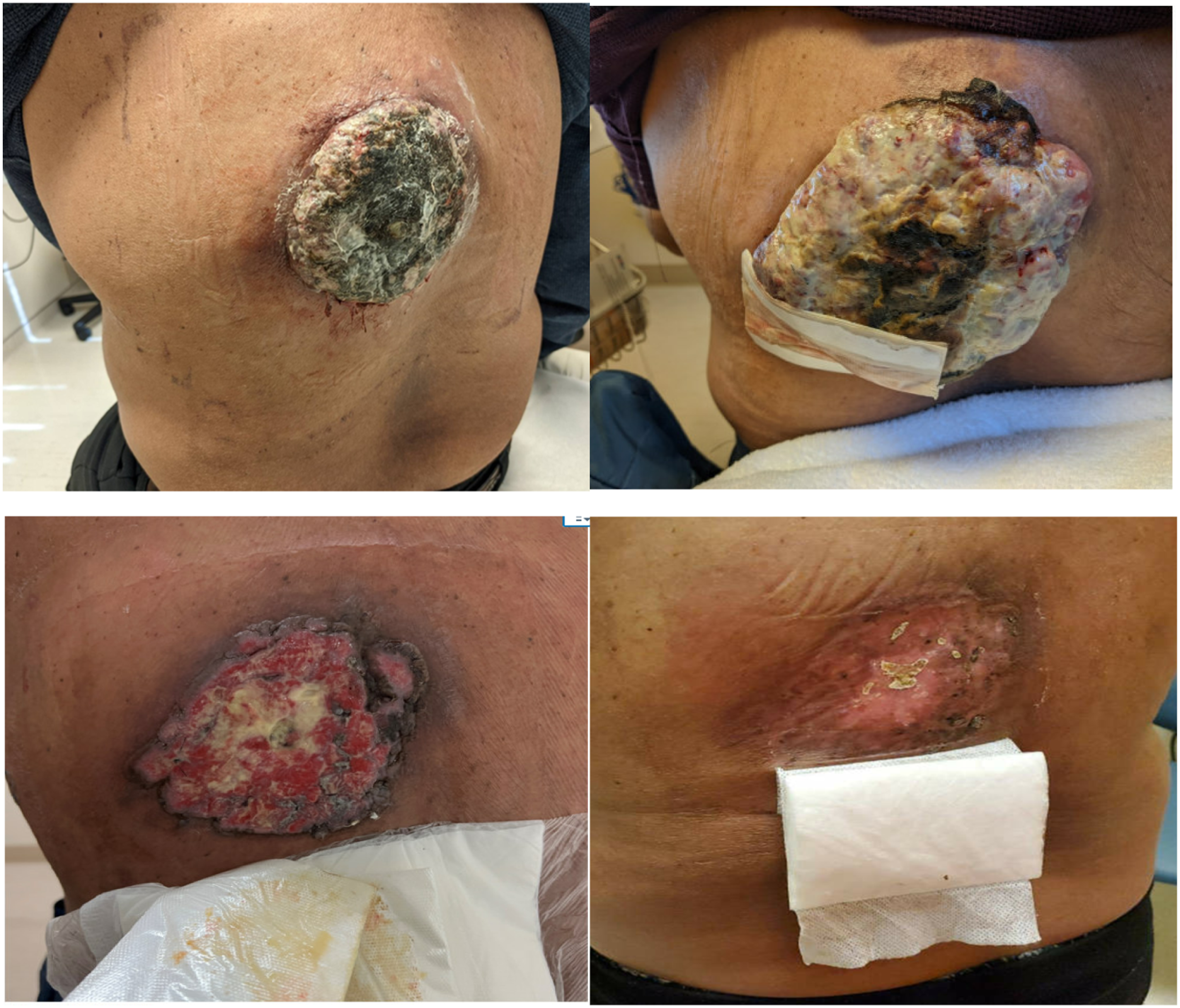
Treatment options including surgical excision, systemic immunotherapy, and radiation were discussed among a multidisciplinary team consisting of medical, surgical, and radiation oncology. The patient was not initially considered as a surgical candidate due to the size of this lesion, necessitating staged surgical resection and reconstruction, and his recent severe COVID-19 infection with ongoing hypoxic respiratory failure requiring 2 liters of supplemental oxygen at rest and significant deconditioning. The recommendation from the multidisciplinary tumor board was to begin with pembrolizumab (anti-PD-1) immunotherapy 6 weeks after his hospitalization for COVID-19. Four days after the first cycle of pembrolizumab, the patient presented to the emergency room due to tumor bleeding. He was found to have acute blood loss anemia with hemoglobin of 6.9 mg/dL, decreased from 8.4 mg/dL 4 days prior, and was given a blood transfusion. Given his poor candidacy for complex staged surgery, the decision was made to proceed with single-fraction radiotherapy (SFRT) with 8 Gy for improved local control.
Two weeks post-radiation and upon consideration for his second cycle of pembrolizumab, the lesion had significant response and was reported to have stopped bleeding entirely (Figure 1C). Seven weeks after radiation, the lesion showed complete clinical response with near-resolution after 3 cycles of pembrolizumab (Figure 1D). Given the favorable treatment response, it was decided to proceed with pembrolizumab and observation over surgical resection at that time. Six months after initial diagnosis and treatment, PET, CT, and MRI scanning showed no evidence of disease, consistent with a radiologic complete response. In total, he completed 17 cycles of pembrolizumab and 4 years from referral to our center, he remains in complete remission on physical exam or cross-sectional imaging (Figure 2). Timeline of case presentation
Discussion
MCC prognosis is dependent upon stage at presentation, with five-year overall survival estimates of 51%, 35%, and 14% being reported for local, nodal, and distant disease, respectively. 2 For surgically resectable clinically N0 disease, upfront surgery is recommended.1,3 For patients with locally advanced MCC not amenable to surgical resection, the National Comprehensive Cancer Network (NCCN) guidelines recommend systemic immunotherapy and/or with radiation therapy (RT). MCC is known to be radiosensitive, and five-year overall survival has been reported in 40-60% of non-surgical MCC patients with a macroscopic primary and/or nodal metastasis who received definitive RT. 13 NCCN guidelines recommend conventional fractioned radiation therapy (CFRT) in a dose of 1.8-2 cGy/fraction in 30 fractions for a total of 56-60 cGy. 3 SFRT, which involves one dose of 8 Gy, is another option. In one study, 26 patients were treated with SFRT to a combined 93 MCC tumors, showing a high response rate (94%), excellent tolerability, and durable palliation in response to treatment. 14 Due to its tolerable safety profile, proven efficacy, and overall convenience, SFRT is an attractive option for patients who cannot tolerate surgery or systemic therapy and was utilized for this patient.
The abscopal effect, or the regression of a metastatic cancer distant to the site of local radiation, has been observed in several cancers including melanoma and demonstrates how RT may activate the immune system and promote antitumor activity.15-17 Basic and translational studies have depicted that RT increases intratumor production of interferon-β, which is critical for priming CD8+ T cells responsible for systemic tumor regression.18,19 Due to this phenomenon, RT has also been associated with enhanced response to ICI.15-17 Our patient received SFRT (8 Gy) to his large MCC for local control to assist with ongoing bleeding from his tumor after his first cycle of pembrolizumab. His tumor then demonstrated rapid clinical regression in the matter of weeks and he completed his planned immunotherapy without complications with a complete clinical and radiographic response. RT, even single fraction, should be considered in patients receiving immunotherapy as it may augment systemic antitumor activity.
In addition to the synergistic effect of RT and immunotherapy, this case illustrates a potential relationship between antiviral and antitumor effectiveness of immune-system activation. Improved responses to ICI have been documented after vaccinations for infectious diseases. A multi-center retrospective cohort study with more than 300 patients from Sweden reports significantly longer progression-free and overall survival in metastatic cancer patients who received recommended influenza vaccinations compared to patients who were unvaccinated while controlling for age, gender, comorbidity, line of treatment, presence of central nervous system disease, and performance status with statistical approaches to avoid immortal-time bias (PFS: P = 0.04, OS: P = 0.03). 20 Notably, they did not observe an increase in immune-related adverse events in the vaccinated group, which supports that the activation of the immune system from vaccines promotes antitumor activity without unwanted off-target effects. A prospective, multi-center observational trial (INVIDIa-2) from Italy originally reported the effectiveness of influenza vaccinations in patients with advanced solid tumors receiving ICI and the authors performed secondary analysis to assess patient outcomes based on immunization status. 9 After propensity score matching, the authors included 1004 patients (502 vaccinated and 502 unvaccinated) and found improved median survival time (27.0 months v 20.9 months, P < 0.01), progression-free survival (12.5 months vs 9.6 months, P < 0.01) and disease-control rate (74.7% vs 66.5%, < 0.01) in the vaccinated group.
Several studies have investigated the use of tumor vaccines in combination with ICI, demonstrating enhanced responses with combination therapy compared to ICI or tumor vaccination alone.8,21,22 Weber et al. in KEYNOTE-942 investigated a mRNA-based individualized neoantigen therapy in combination with ICI compared to ICI monotherapy for patients with resected high-risk melanoma and reported prolonged recurrence-free survival with combination therapy (HR for recurrence: 0.56, 95% CI 0.31-1.02, P = 0.05). 21 A single-center, single-arm study investigating the use ICI along with a tumor vaccine that induces HPV-specific T cells reported an overall response rate of 33% and median overall survival of 17.5 months in patients with incurable HPV-16-positive cancer. 22 The priming of antitumor T cells after tumor vaccination is similar to the mechanisms described to explain improved responses to ICI after vaccinations for infectious diseases.
While our patient received ICI after a severe acute viral infection, not vaccination, his profound sustained response could illustrate the synergy between recovering immune-system hyperactivation and robust response to RT with ICI. COVID-19 infections induce lymphopenia with aberrant monocyte and neutrophil activation which correlate with disease severity and normalize with recovery.10-12 At the time of initial evaluation for his MCC, our patients’ complete blood count (CBC) demonstrated lymphopenia (13%, reference 24-44%) with increased absolute neutrophil count (8.0, reference 1.8-7 × 10³/uL) and absolute monocyte count (1.2, reference 0.0-0.80 × 10³/uL). At the time of his first pembrolizumab infusion 6 weeks later, his CBC was normalizing with only a persistent, but improving, monocytosis (0.90, reference 0.0-0.80 × 10³/uL). While specific cytokine or lymphoid cell populations were not tested in this case, these derangements are consistent with immune cell perturbations from COVID-19. The timing of initiation of ICI with SFRT in the setting of immune hyperactivation after acute viral illness could have supported his observed complete remission. This observation is hypothesis-generating, but an important consideration with advancements in both infectious disease and tumor vaccines becoming more available to patients with advanced solid tumors on ICI. For our patient, who was not a surgical candidate due to advanced local disease with significant comorbidities, SFRT in combination with immunotherapy after a severe COVID-19 infection resulted in complete tumor response and 4 years after treatment, he remains without evidence of disease.
Footnotes

Funding
The authors disclosed receipt of the following financial support for the research, authorship, and/or publication of this article: Research reported in this publication was supported by The University of Kansas Cancer Center Paul Calabresi K12 Career Development Award for Clinical Oncology (K12 CA279868) funded by the National Cancer Institute. It is subject to the NIH Public Access Policy. Through acceptance of this federal funding, NIH has been given a right to make this manuscript publicly available in PubMed Central upon the Official Date of Publication, as defined by NIH.
Declaration of Conflicting Interests
The authors declared no potential conflicts of interest with respect to the research, authorship, and/or publication of this article.