






Abstract
Background
Surgery is considered definitive management for acute uncomplicated appendicitis, with non-operative management an acceptable alternative, but its role in complicated appendicitis remains controversial. Despite guideline recommendations favoring surgery in complicated appendicitis, there remains a trend toward non-operative management due to concern for greater postoperative complications. We aimed to compare in-hospital outcomes with surgical intervention for uncomplicated and complicated appendicitis in a contemporary national cohort.
Materials and Methods
We used the 2019-2022 National Inpatient Sample to identify adult emergency hospitalizations with surgery for acute appendicitis. We compared hospitalizations with surgery for uncomplicated appendicitis against complicated appendicitis examining patient characteristics, extent of resection, length of stay, in-hospital outcomes using survey-weighted multivariable regression.
Results
We identified 406 110 emergency weighted hospitalizations for acute appendicitis; 325 995 included emergency surgery, of which 178 690 (55%) were for uncomplicated and 147 305 (45%) for complicated appendicitis. Compared with uncomplicated appendicitis, surgery for complicated appendicitis more often required unplanned bowel resections (3% vs 1%, P < .001) and had approximately threefold higher rates of gastrointestinal, infectious and wound complications (all P < .001). Complicated appendicitis was associated with longer length of stay (3.9 vs 1.7 days, P < .001) while in-hospital mortality did not differ between the groups.
Discussion
Surgical management for complicated appendicitis more frequently requires additional bowel resection and is associated with higher postoperative complication rates than surgery for uncomplicated appendicitis, despite similar mortality. These highlight the operative complexity of complicated appendicitis and underscore the need for careful perioperative counseling and shared decision-making regarding operative risks and expected outcomes.
Keywords
Key Takeaways
• Compared to uncomplicated appendicitis, surgeries for complicated appendicitis have threefold higher unplanned bowel resections and complications, and associated with longer length of stay. • Preoperative counseling with patients should specifically address the complexity of surgery and postoperative morbidity
Introduction
Acute appendicitis is globally one of the most common surgical pathologies and a common cause for emergency surgical admissions, with an incidence of 100-223 cases/100 000 individuals per year. 1 Acute appendicitis is divided into two types: uncomplicated or complicated. Complicated appendicitis (CA) accounts for roughly 30% of acute appendicitis cases and involves an abscess, phlegmon or perforation, while Uncomplicated appendicitis (UA) is limited to inflammatory changes of the appendix only without clinical or radiological signs of perforation (mass, abscess phlegmon or perforation) . The severity can be stratified on preoperative imaging, intraoperatively, or on final pathology. 2 Surgery is definitive for acute uncomplicated appendicitis, although nonoperative management with antibiotics has also been found to be a safe and acceptable alternative to surgery.3,4 However, controversy exists regarding the role of surgery in complicated appendicitis.
The Society of American Gastrointestinal and Endoscopic Surgeons (SAGES) and World Society of Emergency Surgery (WSES) guidelines both recommend surgical management for CA, and a short postoperative course of antibiotics. 5 Additional studies demonstrate that early surgical management in CA is associated with shorter hospital length of stay, lower readmission rates, and lower 30-day complication rates. 6 However, due to persistent concerns regarding operative difficulty and increased complication risk with surgical intervention in CA, many providers elect for nonoperative management and subsequent discussion for possible interval appendectomy guided by imaging findings and patient’s preferences. 7 Other studies have similarly found that delaying surgical intervention in CA may lower the rate of colonic resection and that initial nonoperative management may reduce complication and re-operation rates compared to earlier surgical intervention. 8
Consequently, no clear consensus currently exists regarding the role or timing of surgical management for complicated appendicitis. The paucity of studies adequately accounting for the complexities of surgical management in complicated appendicitis, variable hospital practices, and limited direct comparisons between operative and nonoperative management further add to this controversy. With these issues in mind, we sought to compare patient outcomes in patients undergoing emergency surgical intervention for acute uncomplicated appendicitis with those undergoing surgical intervention for acute complicated appendicitis. We hypothesized that surgical intervention for complicated appendicitis would be associated with a greater rate of postoperative complications, morbidity, and rate of colonic resection.
Methods
We used the 2019-2022 Healthcare Cost and Utilization Project (HCUP)-National Inpatient Sample (NIS) to do this retrospective study. As the NIS is deidentified and publicly available, this study was qualified for exemption by the Institutional Review Board.
Data from 2019 to 2022 were analyzed because the International Classification of Diseases, 10th revision (ICD-10) diagnosis codes allowing for the distinction between uncomplicated and complicated appendicitis were first introduced into the NIS in 2019.
The NIS is the largest publicly available all-payer inpatient database, encompassing more than 7 million inpatient admissions annually. It includes a 20% stratified sample of all US hospital discharges, excluding rehabilitation and long-term acute care hospitals, and employs the discharge weight variable to generate nationally representative estimates. Demographic, clinical, hospital, and financial parameters are derived from billing claims coded using ICD-10 codes. The ICD-10 diagnosis codes distinguishing UA and CA were categorized according to established definitions and prior literature (Supplement). 9
The database was queried using the ICD-10 diagnosis codes to identify hospitalizations for acute appendicitis in adults aged 18 years or above. Non-emergency hospitalizations were excluded. The ICD-10 procedure codes were then used to distinguish hospitalizations for acute appendicitis that were managed surgically and non-surgically (Supplement). Hospitalizations containing ICD-10 codes for appendectomy, cecum resection, and right hemicolectomy were classified as surgical management, whereas nonoperative hospitalizations were identified by excluding surgical admissions. Hospitalizations involving multiple surgeries were excluded. Subsequent analyses included only hospitalizations managed with surgery, which were categorized into surgery for uncomplicated appendicitis (S-UA) and surgery for complicated appendicitis (S-CA) according to ICD-10 codes (Figure 1). Non-surgical cohort is not part of the primary comparative analyses. Patient selection flowchart
Collected variables included patient demographics (age, sex, race, primary insurance, income quartile), clinical characteristics (severity of illness, mortality risk, extent of resection), hospital attributes (size, location), and outcomes (length of admission, complications, mortality, cost of stay). Extent of resection was defined using ICD-10-CM procedure codes for appendectomy, resection of cecum, and resection of right large intestine (Supplement). Clinical complications were categorized into Pulmonary, cardiac, gastrointestinal, infectious, electrolytes, and acid-base derangement with ICD-10 codes (Supplement).
The primary outcome was the extent of resection, and secondary outcomes included length of stay (LOS), postoperative complications, and in-hospital mortality. Data were analyzed using Stata 18.0 (StataCorp, College Station, TX), incorporating the NIS’s stratified sampling design using discharge-level weights, cluster, and strata variables as in accordance with HCUP.
Continuous variables are reported as mean and histograms were utilized to assess distributional normality. For normally distributed data, comparisons were made using Student’s t-test, whereas Mann-Whitney U-test was applied to non-normally distributed data. Categorical variables are presented as frequency with percentages and were compared using chi-Square tests. Multivariable regression was used to evaluate the association between appendicitis severity and outcomes of interest. All tests were two-sided, with a threshold for statistical significance of P < .05. Missing data were addressed using multiple imputation under a missing at random assumption and estimates following established methods. 10
Results
Study Population
We identified 418 835 weighted hospitalizations for acute appendicitis in adults between 2019 and 2022 (Figure 1). After exclusions, 325 995 weighted hospitalizations remained, including 178 690 uncomplicated (S-UA,55%) and 147 305 complicated (S-CA, 45%)
Baseline Characteristics
Baseline Demographic and Clinical Characteristics of the Study Population
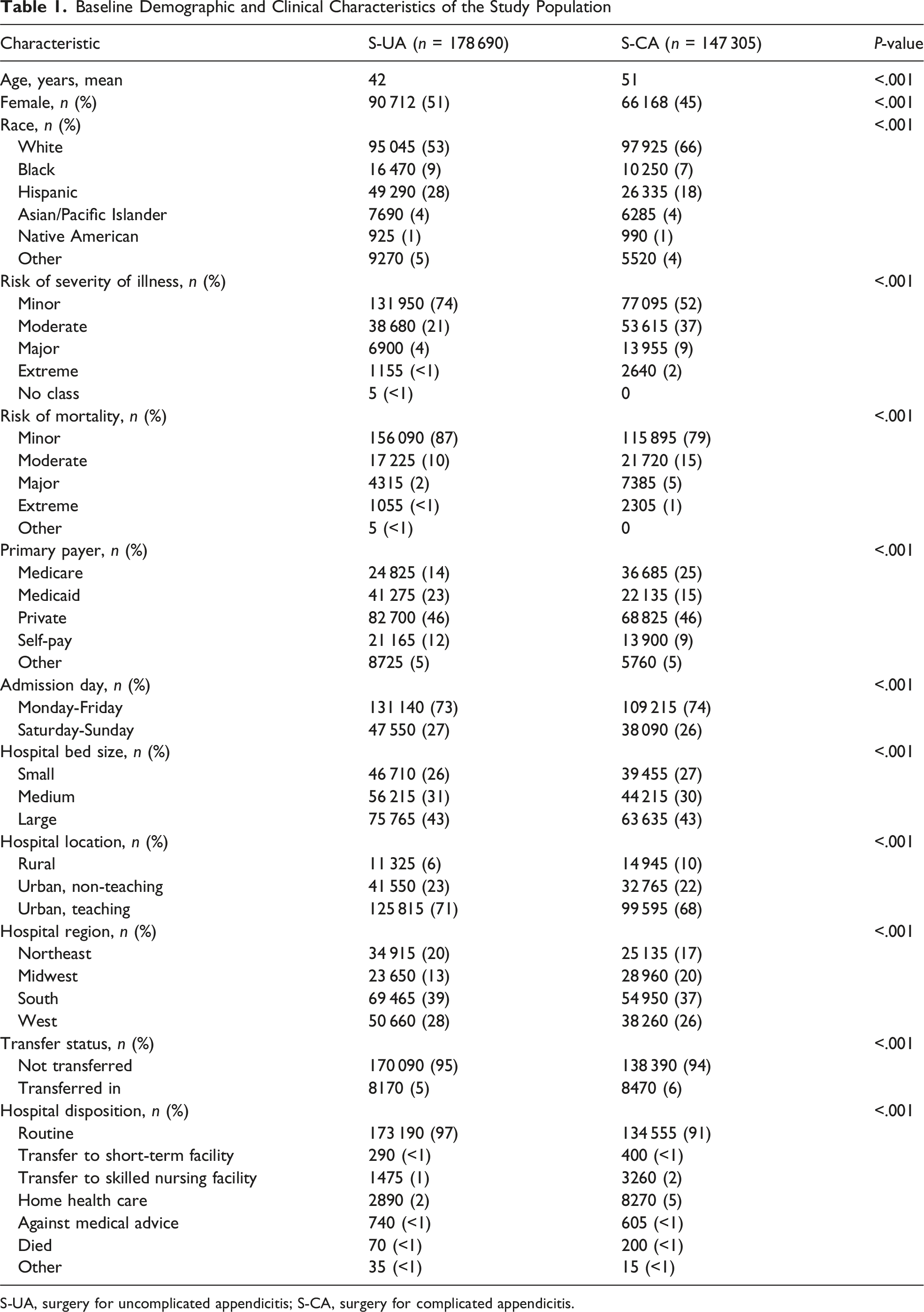
S-UA, surgery for uncomplicated appendicitis; S-CA, surgery for complicated appendicitis.
Surgical Procedures
Extent of Surgical Resection by Appendicitis Severity

S-UA, surgery for uncomplicated appendicitis; S-CA, surgery for complicated appendicitis.
Clinical Outcomes
Surgical Outcomes by Appendicitis Severity
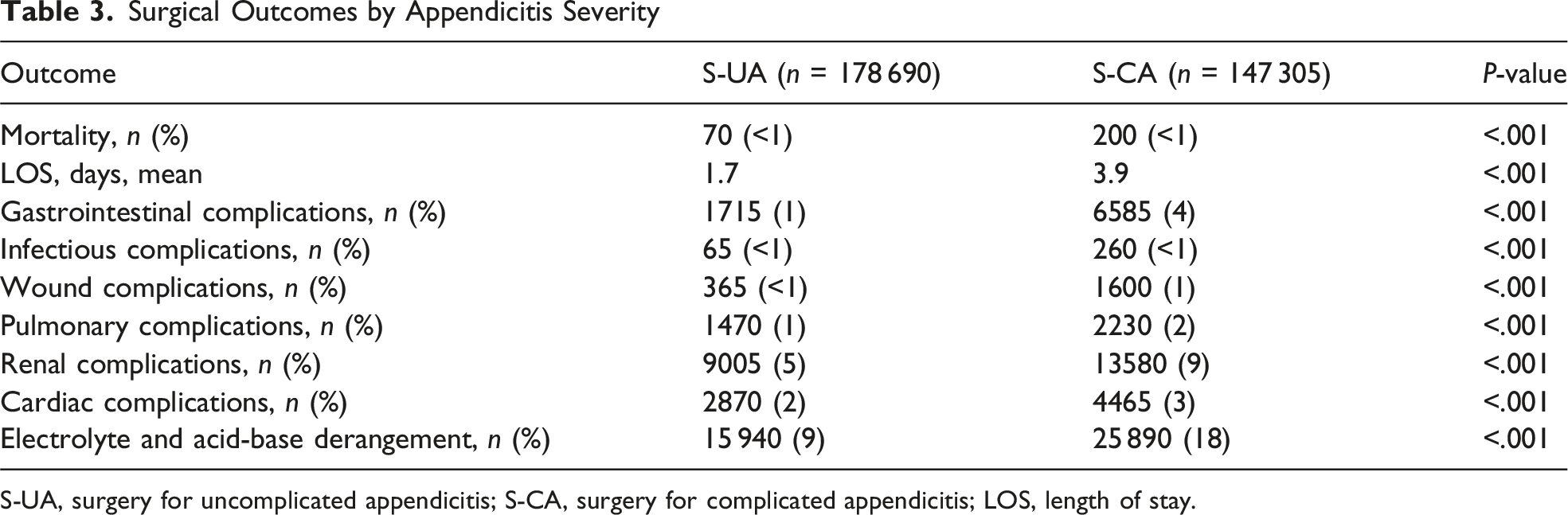
S-UA, surgery for uncomplicated appendicitis; S-CA, surgery for complicated appendicitis; LOS, length of stay.
Multivariable Analysis
Multivariate Regression Analysis of Postoperative Outcomes by Appendicitis Severity
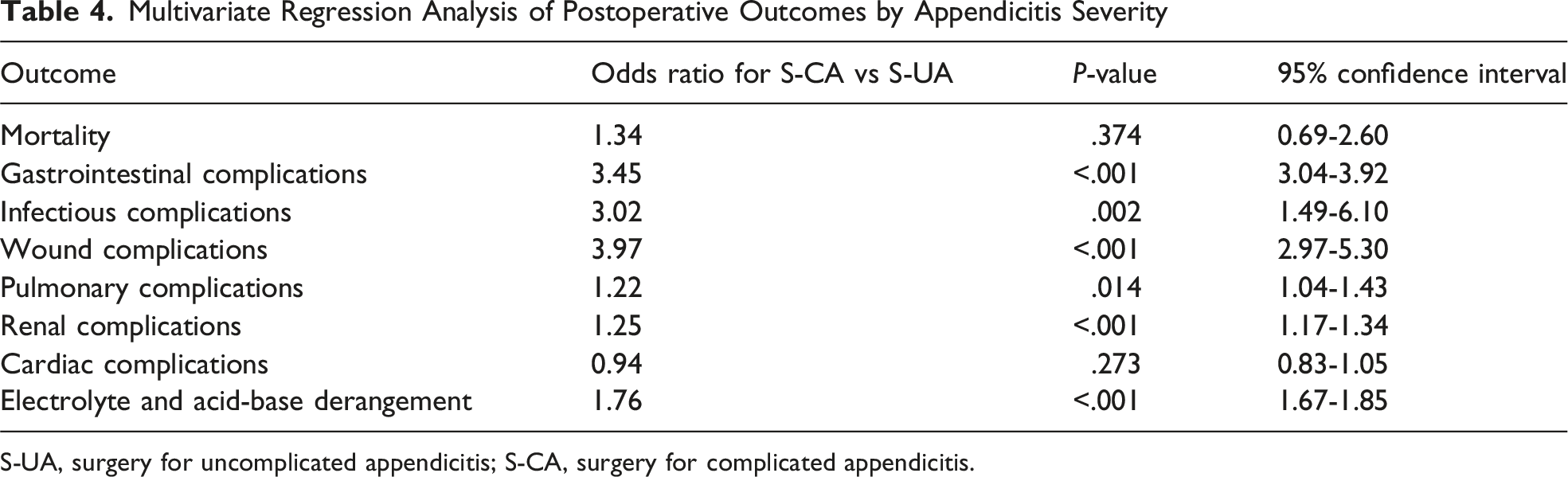
S-UA, surgery for uncomplicated appendicitis; S-CA, surgery for complicated appendicitis.
The S-CA cohort was associated with a longer length of stay, with a mean increase of 4.6 days (95% CI 4.20-5.02, P < .001). There was no higher risk of in-hospital mortality (OR 1.34, 95% CI 0.69-2.60, P = .37) or cardiac complications (OR 0.94, 95% CI 0.83-1.05, P = .27). On Multivariate linear regression, S-CA cohort had a significantly longer length of stay with an adjusted mean increase of 4.6 days (95% CI 4.2-5.0, P < .001).
Discussion
Management of CA is one of the debated areas in emergency surgery with considerable discordance between guidelines recommendations and real-world practice. A major consideration driving the clinical decision is the possibility of unplanned bowel resections in surgeries for CA. Compared to surgeries for UA, our study demonstrates threefold increase in additional bowel resections, consistent with prior reports, with rates ranging from about 1.7% to 11.5%.11,12,13
The recommendations for operative approach in CA need to be calibrated carefully with elevated rates of extensive resection and postoperative complications observed in surgeries for CA. Over time, recommendations have shifted from a predominantly nonoperative strategy toward early surgical intervention, with greater emphasis on careful patient selection and the availability of experienced surgeons.2,5,7,8 The 2025 WSES Jerusalem Guidelines advocate early appendectomy for CA with gangrene or perforation, while recommending an age-stratified approach for peri appendiceal abscess: immediate surgery for patients younger than 35 years and initial nonoperative management with interval appendectomy in those 35 years or older, owing to a reported appendiceal neoplasm risk of up to 14.3. 2 In parallel, SAGES guidelines support nonoperative management in patients with marked cecal inflammation, abscess, or prolonged symptom duration to mitigate operative risk, although they note that surgery confers a shorter length of stay compared with nonoperative treatment. 2
In UA, inflammation is typically confined to the appendix, allowing a straightforward appendectomy with minimal risk to adjacent structures. By contrast, complicated appendicitis is characterized by more severe inflammation and tissue necrosis that may extend to the terminal ileum, cecum, and the right colon distorting normal anatomy and increasing operative complexity.
In this setting, more extensive resection involving the terminal ileum, part of the cecum, or the right colon may be required to achieve adequate margins, remove necrotic and infected tissue, and reduce the risk of stump-related complications, thereby prioritizing infection control and surgical safety. Although a threefold increase in major resection may appear modest, it represents a substantial absolute burden when considered against the 300 000 appendectomies performed annually in the United States. 1 Imaging findings such as appendiceal mass, free intraperitoneal fluid, pneumoperitoneum and cecal wall thickening have been identified as independent predictors for extensive resection in patients with complicated appendicitis. 14
Identifying patients with CA who are at high risk for unplanned bowel resection and postoperative complications is critical when considering operative vs nonoperative management. 15 In patients with high-risk features for ER, an initial nonoperative strategy followed by interval appendectomy may help limit the need for additional bowel resection, reduce complications, and mitigate the risk of missed appendiceal neoplasms. 16 Nonetheless, nonoperative management is not benign and is associated with failure rates of approximately 14-25%, underscoring that operative decision-making in CA must integrate clinical status, imaging findings and surgeon judgment. 17
Gastrointestinal, infectious, and wound complications were nearly threefold higher in patients with CA. The pronounced inflammatory response in CA leads to marked tissue friability and widespread peritoneal contamination with enteric flora, particularly in the setting of perforation and spillage of intestinal contents, where polymicrobial infection may persist despite adequate resection and source control. This scenario necessitates more extensive and technically demanding dissection, increasing the risk of ileus, inadvertent bowel injury, hemorrhage, and leak. Consequently, complicated appendicitis has been identified as an independent risk factor for surgical site infections and intra-abdominal abscess. 18 Moreover, the burden of intraoperative findings exhibit a dose-response relationship with outcomes. Patients with multiple intraoperative findings (perforation, abscess, fecalith, diffuse exudate) experience complication rates that are nearly 50% higher than those with isolated findings. 19 In addition to the intrinsic severity of CA, these observations in our cohort likely also reflect the older age, greater comorbidity burden, and higher baseline clinical acuity of patients with complicated disease.
Our study has several notable strengths including the use of a large, nationally representative dataset encompassing patients with appendicitis across the United States. We also explicitly distinguished complicated from uncomplicated appendicitis using ICD-10 diagnosis codes and restricted the cohort to emergency surgical admissions, thereby enhancing the clinical relevance of our findings. However, important limitations must be acknowledged. Although nonoperative management is increasingly used for appendicitis selectively, this study encompasses only surgically managed patients. Direct comparisons between operative and nonoperative strategies are beyond the scope of this work and represent an area for further research. The NIS is a retrospective administrative database and is subject to potential coding errors, which may result in misclassification of disease severity or specific complications. Prior to 2019, appendicitis diagnoses were aggregated into a single board category and the adoption of Clinical Classifications Software Refined groupings from 2019 allowed more granular characterization of appendicitis (eg, perforated vs non-perforated, acute vs non-acute, abscess, localized vs generalized peritonitis). Restricting our analyses from 2019 to 2022 likely reduced, but did not eliminate, misclassification.
The NIS captures hospitalizations rather than unique individuals; thus a patient undergoing appendectomy who is later admitted with complications would appear as two separate encounters, potentially leading to underestimation of post-surgical adverse events. 20 The dataset also lacks key clinical details that influence diagnosis, management and outcomes, including timing of presentation and operation, imaging findings, operative approach (ie, open vs minimally invasive), disease progression prior to intervention, and laboratory data, all of which are integral to clinical decision-making. Finally, we were unable to quantify the proportion of patients in whom initial nonoperative management failed and ultimately necessitated surgical intervention.
Surgical management of complicated appendicitis is associated with higher likelihood of extensive resection, greater technical complexity, and increased postoperative complications. These findings underscore the importance of counseling patients regarding operative risk and complexity in CA and support the involvement of experienced surgical teams. Further studies are needed to more precisely identify which patients are best served by immediate resection vs an initial nonoperative strategy with interval appendectomy.
Supplemental Material
Suppplemental Material - When Appendicitis Extends Beyond Appendectomy: Bowel Resection and Morbidity in Complicated Appendicitis
Suppplemental Material for When Appendicitis Extends Beyond Appendectomy: Bowel Resection and Morbidity in Complicated Appendicitis by David A. Lieb, Basilio N. Bautista, Amy Y. Lee, Darya Hosein, Franciso R. Matos, Dustin R.R Cummings, Marc Wallack, and Umashankkar Kannan in The American Surgeon™
Footnotes
Acknowledgments
The author gratefully acknowledges Dr James Mariadason for his thorough review of the manuscript and for his constructive, critical comments, which greatly strengthened this work.

Author Contributions
Conception, Methodology: UK. Formal Analysis and Interpretation: UK and DL. Writing—Original Draft: DAL, BNB, AL, DH, and FRM; Writing—Revision and Editing: UK, DRC, and MW; Supervision: UK.
Funding
The authors received no financial support for the research, authorship, and/or publication of this article.
Declaration of Conflicting Interests
The authors declared the following potential conflicts of interest with respect to the research, authorship, and/or publication of this article: David A Lieb 2nd - The views and information presented are those of the authors and do not represent the official position of the U.S. Army Medical Center of Excellence, the U.S. Army Training and Doctrine Command, or the Departments of Army, Department of Defense, or the U.S. Government. Other authors declare no conflicts of interest.
Supplemental Material
Supplemental material for this article is available online.
References
Supplementary Material
Please find the following supplemental material available below.
For Open Access articles published under a Creative Commons License, all supplemental material carries the same license as the article it is associated with.
For non-Open Access articles published, all supplemental material carries a non-exclusive license, and permission requests for re-use of supplemental material or any part of supplemental material shall be sent directly to the copyright owner as specified in the copyright notice associated with the article.
