






Abstract
Diabetic foot infections are one of the complications of diabetes mellitus resulting in extremity amputation and mortality. This study aimed to examine the predictive value of the C-reactive protein (CRP) to albumin ratio (CAR) for amputation risk in diabetic foot infection. Data from 178 patients were retrospectively examined. We found the cut point value of 15.45 according to the receiver operating characteristic (ROC) curve to show the predictive value of CAR for amputation risk in the overall population. We then divided the patients into two groups low (<15.45, n = 96) and high risk (≥15.45, n = 82) according to their CAR value. Matching based on propensity scores produced 64 patients in each group and showed that the amputation rate was high in the high-risk groups (50 vs 25%, P = .003). In the multivariate analysis in the matching group, previous amputation, antibiotic therapy in the last 3 months, and CAR (Odds ratio [OR]: 1.30, 95%Confidence interval [CI]: 1.01-1.45, P < .001) were independent predictors of amputation. These parameters may be useful to predict amputation risk in these patient groups.
Introduction
Diabetes mellitus (DM) is increasingly prevalent worldwide affecting 9.3% of the population aged 20–79 years, in other words, 463 million individuals, as reported in 2019. 1 The number of cases has increased by 62% in the past decade. 1 Morbidity and mortality can be seen in these patients due to complications affecting many systems. Diabetic foot infection is a major complication in this group of patients. 2 The lifetime incidence of diabetic ulcers in diabetic cases is 19%–34% and 65% of these ulcers occur in the first 5 years 3 The development of peripheral neuropathy and peripheral arterial disease in diabetic patients typically leads to perfusion and sensory disorders which contribute to ulcer formation. 3
In infected diabetic foot ulcers, inflammation progresses rapidly due to the effect of underlying immunopathologies, involving bone tissue and potentially results in osteomyelitis or even amputation of the extremity. 4 The level of inflammation is typically classified according to the IWGDF (International Working Group on the Diabetic Foot) classification 5,6 as grade 1, 2, or 3. The markers used to diagnose infected diabetic foot ulcers in the presence of clinical symptoms include erythrocyte sedimentation rate (ESR), C-reactive protein (CRP), procalcitonin (PCT), and leukocyte (WBC) count. Studies have reported that the ESR is valuable in predicting the severity and intensity of the disease. 4 In another study Sharma et al. 7 reported that the sensitivity and specificity of CRP were 77.4% and 84.3%, respectively in diagnosing grade 2 ulcers. PCT had a sensitivity of 85.5% and a specificity of 68.9% in diagnosing grade 3 ulcers. 7 The incidence of non-traumatic major lower extremity amputations is 12–50 per 100,000 individuals per year among medicare patients, with a 5-years mortality rate reaching the 40% range. 8 In amputee cases, there is a decrease in quality of life and loss of work productivity and this situation causes overall global economic losses. 8,9 For these reasons, predicting amputation in the early stages can be life-saving.
Extremity ischemia is an atherosclerotic process associated with inflammatory events, and studies have reported that CRP is a marker for extremity ischemia. 9,10 Albumin is a negative acute-phase reactant and its level is expected to decrease during the inflammatory process. 11,12
There are many studies on markers that can be used to predict amputation but data on CRP/albumin ratio (CAR) are limited. 13 This study aimed to investigate the predictive value of CAR for amputation risk in patients with diabetic foot infection in healthcare institutions.
Materials and Methods
Data from 178 diabetic foot infection cases followed in a tertiary university hospital between 01.01.2019 and 01.01.2020 were retrospectively examined. The patients were divided into two groups: those who underwent amputation and those who did not. Factors affecting amputation rates were recorded in addition to demographic information. These factors included underlying comorbidities, geographic location, antibiotic consumption and hospitalization within the last 3 months, history of diabetic foot infection, and previous amputation. In addition, white blood cell count, HbA1c, and CAR were measured. The albumin and CRP levels were measured using a Roche Diagnostics Cobas 8000 c502 analyzer (Indianapolis, USA).
Statistical Analysis
Continuous variables were expressed as mean ± SD and categorical variables as the number of patients and percentage of the total. Student t-tests or Mann-Whitney U tests were used to compare the two groups depending on appropriateness. The Chi-square test was used to compare categorical values. The factors entered into the multivariate model included those with P-values <0.1 from the univariate analysis and variables with known predictive value. The predictive value of CAR and CAR plus, multivariable model was estimated by the areas under the receiver operating characteristic curve (ROC). We used the DeLong test to compare the area under the curve (AUC) with each of these parameters. 14 Moreover, the increased discriminative value of the CAR was also estimated using net reclassification improvement (NRI) and integrated discrimination improvement (IDI). 15 We determined the cut point value of 15.45 according to the ROC curve to show the predictive value of CAR for amputation risk in the overall population. We then divided the patients into two groups low (<15.45, n = 96) and high risk (≥15.45, n = 82) according to their CAR value. We performed propensity score matching to create a matched dataset (low-risk vs high-risk) and the covariates including the type of DM, lesion on percutaneous transluminal angioplasty, antibiotic therapy in the last 3 months, coronary artery disease, chronic renal deficiency, hemodialysis, and white blood cell were considered for balance between low-risk and high-risk groups. A 2-sided P < .05 was considered statistically significant. SPSS version 26 (SPSS Inc., Chicago, IL, USA) and R software (R Foundation for Statistical Computing) were used for analysis.
Results
Comorbidities and Other Characteristics of Patients.
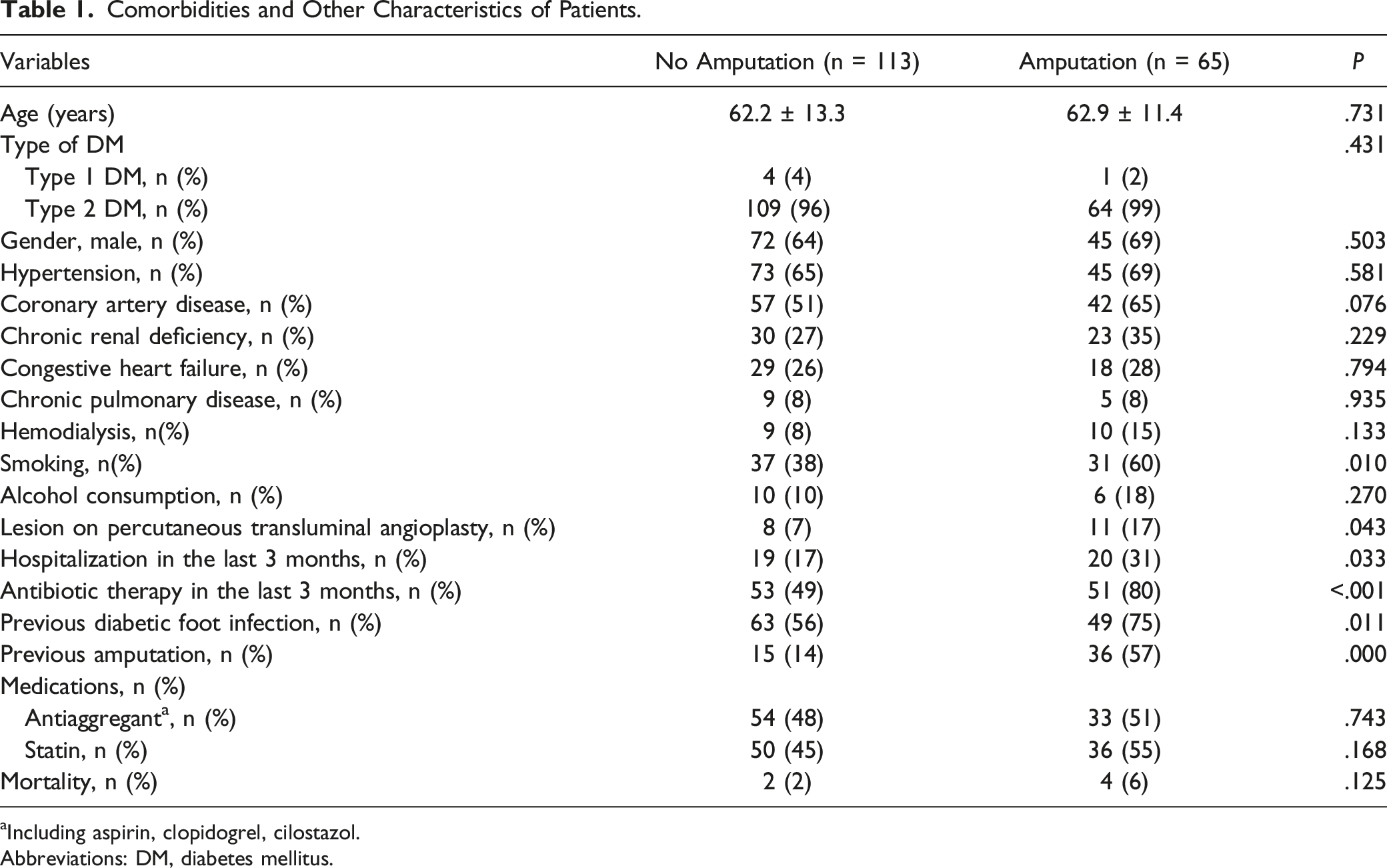
aIncluding aspirin, clopidogrel, cilostazol.
Abbreviations: DM, diabetes mellitus.
The Laboratory and Clinical Parameters of Patients With and Without Amputation.

Abbreviations: DM, diabetes mellitus, CRP, C-reactive protein.
The area under the curve (AUC) of CAR to predict amputation in patients with diabetic foot infection was 0.754 (95%CI: 0.678–0.829, P < .001, Figure 1). Matching based on propensity scores produced 64 patients in each group (Tables 3 and 4) and showed that the amputation rate was high in the high-risk groups (50 vs 25%, P = .003 Table 3, Figure 2). In the multivariate analysis performed after matching; previous amputation, antibiotic therapy in the last 3 months, and CAR (OR: 1.30, 95%CI: 1.01–1.45, P < .001) were independent predictors of amputation (Figures 3 and 4). Receiver operating characteristic (ROC) curves for the C-reactive protein to albumin ratio (CAR) for predicting amputation in all populations. Comorbidities and Other Characteristics of Patients With a Low and High Risk.
aIncluding aspirin, clopidogrel, cilostazol. Abbreviations: DM, diabetes mellitus. The Laboratory and Clinical Parameters of Patients With a Low and High Risk. Abbreviations: DM, diabetes mellitus, CRP, C-reactive protein. Amputation rates in high-risk and low-risk groups after matching. Amputation predictors in the matching group (C-reactive protein to albumin ratio as a continuous variable). Amputation predictors in the matching group (high/low-risk groups).


The addition of CAR to a multivariable model including antibiotic usage in the last 3 months, and previous amputation provided a better predictive value than the multivariable model alone after matching (AUCs: 0.833 vs 0.757, z = 2.710, P = .007; NRI: 69.1%, P < .001; IDI: 0.109, P < .05, Figure 5). Receiver operating characteristic (ROC) curves for the multivariable model, and multivariable model plus C-reactive protein to albumin ratio (CAR) for predicting amputation after matching.
Discussion
The present study found that CAR was independently associated with amputation in patients with diabetic foot infections. Moreover, CAR improved risk stratification and enabled a more accurate prediction of amputation compared with the multivariable model alone.
Diabetic foot infection is a widespread problem worldwide. 1 Complications affecting different systems are observed in these patients, along with frequent development of circulation problems, neuropathy, and inflammation issues. 16 Due to difficulties with wound healing, wound care, inadequate glycemic control, and insufficient pressure-reducing measures, amputation can be required. 16 Preventing amputation can lead to a decrease in both workforce loss and mortality rates. In this study, the amputation rate was 63.2%. The high amputation rate of our center can be explained by being a tertiary care institute, also a comprehensive center that mainly follows end-stage cases.
It has been shown that acute-phase reactants were related to amputation risk in diabetic foot infections. 17 CRP is a plasma protein with a homopentameric structure and serves as a positive acute-phase reactant. 17 It specifically binds to phosphocholine, a component of many bacterial and fungal polysaccharides in a Ca-dependent manner. 17 CRP plays a role in recognizing pathogens and eliminating pathogens through the complement system and phagocytic cells in the first line of natural immunity. 17 It also plays a role in clearing apoptotic and necrotic host cells and restoring damaged tissue. However, recent studies have reported that CRP can also contribute to tissue damage in atherogenesis and acute myocardial infarction. 18–20 Albumin, on the other hand, is a negative acute-phase reactant that decreases during the inflammation process like transferrin, transferrin, antithrombin, and transcortin. 11,12
In the study by Eren and colleagues, CAR in diabetic foot infection was stated to be an indicator of osteomyelitis. 21 CAR was an independent predictor of mortality and amputation risk in peripheral arterial disease patients undergoing endovascular therapy. 13 In the present study, CAR, which has not been previously studied as an indicator of amputation in diabetic foot infections in the literature was examined. High HbA1c and CAR levels were found to predict amputation. In the study by Harb and colleagues 22 in 139 diabetic foot cases, 83 patients were infected, and amputation was performed in 43.3% of infected cases, which is lower than our amputation rate. The high amputation rate in our cases may be due to patients’ late-stage attending for medical care. In addition, similar to our study, a history of amputation, and high HbA1c levels were also mentioned as risk factors for amputation in the same study. 22 In another study of 1771 cases of diabetic foot, the amputation group was reported to be 18.4%, and parallel to our study, conditions that increase the risk of amputation were identified as high levels of CRP and HbA1c. Also, in multivariable logistic regression analysis, CRP was reported to be an independent risk factor for amputation. 23 Due to albumin’s status as an acute-phase reactant, this molecule has also been studied in predicting mortality and hypoalbuminemia has been reported to increase the risk of amputation. 24 However, there is no study examining CAR as a predictor of amputation risk in diabetic foot infection cases. In the present study, CAR in patients with diabetic foot infection was found to be an independent predictor of amputation. We believe that this ratio can be used as an important marker in these cases due to its repeatability and relatively low cost. There is a need for new and comprehensive studies on this topic.
The present study has several potential limitations. It was a retrospective, single-center study involving a relatively small number of patients. New and comprehensive studies are needed for different views of understanding about this subject. More importantly, serum albumin level is also affected by various clinical conditions other than nutritional status. Finally, our conclusion was based on a single determination of the baseline CAR. Dynamic measurements of CAR level may provide additional prognostic significance in these patients.
Conclusions
The present study demonstrated that the combination of CAR and the multivariable model was an independent predictor of amputation in diabetic foot infection. A relatively inexpensive and easy-to-administer test, CAR may be a helpful tool in identifying the risk of amputation in patients with diabetic foot ulcers and managing these patients.
Footnotes
Author Contributions
All authors contributed to: (1) substantial contributions to the conception and design, or acquisition of data, or analysis and interpretation of data, (2) drafting the article or revising it critically for important intellectual content, and, (3) final approval of the version to be published.
Declaration of Conflicting Interests
The author(s) declared no potential conflict of interest concerning the research, authorship, and/or publication of this article.
Funding
The author(s) received no financial support for the research, authorship, and/or publication of this article.
