







Abstract
Objectives:
To elucidate the frequency and types of pre- and post-interview communication that applicants engage with programs, to garner the perceptions of both applicants and program directors (PDs), and determine if communication influences outcomes.
Subjects and Methods:
Electronic surveys were distributed to otolaryngology residency applicants, and to PDs of ACGME-accredited otolaryngology programs after the 2018 to 2019 application cycle.
Results:
93 of 324 applicants (28.7%) and 33 of 106 PDs (31.3%) responded. In the pre-interview period, 58.1% of applicants sent emails of interest, and 41.9% had a mentor initiate communication. In the post-interview period, the majority of applicants (82.8%) sent notes of intent to their number one choice, and 32.3% had a faculty mentor communicate this on their behalf. The majority of PDs (84.8%) were undecided or did not believe that emails of interest influence decisions to offer an interview, whereas 81.8% believed that communication initiated by an applicant’s mentor has an impact on interview offers. No PD agreed that declarations of intent from applicants have an impact on their rank lists, while only 33.3% of PDs believed that a mentor communicating this for an applicant has some impact. Our statistical findings are in agreement with these perceptions as neither applicant-initiated pre-interview (P = .54), mentor-initiated pre-interview (P = .62), applicant-initiated post-interview (P = .11) nor mentor-initiated post-interview (P = .78) communications influenced the number of interviews received or ultimate match outcome.
Conclusion:
Pre- and post-interview communication practices vary widely among otolaryngology applicants. Applicant-initiated communication has no impact on outcomes, while mentor-initiated communication is perceived to have more benefit, despite not impacting interview or match outcomes in this study.
Keywords
Introduction
In 2019, the National Resident Matching Program (NRMP) reported a record high 44,600 registered applicants for 35,185 residency positions. Otolaryngology was one of five specialties with more than 30 positions that filled all available residency positions with a reported 93.9% being U.S. allopathic seniors. 1 The NRMP reported 462 total applicants applied for 328 available otolaryngology residency positions in 2019. 2 Applicants that enter the match process often find themselves unsure and stressed as to how they should communicate with programs outside of the interview day in order to influence their candidacy for a residency position. This added pressure to gain any form of advantage is particularly true in otolaryngology, in which some consider it “impossible” to match without impeccable qualifications given the limited number of positions. 3
A recent study in otolaryngology explored the post-interview communication trends among program directors (PDs) and the perceived impact that communication from applicants have on rank lists 4 , however, there is limited understanding of what forms of communication are effective and how applicants and PDs perceive communication outside of the interview day. The purpose of this study is to investigate the frequency and value that applicants place in both pre-interview and post-interview communications, to compare applicants’ perceptions to those of PDs’, and to evaluate its potential impact on interview invitations and matching outcomes; ultimately this will provide clarity for applicants on appropriate forms of communication.
Materials and Methods
After receiving Institutional Review Board approval by the University of California, Davis (UCD), we distributed anonymous questionnaires using SurveyMonkey (www.surveymonkey.com, San Mateo, California), an online survey platform, to both otolaryngology applicants and otolaryngology PDs. A 14-item questionnaire was sent to 324 applicants who applied to UCD Otolaryngology- Head and Neck Surgery residency program during the 2018 to 2019 application cycle. A 10-item questionnaire was sent to the PDs of 106 Accreditation Council for Graduate Medical Education (ACGME) accredited Otolaryngology-Head and Neck Surgery programs via the Otolaryngology Program Directors Organization. We decided to survey individuals that applied to the UCD Otolaryngology program, as this population represented the vast majority (70%) of total applicants who applied in the otolaryngology application cycle. Additionally, this method facilitated acquiring applicant emails easily, which allowed us to survey this population immediately following the 2019 match.
The questions in the applicant questionnaire assessed demographic information, number of interview offers, the frequency of various forms of communications in the pre- and post-interview periods, and the perceived benefits of such communications on their candidacy and match outcome. The items in the PD questionnaire assessed demographic information, their perceptions of various forms of communications in the pre- and post-interview periods, and their preferences of such communications. The questionnaires were carefully reviewed by all authors to assure clarity of each question.
An invitation to participate in the questionnaire was transmitted electronically to applicants after Match Day 2019 between March 2019 and April 2019; two reminder emails were sent during this period. The PD questionnaire was transmitted electronically between May 2019 and June 2019; two reminder emails were sent during this period. All responses were strictly anonymous, and the purpose of our study was outlined in the invitation email and the first section of each questionnaire.
Statistical analysis was performed on the data to analyze trends on applicant communication behavior. Data was expressed as frequencies and proportions. A Kruskal-Wallis test was performed to determine the impact of behavior frequency and the number of interviews received by the applicant. For post-interview communication trends, data was expressed as a nominal dichotomous variable. A Pearson Chi-Square test of Independence was performed to determine whether post-interview communication had an effect on matching into the applicant’s first choice program. All analyses were performed with SPSS 26.0 and significance was reached with P-value <.05.
Results
Applicant Questionnaire
Out of 324 applicants, 93 responded to the survey for a response rate of 28.7% - 10 of the 93 responding applicants (10.8%) had applied via the couples’ match. Among the respondents, 74.2% had at least ten interview offers, 38.7% matched at their number one choice, and 22.6% matched with a program where they completed a visiting rotation.
Table 1 summarizes the applicants’ communication trends and perceptions in pre-interview communication. 58.1% of applicants indicated that they sent pre-interview emails of interest to programs, and 41.9% of applicants had a faculty member initiate communication on their behalf. Among this population engaging in pre-interview communication, 88.9% responded that they either “rarely” or “sometimes” sent emails of interest, and 97.4% responded that they either “rarely” or “sometimes” had a mentor initiate communication. Conversely, among the couples’ match applicants, 80% responded that they either “usually” or “always” communicated with programs of interest to allude to their partner’s interview status at that institution. Additionally, 60% stated that they “usually” had someone from their partner’s prospective program communicate with the otolaryngology program from the same institution. When asked about the perceived benefit of pre-interview communication, answers varied widely. The majority of applicants (62.4%) were unsure or did not believe that emails of interest influence outcomes, whereas the majority of applicants (78.5%) felt that faculty mentors initiating contact did have an influence on receiving interview offers (Table 1).
Applicants’ Pre-Interview Communication Trends and Perceptions.
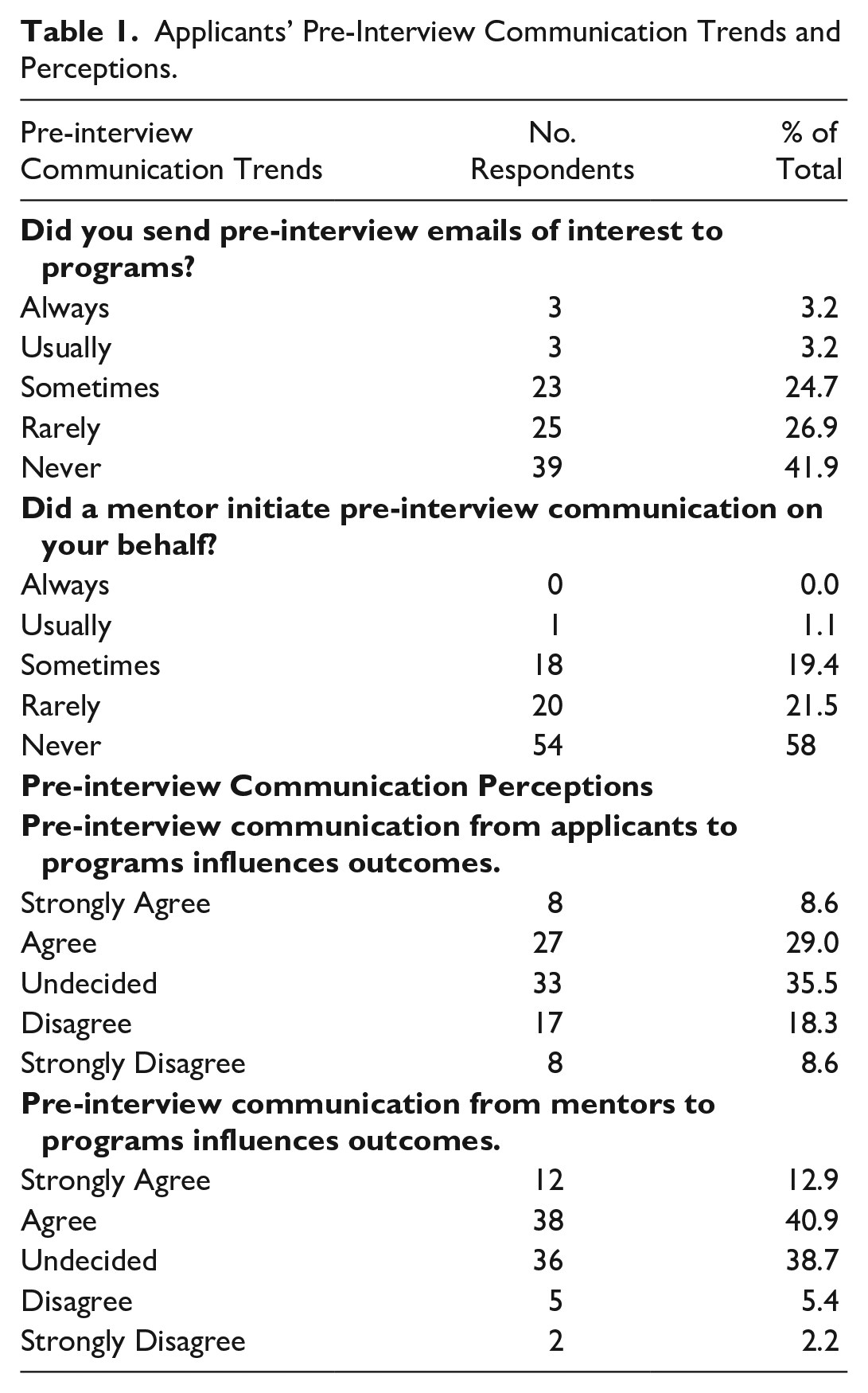
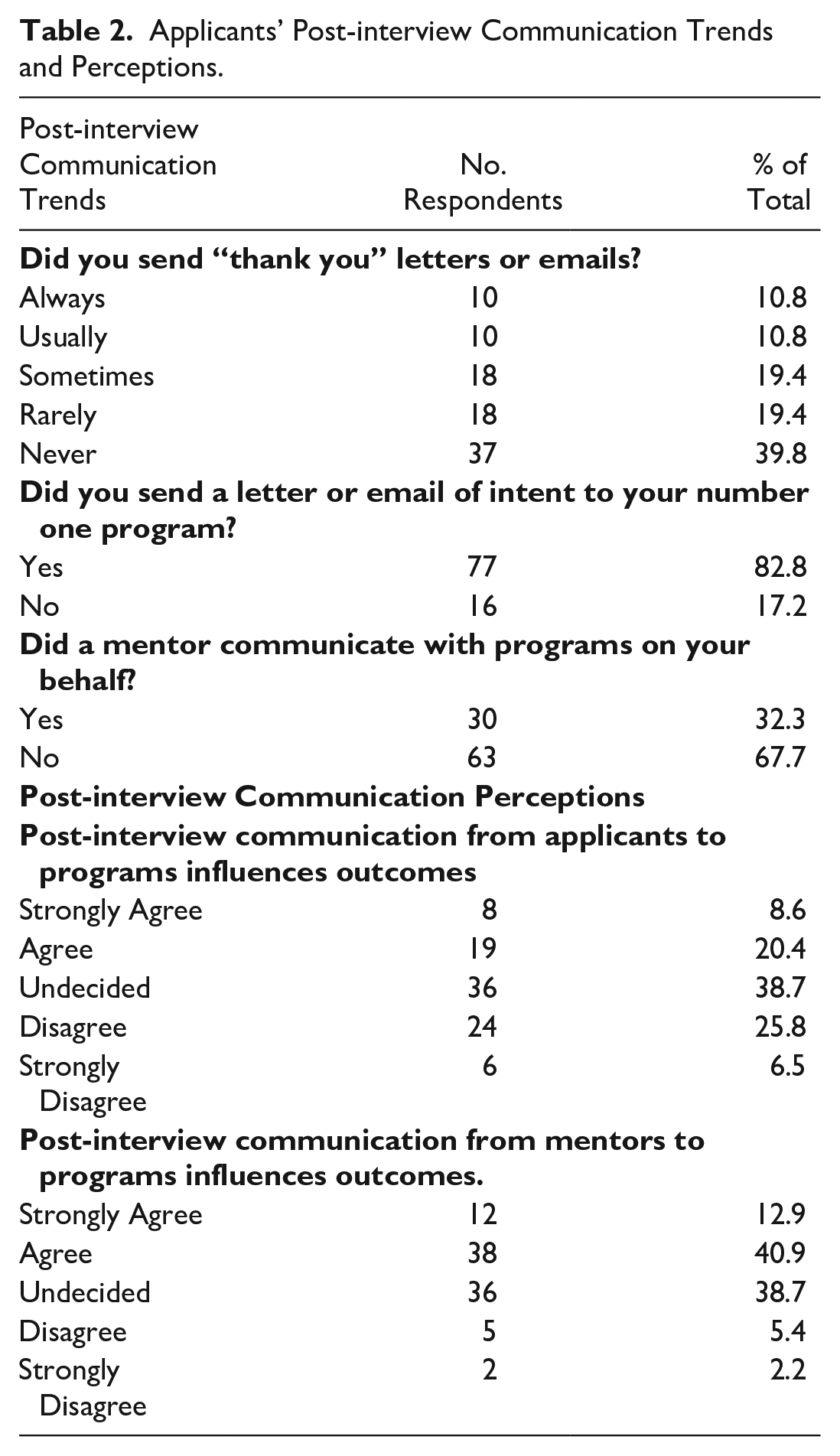
Table 2 summarizes the applicants’ communication trends and perceptions in post-interview communication. When asked about sending “thank you” emails or letters after interviews, 39.8% of applicants indicating that they never sent such forms of communications, while 21.5% responded that they “usually” or “always” did. A large proportion of applicants (82.8%), indicated that they sent emails or letters of intent to express that a particular residency program was their number one choice, and 32.3% indicated that they had a faculty mentor communicate on their behalf. In general, 70.1% of applicants were “unsure” or did not believe that applicant-initiated post-interview communication influences outcomes, however, 53.8% felt that if a faculty member communicated to programs on their behalf influences outcomes (Table 2).
Applicants’ Post-interview Communication Trends and Perceptions.
Program Director Questionnaire
There were 33 PDs who responded to the questionnaire for a 31.1% response rate. Program sizes from one to five residents per year were represented in this questionnaire (Table 3).
Program Directors’ Pre-interview Communication Perceptions.
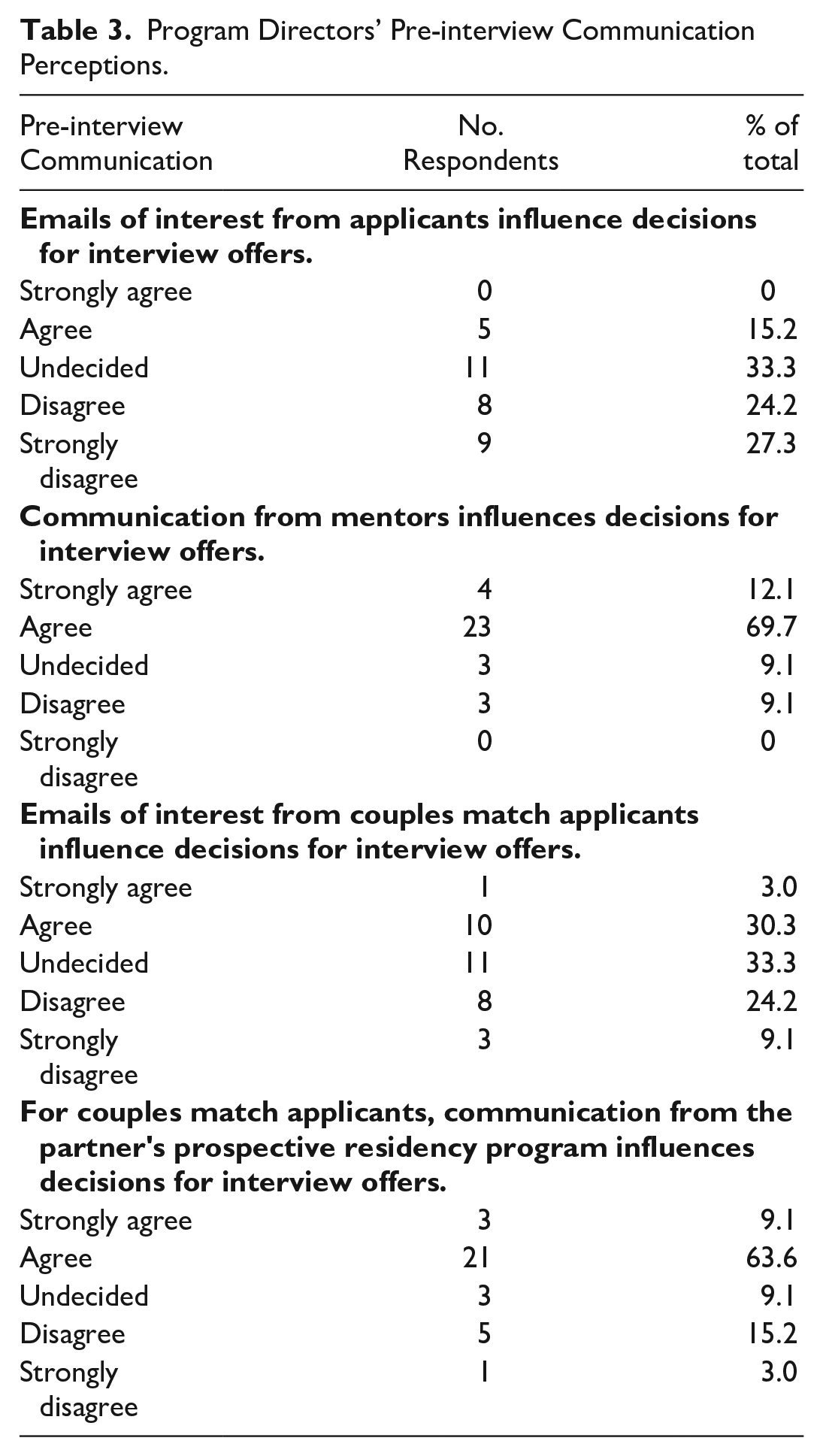
The first portion of the questionnaire focused on PDs’ perception of the impact that pre-interview communications have on interview invitations (Table 3). The vast majority (84.8%) were undecided or did not believe that emails of interest influence decisions to offer an interview, whereas 81.8% believed that communication initiated by an applicant’s faculty mentor has an impact. For applicants entering the match as a couple, 66.7% were undecided or did not think that emails of interest influence decisions to offer an interview, whereas 72.7% did believe that if the partner’s prospective residency program from the same institution communicates with the applicant’s program, then that may influence decisions to offer the otolaryngology applicant an interview (Table 3).
The other portion of the questionnaire focused on PDs’ perception of the impact that post-interview communications have on the candidacy of an applicant (Table 4). The majority of PDs (84.8%) were undecided or did not believe that post-interview “thank you” letters or emails have an influence on their perspective of applicants’ candidacy. All participating PDs were undecided or did not believe that statements of intent from applicants had any bearing on the applicant’s candidacy. Only 33.3% of PDs believed that a mentor communicating on behalf of an applicant in the post-interview period had any influence in an applicant’s candidacy (Table 5).
Program Directors’ Post-interview Communication Perceptions.
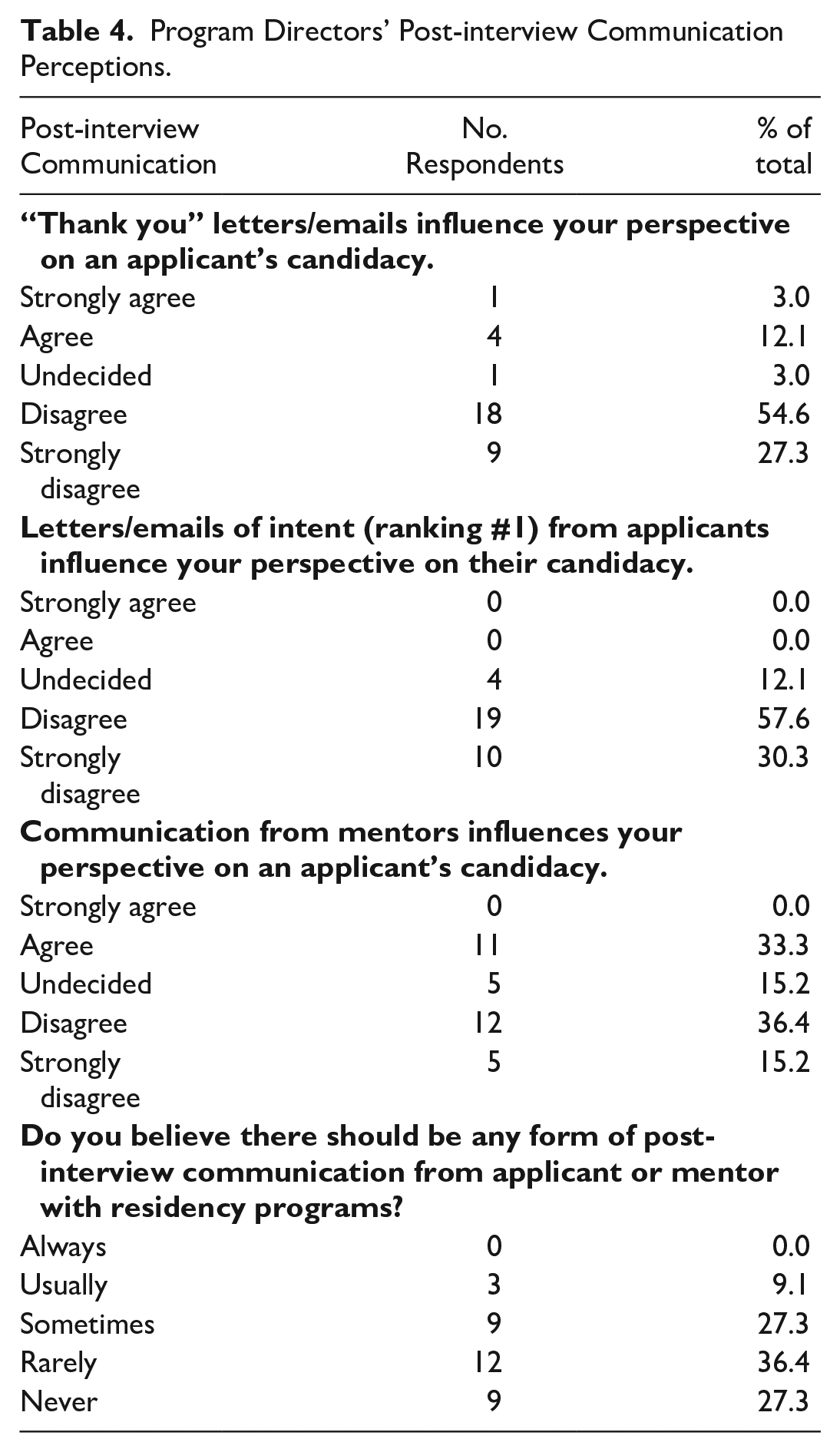
PDs were queried on their preferences regarding whom pre-interview communications listed in Table 4; respondents could select multiple preferences; therefore, the totals do not add up to 100%. For post-interview communication, 63.6% believed that applicants and/or mentors should “never” or “rarely” communicate with residency programs (Table 4).
Statistical Analysis
The impact of pre-interview communication behavioral trends on the number of interviews received was analyzed with respect to the frequency of applicant-initiated communication and frequency of mentor-initiated communication. There was no significant correlation between frequency of pre-interview communication and number of interviews received for both applicant-initiated (P = .54) and mentor-initiated communication (P = .62). Similarly, we analyzed the impact of post-interview communication behavioral trends on the matching at the applicant’s number one choice program and found that neither applicant-initiated post-interview communication in the form of a letter of intent (P = .11) nor mentor-initiated post-interview communication (P = .78) affected the chance of matching at the applicant’s number one program.
Discussion
Leading up to interview invitations, students often find the waiting and uncertainty stressful. The majority of the literature on applicant and program communication is focused on post-interview communication, however, it is widely known that pre-interview communication initiated by applicants is prevalent with the aim to influence interview invitations. Of the applicants surveyed, about half indicated that they had sent emails of interest to programs despite the majority of applicants not believing that this has any influence. Interestingly, the vast majority indicated that they rarely or sometimes did this, which may suggest that applicants generally initiate communication with only a few programs of genuine interest. Despite the high frequency of this behavior, our findings suggest that applicant-initiated pre-interview communication does not influence the number of interview invitations received. Although the minority of both groups thought that applicant-initiated communication is not influential, there appeared to be a discordance with more applicants (37.6%) perceiving it to be influential compared to PDs (15.2%).
On the other hand, both the majority of applicants (78.5%) and PDs (81.8%) agree that mentor-initiated communication influences interview invitations. Less than half of applicants indicated that a mentor contacted a program for them and was often done sometimes or rarely, which may suggest that applicants requested their mentors communicate with programs of high interest. Conceivably, with such a large number of well-qualified applicants each year applying for a limited number of residency positions, any additional supplementation to an application, such as personal endorsements, may be enough to influence decisions to offer invitations. In spite of the overall more positive perceptions around mentor-initiated pre-interview communication, we did not detect a significant correlation between frequency of mentor-initiated communication and number of interview invitations received by applicants. This may be partially explained by the small number of communications that were sent by mentors – it is possible that these had a positive effect on interview invites but was not detected on analysis due to how few invites this may have added overall.
Our study also explored the experiences of those individuals that entered the application cycle as a couple, as couples match applicants have the unique challenge of navigating through the process with the intentions of matching with a partner in the same city or program. Of the ten couples match applicant respondents, eight indicated that they frequently sent emails of interest to programs in which their partner received an interview, while six indicated that they usually had someone from their partner’s prospective residency program communicate with the otolaryngology residency program at the same institution. The frequency of these forms of communication differs from an applicant that does not apply as a couple, which demonstrates the high stakes that couples match applicants innately face. For applicants who participate in the couples match, a third of PDs agreed that applicant-initiated communication influences their decisions to offer an interview, which is twice the rate of an applicant not participating in the couples match. In the cases of faculty from other departments contacting the otolaryngology department to persuade the program to extend an offer to the otolaryngology applicant, the majority of PDs agreed that this mode of communication was effective in influencing interview invitations. Although our data from the couples match applicant side is limited by ten responses, the results of the PD survey suggest that programs are generally more accommodating towards couples match applicants in granting interview invitations, especially in situations where one of the two applicants have already secured an interview at the same institution.
Regarding communication after the completion of interviews, “thank you” notes were sent to programs by 60% of applicants surveyed. However, the majority rarely or sometimes did this. In a survey study of applicants applying to various specialties, 77% sent thank you notes; nearly a quarter indicated that they did so due to the fear of otherwise being viewed unfavorably. 5 Conversely, nearly 83% of applicants communicated with a program to share their intent to rank them number one despite less than a third of applicants believing that post-interview communication has any influence on the final outcome. The rate of this form of communication is higher than studies performed in other specialties that range from 60 to 70%.5,6 Interestingly, of the PDs surveyed in our study, there were none that indicated that applicants’ communications of intent to rank their program number one influenced their rank list. This remains consistent with our data, in which we found that making statements of intent had no significant impact on an applicant matching into their number one choice. In contrast to our findings, Harvey et al. reported that 46.2% of the otolaryngology PDs they surveyed in their study considered such communication to “sometimes” have a positive impact. 4 In a survey study of PDs of multiple specialties, only 5.2% indicated that declarations from applicants influenced their rank lists. 7 Although we did not explore the reasoning as to why PDs are not influenced by such declarations, perhaps some programs find these promises to be dishonest or part of “gamesmanship.”8,9 In a survey of 268 PDs in multiple specialties, 52.6% indicated that at least once a year, one or more applicants falsely claimed they would rank their program number one. 7 In a single internal medicine program, over two recruitment cycles, 31% of ranked-to-match applicants lied about ranking that program number one. 10
Another form of post-interview communication that applicants will often utilize to influence outcomes is having a mentor contact a program after interviews to express the applicants’ desire to match with them. The extent of influence from mentor to program communication on an applicant’s candidacy may be based on the content and the relationship the mentor has with the person he or she contacts in the program. This form of communication was used by about a third of applicants surveyed. While communication from applicants did not seem to have an impact on outcomes in our study, a third of PDs agreed that in general communication from mentors to programs influences rank lists. Perhaps PDs find when such statements are coming from a mentor, then they are given more credibility and less likely to be a lie; additionally, a personal voucher from a respected faculty member may supplement an application in a pool of stellar applicants. In a survey study of obstetrics and gynecology PDs, about half of those that responded indicated that they would consider moving an applicant up if contacted by a mentor known to them. 8 In our study, despite a slightly more positive impression from PDs, there was no significant correlation between mentor-initiated post-interview communication and the applicant matching into their number one program.
There is a wide range of how PDs perceive post-interview communication. When PDs were asked about whether there should be any form of post-interview communication with programs, 63.6% indicated that it should “never” or “rarely” happen. On the other hand, only 21.2% of PDs indicated that they preferred no contact in the pre-interview period. In a multispecialty survey study of applicants from a single institution, 71% of applicants that responded to the survey indicated that they would feel relieved if programs explicitly discouraged post-interview communication. 6 Interestingly, one of the tenets listed on the NRMP’s Match Communication Code of Conduct is “discouraging unnecessary post-interview communication.” 11 These findings highlight the need for a change in the way applicants engage with programs of interest outside of their interview day. Perhaps programs should make an effort to discourage post-interview communication in most instances in order to level the playing field and to decrease the distress experienced by applicants as they try to figure out how to gain a competitive edge. Some programs have already adopted this philosophy by telling applicants during their interview day that post-interview communication is not expected nor will it impact their standing with the program. Additionally, mentors should have open discussions with applicants about what is appropriate in terms of communication.
Our study has several limitations that are inherent in survey type studies. The questionnaire was intentionally disseminated after Match Day, which may pose the risk of recall bias from applicants. Also, we only surveyed applicants that applied to our institution, therefore this data may not represent the entire 2018 to 2019 applicant pool, although it represented the majority of the otolaryngology applicant population. We captured a 28.7% response rate from applicants and a 31.1% rate from PDs. One possible reason that we did not garner a larger response rate from applicants is that there were other surveys distributed to applicants around the same time period, which may have contributed to survey fatigue. However, our response rates are close to the established acceptable response rate of 30% to 40% for these types of studies. 12 Despite these limitations, the strength of our study is that we captured the perspectives of both applicants and PDs, which gives a more complete picture of communication trends and the value perceived by both groups. Our relatively strong response rate also indicates that this topic is of strong interest to both applicants and PDs. We provide new insight into the trends of pre-interview and post-interview communication, which can help future applicants navigate through this challenging process with more information. Residency programs and mentors can use our findings to counsel applicants on what sorts of communications are appropriate.
Conclusion
This study demonstrates that pre-interview and post-interview communication practices among otolaryngology applicants vary widely. Overall, our study found that there is some degree of agreement between applicants and program directors in their impression of how pre- and post-interview communication impacts interview and match outcomes. Despite our findings that suggest there is no significant impact from these practices, the majority of applicants continue to engage in communication with their programs of interest.
Footnotes
Declaration of Conflicting Interests
The author(s) declared the following potential conflicts of interest with respect to the research, authorship, and/or publication of this article: R.N.S. was a participant in the 2018-2019 otolaryngology match cycle and participated in the applicant survey.
R.C.D. is a member of the Otolaryngology Program Directors Organization but did not participate in the program director survey.
All authors declare no other conflicts of interest or financial ties to disclose.
Funding
The author(s) received no financial support for the research, authorship, and/or publication of this article.
