







Abstract
Objective:
It has been shown that prolonged use of face masks results in physiological changes in the nasal cavity. The objective of this study was to examine the effect of prolonged use of face masks on nasal mucociliary clearance (NMC).
Methods:
A single group pre-post study was conducted to determine the effects of prolonged use of N95 face mask (≥4 hours) on the NMC rates in health care workers. Saccharin transit time (STT) was used to measure the NMC. STT before and after using an N95 mask for at least 4 hours was measured for all participants in controlled conditions of temperature and humidity.
Results:
Forty-eight volunteers (20 female and 28 male) completed the study after the enrollment of 57 volunteers. The mean STT before mask use was 580.27 ± 193.93 seconds (95% CI; 523.95-636.58 seconds) and after mask use was 667.47 ± 237.42 seconds (95% CI; 598.53-736.42 seconds). There was significant prolongation of the NMC after prolonged use of N95 mask on performing the paired t-test (P = .002). The mean prolongation was 87.20 ± 184.97 seconds with an actual effect size of 0.40. Ambient temperature and humidity were not significantly different at the two test instances.
Conclusion:
Use of the N95 face masks for 4 hours results in prolongation of the nasal mucociliary clearance as measured by STT. Susceptibility to any respiratory infection may be increased following doffing of the personal protective equipment, including severe acute respiratory syndrome coronavirus 2 (SARS-CoV-2) itself.
Introduction
The respiratory epithelium has significant innate immune functions. The nasal mucociliary clearance (NMC) is an important defense mechanism against inhaled pathogens including the severe acute respiratory syndrome coronavirus 2 (SARS-CoV-2). In the wake of the current pandemic it is important to note that, in an animal study to determine the effect of Middle East respiratory syndrome Corona Virus (MERS-CoV) infection, ciliary loss was identified as an important feature of the disease in inoculated dromedaries. 1 It has been reported that the loss of ciliary function and number results in impaired mucociliary clearance and promote recurrent respiratory infections. 2 Secreted chemicals in the mucus are also known to interact with many pathogens including the corona viruses. 2 These represent the important role of mucociliary clearance in the innate immunity which protect against infections in general.
The face mask is probably one of the most popular infection control measure in most countries affected by the current SARS-CoV-2 pandemic. Courtney and Bax 3 proposed that masks reduce the severity of COVID-19 by their ability to hydrate the respiratory tract. The effect of prolonged use of nasal masks on the nasal mucociliary clearance has not been reported. Mask use might alter the nasal mucociliary function by its effects on humidity in the nasal passage, altered respiratory physiology, and by inciting allergic responses and thereby augmenting or hampering innate immunity. Many factors are known to interfere with normal mucociliary function, including smoking, infections, drugs, vitamin D and other trace element deficiency, and systemic illnesses among others.4,5 While there are many modalities to assess the mucociliary function, saccharin transit time (STT) is commonly described as it is easy to perform, and is safe compared to other methods such as the use of radiolabeled molecules.
The objective of this study was to determine the effect of prolonged use of N95 face masks on the nasal mucociliary clearance rates by measuring the saccharin transit time (STT) in healthy volunteers. There might be implications to the health care workers who wear high efficiency (consequently high resistance) face masks for considerable duration of time in terms of susceptibility to infection, exacerbation of ear and nose conditions such as allergic rhinitis, rhinosinusitis, chronic otitis media, and asthma.
Materials and Methods
Study Design and Population
A single group pre-post study was conducted at a tertiary care hospital in Western India to determine the change in nasal mucociliary clearance (NMC) rates in health care workers using face masks for prolonged durations. Prolonged duration was arbitrarily defined as 4 hours.
Health care workers who use face masks for not less than 4 hours per day of work were eligible for inclusion in the study. Participation in this study was voluntary and no reimbursement was offered to participants. We excluded volunteers with any upper, or lower respiratory symptoms such as rhinorrhea, nasal obstruction, or cough. Known cases of allergic rhinitis, chronic rhinosinusitis, chronic obstructive pulmonary disease, asthma or other significant pre-existing respiratory system disorders, chronic heart disease, angioedema, anaphylaxis, prior nasal surgery or trauma, and chronic smokers were not eligible to be included.
Sample size was calculated as 48 with an alpha error of .05 and power of 95% for calculating a 2 tailed P-value for conducting a paired samples t-test assuming an effect size of 0.80 and standard deviation of the change in the outcome of 1.50. The study protocol was approved by the Institute Ethics Committee (AIIMS/IEC/2020-21/3101) and written informed consent was obtained from all the participants while they were enrolled. Volunteers who enrolled for the study were given appointments for the test. They were required to abstain from consumption of alcohol, and smoking for 12 hours prior to the test.
Procedures Involved in the Study
The baseline STT estimation (STT1) was done when the volunteer reported to work in the morning, designated as time-point T1. This reduced the chance of STT being altered by increased pollution, temperature variations, or any substance that is consumed. The participants were briefed about the test procedure to alleviate any apprehension and were allowed to rest for 15 minutes before the estimation of STT1. Participants maintained a sitting posture with the head in slight extension (10°-15°) for the facilitation of the placement of saccharin. A single particle of saccharin sodium was placed in the floor of the nasal cavity just distal to the mucocutaneous junction. Mean weight of the particles used was 4.9 ± 0.2 mg. Placement was guided by a headlight, and nasal speculum when necessary. A second investigator would start a stopwatch as soon as the investigator placed the saccharin particle.
Participants were asked to maintain their natural breathing and swallowing pattern, and to avoid coughing, sneezing, or manipulation of the nose. This was monitored by the second investigator and if this happened, the test was abandoned and rescheduled with the volunteer’s consent. STT was measured as the time taken from the placement of the particle to the perception of sweet taste. The upper cut off for STT was set as 30 minutes, above which the test was considered invalid and the test was repeated at a subsequent appointment with consent. The measured values were not disclosed to the volunteer to reduce bias.
Following estimation of STT1, the volunteers were asked to wear the N95 masks (EN 149:2001 FFP2) which were fit tested, for a duration of at least 4 hours. They were requested to avoid removal of the mask for more than 15 minutes during this time. However, there was no restriction to perform routine work in their designated areas. The estimation of STT after prolonged use of N95 mask (STT2) was done after the volunteer completed his/her shift, or at the end of 4 hours according to feasibility, designated as time-point T2. STT2 was measured immediately following removal of the mask. Volunteers were requested to inform the investigators once their shifts/work ended so that testing could be done either at their site of work or in the outpatient clinic as soon as the masks were removed. Volunteers were requested not to manipulate the nose, blow or sneeze after removal of the mask, as these measures can themselves alter the STT, and would confound the results. Measurement was done in the same side as the pre mask use test to reduce confounding due to anatomical variations. Ambient temperature and relative humidity which could alter the NMC were measured during both the tests using a digital thermometer and hygrometer (HTC-1; Accuracy ±1.0°C for temperature, and ±5% for relative humidity respectively).
Study Variables and Statistical Analysis
The primary outcome variable was saccharin transit time measured in seconds. Independent variables included; age, gender, ambient temperature, relative humidity, and duration of mask use on the day of test. Continuous variables like age, duration of mask use, and saccharin transit time were expressed as mean ± standard deviation, or median with range. All categorical variables like gender, were expressed as frequencies and percentages. Saccharin transit time was measured in seconds and the change in STT was compared by using the paired samples t-test. A P value of <.05 was considered statistically significant and observed effect sizes were calculated. All statistical analysis was done using IBM SPSS Statistics for Windows, Version 23.0. Armonk, NY: IBM Corp.
Prespecified post hoc analysis included
(1) Variation of saccharin transit time with duration of mask use.
(2) Variation of saccharin transit time with ambient temperature and relative humidity.
Results
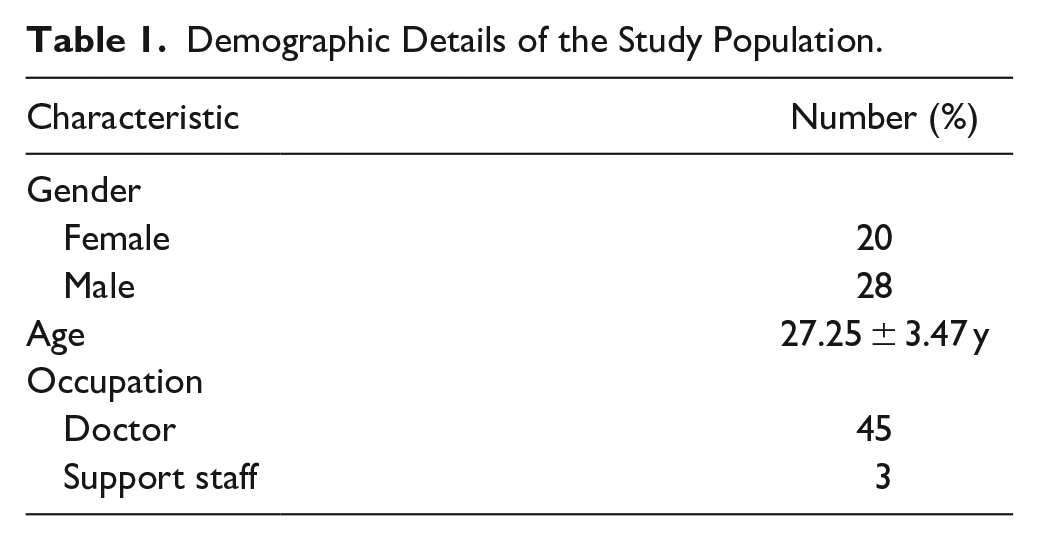
Fifty-seven health care workers who expressed willingness to participate in the study and fulfilled the inclusion and exclusion criteria were serially enrolled from 20-09-2020 to 28-01-2021, to achieve the estimated sample size of 48 volunteers for whom STT1 and STT2 could be measured as specified. Nine volunteers were excluded, as their post tests could not be conducted as scheduled. None of the participants reported any significant adverse event during the study. The demographic details of the study population are summarized in Table 1.
Demographic Details of the Study Population.
Variation of STT With Prolonged Use of N95 Mask
The nasal mucociliary clearance was observed to be prolonged in 70.8% (34/48) of the study population. The same was observed in 64.2% of men and 80% of women. The mean prolongation was found to be 87.20 ± 184.97 seconds. The effects were statistically significant (Table 2 and Figure 1). The actual effect size was found to be 0.40.
Change in Study Variables at Time Points T1 and T2.
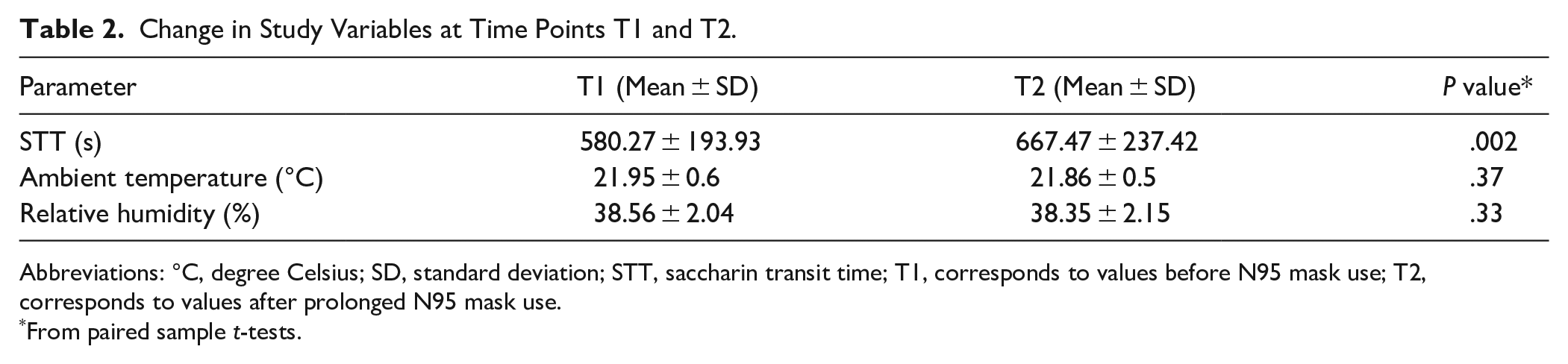
Abbreviations: °C, degree Celsius; SD, standard deviation; STT, saccharin transit time; T1, corresponds to values before N95 mask use; T2, corresponds to values after prolonged N95 mask use.
From paired sample t-tests.
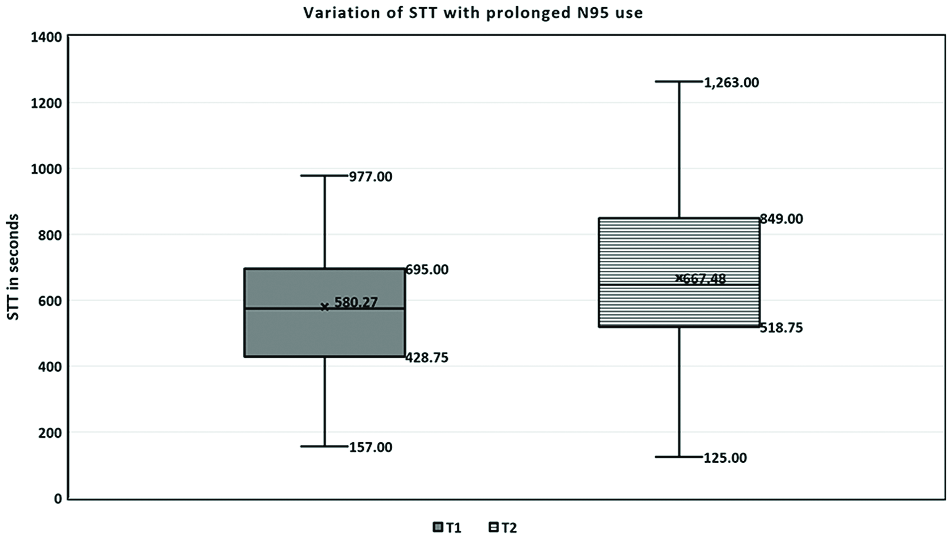
Box plot representing summary statistics of saccharin transit time (STT) at T1 and T2. The upper and lower values represent the range, the upper and lower ends of the box represent the third and first quartiles respectively, and x-represents the mean.
Variation of STT With Duration of Mask Use
The duration of mask use was categorized and correlated to the change in STT as shown in Table 3. On performing the one-way ANOVA test, there was no significant change in the STT across categories when mask use exceeded 4 hours; F(2, 45) = 0.018, P = .98.
Variation of the change in STT with duration of use of N95 masks.
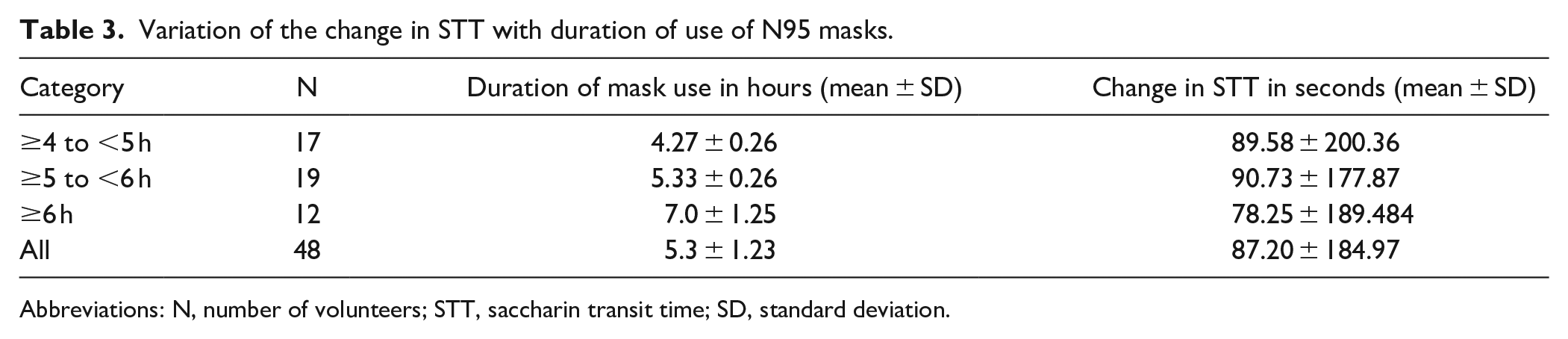
Abbreviations: N, number of volunteers; STT, saccharin transit time; SD, standard deviation.
Comparison of the mean ambient temperature and relative humidity measured at the time of measurement of T1 and T2 respectively is presented in Table 2. These main confounding variables were successfully controlled as evident from the respective P-values. The variation in ambient temperature and relative humidity was insignificant and did not have a significant impact on the measured STT as depicted in Figure 2.
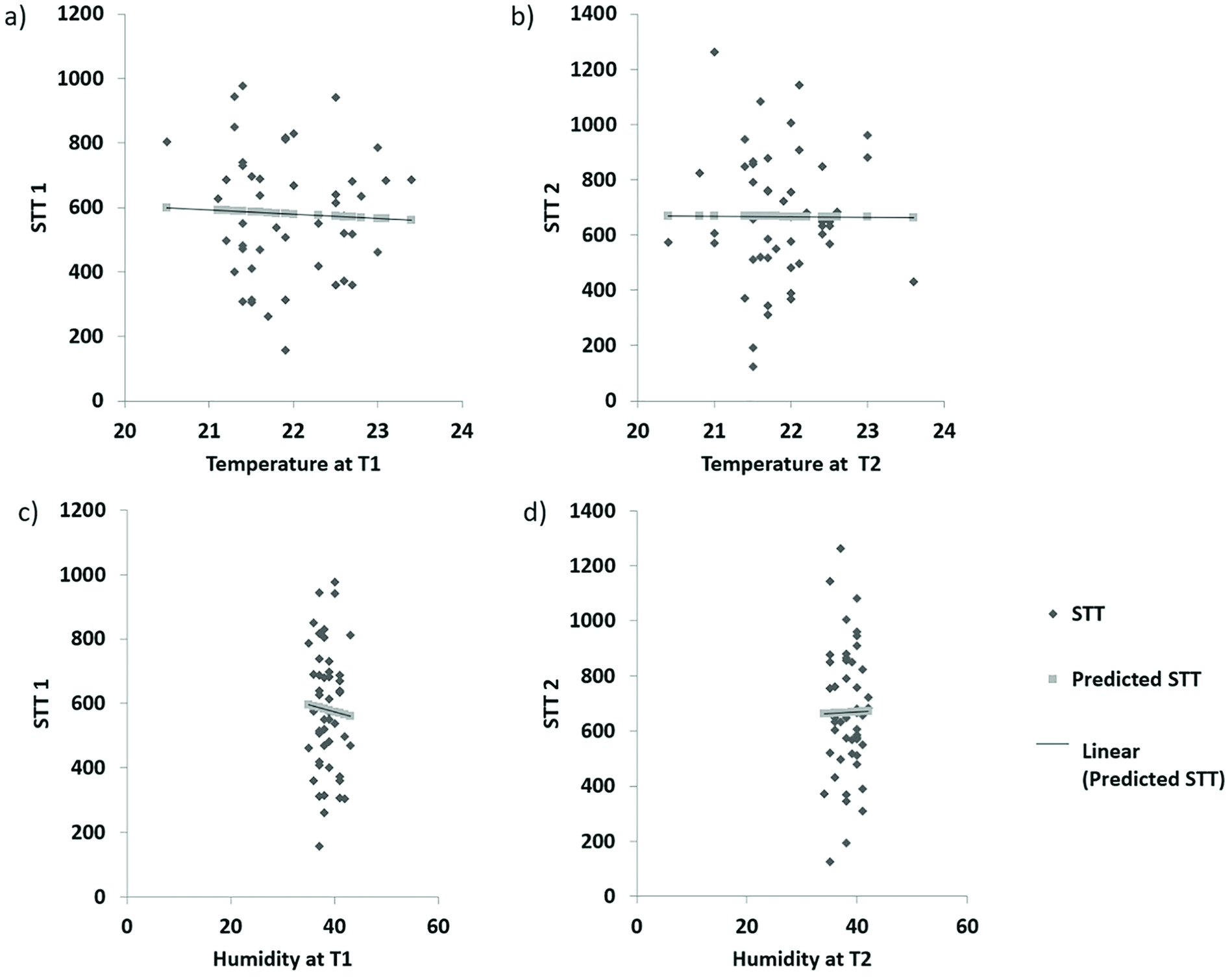
(a and b) Correlation between saccharine transit time (STT) in seconds and ambient temperature in degree Celsius (°C), (c and d) correlation between STT and relative humidity (%). STT measurements were not significantly affected by changes in ambient temperature and relative humidity as seen from the lack of correlation between predicted and measured values.
Discussion
This single group pre/post study demonstrates that the nasal mucociliary clearance is adversely affected by prolonged use of N95 face masks. The main confounding variables were sufficiently controlled to demonstrate a causal relationship between the main outcome variable (STT) and prolonged use of N95 masks. However, the effect size was moderate and STT was not modified by further prolongation of mask use.
Previous research has demonstrated that using N95 face masks results in an increase in the nasal resistance which persists for up to 1.5 hours after removal. 6 Altered nasal physiology may be caused by this increased resistance and changes in humidity within the nasal passages among other unknown factors. Use of nasal CPAP has been shown to interfere with normal mucociliary clearance and alter the ciliary function and epithelial cell changes which is an integral part of the innate defense systems of the upper airway. 7 However, we could not find studies examining the impact of prolonged use of face masks on nasal mucociliary clearance.
Normal STT depends on the method of testing, environmental and geographical factors and varies from 5 to 17 minutes.8-10 STT is widely used in the evaluation of mucociliary clearance and the methodology has been recently standardized. 11 The face mask is reported to be one of the most widely used and successful methods of reducing the risk of airborne viral transmission by reducing the spread and inhalation of aerosols when used properly. Masks have been shown to reduce transmission rates by up to 80% in Health care workers (HCWs) and 47% in general population according to a recent meta-analysis. 12 Compared with surgical masks, N95 respirators perform better in laboratory testing and are being widely used in many centers.
While trying to understand the mechanisms underlying the prolongation of NMC due to prolonged mask use, it should be noted that Li et al 13 demonstrated that the microclimate within the N95 mask was significantly more humid and warmer compared to surgical masks. It has also been reported that inhalation of dry air results in prolongation of the nasal mucociliary clearance rates. 14 Courtney and Bax 3 opined that the nasal mucociliary clearance should improve with the use of masks as they increase the relative humidity of inspired air. However, we observed prolongation of the STT in N95 users. This indicates, that there are other factors, including the duration for which masks are used, which might alter NMC.
In order to reduce the effect of confounding independent variables, namely; ambient temperature and relative humidity, the tests were performed in air-conditioned areas. The mean temperature and relative humidity at the time of both the tests were not significantly different (Table 2). Also, there was no significant variation of either STT1 or STT2 with the respective temperature and relative humidity measurements (Figure 2). Thus, these confounding factors did not significantly affect the primary outcome variable, namely STT.
The other important variable which we examined was the duration for which the mask was used. Prolongation of STT was observed to be comparable when mask usage was categorized as 4 to 5, 5 to 6, and >6 hours (Table 3). However, this estimate is based on a limited sample size. The point at which the plateau occurs remains to be estimated using larger samples with strictly controlled environmental conditions. Transient increase in ciliary activity can be caused due to physical stimulation such as sneezing.15,16 Participants were requested to not manipulate the nose, and avoid coughing or sneezing before the test to avoid these transient changes. We only measured the change in STT within the day. The change in STT is likely to be transient. However, even transient changes during doffing from contaminated areas could increase the susceptibility to infections and should be considered significant. Another factor that can be speculated to have contributed to prolonged STT is the role of autonomic nervous system. Shi et al 17 reported that wearing filtering respirators for short durations had a beneficial effect on the autonomic nervous system. It has been shown that prolonged use of respirators results in congruent increase in wearer discomfort. 18 It remains to be examined if, and how, these factors modify NMC.
There are some limitations to this study. The current pandemic situation warrants use of face masks as they are of proven efficacy. Hence it was not possible to have a control group where STT1 and STT2 was measured for a group of volunteers who did not use N95 masks. Future trials in which such data can be collected and compared should be planned once the pandemic is controlled successfully to establish causality and control for diurnal variations. Also, as the taste of saccharin persists for long durations, the variation of STT with duration of N95 mask use could not be serially monitored by repeated testing. This also prevented the estimation of the minimum duration of mask use which results in prolongation of NMC. We also did not perform any follow-up testing to confirm if, or when, the NMC normalized after the mask was removed. The volunteers were allowed to perform their routine work before measuring STT2. The impact of physical activity, or stress related to different areas of work on STT was not possible to control in this setting. Finally, it has to be kept in mind that STT measures the mucociliary clearance of only a narrow tract and may not be truly representative of the mucociliary clearance of the entire nasal mucosa even though Shaari et al 19 have shown that the basal ciliary beat frequencies are comparable across different sites in the nasal cavity.
This study was undertaken in an arid geographical area with low relative humidity. Generalizability is limited as the study was done under controlled environmental conditions. These controlled conditions would not reflect real world work conditions for most health care workers in India and other developing nations.
Conclusion
Prolonged use of N95 face masks results in prolongation of the nasal mucociliary clearance rate. While there is no doubt as to the physical protection offered against respiratory viruses including the SARS-CoV-2, the prolonged use of face masks appears to alter the physiological functionality of the nasal mucosa. Adequate caution should be followed while doffing from infected areas, as susceptibility to any respiratory infection may be increased following doffing of the personal protective equipment, including severe acute respiratory syndrome coronavirus 2 (SARS-CoV-2) itself.
Footnotes
Author Contributions
Nikhil Rajan: Study design, data collection, statistical analysis, drafting of the manuscript and approval of the final version. Bikram Choudhury: Study design, statistical analysis, critical review and approval of the final version of manuscript. Dipika Prakash: Data collection, statistical analysis, drafting of the manuscript and approval of the final version. Kapil Soni: Study design, statistical analysis, critical review and approval of the final version of manuscript. Darwin Kaushal: Study design, interpretation of data, critical review and approval of the final version of manuscript. Neha Shakrawal: Study design, statistical analysis, critical review and approval of the final version of manuscript. Nithin Prakasan Nair: Study design, statistical analysis, critical review and approval of the final version of manuscript. Amit Goyal: Study design, statistical analysis, critical review and approval of the final version of manuscript.
Declaration of Conflicting Interests
The author(s) declared no potential conflicts of interest with respect to the research, authorship, and/or publication of this article.
Funding
The author(s) received no financial support for the research, authorship, and/or publication of this article.
