







Abstract
Purpose:
To assess for longitudinal changes in the prevalence, duration, and self-perceived impact of persistent tinnitus amongst young adults (ages 18-24) in the United States.
Methods:
The adult National Health Interview Surveys (NHIS) for calendar years 2008 and 2023 were investigated for specific tinnitus related symptoms among young adults (ages 18-24). The prevalence of tinnitus in the past 12 months and the overall duration of tinnitus symptoms were determined and compared between the 2 survey years.
Results:
In 2023, an estimated 2.30 million young adults reported tinnitus in the prior 12 months, risk for which was increased with very loud sound exposure (odds ratio [95% confidence interval], 2.6 [1.7-3.9]). Tinnitus was reported to be a moderate or big problem in 8.7% and 3.1% of respondents, respectively, and only 10.1% saw a medical specialist for their tinnitus. The prevalence of tinnitus increased from 5.8% in 2008 to 7.8% in 2023 (P = .030). From 2008 to 2023 there was also an increase in duration of tinnitus (P < .001).
Conclusion:
Nationally representative data indicate a concerning increasing prevalence and duration of tinnitus among young adults with a significant self-perceived impact. This increasing prevalence of tinnitus may reflect underlying issues of noise exposure and merits further ongoing surveillance.
Level of Evidence:
IV.
Introduction
Tinnitus is consciously perceived sound in the absence of an audible external acoustic stimulus. Symptoms exist along a wide and heterogeneous spectrum, with temporal dynamics ranging from intermittent to constant and intensity from distracting to disabling. 1 Tinnitus is highly prevalent in the adult population, with recent estimates of approximately 10% to 15% of adult individuals experiencing clinically significant tinnitus.2-8 Its pathogenesis remains incompletely understood and treatments relatively limited. 9
Tinnitus is associated with increasing age and strongly correlates with hearing loss, otologic insults, hyperacusis, lifetime noise exposure, and occupation.2,4,10-13 However, the prevalence and health burden of tinnitus amongst young adults remains incompletely understood. Subjective loud noise exposure (>10 hours/week), recurrent otitis media, and hearing loss are the most predictive factors for acute and chronic tinnitus in young adults.14-16 Use of personal headphones at high levels, frequent noise exposure, and limited use of noise protection may increase the risk of noise exposure in young individuals. 17 Estimates of tinnitus prevalence in young adults vary depending on definition, ranging from 4.7% to 18.5% for persistent tinnitus.4,16-19 However, as many as 75% of adolescents and young adults may experience temporary noise-induced tinnitus. 17
To assess for longitudinal changes in the prevalence, duration, association with noise exposure, and self-perceived impact of persistent tinnitus, we investigated the National Health Interview Surveys (NHIS) for calendar years 2008 and 2023 for specific tinnitus related symptoms among young adults (ages 18-24).20,21
Methods
The responses of young adults, defined as ages 18 to 24, in the household-based National Health Interview Series for the years 2008 and 2023 were analyzed.20,21 This study was deemed exempt from review by the Mass General Brigham Institutional Review Board.
Responses pertaining to tinnitus-related variables were extracted and included: presence or absence of tinnitus, duration, perceived problem severity, whether a medical specialist was seen, and non-occupational noise exposure. Responses were elicited by trained interviewers via household surveys using standardized questions, with responses limited to pre-selected answer choices. Respondents were asked about “very loud sound” exposure in non-work environments, defined as “so loud you must shout in order to be understood by someone standing 3 feet or arm’s length away from you.”
Data were imported into Stata (version 19) for analysis. The prevalence, duration, and severity of self-reported tinnitus were determined, associations with noise exposure assessed, and comparisons made between the 2 survey years. Representative statistics for the national population in the United States were obtained by applying sample design weights to the raw sample size. Data are reported as the mean and the percentage of the weighted national sample, with 95% confidence intervals. Comparisons between groups were assessed using Chi-Square tests, with significance set at P < .05. Correlations between 2 variables were measured using Pearson’s correlation tests.
Results
An estimated 28.9 and 29.6 million young adults were studied for the 2008 and 2023 calendar year, respectively (Table 1). In 2023, an estimated 2.30 million young adults (7.8%, [95% confidence interval: 6.5-9.3]) reported persistent tinnitus in the prior 12 months, with no sex predilection (males: 8.0% [6.2-10.1], females: 7.5% [5.7-9.8]; P = .09). Very loud sound exposure during the preceding 12 months was associated with having tinnitus during the same period: 14.8% [11.1-19.6] rate of tinnitus with very loud sound exposure versus 6.2% [4.9-7.8] in the absence of very loud sound exposure (P < .001), with an odds ratio of 2.6 [1.7-3.9]. Only 10.1% of individuals in 2023 saw a medical specialist for their tinnitus.
Tinnitus in Young Adults in 2008 and 2023.
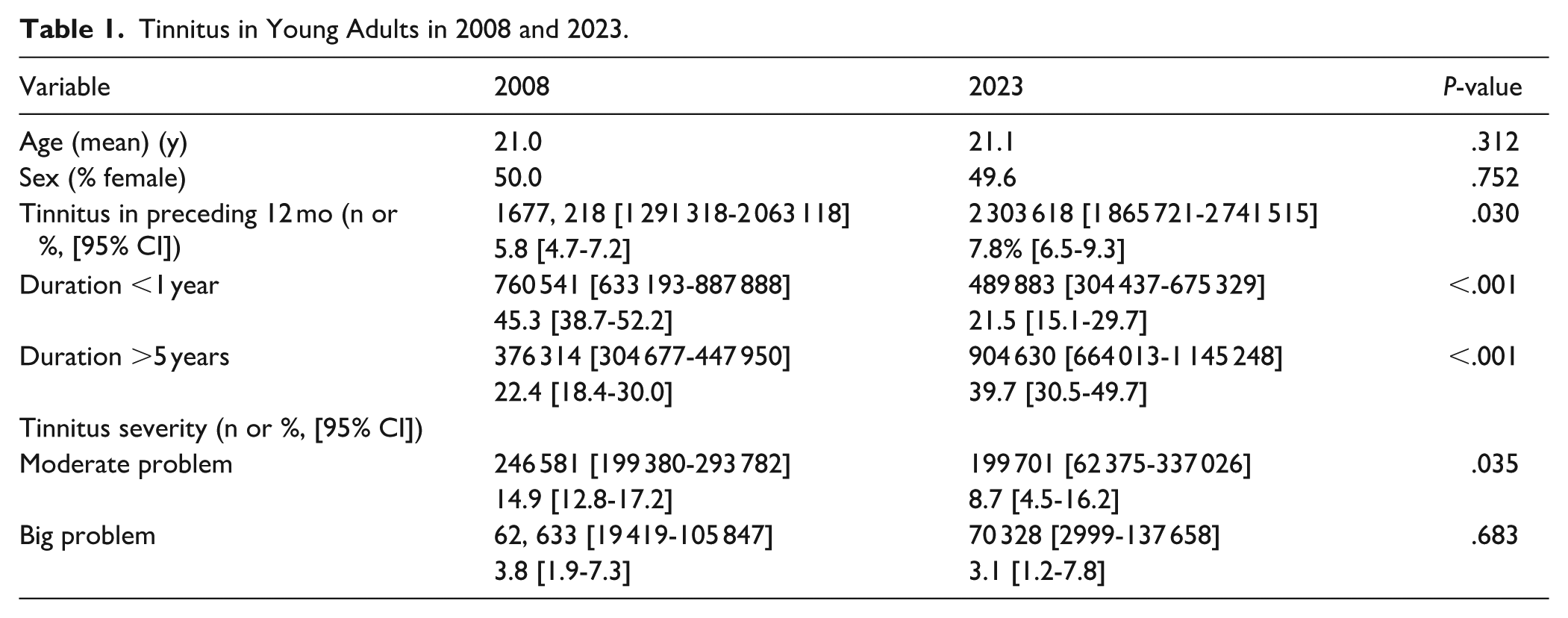
The prevalence of tinnitus amongst young adults significantly increased from 5.8% [4.7-7.2] in 2008 to 7.8% [6.5-9.3] in 2023 (P = .030; Table 1). From 2008 to 2023 there was also an increase in duration of tinnitus, with fewer reporting a duration less than a year and an increase in those reporting duration greater than 5 years (P < .001 for each). However, the subjective severity of tinnitus remained stable or even lessened from 2008 to 2023, with no difference in the percentage of respondents reporting it as a big problem (3.8% vs 3.1%, respectively; P = .68) but fewer reporting it as a moderate problem (14.9% vs 8.7%, respectively; P = .035).
Discussion
These nationally representative data indicate a significantly increasing prevalence and duration of persistent tinnitus among young adults. This increasing prevalence of tinnitus may reflect underlying issues of acoustic trauma as suggested by the association with very loud sound exposures, and merits further ongoing surveillance. Tinnitus carries significant health burdens for those experiencing it, including insomnia, disrupted speech comprehension, impaired concentration, anxiety, and depression. 22 While less than 10% of young adults with tinnitus in 2023 viewed it as a significant problem in our study, the increasing prevalence early in life is worrisome for a problem associated with aging. Given the negative impact on quality of life and limitations in treatment, increased public awareness and education on hearing protection are increasingly important to mitigate this progressing prevalence of tinnitus among young adults.
Strengths and limitations of this study merit mention. The data are derived from a database which represents a large and diverse sampling of the United States population to more precisely estimate their health characteristics. However, given the retrospective nature inherent to household surveys, responses are subject to recall bias. Importantly, respondents were asked only about the occurrence of very loud sound exposure and not the frequency nor duration, which are important factors for acoustic trauma. Certain comparisons across time were also not possible due to absence of some variables in the 2008 dataset, including non-occupational sound exposure and seeking medical care.
Footnotes

Ethical Considerations
This study was deemed exempt from review by the Mass General Brigham institutional review board (REDCap ID#: 3234).
Funding
The authors received no financial support for the research, authorship, and/or publication of this article.
Declaration of Conflicting Interests
The authors declared no potential conflicts of interest with respect to the research, authorship, and/or publication of this article.