






Abstract
Introduction:
Management of deep cervical lipomas (DCLs) is described only in case reports and series in the literature. We aim to present a scoping review of this literature and the largest case series of surgically resected DCLs to describe presentation, workup, and efficacy of transcervical resection for DCLs.
Methods:
A systematic search for surgically resected solitary DCLs was conducted in PubMed, Embase (Elsevier), Scopus, and Cochrane library on 12/19/2025 using PRISMA methodology. Study protocol was registered in PROSPERO (CRD420251052065) and articles were screened independently by 2 authors, with conflicts resolved by a third reviewer. All solitary DCLs resected via a transcervical approach at a tertiary center from 2014 to 2025 were reviewed.
Results:
From a total of 1459 articles, 144 studies met criteria, and 163 cases (median age 45 years, 25.2% pediatric, 67.5% male) were included. The most common presenting symptom was swelling (81.6%), and 63.2% were enlarging. A total of 232 imaging studies, most commonly CT (n = 102), were conducted amongst 90.8% of patients for an average of 1.4 imaging studies per patient. Biopsy was performed in 27.6% of patients, with 43.4% of biopsies being inconclusive or inconsistent with benign fatty tumor. Postoperative complaints were noted for 9.8% of patients, with only 3.1% (n = 5) having persistent complaints. Two recurrences were noted. The institutional cohort of 10 patients (median age 55 years, 10% pediatric, 90% male, 90% non-Hispanic White) mirrored the literature, with the most common presenting symptom being palpable neck mass (80%), at least one imaging study per patient on average, no persistent complaints, and one recurrence.
Conclusion:
DCLs are less common than subcutaneous lipomas but follow a similar clinical course. Presentation most commonly occurs as a palpable mass, most of which are enlarging. Imaging without biopsy is often sufficient for workup. Transcervical resection is diagnostic and therapeutic with minimal morbidity.
Introduction
Lipomas are typically benign, asymptomatic, slow growing, singular, and superficial mesenchymal tumors of mature adipocytes. 1 Lipomas are the most common soft tissue neoplasm, with 29% located in the head and neck.2,3 In addition to the common superficial subcutaneous variety, lipomas also present uncommonly in deeper tissues. Despite general asymptomatic presentation, lipomas are surgically resected when associated with pain, compressive symptoms, cosmesis, or unclear diagnosis. 4
Superficial lipomas are diagnosed clinically, due to their characteristic presentation as a discrete, mobile, and fluctuant mass. 5 In up to 85% cases, superficial lipomas can be diagnosed with clinical examination. 5 Lipomas larger than 10 cm, rapidly growing, painful, fixed to underlying tissues, and deep in location may warrant imaging before surgery. 6 However, features such as fat composition, size, nodularity, and septations on imaging cannot differentiate between benign and malignant lipomatous tumors.7,8
Due to their low frequency and difficulty in excluding malignant variants radiographically, deep cervical lipomas (DCLs) may seem higher in risk than they truly are upon presentation. Literature on DCLs is mainly comprised of case reports and series, and there is no standard for workup or treatment of DCLs. Through the largest published case series of surgically resected DCLs and scoping review of the literature, we aim to establish that surgical resection is curative and associated with minimal morbidity, as well as to characterize clinical presentation, diagnostic workup, and post-operative course for DCLs.
Methods
Study Design
An IRB exempt case series (IRB#22602) was conducted including all consecutive cases of surgically resected DCLs from 2014 to 2025 at Indiana University Health according to the Case Report (CARE) Checklist 9 (Supplemental Appendix 1). This study is also accompanied by a scoping review of deep cervical lipomas using PRISMA methodology 10 (Supplemental Appendices 2 and 3).
Institutional Case Series Eligibility Criteria and Data Collection
Cases included in the case series were solitary lipomas deep to the subcutis and resected via a transcervical approach between February 4, 2014 and March 3, 2025. Excluded cases were subcutaneous, not solitary, not located in the neck, not a lipoma, or not resected using neck dissection techniques via transcervical approach. One reviewer (MB) extracted demographic information (age at presentation, sex, race), presenting symptoms, diagnostic workup, location and size of lipoma, operative details, postoperative course, recurrence, follow up period, and lipoma type determined by final pathology. If lipoma location was not detailed in clinic or operative notes, location was determined by imaging review (JF). Surveillance for recurrence was conducted through review of history and physical findings in ambulatory visit notes.
Scoping Review Information Sources and Search Strategy
The scoping review included articles presenting original cases of solitary deep cervical lipomas resected via a transcervical approach. An advanced MeSH term search was conducted in PubMed, Embase (Elsevier), Scopus, and Cochrane library on December 19th, 2025. This review was registered in PROSPERO (CRD420251052065), and search terms and strategy were developed with a librarian (Supplemental Appendix 4). Titles, abstracts, and publishing information were imported into Covidence (https://www.covidence.org) for article selection according to Preferred Reporting Items for Systematic Reviews and Meta-Analyses (PRISMA) methodology (Table 1). Articles were excluded for the following reasons: duplicate article, location outside neck, multiple tumors (ex. Madelung’s disease, benign symmetric lipomatosis), tumor type other than lipoma, lack of individual case information, article not found in English, superficial location (submucosal or subcutaneous), or no surgical resection or surgical methods other than neck dissection via transcervical approach.
Original Case Series Information.
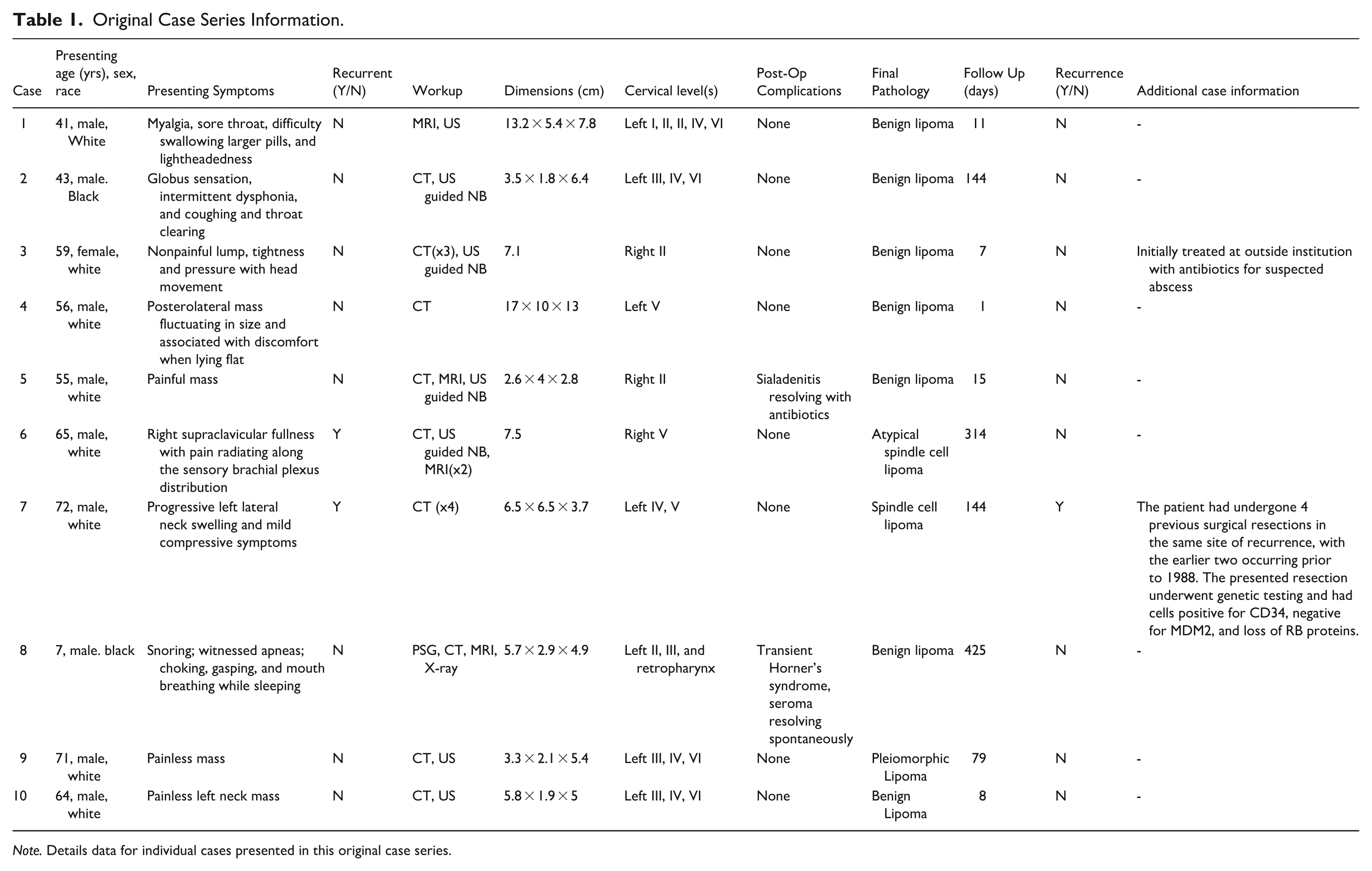
Note. Details data for individual cases presented in this original case series.
Scoping Review Selection Process and Data Collection
Article screening by title and abstract were conducted independently by 2 authors (MB, EC), with conflicts resolved by consensus or a third reviewer (JF). Full-text review was conducted by a single author (MB). Data was extracted from the literature independently by 2 authors (MB, EC), and included the same patient, clinical, surgical, histopathologic, and postoperative course details. Discrepancies were resolved by consensus or a third reviewer (JF). Data and extraction materials are available upon reasonable request.
Results
Case Series Summary
The cohort of 10 patients (median age 58 years, 10% pediatric, 90% male, 80% non-Hispanic White) had pathology-confirmed DCLs (Table 1). In 20%, the presenting DCL was recurrent after prior resection. Besides 20% exclusive to level V, lipomas presented in cervical levels II-IV. Extension into the central neck occurred in 20% of lipomas. Most common presentations were palpable neck mass (80%) and pain (30%). Over half (63%) of DCLs presenting as masses demonstrated interval growth. Workup involved imaging for 100% of DCLs, often with more than 1 modality: computed tomography (CT; n = 14), ultrasound (n = 7) and magnetic resonance imaging (MRI; n = 3). Average largest dimension was 8.7 cm (SD = 5.2 cm). Needle biopsy was conducted in 40% of DCLs. Median follow up was 11 days (range 1-365 days). Close to a third of patients reported postoperative complaints: temporary Horner’s syndrome (n = 1), seroma resolving spontaneously (n = 1), and sialadenitis resolving with antibiotics (n = 1). Of the resected tumors, 70% were simply benign lipoma, 20% spindle cell lipoma, and 10% pleomorphic lipoma. Repeat resections (n = 2) were both spindle cell lipomas. Clinical evidence of recurrence was noted in one case, with imaging indicative of residual lipoma. Full chronological case descriptions and operative details can be found in Supplemental Appendix 5.
Literature Review
A systematic search produced 3205 articles (Embase[Ovid] n = 1411, Scopus n = 825, PubMed n = 966, Cochrane Library n = 3), of which 1746 were removed as duplicates. Full text review of 204 articles resulted in exclusion of 60 studies (5 duplicate articles, 12 subcutaneous lipomas, 2 not lipomas, 11 wrong anatomical location, 4 wrong study design, 5 insufficient detail, 11 non-English article, 2 not surgically excised, 2 non solitary lipomatosis, 1 wrong intervention, 5 not enough data to support deep location), and 144 articles met inclusion criteria (Figure 1), comprising 163 cases (Table 2).
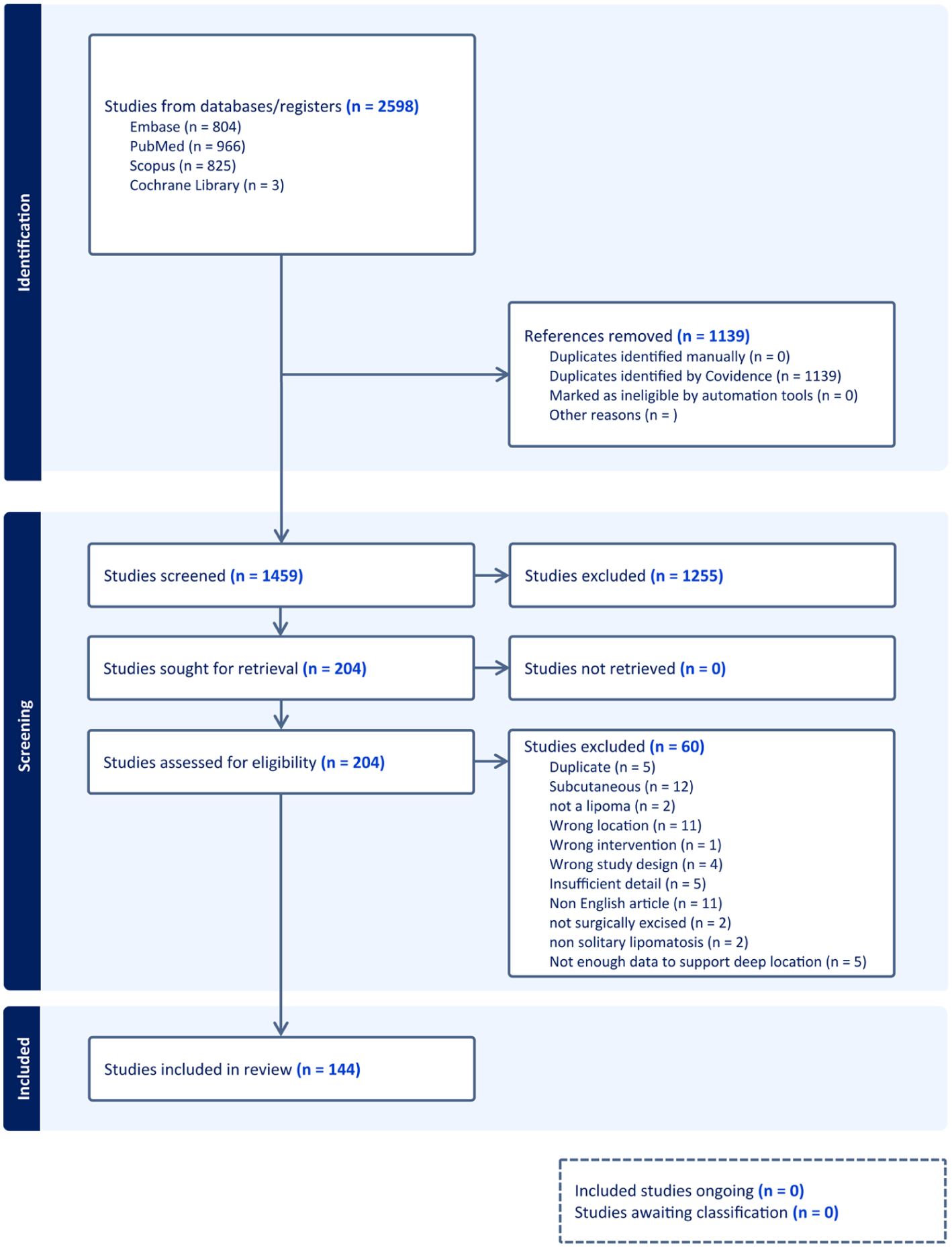
PRISMA Flowchart.
Systematic Review Data on Demographics, Presentation, Workup, Tumor Size, and Tumor Location.
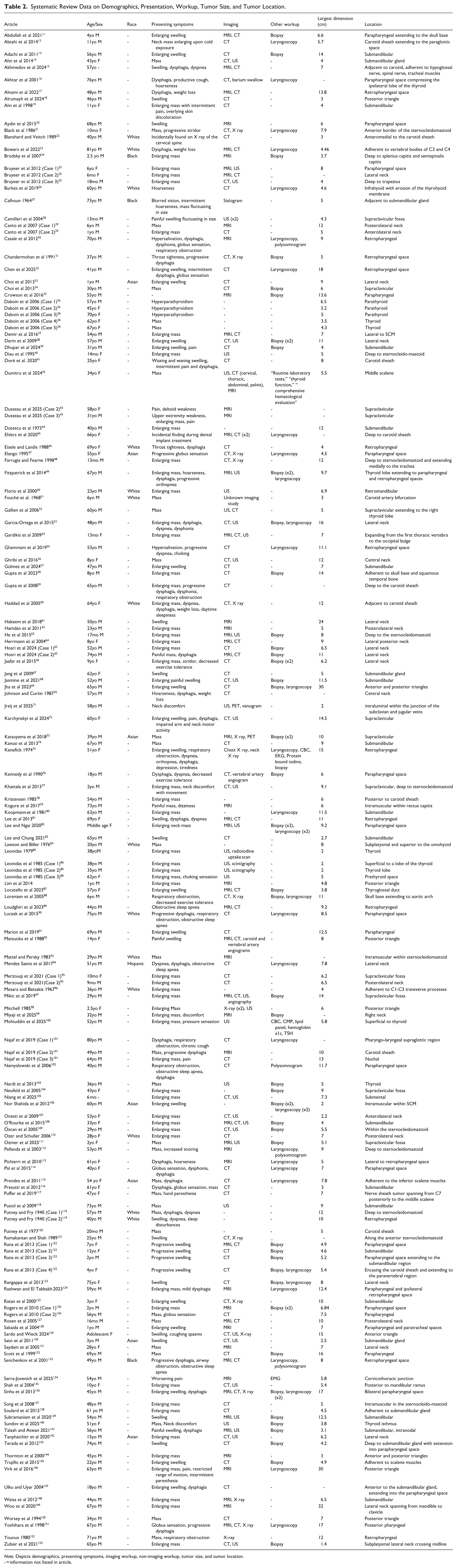
Note. Depicts demographics, presenting symptoms, imaging workup, non-imaging workup, tumor size, and tumor location.
- = information not listed in article.
DCLs had a male predominance (67.5%). Median age at presentation was 45 years, with a range from 6 months to 81 years, and followed a bimodal curve. The first peak occurred early, between 6 months and 5 years, with 25.1% of tumors occurring in children (Figure 2). The second peak occurred between 51 and 60 years. The most common presenting symptoms were mass/swelling (81.6%), dysphagia (21.5%), pain (11.0%), dyspnea (6.1%), and dysphonia/hoarseness (6.1%). Over half (63.2%) of presenting masses were enlarging.
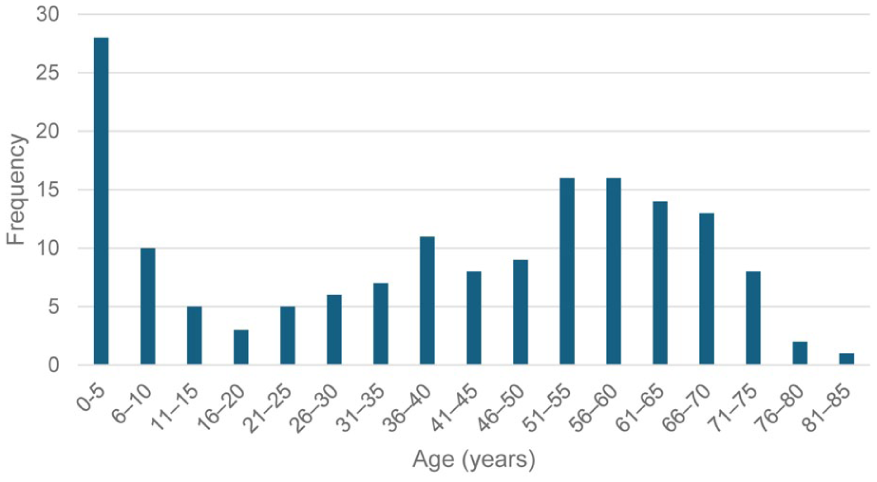
Age distribution.
Imaging was obtained in 90.7% of patients and utilized CT (n = 102), MRI (n = 55), ultrasound (n = 43), X ray (n = 18), angiogram (n = 4), PET scan (n = 2), scintigraphy (n = 2), radioiodine uptake scan (n = 1), and venogram (n = 1), sialogram (n = 1), and barium swallow (n = 1; Table 2). There was one imaging study of unknown modality. On average, 1.4 imaging studies were conducted per patient. The average largest tumor dimension was 8.0 cm (SD = 5.1 cm).
Other common diagnostic studies included biopsy (n = 53) and laryngoscopy (n = 36). Biopsies were performed in 32.0% of patients (Table 3), with 6 being incisional biopsies. Results were inconclusive and inconsistent with benign fatty tumor in 26.4% and 17.0% of needle biopsies, respectively. Findings were consistent with benign lipomatous tumor in only 34.0% of biopsies (Supplemental Appendix 6).
Systematic Review Data on Post Operative Complications, Length of Follow Up, Recurrence, and Tumor Type.
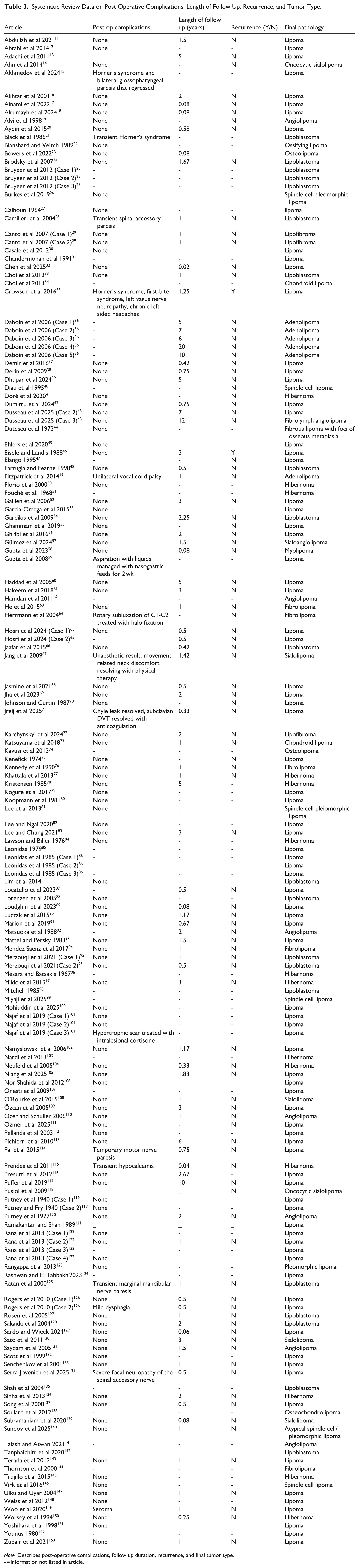
Note. Describes post-operative complications, follow up duration, recurrence, and final tumor type.
- = information not listed in article.
Postoperative surveillance in 125 cases recorded 19 complaints (Table 2) in 14 patients. Only 5 of 125 patients (4%) had persistent complaints (1 patient with an unaesthetic result; 1 patient with mild dysphagia; 1 patient with unilateral vocal cord palsy; 1 patient with Horner’s syndrome, vagus nerve neuropathy, first-bite syndrome, and chronic left sided headache; and 1 patient with spinal accessory nerve neuropathy). Most lipomas were simply designated as “lipoma” (56.8%), while 13.5% were lipoblastoma, 9.5% hibernoma, 5.4% fibrolipoma/lipofibroma, 4.7% angiolipoma, 4.7% adenolipoma, 3.4% sialolipoma/oncocytic sialolipoma, and the remaining spindle cell lipoma/spindle cell pleiomorphic lipoma, fibrolymph angiolipoma, pleiomorphic lipoma, ossifying lipoma/osteolipoma, fibrous lipoma with foci of osseous metaplasia, chondroid lipoma, sialoangiolipoma, myolipoma, and osteochondrolipoma. Of the 99 patients monitored for recurrence, only 2 developed recurrent tumors. One of these tumors had been incompletely resected initially.
Discussion
Given the rarity of deep cervical lipomas, details of their general course and recommended workup algorithms are sparse. In the largest institutional review of these cases in the literature to date, we show that DCLs are uncommon benign lesions that do not have standard workup or treatment guidelines. This case series and scoping review propose that imaging is standard in the workup of DCLs, needle biopsies provide low diagnostic utility, and neck dissection is an effective and low morbidity method to treat and diagnose DCLs.
Presentation and management of DCLs is similar to that of subcutaneous lipomas. Like subcutaneous lipomas, the majority of surgically resected DCLs presented in males. 6 For both tumor types, the most common presentation is a palpable mass, surgery is curative, and morbidity and recurrence rates are low with complete excision.6,8,154-156 In contrast to the generally accepted presentation between 40 and 70 years, we found that DCLs present in a bimodal distribution, peaking in early childhood and late adulthood. 6 While lipoblastoma is thought to be the second most common fatty tumor in children after lipomas, we found that lipoblastomas are by far the most common surgically resected pediatric benign fatty tumor. 157
While core needle biopsy has been proposed for any palpable cervical mass or masses larger than 3 to 5 cm, other recommendations suggest that only small or superficial lipomas or tumors with specific features on MRI may be exempt from biopsy.158-160 In practice, over one third of biopsies returned as nondiagnostic or incorrect. DCL biopsies may be difficult to obtain safely due to vicinity of major neck vessels. 161 With surgical resection being diagnostic and imaging being central to workup regardless of biopsy, biopsy appears to have low utility for surgical planning or diagnosis of DCLs, particularly if there are no clinical signs of malignancy.
Malignant liposarcoma is a rare possibility in the differential of deep lipomatous tumors. 162 Some clinical characteristics of liposarcomas include 10-fold higher recurrence rate, pain, rapid growth, and weight loss, but several benign DCLs also presented with these symptoms.163-165 Radiographic abnormalities may increase suspicion of liposarcoma but are not sufficient to diagnose malignancy. 165 Resection is the only definitive method to rule out malignancy. 163 Resection of the tumor using traditional dissection techniques, in addition to being curative with low recurrence rate, is an appropriate method to diagnose and treat DCLs. In all presented cases, tumors were resected via transcervical approach (Supplemental Appendix 5). Complete resection of the lipomatous tumor without violation of the capsule is preferred. After identification of major cervical vessels and nerves, the tumor can typically be gently pulled away from these structures if the capsule remains intact. However, some lipomas may also invaginate into surrounding muscle, and care should be taken to resect these portions as well. Molecular testing may also be used to assist diagnosis of resected tumor. Molecular testing for CD34; S100; desmin; loss of Rb in types of spindle cell neoplasms (Case 7); and coexpression of MDM2 and CDK4 and amplification of MDM2 in atypical lipomatous tumor/dedifferentiated liposarcoma have been used to support diagnosis of fatty tumors. 166 The spindle cell subtype of lipoma may be more aggressive and associated with recurrence as noted in the presented cases. Further study of spindle cell lipomas may determine a subtype more prone to recurrence and inform follow up considerations for this subtype.
Case series methodology presents inherent limitations. Observed trends are limited to the included patients. Additionally, follow up was not uniform. Few patients did not return for follow up and surveillance with imaging was conducted sparingly at the surgeon’s discretion. Scoping review methodology is also limited to data that has been published and produced in literature search. Race and ethnicity data were not available in the majority of included studies. Variable details included in studies limited our ability to comment on surgical details, including more granular specifics of tumor location. Additionally, there were many subtypes of lipomas included, but small numbers of each subtype did not allow for comparison between groups. However, the congruence between presentation, workup, and postoperative complication and recurrence rates of the case series and the larger scoping review strengthens the observed trends. The systematic methodology employed for literature review, as well as the large number of included cases, increases the validity of observed trends.
Conclusion
Palpable mass, often accompanied by interval growth, is the most common presenting symptom of DCLs. Dysphagia and pain are less common but may also be observed. Imaging, typically with CT, is standard in the workup of DCLs, whereas biopsy has low utility for diagnosis or surgical planning. Traditional transcervical approach to resection are associated with minimal morbidity and is both diagnostic and therapeutic for DCLs.
Supplemental Material
sj-docx-1-aor-10.1177_00034894261467355 – Supplemental material for Deep Cervical Lipomas: Case Series and Scoping Review of the Literature
Supplemental material, sj-docx-1-aor-10.1177_00034894261467355 for Deep Cervical Lipomas: Case Series and Scoping Review of the Literature by Meghana Bhaskara, Emily H. Chestnut, Brent Molden, Diane W. Chen, David A. Campbell, Avinash Mantravadi, Michael Moore, Michael W. Sim, Jessica A. Yesensky and Janice L. Farlow in Annals of Otology, Rhinology & Laryngology
Supplemental Material
sj-docx-2-aor-10.1177_00034894261467355 – Supplemental material for Deep Cervical Lipomas: Case Series and Scoping Review of the Literature
Supplemental material, sj-docx-2-aor-10.1177_00034894261467355 for Deep Cervical Lipomas: Case Series and Scoping Review of the Literature by Meghana Bhaskara, Emily H. Chestnut, Brent Molden, Diane W. Chen, David A. Campbell, Avinash Mantravadi, Michael Moore, Michael W. Sim, Jessica A. Yesensky and Janice L. Farlow in Annals of Otology, Rhinology & Laryngology
Supplemental Material
sj-docx-3-aor-10.1177_00034894261467355 – Supplemental material for Deep Cervical Lipomas: Case Series and Scoping Review of the Literature
Supplemental material, sj-docx-3-aor-10.1177_00034894261467355 for Deep Cervical Lipomas: Case Series and Scoping Review of the Literature by Meghana Bhaskara, Emily H. Chestnut, Brent Molden, Diane W. Chen, David A. Campbell, Avinash Mantravadi, Michael Moore, Michael W. Sim, Jessica A. Yesensky and Janice L. Farlow in Annals of Otology, Rhinology & Laryngology
Supplemental Material
sj-docx-4-aor-10.1177_00034894261467355 – Supplemental material for Deep Cervical Lipomas: Case Series and Scoping Review of the Literature
Supplemental material, sj-docx-4-aor-10.1177_00034894261467355 for Deep Cervical Lipomas: Case Series and Scoping Review of the Literature by Meghana Bhaskara, Emily H. Chestnut, Brent Molden, Diane W. Chen, David A. Campbell, Avinash Mantravadi, Michael Moore, Michael W. Sim, Jessica A. Yesensky and Janice L. Farlow in Annals of Otology, Rhinology & Laryngology
Supplemental Material
sj-docx-5-aor-10.1177_00034894261467355 – Supplemental material for Deep Cervical Lipomas: Case Series and Scoping Review of the Literature
Supplemental material, sj-docx-5-aor-10.1177_00034894261467355 for Deep Cervical Lipomas: Case Series and Scoping Review of the Literature by Meghana Bhaskara, Emily H. Chestnut, Brent Molden, Diane W. Chen, David A. Campbell, Avinash Mantravadi, Michael Moore, Michael W. Sim, Jessica A. Yesensky and Janice L. Farlow in Annals of Otology, Rhinology & Laryngology
Supplemental Material
sj-docx-6-aor-10.1177_00034894261467355 – Supplemental material for Deep Cervical Lipomas: Case Series and Scoping Review of the Literature
Supplemental material, sj-docx-6-aor-10.1177_00034894261467355 for Deep Cervical Lipomas: Case Series and Scoping Review of the Literature by Meghana Bhaskara, Emily H. Chestnut, Brent Molden, Diane W. Chen, David A. Campbell, Avinash Mantravadi, Michael Moore, Michael W. Sim, Jessica A. Yesensky and Janice L. Farlow in Annals of Otology, Rhinology & Laryngology
Footnotes
Acknowledgements
We thank Mirian Ramirez, medical librarian at the Ruth Lilly Medical Library, Indiana University School of Medicine, for providing feedback and guidance in developing our search strategy and study protocol.

Ethical Considerations
Ethical approval to report this case series was obtained from Indiana University Health IRB (IRB#22602).
Funding
The authors received no financial support for the research, authorship, and/or publication of this article.
Declaration of Conflicting Interests
The authors declared no potential conflicts of interest with respect to the research, authorship, and/or publication of this article.
Supplemental Material
Supplemental material for this article is available online.
References
Supplementary Material
Please find the following supplemental material available below.
For Open Access articles published under a Creative Commons License, all supplemental material carries the same license as the article it is associated with.
For non-Open Access articles published, all supplemental material carries a non-exclusive license, and permission requests for re-use of supplemental material or any part of supplemental material shall be sent directly to the copyright owner as specified in the copyright notice associated with the article.
