







Abstract
The Tunney Act and its 2004 Amendment have sought to eliminate judicial rubber-stamping of antitrust consent decrees. Congress sought to assure meaningful judicial review of consent decrees to assure they were in the public interest. The caselaw in the D.C. Circuit undermines the purpose, intent, and plain meaning of the Tunney Act by arguing that such review would present separation of powers issues, an argument at best disingenuous in light of other settlements readily rejected within the Circuit. The Article commences with a review of the legislative history of the original Tunney Act. The article next examines the D.C. Circuit cases against that the drafters of the Amendment to the Tunney Act are rebelling. This legislative history is highlighted and extended in the legislative history of the 2004 TunneyAct Amendment. The article next describes how D.C. district courts uniformly ignore and dismiss the Congressional intent behind the 2004 Amendment under the auspices of prosecutorial discretion. Finally, the Article tackles the (false) problem of separation of powers the D.C. Circuit case law presents and proposes a solution to this deadlock that is true to the original intent of the Tunney Act.
I. Introduction
Consent decrees entered into between merging parties and the U.S. Department of Justice’s (DOJ’s) Antitrust Division are a long-standing tradition. Merging parties seek to consummate their merger, while the DOJ seeks to mitigate any anticompetitive harm arising from the merger without the risks associated with litigation. Consent decrees count as “wins” for purposes of congressional appropriations.
The Tunney Act process is generally amicable enough. The trouble begins when third parties seek to inquire about other theories of competitive harm, about the weaknesses of potential remedies, and about issues the DOJ either investigated and rejected or failed to investigate at all. In such circumstances, at least within the D.C. Circuit, objectors typically file comments, to which the DOJ responds. These comments are cast away, serving no purpose whatsoever, because the D.C. Circuit case law forbids rejection of a consent decree in most instances.
Worse, oftentimes the merging parties are permitted to consummate the merger even prior to the required Tunney Act hearing before the court. 1 According to the Act, the court must hold such hearings to determine whether the merger is in the public interest. In the D.C. Circuit, absent skullduggery on the part of the DOJ, the district courts are compelled to answer the public interest question in the affirmative. Thus, the DOJ can assure merging parties that pre-Tunney hearing consummation is fine because the chances of a court rejecting the consent decree are zero.
Because of the D.C. Circuit’s horrid track record of total disdain for the Tunney Act, Congress modified the legislation to compel courts to undertake a more serious review of antitrust consent decrees. At least within the D.C. Circuit, there has been serious pushback, as the courts within that circuit have held that any meaningful review is unconstitutional because it infringes on the DOJ’s prosecutorial discretion. This protestation is without concern for the self-inflicted injury to judicial powers caused by compelling entry of a judicial decree, regardless of content, and contrary to the intent of Congress and plain language of the Tunney Act.
This article proposes a solution to the D.C. Circuit’s (false) separation of powers conundrum. The solution, quite simply, suggests that there is no such problem. A court may reject or accept a consent decree. If rejected, the DOJ and merging parties can continue with litigation, or the DOJ can abandon the case. In other words, this setting is no different than the countless thousands of plea bargains that are handled in the criminal context. In those instances, courts have broad discretion to reject plea bargains. The result is that the prosecution can either go to trial—or not. Prosecutorial discretion is preserved, as are the powers of Article III courts.
This article commences with a review of the legislative history of the original Tunney Act. That legislative history has already been eloquently described elsewhere, but is repeated here as foundation for the 2004 Tunney Act amendments. Section III of the article examines the D.C. Circuit cases against which the drafters of the Amendment to the Tunney Act are rebelling. Section IV examines the legislative history of the 2004 Tunney Act Amendment. Section V examines how the D.C. district courts uniformly ignore and dismiss the congressional intent behind the 2004 Amendment under the auspices of prosecutorial discretion. Section VI tackles the (false) problem of separation of powers the D.C. Circuit case law presents. Section VII proposes a solution to this deadlock that is true to the original intent of the Tunney Act.
II. A Brief (Legislative) History of the Tunney Act
The Tunney Act, named after Senator John V. Tunney, emerged from scandal surrounding backroom dealings to settle a DOJ merger challenge. It first became a major issue during hearings on Richard Kleindienst’s nomination to be attorney general. Senator Tunney expressed outrage at such closed-door discussions. Senator Tunney decried a massive behind-closed-doors campaign [that] resulted in halting of the prosecution of the ITT case and its hasty settlement favorable to the Company. During these hearings, [he] became concerned with the apparent weakness of the consent decree process which could allow this kind of corporate pressures to be exercised.
2
Moreover, Kleindienst’s confirmation hearings revealed to the public for the first time the underlying rationale for the DOJ settlement with ITT. In the hearing, Kleindienst asserted that one reason for the settlement was DOJ fear that divestiture would cause ITT’s stock price to fall, causing hardship to shareholders. Another DOJ concern was apparently that the plummeting stock price would ripple throughout the U.S. economy. 9
Ralph Nader moved to intervene to ask the Court to set aside the consent decree on the ground that it was obtained by “fraud…, misrepresentation, or other misconduct of an adverse party.” 10 The District Court denied Nader’s motion, finding that hardship on shareholders was a legitimate DOJ consideration in settling the case. 11 At that time, prior to the Tunney Act, third parties could only participate via a motion to intervene. Such a motion was granted only if the substantial interests of the movant were “less than adequately represented” by the DOJ. 12 Typically, the motion was not granted. The secret negotiations of the DOJ in ITT and the inability of third parties to intervene, when combined with judicial “rubber stamping” of consent decrees brought before the Courts by the DOJ, prompted legislation designed to cure these ills.
The Supreme Court endorsed the view that courts should give deference to the DOJ in the imposition of consent decrees in Sam Fox Publishing Co. v. United States.
13
In that case, the Court was confronted with an appeal from an order of the District Court for the Southern District of New York denying appellants’ motions to intervene as a matter of right in a proceeding to modify a consent decree previously entered in a government antitrust suit. The Court upheld the denial of the motion and also added that the Court should not entangle itself in modifications of consent decrees: “Sound policy would strongly lead us to decline appellants’ invitation to assess the wisdom of the Government’s judgment in negotiating and accepting the 1960 consent decree, at least in the absence of any claim of bad faith or malfeasance on the part of the Government in so acting.”
14
In the Tunney Act, Congress rejected the Supreme Court’s notion that courts must give deference to the DOJ in their determination that a consent decree is in the public interest. Instead, Congress sought to have the courts make an independent, objective, and active determination without deference to the DOJ. The legislative history is replete with references to congressional distaste for judicial rubber-stamping of consent decrees. As Senator Tunney stated: The mandate [imposed on the courts by this new statute, to independently determine the public interest] is a highly significant one because it states as a matter of law that the role of the district court in a consent decree proceeding is an independent one. The court is not to operate as a rubber stamp, placing an imprimatur upon whatever is placed before it by the parties. Rather, it has an independent duty to assure itself that entry of the decree will serve the interests of the public generally. Though this may seem a truism to some, too often in the past district courts have viewed their rules [sic roles] as ministerial in nature—leaving to the Justice Department the role of determining the adequacy of the judgment from the public’s view. While in most cases that judgment may be a reasonable one, there may well be occasions when it is not. Furthermore, submission of the proposed decree to the court and its subsequent embodiment in a judgment lends a permanence that endures long after the passing of a particular administration of the Department. For all these reasons, the mandate placed upon the court by this section, even though a general one, carries with it a major significance.
15
Reinstating the judicial function of the district court as an independent reviewer of any consent decree was the fundamental purpose of the Tunney Act. The term “independent” is used throughout the legislative history to emphasize the importance of the discontinuation of the district court's “rubber stamp” operation, which directed it to accept any consent decree submitted before it, no matter how atrocious.
III. The D.C. Circuit Engages in Judicial Activism
Nonetheless, the D.C. Circuit continued to embrace the notion that its sole function was rubber-stamping. When district courts sought to reject consent decrees, the D.C. Circuit set them straight to conform with its notion that courts are essentially powerless and must defer to the DOJ. While other circuits do not have such a strict standard of abdication, the D.C. Circuit handles the greatest number of consent decrees, and so plays a unique role in antitrust through its policy of total disengagement.
A. U.S. v. Microsoft (1995) 16
The crusade to end meaningful judicial review after passage of the Tunney Act began with the DOJ’s first case against Microsoft. In 1994, the DOJ brought a civil complaint against Microsoft under Sherman Act Sections 1 and 2, alleging in part that Microsoft had unlawfully maintained a monopoly of operating systems for IBM-compatible personal computers (PCs). 17 The DOJ claimed that Microsoft had unreasonably restrained trade of the same through certain anticompetitive marketing practices. 18 These practices included imposing a per-processor licensing fee that required original equipment manufacturers to pay Microsoft a royalty for each computer produced—regardless of whether or not a Microsoft operating system was on it—and overly restrictive nondisclosure agreements with certain independent software vendors (ISVs), which limited the ISVs’ ability to provide software for competing operating systems. The complaint was filed with a consent decree. 19 The consent decree prohibited Microsoft from engaging in these practices in the future. 20 The DOJ moved for entry of the decree in January 1995. Judge Sporkin found that the consent decree was not in the public interest. 21 Specifically, Judge Sporkin was concerned about four things: (1) procedure, 22 (2) scope of the decree, 23 (3) effectiveness of the remedy, 24 and (4) compliance. 25
The D.C. Circuit reversed Judge Sporkin’s decision in Microsoft I and remanded the case to a different judge, Judge Jackson, believing that Judge Sporkin would not be impartial on remand.
26
The court then linked Tunney Act review to a standard of deference granted to administrative agencies.
27
Rather than making an independent determination as to whether the consent decree was “in the public interest,” the standard mandated by Congress in the Tunney Act,
28
the “appropriate” standard according to the court, was a deferential one: The court should also bear in mind the flexibility of the public interest inquiry: the courts function is not to determine whether the resulting array of rights and liabilities “is the one that will best serve society,” but only to confirm that the resulting settlement is “‘within the reaches of the public interest.’” Thus, a court should not reject an agreed-upon modification unless “it has exceptional confidence that adverse antitrust consequences will result—perhaps akin to the confidence that would justify a court in overturning the predictive judgments of an administrative agency.”
29
In reading the language of the Tunney Act and its legislative history, this is precisely the sort of deferential standard the drafters of the Tunney Act did not want. 32 The language of the Act expressly provides that the court, not the DOJ, shall determine whether or not the consent decree is in the public interest. 33 The language of the Act also indicates that the court may consider numerous factors in its determination, including whether the consent decree terminates the alleged violations, if it provides mechanisms for enforcement, the duration of relief sought, and the “anticipated effects of alternative remedies actually considered.” 34 In addition, section 5(f) provides extensive powers for the Court to explore the merits of the proposed decree, powers that would be irrelevant if the court is required to defer to the decision-making of the DOJ. In short, Judge Sporkin’s concerns raised issues well within the scope of the Tunney Act.
Moreover, the legislative history of the Tunney Act is filled with statements decrying judicial rubber-stamping of consent decrees. To ignore this substantial legislative history and the express language of Section 5(e) in favor of a deferential standard is to place the District of Columbia Circuit in the position of an activist court rewriting legislation. Despite the clear intent of Congress and the authors of the Tunney Act to ensure that the courts have discretion and an active role in the determination of the public interest, 35 the District of Columbia Circuit chose to ignore legislative intent and cast judicial review of consent decrees back to the days when rubber-stamping was prevalent. 36 Moreover, the standard adopted reopens the potential for political abuse in the settlement of antitrust cases by closed-door negotiation and settlement of significant cases—one of the very abuses Congress sought to end with the passage of the Tunney Act. 37 It is difficult to conceive of a more patent rewrite of a law Congress intended to prevent judges from rubber-stamping consent decrees negotiated by the DOJ.
B. Massachusetts School of Law at Andover, Inc. v. U.S. 38
Massachusetts School of Law (MSL) sought to intervene in the DOJ’s consent decree against the American Bar Association (ABA). The DOJ alleged that the ABA sought to use its control of law school accreditation as a means to fix faculty salaries in violation of Section 1 of the Sherman Act. MSL sought to intervene, both as a matter of right and in the Tunney Act proceedings.
The case is relevant for purposes of understanding the DC Circuit’s restrictive view of Tunney Act review, and is often cited for that purpose. Within the context of determining whether MSL could intervene in the Tunney Act proceeding, the court stated, “Thus only if the would-be intervenor can point to the specific defects identified by Microsoft, or some discrepancy between the remedy and substantially undisputed facts so broad as to render the decree a ‘mockery of judicial power,’ will intervention under Rule 24(b)(2) (and reversal) be warranted.” 39
The language, of course, is a direct quote of the language used in Microsoft I. It expressly limits intervention in consent decrees to exceptionally rare circumstances. It further places extreme deference into the hands of the DOJ.
C. U.S. v. Microsoft (2001) 40
While not directly pressing on the standard of review for Tunney Act proceedings, my prior article with John J. Flynn (who helped draft the Tunney Act) describes the misapplication of the Tunney Act to a fully litigated case. In that article, we describe, using tools of statutory construction, that the Tunney Act does not apply to litigated cases. 41
Soon after Microsoft I, the DOJ and Microsoft became entangled in a series of trials and “errors.” Specifically, the DOJ brought a contempt action against Microsoft for tying its Internet browser to its operating system in claimed violation of the Microsoft I consent decree. 42 Judge Jackson, the second of the three judges to oversee the Microsoft line of cases, interpreted the decree as one designed to prohibit unlawful tying arrangements under general antitrust tying standards and issued a preliminary injunction prohibiting Microsoft from tying its Internet Explorer application with its Windows operating system. 43 The Court of Appeals reversed. 44 However, prior to the Court of Appeals decision, the DOJ brought a monopolization, attempted monopolization, and exclusive dealing and tying case against Microsoft. 45 The result was a trial with conclusions of law, findings of fact, and yet another appeal. 46 Ultimately, the D.C. Circuit upheld the majority of the findings of facts and conclusions of law by Judge Jackson on monopolization but reversed Jackson’s attempted monopolization and tying analyses and his remedy ordering structural relief. 47 The D.C. Circuit, citing improper communications with the press prior to issuance of Judge Jackson’s opinion, remanded the case for determination of remedy to Judge Kollar-Kotelly. 48 Of particular note was the displeasure of the D.C. Circuit that Judge Jackson failed to hold a remedy hearing prior to ordering divestiture of Microsoft’s operating system from the rest of the company. 49
On remand, Judge Kollar-Kotelly, after and because of the events September 11, 2001, strongly urged the parties to settle. 50 The DOJ eventually settled with Microsoft, taking nine states along with it. 51 The settlement was negotiated in secret, presented to Judge Kollar-Kotelly as a consent decree under the Tunney Act, and was not signed by trial staff. 52 The split between the plaintiffs and the remedy hearing required to litigate the nonsettling states’ case caused Judge Kollar-Kotelly to bifurcate the trial of the litigating states and the settlement between Microsoft and the DOJ into two separate proceedings. 53 The bifurcation of the remedy proceeding only further complicated the already complex problem of determining the appropriate remedy for the violation established in Microsoft II. Instead of holding a unified trial on the appropriate remedy, the court reviewed the DOJ’s “consent decree” with Microsoft under the standards of the first “Microsoft Fallacy,” deferring at every turn to the discretion of the DOJ, to enter the settlement despite occasional indications of reservation by the court. 54
In sum, the court in essence abdicated its power under Section 4 of the Sherman Act by converting a hearing on remedy held after findings of fact and conclusions of law into a consent decree process subject to the D.C. Circuit’s referential standard of non-review.
IV. Congressional Intervention to Stop the D.C. Circuit’s Judicial Abdication
Displeased with the cases in the D.C. Circuit that suggested that the only route for the courts was to rubber-stamp final judgments proposed by the DOJ, Congress sought to establish more clearly the intended consequences of the Tunney Act. It did so by compelling courts to undertake a meaningful Tunney Act review under 15 U.S.C. § 16(e), in the Antitrust Criminal Penalty Enhancement and Reform Act of 2004. 55 The original language of that section stated that the court “may” consider a variety of factors relevant to the determination of the consent decrees impact on the market and upon public interest. The change from permissive “may” to the compulsory “shall” language sought to make clear, specifically to the D.C. Circuit and its lower courts, that Congress was reversing the D.C. Circuit’s anemic interpretation of the Tunney Act.
The Amendment also expanded the scope of judicial review, adding additional factors the court is obliged to consider. These factors are “whether [the proposed final judgment’s] terms are ambiguous,” and “the impact of entry of such judgment upon competition in the relevant market or markets.” 56
Congress also sought to strengthen the Tunney Act’s already obvious legislative history, to deter “rubber stamping,” and to overturn D.C. Circuit precedent that destroyed the courts’ oversight role: The amendments to the Tunney Act found in our bill will restore the original intent of the Tunney Act, and make clear that courts should carefully review antitrust consent decrees to ensure that they are in the public interest. It will accomplish this by, No. 1, a clear statement of congressional findings and purposes expressly overruling the improper judicial standard of recent D.C. Circuit decisions; No. 2, by requiring, rather than permitting, judicial review of a list of enumerated factors to determine whether a consent decree is in the public interest; and No. 3, by enhancing the list of factors which the court now must review.
57
Implicit is the recognition that it is impossible to determine whether or not a settlement was subject to political pressure without meaningful judicial review. Moreover, there are ways to determine whether or not the settlement is in the public interest when meaningful judicial review is undertaken, including comparing the scope of the complaint to the remedies proposed, a review that is forbidden under the D.C. Circuit’s contorted view of the Tunney Act.
The Tunney Act also enables the judge to apply additional remedies when the proposed final judgment is deficient, thereby acting as “mediator.” 59
The legislative history takes the D.C. Circuit’s interpretation specifically to task. It details how the D.C. Circuit decisions state the purpose of the Tunney Act to be to avoid “rubber stamping,” yet articulate a standard that ensures just that. Specifically, the inability of a district court to do anything but enter a consent decree (unless to do so would make a “mockery of the judicial function”) ensures that the courts do exactly that. The express purpose of the amendment was require that Courts engage in meaningful Tunney Act review and to “overrule recent D.C. Circuit decisions holding to the contrary.” 60
Notably called out in the legislative history is Microsoft I and Massachusetts School of Law. The legislators specifically sought to reverse the “mockery of judicial function” standard found in those two cases. However, that is not all Congress sought. In addition, Congress affirmed that the courts have tremendous power to conduct hearings, take testimony, appoint special masters, or “take such other action in the public interest as the court may deem appropriate” in the court’s broad discretion. Absent a broader interpretation of what constitutes the public interest, these powers are virtually useless. Thus, the legislative history reminds us that the procedures and substantive law go hand in hand, contradicting the D.C. Circuit’s opinion that such power is only wielded in the face of skullduggery.
Congress could not have been more explicit in its directive to the D.C. Circuit and its district courts to not engage in “rubber-stamping” and that the scope of Tunney Act review is far broader than envisioned by the D.C. Circuit.
V. Judicial Abdication Continues
Review, or more precisely lack of review, of consent decrees continued as if the Tunney Act amendment had not passed. Given the courts’ performance up to 2004, it remains unsurprisingly the case that no consent decree has ever been challenged by a district court judge since Microsoft, and the status quo of judicial abdication continues.
A. The Telecomm Decision
The first decision to thoroughly review the impact of the 2004 Tunney Act amendment on standards for consent decree review is U.S. v. SBC Communications. 61 The decision involved review of a consent decree surrounding divestitures crafted after massive consolidation in the telecomm industry. Four of the largest telecommunications companies agreed to merge into two companies. Both mergers were blessed by the DOJ, subject to the usual divestiture consent decrees.
Judge Sullivan began by noting the three changes made by the 2004 Tunney Act amendments. Focusing on their impact, the court broke the effects up based upon standards of review.
The court most readily was able to knock down the notion that “mockery of judicial power” continued to be the standard of review. Referring to its use in Microsoft I and MSL, the court noted that congressional findings explicitly sought to overturn those cases. Moreover, the change in the statutory language compelled consideration of factors beyond those used to determine whether the decree makes a mockery of judicial power: The 2004 amendments to the Tunney Act clearly overruled the Circuit court’s holding in Massachusetts School of Law. First, a court must now consider all of the enumerated factors, as opposed to just ambiguity of terms, enforcement mechanisms, and third-party harms.…Second, the Congressional findings in the text of the amendments state that Tunney Act review is not limited “solely to determining whether entry of those consent judgments would make a ‘mockery of the judicial function.’”
62
The court next turned to whether the court could review matters beyond the scope of the complaint and proposed final judgment. Reminding the reader of the mockery of judicial power standard, the court then discusses other rationales for not going beyond the four corners of the complaint. First, the court asserted that the plain language of the Tunney Act references the complaint. Second, the court warned that there are grave separation of powers concerns implicit in allowing a court to go beyond the borders of the complaint, potentially trampling prosecutorial discretion. The court then reminded that the D.C. Circuit in Microsoft I rejected the concern that the DOJ could limit Tunney Act review merely by drafting a narrow complaint because the “court’s authority to review the decree depends entirely on the government’s exercising its prosecutorial discretion by bringing a case in the first place.” 64
The court then proceeded to resurrect the “mockery of judicial power” standard of review as the standard to apply when the DOJ drafts a complaint so narrowly as to limit the court’s ability to review the public interest. It then searched in vain for something in the legislative history or text to undermine the D.C. Circuit’s Microsoft I reasoning, for this portion of its argument ignoring the legislative history’s direct assertion it sought to overturn Microsoft I. In any event, according to the court, absent that instance, a court may never go beyond the bounds of the complaint filed by the DOJ.
Finally, the court turned to the review of remedy. The court began with the question of how much deference the DOJ should be given in reviewing DOJ’s proposed remedy. Turning quickly to the standard of “public interest” compelled by the Tunney Act, the court noted that there is really no guidance for what that term actually means. The court, relying on Microsoft I, asserted that DOJ should be given deference, despite the fact that the original legislative history of the Tunney Act decries such deference.
Blissfully declaring that Congress has provided no instruction on how to apply the “public interest” standard, the court followed the lament in Microsoft I about a lack of standard. Thus, referring to Microsoft I, the court resurrected the notion that the court is not permitted to reject proposed remedies merely because the court believes other remedies are preferable. Instead, the question is not whether a proposed remedy is the best one, but only whether it is “within the reaches of the public interest.” Such a rule is justified because “[r]emedies which appear less than vigorous may well reflect an underlying weakness in the government’s case, and for the district judge to assume that the allegations in the complaint have been formally made out is quite unwarranted.”
65
The court noted that the textual changes to the 2004 Amendments do not address any of this, and therefore the court clings to Microsoft I. Scouring the legislative history, the court finds little that illuminates any standard to help them define the parameters of public interest other than those found in Microsoft I.
The court then turned to statements by Senator Herb Kohl. First, the court quoted Senator Kohl’s statement decrying the “reaches of the public interest” standard as making it “difficult if not impossible for courts to exercise meaningful scrutiny” of proposed decrees. But, the court continued, “difficult if not impossible” did not clearly indicate that Congress intended to overrule the holding in Microsoft I. Of course, the court might have turned to language in the legislative history that the courts should have broad discretion in public interest review.
The court then quoted Senator Kohl’s assertion that courts should ensure that “in the public interest and analytically sound.” The court rejected the notion that this meant anything meaningful, however, because it was the word of a single senator. 67 Showing slavish devotion to Microsoft I, the court dismissed a fake argument that the court should have to “perfectly remedy antitrust violations when those violations have not yet been proven at trial.”
The problem with the telecomm decision is that it ignores the intent of Congress, the purpose of the Tunney Act Amendment, and the plain language of the act through a contorted, tortured analysis. Thus, despite the great efforts of Congress, the court just could not see any means to escape Microsoft I. Sadly, that is precisely the goal of the 2004 Amendment.
The court concluded that the Amendments to the Tunney Act do not allow it discretion to address matters either within or outside the complaint. With respect to remedies for harms outside the scope of the complaint, the court cited the D.C. Circuit in Microsoft for the proposition that allowing a court to do so would raise separation of powers concerns. 68 The court also held that the 2004 Amendments did nothing to assert that such a position would be required. 69
But the court did not stop there. It argued that it lacked the ability to review the remedies proposed by the DOJ so long as they are reasonable. The court stated, “The relevant inquiry is whether there is a factual foundation for the government’s decisions such that its conclusions regarding the proposed settlements are reasonable.” While the court noted that Congress mandated that the courts consider a multitude of factors, the court essentially reduced those factors down to whether or not the DOJ’s rationale is reasonable. In essence, this is an administrative law–like standard that confers upon the agency deference, a standard specifically contrary to the intent of Congress as described both in the original Tunney Act and the 2004 Amendments.
Even in reasonableness review, however, there is usually a link required between the initiation of a matter and the outcome. In rulemaking, the requirement is that the final rule be a “logical outgrowth” 70 from the notice of proposed rulemaking. In formal adjudication, the courts require substantial evidence based on the record as a whole, such that the agency cannot pick and choose relevant facts in a vacuum. 71 In either form, consideration of alternatives is required, meaning that if the court were being consistent, it would have considered alternative remedies in its reasonable review.
B. The Telecomm Decision Sets D.C. Circuit Precedent
Sadly, there has been no resistance to the arguments laid forth in the telecomm decision. Instead, the district courts within the D.C. Circuit have embraced the ruling and the interpretation of Judge Sullivan without consideration. Thus, the ruling has become de facto the law of the D.C. Circuit.
In U.S. v. Republic Services, Inc., 72 the court rejected a proposed alternative remedy because the DOJ’s remedy was reasonable, citing the telecomm decision. The court, citing pre-2004 precedent, argued that “a court may not reject a remedy simply because it may not be, in the court’s view, the ‘best’ remedy available.” 73 Thus, the court utilized the telecomm decision as a seamless transition between the pre- and post- 2004 Tunney Amendment eras.
In U.S. v. U.S. Airways Group, Inc., 74 the court elaborated eloquently that the scope of the court’s Tunney Act review is limited, that the court may not second-guess remedies, and that the DOJ is entitled to deference. The court cited Republic Services, Microsoft I, and the telecomm decision. In this instance, a broadly worded complaint about national competitive harm in hundreds of airport pair markets was settled cheaply for some slots at National Airport. The disconnect between the complaint and the remedy is discounted, according to the court, because the “government needs room to negotiate a settlement.” 75 In this case, the room may have been the Oval Office, where political pressure may have compelled the settlement. 76 This type of interference was precisely the type that the Tunney Act sought to bring to light, and the court gave it a miss.
But, much like the aficionado of romantic comedies, the aficionado of Tunney Act precedent within the D.C. Circuit recognizes that all plot lines yield this predictable end. So much so, the DOJ has taken to allowing parties to consummate their mergers prior to the entry of the final judgment before the court. While this makes sense if one believes that the Tunney Act has been reduced to a worthless piece of legislation by its wrong-minded interpretation by the D.C. Circuit courts, it is further evidence of the deliberate gutting of the act by that same circuit.
Also, the telecomm decision has become a favorite for the DOJ’s memoranda in response to public comments on proposed final judgments. As these documents are essentially cookie-cutter memos, one example should suffice. The DOJ argues that the holding of SBC is the conclusion that the 2004 amendments to the Tunney Act “effected minimal changes” to the court’s scope of review under Tunney Act, and that review is “sharply proscribed by precedent and the nature of Tunney Act proceedings.” 77 In essence, that the DOJ is entitled to a “super-deference” not afforded to any administrative agency. In essence, the courts in the D.C. Circuit have conferred upon the DOJ nearly unreviewable discretion. 78 For this reason, the telecomm decision has become a favorite for the DOJ in arguing that the court is completely impotent to do anything but rubber-stamp even the most inadequate settlements.
The origin of this extreme deference to an agency, and the complete impotence of courts within the D.C. Circuit to conduct Tunney Act hearings as intended by Congress, is the notion that doing so tramples upon the prosecutorial discretion of the DOJ. This article turns to resolve that problem next.
VI. The “Separation of Powers” Nonproblem
Executive and judicial powers have been intermingled in the realm of government antitrust enforcement for a long time as a result of the widespread use of consent decrees as an enforcement tool in civil cases and nolo contendere pleas to settle criminal cases without formal litigation of the charges. 79 Such a state of affairs is, of course, unavoidable because Congress has bestowed the executive branch with the power to initiate civil or criminal cases in order to enforce the antitrust laws and has endowed the judiciary with the power to apply criminal sanctions and equitable relief by entry of judgments of illegality and decrees imposing a remedy. 80
The clear statutory scheme of both the Sherman Act and the Clayton Act leaves to the discretion of the attorney general the power to initiate and voluntarily dismiss criminal or civil cases, while leaving to the judiciary the power to determine the appropriate remedy in criminal and civil cases—whether by a plea of nolo contendere, or a conviction upon trial in criminal cases, or entry of an injunction in a civil case by consent or by litigation. 81 Consent decrees require a judicial act and become an injunction of a court once entered. As a judicial act imposing injunctive relief, consent decrees, like litigated injunctions, are subject to potential future judicial proceedings by way of a contempt action. 82 Both the act of deciding to enter a decree and the act of deciding whether to enforce the decree by a contempt citation are judicial functions and not executive branch functions entrusted solely to the discretion of the DOJ. 83
Although the DOJ certainly has the right to dismiss a civil or criminal antitrust complaint or negotiate a settlement with any party, the right of prosecutorial discretion ends when a court is asked to exercise its power to enter a consent decree. Entry of both the judgment and a remedy decree are judicial functions, subject to the court’s full equitable powers, regardless of whether or not the decree is a consent decree within the meaning of the Tunney Act. 84 Moreover, Congress specifically designed the Tunney Act to deal with the practice of excessive deference to the judgment of the DOJ in establishing the terms of a consent decree and to stop the practice of courts rubber-stamping the DOJ’s proposed injunctive relief. Congress mandated that the courts consider the public interest, not whether the DOJ achieved what it considered to be in the public interest when designing the appropriate relief, when deciding whether or not to enter a decree. 85
A parallel can be drawn to litigated cases wherein the parties propose a settlement. Congress specifically delegated the power of determining the equitable remedy in litigated government civil antitrust cases to the courts under § 4 of the Sherman Act. The wisdom, effectiveness, and necessity of specific remedies are choices Congress has reserved to the courts in litigated antitrust suits. Congress did not give the DOJ the right to determine the remedy in a litigated case by submitting a proposed consent decree in circumstances where a consent decree is entirely inappropriate. Although the DOJ and a defendant may propose a remedy in such circumstances, the court cannot abdicate its statutory responsibility to determine the appropriate remedy under § 4 of the Sherman Act in order to defer to the DOJ where the case is a fully litigated one.
Because the entry of a decree is an inherently judicial function, it cannot be the case that the Court should be obligated to defer to the DOJ in terms of either the adequacy of the remedies proposed by the parties in the consent decree or in terms of the behavior restrained in light of the complaint. With respect to the former, the Tunney Act is quite clear in terms of form and substance that the court is to make its own separate determination as to whether the remedy is in the public interest. An independent determination of the adequacy of remedy cannot equate to deference and reliance upon the assertions of the DOJ.
Further, it cannot be the case that the court is bound by the four corners of the complaint. While the court cannot require the DOJ to prosecute a case brought under prosecutorial discretion, it can determine whether or not the remedies prevent and restrain violations of the Sherman Act. Moreover, a determination of whether or not a consent decree is in the public interest cannot be done in a vacuum. Such a determination must include consideration of “any…competitive considerations bearing upon the adequacy of the judgment that the court deems necessary to a determination of whether the consent judgment is in the public interest.” 86 As with administrative agency action, determining what is reasonable must include a determination of alternatives.
In engaging in the public interest determination task, the Court may invoke broad powers as outlined in 15 U.S.C. 15(f). These powers include the taking of testimony, appointment of a special master, and other procedural elements. These powers would be unnecessary if Congress merely sought to require the courts to defer to the DOJ’s proposed remedies and analysis of competitive harm.
The separation of powers problem, therefore, is not the one the D.C. Circuit cases describe of trampling prosecutorial discretion. Rather, the problem is the trampling of the judicial function and Article III of the Constitution. As a couple of commentators have proclaimed in the context of the Microsoft cases: A denial of the court’s power to refuse to enter decrees that do not protect the public interest could itself represent an unconstitutional infringement on judicial power. Such a denial would arguably prevent the court from accomplishing its constitutionally assigned function of enforcing the laws…as a court of equity.
87
The argument for deference made by the Justice Department and Microsoft fails to consider the courts’ inherent equitable power to reject the entry of judgments that contravene the public interest. Although negotiations involve administrative decisions by the government, a court’s entry of a consent decree is a judicial act which is both constitutional and statutory in nature. Thus, an intensive review of a consent decree by a district court may be supported apart from the Tunney Act.
88
Because the will of Congress has been ignored, and because separation of powers issues are implicated that once again aggrandize the executive branch at the expense of the judiciary, the Tunney Act issue is quite important. Congress could revisit the Tunney Act once again to make clear that the scope of judicial review includes the entirety of competitive analysis, not just the four corners of the complaint. Moreover, Congress could also make expressly clear that no deference ought to be given to the DOJ. Finally, Congress could bar the practice of allowing a merger subject to a proposed consent decree to consummate prior to entry of the final judgment. Of course, the D.C. Circuit could yet again ignore the will of Congress, much like the last two times.
The legislative history of the Tunney Act and its 2004 Amendment make clear that the purpose of the Act was to confer upon the courts substantial power to review proposed consent decrees to determine whether or not they are in the public interest. This legislative history was specifically adopted and referenced in the 2004 amendments.
In the Tunney Act, Congress rejected the Supreme Court’s notion that courts must give deference to the DOJ when determining if a consent decree is in the public interest. Instead, Congress wanted the courts to make an independent, objective, and active determination without deference to the DOJ. The legislative history is replete with references to congressional distaste for judicial rubber-stamping of consent decrees.
The legislative history bears this interpretation out. Senator Tunney stated during hearings: The concept that the trial court judge ought to be independently involved in making the determination that the proposed decree is in the public interest must be preserved. The purpose of section 2(d) is to insure that the court shall exercise its independent judgment in antitrust consent decrees—and not merely act as a rubberstamp upon out-of-court settlements.
89
The bill further requires that the court accept a proposed consent decree only after it determines that to do so is in the public interest. This is a particularly important provision, since after entry of a consent decree it is often difficult for private parties to recover redress for antitrust injuries.…In some cases, the court may find that it is more in the public interest, for this reason and others, that the case go to trial instead of being settled by agreement.
90
Further, the legislative history of the Tunney Act amendments makes clear that the purpose is to overrule cases like Microsoft I 93 in which courts have held that a court essentially must enter a consent decree proposed by the DOJ except “if the enforcement mechanism is inadequate, if third parties will be positively injured, or if the decree otherwise makes a mockery of judicial power.” 94
As Senator Leahy asserted, “The amendments to the Tunney Act found in our bill will restore the original intent of the Tunney Act, and make clear that courts should carefully review antitrust consent decrees to ensure that they are in the public interest.” 95
Senator Leahy continued: First, section 221(a) of our bill contains Congressional Findings and Declarations of Purposes. These provisions clarify that we are determined to effectuate the original Congressional intent of the Tunney Act. In other words, after the enactment of this legislation, courts will once again independently review antitrust consent decrees to ensure that they are in the public interest. The Congressional Findings expressly state that for a court to limit its review of antitrust consent decrees to the lesser standard of determining whether entry of the consent judgments would make a “mockery of the judicial function” misconstrues the meaning and intent in enacting the Tunney Act. The language quoted paraphrases the D.C. Circuit decisions in Massachusetts School of Law v. U.S., 118 F.3d 776, 783 (D.C. Cir. 1997) and U.S. v. Microsoft, 56 F.3d 1448, 1462 (D.C. Cir. 1995). To the extent that these precedents are contrary to section 221(a) of our bill regarding the standard of review a court should apply in reviewing consent decrees under the Tunney Act, these decisions are overruled by this legislation. While this legislation is not intended to require a trial de novo of the advisability of antitrust consent decrees or a lengthy and protracted review procedure, it is intended to assure that courts undertake meaningful review of antitrust consent decrees to assure that they are in the public interest and analytically sound.
96
Leahy goes on to say that the requirement that the courts shall look at the public interest factors enumerated was designed to eliminate the rubber-stamping. 97 There is no need to examine the public interest factors listed if a court is bound to accept the consent decree, as the D.C. Circuit misperceives. The result is that for the bulk of consent decrees, the Tunney Act process, as interpreted in the D.C. Circuit, is a colossal waste of time and procedure. It is no wonder that merging parties are permitted to consummate the transaction before judicial review of a consent decree, as if to accentuate the degree of judicial impotence.
VII. The Proposed Flynn-Bush Solution
The preceding discussion raises the obvious question: When should the Tunney Act apply in a meaningful way? The answer is that the Tunney Act applies to any settlement entered into between the government and defendant in an antitrust proceeding before trial commences. Once trial commences, the case could either be litigated fully or be settled during trial. In either case, it is not the Tunney Act that applies. Instead, the full equitable powers of the court and Section 4 of the Sherman Act, or Section 15 of the Clayton Act if the violation is found under the Clayton Act, will apply.
Figure 1 outlines the methodology implicit in the legislative history that distinguishes between Tunney Act proceedings and other settlements. If the DOJ and the defendant agree to settle prior to the filing of a complaint, 98 then the Tunney Act clearly applies. The DOJ would file a complaint, a consent decree, and a competitive impact statement. The consent decree would be subject to Tunney Act review—namely, public comments would be solicited and the judge would make an independent determination with no deference to the DOJ—as to whether the settlement is in the public interest.
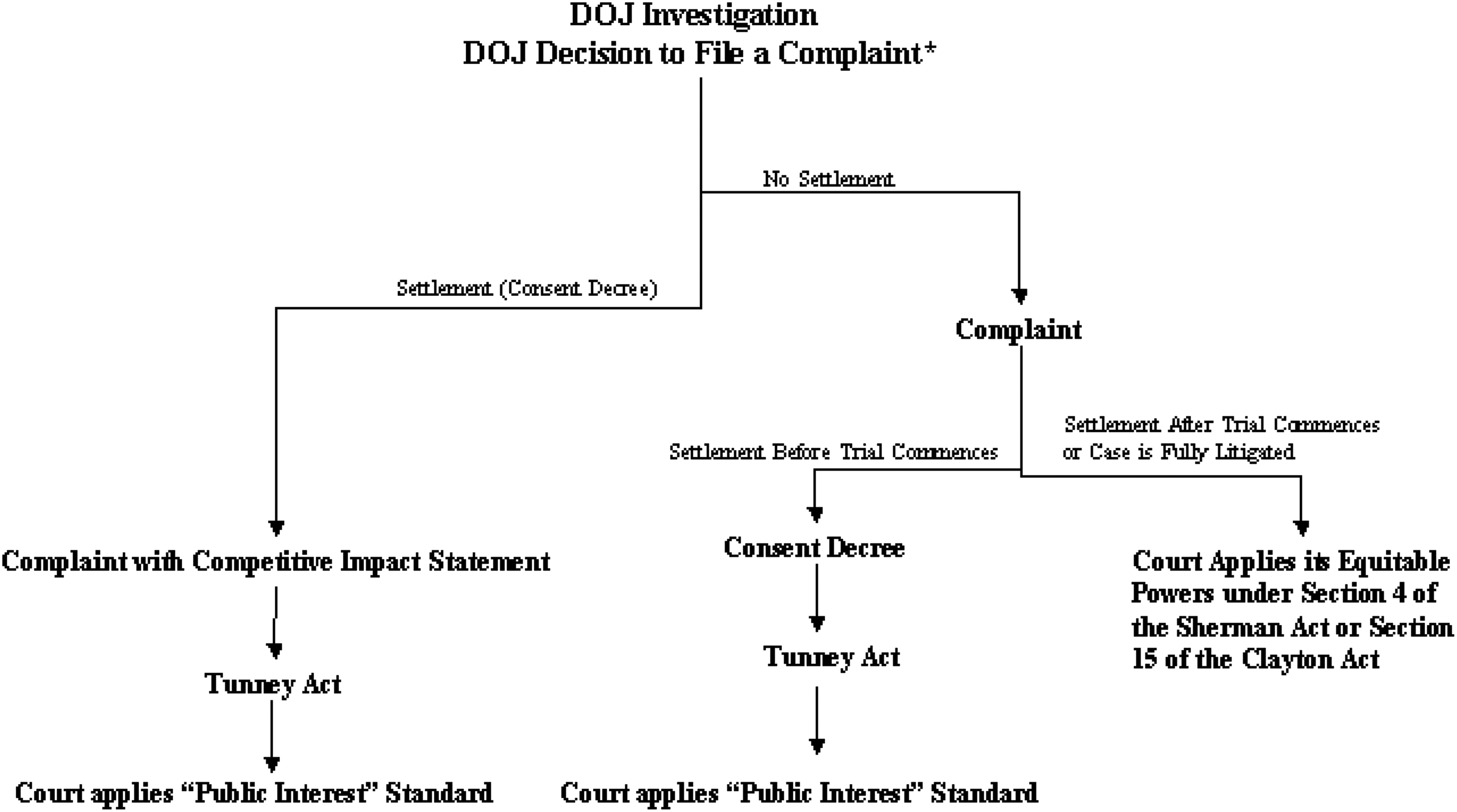
Proper application of the Tunney Act and Section 4 of the Sherman Act.
This methodology differs from what traditionally took place prior to the enactment of the Tunney Act, with respect to consent decrees, in one significant respect. As was discussed above, the court owes no deference to the DOJ’s proposed remedy and is required under the Tunney Act to make its own independent determination as to whether the remedy is in the public interest. If the court failed to make an independent determination, as was the case in Microsoft I without deference to the DOJ—it would be ignoring the express language and the legislative history of the Tunney Act discussed above. Courts would return to the days of judicial rubber-stamping of consent decrees—the very thing that Congress sought to eliminate when it passed the Tunney Act. It may also be the case that the DOJ and the defendant settle at some point after the complaint is filed and prior to the commencement of trial. In these circumstances, the Tunney Act also applies, as does the court’s independent judgment of whether to approve the consent decree without deference to the DOJ.
The polar opposite scenario would be a case that has been fully litigated to a final judgment. In such a case, Section 4 of the Sherman Act clearly applies and not the Tunney Act. Once a final judgment has been entered, the judge has the responsibility and the discretion to consider all possible remedies in order to implement the most effective remedy: The Supreme Court has explained that a remedies decree in an antitrust case must seek to “unfetter a market from anti-competitive conduct,”…“terminate the illegal monopoly, deny to the defendant the fruits of the statutory violation, and ensure that there remain no practices likely to result in monopolization in the future.”
99
Microsoft II took place in the context outlined above. A final judgment had been entered as to liability. What was left was a hearing or trial on remedy—a trial mandated by the Court of Appeals. The DOJ cannot usurp the powers of the court and the court’s obligation to determine independently an appropriate remedy, by mislabeling a proposed final judgment a “consent decree” at a stage of a proceeding well beyond the “taking of testimony.” Nor can the court ignore the purpose of Congress in adopting the Tunney Act by applying it in circumstances where Congress did not intend for the Act to be applied.
The final possibility is where a settlement or dismissal of the complaint is proposed after trial has commenced but before entry of any final judgment. Here, some testimony has been taken, but there has not been a complete trial on the merits before the judge. Instead, the parties offer a proposed final judgment or the DOJ moves to dismiss the complaint. 101 The judge may or may not accept the proposed judgment under the court’s equitable powers. The judge has the discretion to hold additional hearings in order to determine whether the settlement “prevent[s] and restrain[s] violations,” 102 and fulfill the court’s obligations under Section 4 of the Sherman Act or Section 15 of the Clayton Act. In order to make that determination, the judge may hold hearings, solicit public comment, and order the filing of a Tunney-like “competitive impact statement,” explaining the proposed decree. 103 No deference would be due to the DOJ’s proposed remedy because the court would be exercising its independent power under Section 4 of the Sherman Act or Section 15 of the Clayton Act.
Additionally, the DOJ would not be entitled, under this scenario, to repeal Section 5(a) of the Clayton Act by inserting exculpatory language into the settlement. Section 5(a) clearly indicates that once testimony has been taken and a settlement is proposed, the exculpatory language cannot be inserted because when any evidence is taken, hearings on the remedy and the decree may be used as prima facie evidence against the defendant. Thus, the court would be obligated to strike any such exculpatory language should it choose to accept a proposed settlement under the guidelines set forth above.
In the event the DOJ moves to dismiss the case, the motion should generally be considered a decision within the discretion of the DOJ, in the absence of some reason to the contrary. Such a motion would obviously not be one subject to either the Tunney Act or Section 4 of the Sherman Act because neither a consent decree is being proposed in such circumstances nor is there any request for injunctive relief being sought from the court requiring invocation of the its equitable powers.
Rejection is precisely what happens in other circuits. For example, in U.S. v. SG Interests I, Ltd., 104 the court addressed a Tunney Act consent decree in the District of Colorado. The defendants were charged with collusion in bidding on federal lands offered for lease by the Bureau of Land Management (BLM) in April and May 2005. The court decried the consent decree after numerous commentators in the Tunney Act process objected to the “slap on the wrist” the DOJ was handing the defendants. 105 The court rejected the settlement, stating that “there is no basis for saying that the approval of these settlements would act as a deterrence to these defendants and others in the industry, particularly as GEC considers ‘joint bidding’ to be common in the industry. In sum, the settlement of this civil action for nothing more than the nuisance value of this litigation is not in the public interest.” 106
In reaching this conclusion, the court looked to the potential of other remedies to cure the ills challenged in the complaint. It also looked at the unrepentant nature of one of the defendants in particular, something not addressed in the proposed final judgment. The court did not compel trial, but merely rejected the settlement, allowing the DOJ in its prosecutorial discretion to be free to choose submitting a different settlement, going to trial, or dropping the investigation completely. 107
Thus, the problem of abdication of judicial responsibility regarding the Tunney Act is a problem endemic in the D.C. Circuit, not the entire judiciary. Sadly, the D.C. Circuit has jurisdiction over the bulk of consent decrees, meaning that the vast majority of consent decrees do not get any meaningful review. Thus, the Tunney Act as a statute is not a house still standing given the level of self-imposed impotence. 108
The reasoning in the D.C. Circuit is even more problematic when you consider the lack of separation of powers concern when courts exercise their judicial power in other realms. For example, an analogy to the consent decree process this article seeks to propose might be where, in federal criminal law, a plea bargain submitted under Rule 11(c)(1)(c) before the court detailing a proposed sentence. Recall that Senator Tunney remarked, “It is very important to me that the court not act as a rubber stamp, that it make an independent evaluation, as it does in other kinds of cases.” 109 In context of plea bargains, it is well settled and common for a court to reject the plea agreement. The court may reject a plea agreement if it is contrary to the interests of justice/the public interest. 110
Under Rule 11(c)(3), a court may “accept” or “reject” a plea agreement. The Advisory Committee on Rules notes left to the discretion of the judge the decision whether or not to reject or accept a plea: “The plea agreement procedure does not attempt to define criteria for the acceptance or rejection of a plea agreement. Such a decision is left to the discretion of the individual trial judge.” 111
The Rule recognizes that while there is broad discretion for a court to reject a plea agreement. 112 While “the procedures of Rule 11 are largely for the protection of criminal defendants…Rule 11 also contemplates the rejection of a negotiated plea when the district court believes that bargain is too lenient, or otherwise not in the public interest.” 113
It is not even controversial that the court can reject a plea bargain, so long as it does not seek to enter into the negotiations between the parties. Instead, the court has broad discretion to determine what is in the public interest as an inherent exercise of its judicial function. The DOJ has said so in its briefs before numerous courts.
It seems odd, therefore, for the D.C. Circuit courts to engage in judicial activism by ignoring its statutory requirements within the context of the Tunney Act, all the while embracing those requirements in other areas of law.
VIII. Conclusion
The argument of this article is sixfold. First, the original Tunney Act legislative history supports an independent judicial review within the scope of the consent decree process. Judgments entered into arising from the consent decree process are inherently judicial functions. The function of the court is to assure the settlement is in the public interest. Such a standard has no place for deference to the DOJ or judicial rubber-stamping.
Second, the D.C. Circuit has ignored and blatantly usurped the will of Congress by ignoring the legislative history, the plain language, and the purpose of the Tunney Act. The result has been a return to judicial rubber-stamping of consent decrees. To the extent judges have sought to reject consent decrees as inadequate, the D.C. Circuit has said forcefully that district courts may not reject consent decrees.
Third, Congress sought to overturn the D.C. Circuit’s patently wrong interpretation of the Tunney Act. It did so forcefully and clearly, in hopes that district courts would return to broader review of antitrust consent decrees within the D.C. Circuit.
Fourth, the D.C. Circuit and its lower courts to date have fundamentally rejected the will of Congress yet again. It has done so through a contortionist amalgam of separation of powers concerns aimed at assuring that the DOJ has unfettered discretion in submitting Tunney Act consent decrees.
Fifth, other circuits do not follow this notion. Other circuits have rejected consent decrees. This is because, as argued here, the separation of powers allows courts to refuse to enter settlements. While the court may not compel changes in the terms of a consent decree, it may reject the consent decree as not in the public interest. From there, the DOJ has, in its prosecutorial discretion, the ability to either renegotiate the settlement, litigate, or abandon its concerns and allow the merger to consummate unabated.
Sixth, the D.C. Circuit knows full well there is no separation of powers problem that encroaches upon the executive branch. The model this article proposes is in essence parallel to that followed in plea bargains. The courts have broad discretion in plea bargains to determine what is in the public interest. There is no reason based upon constitutional concerns for the D.C. Circuit to assert no problem in the plea bargain arena and giant red flags in the realm of consent decrees.
It is unlikely that Congress will go back once more unto the breech to correct this issue. And given the D.C. Circuit’s history of ignoring Congress, it might appear pointless to try. However, congressional oversight of the DOJ might prove an effective tool in assuring that such consent decrees meet with appropriate scrutiny. Or perhaps it will lead some to consider whether or not it is time to consider the benefits and costs of antitrust enforcement altogether. 114
Footnotes
Author’s Note
I, along with John J. Flynn, authored the prequel to this article on the Tunney Act, The Misuse and Abuse of The Tunney Act in the Microsoft Cases: The Adverse Consequences of The “Microsoft Fallacies,” 34 L
Declaration of Conflicting Interests
The author(s) declared no potential conflicts of interest with respect to the research, authorship, and/or publication of this article.
Funding
The author(s) received no financial support for the research, authorship, and/or publication of this article.