







Abstract
Among the numerous legislative initiatives implemented around the globe on digital platforms, some of these provisions are explicitly directed toward app stores. As they have all the distinctive features of multi-sided markets, app store owners represent the prototype of digital gatekeepers, controlling access to mobile ecosystems and competing with business users operating on the platforms. In light of the rule-setting and dual role of these gateway players, regulatory interventions are required in order to ensure that large app stores are treated like common carriers or public utilities, thereby imposing upon them a neutrality regime vis-à-vis new entrants. For the very same reasons, dominant app store providers have been subject to an increasing number of antitrust investigations attempting to ensure equal treatment and to avoid self-preferencing at the expense of rivals’ services. Against this background, the article investigates whether antitrust provisions are flexible enough to curb anticompetitive practices carried out by app stores and the extent to which regulatory interventions could, on the other hand, be necessary in order to address the seemingly unique features of the app economy.
I. Introduction
App stores are at the forefront of the debate on the regulation of the digital markets. Indeed, they represent the prototype of multi-sided platforms, having all their distinctive features: the presence of significant indirect network effects and economies of scale and scope leading to highly concentrated and not easily contestable markets; the growth in ecosystems providing a variety of products and services that serve as vital gateways for business users to reach potential end customers; the control and intermediation power exerted by gatekeepers, which act as private regulators, determining the terms and conditions under which users can join the network, playing a dual role as both intermediaries and trading operators on the platform.
With regard to app stores, the gatekeeping position of Apple and Google, and the related concerns about their rule-setting and dual role have been the subject of market studies launched by the Australian Competition and Consumer Commission (ACCC), 1 the Netherlands Authority for Consumers & Markets (ACM), 2 the U.K. Competition and Markets Authority (CMA), 3 the Japan Federal Trade Commission (JFTC), 4 and the U.S. House of Representatives. 5 Furthermore, the terms and conditions for accessing app stores, such as in-app purchasing rules and restrictions on the freedom of choice regarding payment apps on smartphones, are being scrutinized by courts and antitrust authorities all around the world. Moreover, numerous legislative initiatives have been implemented to safeguard market contestability and establish a level playing field by promoting regulatory approaches that essentially aim to characterize large digital platforms as common carriers or public utilities in order to impose upon them a neutrality regime. Notably, a new ex ante regulatory regime has been advanced in the European Commission’s Digital Markets Act (DMA) proposal and in the CMA’s code of conduct aimed at governing online platforms with “gatekeeping” position or “strategic market status,” respectively. 6 In pursuing the same goal, Germany has strengthened its national Competition Act (GWB), introducing a new Section 19a which sets specific standards of conduct for undertakings of “paramount significance for competition across markets.” 7 In a similar vein, in June 2021, the U.S. House of Representatives unveiled a five-bill antitrust package designed to curb the market power of large online platforms representing “critical trading partners.” 8
This approach was endorsed by the European General Court in the recent Google Shopping 9 case. The Court relied on a principle of equal treatment, considering it to be a general principle of the European Union (EU) law inferred from case law applied to public undertakings. 10
Despite their differences, the legislative initiatives cited above do share the same aims and concerns. By and large, the call for action stems from the hurdles experienced by antitrust enforcers, aiming to remedy an enforcement failure. 11 With regard to the digital markets, antitrust is considered to be falling short mainly because competition rules apply ex post and require an extensive investigation on a case-by-case basis. Therefore, corrective tools are required to speed up the enforcement process and to achieve the result of prohibiting certain practices.
Against this background, some of the obligations envisaged are clearly addressed to app stores in an attempt to introduce a platform and device neutrality regime. Notably, the European DMA, the German Section 19a, and some of the U.S. bills (in particular, the American Choice and Innovation Online Act, and the Augmenting Compatibility and Competition by Enabling Service Switching Act, and the Ending Platform Monopolies Act) prohibit, for instance, the designated platforms from: discriminating between users by engaging in self-preferencing and applying unfair access conditions; preventing users from sideloading (i.e., installing apps without going through an app store) and un-installing pre-installed apps; impeding data portability and interoperability; and imposing anti-steering provisions. Moreover, in August 2021, an ad hoc app store bill (“Open App Markets Act”) was introduced in the U.S. Senate to reduce “gatekeeper power” in the app economy. 12 Finally, although the U.K. regime follows a principle-based rather than a rule-based approach that relies on firm-specific codes of conduct, the CMA has also suggested a range of procompetitive interventions (including third-party access to data, interoperability and common standards, interventions to overcome consumer inertia and default bias, obligations to provide access on fair and reasonable terms, and separation remedies) that cannot be achieved via codes of conduct and would have a major impact on app stores. 13 In its Interim Report on mobile ecosystems, the CMA has considered possible interventions aimed at addressing Apple and Google’s market power, which include allowing sideloading and removing anti-steering provisions and restrictions to alternative payment options for in-app purchases. 14 The findings of the CMA’s market study on mobile ecosystems will provide information on how the regime is designed and implemented by the newly appointed Digital Markets Unit, supporting the development of codes of conduct in relation to app stores and the potential use of the aforementioned procompetitive interventions.
However, the very first country to approve legislation on app stores was South Korea. Its Legislation and Judiciary Committee, indeed, supported the amendment to the Telecommunications Business Act which, among other things, will prohibit app store operators in dominant market positions from forcing payment systems upon content providers and inappropriately delaying the review of, or deleting, mobile contents from app markets. 15
Against this background, this article aims to investigate whether antitrust provisions are flexible enough to keep up with the dynamics of digital app stores and whether regulatory interventions are, on the other hand, required in order to address their unique features.
The work is structured as follows. Section II describes the role and economic features of app stores. Section III analyses antitrust investigations and private litigation initiated against Google and Apple stores by focusing on the different practices at stake. Section IV illustrates the regulatory initiatives recently implemented to address the seemingly distinctive features of the digital markets and the strategic role played by large online platforms. Section V explores how the main anticompetitive practices within app stores can be tackled by current antitrust rules and the potential role played by regulation in bridging the enforcement gaps. Section VI concludes.
II. App Store Ecosystems
The economic features of the digital economy are epitomized by the structure of mobile ecosystems in which consumers can access a variety of products, contents, and services through an app store, embedded in a specific operating system, which is, in turn, installed on a smart device. Indeed, app stores represent an essential component of mobile ecosystems which, built on the combination of an operating system and mobile phone, have emerged as digital infrastructures on which a huge number of retail and social interactions now take place. Notably, working as distribution channels, app stores act as a catalyst, governing interactions between app providers and mobile users. They are essentially a gateway giving app developers access to such new digital markets by offering their apps to users of a specific mobile operating system. Similarly, consumers use them to search, update, install, and remove a wide array of applications from their devices.
The two most predominant mobile operating systems, namely, Apple’s iOS and Google’s Android, come with their own closely integrated app stores (App Store and Play Store) and web browsers (Safari and Chrome). 16 Apple allows users and developers to use only the App Store while Google strongly encourages the use of its own Play Store, which is pre-installed on devices that comply with Android’s compatibility requirements. Although consumers perhaps only notice minimal divergences between the two, for developers, the experience can be quite different. Indeed, iOS-based and Android-based platforms embrace two different business models. While the former is a walled garden, being vertically and exclusively integrated throughout the whole mobile value chain (running from app stores to devices), the latter is an open ecosystem with competitive and independent manufacturers producing the devices and Google managing the Play Store.
Although Google is said to have gradually followed a walled garden approach aimed at keeping users increasingly within its ecosystem, 17 the business model adopted still differs from Apple’s, and this differentiation is crucial for the antitrust analysis. 18 Indeed, while the latter generates revenue primarily through device sales (device-funded ecosystem), the former’s main source of revenue is through digital advertising (ad-funded ecosystem). 19
From an economic perspective, app stores magnify the features of multi-sided markets and the multi-layered architecture of ecosystems. According to the literature on multi-sided markets, an app store enables interactions between two or multiple groups of users that would not be able to capture the value generated by their interaction if it were not for the platform. Furthermore, it influences the volume of transactions by applying asymmetric prices to groups working on different sides. 20 The value of the service offered by the platform to one group increases with the number of such users as well as the number of participants in the other group (direct and indirect network effects). 21 Due to the interdependence between the groups that interact through the platform, an app store needs to bring (and keep) both sides on board, thus gathering and ensuring a sufficient number of agents on every side in order to reach a critical mass to trigger indirect network effects. Finally, access to data might influence the ability to compete, granting to app store controllers informative advantages as a result of their role as intermediaries.
The combination of these economic distinctive traits gains prominence in terms of competition dynamics. Indeed, platforms may benefit from self-reinforcing effects, which favor the emergence of highly concentrated markets. The more users are attracted to the platform, the more the platform is considered valuable, the more data are collected, the more the service provided can be improved, and the more the user is encouraged to stay within the digital ecosystem and is discouraged from switching to competing services.
One consequence of these characteristics is also the presence of economies of scope and the development of conglomerate structures, which assist us in understanding why, in digital markets, the competition is increasingly between the ecosystems. 22 Once a digital ecosystem has been established, it attracts hardware, devices, software, apps, websites, and a varied range of complementary services. This centripetal force facilitates the creation of an ecosystem based on technical standards, which can pose serious protocol interoperability problems and increase switching costs and lock-in scenarios. Indeed, the need to ensure that everything is compatible with each other favors the development of the ecosystem around a dominant design, whose controller may be considered an orchestrator. 23 As platform providers strive to become the default gateway to online content and services, competition is essentially for the market, rather than on the market.
However, in accordance with the natural dualism of multi-sided markets, the very same economic factors that allow mobile ecosystems to grow also represent the main threats to their success, requiring a difficult balance to be struck in order to ensure the ecosystem continues to thrive and so as not to dissuade a specific user group from engaging with the platform. Indeed, it has been noted that a platform ecosystem resembles a meta-organization, combining a set of product or service providers, users, and advertisers. 24 As a consequence, the value created is not fully under the control of the platform owner but depends upon the participation and actions of content and service providers (complementors). Therefore, platform ecosystems are extremely sensitive to bad behavior. 25 Such bad conduct by users generates negative externalities, which in turn reduce economic efficiency, make the platform less attractive, and could ultimately disrupt the entire ecosystem. For these reasons, governance is crucial to the success of digital ecosystems, and multi-sided platform owners must take action to preserve the value and integrity of their ecosystems. They must address potential market failures by adopting a variety of legal, technological, and informational measures, regulating access to and interactions around their ecosystems. 26
In general terms, the main justifications offered by platforms for their governance policies apparently reflect vital needs, namely, to ensure the financial sustainability of the platform, the quality of the content or services provided, and the quantity and quality (including security) of interactions between users. Notably, with regard to app stores, some payment restrictions have been introduced to address concerns related to the financial viability of the platform: Apple and Google seek to justify the use of their in-app payment systems through which they collect fees for certain purchases based upon the argument that this is how they are able to prevent developers from free-riding on app store investments.
Governance of platform access also plays a significant role in influencing interactions between app developers by incentivizing their value creation activities (such as development of innovative complements and knowledge sharing), which are critical to the attractiveness of the ecosystem. 27 For instance, bringing large numbers of software application producers on board may generate crowding-out effects, undermining complementors’ incentives for developing apps. 28 In essence, if app stores are becoming so overwhelmed by the offer of apps that providers are struggling to stand out and attract users to their app, the lower profitability for app developers may lead to a decline in product innovation and a consequent loss of value for the ecosystem. For the same reason, app stores are attentive to the ranking and featuring of apps in order to reduce consumers’ search costs and increase the discoverability of apps.
Similarly, due to indirect network effects, the quality of apps may affect the profitability of the entire ecosystem. 29 Therefore, in line with the aim of increasing the overall value of their ecosystem, app stores have an incentive to review and monitor apps, gathering as many qualitatively good apps as possible. 30 From this perspective, the need to minimize negative externalities represents the main justification put forward by Google for imposing anti-fragmentation agreements upon device manufacturers, preventing them from using any alternative version of Android not approved by Google. Indeed, fragmentation is a significant threat and a recurrent problem in open-source platforms 31 : if device makers are free to “fork” Android to create bespoke versions, incompatible versions may emerge, undermining the integrity of the operating system and making it vulnerable to negative externalities.
Finally, app stores have an incentive to exert control over apps in order to protect users, guaranteeing security, privacy, and safety by mitigating threats from vulnerable apps and keeping malicious and privacy-invasive apps out of the app store. 32
However, by establishing rules to mold the behavior of users, platforms act as private regulators self-entitled to incentivize, penalize, and even exclude some figures, which inevitably generates disputes and investigations. 33 There is systemic disagreement, in the case of app stores, as to whether the refusal or removal of an app meets a legitimate justification or if, by contrast, it is just a pretext for stifling competition, especially when, as a result of the dual role of the app store owner, a competitive app is involved. Furthermore, due to architectural and governance control, platforms may have leverage and incentives to manage their ecosystems in order to strengthen their bargaining power vis-à-vis business users and to influence consumer choices.
In short, by and large, the challenges brought about by the economic features of multi-sided digital platforms affect all stages of the antitrust analysis.
Based upon the relevant market definition, competition authorities need to assess not only whether different mobile ecosystems are separate markets but also whether the multi-sidedness of the market should be considered as a whole, rather than looking at only one side in isolation. By facilitating a direct transaction between two groups of users, app stores belong to the category of transaction platforms, which should require an integrated market approach, at least according to a strand of economic literature 34 endorsed by the U.S. Supreme Court in Amex. 35
The role played by app stores within mobile ecosystems and the importance of ecosystem competition also support the need for a bespoke approach to the digital markets by replacing the market definition concept with the ecosystem concept. 36 In this respect, the recent market study carried out by the CMA on Apple’s and Google’s mobile ecosystems precisely seeks to assess the interconnections between the different markets. 37 In a similar vein, relying on new powers assigned by Section 19a GWB, the German Competition Authority has opened an investigation to determine whether Apple holds a position of paramount significance across the markets thanks to the creation of a digital ecosystem 38 : the main focus of the investigation will be on the operation of the App Store as it enables Apple to influence the business activities of third parties. Finally, in its Android decision, the European Commission referred several times to the concept of ecosystem and considered mobile ecosystems to be different markets on their own while app stores were considered to be mere aftermarkets within which the platform owner is a near-monopolist. 39
Furthermore, when it comes to determining the level of market power enjoyed by an undertaking, the competition authorities would need to carry out a preliminary assessment covering the platform’s degree of diversification and the relevance of its network effects as well as the possibilities enjoyed by users on each side of transacting over alternative platforms (multi-homing). Accordingly, in 2017, the German legislator updated the national antitrust law introducing new criteria which, particularly in the case of multi-sided markets and networks, must be considered in addition to the existing criteria for the assessment of market power. Pursuant to Section 18(3) GWB, the new criteria include direct and indirect network effects, the parallel use of several services and the switching costs for users, economies of scale arising in connection with network effects, access to data relevant for competition, and competitive pressure driven by innovation.
Moreover, the aforementioned dualism of multi-sided markets should necessarily influence the antitrust evaluation of the behaviors and strategies implemented in app marketplaces. Due to network externalities, the circumstances in which a practice may determine a restriction of the market are exactly the same as those in which it may generate procompetitive effects. Therefore, the features of platform economics and the dualistic competitive interpretation of behaviors require, in principle, the antitrust authorities to assess the effects of a specific practice (rather than considering it, by its very nature, to be harmful to competition) and to make a judgment on counterfactual hypotheses in order to measure the actual impact on competition. This would allow the authorities to evaluate whether the behaviors in question are justified economically by testing the realistic scenario that would occur if the investigated conduct were absent and giving appropriate consideration to the business model applied by the platform. Indeed, as acknowledged in the special advisers’ report for the European Commission, the efficiencies of certain practices in the platform economy are “not yet well understood and our knowledge and understanding still needs to evolve step by step.” 40
III. Platform-Related Behaviours Targeted in Antitrust Disputes and Investigations
The vast array of ongoing antitrust disputes and investigations concerning app stores provides a fascinating insight into the more contentious issues involving the conduct of app store providers worldwide. At their heart, in relation to the app economy, these legal actions are based upon a threefold competitive concern. First, Google and Apple enjoy a gatekeeping position by which they control access to their mobile ecosystems autonomously. Second, they have the ability to act as private regulators by establishing rules that apply to all players using the app store. Third, as the two companies perform the dual role of competing within their own platform alongside other businesses and policing the same marketplace, conflicts of interest threaten to hamper competition. Such factors, coupled with scale and speed in the use of data online, are leading the antitrust authorities to believe that several business practices that, until now, have been considered perfectly legitimate could be seen as exclusionary abuses of market power when it comes to the online platform economy. However, it is worth considering that such practices and policies take place against the broader background of interplatform competition in which Apple and Google are competing with each other to attract and retain customers on their mobile ecosystems. Therefore, it is crucial to ensure that any measures proposed to increase competition within mobile ecosystems do not jeopardize competitive pressure between mobile ecosystems.
Self-preferencing represents the most egregious example of the difficulty in assessing the behaviors of app stores from a competition policy perspective. This term usually refers to the ability of a gatekeeper to favor its own services over those of third-party providers hosted on the same platform. 41 However, various business practices can fall within this vague concept. 42
As Google and Apple are in charge of the technical architecture underpinning their respective mobile ecosystems, on a purely technical level, self-preferencing may initially arise from restricted forms of interoperability between the mobile ecosystem and independent apps. 43 For instance, the application programming interfaces (APIs) necessary for making full use of the hardware and software components of a device may not be freely and thoroughly accessible from third-party apps, limiting their ability to offer certain services or to provide adequate levels of product quality and customer experience to compete on a level playing field with Apple and Google.
Furthermore, by controlling the user interface, app stores enjoy additional leeway for undermining third-party apps. First and foremost, they have substantial discretion over the functioning of ranking and auction algorithms displaying apps to consumers, which allow platforms to place the apps they prefer at the top of search results or in a prominent position in dedicated sections. 44 Moreover, default options allow app stores constantly to offer consumers proprietary apps rather than alternatives provided by autonomous developers. Default options, together with pre-installation, are likely to limit consumer choice, entrench market power, and reduce the potential for innovation in downstream markets. 45 Indeed, independent developers face an uphill battle when competing against proprietary apps pre-installed on devices.
Self-preferencing can also take place through terms and conditions imposed by the app store on third-party developers. The terms and conditions implemented by app stores envisage a vast amount of requirements regarding content, app functionality, collection, and distribution of revenues between the app and the app store. Therefore, the power held by Apple and Google in establishing the terms and conditions for operating within their mobile ecosystem is a major concern for antitrust authorities and policymakers. 46
While there are multiple grounds to justify objectively and consider the beneficial impacts of such rules and, more generally, the app-reviewing process (e.g., privacy protection, customer experience, cybersecurity), 47 it cannot be overlooked that they may also translate into an indirect form of self-favoring. In particular, it is often the case that app stores’ terms and conditions are broadly defined, thereby making it tricky to gauge in advance what is allowed and what is forbidden, raising the risk of inconsistent application, and ultimately offering a way to exclude competitors arbitrarily due to non-compliance. 48 For instance, some developers reported that the App Store managed to shield Apple Pay from the competition by denying access to rival payment apps in light of alleged inconsistencies with its guidelines. 49 In the same vein, others complained that Apple hampered the viability of rival apps when introducing its own competing applications by selectively disabling key features for a seamless customer experience. 50
Given the difficulty in tackling self-preferencing as a stand-alone practice and due to the significant amount of conduct under scrutiny, in the following paragraphs we will focus on the most relevant behaviors, providing an overview of the recent investigations and antitrust cases on both sides of the Atlantic.
A. Terms Related to App Payments: Fees and Anti-Steering Provisions
The practice of charging commission fees on third-party apps coupled with the imposition of anti-steering provisions has surfaced as one the main competitive concerns involving app stores. 51 When users install an app and purchase within an app (in-app purchase system—IAP system) Apple and Google charge a fee ranging between 30 and 15 percent. 52 In addition, the app stores’ rules explicitly prevent app developers from using payment channels other than Google Play Billing and In-App Purchase, respectively, provided by Google and Apple. Moreover, in the case of Apple, due to an anti-steering provision, app developers are prevented from informing users of alternative options for purchasing paid content: indeed, while the App Store allows users to consume content purchased elsewhere (e.g., on the app developer’s website) in the app, its rules prevent developers from informing users about these purchasing possibilities.
The level of the commission is difficult to assess from an antitrust perspective. On the one hand, it puts rivals at a competitive disadvantage, raising their costs or squeezing their margins, leading overall to higher prices for consumers. On the other hand, the commission perhaps, at least partly, reflects the cost of services incurred in maintaining the app store and the benefits provided by the app marketplace as a privileged channel for the distribution of developers’ apps, thereby allowing particularly small and new developers to reach a large audience with a relatively small investment. 53 Moreover, it is troublesome to establish if and how much the amount of the commission charged for in-app payments is inflated by Apple and Google’s market power. 54
Admittedly, the concerns are not only represented by the 30 percent commission in itself but mainly by the fact that it comes with the obligation to use only the payment mechanism provided by Google and Apple, as anti-steering provisions limit the flow of information to consumers on the payment structure related to in-app purchases. 55 Indeed, this policy has led to a number of complaints regarding the fact that Apple and Google are unlawfully foreclosing app distributors, deterring entry into the app market, and depriving end users of potential new apps.
In Cameron v. Apple, two California-based app developers filed a class action complaint, arguing that Apple’s ability to charge supra-competitive fees over time demonstrates its market power and the lack of alternatives for developers. 56 The level of the commission also features in the litigation brought by a group of users in Apple v. Pepper, arguing that Apple has monopolized the retail market for the sale of apps and has unlawfully used its monopolistic power to charge consumers higher-than-competitive prices. 57 Furthermore, the combination of high commission fees and anti-steering provisions is at the heart of the litigation brought by Epic Games against Google and Apple. The dispute was triggered by the removal of the popular Fortnite game from the App Store and the Play Store as a reaction to the offer of a new direct (and cheaper) payment option alternative to Apple and Google’s payment processor. 58
Epic Games alleges that Apple and Google engaged in anticompetitive behaviors in order to maintain monopoly power unlawfully both in their own ecosystems’ app distribution and in-app payment processing markets. Notably, according to Epic Games, Apple and Google implemented a twofold antitrust violation. First, they imposed an anticompetitive restriction by coercing all app developers wishing to use the app store to use exclusively their own payment processing mechanisms for all in-app purchases, thereby unlawfully extending their monopoly power from the app distribution market. Second, as the sole payment processor, Apple and Google can then leverage their monopolist intermediary position to extract supra-competitive rents through a 30 percent fee on all in-app purchases. In accordance with Epic’s narrative, this translates into a foreclosure of other payment processors, having exclusionary effects on app developers and causing harm to consumers in terms of reduced innovation and higher prices. Furthermore, Epic argues that Apple’s App Store anti-steering rule unlawfully prohibits developers from directly or indirectly targeting iOS users to use a purchasing method other than the in-app purchase.
On similar grounds, a group of U.S. State attorneys general launched an antitrust lawsuit accusing Google of unlawfully restricting trade and maintaining monopolies in the markets for Android software application distribution and for payment processing of digital content purchased within Android apps. 59 Mimicking Epic Games’ complaint, according to the allegations, Google has closed off its purportedly open Android operating system from competition in app distribution by imposing an “extravagant” 30 percent commission fee on sales made through the app and implementing an anticompetitive restriction requiring Android app customers to use Google Play Billing for in-app purchases of digital content.
In September 2021, Judge Rogers handed down the decision in the Epic Games case, concluding that Apple’s anti-steering provisions are anticompetitive as they hide critical information from consumers and illegally stifle consumer choice. 60 Therefore, pursuant to the injunction issued by the Californian District Court, Apple is no longer allowed to prohibit developers from informing users about alternative payment options to Apple’s IAP system. Notably, Apple is restrained from prohibiting developers to include in their apps and their metadata buttons, external links, or other calls to action that direct customers toward purchasing mechanisms, in addition to the IAP system, and communicating with customers through points of contact obtained voluntarily from the latter by way of account registration within the app. Having said that, Apple remains free to prohibit third-party IAP systems within the App Store, thus maintaining the convenience of its own IAP. Indeed, the Court only challenged the prohibition on communicating external alternatives and allowing links to those external sites.
Furthermore, the decision did not challenge the amount of Apple’s fee, 61 or impose sideloading apps on to iOS devices, or allow third-party competing app stores on iOS. Moreover, the Court held that Epic Games had failed to prove that users are locked-in, as the low switching rate between operating systems instead appears to stem from the level of overall satisfaction with the existing devices. 62 Finally, the Court did not conclude that Apple is a monopolist. Indeed, the injunction was granted under California state unfair competition law, rather than under antitrust law. Notably, rejecting the arguments of both Apple and Epic with regard to the relevant market, Judge Rogers stated that the effective area of competition is the market for digital mobile gaming transactions (rather than digital games generally or just Apple’s own ecosystem) and, although Apple enjoys a considerable market share of more than 55 percent and extraordinarily high profit margins, “these factors alone do not show antitrust conduct. Success is not illegal.” 63
Moving to the other side of the Atlantic, the European Commission, the ACM, and the CMA are investigating the in-app purchasing rules put into place by Apple. 64 Following a complaint lodged by Spotify, the European Commission recently sent a statement of objections, informing Apple of its preliminary view that it had abused its dominant position held in the distribution of music streaming apps through its App Store due to the imposition of proprietary IAP for the distribution of paid digital content and the systemic use of anti-steering provisions. 65 In the European Commission’s view, these behaviors allow Apple to increase the costs of its rivals and to distort the competitive process for music streaming services, ultimately harming consumers who end up bearing the 30 percent commission fee.
More recently, Netherlands ACM has ordered Apple to adjust the conditions applied to dating-app providers allowing them to use their own in-app payment system. 66 The ACM has considered Apple’ conditions not proportional to the additional payment service and unnecessary for running the App Store, hence unreasonable and in violation of competition rules. The District Court of Rotterdam upheld the injunction against Apple dismissing, among other things, the arguments that IAP is needed for security and privacy. 67
Finally, the Competition Commission of India has joined in by ordering an investigation against Alphabet (the parent company of Google India) and Apple for abusing their dominant position by mandating, among other things, third-party apps to use their IAP systems for charging their users. 68
On the contrary, the ACCC did not recommend that Apple or Google should be precluded from imposing the use of their IAP systems. 69 According to the Australian Authority, it is unclear how effective the unbundling would be at addressing the issues raised by Apple and Google’s control over their respective marketplaces and payment systems, and the detriment that may be caused to app developers by any resulting changes to Apple and Google’s revenue-raising model. With regard to the latter, the ACCC mentioned, in particular, the risk that changes in Apple and Google’s fee or commission structure may limit app marketplaces to less efficient forms of charges (e.g., the imposition of higher flat fees on apps providing digital goods and services), encouraging smaller innovative apps to explore alternative avenues to app marketplaces in order to avoid paying the fee, in turn reducing the apps available through the app store, and reducing its value to consumers.
More recently, the Russian antitrust enforcer has also targeted Apple’s anti-steering provisions, warning the company to remove them in order to avoid a full-scale investigation. 70 Furthermore, closing its investigation, the Japan Fair Trade Commission accepted Apple’s measures to allow developers to include an in-app link within “reader” apps, which provide previously purchased content or content subscriptions for digital magazines, newspapers, books, audio, music, and video (e.g., Spotify, Netflix, Amazon Prime, and Kindle). 71 While the agreement was made with the JFTC, Apple undertook to implement this change globally to all reader apps on the store, thus allowing all developers of reader apps around the world to link up to an external website in order to set up or manage an account, thereby avoiding the App Store’s fee. Although the remedy will not apply to games, 72 the JFTC acknowledged that it will eliminate concerns about the prohibition on providing sales channels other than IAP.
B. Access to Near-Field Communication
Near-field communication (NFC) is a short-range wireless connectivity standard enabling data exchange between devices in close proximity (ten centimeters or less). Within the app economy and the Internet of Things (IoT) ecosystem, NFC chips retain great commercial value as they allow a vast array of applications to read or write data out of electronic tags attached to real-world objects and other devices. 73 For instance, by means of this form of communication, mobile applications can perform “card emulation” functions, acting as payment, transport, or access cards. Notably, this technology could be quite disruptive to the payment system as it facilitates tap-and-go contactless payments between smartphones and payment terminals without the need for consumers to carry a physical card.
Both Google and Apple have developed their own payment services, namely, Google Pay and Apple Pay, allowing users to upload their payment card details onto their device and pay by tapping a terminal. However, in line with their respective business models, they adopted different strategies to harness the potential of NFC. Since 2013, Android has offered third-party developers access to NFC chips, thereby allowing rival apps (such as Samsung Pay and PayPal) to provide “tap and go” payment services on a level playing field with Google Pay. Conversely, Apple has been more cautious in sharing NFC functionalities with third-party apps by reserving, for instance, “tap and go” payments on iPhones and Apple Watches for its in-house app. 74 The firm has always motivated this restriction by invoking the need to ensure high standards of security for iPhone users, together with the overall integrity of its mobile ecosystem. 75 While it has not yet been definitively ascertained whether or not these limitations are justifiable, it is worth noting that similar security-related issues were never raised within the Android ecosystem. Similarly, critics pointed out that Apple’s line of defense is not entirely consistent as access to NFC chips is denied only to rival payment apps, but not to hotel companies, gym equipment makers, and car manufacturers seeking access to non-payment functions.
Unsurprisingly, NFC limitations by Apple have attracted antitrust scrutiny from several competition agencies concerned about their potential anticompetitive impact. In 2020, both the European Commission and the ACM launched an investigation into the terms, conditions, and other measures limiting access to NFC functionality for rivals. 76 These assessments are based upon the competitive concern that Apple is undermining competition by reserving the potential of NFC technology exclusively to its own proprietary payment app. The fear is that, with consumers increasingly relying upon contactless payments due to the Covid-19 pandemic, Apple could leverage its dominance within the mobile ecosystem to monopolize the lucrative market of value-added financial services within its own ecosystem.
At the same time, Google has not escaped attracting antitrust attention with reference to its own mobile payment services. The investigation launched by the Competition Commission of India in November 2020 targeted what appears to be a surreptitious attempt to foreclose competing payment apps. 77 With the only mobile payment method accepted on the Play Store being Google Pay, there is a concern that users, due to the status quo bias, would not switch to competing apps when making other physical and digital transactions different from in-app purchases. 78 Consequently, according to the Indian antitrust authority, alternative applications facilitating mobile payments are at a competitive disadvantage as they face higher barriers to entry compared to Google Pay.
C. Refusal to Deal
As app stores act as gateways for app developers to reach potential end customers, a significant amount of cases involve refusals to deal with rivals. The overall category includes different types of practices, which are difficult to evaluate under a common standard. Therefore, it is worth applying an overall distinction according to the market level involved. First, there are refusals to deal which occur in the primary market of Apple’s and Google’s ecosystem (access request to the operating system in order in order to deliver a rival app store). Second, there are refusals involving a secondary market that poses economic threats to their core business or into which Apple and Google are vertically integrated (access request to their app stores in order to supply a rival app). 79
With regard to the former, one of the main allegations against Apple in Epic Games relates to its denial of access to the essential facility represented by the iOS mobile operating system. By refusing to allow rival app stores on iOS devices, Apple is accused of preventing app distributors from competing in the iOS app distribution market, ultimately entrenching its monopoly power in that market. 80 From this perspective, access to the operating system is essential for effective competition in the iOS app distribution market and app distributors are practically unable to duplicate iOS. However, as it is technically feasible for Apple to provide app distributors with access to iOS, this would not interfere with or significantly inhibit Apple’s ability to conduct its business. Hence, Epic argues, Apple’s denial of access to iOS has no legitimate business purpose and serves only to assist Apple in maintaining its unlawful monopoly position in the iOS app distribution market.
In relation to the latter, the Unlockd case, which involves the removal of an app from the app store, is interesting. 81 The start-up Unlockd used to offer an app enabling mobile phone users to obtain rewards in exchange for opting in to advertisements. In April 2018, Google announced its intention to remove the app from the Play Store in light of an alleged infringement of its terms and conditions which prohibit apps from paying users to view ads. Unlockd complained that Google’s policy was disadvantageous to app developers wishing to develop innovative business models in competition with Google’s own online advertising business, and managed to receive judgments from the Federal Court of Australia and the U.K. High Court of Justice granting interim injunctions that stopped Google removing the app from the platform. However, thereafter, the start-up suffered from a lack of funding due to a failed IPO, eventually going into administration and withdrawing its claims. 82
The very same analysis of the conduct in question can also be applied to the rejection of an app at the end of the app store review process. Indeed, before being admitted into the app store, third-party mobile apps must undergo a review process to check whether they comply with the guidelines in terms of functionality, performance, safety, and security. For instance, Apple has recently disclosed a number of statistics about its app rejection process in 2020, revealing that: nearly 1 million new apps, and an additional nearly 1 million app updates, were rejected or removed because they were unfinished or not functioning properly, or they lacked a sufficient mechanism for moderating user-generated content; 48,000 apps were removed for using hidden or undocumented features; 150,000 apps were removed as they were found to be spam, copycats, or misleading to users; 95,000 apps were removed due to fraudulent violations (often because they changed functionality after Apple’s review to become a different kind of app, including gambling apps or pornography hubs); and 215,000 apps were removed due to privacy violations. 83
App review processes and associated terms and conditions are under the scrutiny of antitrust authorities due to concerns expressed by some app developers about their opaqueness and their inconsistency of enforcement. 84 These concerns are heightened by the dual role played by Apple and Google as downstream app developers in competition with third-party apps, and as app store providers and regulators: this conflict of interest may lead Apple and Google to establish and enforce rules for accessing their app marketplaces to guarantee preferential treatment for their own apps and to undermine the competitive pressure originating from third-party apps. For instance, although Unlockd is not in direct competition with Google, it does affect Google’s ability to gain profits from its core advertising business.
An interesting case, particularly due to the remedies imposed, is the recent Italian Competition Authority’s (AGCM) decision against Google for refusing to integrate Enel’s X Recharge app (JuicePass) into Android Auto, an infotainment system that integrates on a car dashboard some features of Android devices, such as navigation, calls, maps, music, and text messages. 85 By enabling a wide range of services for recharging electric cars (in particular, allowing drivers to locate a charging station, manage the charging session, and reserve a slot at the station), JuicePass is apparently a rival of Google Maps app, which enables similar functionalities but does not include reservation and payment services. Therefore, according to the AGCM, by refusing to integrate JuicePass into the Android Auto ecosystem, Google was attempting to favor its own app, ultimately reserving the full spectrum of recharging services to Google Maps.
The AGCM’s reasoning is based upon the fact that Android Auto forms a “competitive space” within which service apps compete against the additional functionalities effectively or potentially offered by Google’s proprietary navigation app. 86 However, the Italian authority considered that Android Auto is indispensable for the purposes of applying the essential facility doctrine. 87 This is despite the fact that drivers with a smartphone can easily access JuicePass through both the Play Store and the App Store.
Due to Google’s gatekeeping position and the conflict of interests generated by its dual role, the AGCM mandated the company to ensure an effective level playing field for all service apps offering recharge services to avoid Google continuing to favor its own navigation app within the Android Auto ecosystem. This means that Google is required to develop and update a proper template to accommodate the needs of third-party recharge applications, thereby allowing their interoperability with Android Auto. 88
IV. Regulating Digital Platforms
Alongside numerous antitrust disputes and investigations on the practices of digital platforms, sometimes specifically involving app stores, a wave of regulatory initiatives is emerging to address the distinctive features of digital markets and the strategic role played by large online platforms.
As a result of the combination of economic factors (strong economies of scale, extreme indirect network effects, remarkable economies of scope due the role of data as a critical input, conglomerate effects, consumers’ behavioral biases, and single-homing tendency), the digital markets are highly concentrated, prone to tipping and not easily contestable. 89 Furthermore, competition in the digital economy increasingly consists of a competition between ecosystems attracting and leveraging a wide range of complementary services around technical standards, which, in turn, can pose interoperability problems, increasing switching costs and lock-in scenarios. In addition, while competition law enforcement occurs ex post and requires an extensive investigation of very complex facts on a case-by-case basis, 90 digital markets move too fast to be supervised ex post; therefore, antitrust enforcers often find themselves intervening after the tipping point has already been reached. Finally, large online platforms enjoy a brand-new type of market power combining a gatekeeping or bottleneck position in the digital ecosystem with a parallel role as rule-setter within the established digital environment.
Accordingly, due to their regulatory role and intermediation power, large digital platforms should take on special responsibility for ensuring a level playing field and undistorted competition both on the platform and on neighboring markets. This is seen as particularly necessary whenever they perform a dual role, acting as both referee and player on their own ecosystems, thereby competing with their business customers operational on the platform and increasing concerns about the incentive to discriminate by self-favoring their own products and services as opposed to those of their rivals.
These arguments essentially question the capability of current antitrust rules to scrutinize the practices and business models of platforms, supporting the idea that existing antitrust is unfit to address effectively the challenges posed by the economic features of digital markets and the emergence of large technology platforms, which instead require ex ante interventions and regulatory approaches.
Against this backdrop, three main models have emerged thus far.
In the United Kingdom, the CMA has supported the adoption of a legally binding firm-specific code of conduct, which will shape the behavior of firms with “strategic market status” governing elements of how they do business with other companies and treat their users, and the appointment of a Digital Markets Unit tasked with overseeing this framework and enforcing the new set of rules. 91 The Digital Markets Unit will also be allowed to impose procompetitive interventions on firms with the strategic market status, which may include third-party access to data, data mobility, interoperability and common standards, interventions to overcome consumer inertia and default bias, obligations to provide access on fair and reasonable terms, and separation remedies.
In the DMA proposal, the European Commission has opted for a sector-specific approach to digital services, suggesting an ex ante regulatory regime aimed at governing online platforms with “gatekeeping” positions through a set of eighteen detailed obligations (ranging from a prohibition on parity clauses, anti-steering clauses, self-preferencing and certain bundling strategies to duties to deal, data portability, and interoperability). 92 The obligations amount to per se violations since they are enforced irrespective of the business model employed by the platform and without allowing any efficiency defense.
Finally, the German legislature has decided to strengthen its national antitrust enforcement tools by introducing a new Section 19a to the GWB containing a list of seven types of abusive practices for undertakings of “paramount significance for competition across markets.” 93 Although the list is similar and functionally equivalent to the European DMA proposal, the German provision does not consider the practices at stake per se prohibited, but introduces a reversal of the burden of proof, allowing firms to provide objective justifications for their conduct. In a similar vein, other European Member States, such as Austria, Greece, and Italy, are looking at the German approach to update their domestic antitrust provisions. 94
On the other side of the Atlantic, the U.S. President Joe Biden has signed an Executive Order aimed at promoting competition in the American economy and enforcing antitrust laws to “meet the challenges posed by new industries and technologies, including the rise of the dominant Internet platforms.” 95 In particular, the Executive Order identified, as practices that should be investigated and pursued, “serial mergers, the acquisition of nascent competitors, the aggregation of data, unfair competition in attention markets, the surveillance of users, and the presence of network effects.” Moreover, the U.S. House of Representatives has unveiled a five-bill antitrust package designed to curb the market power of large online platforms representing “critical trading partners” by curtailing their ability to buy competitors, imposing line of business restrictions and a non-discrimination regime, mandating data portability and interoperability. 96 Just as in the European DMA, the relevant requirement in the designation process relates to the size of the platform (e.g., market capitalization and number of users), thus dispensing the authorities from proving the market power aspect. However, unlike the DMA, the U.S. bills allow for an affirmative defense, enabling the designated platform to demonstrate that its conduct under scrutiny is objectively justified and does not cause damage to the competitive process.
In the international scenario, it is also worth noting that in February 2021 China’s State Administration for Market Regulation issued the “Antitrust Guidelines for the Platform Economy,” which represent China’s first specific antitrust rules on platforms and identify several practices which are considered unlawful, such as refusing access to the platform, adopting parity clauses and “choosing one from two” exclusivity obligations, using big data to discriminate and manipulate the market. 97
Despite the differences between the aforementioned models and approaches, these initiatives share the common goal of bridging the apparent enforcement gaps in current antitrust rules by expanding the toolkit and dispensing enforcers from the need to deal with the constraints of the antitrust law regime (such as proof of dominance and the effects of a certain behavior on the market) to address anticompetitive behaviors that standard antitrust analysis would struggle to combat. 98 Notably, these interventions are leaning toward making the assessment of some practices faster and simpler by introducing a blend of corrective tools, such as ex ante prohibitions, market investigations, legal presumptions, and inversions of the burden of proof. Indeed, for instance, the obligations envisaged in the DMA apparently capture practices subject to past and ongoing antitrust cases.
Moreover, these interventions are based upon the very same premise of considering digital platforms to be common carriers, thus subject to a public utilities-style regulation. 99 Accordingly, reforms based upon structural separation, line of business restrictions, and duties to deal should be considered in order to reduce the intermediation power exerted by dominant platforms and any conflicts of interest 100 . Notably, the common carriage regime and the essential facility doctrine should be revived in order to remedy the harm caused by self-preferencing 101 and to guarantee access to digital bottleneck facilities, 102 respectively. In a similar vein, the European General Court in Google Shopping extended to a dominant platform the principle of equal treatment applied to public undertakings. 103
A. Platform and Device Neutrality Provisions: App Stores as Public Utilities?
Against this background, some provisions are relevant to app stores, while others explicitly target them.
Considering first the European DMA proposal, as online intermediation services, app stores are considered core platform services and are thus included in the list of digital services that are within the scope of application of the new regulation. 104 As a consequence, providers designated as gatekeepers must comply with the obligations laid down in Articles 5 and 6. The first relevant obligation for app stores relates to the anti-steering provision which is at the center of the European Apple App Store case and Epic Games’ complaint against Apple 105 : in accordance with the provision at issue, business users should be free to promote and choose the distribution channel they consider most appropriate to interact with any end-users.
The ban on parity clauses may also play a role in interplatform competition by prohibiting, for example, a gatekeeper from requiring—as a condition for accessing an app store—that its pricing terms or conditions of sale must be equal to or more favorable on its app store than the terms or conditions on another app store. 106
Other provisions tackle specific forms of self-preferencing aimed at preventing a gatekeeper from unfairly benefiting from its dual role. This applies to the ban on sherlocking (the use of data of business users to compete against them), 107 on preventing end-users from un-installing any pre-installed software applications on its core platform service, 108 on giving more favorable treatment by ranking its own services and products higher, 109 and on providing preferential access to technical functionality (operating system, hardware or software features) to its own ancillary services, such as identification or payment services and technical services which support the provision of payment services. 110 In the latter case, the DMA includes a clear reference to the Apple Pay investigation. The proposal mentions, as an example of the conduct in question, the case of a gatekeeper that manufactures devices and restricts access to some of the functionalities of its devices (such as NFC technology and the software used to operate that technology) which may be necessary for the effective provision of downstream services. 111 Therefore, the goal of the provision is to address leveraging by gatekeepers into ancillary services: as gatekeepers frequently provide the portfolio of their services as part of an integrated ecosystem, they are likely to have increased ability and incentive to leverage their power from their core platform services to adjacent markets. 112
Concerns about potential leveraging strategies are also addressed by the prohibition on bundling and tying. Notably, a gatekeeper must refrain from exploiting the “dependency” position of business users to require the inclusion of identification services provided by a gatekeeper together with one or more core platform services. 113 Therefore, an app store operator must not unilaterally require app developers to integrate the app store’s own user ID functionality into their apps and to display this ID functionality to their app customers. In a similar vein, a gatekeeper must not require business or end-users to subscribe to any core platform services as a condition for accessing another core platform service. 114
Furthermore, some provisions are essentially intended to apply to app stores. First, app store providers must allow sideloading and even open the door to third-party app stores (so-called “store-within-a-store”). Indeed, pursuant to the proposed DMA, app store providers must allow the installation and effective use of third-party apps or app stores using, or interoperating with, their operating systems and allow these apps or app stores to be accessed by means other than their core platform services. 115 The goal of the obligation is to increase the contestability of app stores, and this could have a severe impact on Apple’s and Google’s governance of their app stores, namely, the terms and conditions, review process, and IAP system. 116 Second, app store gatekeepers shall apply fair, reasonable, and non-discriminatory (FRAND) access conditions for business users. 117 The obligation does not establish an access right to app stores but aims to address the imbalance in commercial relationships that could lead to unfair and unjustifiably differentiated conditions to the detriment of business users, for instance, by challenging Apple’s and Google’s practice of charging commission fees on third-party apps. 118 Moreover, gatekeepers should refrain from technically restricting the ability of end-users to switch between different apps and services. 119 However, pre-installation should not be construed as constituting a prohibited barrier to switching. 120
Finally, as a general rule facilitating switching or multi-homing, gatekeepers must provide effective portability of data generated through the activity of a business user or an individual and provide tools for end-users to facilitate the exercise of data portability, including by providing continuous and real-time access, such as through high-quality APIs 121 . Furthermore, gatekeepers must provide business users, free of charge, with effective, high-quality, continuous, and real-time access and use of aggregated or non-aggregated data. 122
Alongside the obligations envisaged in the European DMA proposal, the new Section 19a of the German Competition Law also contains an exhaustive list of seven (broadly defined) types of practice that may be prohibited by the Bundeskartellamt once an undertaking is designated as being of paramount significance for competition across markets. 123
The possibility for the German Competition Authority to prohibit the following activities is particularly relevant to app stores: self-preferencing (especially in the presentation of offers, for instance, through the ranking and advertisement of apps in app stores, or via exclusive pre-installations); measures that hinder supply or sales activities of other (even non-competitor) firms; measures that impede other undertakings by processing data relevant to competition that have been collected by the platform, or that demand terms and conditions permitting the processing of relevant data received from other undertakings for purposes other than those that are required to provide its own services to such undertakings; practices (such as predatory pricing, exclusivity agreements, tying, and bundling) hindering rivals on a market on which the designated undertaking can rapidly expand its position; restrictions on the interoperability or the portability of data; and the request for disproportionate remuneration from business users.
Moreover, Germany has paved the way for new rules allowing e-money issuers and mobile payment service providers to access platform-based technical infrastructures. Notably, Section 58a of the German Payment Services Supervisory Act (PSSA) provides them with the right to access the functionalities of the operating systems of online devices and the respective NFC interface technical infrastructure integrated in mobile phones and other devices. 124 At its heart, such an ex ante regulatory intervention imposes on digital platforms a duty to share their market ecosystem with potential competitors in the field of payment services. The provision aims to unbundle the market for stationary hardware from software applications running on them, counterbalancing the gatekeeper position and the network effects enjoyed by digital enterprises operating large platforms which could have facilitated their rapid monopolization of the payment services market, also by means of self-preferencing. In fact, the right in question applies only when the hardware-based infrastructure is used to execute e-money transactions or to provide payment services. This regulatory mechanism is designed to prevent operators enjoying close proximity to users from leveraging on their position and gaining full control of front-end customer interaction to the detriment of potential competitors.
The rule has been labeled “Lex Apple Pay” as it is likely to have a particular impact upon Apple’s proprietary business model; the German Savings Banks Association has reportedly lobbied for a legislative measure to improve the position of payment service providers in relation to Apple. 125 Indeed, since Apple’s NFC interface can only be accessed via Apple Pay, payment service providers cannot integrate their own payment solutions into the iPhone’s NFC system without paying onboarding and transaction fees for using the Apple Pay App. Interestingly, shortly before the entry into force of Section 58a in January 2020, 371 of 379 Germans savings banks agreed to use Apple Pay, foregoing the option of direct access to the NFC interface through their own apps.
Turning to the U.S. scenario, several provisions envisaged in recently released bills resemble those implemented in Europe. In June 2021, the House of Representatives unveiled a five-bill package targeting large online platforms by introducing dramatic statutory changes to antitrust law. Three bills are particularly relevant to app stores.
Notably, the Ending Platform Monopolies Act aims to tackle the dual role of platforms, thereby eliminating their potential conflicts of interest and related risks of preferential treatment for their own products and services, by imposing line of business restrictions. 126 Designated platforms would be prohibited from owning, controlling, or having a beneficial interest in a line of business other than the covered platform that: utilizes the covered platform for the sale or provision of products or services; offers a product or service that the covered platform requires a business user to purchase or utilize as a condition for accessing the covered platform, or as a condition for preferred status or placement of a business user’s product or services on the covered platform; or gives rise to a conflict of interest. As a result, the Act may potentially prevent Apple and Google from offering their proprietary apps in their own app stores. 127
In addition, the Augmenting Compatibility and Competition by Enabling Service Switching (ACCESS) Act would mandate data portability and interoperability. 128 In particular, in order to reduce switching costs for users, a designated platform must maintain a set of transparent, third-party accessible interfaces (including APIs) to: enable the secure transfer of data to a user, or with the affirmative consent of a user, to a business user if instructed by a user, in a structured, commonly used, and machine-readable format; and facilitate and maintain interoperability with a competing business or a potential competing business.
Furthermore, the American Choice and Innovation Online Act is intended to outlaw certain discriminatory behaviors by designated platforms. 129 In particular, the bill prohibits any conduct that: gives an advantage to the covered platform operator’s own products, services, or lines of business over those of another business user; excludes or disadvantages the products, services, or lines of business of another business user compared with the covered platform operator’s own products, services, or lines of business; or discriminates between similarly situated business users. 130 Moreover, the bill prevents a designated platform from: restricting or impeding the capacity of a business user to access or interoperate with the platform’s technical functionality 131 ; conditioning access to the platform or preferred status or placement on the purchase or use of other products or services offered by the platform operator 132 ; sherlocking 133 ; restricting or impeding a business user from accessing data generated on the platform by the activities of the business user or its customers, and preventing the portability of such data to other systems or applications 134 ; restricting or impeding users from un-installing pre-installed apps or changing default settings that direct or steer users toward products or services offered by the covered platform operator 135 ; introducing anti-steering provisions that restrict or impede businesses users from communicating information or providing hyperlinks on the platform to end users to facilitate business transactions 136 ; treating the platform operator’s own products, services, or lines of business more favorably than those of another business user in connection with any user interfaces, including search or ranking functionality offered by the platform 137 ; interfering with or restricting a business user’s pricing of its goods or services (e.g., by imposing parity clauses) 138 ; and restricting or impeding a business user, its customers, or users from interoperating or connecting to any product or service (e.g., by impeding sideloading). 139
In short, in addition to the European DMA proposal, the provisions of this non-discrimination bill would significantly affect the governance of app stores by preventing Apple and Google from enforcing their current policies.
In August 2021, a bipartisan trio of senators (Blumenthal, Blackburn, and Klobuchar) also put forward an ad hoc app store bill in the U.S. Senate. 140 By explicitly referring to gatekeeper power in the app economy, the Open App Markets Act would introduce similar obligations to those included in the European DMA. Notably, it would ban app stores from forcing developers to use the IAP system, imposing parity clauses, or punishing developers that offer lower prices on a separate app store or through their own payment systems 141 ; introducing anti-steering provisions 142 ; sherlocking 143 ; impeding or restricting sideloading, app un-installing, and the possibility of choosing third-party apps and app stores as defaults 144 ; self-preferencing in ranking 145 ; and impeding or restricting access to technical functionality. 146
Finally, in the United Kingdom, the findings of the ongoing CMA’s market study on mobile ecosystems will inform the scope of the new regulatory regime, providing the basis for the development of codes of conduct and the potential use of procompetitive interventions by the Digital Market Unit. 147 Two of the issues tackled by the study involve app stores directly and, in particular, relate to competition in the distribution of mobile apps and the dual role of Apple and Google in competition between app developers. In light of this, the CMA aims to investigate a wide range of phenomena, namely, the extent to which consumer behavior is influenced by the way platforms shape the choices available to users, including the pre-installation of mobile apps, default settings and other aspects of choice architecture; the potential justifications for interoperability restrictions; the prominent placement of Apple and Google’s proprietary apps in the rankings of their app stores or prominent positioning in dedicated sections of their app store; the relevance of sideloading and in-app payment systems; potential benefits (e.g., increased security) and costs (e.g., reduced innovation, choice and competition) of more closed ecosystems as opposed to more open ones; the collection and use of commercial information on rivals that would facilitate Apple or Google’s expansion into different app categories; the restrictions on the ability of third-party developers to access software and hardware functionalities that are used by Apple and Google’s proprietary apps; the impact that app review processes may have on competition between third-party developers.
In its Interim Report, the CMA has considered a range of possible interventions aimed at addressing Apple and Google’s market power by targeting specific forms of conduct, such as a requirement to allow sideloading under certain conditions, remove anti-steering provisions, and allow alternative in-app payment options to be displayed alongside their own payment services within apps 148 .
Notably, the first app store proposal to be converted into law occurred in South Korea. 149 The recently revised Telecommunications Business Act will prohibit dominant platforms from compelling app developers to use a specific payment system, charging them commissions on in-app purchases, and unjustifiably deleting apps from the store or delaying their review process.
By and large, focusing on the content of the international initiatives undertaken so far from the perspective of app stores, they are attempting to introduce a neutrality regime with the aim of increasing contestability, facilitating the possibility of switching by users, tackling conflicts of interests, and addressing imbalances in the commercial relationship. This goal is pursued by introducing obligations in terms of both device and platform neutrality. While the former includes provisions on app un-installing, sideloading, app switching, access to technical functionality, and the possibility of changing default settings, the latter entails data portability and interoperability obligations, and the ban on self-preferencing, sherlocking, and unfair access conditions (see Table 1).
App Store Obligations: Comparison between EU, German, and U.S. Initiatives.
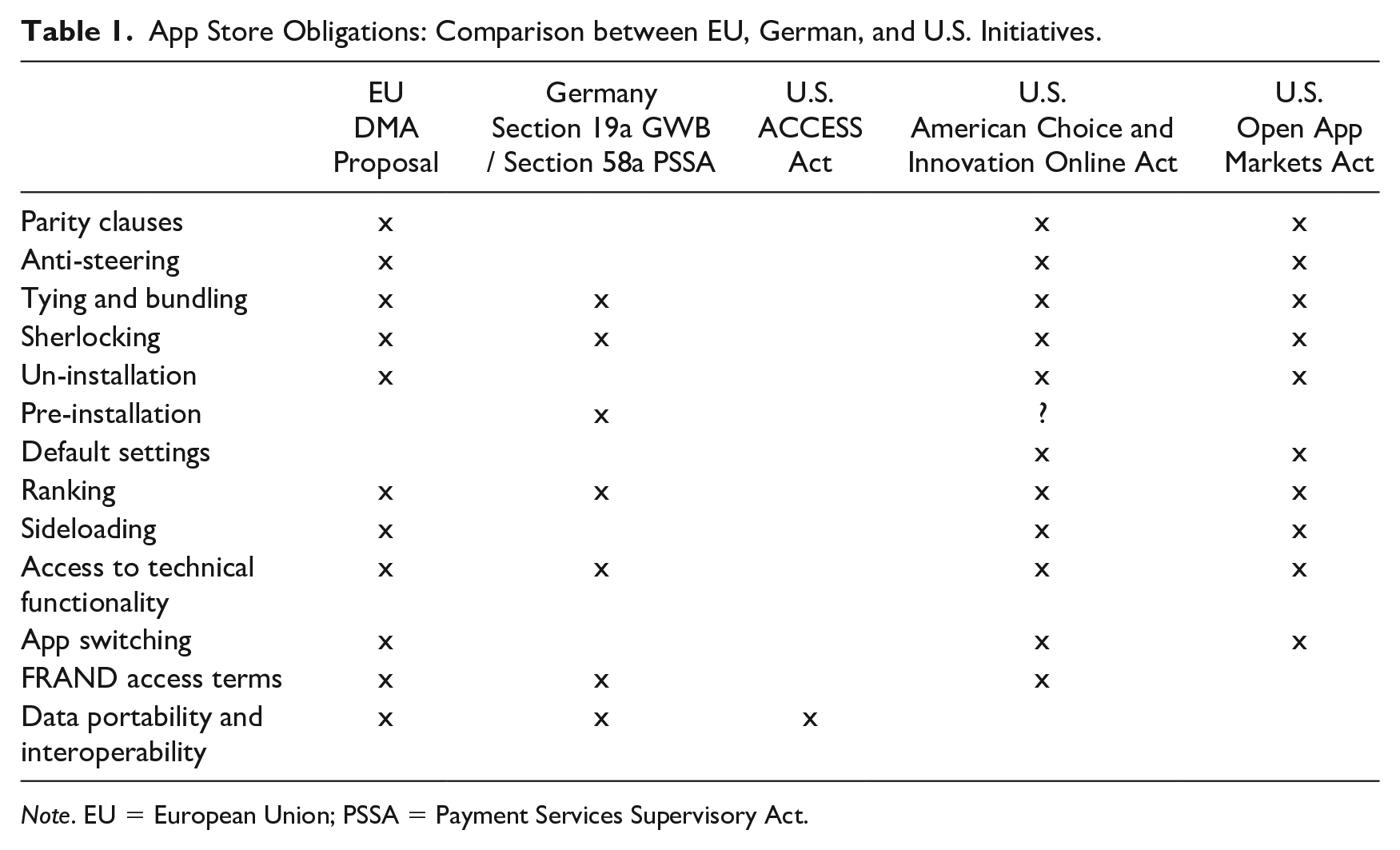
Note. EU = European Union; PSSA = Payment Services Supervisory Act.
This line of reasoning was confirmed by the European Google Shopping decision. In evaluating the conduct of a dominant player accused of favoring its own service at the expense of those of its rivals, the Court referred to the Regulation on net neutrality
150
and the CJEU decision in Telenor
151
regarding zero-rating practices, arguing that the legal obligation of non-discrimination that ensues from this legislation for internet access providers on the upstream market cannot be disregarded when analysing the practices of an operator like Google on the downstream market, given the undisputed ultra-dominant position of Google on the market for general search services and its special responsibility not to allow its behaviour to impair genuine, undistorted competition in the internal market.
152
In a similar vein, in the United States, the Federal Communications Commission’s 2015 “Open Internet Order” justified the net neutrality regulation pointing to the significant bargaining power exerted by broadband providers which act as “gatekeepers” standing between edge providers and consumers. 153
Against this background, the U.S. Ending Platform Monopolies Act pushes the regulatory intervention even further by imposing a line of business restrictions to eliminate any risk of conflict of interests by platforms. 154 As noted, this may require Apple and Google not to offer their apps in their own stores. Furthermore, the provisions, such as those approved in South Korea, banning app store operators from forcing app developers to use their payment systems may jeopardize the current monetization model of Google and Apple. Indeed, Google is attempting to comply with the new South Korean legislation without changing its underlying monetization model. Notably, Google announced that developers will be able to add an alternative in-app billing system, alongside Google Play’s billing system, for their mobile and tablet users in South Korea. 155 However, service fees for distributing apps via Android and Google Play will continue to be based on digital sales on the platform: since developers will incur costs to support their billing system, when a user selects alternative billing, Google will reduce the developer’s service fee by 4 percent.
Furthermore, an interesting question concerns app pre-installation, namely, whether a designated platform can pre-install apps and mainly decide which apps will benefit from this preferential treatment. Indeed, to enable end-user choice and address this form of self-preferencing, some initiatives encompass an explicit obligation to ensure the un-installing of any pre-installed apps. However, different approaches emerge as regards the possibility for an app store operator to select pre-installed apps. Notably, while the DMA allows pre-installation, not considering it a barrier to switching, 156 the German Section 19a presumes as unlawful the exclusive pre-installation of the gatekeeper’s own offers, considering it a measure that could favor the latter over the offers of its rivals when mediating access to supply and sales markets, or that could impede other undertakings in carrying out their business activities on supply or sales markets. 157
The situation is also unclear in the United States. Indeed, as noted by Randal Picker, there is an argument that, by pre-installing some apps, the designated platform is giving advantages to its own offers over those of another business user, excluding or penalizing the offers of another business user or discriminating between similarly situated business users. 158 These practices may all be outlawed by the American Choice and Innovation Online Act. 159 Therefore, the provision in question may require an app store operator to pre-install every app in a category if installing a corresponding proprietary app; otherwise, it would be engaging in unlawful discrimination. In other words, the safety net for a designated platform to avoid liability would be an all-or-none pre-installation strategy. According to Picker, for instance, if Apple pre-installs Apple Music, it must also pre-install Spotify. 160 Alternatively, the platform owner could provide a “choice screen” allowing users to turn the proprietary app off and choose a third-party developer service.
V. Tackling App Store Practices: Antitrust or Regulation?
As an increasing number of antitrust investigations worldwide are targeting app store business practices and strategies, it is worth assessing the limits and potential of competition law to evaluate whether the new regulations—so greatly invoked—are actually needed. Indeed, antitrust law has developed over the years, in both the EU and United States, an economic-sensitive approach that could prove extremely useful when dealing with platform-related business practices. At first glance, regulation seems, on the other hand, to be a much more rigid tool for tackling market failures only.
This section will first provide an analysis of how the main anticompetitive practices within the app economy can be tackled by current antitrust rules. Thereafter, our attention will turn to the prospects and perils of ex ante regulation for bridging the antitrust enforcement gaps.
A. Assessment under Antitrust Rules
With reference to the antitrust assessment of platform-related conduct, self-preferencing has been emerging as a catchall category. It reflects concerns associated with the dual role sometimes enjoyed by digital platforms and their status as vertically integrated firms. Notably, from this perspective, acting as referees and players in the market, platforms can leverage their power, giving preferential treatment to their own products and services with respect to those provided by other entities. 161 Moreover, the emergence of this brand-new category reveals the apparent difficulties in identifying the appropriate legal treatment for new strategies that do not fit perfectly into traditional antitrust forms of anticompetitive practices. 162
However, while it is disputed whether a dominant firm is required to ensure a level playing field by treating rivals in the same way as its own business, self-preferencing is also misleading as it covers, under the same umbrella, different practices evaluated according to different legal standards 163 . More specifically, the antitrust toolbox prohibits—in specific circumstances—practices such as refusal to deal, margin squeeze, tying, and discrimination, which apparently represent forms of self-preferencing. Therefore, rather than constituting a stand-alone practice, self-preferencing describes behaviors belonging to the general category of (offensive and defensive) leveraging. For instance, in confirming the European Commission’s decision in Google Shopping, the General Court used terms such as “favouring” and “internal discrimination,” also stating that, more generally, leveraging is a generic term, applying to several different practices capable of being abusive, such as tied sales, margin squeeze, or loyalty rebates. 164 Moreover, it is far from clear whether the Court in Google Shopping was sanctioning the favoring practice as such. Indeed, the anticompetitive strategy in question is formed by a combination of two practices, namely, the promotion of Google’s own services and the demotion of its rivals’ services. Thus, even after Google Shopping, it is questionable whether a dominant platform is forbidden from promoting its own products/services without demoting its rivals.
For these reasons, in order to avoid the risk of applying the same legal treatment to different behaviors, rather than relying on the undefined (albeit fascinating) label of self-preferencing, the main app store practices will now be assessed under the traditional antitrust forms.
1. Refusal to Deal
App stores might either prevent app developers from accessing the platform or expel them at some point during their business relationship. From a competition law perspective, this conduct may fall under the exclusionary abusive behavior known as refusal to deal. The underpinning rationale of such a prohibition is based on the acknowledgment that Apple and Google do not have to face effective competition in their primary market. It follows that without mandatory access to their ecosystem, other market participants are deprived of an essential input in order to operate.
Within this framework, the essential facility doctrine has been developed, relying on the idea that a firm—by virtue of being a monopolist—has a duty to share its facilities with everyone who requests access, including competitors. Hence, the doctrine forms a narrow exception to the general rule which states that firms, even monopolistic ones, have the freedom to select their business partners.
The doctrine in question has developed differently over the years in the EU and in the United States. Although it has its roots in U.S. case law and despite recent proposals to revitalize the essential facilities doctrine, 165 the current legal framework does not consider it to be established law. As stated in Trinko, the Supreme Court has never recognized the doctrine, while compelling firms to share the source of their advantage is somewhat at odds with the underlying purpose of antitrust law, since it may lessen the incentive for the monopolist, the rival, or both to invest in those economically beneficial facilities. 166 Furthermore, in order to safeguard the incentive to innovate, the holding of monopoly power is an important element of the free-market system; therefore, the mere holding of monopolistic power cannot be found to be unlawful unless it is accompanied by an element of anticompetitive conduct.
The only “limited” exception to this general rule is provided by the circumstances depicted in the Aspen Skiing decision. 167 Whether or not the owner of a facility voluntarily engaged in a course of dealing with its rivals, the unilateral termination could be seen as a surreptitious form of exclusionary practice. Notably, an unreasonable change in behavior by one firm (i.e., the termination of a voluntary, thus presumably profitable, course of dealing) will be considered unlawful if the firm is forsaking short-term profits to achieve an anticompetitive end, namely, long-term profits associated with the exclusion of the competition.
The essential facility doctrine has, on the other hand, gained huge success in the European scenario. According to the “exceptional circumstances” established in Magill, a refusal to deal may trigger an antitrust violation when (1) access to the product or service is indispensable to enable an undertaking to carry on business in a market, (2) the refusal is unjustified, (3) it is such as to exclude any competition on a secondary market, and, if intellectual property rights are involved, and (4) it prevents the emergence of a new product for which there is potential consumer demand. 168 The following IMS 169 and Microsoft 170 judgments have substantially dismantled the third and fourth requirements, respectively, by considering the secondary market requirement met even if that market is just potential or hypothetical and the new product requirement satisfied even when access to the facility is necessary for rivals to develop follow-on innovation, namely, improved products with added value.
However, the requirement of the indispensability of the requested resource is still in place and it is not easy to prove. Indeed, according to Bronner, access to an input is indispensable if there are no technical, legal, or even economic obstacles capable of making it impossible, or even unreasonably difficult, to duplicate it. 171 Furthermore, in order to demonstrate the lack of a realistic potential alternative, it would be necessary—at the very least—to establish that it is not economically viable to create the resource on a scale comparable to that of the firm controlling the existing product or service. In other words, in order to prove that the input is indispensable, the requesting firm must demonstrate that such input and its fungible alternatives are not economically viable even for firms that decide to make the same investments as the dominant firm.
In this regard, although related to a U.S. dispute, it is interesting to note the arguments made by the Northern District of California in dismissing Epic’s claim concerning the Apple iOS platform being an essential facility. In particular, the Court objected that, according to Epic’s theory, given the proprietary nature of iOS, rivals could not replicate it, while, in terms of the distribution of mobile apps, multiple avenues do exist for distributing content to consumers: This doctrine does not require distribution in the manner preferred by the competitor, here native apps. The availability of these other avenues of distribution, even if they are not the preferred or ideal methods, is dispositive of Epic Games’ claim. The doctrine does not demand an ideal or preferred standard.
172
However, the Court noted that, although Epic Games claimed that it would not have a viable way of monetizing Fortnite without being able to sell in-app content, records show that it monetizes Fortnite in nine other ways. 173 Finally, the Court found that Epic Games had failed to prove that users were locked-in or would not switch to Android devices in response to a significant change in game app prices, availability, or quality: “Apple’s evidence strongly suggests that low switching between operating systems stems from overall satisfaction with existing devices, rather than any “lock-in.” 174
The decision of the Italian antitrust authority in the dispute between Enel and Google stands out, on the other hand, as the first clear-cut case of application of the essential facility doctrine in the app store scenario. 175 The AGCM apparently addressed the indispensability requirement with reference to Android Auto by departing from the definition provided in Bronner. Indeed, according to the decision, the indispensability element of the test is fulfilled as there are no alternatives that are as convenient and safe as Android Auto, despite the existence of less advantageous options for achieving the same result. Furthermore, the related remedy is noteworthy as it goes far beyond the imposition to grant access in favor of a potential rival by mandating Google to redesign its platform according to Enel’s business needs. Therefore, it will be interesting to see whether such a new approach to the essential facility doctrine will be embraced by the Italian courts following the appeal brought by Google.
Against this background, the recent Slovak Telekom judgment brought about a remarkable change. 176 At the very beginning, the CJEU agreed with the concerns about the consequences of forcing a dominant undertaking to conclude a contract with rivals already highlighted in Bronner and by the U.S. Supreme Court in Trinko. Such an obligation is, indeed, detrimental to the freedom of contract and the right to property of the dominant undertaking, since a player, even if dominant, remains, in principle, free to refuse to conclude contracts and to use the infrastructure it has developed for its own needs. 177 Moreover, in the long term, it is favorable to the development of competition and in the interest of consumers to allow a company to reserve for its own use the facilities that it has developed for its own business needs: if access to a production, purchasing, or distribution facility were allowed too easily, there would be no incentive for competitors to develop competing facilities, and the dominant undertaking would be less inclined to invest in efficient facilities if it could be bound, at the mere request of its competitors, to share with them the benefits deriving from its own investments. 178 Consequently, if a dominant undertaking refuses to give access to an infrastructure that it has developed for the needs of its own business, the decision to obligate that undertaking to grant such access cannot be justified, at the competition policy level, unless the dominant undertaking has a genuinely tight grip on the market concerned. 179
By contrast, the CJEU stated that the conditions laid down in Bronner, particularly the requirement relating to the indispensability of the access, do not apply where the dominant undertaking gives access to its infrastructure but makes that access subject to unfair conditions. 180 Thus, such practices cannot be equated to a simple refusal to allow a rival access to the facility. In addition, and more importantly, the CJEU implied that enforcers are also dispensed from proving the indispensability when access to the facility has been granted as a result of a regulatory obligation rather than voluntarily. 181 In a similar vein, the General Court previously held in Lithuanian Railways that Bronner’s exceptional circumstances had been laid down and applied in the absence of any regulatory obligation to require a dominant undertaking to share the facility with its rivals. 182 Rather, where there is a legal duty to supply, the necessary balancing of the economic incentives, the protection of which justifies the application of the exceptional circumstances developed in Bronner, has already been carried out by the legislature at the point when such a duty was imposed.
The implications of Slovak Telekom and Lithuanian Railways are crucial in light of the forthcoming approval of the DMA. Indeed, the existence of a regulatory framework requiring access to platforms qualifying as gatekeepers would exempt antitrust authorities from demonstrating the indispensability of such access.
However, the recent Google Shopping decision has added further uncertainty to the application of the essential facility doctrine in Europe.
183
Arguing that Google’s general results page has characteristics “akin to those of an essential facility,” the General Court introduced an unprecedented quasi-essential facility doctrine.
184
Furthermore, the Court stood in favor of the Commission’s decision not to apply Bronner’s indispensability requirement distinguishing between an express refusal to supply and the exclusionary practice at issue which does not lie “principally” in a refusal as such
185
. However, the obligation for an undertaking that is abusively exploiting a dominant position to transfer assets, enter into agreements, or give access to its service under non-discriminatory conditions does not necessarily involve the application of the criteria laid down in Bronner: if, in a situation such as that at issue in the case giving rise to [Bronner], the undertaking that owned the newspaper home-delivery scheme had not only refused to allow access to its infrastructure, but had also implemented active exclusionary practices that hindered the development of a competing home-delivery scheme or prevented the use of alternative methods of distribution, the criteria for identifying the abuse would have been different. In that situation, it would potentially have been possible for the undertaking penalised to end the abuse by allowing access to its own home-delivery scheme on reasonable and non-discriminatory terms. That would not, however, have meant that the abuse identified would have been only a refusal of access to its home-delivery scheme.
186
Nonetheless, it is unclear why the finding of an additional abusive conduct (e.g., discrimination) should imply the dismissal of the requirements developed for refusal to deal with cases. Indeed, by dismissing the indispensability requirement, the Court disregarded the principle affirmed in Slovak Telekom according to which forcing a dominant undertaking to conclude a contract with its rivals would be detrimental to the freedom of contract and the right to property of the undertaking.
Moreover, the General Court justified this outcome in light of the business model adopted by Google, namely, “the universal vocation” of its search engine, and its “superdominant” (or “ultra-dominant”) position as a gateway to the Internet. 187 Notably, Google’s general search engine is in principle “open,” thus distinguishable from the tangible or intangible assets referred to in case law 188 : unlike these infrastructures, “the rationale and value of a general search engine lie in its capacity to be open” to results from external sources and to display multiple and diverse sources on its general results pages. 189 Accordingly, favoring its own specialized results over third-party results is “the converse of the economic model” underpinning the initial success of Google’s search engine. 190 However, by linking the “abnormality” of favoring the openness of the business model, the Court seems to imply that, rather than being a general principle, the duty of equal treatment does not apply to platforms adopting a different business model (e.g., Apple).
2. Margin Squeeze
The EU framework is friendlier to antitrust enforcers, granting them more leeway than the U.S. rules also with regard to the possibility of assessing app store pricing practices from the perspective of the margin squeeze strategy.
Indeed, Google and Apple can be considered to be vertically integrated firms holding a dominant position in an app distribution market and competing downstream with third-party app developers for which access to the app store is a key input. Thus, the spread between the commission levied for in-app purchases and the price charged to final consumers downstream for using proprietary apps can be evaluated as exclusionary when it undermines the ability of rivals to compete on equal terms.
However, in the United States, margin squeeze claims cannot be brought under Section 2 of the Sherman Act following linkLine. 191 According to the Supreme Court, price squeeze is “nothing more than an amalgamation of a meritless claim at the retail level and a meritless claim at the wholesale level.” 192 A dominant firm may incur antitrust liability for purely unilateral conduct only in two instances, that is, when charging predatory prices or in the limited circumstances illustrated in Aspen Skiing. If there is no duty to deal at the wholesale level and no predatory pricing at the retail level, then a firm is certainly not required to price both of these services in a manner that preserves its rivals’ profit margins. Moreover, recognizing price squeeze claims would require enforcers to assess the fairness of the margin between wholesale and retail prices, which is nearly impossible without conducting complex analyses.
Unsurprisingly, in an attempt to “revitalise” antitrust enforcement, the Subcommittee on Antitrust, Commercial, and Administrative Law of the U.S. House of Representatives recommended that Congress override both Trinko and linkLine. 193
Nonetheless, the practice in question could still amount to exclusionary conduct in terms of the raising rivals’ cost paradigm. 194 By setting the cost of a critical input at a level that forces competitors to reduce their output or raise their prices, the excluding firm is able to harm consumers and gain supra-competitive profits. Arguably, this paradigm can prove helpful in assessing a broad range of exclusionary practices under the rule of reason analysis. 195
Conversely, under EU competition law, margin squeeze is a stand-alone abuse that undermines the condition of equality of opportunity between economic operators. The statement of objections issued by the European Commission against Apple with reference to the distribution of music streaming apps through its App Store is likely to be based on a margin squeeze claim. 196
The European Commission has initially equated this practice to a constructive refusal to deal, noting that, instead of refusing to supply, a dominant undertaking can charge a price for the product on the upstream market which, compared to the price it charges on the downstream market, does not allow even an equally efficient competitor to trade profitably in the downstream market on a lasting basis 197 . Furthermore, in order to justify the non-application of Bronner’s requirements, the Commission introduced the so-called Telefonica exceptions, stating that, in certain specific cases, imposing an obligation to supply is manifestly incapable of having negative effects on the input owner’s and/or other operators’ incentives to invest and innovate upstream. 198 This is likely to occur in two cases: where regulation compatible with EU law already imposes an obligation to supply on the dominant undertaking and it is clear, from the considerations underlying such regulation, that the necessary balancing of incentives has already been made by the public authority when imposing such an obligation to supply; or where the upstream market position of the dominant firm has been developed under the protection of special or exclusive rights or has been financed by state resources.
However, the CJEU has progressively shaped the requirements of the margin squeeze and rejected the concept of an implicit refusal to grant access, holding that margin squeeze shall not be treated as a subcategory of refusal to deal, thereby introducing a broader exception to Bronner than the Telefonica ones. Notably, while in Deutsche Telekom an essential facility was involved, the owner of the facility had a regulatory obligation to share, and rivals’ margins were negative, 199 Teliasonera detected a margin squeeze in a situation where the input of the dominant undertaking was not indispensable, there was no regulatory obligation to supply, and rival firms’ margins were positive, but insufficient, as the rivals were forced to operate at artificially reduced levels of profitability. 200 Telefonica 201 and Slovak Telekom 202 upheld the approach of considering margin squeeze as an independent form of abuse distinct from that of a refusal to supply, to which the criteria established in Bronner, and, in particular, the condition relating to the indispensability of access, are not applicable.
Nonetheless, anticompetitive effects still need to be proven as the sole existence of a margin squeeze, in itself, is insufficient to demonstrate them. 203 Notably, the proof of exclusionary effects involves the need to establish that the practice is capable of making market entry very difficult or impossible for equally efficient rivals. 204 Indeed, case law on the abuse of a dominant position is clear in stating that the anticompetitive effects go beyond the harm to individual competitors; therefore, they cannot be inferred from the fact that a company is losing customers to a dominant firm, is put at a competitive disadvantage or suffers a restriction of its freedom of action. 205
3. Tying
As part of their business strategies, app stores may also attempt to keep some activities for themselves by combining the sale of two products or services, namely refusing to sell one product unless the buyer takes the other. This practice can be seen as a form of tie-in, according to which a dominant player can leverage its market position in the tying product, making the purchase of the latter subject to the acceptance of another (tied) product. In the app store scenario, for instance, according to Epic Games’ complaint, Google and Apple have tied their stores to their IAP systems, making the availability of the Play Store and the Apple App Store for app distribution conditional upon the app developer accepting their in-app payment processing services. From this perspective, app developers are coerced into using Google and Apple’s IAP systems (tied product) by virtue of wanting to use the app stores (tying product). As a result of this strategy, dominant app stores can foreclose the competition and lock users into the ecosystem, preventing app developers from circumventing the payment of commissions on in-app purchases. Moreover, with specific reference to Apple’s mobile ecosystem, third-party developers seeking to provide their apps to iOS users have no other choice than to rely upon the App Store. Making access to the operability of an operating system conditional on a specific app distribution service can be seen as a tie between the App Store and the operating system.
Rather than being just contractual, tying can also be technical (or technological); this occurs when the tying product is designed in such a way that it only works properly with the tied product (and not with the alternatives offered by competitors). 206 The integration of different features and functionalities through product design plays a crucial role in the digital markets due to the risk of incompatibility with rival products/services. Accordingly, the antitrust authorities seem increasingly likely to challenge firms’ decisions on product design as forms of illegal tying or refusal to deal aimed at foreclosing the markets by favoring their own products/services or impeding interoperability. 207 With regard to app stores, the Italian investigation into Android Auto 208 and the EU Commission and the Netherlands ACM investigations into Apple’s measures limiting access to NFC functionality 209 provide a good example of cases involving product design.
In evolving industries, tying can represent both a defensive leveraging strategy to protect the dominant position in the primary market (especially when there is a low users’ attitude toward multi-homing) 210 and a means of foreclosing the tied market by pre-emptively entering in an adjacent market by combining functionalities with those of the target to leverage shared user relationships (so-called platform envelopment). 211
As far as U.S. antitrust law is concerned, tying may be evaluated under either the per se or the rule of reason analysis. Against an early period characterized by a hostile approach based on the assumption that “tying agreements serve hardly any purpose beyond the suppression of competition,” 212 from Jefferson Parish onward, the courts have adopted a modified per se illegality rule recognizing the potential benefits generated by tying arrangements, thus requiring a market analysis. 213 Therefore, condemning a tying process requires proof that: (1) the tie links two separate and distinct products; (2) the undertaking possesses enough economic power in the tying product market to coerce its customers into purchasing the tied product; (3) the tying arrangement affects a not insubstantial volume of commerce in the tied product market; and (4) there are no offsetting efficiencies that are passed on to consumers.
Moreover, with respect to “pervasively innovative” industries, in Microsoft the Court of Appeal identified a sort of technology exception, upholding that the rule of reason, rather than per se analysis, should govern the legality of tying arrangements involving platform software products.
214
However, the Court acknowledged a judicial deference to product innovation holding that, “[a]s a general rule, courts are properly very sceptical about claims that competition has been harmed by a dominant firm’s product design changes.”
215
Indeed, [i]n a competitive market, firms routinely innovate in the hope of appealing to consumers, sometimes in the process making their products incompatible with those of rivals; the imposition of liability when a monopolist does the same thing will inevitably deter a certain amount of innovation. This is all the more true in a market, such as this one, in which the product itself is rapidly changing.
216
In the app stores scenario, the reference to Microsoft is also useful for assessing whether the very first element of a tying claim (i.e., the separate-products test) is met in relation to the integration of functionalities into a platform. Indeed, pursuant to Jefferson Parish, the answer to the question as to whether one or two products are involved does not revolve around the functional relationship between them but, rather, around the nature of demand for the two items. 217 Notably, the purchaser demand test of Jefferson Parish requires an examination of the direct and indirect evidence of consumer demand for the tied product in order to establish whether there is sufficient demand for the purchase of the tied product separate from the tying product to identify a distinct product market in which it is efficient to offer the tied product separately from the tying product. However, while in early cases, tying involved products that were intuitively separate, in Microsoft the tying claim involved both the contractual and the technological bundling of the web browser with the operating system. As a consequence, after noting that the tied good was not physically and technologically integrated with the tying good in any of the prior Supreme Court cases, the Court argued that, since direct consumer demand and indirect industry custom inquiries are backward-looking, the separate-products test was a poor proxy for overall efficiency in the presence of new and innovative integration. 218
Ultimately, while the Court condemned Microsoft’s commingling of the operating system and browser code into a single program, claiming that the combination was merely aimed at excluding rival browsers, previously the same Court stated that Microsoft’s operating system constituted a single integrated product, which should be seen as “a product that combines functionalities (which may also be marketed separately and operated together) in a way that offers advantages unavailable if the functionalities are bought separately and combined by the purchaser.” 219
Against this backdrop, rejecting Epic Games’ tying claim against Apple, the Northern District of California referred to both Jefferson Parish and Microsoft arguing that the IAP system is integrated into the iOS devices, it is not a product bought or sold but it is just one component of the full suite of services offered by iOS and the App Store. 220 Notably, with respect to integration, the Court described IAP as not merely a payment processing system, but a comprehensive system for collecting commissions and managing in-app payments. However, with respect to consumer demand, Epic Games presented no evidence to demonstrate that demand exists for IAP as a stand-alone product. Therefore, whether analyzed as an integrated functionality or from the perspective of consumer demand, IAP is not a product separate from the iOS app distribution.
As far as European competition law is concerned, a general approach to the assessment of tying can be identified, which evolved from an original quasi-per se prohibition to a more comprehensive effect-based analysis. 221 More specifically, in order for a tying practice to fall under the prohibition contained in Article 102(d) TFEU, the following conditions must be met: (1) the firm holds market power in the tying market, (2) there are two separate markets for the tying and the tied products, (3) the tying product could not be obtained without the tied product, (4) the tying led to anticompetitive foreclosure in the tied market, and (5) there is no objective justification capable of offsetting the anticompetitive effects identified.
While the requirement of market power is common to any other abuse of dominance dispute, the Google Android case offers the chance to clarify how to identify a dominant position when it comes to cross-platform expansion from the app distribution market. 222 In light of the open-source nature of Android and the apparent lack of barriers to entry and network effects, it is disputed whether Google holds market power by means of its Play Store. 223 Conversely, when it comes to on-platform expansion, the issue becomes trickier as it needs to be ascertained if the firm is dominant within a specific set of interactions that it enables.
Turning to the requirement of product separateness, in line with the Microsoft case, the European Commission considers two products distinct if, in the absence of the tie, a significant number of consumers would purchase the tying product without also buying the tied product from the same provider. 224 Furthermore, in Microsoft, the Court pointed out that complementary products can nevertheless constitute separate products since “it is quite possible that customers will wish to obtain the products together, but from different sources.” 225
Moreover, Article 102(d) TFEU requires that consumers of the dominant firm are forced to purchase the tied product if they want to acquire the tying product. 226 When the tied product is offered for free (as is often the case in the app economy), the Court in Microsoft clarified that it is not necessary for customers also to be prevented from using competitors’ products in order to meet the coercion requirement. 227
As to the requirement of competition foreclosure, the focus is on whether the tying practice is able to harm long-term social welfare and productivity with reference to the structural features of the tied market. Arguably, the exclusion of an equally efficient competitor by a dominant undertaking in order to preserve or obtain market power is key to triggering antitrust liability. 228 When it comes to the digital economy, the Microsoft case provides further guidance, as the relationship between operating systems and media players is very similar to the one between mobile apps and mobile operating systems. The Court noted that the practice of bundling a specific piece of software to an operating system, which is pre-installed on the vast majority of devices sold throughout the world, allows the tied product “to benefit from the ubiquity of that operating system . . . which cannot be counterbalanced by other methods of distributing media players.” 229 This means that, according to the Court, the ubiquity of a dominant player within the tying market is likely to foreclose competition in the tied market. In brief, it is likely that tying cases involving platforms’ conduct within the app economy would require extensive effects assessments to gauge the impact of network effects, two-sided markets dynamics, barriers to entry, and evidence of exclusionary strategies. 230
However, foreclosure can also arise when consumers obtain the tied product free of charge and are not prevented from obtaining rival services. The Android case offers an opportunity to assess the test for abusive contractual tying in the context of the digital markets. Indeed, according to the Commission, Google carried out a leveraging practice to maintain its dominance in the search engine market. 231 Crucially, for a finding of abusive tying, sound evidence of how the imposition of anti-fragmentation requirements by Google had prevented the viability of as-efficient-competitors would need to be provided. 232 For instance, the incentive underpinning Google’s tying of Chrome and Google Search with the Play Store must consist of the aim of monopolizing the general search market, ultimately reaping supra-competitive advertising rates. While this assessment requires a cumbersome behavioral economic analysis of both the demand and the supply side, it is crucial to avoid the circumstance where antitrust treatment of tying turns into inefficient overdeterrence.
Against this background, it should be considered that the current app economy presents significantly lower transaction costs and fewer barriers to entry than in the time of the Microsoft case, 233 not to mention the fact that in the Android ecosystem, app developers are free to supply competing app stores. 234 This may mean that the lock-in effects within the tied app markets may not be so strong as to qualify a tying practice as abusive. 235 Conversely, Google tying may increase barriers to entry in the search market and provide an illegitimate competitive advantage to its own mobile web browser.
Finally, in order to escape antitrust liability, EU law gives the dominant undertaking the right to demonstrate that tying fosters efficiency or is objectively justified (e.g., by safety requirements or the need to preserve quality and the firm’s goodwill). 236 While in the early period, enforcers and EU courts adopted a rather formalistic and hostile approach to potential justifications for tying practices, since the Microsoft case, the European Commission has explicitly acknowledged that tying (and bundling) can generate savings in distribution or production that would benefit consumers. 237 As far as the Android case is concerned, the imposition by Google of minimum compatibility standards on device manufacturers could be justified in light of the need to avoid the fragmentation and degradation of the user experience of an open-source system like Android. Furthermore, this case offers the chance to clarify how to take into account the multi-sided nature of a platform, particularly when it comes to cross-subsidization arguments. 238 Moreover, objective justifications allow the defendant to prove that the tying of two different products into a new complex one increases overall consumer welfare.
4. Discrimination
Another way to scrutinize the preferential treatment granted by app store providers to their own products or any of their third-party developers is to focus on atitrust non-discrimination provisions. Dominant platforms may be investigated for using their control of app stores to discriminate against and apply to some rivals more onerous conditions than its own downstream businesses (primary line injury) or other firms (secondary line injury).
Under U.S. antitrust law, discriminatory practices violate Section 2 of the Sherman Act when they involve pricing policies that pursue a predatory strategy aimed at establishing or consolidating market power. In addition, Section 2(a) of the Clayton Act, as amended by the Robinson-Patman Act, establishes a general prohibition on price differentiation with respect to the sale of goods “where the effect of such discrimination may be substantially to lessen competition or tend to create a monopoly in any line of commerce.” 239 The Act permits two affirmative defenses to escape liability, namely a cost justification defense (i.e., if the defendant proves that any price difference is due to the cost of making the sales, then the price difference is lawful) and a meeting competition defense (under which lower prices charged to meet the competition are lawful).
However, as ruled by the Supreme Court in Brooke Group, a difference in prices coupled with disadvantages to a customer is not sufficient for plaintiffs to show a substantial lessening of competition in cases of primary line injury.
240
Indeed, [b]y its terms, the Robinson-Patman Act condemns price discrimination only to the extent that it threatens to injure competition. The availability of statutory defences [. . . ] confirms that Congress did not intend to outlaw price differences that result from or further the forces of competition.
241
It follows that the current antitrust treatment of primary line discrimination can only fall under the general predatory pricing paradigm as it implies lower prices for some groups of customers. Finally, although the Robinson-Patman Act was also intended to tackle secondary line discrimination, the shift toward economically based analysis endorsed by modern antitrust jurisprudence has led to substantial neglect of the Act’s prohibitions by public enforcers. 242
Against this background, with the aim of affirming a duty of equal treatment, the U.S. House Judiciary Antitrust Subcommittee recommended establishing non-discrimination rules requiring dominant platforms to offer equal terms for equal service and this would apply to price as well as to terms of access. 243 The proposal is in line with the general argument of characterizing large digital platforms as public utilities. Indeed, the Subcommittee mentioned some statements submitted by experts according to which non-discrimination has been a mainstay principle for governing network intermediaries, especially those that play essential roles in facilitating transportation and communications. 244
Under EU competition law, Article 102(c) TFEU establishes the abusive character of “applying dissimilar conditions to equivalent transactions with other trading parties, thereby placing them at a competitive disadvantage.” The type of discrimination in question can take different forms, ranging from different wholesale/retail prices to targeted rebates and selective price cuts. However, it is certainly not straightforward to distinguish between legitimate entrepreneurial discretion and discriminatory behaviors leading to anticompetitive outcomes.
First, the concept of “equivalent transactions” involves a cost weighed assessment of the product/service supplied by the dominant company to its customers.
245
Furthermore, while “competitive disadvantages” were previously presumed to be in place whenever a dominant firm charged customers higher prices for the same service/product,
246
the CJEU in MEO endorsed a more effect-based case-by-case approach.
247
In particular, the Court supported the approach undertaken by the Advocate General Wahl, who, referring to the U.S. framework, affirmed, in his Opinion, that discrimination, including discrimination in the charging of prices, is not in itself problematic from the point of view of competition law. The reason for that is that price discrimination is not always harmful to competition. On the contrary, as is evidenced in particular by the (vain) official attempts made in the United States to repeal the provision in the Robinson-Patman Act of 1936 which prohibits such discrimination, purely and simply prohibiting price discrimination may prove injurious to economic efficiency and the well-being of consumers.
248
Accordingly, not every disadvantage affecting some customers of a dominant firm can amount to an anticompetitive effect. Notably, antitrust enforcers are required to take into account all circumstances of the relevant case, assessing the undertaking’s dominant position, the negotiating power as regards the tariffs, conditions, and arrangements for charging those tariffs, their duration and amount, and the possible existence of a strategy aimed at excluding from the downstream market one of its trade partners which is at least as efficient as its competitors. 249
Against this backdrop, the recent decision in Google Shopping could be a game changer. 250 If confirmed by the CJEU, the principle of equal treatment affirmed by the General Court would obligate vertically integrated platforms (at least those adopting an open business model) to refrain from favoring their own services as opposed to rival ones.
However, it is worth noting that, few months before Google Shopping and without referring to self-preferencing, the French Competition Authority (AdlC) already sanctioned favoring practices. 251 Notably, the AdlC found that Google engaged in abusive practices to favor its own advertising intermediation technologies granting preferential treatment to its proprietary technologies offered under the Google Ad Manager brand. By the Authority’s view, Google used its dominant publisher ad server (DoubleClick for Publishers—DFP) to favor its programmatic advertising space sales platform (AdX), and conversely, on the separate market for supply-side ad intermediation platforms (SSPs), used AdX to favor DFP.
Both discriminatory practices were described as a form of leveraging, namely of offensive and defensive leveraging, respectively. Indeed, in the first case, the DFP organized asymmetric competition between the AdX bidding platform and its competitors allowing Google to leverage its market power from the market of publisher ad servers to that of SSPs. In the second case, the AdX granted the DFP preferential conditions of interoperability, hence strengthening Google’s dominant position in the market for ad servers. In this last hypothesis, the AdlC explicitly stated that the limitation on interoperability between AdX and third-party ad servers is not a competition on the merits. 252 Furthermore, although Google did not hold a dominant position in the market for SSPs, the AdlC relied on the European and national case law to argue that, under specific circumstances, behavior implemented in a non-dominated market which has effects either on the dominated market may be considered abusive. 253 These particular circumstances may result from the fact that markets involved are related and from the pre-eminence of the undertaking in the non-dominated market.
B. The Role of Regulation
Despite the growing consensus over the need to rely on ex ante regulation to govern the digital markets and to tackle the practices of large online platforms, the previous paragraph has demonstrated that standard antitrust law still provides a flexible framework for scrutinizing several practices sometimes described as new and peculiar to app stores, as well as other relevant behaviors, such as anti-steering provisions and parity clauses. From this perspective, by lowering the legal standards and alleviating the burdens of proof, the call for a regulatory approach seems to reflect the perceived need to facilitate enforcement rather than bridging the alleged gaps. After all, as argued by the European DMA, competition law enforcement requires an extensive investigation of very complex facts on a case-by-case basis. 254
It is even more surprising to note that the early and strongest regulatory initiative was launched in Europe, despite the fact that, as illustrated, the European antitrust framework grants significant leeway to antitrust enforcers in comparison to the U.S. scenario. Indeed, considering legislative proposals to modernize antitrust law and to strengthen its enforcement, the U.S. House Judiciary Antitrust Subcommittee, along with authoritative scholars, have suggested emulating the European model by imposing particular responsibility on dominant firms by introducing the notion of abuse of dominant position and overriding several Supreme Court decisions in order to clarify the prohibitions on monopoly leveraging, predatory pricing, denial of essential facilities, refusals to deal, and tying. 255
By contrast, regulation appears better suited to supporting interventions aimed at solving structural market deficiencies and implementing industrial policy objectives. This applies, in particular, to provisions prohibiting app stores from impeding or restricting sideloading, app un-installing, and the possibility of choosing third-party apps and app stores as defaults as well as provisions that would mandate or ensure data portability and interoperability.
For instance, the U.S. House Judiciary Antitrust Subcommittee recommended that Congress consider whether making a design change that excludes competitors or otherwise undermines competition should be considered an antitrust violation, regardless of whether the design change can be justified as an improvement for consumers. 256 Indeed, as confirmed by the recent Supreme Court decision in NCAA, the antitrust analysis should follow a cautious, individualized, and not intrusive approach. 257 Notably, quoting on several occasions Trinko and American Express, the Court renewed a call for regulatory humility, stating that judges must be wary of the temptation to specify the proper price, quantity, and other terms of dealing, and must be mindful of “their limitations—as generalists, as lawyers, and as outsiders trying to understand intricate business relationships. Judges must remain aware that markets are often more effective than the heavy hand of judicial power when it comes to enhancing consumer welfare.” 258 When it comes to remedies, “[j]udges must be sensitive to the possibility that the “continuing supervision of a highly detailed decree” could wind up impairing rather than enhancing competition.” 259 Furthermore, “[w]hether an antitrust violation exists necessarily depends on a careful analysis of market realities,” 260 and the focus should be on consumers: “[t]he goal is to distinguish between restraints with anticompetitive effect that are harmful to the consumer and restraints stimulating competition that are in the consumer’s best interest.” 261 However, “[f]irms deserve substantial latitude to fashion agreements that serve legitimate business interests—agreements that may include efforts aimed at introducing a new product into the marketplace.” 262 In short, “courts must have a healthy respect for the practical limits of judicial administration . . . judges make for poor “central planners” and should never aspire to the role.” 263
Unsurprisingly, in its lawsuit with Epic Games, Apple submitted NCAA to the court, claiming the decision provided guidance that ought to have been considered by the judge.
On the European side, despite the recent ruling of the General Court, the issue of the appropriate remedy in the Google Shopping case is still not defined and clearly belongs to product design. Indeed, in its decision, the European Commission did not give precise indications but, rather, stated that it was up to Google to come up with a solution that ensures equal treatment, namely, equal access by Google’s comparison shopping service and competing comparison shopping services to Google’s general results pages, irrespective of the type of result concerned. 264 The solution delivered by Google has been to establish Google Shopping as a separate business unit to compete in the ad auction against other comparison shopping engines. Accordingly, all of the ad slots are made available to all bidders, with no possibility to reserve slots for either Google Shopping or other comparison shopping engines. However, the latter have complained that the auction-based mechanism is neither compliant with the equal treatment standard nor effective. 265 Indeed, in their view, while rivals are compelled to bid away the vast majority of their profits, Google Shopping’s bids represent just internal accounting, thus costing it nothing. The General Court avoided addressing the issue. It merely noted that, in finding that Google engaged in the favoring of results from Google’s own comparison shopping service, the Commission compared the positioning and display of Shopping Units with the positioning and display of generic results from competing comparison shopping services. 266 As a consequence, it could be argued that, as no slots are reserved to Google’s own services, hence no discrimination is allowed, the auction mechanism is compliant, regardless of the fact that Google can outbid its rivals.
The apparent difficulty in tackling the issue of a remedy involving product design also raises doubts about the possibility for regulators to craft feasible and effective solutions.
In this context, the policy debate is witnessing a paradigm transposition from net neutrality to platform and device neutrality under which the key pillars of openness, non-discrimination, and transparency also apply to app store providers in light of their gatekeeper position in the app discovery layer of the Internet value chain. 267 The nexus between the envisaged regulatory interventions and the net neutrality regulation was explicitly affirmed by the European General Court in Google Shopping. 268 After all, the neutrality regime is the ultimate goal of any proposal aimed at considering dominant online platforms as common carriers or public utilities. With specific regard to app stores, as they are one of the most prominent gateways for mobile users to access content and other online services, there are many calls for the neutrality principle to be extended beyond broadband networks to the device layer. 269
Nonetheless, the neutrality principle cannot be transposed perfectly to online platforms. 270 Indeed, the working of the app discovery and distribution markets differs from broadband networks as rankings and mobile services by definition involve some form of continuous selection and differentiated treatment to optimize the mobile customer experience.
The provision of mandating interoperability is functional to imposing a duty of equal treatment over dominant platforms. 271 Advocates of this remedy argue that it would allow entrants to benefit from the proprietary network effects otherwise enjoyed only by the dominant operator. The hypothesis on which the proposal is based argues that while platform users make a very large contribution to the total surplus by interacting with each other, they are not able to bargain fairly with the platform’s owner on an individual basis. By lowering the entry barriers for new entrants and allowing competition in the market, interoperability would open up network externalities in favor of users on both sides of the platform.
However, as noted by Andreas Mundt, the President of the German Competition Authority, the topic is multi-faceted and it is not easy to strike the right balance between competition, innovation, and data protection. 272 Furthermore, the Open Banking experience suggests that establishing an effective regime of data interoperability able to boost competition is a cumbersome task involving close cooperation between private firms and public authorities, and its implementation requires ongoing regulatory supervision. 273 Notably, public authorities are called upon to monitor the definition process of APIs that will be used by undertakings, notably whether to create them in a standardized way and who should be entrusted with the task of setting the standard. 274
Finally, in general, it is worth sounding a note of caution when it comes to regulatory interventions influencing multi-sided business models. As private governance systems are developed and enforced by platforms, they are arguably more efficient than social control in coping with negative externalities, whereas sweeping regulatory interventions could reduce the positive externalities for participants (both consumers and businesses) or even hamper the viability of multi-sided business models. 275 Indeed, as already noted, platform governance and design are crucial to value creation and appropriation. Since the value created depends on the participation and the actions of complementors, platform owners are required to develop and impose a set of rules and constraints aimed at addressing market frictions, which may undermine the attractiveness of the ecosystem. 276
For instance, in Epic Games Judge Rogers acknowledged that [b]oth Apple and third-party developers like Epic Games have symbiotically benefited from the ever-increasing innovation and growth in the iOS ecosystem. There is no dispute in the record that developers like Epic Games have benefited from Apple’s development and cultivation of the iOS ecosystem, including its devices and underlying software. Nor is there any dispute that developers like Epic Games have enhanced the experience for iOS devices and their consumers by offering a diverse assortment of applications beyond that which Apple can or has provided.
277
Moreover, Judge Rogers addressed two business justifications asserted by Apple for its app distribution restrictions, namely security and intellectual property justifications. 278 With regard to the former, the court found that, while decentralized distribution increases the risk of infection by giving malware more opportunities to break through, centralized distribution through App Store, which includes both technical and human components, increases security by thwarting social engineering attacks and allowing Apple to filter fraud, objectionable content, and piracy. 279 Due to these protections, Apple ensures privacy, quality, and trustworthiness, providing a safe and trusted user experience on iOS, which encourages both users and developers to transact freely and is mutually beneficial. As a corollary, Judge Rogers found that app distribution restrictions promote interbrand competition. 280 With regard to the intellectual property justification, namely, Apple’s claim that its contractual restrictions are necessary to protect intellectual property investments and prevent free-riding, Judge Rogers found these arguments are specious with respect to the specific commission rate but not to the exclusion of some measure of compensation. 281 Indeed, Apple is entitled to license its intellectual property for a fee and to guard its intellectual property against uncompensated use by others: the restrictions on app distribution on the iOS platform accomplish that aim, whereas Epic Games’ proposed alternatives would weaken it.
VI. Concluding Remarks
Recent legislative initiatives are questioning the role of competition law in the digital economy, considering current antitrust rules unfit to address effectively the challenges posed by the conduct of online gatekeepers. Due to the peculiar role of app stores within digital ecosystems, they represent the perfect testing ground for research aimed at investigating whether regulatory interventions are better suited to tackling their seemingly unique features. Indeed, several provisions envisaged in the aforementioned proposals explicitly target app store providers.
As opposed to the widespread nostalgia for regulation, an in-depth analysis of the most relevant anticompetitive practices carried out by app stores supports the idea that antitrust law enjoys considerable leeway in keeping up-to-date with market dynamics, providing a less intrusive and more individualized approach, which would eventually benefit consumers by safeguarding quality and innovation. 282 Although digital markets have some unique characteristics, they are nevertheless susceptible to fact-specific antitrust enforcement, particularly when it comes to exclusionary practices. 283
Overall, lengthy investigations and challenging economic assessments cannot be a justification per se for introducing new all-encompassing regulatory shortcuts. Rather than embarking on misplaced regulatory efforts, it seems more appropriate to focus on ensuring that the current competition toolbox is harnessed to its full degree. For instance, interim measures already allow enforcers to tackle promptly the most pressing anticompetitive behaviors. Moreover, new hiring campaigns could fill the skill gap that may affect public enforcers having to deal with the features of the digital economy.
Regulation seems, on the other hand, the correct tool for intervening in product design and business models underpinning app stores, for instance, by mandating data portability and interoperability, or enabling sideloading, app un-installing, and alternative app stores. However, regulatory proposals may cause unnecessary overreaching. Indeed, by questioning the core of digital platform business models and affecting their governance design, these interventions entrust public authorities with mammoth tasks that could ultimately jeopardize the profitability of app store ecosystems. Furthermore, they may overlook the differences between Google and Apple business models.
For these reasons, in comparing the scope and potential impacts of the antitrust toolbox with regard to regulation within the app economy, the actual ability of broad-brush public control to strike the right balance between competition and innovation remains unclear.
Footnotes
Declaration of Conflicting Interests
The author(s) declared no potential conflicts of interest with respect to the research, authorship, and/or publication of this article.
Funding
The author(s) received no financial support for the research, authorship, and/or publication of this article.
1.
2.
3.
4.
5.
6.
European Commission, Proposal for a Regulation on Contestable and Fair Markets in the Digital Sector (Digital Markets Act), COM(2020) 842 final; UK Competition and Markets Authority, A New Pro-Competition Regime for Digital Markets. Advice of the Digital Markets Taskforce (2020),  . Accessed Oct. 10, 2021.
7.
Gesetz zur Änderung des Gesetzes gegen Wettbewerbs- beschränkungen für ein fokussiertes, proaktives und digitales Wettbewerbsrecht 4.0 und anderer Bestimmungen (GWB- Digitalisierungsgesetz), Jan. 18, 2021.
8.
See H.R. 3816, American Choice and Innovation Online Act, https://www.congress.gov/bill/117th-congress/house-bill/3816/text?r=43&s=1. Accessed Oct. 15, 2021; H.R. 3825, Ending Platform Monopolies Act, https://www.congress.gov/bill/117th-congress/house-bill/3825/text?r=34&s=1. Accessed Oct. 15, 2021; H.R. 3826, Platform Competition and Opportunity Act, https://www.congress.gov/bill/117th-congress/house-bill/3826?s=1&r=5. Accessed Oct. 15, 2021; H.R. 3843, Merger Filing Fee Modernization Act, https://www.congress.gov/bill/117th-congress/house-bill/3843?s=1&r=11. Accessed Oct. 15, 2021, and H.R. 3849, Augmenting Compatibility and Competition by Enabling Service Switching (ACCESS) Act, https://www.congress.gov/bill/117th-congress/house-bill/3849?s=1&r=1. Accessed Oct. 15, 2021.
9.
General Court, Nov. 10, 2021, Case T-612/17, Google LLC and Alphabet Inc. v. European Commission.
10.
Id. at para. 155.
11.
Marco Cappai & Giuseppe Colangelo, Taming Digital Gatekeepers: The ‘more regulatory approach’ to Antitrust Law, 41 C
13.
UK Competition and Markets Authority, supra note 6, at para. 4.68.
14.
UK Competition and Markets Authority, supra note 3, at 27–31.
15.
Jiyoung Sohn, Google, Apple Hit by First Law Threatening Dominance Over App-Store Payments, W
16.
See Australian Competition and Consumer Commission, supra note 1, at 28, stating that, while they may place some constraints on each other, the duopoly nature of the market for mobile operating systems and the significant barriers to entry and expansion provide each of Apple and Google with significant market power in Australia; the Netherlands Authority for Consumers & Markets, supra note 2, at 39 and the U.S. House of Representatives, Subcommittee on Antitrust, Commercial, and Administrative Law, supra note 5, at 39, pointing out that over 99 percent of smartphones are part of either Google’s or Apple’s app-ecosystem; UK Competition and Markets Authority, supra note 3, at 44, arguing that consumers are in practice faced with a binary choice between two mobile ecosystems and Apple and Google hold an effective duopoly in key elements of the mobile device value chain.
17.
See, for example, European Commission, July 18, 2018, Case AT.40099, Google Android, fining Google for requiring manufacturers to pre-install Google Search and Chrome browser, as a condition for licensing Google’s app store, and for locking down Android in the Google-controlled ecosystem, preventing manufacturers wishing to pre-install Google apps from selling smart mobile devices running on alternative Android versions not approved by Google (so-called forking restriction). Commenting on the decision, Commissioner Vestager argued that the way in which Google restricted the opportunity and incentive for others to develop Android forks was “not open at all” (European Commission, Statement by Commissioner Vestager on Commission Decision to Fine Google €4.34 Billion for Illegal Practices Regarding Android Mobile Devices to Strengthen Dominance of Google’s search engine (2018), . Accessed Oct. 25, 2021).
18.
Federico Etro, Device-Funded vs. ad-Funded Platforms, 75 I
19.
UK Competition and Markets Authority, supra note 3, at 10–12.
20.
David S. Evans & Richard Schmalensee, Matchmakers: The New Economics of Multisided Platforms, Boston, Harvard Business School (2016); Andrei Hagiu & Julian Wright, Multi-Sided Platforms, 43 I
21.
Mark Armstrong, Competition in Two-Sided Markets, 37 RAND J. E
22.
23.
The Netherlands Authority for Consumers & Markets, supra note 2, at 30.
24.
Tobias Kretschmer, Aija Leiponen, Melissa Schilling, & Gurneeta Vasudeva, Platform Ecosystems as Meta-Organizations: Implications for Platform Strategies, 43 S
25.
Friso Bostoen & Daniel Mândrescu, Assessing Abuse of Dominance in the Platform Economy: A Case Study of App Stores, 2–3 E
26.
Kevin J. Boudreau & Andrei Hagiu, Platforms Rules: Multi-Sided Platforms as Regulators 163, in A
27.
See Yuchen Zhang, Jingjing Li, & Tony W. Tong, Platform Governance Matters: How Platform Gatekeeping Affects Knowledge Sharing among Complementors, 43 S
28.
Kevin J. Boudreau, Let a Thousand Flowers Bloom? An Early Look at Large Numbers of Software App Developers and Patterns of Innovation, 23 Org. Sci. 1409 (2012).
29.
See Thanh Doan, Fabio Maria Manenti, & Franco Mariuzzo, Platform Competition in the Tablet PC Market: The Effect of Application Quality, CCP Working Paper No. 8 (2020), . Accessed Oct. 25, 2021, showing how the quality of the apps distributed in each dedicated app store affects the competition between iOS-based and Android-based tablets, and finding that the exclusion of low-quality applications is beneficial to tablet producers in both platforms but is more pronounced for Apple.
30.
The Netherlands Authority for Consumers & Markets, supra note 2, at 104.
31.
See Christopher S. Yoo, Open Source, Modular Platforms, and the Challenge of Fragmentation’, 1 C
32.
33.
See Bostoen & Mândrescu, supra note 25; Cappai & Colangelo, supra note 11; Evans, supra note 25; and Niamh Dunne, Platforms as Regulators, 9 J. A
34.
Lapo Filistrucchi, Damien Geradin, Eric van Damme, & Pauline Affeldt, Market Definition in Two-Sided Markets: Theory and Practice, 10 J. C
35.
Ohio et al. v. American Express Co. et al., 138 S. Ct. 2274 (2018). However, see Caio Mario da Silva Pereira Neto & Filippo Maria Lancieri, Towards a Layered Approach to Relevant Markets in Multi-Sided Transaction Platforms, 83 A
36.
See, for example, Michael G. Jacobides & Ioannis Lianos, Ecosystems and Competition Law in Theory and Practice, UCL CLES Research Paper No. 1 (2021), . Accessed Nov. 5, 2021; V
37.
UK Competition and Markets Authority, supra note 3.
38.
39.
See European Commission, supra note 17, at Section 7.4, taking the view that the Play Store represents a separate market for app stores for Android devices.
40.
Crémer, de Montjoye, & Schweitzer, supra note 22, at 70.
41.
See EU Expert Group for the Observatory on the Online Platform Economy, Work Stream on Differentiated Treatment, (2020) Progress Report, 17–18, . Accessed Nov. 5, 2021, distinguishing between “pure” self-preferencing with an exclusionary nature (whereby a vertically integrated platform treats its own services more favourably than those of downstream rivals), “pure” secondary line differentiation with an exploitative nature (whereby a non-vertically integrated platform differentiates between non-affiliated services in a market in which it is operating itself), and “hybrid” cases.
42.
Pablo Ibáñez Colomo, Self-Preferencing: Yet Another Epithet in Need of Limiting Principles, 43 W
43.
Australian Competition and Consumer Commission, supra note 1, at 57–62; the Netherlands Authority for Consumers & Markets, supra note 2, at 81–82.
44.
Australian Competition and Consumer Commission, supra note 1, at 7; the Netherlands Authority for Consumers & Markets, supra note 2, at 85; UK Competition and Markets Authority, supra note 3, at 23; U.S. House of Representatives, Subcommittee on Antitrust, Commercial, and Administrative Law, supra note 5, at 360.
45.
Australian Competition and Consumer Commission, supra note 1, at 6; the Netherlands Authority for Consumers & Markets, supra note 2, at 84; UK Competition and Markets Authority, supra note 3, at 23. See also Swiss Competition Commission, COMCO Secretariat Agrees with Apple about a TWINT-friendly Solution, 2018, . Accessed Nov. 5, 2021, taking issue with the automatic launch of Apple Pay when scanning a QR code for a contactless payment. The preliminary investigation was closed when Apple promised to allow competitors to suppress Apple Pay during the payment transaction.
46.
See, for example, Australian Competition and Consumer Commission, supra note 1, at 46–48; European Commission, Commission sends Statement of Objections to Apple on App Store Rules for Music Streaming Providers, 2021, https://ec.europa.eu/commission/presscorner/detail/es/ip_21_2061. Accessed Nov. 5, 2021; the Netherlands Authority for Consumers & Markets, Investigation into Abuse of Dominance by Apple in its App Store, 2019, https://www.acm.nl/en/publications/acm-launches-investigation-abuse-dominance-apple-its-app-store. Accessed Nov. 5, 2021; UK Competition and Market Authority, Investigation into Apple App Store, 2021, . Accessed Nov. 5, 2021.
47.
As to justifications based on privacy protection grounds, the French antitrust authority recently rejected the request for interim measures against Apple’s adoption of the App Tracking Transparency (ATT) framework for applications on iOS 14, which creates new consent and notification requirements for app publishers: see Autorité de la concurrence, Decision 21-D-07 of Mar. 17, 2021 regarding a request for interim measures submitted by the associations Interactive Advertising Bureau France, Mobile Marketing Association France, Union Des Entreprises de Conseil et Achat Media, and Syndicat des Régies Internet in the sector of advertising on mobile apps on iOS, 2021, . Accessed Nov. 8, 2021.
48.
See, for example, Australian Competition and Consumer Commission, supra note 1, at 51–53; and the Netherlands Authority for Consumers & Markets, supra note 2, at 76, reporting developers’ complaints about the inconsistent interpretation and application by Apple and Google of their terms during the app review process.
49.
The Netherlands Authority for Consumers & Markets, supra note 2, at 82–83.
50.
This is the case of Tile, a Bluetooth tracking technology allowing users to find their keys, phones, or other items, when Apple launched FindMy. In the same vein, Kidslox, a parental control software maker, faced several technical hurdles when Apple launched Screen Time. On this topic, see also the Federal Antimonopoly Service of the Russian Federation, Ruling and Remedies on the Case No. 110110-242019 against Apple Inc., 2020, . Accessed Nov. 8, 2021, finding that Apple engaged in a violation of antimonopoly legislation by restricting the tools and capabilities of third-party parental control applications. The remedy required Apple to ensure that in-house apps do not take precedence over third-party apps, and that developers of parental control apps can distribute apps to the App Store without losing the important functionality.
51.
See Australian Competition and Consumer Commission, supra note 1, at 72; the Netherlands Authority for Consumers & Markets, supra note 2, at 7; UK Competition and Markets Authority, supra note 3, at 314; U.S. House of Representatives, Subcommittee on Antitrust, Commercial, and Administrative Law, supra note 5, at 99.
52.
Fees are lowered to 15 percent for subscription apps after the first year; however, the amounts are subject to change for certain apps. Furthermore, they do not apply to in-app purchases of physical goods and services (e.g. Airbnb stay and Uber ride) or to previously purchased media and audio contents. Recently, both Google and Apple have announced a fifty percent reduction in their longstanding 30 percent fee for developers that earn less than one million dollars of revenue per year. See Apple, App Store Small Business Program, (2021), https://developer.apple.com/app-store/small-business-program/; Google, Boosting Developer Success on Google Play, 2021, https://android-developers.googleblog.com/2021/03/boosting-dev-success.html. Accessed Nov. 8, 2021. However, while, for Google, the reduction applies to the first $1 million of revenue the developer makes on the Play Store each year, Apple will apply the reduced commission only to those who do not reach the 1 million USD threshold: indeed, if a developer surpasses the threshold, the standard commission rate will apply to future sales, but if a developer’s proceeds fall below the threshold in a future calendar year, they can re-qualify for the 15 percent commission in the following year. Thereafter, Google decided to lower the service fee for all subscriptions on Google Play from 30 to 15 percent starting from day 1; therefore, developers offering subscriptions will benefit from this cut from the first year (see Google, Evolving our Business Model to Address Developer Needs, 2021, . Accessed Nov. 8, 2021).
53.
Australian Competition and Consumer Commission, supra note 1, at 22 and 71.
54.
Id. at 72–73, pointing out that charges for use of a mobile ecosystem are usually not cost-based and that there are no clear benchmarks to be used to compare the commission rates. See also U.S. House of Representatives, Subcommittee on Antitrust, Commercial, and Administrative Law, supra note 5, at 98, highlighting that “Apple established its 30% commission on paid apps in 2009 with the introduction of the App Store, and that rate has become the industry standard.”
55.
The Netherlands Authority for Consumers & Markets, supra note 2, at 91.
56.
Donald R. Cameron and Pure Sweat Basketball Inc. v. Apple Inc., Case No. 5:19-cv-3074 (N.D. Cal. 2019): “Apple’s market power has allowed it to charge developers a supracompetitive 30% commission on the sale of paid apps and in-app products for almost 11 years now, despite the inevitable accrual of experience and economies of scale” (emphasis in original).
57.
Apple Inc. v. Pepper et al., 139 S. Ct. 1514 (2019). The U.S. Supreme Court ruled that iPhone owners who purchase apps from the App Store (rather than app developers who just pass the cost of the commission onto them) are direct purchasers and therefore have standing to sue Apple over the 30 percent fee under the Illinois Brick direct-purchaser rule (see Illinois Brick Co. v. Illinois, 431 U.S. 720 (1977).
58.
Epic Games Inc. v. Apple Inc., Case No. 4:20-cv-05640 (N.D. Cal. 2020); Epic Games Inc. v. Google LLC., Case No. 3:20-cv-0567 (N.D. Cal. 2020).
59.
State of Utah et al. v. Google LLC, Case No. 3:21-cv-05227 (N.D. Cal. 2021).
60.
Epic Games Inc. v. Apple Inc., Case No. 4:20-cv-05640 (N.D. Cal. 2021).
61.
Id. At the outset the Court (at 13) acknowledged that “[g]enerally, plaintiff must pay 30% across most platforms. Indeed, for example, Epic Games has agreed to such a rate on all Fortnite transactions via the Microsoft (Xbox) Store, the PlayStation Store, the Nintendo eShop, and Google Play.” Nonetheless, the Court (at 35, 114 and 146) found that, although some measure of compensation cannot be excluded, with respect to the 30 percent commission rate specifically, Apple’s arguments are specious as there is no evidence that Apple sets or maintains its specific commission rate with any consideration of the value or cost of intellectual property in mind.
62.
Id. at 51.
63.
Id. at 1.
64.
European Commission, supra note 46; the Netherlands Authority for Consumers & Markets, supra note 46; UK Competition and Market Authority, supra note 46.
65.
European Commission, supra note 46.
66.
67.
Rechtbank Rotterdam, Dec. 24, 2021, Case No. ROT 21/4781 and ROT 21/4782. Further, see The Netherlands Authority for Consumers & Markets, Apple Fails to Satisfy Requirements Set by ACM, 2022, https://www.acm.nl/en/publications/apple-fails-satisfy-requirements-set-acm. Accessed Feb. 2, 2022, finding that Apple changes did not meet the requirements set since it did not allow dating apps to use third-party payment solutions and refer consumers to other payment solutions outside the app, but rather it provided such apps with these options as alternatives. In response, Apple planned to charge a 27 percent commission to those apps that decide to use an alternative IAP system and to require them to show users a screen declaring that this app does not support the App Store’s private and secure payment system” (see Apple, Distributing Dating Apps in the Netherlands, 2022, . Accessed Feb 5, 2022).
68.
69.
Australian Competition and Consumer Commission, supra note 1, at 78–79.
70.
71.
Japan Fair Trade Commission, Closing the Investigation on the Suspected Violation of the Antimonopoly Act by Apple Inc., 2021, https://www.jftc.go.jp/en/pressreleases/yearly-2021/September/210902.html. Accessed Nov. 8, 2021. See also Apple, Japan Fair Trade Commission Closes App Store investigation, 2021, . Accessed Nov. 8, 2021.
72.
See Epic Games Inc. v. Apple Inc., supra note 60, at 61, reporting that, in recent years, game app revenues constitute between 60 anfd 75 percent of all app transactions for Apple’s App Store.
73.
Australian Competition and Consumer Commission, supra note 1, at 59.
74.
See the Netherlands Authority for Consumers & Markets, supra note 2, at 83, noting that Apple’s policy also applies with reference to services not offered by competitors. It was reported that Apple denied NFC access also to the e-Identification service offered by the Dutch Government and to apps simplifying passport identification process for EU citizens in the UK under the EU Settlement Scheme.
75.
U.S. House of Representatives, Subcommittee on Antitrust, Commercial, and Administrative Law, supra note 5, at 356, referring to the answers offered by Apple’s CEO, Tim Cook, to the questions posed by Subcommittee Chairman David Cicilline and Representative Kelly Armstrong.
76.
European Commission, Commission Opens Investigation into Apple Practices Regarding Apple Pay, 2020, https://ec.europa.eu/commission/presscorner/detail/en/ip_20_1075. Accessed Nov. 8, 2021; the Netherlands Authority for Consumers & Markets, Investigation into Users’ Freedom OF Choice Regarding Payment Apps On Smartphones, 2020, . Accessed Nov. 8, 2021.
77.
Competition Commission of India, supra note 68, at paras. 45 and 46.
78.
Due to the establishment by the National Payments Corporation (NPCI) of the Unified Payment Interface (an instant real-time payment system developed by facilitating inter-bank transactions), in India there is a market for mobile applications facilitating instant payments on such infrastructure rather than via correspondent banking relationships. Interestingly, in order to limit the monopolization risk of the payment service market, the NPCI has capped the market share (by transaction volume) at 30 percent for any third-party app providers, which entered into force on Jan. 1, 2021. See Derryl D’Silva, Zuzana Filková, Frank Packer, and Siddharth Tiwari, The Design of Digital Financial Infrastructure: Lessons from India, BIS Papers No. 106 (2019), . Accessed Nov. 8, 2021.
79.
Erik Hovenkamp, The Antitrust Duty to Deal in the Age of Big Tech, 131 Y
80.
Epic Games Inc. v. Apple Inc., supra note 53, at 48–49.
81.
UK High Court of Justice, May 25, 2018, Unlock Ltd v. Google Ireland Ltd, [2018] EWHC 1363 (Ch); Federal Court of Australia, May 31, 2018, Unlockd Ltd v. Google Asia Pacific Pte Ltd, [2018] FCA 826.
82.
UK Competition Appeal Tribunal, May 21, 2019, [2019] CAT 17.
83.
84.
Australian Competition and Consumer Commission, supra note 1, at 48–56; Japan Fair Trade Commission, supra note 71; the Netherlands Authority for Consumers & Markets, supra note 2, at 97–98; UK Competition and Markets Authority, supra note 3, at 32; U.S. House of Representatives, Subcommittee on Antitrust, Commercial, and Administrative Law, supra note 5, at 368–73.
85.
Italian Competition Authority, Apr. 27, 2021, Decision No. 29645, Google/Enel X.
86.
Id. at paras. 111–12.
87.
Id. at para. 382.
88.
Id. at paras. 443–50.
89.
See, for example, Crémer, de Montjoye, & Schweitzer, supra note 22; Stigler Committee for the Study of Digital Platforms, Market Structure and Antitrust Subcommittee, 2019, https://research.chicagobooth.edu/stigler/events/single-events/antitrust-competition-conference/digital-platforms-committee. Accessed Nov. 10, 2021; UK Digital Competition Expert Panel, Unlocking Digital Competition, 2019, . Accessed Nov. 10, 2021.
90.
DMA, supra note 6, at Recital 5.
91.
UK Competition and Markets Authority, supra note 6.
92.
DMA, supra note 6.
93.
GWB-Digitalisierungsgesetz, supra note 7. For an analysis, see Jens-Uwe Franck & Martin Peitz, Digital Platforms and the New 19a Tool in the German Competition Act, 12 J. E
94.
See the Austrian Kartell- und Wettbewerbsrechts-Änderungsgesetz (KaWeRÄG) 2021, https://www.ris.bka.gv.at/Dokument.wxe?Abfrage=Begut&Dokumentnummer=BEGUT_COO_2026_100_2_185138. Accessed Nov. 10, 2021; the Greek Competition Law Bill, 2021, http://www.opengov.gr/ypoian/?p=12356. Accessed Nov. 10, 2021, introducing a special rule on digital ecosystems prohibiting the “abuse of power in an ecosystem of structural importance for competition”; and the Italian Competition Authority’s Annual Competition Law proposals for pro-competitive reforms, 2021, . Accessed Nov. 10, 2021.
95.
96.
Supra, supra note 6. For a comparison between the EU DMA and the U.S. bills, see Monika Schnitzer, Jacques Crémer, David Dinielli, Amelia Fletcher, Paul Heidhues, Fiona M. Scott Morton, & Katja Seim, International Coherence in Digital Platform Regulation: An Economic Perspective on the US and EU Proposals, Yale Tobin Center for Economic Policy, Policy Discussion Paper No. 5 (2021), . Accessed Nov. 10, 2021.
97.
98.
Cappai & Colangelo, supra note 11.
99.
See Elizabeth Warren, Here’s How We can Break Up Big Tech, 2019, . Accessed Nov. 10, 2021, proposing to designate large tech companies as platform utilities; Lina M. Khan, The Separation of Platforms and Commerce, 119 C
100.
U.S. House of Representatives, Subcommittee on Antitrust, Commercial, and Administrative Law, supra note 5, at 380.
101.
See State of Ohio v. Google LLC, Case No. 21 CV H 06 0274 (Del. Com. Pl. 2021), where the Attorney General argued that, since “Google is so ubiquitous that its name has become a verb,” its provision of internet search should be classified as a common carrier and public utility.
102.
U.S. House of Representatives, Subcommittee on Antitrust, Commercial, and Administrative Law, supra note 5, at 398. See also Nikolas Guggenberger, The Essential Facilities Doctrine in the Digital Economy: Dispelling Persistent Myths, 23 Y
103.
Google Shopping, supra note 9, at para. 155.
104.
DMA, supra note 6, at Article 2.2(a).
105.
Id. at Article 5(c).
106.
Id. at Article 5(b).
107.
Id. at Article 6.1(a).
108.
Id. at Article 6.1(b).
109.
Id. at Article 6.1(d).
110.
Id. at Article 6.1(f).
111.
Id. at Recital 52.
112.
Id. at Recital 14.
113.
Id. at Article 5(e) and Recital 40.
114.
Id. at Article 5(f). However, according to Recital 41, the mere offer of a given product or service to end-users, including by means of pre-installation, as well the improvement of the end-user offer, such as cheaper prices or increased quality, would not, in itself, constitute a barrier to switching.
115.
Id. at Article 6.1(c).
116.
See Recital 47, stating that, in order to ensure that third-party apps or app stores do not endanger the integrity of the hardware or operating system provided by the gatekeeper, the latter may implement proportionate technical or contractual measures to achieve this goal if it demonstrates that such measures are necessary and justified and that there are no less restrictive means to safeguard the integrity of the hardware or operating system.
117.
Id. at Article 6.1(k).
118.
See Recital 57, indicating the following benchmarks as a yardstick for determining the fairness of general access conditions: prices charged or conditions imposed for the same or similar services by other app store providers; prices charged or conditions imposed by the app store provider for different, related or similar services or to different types of end users; prices charged or conditions imposed by the app store provider for the same service in different geographic regions; prices charged or conditions imposed by the app store provider for the same service offered by the gatekeeper to itself.
119.
Id. at Article 6.1(e).
120.
Id. at Recital 50.
121.
Id. at Article 6.1(h) and Recital 54.
122.
Id. at Article 6.1(i).
123.
GWB, supra note 7.
124.
Gesetz über die Beaufsichtigung von Zahlungsdiensten (Zahlungsdiensteaufsichtsgesetz - ZAG) 2020, . Accessed Nov. 12, 2021. According to a de minimis exception, the access rule is triggered only if, at the time of the request, the technical infrastructure is deployed by more than ten payment service providers or e-money issuers or the firm operating the infrastructure enjoys more than two million users.
125.
Jens-Uwe Franck & Dimitrios Linardatos, Germany’s “Lex Apple Pay”: Payment Service Regulation Overtakes Competition Enforcement, 12 J. E
126.
Ending Platform Monopolies Act, supra note 8.
127.
128.
ACCESS Act, supra note 8.
129.
American Choice and Innovation Online Act, supra note 8. The Act was later backed up by a similar bill (American Innovation and Choice Online Act) introduced before the Senate by a bipartisan group of senators and essentially designed to prohibit digital platforms from self-preferencing (S. 2992, https://www.congress.gov/bill/117th-congress/senate-bill/2992/text?q=%7B%22search%22%3A%5B%22s+2992%22%2C%22s%22%2C%222992%22%5D%7D&r=4&s=1. Accessed Nov. 12, 2021).
130.
Id. at Section 2(a).
131.
Id. at Section 2(b)(1).
132.
Id. at Section 2(b)(2).
133.
Id. at Section 2(b)(3).
134.
Id. at Section 2(b)(4).
135.
Id. at Section 2(b)(5).
136.
Id. at Section 2(b)(6).
137.
Id. at Section 2(b)(7).
138.
Id. at Section 2(b)(8).
139.
Id. at Section 2(b)(9).
140.
Open App Markets Act, supra note 12.
141.
Id. at Section 3(a).
142.
Id. at Section 3(b).
143.
Id. at Section 3(c).
144.
Id. at Section 3(d).
145.
Id. at Section 3(e).
146.
Id. at Section 3(f).
147.
UK Competition and Markets Authority, supra note 3.
148.
Id. at 27–31.
149.
Sohn, supra note 15.
150.
Regulation (EU) 2015/2120 laying down measures concerning open internet access and amending Directive 2002/22/EC on universal service and users’ rights relating to electronic communications networks and services and Regulation (EU) No 531/2012 on roaming on public mobile communications networks within the Union, (2015) OJ L 310/1.
151.
CJEU, Sept. 15, 2020, Case C-807/18 and C-39/19, Telenor Magyarország Zrt. v. Nemzeti Média- és Hírközlési Hatóság Elnöke.
152.
Google Shopping, supra note 9, at para. 180.
153.
(2015) 30 FCC Rcd 5601, paras. 20, 21, and 80. The order has been repealed by the Restoring Internet Freedom Order (2018) 33 FCC Rcd 311.
154.
Ending Platform Monopolies Act, supra note 8.
155.
Google, Enabling Alternative Billing Systems for Users in South Korea, 2021, . Accessed Nov. 14, 2021: “Like any business, we need to have a sustainable model to continue to improve our products while maintaining important user protections. Just as it costs developers money to build an app, it costs us money to build and maintain an operating system and app store that makes those apps easily and safely accessible by consumers. Instead of charging licensing fees for our operating system like other platforms have, we chose to do things differently by making Android and Google Play free, with minimal restrictions.”
156.
DMA, supra note 6, at Recitals 41 and 50.
157.
GWB, supra note 7, at Section 19a (2)1(b) and (2)2(a).
158.
159.
American Choice and Innovation Online Act, supra note 8, at Section 2(a)
160.
Picker, supra note 124: “It isn’t clear to me whether Apple would be able to sell preinstallation. If every firm in a category gets to bid for say, the single preinstall slot for search, does that mean there has been no impermissible discrimination? (Apple reportedly gets paid billions by Google to preinstall Google search.) Can Apple be a competing bidder if it auctions off a single pre-installation slot for a particular category of apps? That would mean Apple could preinstall Apple Music (and not Spotify) if Apple valued preinstallation more than Spotify.”
161.
See, for example, European Commission, June 27, 2017, Case AT.39740, Google Search (shopping), upheld by General Court, supra note 9, finding that the discriminatory treatment of rivals by a vertically integrated search engine may amount to abuse of a dominant position if the platform gives an illegal advantage to its own comparison shopping service by systematically ensuring that it is prominently placed, demoting rival comparison shopping services in its search results.
162.
163.
Colomo, supra note 42.
164.
See Google Shopping, supra note 9, at para. 163.
165.
U.S. House of Representatives, Subcommittee on Antitrust, Commercial, and Administrative Law, supra note 5, at 398. On a different note, see Hovenkamp, supra note 79, suggesting that courts should apply different legal standards in primary and secondary cases. Notably, courts should continue to disfavour intervention in primary refusal cases, while they should allow a plaintiff to challenge a secondary refusal as a de facto tie-in.
166.
Verizon Communications, Inc. v. Law Offices of Curtis V. Trinko, 540 U.S. 398 (2004).
167.
Aspen Skiing Co. v. Aspen Highlands Skiing Corp., 472 U.S. 585 (1985).
168.
CJEU, Apr. 6, 1995, Joined Cases C-241/91 P and 242/91 P, RTE and ITP v. Commission.
169.
CJEU, Apr. 29, 2004, Case C-418/01, IMS Health GmbH & Co. OHG v. NDC Health GmbH & Co. GH.
170.
General Court, Sept. 17, 2007, case T-201/04, Microsoft Corp. v. Commission.
171.
CJEU, Nov. 26, 1998, Case C-7/97, Oscar Bronner GmbH & Co. KG v. Mediaprint Zeitungs- und Zeitschriftenverlag GmbH & Co. KG, Mediaprint Zeitungsvertriebsgesellschaft mbH & Co. KG and Mediaprint Anzeigengesellschaft mbH & Co. KG.
172.
Epic Games Inc. v. Apple Inc., supra note 60, at 158–59.
173.
Id. at 12.
174.
Id. at 51.
175.
Google/Enel X, supra note 85.
176.
CJEU, Mar. 25, 2021, Case C-165/19 P, Slovak Telekom a.s. v. Commission.
177.
Id. at para. 46.
178.
Id. at para. 47.
179.
Id. at paras. 48–49.
180.
Id. at para. 50.
181.
Id. at para. 57.
182.
General Court, Nov. 18, 2020, Case T-814/17, Lietuvos geležinkeliai AB v. Commission, para. 92.
183.
Google Shopping, supra note 9.
184.
Id. at 124. See also Harry First & Eleanor Fox, Big Tech and Antitrust – Calling Big Tech to Account Under U.S. Law, NYU Law and Economics Research Paper No. 20-53 (2020), 5, . Accessed Nov. 12, 2021, arguing that “[Google, Amazon, Facebook, and Apple] are akin to essential facilities for many smaller businesses.”
185.
Google Shopping, supra note 9, at para. 232.
186.
Id. at para. 244.
187.
Id. at paras. 176, 180 and 183.
188.
Id. at para. 177.
189.
Id. at para. 178.
190.
Id. at para. 179.
191.
Pacific Bell Tel. Co. v. linkLine, 555 U.S. 438 (2009).
192.
Id. at 452.
193.
U.S. House of Representatives, Subcommittee on Antitrust, Commercial, and Administrative Law, supra note 5, at 398.
194.
Bapu Kotapati, Simon Mutungi, Melissa Newham, Jeff Schroeder, Shili Shao, and Melody Wang, The Antitrust Case against Apple, Yale University – Thurman Arnold Project, Digital Platform Theories of Harm Paper Series (2020), 22–23.
195.
Steven C. Salop, The Raising Rivals’ Cost Foreclosure Paradigm, Conditional Pricing Practices, and the Flawed Incremental Price-Cost Test, 81 A
196.
European Commission, supra note 46.
197.
European Commission, Guidance on the Commission’s Enforcement Priorities in Applying Article 82 of the EC Treaty to Abusive Exclusionary Conduct by Dominant Undertakings, (2009) OJ C 45/7, para. 80.
198.
Id. at para. 82; and European Commission, July 4, 2007, Case COMP/38.784, Wanadoo España v. Telefónica.
199.
CJEU, Oct. 14, 2010, Case C-280/08 P, Deutsche Telekom AG v. European Commission.
200.
CJEU, Feb. 17, 2011, Case C-52/09, Konkurrensverket v. TeliaSonera Sverige AB.
201.
CJEU, July 10, 2014, Case C-295/12 P, Telefónica SA and Telefónica de España SAU v. European Commission.
202.
Slovak Telekom, supra note 171.
203.
Deutsche Telekom, supra note 199, at para. 250.
204.
Id. at para. 177.
205.
See Pablo Ibáñez Colomo, Anticompetitive Effects in EU Competition Law, 17 J. C
206.
European Commission, supra note 197, at para. 48.
207.
208.
Google/Enel X, supra note 85.
209.
European Commission, supra note 76; the Netherlands Authority for Consumers & Markets, supra note 76.
210.
Dennis Carlton & Michael Waldman, The Strategic Use of Tying to Preserve and Create Market Power in Evolving Industries, 33 RAND J. E
211.
Thomas Eisenmann, Geoffrey Parker, & Marshall Van Alstyne, Platform Envelopment, 32 S. Accessed Nov. 12, 2021.
212.
International Salt Co. v. United States, 332 U.S. 392 (1947); Standard Oil Co. of California et al. v. United States, 337 U.S. 293 (1949).
213.
Jefferson Parish Hospital District No. 2 v. Hyde, 466 U.S. 2 (1984); National Collegiate Athletic Association v. Board of Regents of the University of Oklahoma, 468 U.S. 85 (1984); Illinois Tool Works v. Independent Ink, 547 U.S. 28 (2006).
214.
United States v. Microsoft Corp., 253 F.3d 34, 93 (D.C. Circuit 2001).
215.
Id. at 65.
216.
Id..
217.
Jefferson Parish, supra note 213, at 19.
218.
Microsoft, supra note 214, at 89–90.
219.
United States v. Microsoft Corp., 147 F.3d 935, 948 (D.C. Circuit 1998).
220.
Epic Games Inc. v. Apple Inc., supra note 60, at 154–55.
221.
See European Commission, supra note 197, at paras. 47–62. For a broader analysis, see Renato Nazzini, The Evolution of the Law and Policy on Tying: A European Perspective from Classic Leveraging to the Challenges of Online Platforms, 27 J. T
222.
In Google Android, supra note 17, at paras. 172–91, the European Commission explicitly relied on tying to target the Google’s Mobile Application Distribution Agreements (MADAs) with OEMs (such as Samsung & Huawei). This contractual agreement provided that ‘once a hardware manufacturer decides to pre-install one or more Google proprietary apps on its devices, it must pre-install all mandatory apps’ (the bundle of apps is referred to as ‘Google Mobile Services’ or GMS). The number of mandatory apps gradually increased over the years (up to thirty in 2014) and OEMs were forced to set Google Search as the default search engine for all web access points and to ensure that it could be directly accessed from the device home screen.
223.
See Nazzini, supra note 221, at 20–24.
224.
European Commission, supra note 197, at para. 51.
225.
Court of First Instance, Sept. 17, 2007, Case T-201/04, Microsoft v. Commission, para. 922. Further, at para. 935, the Court pointed out that technical integration of one product into another does not have the consequence that such products are no longer separate for the purpose of Article 102 TFEU.
226.
See Daniel Mandrescu, Tying and Bundling by Online Platforms—Distinguishing between Lawful Expansion Strategies and Anti-competitive Practices, 40 C
227.
Microsoft, supra note 225, at paras. 972–74.
228.
Nazzini, supra note 221, at 20.
229.
Microsoft, supra note 225, at para. 1036.
230.
See European Commission, Mar. 6, 2013, Case COMP/C-3/39.530, Microsoft (Tying), para. 56, arguing that indirect network effects on the tied market were key in making software providers not develop services for rival web browsers.
231.
European Commission, supra note 17, at paras. 773–876 and 896–992.
232.
See Mandrescu, supra note 226, at 21, arguing that it is necessary to look primarily at the single or multi-sided nature of the tied or bundled product markets in each case followed by an assessment of the effect of the tying or bundling practices on the platform concerned in light of the indirect network effects at play, rather than on the ability of competitors to match the offer of Google.
233.
See Nazzini, supra note 221, at 44 arguing that pre-installation in no way discourages users from downloading their preferred apps, as demonstrated by the success of Dropbox over Google’s GMS pre-installed file-sharing app Drive, and of WhatsApp over Google’s GMS pre-installed messaging app Hangouts.
234.
This is the case of the Samsung Galaxy app store, Aptoide, Humble Bundle, and the Amazon Appstore, which work smoothly on devices using the Android operating system.
235.
236.
However, as stated by the Court of First Instance, Dec. 12, 1991, Case T-30/89 Hilti v. Commission, paras. 118–19, and endorsed by the European Commission, supra note 197, at para. 29, it is not the task of a dominant undertaking to take steps on its own initiative to exclude products which it regards, rightly or wrongly, as dangerous or inferior to its own product.
237.
European Commission, supra note 197, at para. 62. See Mandrescu, supra note 226, at 14.
238.
Mandrescu, supra note 226, at 23, criticizing the Commission for not taking into account the multi-sided nature of the Android platform, that is, all parties interlinked by the Android ecosystem influenced by the tying at issue.
239.
15 U.S.C. §13(a).
240.
Brooke Group Ltd. v. Brown & Williamson Tobacco Corp., 509 U.S. 209 (1993).
241.
Id. at 220.
242.
See Federal Trade Commission, Brief of Amicus Curiae in Woodman’s Food Mkt., Inc. v. The Clorox Co., 833 F.3d 743 (7th Cir. 2016), . Accessed Nov. 12, 2021, urging the court to interpret the Robinson-Patman Act consistently with modern antitrust jurisprudence. See also Herbert Hovenkamp, The Robinson-Patman Act: Unfinished Business, 68 A
243.
U.S. House of Representatives, Subcommittee on Antitrust, Commercial, and Administrative Law, supra note 5, at 383.
244.
Id..
245.
CJEU, Feb. 14, 2021, Case C-27/76, United Brands Company and United Brands Continentaal BV v. Commission, paras. 228–29.
246.
CJEU, Mar. 15, 2007, C-95/04 P, British Airways plc v. Commission, paras. 144–45.
247.
CJEU, Apr. 19, 2018, C-525/16, MEO v Autoridade da Concorrência.
248.
Opinion of Advocate General Wahl, Dec. 20, 2017, Case C-525/16, para. 61.
249.
MEO, supra note 247, at para. 31.
250.
Google Shopping, supra note 9.
251.
Autorité de la concurrence, June 7, 2021, Decision 21-D-11, Google.
252.
Ibid., para. 410.
253.
Ibid., para. 367, citing CJEU, Nov. 14, 1996, Case C-333/94, Tetra Pak v. Commission.
254.
DMA, supra note 6, at Recital 5.
255.
U.S. House of Representatives, Subcommittee on Antitrust, Commercial, and Administrative Law, supra note 5, at 391–99. See Herbert Hovenkamp, Monopolozing and the Sherman Act, 2021, https://ssrn.com/abstract=3963245. Accessed Nov. 15, 2021, arguing that the United States should adopt an abuse of dominance standard as the proper approach to self-preferencing as well as other anticompetitive practices in networked markets. By the same token, see also Spencer Weber Waller, Submission to the U.S. House Judiciary Antitrust Subcommittee Investigation of Digital Platforms, (2020), . Accessed Nov. 12, 2021; Eleanor M. Fox, Platforms, Power, and the Antitrust Challenge: A Modest Proposal to Narrow the U.S.-Europe Divide, 98 N
256.
U.S. House of Representatives, Subcommittee on Antitrust, Commercial, and Administrative Law, supra note 5, at 398–99.
257.
National Collegiate Athletic Association v. Alston, et al., 141 S. Ct. 2141 (2021).
258.
Id., 30 and 35.
259.
Id., 30.
260.
Id., 21.
261.
Id., 9.
262.
Id., 29.
263.
Id., 31.
264.
European Commission, supra note 161, at paras. 699–700.
266.
Google Shopping, supra note 9, at para. 310.
267.
See, for example, Friso Bostoen, Neutrality, Fairness or Freedom? Principles for Platform Regulation, 7 I. Accessed Nov. 16, 2021.
268.
Google Shopping, supra note 9, at para. 180.
269.
270.
EU Expert Group for the Observatory on the Online Platform Economy, supra note 41, at 10–11.
271.
See Gregory S. Crawford, David Dinielli, Amelia Fletcher, Paul Heidhues, Monika Schnitzer, Fiona M. Scott Morton, & Katja Seim, Equitable Interoperability: The “Super Tool” of Digital Platform Governance, Yale Tobin Center for Economic Policy, Digital Regulation Project, Policy Discussion Paper No. 4 (2021), 2, . Accessed Nov. 16, 2021, proposing the concept of “equitable interoperability” under which new entrants can join the platform on “qualitatively equal terms as others, without being discriminated against by the dominant platform that might have its own competing service.” For instance, if Google complied with an equitable interoperability requirement, handset makers could sell Android handsets with any kind of competing apps on them and they would all be fully functional.
272.
273.
Oscar Borgogno & Giuseppe Colangelo, Data Sharing and Interoperability: Fostering Innovation and Competition through APIs, 35 C
274.
See Nicholas Megaw, Watchdog Criticised over Plans to Combat Dominance of Big Banks, W. Accessed Nov. 16, 2021, reporting that several FinTechs expressed concerns to the CMA about the rollout of Open Banking, complaining that putting decision making in the hands of large banks and asking the banking industry’s own lobby group to design a supervisory body is like “putting foxes in charge of the henhouse.”
275.
David S. Evans, Governing Bad Behaviours by Users of Multi-Sided Platforms, 7
276.
Boudreau & Hagiu, supra note 26; Evans, supra note 25; Andrei Hagiu & Julian Wright, Controlling vs. Enabling, 65 Manag. Sci. 577 (2019).
277.
Epic Games Inc. v. Apple Inc., supra note 60, at 3.
278.
Id. at 104.
279.
Id. at 107–10.
280.
Id. at 145.
281.
Id. at 114 and 146.
282.
Herbert Hovenkamp, Antitrust and Platform Monopoly, 130 Y
283.
Id. at 1957.