







Abstract
If competition policy interventions failed to substantially deter anticompetitive behavior, their overall impact on consumer welfare would be limited to remedying consumer harm only in the behavior detected and punished. This is likely to be modest. Therefore, effective deterrence must be the ultimate goal of competition policy. An antitrust authority has control of many, but not all, levers to ensure the potential perceived likely punishment can act as a sufficient deterrent. This article builds on the existing literature and the current approach in Europe and suggests that antitrust authorities should try to maximize the use of all the relevant elements of antitrust punishment to ensure that optimal deterrence could be achieved.
I. Introduction
Effective deterrence of antitrust—that is, cartels, other anticompetitive agreements, and abuses of dominant position—violations is key for competition policy to achieve its objective—that is, to maximize consumer welfare—while keeping enforcement costs low. There is now an extensive theoretical literature on the setting of the optimal antitrust fines. A branch of this literature also attempts to answer the question whether, in practice, the actual punishment set by antitrust authorities has been successful in achieving deterrence. The level of the overall punishment needs to be sufficiently high to deter anticompetitive behavior but should not be so high to get into overdeterrence. This is because enforcement is a costly activity. It is also subject to errors, and a very high punishment may also deter behavior, which is likely to be pro-competitive, but for which there is a (small) risk of error and hence punishment. Hence, enforcement should only be performed when socially beneficial.
From the viewpoint of a potential infringer, it is the perceived probability of being detected and punished times the overall nominal level of the punishment that needs to make behaving anticompetitively unprofitable relative to rectitude. However, the literature on optimal deterrence sets the nominal level of punishment at a higher level, with the goal of forcing potential infringers to internalize the harm to third parties caused by their anticompetitive behavior.
This article first takes stock of the debate so far and complements it by including issues, which have not been fully or systematically considered so far. The aim is to provide a comprehensive and coherent approach that can help competition authorities to consider all levers they have at their disposal and explore how all these tools interact with each other to maximize the effectiveness of deterrence. The first issue relates to better understanding the level of the expected punishment from detecting and pursuing an antitrust infringement. The expected punishment could be broken down into several elements, each having different and often conditional probabilities. While fines, damage claims, and reputational damages are important to remove the gains of the infringer backward-looking, one should not dismiss the importance of effective remedies to perform the same task forward-looking. In addition, disentangling the probabilities of all elements of punishment can help to better assess whether the expected overall punishment is likely to be a sufficient deterrent. Second, even if the overall expected punishment is deemed sufficient to deter a rational firm from engaging in anticompetitive behavior, firms, like consumers, may not act rationally—for example, unreasonably discount future punishments as very unlikely. Therefore, what matters is the likely punishment, as perceived by potential infringers. This can be strategically influenced by competition authorities to improve deterrence. Third, the fact that the principal-agent relationship between shareholders and managers could be influenced by personal sanctions may also be an important consideration. Last, the analysis of optimal deterrence in the law and economics literature and its practical application seems static. This is because it does not seem to sufficiently take into account the incentives and possible strategic reactions of the infringers both ex ante and ex post. The former refers to attempts to reduce the probability of detection and, hence indirectly, the probability of being punished. The latter refers to attempts to minimize the probability of being punished or harshly punished, having been detected and while under investigation, by withholding information. The effects of such tactics are to lower the level of punishment in real terms by delaying punishment for as long as possible.
A high-level estimation of the nominal level and probability of punishment in the European Union (EU) based on available data and reasonable and conservative assumptions suggests that the current level of punishment may fall short of achieving optimal deterrence, particularly for cartels. However, achieving effective deterrence of anticompetitive behavior is not just a question of setting the level of the nominal punishment sufficiently high and increasing the detection and punishment effort. An antitrust authority could increase the level of perceived punishment by strategically acting on communication and ensuring that delaying tactics are minimized, or their effects are properly considered when setting the level of nominal punishment.
II. Deterrence
Deterrence is critical in ensuring that consumer harm from antitrust violations is minimized taking into account enforcement costs. While actual enforcement can reduce or rectify consumer harm in the affected markets, it is well and widely accepted that a credible risk of being caught and be severely punished can deter anticompetitive behavior, much more broadly in the wider economy without incurring additional enforcement costs. Dissuading anticompetitive behavior is, therefore, an efficient way to enforce antitrust policies. The European Commission’s 2006 Guidelines on Fines make it clear that the European Commission has a general duty to “ensure that its actions have the necessary deterrent effect” and that
[f]ines should have a sufficient deterrent effect, not only to sanction the undertakings concerned (specific deterrence) but also in order to deter other undertakings from engaging in, or continuing, behaviour that is contrary to [Articles 101 and 102] (general deterrence).
1
Purely hypothetically, if ex-ante deterrence was extremely effective, actual enforcement could in principle be very limited. Deterrence is effective if both potential infringers expect to be caught—that is, the probability of detection and punishment is positive and sufficiently high—and the actual punishment is at least at the level that the perceived expected punishment makes the choice of behaving anticompetitively irrationally unprofitable. Therefore, at the simplest level, the decision to behave anticompetitively is driven by the probability of detection, as perceived by the potential infringer, times the level of punishment. This assumes that the expected punishment is set at the optimal level—that is, sufficient to trigger deterrence.
A. The simplest case
In order to understand the level of punishment that may be sufficient to deter antitrust infringements and better achieve optimal deterrence, first assume an omniscient (i.e. gifted with perfect detection) antitrust authority that can enforce antitrust at no cost and a perfectly rational set of producers. In this benign Orwellian world, an antitrust authority just needs to set the nominal punishment (P) at a level that makes any infringement unprofitable. This looks exceedingly simple. The level of punishment should be made just a bit larger than the additional profit derived from the anticompetitive behavior. This would be a “gain-based punishment.” To illustrate this, take the simplest possible example of a competitive homogenous product market with an upward sloping marginal cost MC (Figure 1), which resulted in a competitive price and quantity (PC and QC). Consider now a drastic change. For example, suppose all producers set up a perfectly stable cartel (e.g. supported by legislative measures) that allowed them to collectively set the monopoly price (PM) with a reduced output (QM). This would lead to the largest possible consumer harm, from perfect competition to monopoly. In Figure 1, a gain-based punishment (P) would be set at P > πA – DWP, where DWP is the Dead Weight Profit—that is, the profit loss due to the increase in price and corresponding lost output—and πA is the consumer overcharge, that is the additional price that the retained customers pay under collusion. In this simplified world, this level of P would be sufficient to deter anticompetitive behavior.
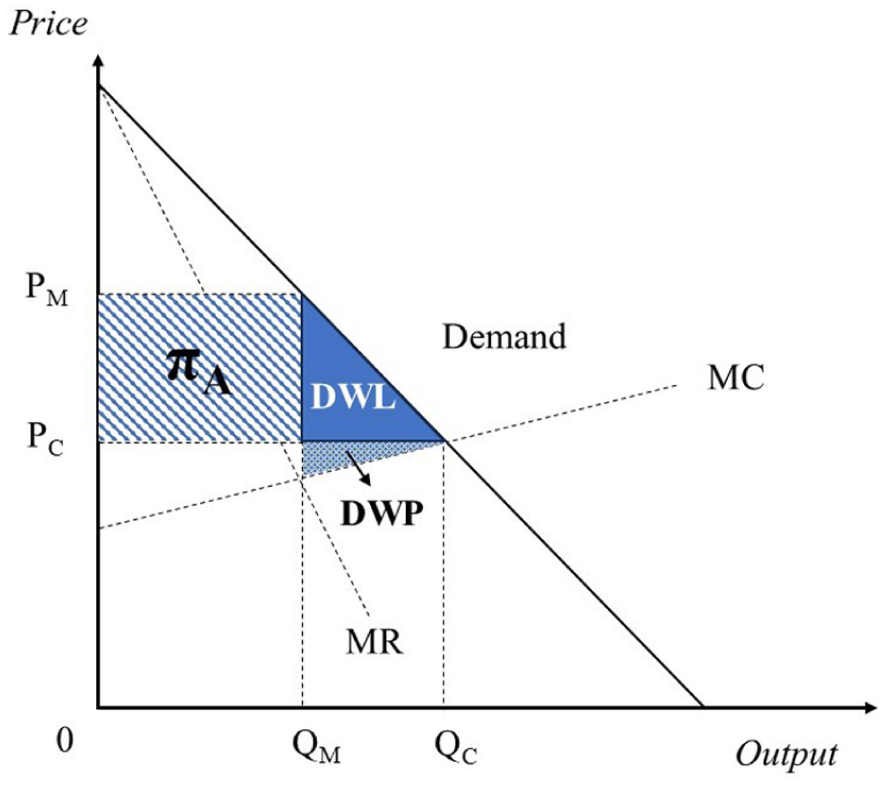
Social welfare impact of a “perfect” cartel.
However, the literature on optimal antitrust punishment dating back to Becker, 2 although his seminal paper was not about antitrust, does not advocate for a gain-based punishment, but for a “harm-based punishment.” Becker’s main contribution was to show that the implementation of legal rules changes the economic incentives for illegal practices. More generally, Becker showed that a crime should be deterred only when it is efficient to do so in order to implement enforcement in the most cost-effective way. The optimal level of deterrence is, therefore, achieved when only those conducts that cause harm to society are deterred. The idea was later adapted and applied to antitrust violations by Landes. 3 An antitrust punishment based on a Becker’s rule, therefore, requires setting the overall level of the optimal punishment (P*), at least, at the level of the social harm caused. Therefore, the so-called Becker’s rule forces the infringers to internalize the social costs of their actions in violation of antitrust rules on harmed third parties. This ensures ex-ante deterrence of all socially inefficient behaviors. In Figure 1, an optimal harm-based punishment would be set at P* > πA + DWL, where DWL is the Dead Weight Loss—that is, the welfare loss due to the increase in price and the corresponding lost consumption. In essence, this amounts to the consumer loss, resulting from the anticompetitive behavior. A harm-based punishment therefore tallies well with an antitrust approach based on a consumer standard and has the advantage of ensuring that firms, considering whether to infringe the law, fully internalize the harm they would cause to consumers. As both DWL and DWP ≥ 0, a harm-based punishment is more severe than a gain-based punishment. In this simplified world, a harm-based punishment would be strictly above and beyond what may be required to deter anticompetitive behavior.
It is useful to also consider a few variations of this simple framework. First, Figure 1 shows the harm from a “perfect” cartel. Both the cartellists and their competitors gain, while consumers lose (by more because of the DWL, unless DWP is particularly large). Consider, instead, an exclusionary abuse whereby one of the producers managed to monopolize the entire market by behaving anticompetitively. Take the simplest case—that is, an abuse of dominant position in a duopoly leading to exit of the rival and resulting in a monopoly with a constant marginal cost curve (Figure 2). Prior to the abuse, the dominant firm made profits of πDom = (Po – Pc)QDom, where Po is the oligopoly price, and its rival of πRiv = (Po – Pc)(QC – QDom). After a “successful” abuse, the dominant firm is able to charge the monopoly price and achieve monopoly profit. The dominant firm increases its profit by πA – DWPDom. In this case, a harm-based optimal punishment would be equal to P* = πA + DWL + πRiv. 4
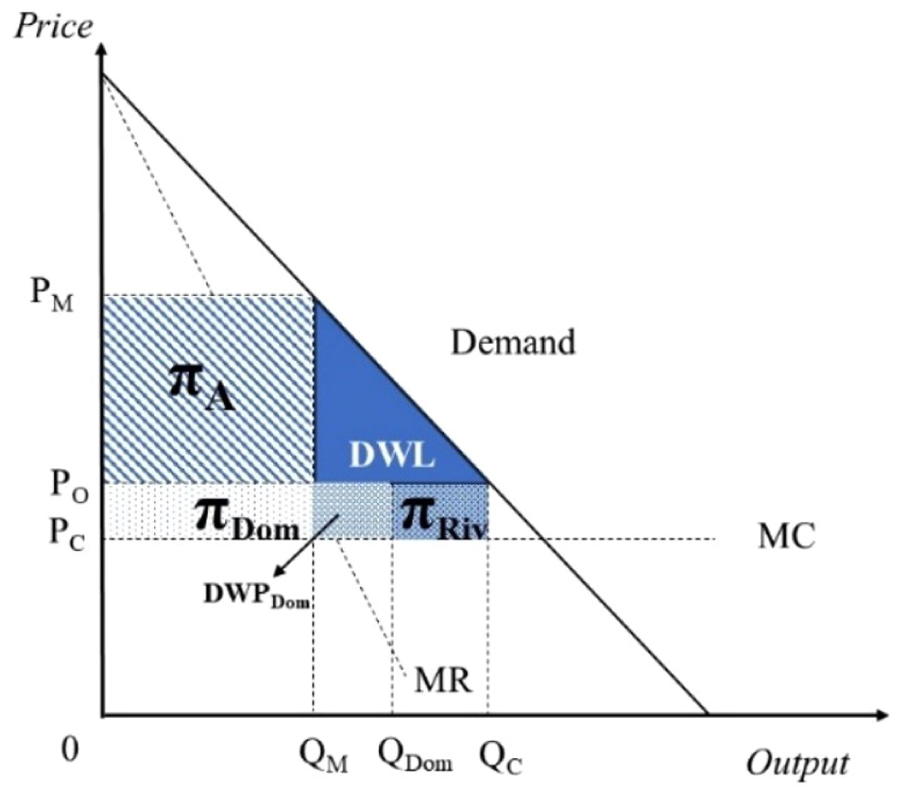
The gain and the harm from an abuse of dominant position.
Second, some argue that a cartel could lead to increased efficiency. 5 A possible example is when the cartel or the new monopolist emerging from a (successful) abuse of dominance may act as a monopsonist and obtain inputs at cheaper prices when bargaining with a monopolist input supplier. These lower input costs may be passed on, at least in part, to consumers in the form of lower prices. This is shown in Figure 3 as a lower marginal cost driven by the cartel formation, with a related welfare gain (Eff). 6 In this case, a harmed-based punishment, as defined earlier, would be unchanged in its definition, but the values for ΔπA and DWL would be correspondingly lower as prices may be lower.
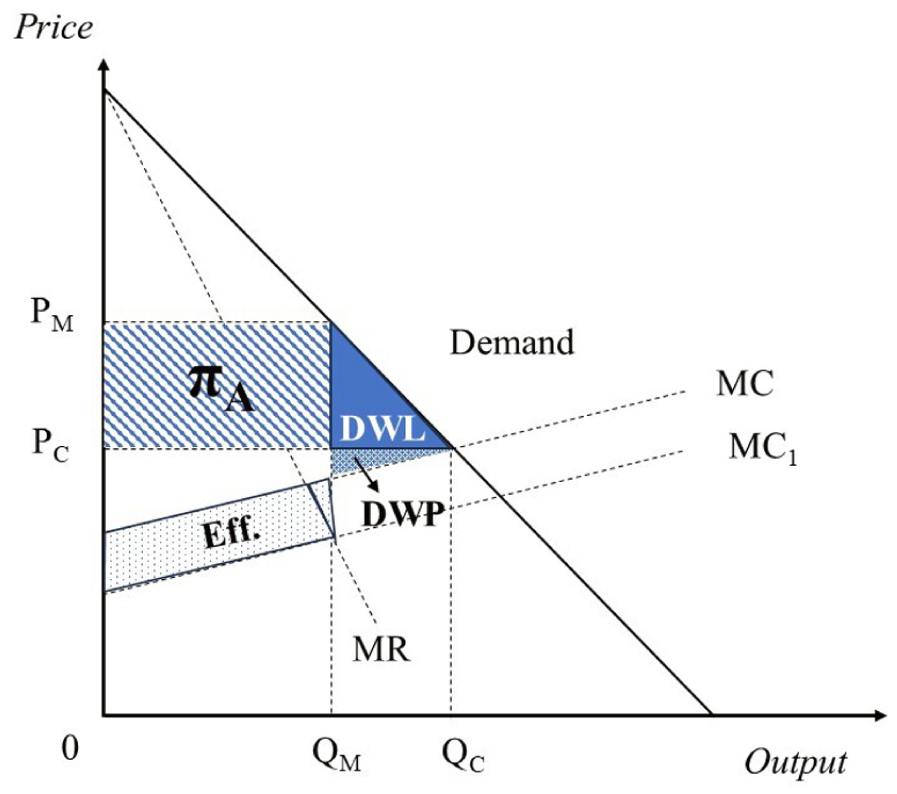
The social welfare impact of an abuse or cartel with cost-efficiencies.
Lasty, consider a total, rather than consumer, welfare approach, instead. As πA is a welfare transfer from consumers to producers, deterrence should only apply if there is a negative impact on total welfare—that is, by setting P* > DWL + DWP – Eff. As DWP and Eff are likely to be small in many circumstances and offsetting each other, a total welfare harm rule could often simplify to roughly P > DWL. While this could internalize the DWL, it provides insufficient deterrence in practice, as the punishment would be lower than the gain from behaving anticompetitively—that is, P = DWL < πA.
B. Adding Complexity and Realism
The simple world described earlier can be made more realistic by considering that:
Enforcement is a costly; and
The antitrust authorities operate with imperfect and asymmetric information and, as a result:
a. Not all violations are detected and punished; and b. Even when detected and punished, antitrust authorities can incur in errors.
1. Costly Enforcement
Enforcement is a costly activity—that is, these costs arise from an antitrust authority running investigations, defending appeals, and imposing sanctions and potential infringers incurring legal and consultancy costs and diverting managerial time away from running the business. In addition, the marginal cost of enforcement is likely to be increasing for several reasons. For example, the budget of the antitrust authority is constrained, and the best resources are likely to be prioritized to detect and punish the most harmful infringements. As an antitrust authority’s volume of investigations increases, the quality of the resources at its disposal is likely to decrease, increasing the probability of errors and the time required to complete an investigation. Beyond the allocated budget, additional resources are increasingly difficult to obtain and could be increasingly costly—for example, the use of short-term contracts. At the same time, the marginal benefit of the enforcement activity can be presumed to decline, as the investigations that lead to the largest consumer harm are more likely to be investigated first. 7 Therefore, enforcement should be undertaken up to the point when the marginal social cost equals the marginal social benefit. If one considers deterrence as a positive externality of actual enforcement, it may be optimal to enforce beyond that and include the deterrence effect as part of the social benefit of enforcement. Therefore, enforcement should only target behavior, which cause a harm to consumers that is larger or equal than the enforcement costs plus the externality value of deterrence. The latter includes both the prevented consumer harm and the resources saved by not having to enforce the law very frequently.
2. Probability of Detection and Punishment
If the probability of detection and punishment was equal to one (and the antitrust authorities did not incur any errors), the optimal level of deterrence would be achieved by setting the actual punishment at P* = P—that is, the optimal punishment under perfect detection. Every infringement could not be hidden and would be immediately detected. Therefore, potential infringers should not even try to behave anticompetitively. However, due to imperfect and asymmetric information, the overall probability of being detected and punished, Prob(P), is likely to be substantially below 1 (this is especially so for cartels, but less so for abuses of dominant position). The uncertainty relates not only to the probability of being detected and punished at all but also to the added uncertainty as to when this may occur. As an illustration, assume an antitrust authority that “sooner or later” always catches infringers. Hence, the sole uncertainty relates to when an infringer is caught. Under a “gain-based punishment,” assume a firm will be deterred from engaging in anticompetitive behavior at t0, if it expects to be worse off, if caught at t1, where π (>0) is the extra profit due to the anticompetitive behavior and P (<0) is the punishment if instead caught at t1, that is when: 8

Where the left-hand side of the expression is the expected benefit at t0 if not caught at t1 and the right-hand side is the expected net benefit at t0 if caught at t1
This can be further simplified to:

The expected punishment depends on the Prob(P) and would require that the optimal punishment is set at P* = Prob(P)P, where P is described in Section II.A above. Prob(P) is not exogenous but can be influenced by the efforts of both the antitrust authority and the potential infringer, as discussed in Section III.E.
If an antitrust authority was capacity-constrained, there is a risk that Prob(P) may be perceived as not very high at peak points—for example, during periods when the antitrust authority is running several, or few but resource-heavy, investigations. That is why it is important for an antitrust framework to have capacity to enforce via private litigation in the national courts. 9 This should ensure that Prob(P) does not reduce further at peak activity times. However, it should be considered that courts in their private enforcement of competition law cannot issue fines. This makes the overall level of P in such proceedings substantially lower.
3. Enforcement Errors, Costs, and Implication for Optimal Deterrence
The information available to antitrust authorities is imperfect—that is, it is not always correct—and asymmetric—that is, antitrust authorities know less than the companies they supervise. In addition, theories of harm from anticompetitive behavior evolve over time, and they may not be of easy determination. 10 Lastly, empirical analysis and results are also subject to interpretation. Consequently, antitrust authorities may incur in errors, even if very well resourced and under best endeavors. They may incorrectly punish a firm that behaves competitively (Type I error) or wrongly acquit a firm that behaved anticompetitively (Type II error). If a Type I error occurred, firms would know that even if they did not behave anticompetitively, they could still be wrongly sanctioned. Given that compliance with antitrust law does not guarantee avoiding punishment, a firm may be better off by infringing the law, in the first place. If a Type II error occurred, firms would know that they could infringe the law and most likely go unpunished. As a result, the actual and perceived Prob(P) is reduced, leading to lower expected punishment. Therefore, when an antitrust authority frequently incurs in errors, it may very well stimulate the very behavior it meant to deter. 11
If the probability of committing both Type I (ProbI) and II (ProbII) error were very high (at the extreme when 1 – ProbI – ProbII = 0), even a very high nominal punishment P would fail to deter anticompetitive behavior, enforcement would be toothless, and if costly, it should not be undertaken at all. More realistically, if the antitrust authority occasionally, but not too frequently, makes mistakes, the optimal nominal punishment P* should be set higher than the level set under certainty as making mistakes can be considered as reducing the probability of detection. The above rule should, therefore, be modified as P* = Prob(P)P(1 – ProbI – ProbII). Therefore, an antitrust agency can simply increase deterrence, and to do so, it would not need very high punishment, if invested in reducing the risk of error. As for Prob(P), neither ProbI nor ProbII are exogenous but can be reduced, though not fully eliminated, by the efforts of the antitrust authority or increased by the potential infringer, as discussed in Section III.E.
III. Punishment in Practice
While Section II broadly defined the expected punishment as Prob(P)P, the reality of antitrust enforcement is more complex, and both P and Prob(P) need to be further decomposed into a number of components. A first element of complexity reflects the fact that there is no single punishment, which instead consists of several components, such as fines (F), remedies (Rem), damage claims (D), and reputational damages (Rep). Second, each of these components is often initially set but can be subsequently confirmed, revised, or set aside. Third, following from this, the probabilities of each punishment element occurring and its severity depends on conditional probabilities, making the exact extent of punishment uncertain ex ante.
A. Elements of Punishment
In order to better understand the level of each element of punishment and its associated probabilities, Figure 4 breaks down the relevant time period into four distinct phases, which are relevant for the four punishment elements mentioned earlier. The first phase (t0 – t1) covers the period over which an infringement starting at t0 went undetected and unpunished until t1 (“infringement period”). In this period, the potential infringer benefits (B = πA – DWP in Figure 1) from behaving anticompetitively. The second phase (t1 – t2) is the “investigation period,” starting with either a dawn raid or the official opening of a case investigation, whichever comes first. This starts when the investigation becomes public information (t1) and lasts until the time the antitrust authority reaches a decision (t2). At t2, the antitrust authority may issue either an infringement or a noninfringement decision, accept commitments, or enter a settlement procedure. The third phase is the “appeal period” (t2 – t3) covering the time from t2 to the final appeal judgment (t3). The last phase considered (t2 – t4) covers the time of any damage claims. The “damages period” generally starts at the time when the antitrust authority issues a decision, or accepts commitments (t2), or any time afterwards and lasts till the conclusion of damages claim process (t4). The appeal period and the damages period could, therefore, partially overlap and run in parallel.
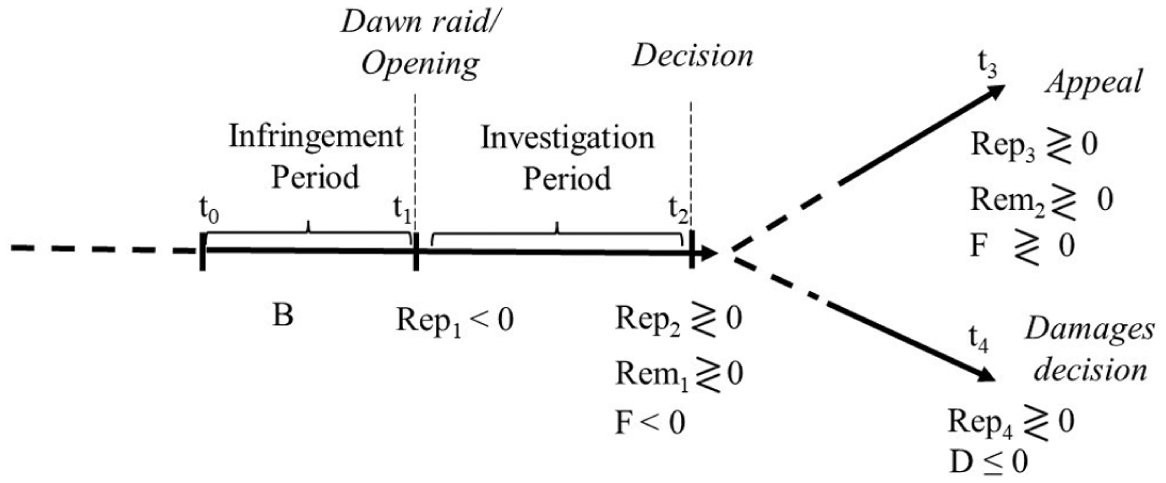
Timing and implication of all elements of antitrust punishment.
The terms F, D, Rep, and Rem cover the monetary value of all the potential elements of P that stem from the opening of an antitrust investigation that could lead to a conviction and potentially a claim for damages. Each element of the punishment has an expected monetary value that depends on the level of punishment, when it is imposed and potentially rectified through the process and the probabilities at each step. F and D are backward-looking as they remedy the harm up to the point an infringement is sanctioned. Rem instead is usually not discussed as a punishment for antitrust infringement. However, it is particularly important as it prevents future harm. Hence, on a forward-looking basis, the right choice of remedies (in case of an abuse of dominance infringement) is critical to prevent the continuation of harm. An optimal level of F and D may still fail to deter anticompetitive behavior, if Rem cannot fully address concerns about the continuation of anticompetitive behavior and its effects.
The settlement process for cartels or the acceptance of commitments in abuse of dominance cases can save resources and time by leading to an early resolution of the antitrust concern. However, the main disadvantage, which only applies to abuse of dominance cases, is that either a settlement or accepting commitments reduces deterrence. They do so for several reasons. First, the settlement procedure leads to a lower F as a reward for cooperation and no F for acceptance of commitments. 12 Second, both procedures do not end up in a decision by the antitrust authority. As a result, it is more difficult to claim for D, as claimants would have to prove both the antitrust infringement and the damages quantum (stand-alone damage claims). 13 Third, it is likely that, while Rep would be negative, it would be smaller, as a successful infringement would lead to several more opportunities for negative news about the infringer’s anticompetitive behavior. 14 Fourth, Rem could be thought as being unaffected by the choice of a settlement or commitment procedure. However, the remedies will be imposed on the basis of less information than at the end of an infringement decision. Hence, they are likely to be less effective.
1. Fine
A firm sanctioned by an antitrust authority for anticompetitive behavior will, in the largest majority of instances, face a F at t2, which will be due then but may be revised either upward, downward, or removed altogether following the conclusion of an appeal at t3. Fines in themselves have no impact on static welfare—they are just a transfer of resources—however, they are key in achieving deterrence.
The European Commission15,16,17 sets its fines by first calculating the Basic Amount (BA). The latter is calculated as a percentage of the last full year’s Value of Sales (VoS) of the potential infringer in the market affected by the cartel 18 multiplied by the duration of infringement, plus an additional amount called an “entry fee.” As set out in Veljanovski 19 :
S is the firm’s VoS of goods and services affected by the infringement in the relevant geographic area of the European Economic Area (EEA); 20
t is the number of years of the participation in the infringement; 21
S is a mandatory “entry fee”; and
a and b < 1, are, respectively, the gravity or the percentage of the VoS of up to 30% 22 with cartels at the higher end of the scale, 23 and b varies between 15% and 25% of the value of the last full year’s VoS, which is added “in order to deter undertakings from even entering into horizontal price-fixing, market-sharing and output-limitation arrangements.” 24
The Commission then calculates the Adjusted Basic Amount (ABA) by adding aggravating and subtracting mitigating circumstances, respectively. 25 Aggravating circumstances include recidivism (up to 100% increase per prior similar infringement), refusal to cooperate, and leadership including coercion and threats of retaliation. 26 The amount of the fine calculated as above cannot exceed 10% of total worldwide turnover in the preceding business year.
The 2006 Guidelines on Fine were drafted with a sellers’ cartel in mind, which increases the VoS by the amount of the (annual) overcharge. 27 The major innovation of the 2006 Guidelines on Fines was to calculate the fine as a percentage of the infringing firm’s annual sales in the relevant market. This linked the fine to a proxy for the “consumer harm” on the assumption that the harm caused by a cartel is positively correlated with a firm’s VoS. 28 In this, conceptually, F, as calculated in the EU, is more akin to gain-based rather than harm-based punishment. However, as noted by Katsoulacos et al., 29 for cartels, F may be underestimated, if the cartel was terminated by the time an investigation was opened, and this led to lower prices since. In addition, F calculated in this way neither includes the consumer loss in terms of DWL nor the competitors’ losses (πRiv).
2. Remedies
An antitrust authority may also impose remedial measures (Rem) at t2, which could be either confirmed, revised, either upward or downward, or removed altogether following the conclusion of an appeal (t3). 30 Their purpose is to prevent the continuation of this infringement in the future. If the remedy is effective, in monetary terms, this is equivalent to the lost future additional profits from the anticompetitive behavior. In essence, the Rem would make the infringer no better off by infringing competition law going forward, while F and D (Section III.A.3) have the same effect looking backwards. It is possible though that this effect may predate the imposition of the remedy, as the firms may stop any or most anticompetitive behavior when caught (i.e. the behavior may stop at t1 rather than at t2). This is often the case for cartels, which may no longer be functional or may break down after the first dawn raid. For abuses of dominant position, this is less clear-cut though, and the abuse may only be halted when a decision is issued. Remedies are a key component of P, as they are designed to stop future anticompetitive behavior.
The European Commission can set remedies ranging from “cease and desist” orders to behavioral and structural remedies, though the latter are rarely applied under Article 102. An interesting question is whether the remedies should aim at restoring the competitive situation (a) prior to the infringement, (b) that would have existed absent the infringement, or (c) simply restore the competitive process. As (b) would require the identification of a counterfactual and evidence that the competitive effects may have persisted, the European Commission 31 rarely relies on (b).
3. Damages Claims
In most cases, when an antitrust authority concludes that an infringement took place either in a decision or following acceptance of commitments, consumers and/or competitors could also sue the infringer for damages (D) at t2, with a possible court decision at t4 (follow-on damage claim). 32 The value of D could range between zero (i.e. the damage claim being rejected) and the highest possible damages that could be awarded. The monetary value of D is the present value of the harm suffered by consumers and/or rivals, as recognized by the court’s decision on the level of the harm. Like for F, the award of D also involves a transfer of resources, but, unlike for F, its impact on welfare may be dynamic in abuse of dominance cases—that is, resources are redirected to rivals (and not paid into the budget of the antitrust authority or state), which were negatively affected by anticompetitive behavior; hence, perhaps it is more efficient as it can contribute to restoring the degree of competition that existed prior to the infringement.
In the EU, the damages directive recognizes that consumers, firms, and public authorities have a right to be compensated for any loss of profit, plus interest accrued from time the harm occurred to when compensation is paid. 33 The key principle is that “full compensation shall place a person who has suffered harm in the position in which that person would have been had the infringement of competition law not been committed.” 34 Therefore, for damages, the standard seems to be the recreation of the competitive situation that existed prior to the infringement—that is, case (a) mentioned in Section III.A.2. The profit loss consists of the overcharge (πA) 35 and the loss of sales due to the increase in prices (DWL). 36 The inclusion of interest is particularly important as it often takes a long time to obtain damages compensation. 37
Damages are not meant to punish or deter infringers, as punitive and/or multiple damages greater than necessary to compensate those harmed are expressly excluded by the Damages Directive, which seeks to avoid overcompensation. 38
Conceptually D should capture the entire harm to third parties from the anticompetitive behavior, and hence, its value coincides with the harm-based punishment. In practice, harm is unlikely to be fully recovered in all cases given that those harmed, especially consumers (individuals or small businesses), are less likely to put forward claims. Furthermore, the risks and costs of litigation may be substantial, especially if claims span over different jurisdictions. Follow-on damages claims can be based on a finding of infringement, but not on the basis of a commitment decision. Furthermore, defendants in damages claims have generally access to more resources than claimants, which may tilt the outcome in their favor.
4. Reputational Damage
Being found to have infringed competition law may have a negative reputational damage (Rep) leading to lower sales and profits for the infringer. This may also affect the firm’s share value, therefore, also increasing its cost of capital. The initial reputational damage may start at t1, but it is very likely to be revised throughout the entire timeframe at t2, t3, and t4. For example, the impact at t1 is usually negative, but this could be revised upward or downward over time depending on the nature of the subsequently released information. However, the lowest possible Rep should be assumed to be zero—that is, a lengthy investigation may come to nothing and not cause any reputational damage. Rep is best thought as a reputational by-product of any antitrust investigation.
There are several studies that examined the impact of news about antitrust investigations on the share price of the firms involved. These may be interpreted as a proxy for Rep. Veljanovski refers to several event studies looking at cartel enforcement in Europe, which indicate that the reduction in the market capitalization of prosecuted firms far exceeds the Commission’s fines. 39 However, one need to be cautious about interpreting these studies given that following an infringement decision the share price does not only reflects the expectations in terms of Rep on future profitability, but also reflect the impact on profits of F, Rem (the lost future profit due to the anticompetitive behavior), and now more and more frequently, D. To the extent that the share price reaction to news reflects all these elements, interpreting the results of these studies as an indication of size of Rep would lead to double counting. However, if the share price reduction is beyond what can be explained by F, Rem, and D, this could be ascribed to Rep—for example, a reduction in sales due to the damaged reputation of the news of being found to be a cartel member. 40 A few studies, in particular, tried to disentangle the drivers of the share price reactions to antitrust news. Based on a sample of European cartels, Aguzzoni et al. 41 find that the Commission’s actions reduced firms’ market value by about 3%–4.5%, but the authors estimated that the Commission’s fines were responsible for no more than 8.9% of this loss in value. Instead, they conjecture that most of the loss in market value was due to the lost profits from the cessation of the firms’ anticompetitive behavior. Mariuzzo et al. 42 examined whether (negative) media exposure of anticompetitive behavior increases these reputational losses, in addition to those registered immediately around the announcement. When an antitrust authority discovers a cartel, this information is not automatically distributed to all related parties (especially not to atomistic consumers, who do not read the business press). Various information channels are in action to pass the news on the cartel conduct to the public, and because there would be no reputational impact without this information, Mariuzzo et al. posit that the reputational effect is directly related to the sentiment and the intensity of the information. They find that fines play a key role on a narrow window around the decision, while reputational sanctions reflect value losses on a longer time period, making the two effects complementary rather than substitutes. Therefore, Mariuzzo et al. suggest that antitrust authority should name and shame infringers to increase the severity of its punishment. 43
5. Other Punishments
In addition, in some jurisdictions, antitrust authorities can also impose sanctions on individual managers (UK) or even criminal sanctions (USA), which instead do not apply in the EU. These are not necessarily a cost or, at worst, a significant cost for the company. Lande and Davies compute total deterrence as the sum of both individual and corporate punishment. 44 However, this assumes that the firms care and, as a result, are willing to pay for individuals that take risks on the firm’s behalf and happen to be punished, which may not necessarily be the case.
C. Is the Punishment Sufficient to Deter Infringements?
Several authors attempted to provide an answer to this question. Veljanovski 45 summarized the early empirical research that, based on estimates of both the overcharge and the probability of prosecution and estimated Prob(P)P, the fines historically imposed by the European Commission were significantly below the optimal deterrence level. More recent research is much more cautious and more optimistic that the punishment, and specifically the F imposed by the European Commission may very often deter a good proportion of, though not all, cartels. Allain et al. 46 criticized the early work as static—that is, estimating the total deterrence F as the total incremental profit from cartel nπA, where n is the number of years of the cartel before detection, divided by the probability of detection—that is, nπA/Prob(Det). Instead, they relied on a dynamic game to set a much lower fine that achieves deterrence based on the fact that probability of detection increases with the years of activity of the cartel—that is, nπA/[1 – (1 – Prob(P))n]—which they approximate to πA/Prob(P). They call this deterrence fine, while they define a compensatory fine (which we refer to as P) as nπA and assume that any F above either level would achieve both deterrence and compensation. They rely on a number of assumptions to establish the level of deterrence and compensatory fines—that is, Prob(Det) = 15%, the but-for mark-up were assumed in the 5%–20% range, the cartel price increase (ΔπA) in the range 5%–30%, and demand elasticity estimates ranging from 0 to 2. They then compare these level ranges with the actual firm level F the European Commission’s decisions set for cartels over the period 2005–2012 (not those that may have been later adjusted, mostly downward, by the Courts). Their conclusion is that in 30%–80% (50%–90%) of cartel cases, the actual fines were above the deterrence (compensatory) benchmarks, though they observed a large variation—that is, some F were significantly above and some significantly below the benchmark. Katsoulacos and Ulph 47 also argue that the existing penalties are within the range established for optimal F.
This article takes a simpler and different angle, following the approach used in Section II. First, it starts with the simplest unrealistic world where infringements are detected and punished with certainty and asks whether the overall level of nominal punishment (P) in the EU could be sufficient to deter infringements. Differently from the existing literature—a possible exception being Heimler et al. 48 that considered both F and D—this article considers all possible elements of P, but Rep, and does not only focus on F. Second, it also examines whether the expected level of punishment—that is, taking into account the probabilities that each component of P can realistically take—may be sufficient to deter infringements. It does so by normalizing the value of the optimal P to 1 to assess whether all the combined elements of Prob(P)P, if estimated correctly, could be close to or above 1. Values above 1 would signal that conceptually Prob(P)P could offer sufficient deterrence. Different from some of the existing literature, this article does not venture into assessing whether the F actually imposed by the European Commission were at a sufficient level to deter infringements.
1. The Notional Level of Punishment
Under certainty—that is, assuming a Prob(P) = 1—the overall level of P, as calculated in the EU, should be sufficient to deter infringements. To see this, first assume that Rem removes all future πA. If cartels are stopped by the start of an investigation (t1), an appropriately set Rem removes all future profits from the infringement at the earliest possible moment. For abuses of dominant position, this is less clear, and it is possible that an ongoing infringement is only halted later on, when a decision is issued (t2). Then all that is required is for D to be set, at least, at the level of harmed-based punishment. With Prob(P) = 1, this would be sufficient to deter any infringement.
As explained in Section III.A.3, in the EU, claims for damages cover not only the consumer loss (both the overcharge πA and DWL) but also any profit losses by affected rivals (Figure 3). In addition, as D includes interest, the delay between when the damage is incurred and when compensation is awarded becomes irrelevant. 49 Therefore, under certainty, the level of D + F is already above the optimal fine (as the overcharge is counted twice), again assuming that Rem should have removed any future profits from anticompetitive behavior.
Therefore, the addition of F and Rep to D seems very likely to make the overall P sufficient. The EU Commission calculates F in a way that approaches the estimation of the overcharge (πA) by taking a percentage of the VoS related to last year before issuing the decision or an average of the years of infringement times the duration of the infringement. While F must be paid when the decision is published (t2), its amount could be revised (usually downward), and if it was revised upward, this should include interest on the additional amount which was not paid at t2. The evidence on Rep, summarized in Section III.A.4, suggests that this is likely to be different from zero and may be substantial and could play an important role. However, relying on Rep to deter infringements does not seem appropriate, as would reward infringers that have better lobbying and communications departments that could reduce the impact of Rep. In other words, this would reward a socially inefficient use of resources.
Overall, under certainty, the overall level of P in the EU seems more than sufficient to deter infringements. According to some, 50 over-deterrence could occur when F and D are set in an uncoordinated way, and together, they exceed the optimal punishment. As explained in the next section, overdeterrence seems unlikely in the EU, once the expected values of these punishments are considered—that is, Prob(P) < 1.
2. The Expected Level of Punishment
What matters for effective deterrence is the probability of punishment, as perceived by potential infringers. This section considers the probability of punishment on the assumption of perfect rationality, while Section III.C considers the possible implications of relinquishing the rationality assumption. While the literature discusses the probability of punishment as a single probability as Prob(P), in order to better understand the potential overall value it may take, its several components, illustrated in Figure 4, should be further broken down.
As not all infringements get caught, the first relevant probability is that of the anticompetitive behavior being detected, Prob(Det)—that is, when an initial investigation is opened. There are only two possible events—that is, the behavior is either detected or not. Being detected at the start of an infringement may provide a stronger deterrence than at the end of an infringement when the firm(s) have already benefited from the anticompetitive abuse. However, this is, in principle, already addressed by adjusting the value of F and D to reflect the duration of the infringement, which should, in principle, make a potential infringer indifferent as to when it is caught (if it is caught). Prob(Det) affects the conditional probabilities of each element of the punishment. However, Prob(Det) is inherently the most difficult probability to estimate, as it requires knowing the total number of anticompetitive infringements, which is obviously not known. Veljanovski 51 summarized the available evidence as indicating a rate of detection for cartels ranging between 13% and less than 20%. 52 However, it is not clear whether this refers to cases that have been opened or those for which the antitrust authority has reached an infringement decision. Furthermore, it seems more likely that the detection rate is lower for cartels than for abuses of dominant position, as the latter are more likely to trigger a complaint from an interested harmed rival and, hence, be more easily detected.
The other relevant probabilities are:
Prob(Inf)—the probability that an antitrust authority, after having opened an investigation, also issued an infringement decision or accepted effective commitments at t2. We assumed that the estimates of Prob(Det) mentioned above refer to the conditional probability Prob(Det)* Prob(Inf); 53
(1 – ProbI – ProbII)—the probability of an antitrust authority not committing a Type I or II error. This means that even if an antitrust authority managed to detect an anticompetitive behavior and to reach an infringement decision, it could still get its decision wrong. If an error is made, the antitrust authority achieves no deterrence as discussed in Section II.B.3. This excludes the risk of procedural errors leading to an annulment of a decision, which is considered and included under Prob(AppFOut) and Prob(AppRemOut), discussed below. ProbI and ProbII are very difficult to estimate other than relying on ex post assessments of past decisions. Relative old studies found that in roughly one-third of the U.K. cases 54 and one-quarter of German competition policy investigations, 55 the cases against potential infringers were eventually found to have had insufficient merit;
Prob(F)—the probability that an infringement decision also includes a F. It is realistic to assume that this probability is equal to 1; 56
Prob(Rem)—the probability that an effective remedy is imposed at t2. This is particularly relevant for abuses of dominant position and the only reason why a remedy may not be imposed is that the abuse may have already ceased. For cartels, it is reasonable to assume that the cartel breaks down with the start of the investigation. Therefore, like for Prob(F), this probability can be assumed to be equal to 1;
Prob(App)—the probability that an antitrust authority’s decision is appealed, at t2. The probability of an appeal of an Article 101 and 102 decision between 2000 and 2009 was 79% 57 and 57% 58 from 2010 to 2019 59 ;
Prob(AppFOut)—the probability that F is removed or substantially reduced following the outcome of an appeal at t3. The average F per cartel decision was 319.6 EUR million over the 2010–2019 period. On average, this was only very slightly reduced on appeal. 60 From January 2005 to February 2017, one in three of the 339 appeal judgments led to a reduction of the F. However, such reduction was very small—that is, on average, just over €3 million. This suggest that an appeal can be expected to reduce F by an average of about 0.3%. 61 These reductions are small, and “the odds of actually recouping very substantially more than the costs of an appeal by obtaining a fine reduction greater than that amount are rather low”; 62
Prob(AppRemOut)—the probability that a remedy imposed in an abuse of dominant position is confirmed (or not significantly watered down) following the outcome of an appeal at t3 can be assumed to be high;
Prob(D)—the probability that at t4 damages may be awarded. 63 At the end of 2020, in the thirty European countries surveyed by Laborde, 64 there have been 299 cartel damages actions: in 58, damages were awarded, 65 in 93, liability was established, 66 134 were dismissed, while 14 were still pending. Therefore, damages were awarded in 20% of cases, while damages and/or liability were established and/or awarded for a total of 52% of the cases. The values are likely to be much lower for abuses of dominant position;
Prob(FCD)—the probability that, at t4, the actual damages awarded fully compensate those harmed. According to Laborde, 67 the average rate of overcharge per cartel ranged from 1% to 34% with an average of 12% and a median of 10%. This is based on the fifty-eight cases when damages have been awarded between June 1998 and December 2020; and
Prob(Rep)—the probability that the investigation will result in Rep, 68 starting at t0 and revised at the key points identified throughout the entire timeframe.
Consideration of all the above probabilities provides a better understanding of the components that make up the expected values of each component of P. Three of these expected values—that is, E(F), E(Rem), and E(D)—depend on conditional probabilities, while E(Rep) is the sum of conditional probabilities of events taking place at different points in time. The expected values of each element of the punishment could be thought as follows:




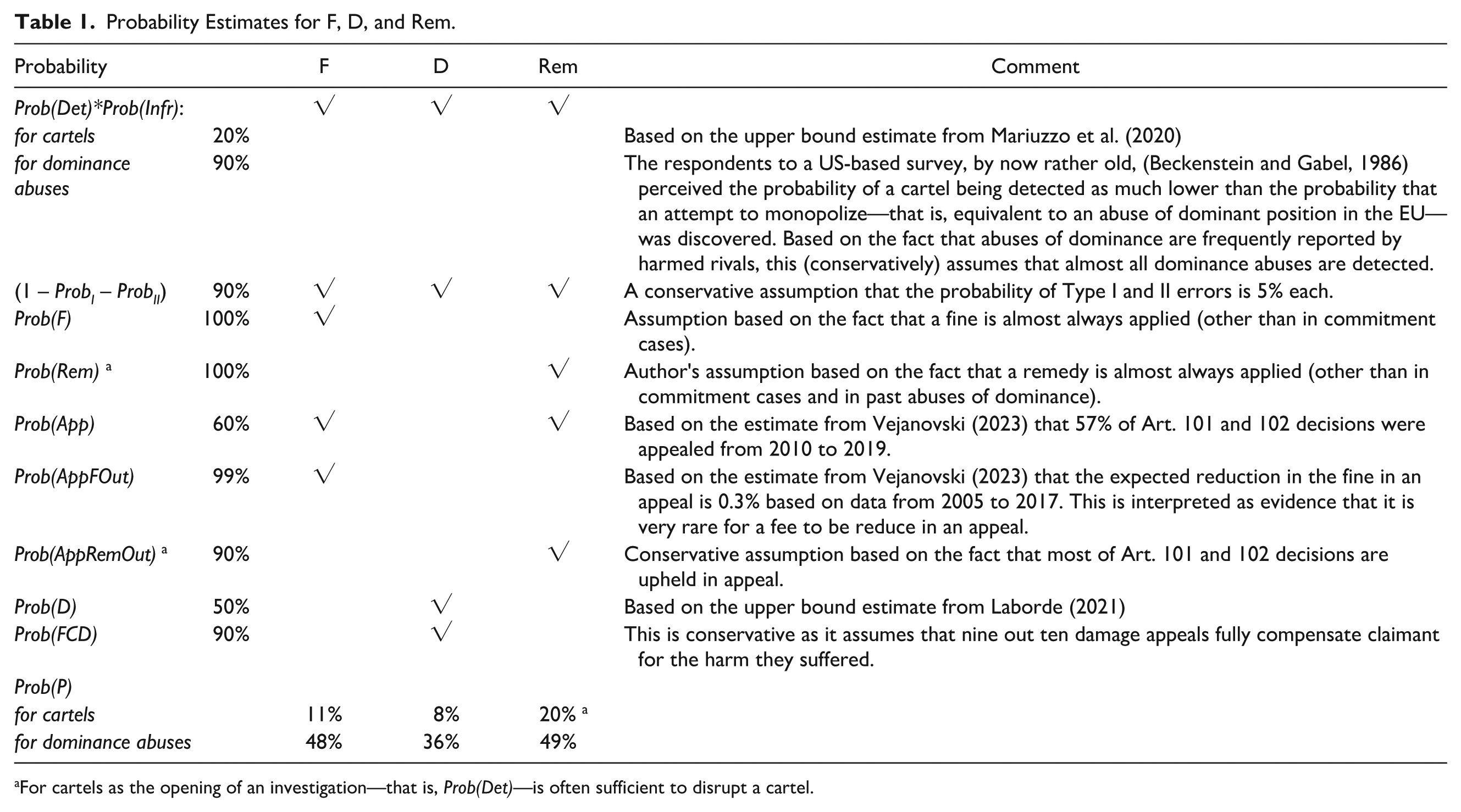
How can all this inform us about whether the overall expected punishment is at the optimal harmed-based punishment? Assume first that we are under the hypothetical certainty described in Section III.A. Assume that if D is correctly estimated, they cover the entire past harm (prior to t1). They would be equivalent to a “harm-based punishment” and sufficient to deter a potential infringer, as long as the anticompetitive behavior is halted—that is, Rem is effective in addressing the harm on forward-looking basis. Hence, D can be normalized to 1, a value equivalent to the optimally set deterrence level of P. Also assume that F in the EU covers about 75% of the past harm (prior to t1)—that is, it covers the overcharge (πA), but may not include the DWL. 69 This means that under certainty, F and D combined would be equal to about roughly 1.75, the optimal deterrence level when looking at past harm. However, what matters is not P, but Prob(P)(P). Table 1 puts together a set of reasonable, but conservative, assumptions as to the probabilities related to F, D, and Rem.
Probability Estimates for F, D, and Rem.
For cartels as the opening of an investigation—that is, Prob(Det)—is often sufficient to disrupt a cartel.
Table 1 shows that under reasonable and conservative assumptions, the conditional probabilities for E(F) and E(D) appear rather low, although slightly higher for dominance abuses, due to the higher Prob(Det) than for cartels. Table 1 also shows that E(Rem), the probability that a remedy that is effective at halting the future profit from anticompetitive behavior, is higher than E(F) and E(D), but in absolute terms, it still remains less than 1—that is, on average, remedies are expected to be imperfect.
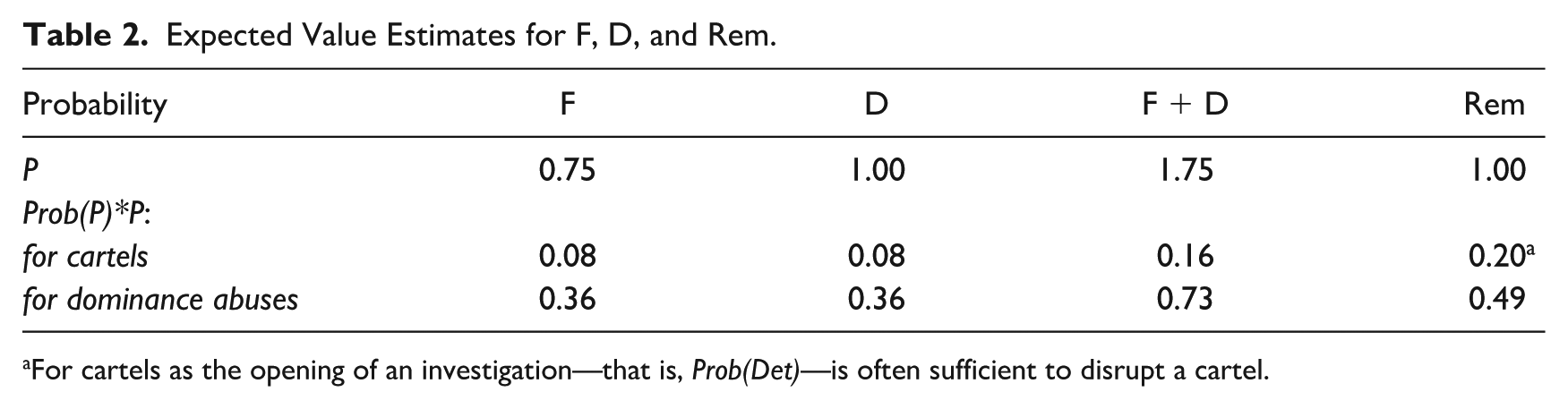
Table 2 compares the nominal and the expected values of F, D (removing the incentives to infringe antitrust rules up to the moment the behavior is detected), and Rem (removing the incentives to infringe antitrust rules on a forward-looking basis).
Expected Value Estimates for F, D, and Rem.
For cartels as the opening of an investigation—that is, Prob(Det)—is often sufficient to disrupt a cartel.
It shows that the expected combined value of F and D seems unlikely to be sufficient under a harm-based rule to deter infringement, especially for cartels, unless one can expect the Rep to be very significant. Katsoulacos and Ulph 70 argue that the literature assumes detection and punishment takes place as soon as anticompetitive behavior has ended. However, in practice, intervention could either cut an infringement before its natural end or come years after it had already terminated. Based on a sample of 32 Art. 102 decisions by the European Commission and national competition authorities, they estimate that the optimal F should be about 75% of the optimal F determined on the basis of a consumer welfare approach.
Even assuming that Rem could remove all incentives to behave anticompetitively after its imposition, the estimated conditional probabilities suggests that Prob(P) P would fall short of the value of 1 especially for cartels.
The much lower detection rate for cartels relative to abuse of dominance means that backward- (F + D) and forward-looking (Rem) deterrence is likely to be more effective for the latter. Increasing the actual or perceived (See Section III.C) detection rate for cartels, therefore, appears the single most important factor to deter cartel formation and survival.
C. Behavioral Biases
Allain et al. 71 consider behavioral biases as a possible explanation as to why, if P is at a sufficient level to deter anticompetitive behavior, infringements continue to be still widely observed and detected. The firms’ abidance to competition laws is not only driven by P and a “rational” expectation of Prob(P), but by the same probability, as perceived by the potential infringer. The fact that not only consumers but also firms and policy makers, such as antitrust authorities, may sometimes, often, or routinely not behave according to the principle of rationality is well known and accepted. 72 The implications of behavioral economics for whether the current level of punishment in the EU is sufficient to achieve deterrence are, however, not very clear-cut for several reasons. First, there are several behavioral biases, and each can suggest a possible different expected outcome. As such, it is not easy to understand a priori which one could prevail and provide clear policy recommendations. Second, the biases, if present, may change from case to case and over time, and as such, they may not provide a stable framework for intervention. Third, if one accepts that all actors, enforcers, firms, their rivals, and consumers can all be affected by behavioral biases, a policy approach may sound very difficult to shape. 73 Perhaps the best take-away from behavioral economics in terms of improving deterrence is for antitrust authorities to understand how they can best influence Prob(P)P.
Section III.B.2 appears to suggest that under a rationality framework, the expected punishment may well be insufficient to deter anticompetitive behavior. However, a (rational) antitrust authority could exploit biases of potential infringers and adopt policies or communications that can credibly increase the perceived probability of detection and punishment. It could also convince potential infringers that damage claims will be almost always put forward by harmed consumers and rivals, the awarded damages will be particularly high, and that the probability that an appeal against an infringement decision could lead to a large reduction in the fines and softening of the remedies is, correspondingly, very low. Exploiting potential biases of the firms’ managers may help to increase or decrease the perceived relative to the actual probabilities. These considerations are particularly relevant for cartels where Prob(Det) is particularly low, relative to that of abuses of dominant position.
A few examples may illustrate how antitrust authorities may exploit the fact that the firms’ managers could be influenced by subtle communication to comply with antitrust provisions even if, rationally, the expected punishment may be insufficient to elicit deterrence. The firms’ managers may give more importance to the latest information to assess the probability of detection or punishment. If this is the case, in periods of low activity and limited or low fines, an antitrust authority could publicize the average historical detection rates and punishment levels or perhaps publicize the upper bound of these. This could influence and increase the perceived expected probabilities of detection and level of punishment even in periods of low enforcement. The same concept applies when some sectors show low probabilities of detection and punishment relative to other sectors. Alternatively, it may help if an authority could impose a record fine from time to time, as this could be more effective than increasing the actual Prob(Det) and constantly sanctioning companies with small values of F. The language used in press releases related to infringements may also help, especially if drafted in a way that better conveys the risk of noncompliance, which can be picked up by the business press read by firms’ managers. The press releases could also illustrate how ineffective and futile any attempts to conceal infringement have been. If the conditions for leniency cannot be modified to occasionally increase the level of F, an authority could still increase the perception that detection could be high by publicizing ex officio cases that were picked up via cartel screening and other (i.e. whistleblowers and informants) programs. In addition, if reputational damage is significant, then communications based on a name and shame principle can be very effective, if picked up by the business and the general press. Lastly, the punishment for recidivism—that is, when a firm is a repeat offender—should be as severe as possible to signal when a firm is caught, it should learn the lesson and be strongly dissuaded from infringing the law a second time. In the absence of such punishments, the risk is that the firms’ managers may attribute the reason of being caught the first time to bad luck, and their experience of the level of punishment may induce them to try it again.
An interesting observation relates to recidivism. The European Commission has the means to severely punish repeat offenders. The 2006 EU Guidelines on Fines 74 state that “the basic amount will be increased by up to 100%” for each infringement whether by the European Commission (EC) or under national laws. The European Commission confines the definition of a repeat offender to a firm that initiated a new cartel after having been successfully prosecuted for its participation in a previous cartel. Veljanovski 75 reports that the European Commission has only once imposed a 100% increase in the fine for a repeat offense in the 2000–09 decade and found that, in the 2010–19 decade, the European Commission fined only seven (or 2.6%) of the 272 firms found to have been involved in a previous cartel. According to this source, in six cases, the fine was increased by 50%, and in one case, by 60%.
If recidivism in the EU is rare, this may suggest that, if the average F was increased by at least 50%, this may make the new level of F a sufficient deterrent. However, although this higher level of F may prevent recidivism, it may still be insufficient to deter first-time infringements. Based on Table 2, under the assumption of perfect rationality, an increase in F of 50%, 60%, or even 100% on paper would still be insufficient to deter infringements, especially for cartel. However, if the cartel was found through a leniency application, rather than ex officio, re-establishing the same cartel may become significantly more difficult, as the trust among former cartellists may have evaporated. This possible explanation would work under the rationality assumption. In addition, behavioral economics could also help understanding this result. Being caught a first time perhaps increases the perceived Prob(Det), as the perception of firms’ managers that have experienced being found infringing competition law may be altered. Their corresponding appetite for taking the risk again, even if recidivism would still be a rational profitable strategy, may have been sapped.
D. Principal Agent
It is well known that the interest of a firm’s shareholders (principal) and of its managers (agent) may not coincide. First, assume that the principal may want the agent to behave anticompetitively to increase its own returns. The agent would be particularly willing to do so, if it is not exposed to personal liability for its actions or better for obeying the (illegal) orders of his or her principal. The agent may also benefit through a higher salary or bonus from abiding by the principal’s orders. Currently in the EU, individuals face no liability, hence, resisting the principal’s requests to behave anticompetitively is disincentivized. Second, assume instead that it is the agent that would like to breach competition law. An agent whose salary is based, at least in part, on current or future performance may have such incentive. By doing so, the agent would increase the firms’ profitability and, as a result, its own remuneration. As for the downside, if the infringement gets detected, the agent may leave the firm, when this occurs, at no liability, and all future P would be borne by the principal. Such an agent may have a strong incentive to behave anticompetitively, as it can discount most of the effects of P on its future remuneration. The only way to avoid this moral hazard is to also impose some liability on the agent in addition to those on the principal.
E. Incentives of Potential Infringers to Affect Optimal Deterrence in Their Favor
The literature on antitrust deterrence is static, in the sense that it considers the relevant factors in setting the optimal level of deterrence, but it does not address the fact that both main parties in the deterrence game can act strategically to alter Prob(P).
An antitrust authority could put in place additional actions to increase deterrence. It can ask for more and/or better resources, for additional investigative powers, undertake more advocacy or subtle communication (Section III.C), and develop better investigative approaches or improve the internal and external procedures. Furthermore, it could provide additional information in its decisions that could reduce the barriers for claimants to estimate D—for example, by adding information on the competitive situation before and after the collusive period. Instead, increasing the nominal punishment—that is, F—may be seen as an unfair substitute to increasing the detection rate as only few convicted firms would bear the entire cost of deterrence. For illustration, suppose an F of EUR 100 would be sufficient to deter an anticompetitive behavior, but the detection rate is only 1%. This would mean that an (E)F sufficient to deter would require a nominal F of EUR 10,000. Hence, deterrence is achieved by fining very severely 1% of the potential infringers. There is substantial learning by doing in running antitrust cases through which staff gets better the more (similar) cases an authority runs. This is not a concern for frequent typologies of cases, such as cartels (and also mergers), most of which fall into well-known theories of harm, but it can be a concern for abuse of dominance cases, which are far fewer and more diverse. For a given P, all the actions mentioned earlier could increase Prob(P). An antitrust authority could also increase the overall nominal P. However, as discussed below, this has the downside that it is also likely to increase the incentives of infringers to delay the process once caught and thus reduce the value of P in real terms. Delay is particularly valuable in the case of Rem and F, but less so for D, which also include interest. In addition, to the extent that both the potential infringer and the antitrust authority fight on procedural issues, this can divert the scarce authority’s resources away from other investigations and general detection.
Conversely, the potential infringer could react and reduce the probability of being caught Prob(Det) and, if caught, the real terms level of punishment P it faces. Potential infringers can influence the outcome in their favor both ex ante (to a more limited extent) and ex post—that is, after detection.
Ex ante, if the potential infringer’s anticompetitive behavior affects third parties with a strong and concentrated interests, such as large competitors (unlike consumers with diffused/dispersed interest), their ability to influence Prob(Det) is limited. However, the potential infringer can still take actions ex ante to influence Prob(Det)—for example, being secretive on anticompetitive decisions and avoid leaving any written or digital traces. 76 This is an argument in favor of going after firms abusing their dominance, even in the absence of internal documents showing a strategy to exclude and focus more on the anticompetitive effects of such behavior. All these actions by potential infringers, if successful, generate a negative externality in that they reduce the expected punishment and, hence, deterrence in general. These considerations have important implications for the optimal P and deterrence.
However, the main focus of this section is on the potential infringer’s incentives ex post, once it has been caught by the antitrust authority. Ex post, the potential infringer retains the incentive to (a) minimize all the probabilities of being punished—that is, Prob(Infr), Prob(F), Prob(D), Prob(Rem), and Prob(App) and (b) reduce as much as possible the value of P in real terms, including delaying as long as possible the time of the punishment. The potential infringer can influence (a) and (b) by investing in the quality of its defense. As long as this is not misleading, it guarantees its rights of defense and should be helpful to establish the facts and their correct interpretation. However, the potential infringer could also raise vexatious procedural issues with the sole purpose of either reducing Prob(P) or reducing the value of P by delaying it as long as possible. Delay is valuable to the potential infringer, if there is a significant monetary value attached to it. Figure 5 illustrates the binary nature of setting the optimal P. If Prob(P) is taken as given, then the optimal punishment is, statically, defined as Prob(P)P*. If the antitrust authority sets P* too low, there would be no deterrence. Instead, if it is set at or above P*, deterrence is complete, or there may even be overdeterrence. However, if the potential infringer has the ability and incentive to tactically raise procedural issues to reduce Prob(P) and delay P, then the optimal deterrence punishment should be raised to Prob(P)P**, as illustrated in Figure 5; otherwise the original Prob(P)P* would become ineffective in deterring infringements.
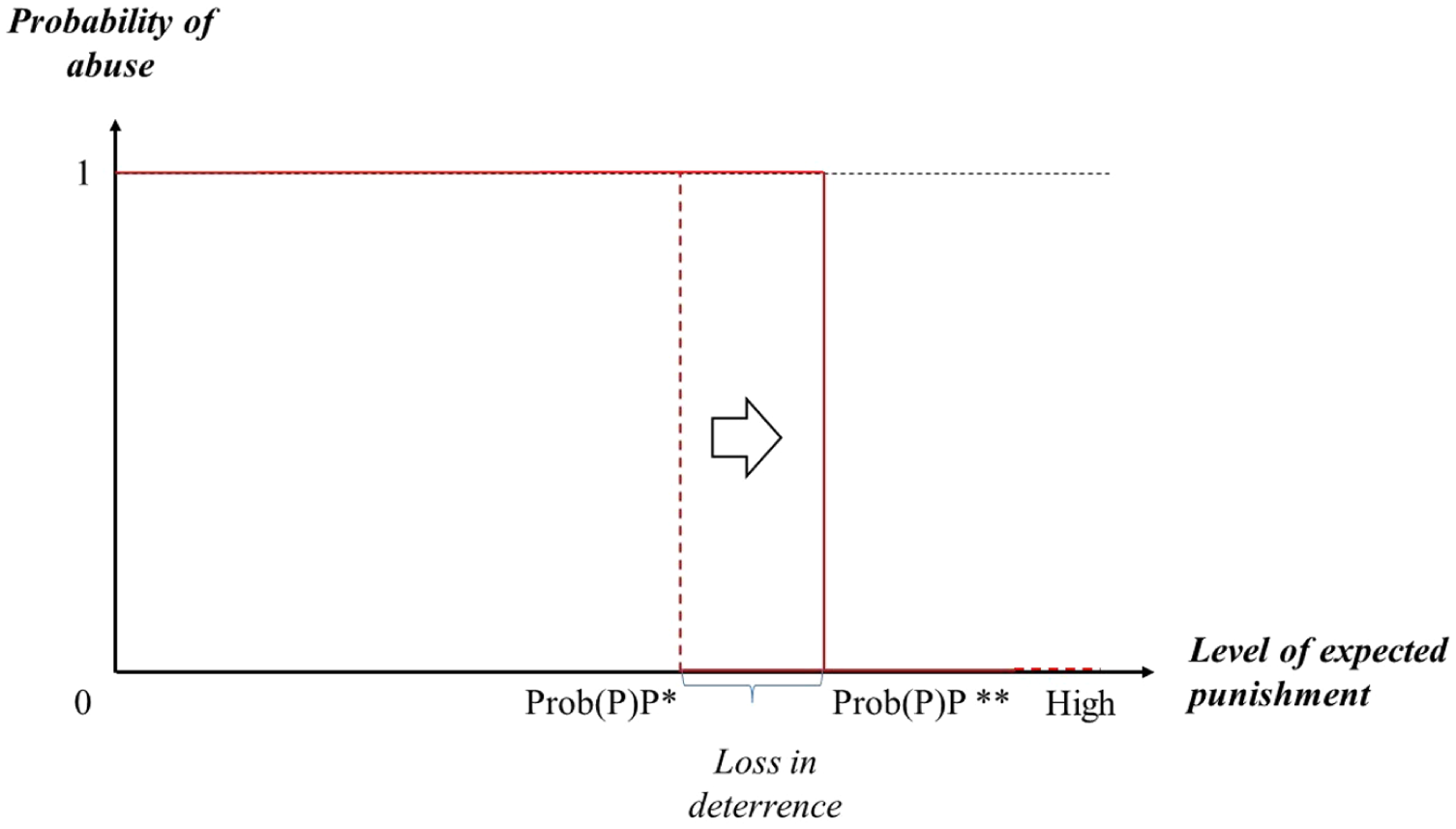
Effects of strategies to delay and reduce the probability of punishment.
A potential infringer could not only try to reduce Prob(P)P by acting on each element of P and its associated probabilities but also to achieve the same objective by delaying P, which is equivalent to reducing its value in real terms. Delaying F may reduce its value, only if it is affected in real terms. Given that, in the EU, F is set as percentage of the VoS of either the last year or the average of the years of infringement, this is not a given. Rem should put a halt to the future profits from infringement, especially for abuses of dominance, while for cartels, the infringement is most likely to stop at the time of the dawn raid. If, however, some anticompetitive practices are continued up to the time of the conclusion of an appeal or beyond, there is a value for the potential infringer in postponing Rem, as much as possible. Instead, delaying D may not matter, if the interest from the time when the harm was inflicted is included. However, this is not the case if the interest rate used is lower than the potential infringer’s Internal Rate of Return (IRR). The impact of delaying on Rep is the most difficult factor to assess. However, if consumers have a bias against taking into account older information, a delay may discount previously damaging information. In general, delaying tactics may also reduce the probative value of evidence or make it more difficult to obtain documents and, hence, reduce Prob(P).
In the light of the aforementioned considerations, why not make it more difficult for a potential infringer to delay the process? The problem is that it may not be straightforward ex ante to distinguish between legitimate procedural claims and those that are just purely vexatious tactics to lengthen proceedings. Ex post potentially at the end of an appeal or a damage claim case, a court could come to a view as how much procedural tactics were used to delay and punish any abuse accordingly. However, balancing off the right of defense and disincentivizing delaying tactics means that some of the latter may not be removable, even trying to reform the process to discourage this type of behavior. As Figure 5 shows, this means that the incentives of the potential infringers to reduce the punishment need to be taken into account in setting the overall level of P. This means setting a higher level of P overall than previously considered. How higher, though, also matters. This is because the potential infringer’s incentive to delay or decrease the value of P becomes stronger the higher the Prob(P)P is (Figure 6). Taking this into account the optimal value of P may be adjusted downward accordingly.
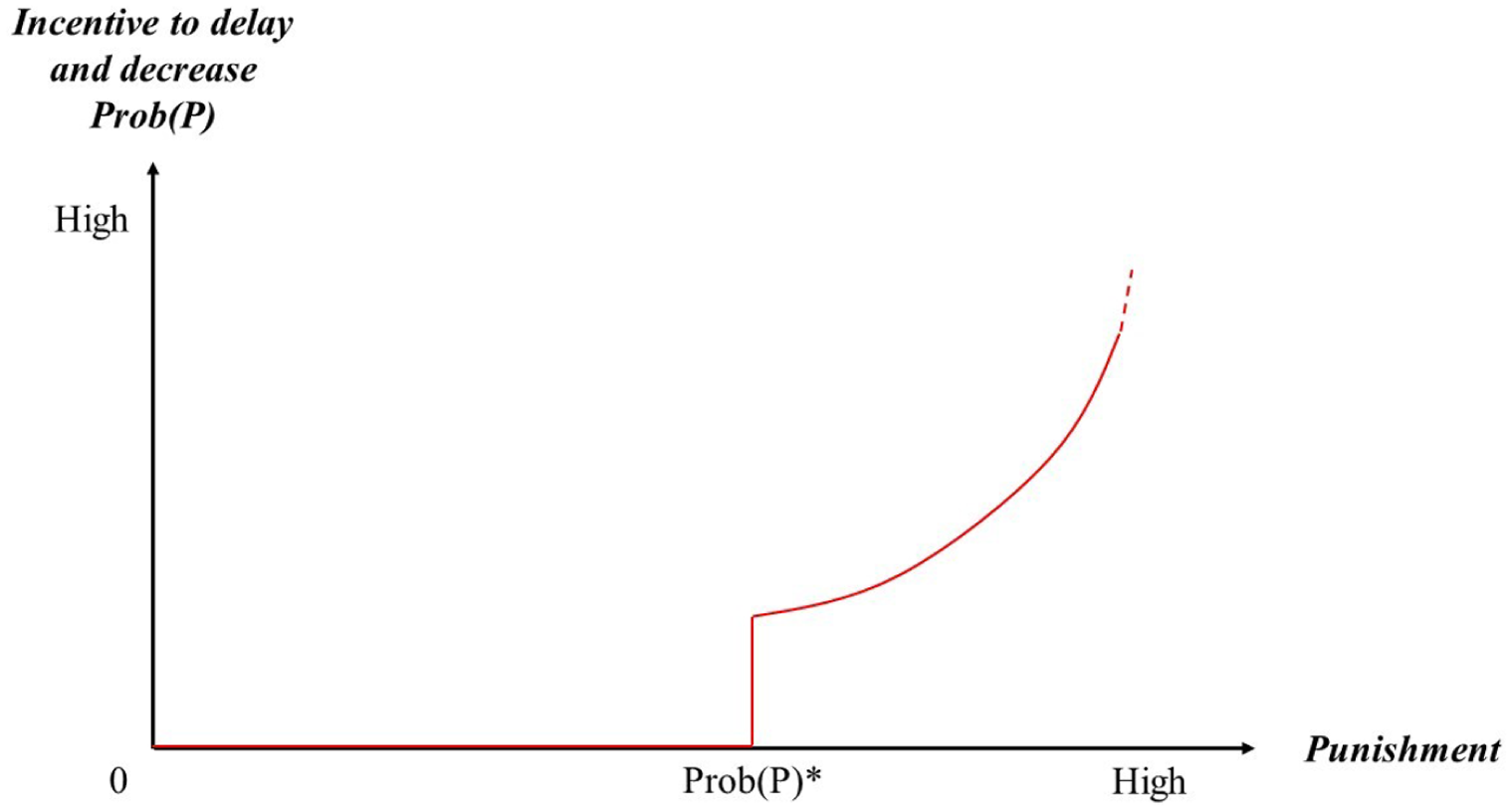
Level of the punishment and incentive to reduce the punishment.
IV. Conclusions
Deterring anticompetitive behavior is critical for the success of competition policy. However, it is well known that the effectiveness of deterrence depends on a number of factors, such as the level of the nominal punishment and the probabilities that a potential infringer is forced to bear the consequences of its actions. This is already a difficult exercise given that punishment may consist of several elements set in an uncoordinated fashion and revised at different times and according to different rules by different actors, that do not take into account the overall impact of all the relevant interventions. All these elements of punishment and their conditional probabilities of punishment will have an impact on deterrence.
In this article, we consider that, under the assumption of perfect rationality, the overall level of the expected punishment in the EU appears far from the theoretically optimal level. However, it is still possible that the overall level of P in the EU is sufficient for deterrence. However, increasing deterrence may not necessarily require increasing the current level of nominal fines or increase the detection efforts. The former may not be justifiable as too high a fine may raise concerns about proportionality, with very few infringers ending up bearing the entire cost of deterrence. At the same time, increasing the expected punishment would require a large increase in resources, which is difficult to obtain. However, there is a case for increasing the detection effort for cartel, which is estimated to be low relative to abuse of dominance. In this light, the current efforts to reinforce screening tools and adding them to existing leniency and other programs are a step in the right direction. In addition, an antitrust authority can rely on other tools to achieve the same aim. First, the firms’ perceived level of the expected P is what affects their decision whether or not to comply with competition law. In this respect, an antitrust authority may be able to better influence perceptions to increase deterrence, if it can act cunningly on the information it releases and on how it releases it. Second, the big unknown in the level of P is the reputational damage. This too can be increased, if the information can filter to and be absorbed by consumers and ultimately affecting their perception about the reputation of firms caught behaving anticompetitively. Third, an antitrust authority could provide additional information in its decisions that could reduce the barriers for claimants to estimate D, thus increasing its real and perceived value. Fourth, penalties on management may also help to create the right incentives to ensure compliance by managers and could be considered as an additional complementary lever. Fifth, it is also helpful to recognize that potential infringers may reduce the value of P, for instance, by employing vexatious delaying tactics, which may not be possible to fully remove or neutralize without affecting the firms’ rights of defense. In these instances, the potential infringer’s incentive to delay P increases with the level of P. Evidence pointing to substantial delaying tactics should be taken into account when setting the nominal level of P overall and perhaps taken into account as an aggravating factor in setting the level of F.
Footnotes
Acknowledgements
I am grateful to Andrea Amelio, Maria Jaspers, Lapo Filistrucchi, Geza Sapi, and Mateo Silos Ribas for very helpful suggestions and comments.
Authors Note
The views and opinions expressed in this paper are the sole responsibility of the author and do not necessarily reflect those of his past, current, or future employers.
Declaration of Conflicting Interests
The author declared no potential conflicts of interest with respect to the research, authorship, and/or publication of this article.
Funding
The author received no financial support for the research, authorship, and/or publication of this article.

1.
European Commission, Guidelines on the method of setting fines imposed pursuant to Article 23(2) of Regulation No 1/2003, OJ C210, 2006 (“2006 Guidelines on Fines”) (2006) at point 4.
2.
G. Becker, Crime and Punishment: An economic approach, 76(2)
3.
W. M. Landes, Optimal Sanctions for Antitrust, 50
4.
Note that some Chicago School proponents argue that the lost profits of rivals should not be treated as a welfare or social loss. W. H. Page, Optimal Antitrust Penalties and Competitors’ Injury, 88(7)
5.
Supra note 3.
6.
In the EU, Eff could, in theory, be considered as an efficiency gain when assessing the legality of the practice, but only as a possible objective justification for an abuse of dominant position. There is no equivalent for cartels which are per se infringements.
7.
This may not always be the case as antitrust authorities may be tempted to tackle first infringements that are easier to tackle—for example, those that are less complex and for which they have the most compelling evidence. Note though that these would have the highest probability of punishment, and hence, it may not necessarily be irrational or inefficient to do so.
8.
9.
In the EU, national antitrust authorities can also enforce EU and national competition laws, providing further enforcement capacity, although this is limited to cases that have a national dimension.
10.
The risk of error seems lower for cartel detection, which are a per se violation, once some factual evidence is assembled, compared to abuse of dominant position, or vertical agreements, which are, in most cases, not per se violations and often of more difficult interpretation. In the case of vertical agreements, some argue that, as a result, it may be optimal to opt for under-deterrence. P. Buccirossi et al., Deterrence in Competition Law, in
11.
M. Schinkel & J. Tuinstra, Imperfect Competition Law Enforcement, 24
12.
For cartels, the only difference between a normal prohibition and a settlement decision is the level of details or length of the decision and a (standard) 10% fine reduction.
13.
For cartels, a settlement-prohibition decision has the same standing as a normal prohibition decision—that is, damage claims are follow-on claims. The fact that the decision is less detailed (in the factual part) can in some cases lead to a higher burden for claimants. However, it can, in other cases, turn to their advantage, since the settling party has admitted the infringement (which in some national courts means that it is prevented from raising certain objections in the private litigation).
14.
For cartels, the European Commission’s communication (press and published decision) is the same for normal and cartel-settlement-prohibition decisions.
15.
Supra note 1.
16.
European Commission, Commission Notice on immunity from fines and reduction of fines in cartel cases, OJ (2006/C 298/11). This revised, without minor changes, the earlier 2002 Commission Notice on immunity from fines and reduction of fines in cartel cases, OJ (2002/C45/03) (2006).
17.
European Commission, Commission Notice on the conduct of settlement procedures in view of the adoption of decisions pursuant to Article 7 and Article 23 of Council Regulation (EC) No 1/2003 in cartel cases, OJ (2008/C107/01) (2008).
18.
In practice, an alternative often used is the average value of sales of the years of infringement.
19.
C. Veljanovski, The Effectiveness of European Antitrust Fines, in
20.
Supra note 1, point 13.
21.
Supra note 1, point 24.
22.
Supra note 1, point 21.
23.
Supra note 1, point 23.
24.
Supra note 1, point 25.
25.
Supra note 1, point 27.
26.
Supra note 1, point 28. The European Commission may then impose a further percentage uplift to promote specific deterrence (points 30 & 31). The Specific Deterrence Increase (SDI) may be imposed on firms with a “particularly large turnover beyond the sales of goods or services to which the infringement relates.” “The Commission will also take into account the need to increase the fine in order to exceed the amount of the gains improperly made” from the infringement (point 31).
27.
For cartels, the European Commission’s practice has often been to impose a further 10% on top of VoS in buyer cartels. C. Veljanovski, An Empirical Assessment of the European Commission’s Cartel Prosecutions, 2010–2019, 68(3)
28.
Supra note 19.
29.
Y. Katsoulacos & D. Ulph, Antitrust Penalties and the Implications of Empirical Evidence on Cartels Overcharges, 123(572)
30.
An antitrust authority could also impose “interim measures” to prevent harm to competition during and before the conclusion of an investigation, although these are not adopted very frequently.
31.
European Commission, Remedies and commitments in abuse cases – Contribution from the European Union, contribution under the OECD Session IV of the Global Forum on Competition to be held on 1–2 December 2022 (2022).
32.
In some instances, stand-alone damages could be claimed without waiting for an antitrust authority to issue a decision or just following a commitment decision. These would require both a finding of antitrust infringement and a damages estimation by the court. However, at the end of 2020, only 2% of 299 judgements were stand-alone damage claim. J. F. Laborde, Cartel Damages Actions in Europe: How Courts Have Assessed Cartel Overcharges, 3
33.
European Commission, Directive 2014/104/EU on certain rules governing actions for damages under national law for infringements of the competition law provisions of the Member States and of the European Union, 26 November (2014), point 12.
34.
Supra note 32, Art. 3.2.
35.
The degree of pass-on determines who is entitled to what proportion of the overcharge—that is, retailers versus final consumers or “indirect purchasers”—but not the overall level of the overcharge.
36.
“In situations where the passing-on resulted in reduced sales and thus harm in the form of a loss of profit, the right to claim compensation for such loss of profit should remain unaffected” (Point 39).
37.
Laborde (Supra note 32) found that in the 299 damages claim cases in the EU he examined, the infringement decision came on average 8.4 years after the date of purchase, and the first civil judgment was handed down 4.5 years later. The total duration from the time the harm potentially occurred to the first judgment is therefore 12.9 years on average.
38.
Supra note 32, Art. 12(3).
39.
Supra note 27.
40.
To the extent that the anticompetitive behaviour also harms rivals in addition to consumers, any reputational effect is unlikely to have a negative effect on the share price. In addition, an aggressive exclusionary behaviour could help to build an aggressive reputation for the firm and help to deter future entry. This may counter any negative reputation from antitrust convictions.
41.
L. Aguzzoni et al., The Effect of EU Antitrust Investigations and Fines on a Firm’s Valuation, 61(2)
42.
F. Mariuzzo et al., Fines and Reputational Sanctions: The Case of Cartels, 69(C)
43.
An earlier study of the penalties imposed on Dutch listed firms between 1998 and 2008 based on a simple approach estimates that fines drove only 12% of the total share losses, with 40% explained by lost cartel profits, and the remaining 48% due to reputational loss. S. van den Broek et al., The Reputational Penalties to Firms in Antitrust Investigations, 8(2)
44.
R. H. Land & J. P. Davis, Comparative Deterrence from Private Enforcement and Criminal Enforcement of the U.S. Antitrust Laws,
45.
Supra note 19.
46.
M. L. Allain et al., Are Cartel Fines Optimal? Theory and Evidence from the European Union, 42
47.
Supra note 29.
48.
A. Heimler & K. Mehta, Violations of Antitrust Provisions: The Optimal Level of Fines for Achieving Deterrence, 35(1)
49.
This is so, as long as the interest awarded is based on the cost of borrowing of the average consumers. Rivals could be sufficiently compensated on the basis of their cost of capital, which on average is likely to be higher than the base interest rate.
50.
Supra note 10.
51.
Supra note 19.
52.
For the upper bound estimate, see Mariuzzo et al., supra note 42.
53.
This is conservative in that, if it was not true, Prob(Det) * Prob(Inf) would be lower leading to a lower value of the expected punishment Prob(P)P.
54.
S. W. Davies et al., Monopoly in the UK: What Determines Whether the MMC Finds Against the Investigated Firm? 47
55.
M. Lauk, Econometric Analysis of the Decisions of the German Cartel Office, Working Paper, TU Darmstadt (2002).
56.
This is conservative, as commitment or settlement decisions would, however, not have F.
57.
F. Smuda et al., Determinants of the Duration of European Appellate Court Proceedings in Cartel Cases, 53(6)
58.
Supra note 56. This decline largely due to the increase in the number of settlement decisions, which are rarely appealed. See Veljanovski, Supra note 19.
59.
Supra note 27.
60.
Id.
61.
This assumes (conservatively) that in the remaining 255 appeals, F was neither reduced nor scrapped.
62.
D. Paeman & J. Blondeel, Appealing EU Cartel Decision before the European Courts: Winning (and Losing) Arguments, 18
63.
This implicitly assumes that the probability that an infringement decision is appealed is equal to 1. This is likely to be the case in intermediary products. However, this seems less likely for final products, where harmed consumers have dispersed and do not have very strong interest to bring damages claim. The role of class actions is particularly important in these cases.
64.
Supra note 32.
65.
Supra note 36. These appear to be geographically concentrated in a few countries (France 22, Spain 16, Germany 10, Denmark 3, Greece 2, Austria, Belgium, Finland, Italy, and the UK with 1 each).
66.
Of the total, 70 were in Germany.
67.
Supra note 36.
68.
If an infringement decision is issued, it is realistic to assume that the probability of at least some reputational damage is equal to one.
69.
This depends on whether the VoS includes quantities set at the time of the cartel or the dominant firm’s abuse or when the infringement had terminated.
70.
Supra note 29.
71.
Supra note 45.
72.
M. Armstrong & S. Huck, Behavioural Economics and Antitrust, in
73.
D. Moncuit, Relevance and Shortcomings of Behavioural Economics in Antitrust Deterrence, 11(5–6)
74.
Supra note 1.
75.
Supra note 27.
76.
R. M. Abrantes-Metz et al., The Increased Importance of Economics in Cartel Cases,