







Abstract
This paper examines an antitrust dispute in the mobile gaming sector: Epic Games’ “Project Liberty” challenge to app store restrictions and mandatory in-app payment systems for its game Fortnite. Claims were brought against both Google and Apple in two very similar cases that, despite their parallels, produced completely different outcomes in the U.S. courts. The paper further highlights the contrasting logic of the European Union’s Digital Markets Act (DMA), which establishes proactive obligations for gatekeepers to prevent harm before it occurs. The analysis demonstrates how similar cases may produce divergent results depending on the interaction between ecosystem architecture (closed vs. contractually restricted) and whether they are adjudicated by judges, juries, or proactive regulators. Building on these observations, it contributes to the antitrust debate by examining which model most effectively ensures fairness, fosters innovation, and protects consumer welfare in digital markets, considering the perspectives of developers, platform owners, and consumers.
Keywords
I. Introduction and Background
COMPETITION MAKES EVERYBODY BETTER. YOU HAVE A MONOPOLY THAT’S FORCED TO COMPETE, SUDDENLY THE MONOPOLY’S PRODUCTS GET MUCH BETTER. THE OFFERINGS TO CONSUMERS GET MUCH BETTER. (Tim Sweeney, 2025)
1
Mobile gaming has become one of the most profitable and dynamic segments of the digital economy, a trend within a mobile operating system market characterized by a duopoly: Google Android holds 73 percent of the market, and Apple iOS 25 percent, while other players remain insignificant. 2 Access to this sector is controlled through app stores that act as central gateways by managing distribution, enforcing mandatory in-app payment systems, and setting the contractual terms under which developers reach end users, thereby demonstrating the underlying mechanisms of two-sided market dynamics. 3 The $150.1 billion of mobile app and gaming revenues is split between $103.4 billion on iOS and $46.7 billion on Google Android, with gaming ($80.9 billion for Apple and $49.7 billion for Google) being the largest revenue driver for both stores. 4 Apple and Google retain 15 to 30 percent of these gross consumer expenditures as commission, with the remainder distributed to developers. 5
This concentration of market power has provoked resistance from developers. Tim Sweeney, the founder and major shareholder of Epic Games, which is the developer and publisher of Fortnite, complains about big companies like Apple that “they block software makers from doing business directly with the customers. [. . .] And there is absolutely no reason, that Apple should block from installing Apps from other developers directly if you want.” He adds that “Apple is adding a 30% junk fee to all commerce you do. And why do they selectively apply it to some things and not others?” 6
Such criticism underlines the argument that app stores function as bottlenecks—or, in competition law terminology, gatekeepers—in the digital economy, serving billions of users and millions of developers while effectively determining how software can be distributed and monetized, thus representing a typical example of a two-sided market.
The dual role of the stores—as both infrastructure providers (gateways through which developers must distribute their apps) and market participants competing with those same developers through their own apps and services—raises long-standing concerns about market power, lock-in effects (i.e., users’ dependence on one ecosystem like iOS or Android because of the high switching costs), and fairness. Courts in the United States have emphasized that, in two-sided platform markets, the relevant market must encompass both users and business partners, and that competitive harm must be demonstrated across the platform as a whole rather than for one side alone. This approach sets a high bar for plaintiffs, since evidence of harm to developers or merchants may be offset by claimed benefits to consumers, thereby complicating antitrust enforcement in digital markets.
Faced with these legal hurdles, Epic Games launched its strategic initiative “Project Liberty” in 2020. 7 By introducing a direct payment option in Fortnite, Epic decided to bypass Apple’s and Google’s in-app payment systems and their standard 30-percent commission, directly challenging what it regarded as exclusionary gatekeeper practices.
When asked why Epic took this step and larger firms did not, Tim Sweeney explained that Epic’s iOS market share on Fortnite was only around 7 percent, which gave the company more leeway to confront Apple when compared to firms like Spotify whose business models were far more dependent on the platform. 8 Despite this relatively small share, Fortnite players spent nearly $750 million on in-app purchases in Fortnite on iOS in two years. Nearly $500 million of these purchases were made by players who only ever made Fortnite purchases on iOS. 9 This illustrates both the economic significance of the market and the risks involved in challenging Apple’s policies in court.
The resulting lawsuits—Epic v. Apple and Epic v. Google—raised fundamental issues before the U.S. courts of market definition, monopoly power, and appropriate remedies in digital-platform markets. The outcomes, however, diverged sharply: in Epic v. Apple, the district court dismissed monopoly claims under the Sherman Act, relying on a controversial market definition and finding only a limited anti-steering violation under California law, whereas in Epic v. Google, a jury in 2023 concluded that restrictive contracts unlawfully preserved Google’s dominance in Android app distribution.
Academic debate has underscored the significance of these cases. Alderman and Blair argue that the court’s application of the two-sided market doctrine in Epic v. Apple resulted in an overly broad market definition that treated Apple’s App Store and Google Play as interchangeable, even though users cannot realistically switch between them without changing devices. They argue that “the District Court, however, undermined this economic reality
This unresolved issue has prompted scholars to search for alternative ways of conceptualizing market power in digital ecosystems. Steinbaum, for example, emphasizes that traditional approaches relying on market definition are unsuited to platform markets where services are provided free of charge to users and monetization occurs indirectly. He suggests instead that indicators such as residual demand elasticity, user stickiness, and the persistence of high profitability offer a more accurate measure of exclusionary power. 12 These criteria highlight the fact that platforms may operate as de facto monopolies even in the absence of a formally dominant market share.
Such critiques resonate with a broader transatlantic divergence. While the U.S. antitrust law continues to rely on ex post judicial enforcement and contested market definitions, the European Union (EU) has shifted toward a proactive regulatory model. The Digital Markets Act (DMA), in force since 2023, designates large platforms as gatekeepers and imposes uniform obligations to prevent harm before it occurs. These obligations include prohibitions on self-preferencing, requirements for interoperability, and obligations to allow third-party app stores and sideloading (installing apps outside the official App Store). Scholars interpret the DMA as a regulatory paradigm shift: a move beyond case-by-case antitrust enforcement toward systemic intervention in platform conduct. Deutscher further frames the DMA as an error-cost framework, meaning a framework that accepts some risk of over-enforcement in order to avoid under-enforcement and thereby ensures greater predictability and contestability in concentrated digital markets. 13
However, much of the existing literature treats Epic v. Apple and Epic v. Google as isolated disputes, while analyses of the DMA often remain abstract and detached from concrete case outcomes. This paper closes that gap by examining Apple, Google, and the DMA side by side, showing how the same underlying conflict is addressed by a judge, a jury, and a regulator. In doing so, it contributes to the broader debate on the strengths and weaknesses of ex post antitrust enforcement versus ex ante regulation in digital-platform markets.
This leads to the central research question: Why did the Epic Games lawsuits against Apple and Google, arising from the same dispute over app store restrictions, result in divergent legal outcomes, and what do these differences reveal about the strengths and limitations of the U.S. antitrust law compared to the EU’s proactive regulatory approach under the DMA?
To address this question, the paper proceeds in three steps. Section II presents the cases of Epic v. Apple and Epic v. Google, outlining the factual background, legal claims, and remedies in each instance, and contrasts them with the EU’s DMA, which establishes ex ante regulatory obligations for gatekeepers. Section III develops the comparative legal analysis and situates the cases within the broader academic debate, examining the strengths and weaknesses of judicial antitrust enforcement in the United States versus regulatory intervention in the EU. Section IV discusses the implications of these findings in detail, addressing the limits of market definition; the perspectives of developers, platforms, and consumers; Epic’s distribution strategy; and the role of the DMA, before concluding with transatlantic lessons, an overall conclusion, and an outlook for future platform governance.
II. Case Studies: Epic v. Apple, Epic v. Google, and the EU DMA
A. Epic Games v. Apple (U.S. Court Case, Decided by Judge)
“WE DON’T INTEND TO MAKE MONEY OFF THE APP STORE”; “WE ARE BASICALLY GIVING ALL THE MONEY TO DEVELOPERS HERE AND IF THAT 30% OF IT PLAYS FOR RUNNING THE STORE, WELL THAT WILL BE GREAT.” (Steve Jobs, 2008)
14
The Apple case is analytically significant because it shows the limits of traditional antitrust doctrine when applied to technically closed ecosystems. The court’s broad market definition effectively foreclosed Epic’s monopolization claim before the underlying conduct could be meaningfully assessed, illustrating how market definition—long treated as a preliminary question—can be outcome-determinative in digital-platform disputes. The following account traces how that outcome emerged and what it reveals about the limits of the U.S. antitrust law in this setting.
Before turning to the litigation itself, it is important to outline the background to the conflict. As early as June 30, 2020, Epic confronted Apple’s leadership with a direct request to open iOS to alternative payment solutions and to allow the distribution of a competing Epic Games Store (EGS). In an email to Tim Cook and other Apple executives, Tim Sweeney argued that Apple’s restrictive contracts prevented consumers from accessing cheaper digital products and developers from earning more revenue. Epic demanded two changes: (1) permission to use competing in-app payment systems without Apple’s commission, and (2) the ability to install and update apps via a competing EGS on iOS. Apple rejected these proposals, insisting on its existing App Store rules. 15
On August 13, 2020, Epic unilaterally activated a “hotfix” in Fortnite that introduced a direct payment option (“Epic Direct Payment”), bypassing Apple’s in-app purchase system and its 30-percent commission. On the same day, Apple removed Fortnite from the App Store for violating its guidelines. This immediate escalation triggered Epic’s lawsuit and the broader public campaign under the slogan #FreeFortnite. 16
In April 2021, Epic submitted its Proposed Findings of Fact and Conclusions of Law to the U.S. District Court for the Northern District of California. 17 Epic’s central contention was that Apple had unlawfully monopolized two distinct aftermarkets within the iOS ecosystem: once a consumer had purchased an iPhone, they were locked into Apple’s exclusive channels for app distribution—in which Apple held a 100-percent market share since making the App Store the sole route to iOS users in 2008 18 —and for in-app payments, governed by Apple’s proprietary IAP (In-App Purchase) system with its 30-percent commission. Epic framed the tying of these two aftermarkets as monopoly maintenance under Section 2 of the Sherman Act, arguing that it raised consumer prices, suppressed innovation, and foreclosed lower-cost third-party payment alternatives. 19
Epic also directly confronted Apple’s principal defense. Apple had justified its restrictions on security grounds, but Epic countered that Apple’s own macOS ecosystem permitted distribution from multiple stores without compromising security, and that iOS security was primarily a function of the hardware and operating system, not of App Store exclusivity. 20 Epic further pointed to the concrete harm caused by Fortnite’s removal from the App Store in August 2020, which it claimed had cost the company significant revenue and cut iOS users off from cross-platform play. 21
Apple’s response rested on three pillars. First, on market definition, Apple argued that competition had to be assessed broadly across the entire smartphone market, where iOS competes with Android, rather than narrowed to iOS-specific aftermarkets. 22 Second, Apple defended the App Store and IAP system as integrated elements of a curated ecosystem that provides security, privacy, and trust for consumers and developers alike, with the 30-percent commission reflecting investments in platform infrastructure rather than monopoly rents.23,24 Third, Apple characterized Epic’s “hotfix” as a deliberate breach of the Developer Program License Agreement (DPLA): regardless of the merits of Epic’s antitrust claims, bypassing the IAP system and withholding the 30-percent commission were contractual violations, not evidence of anti-competitive conduct. 25
In September 2021, Judge Yvonne Gonzalez Rogers issued her 185-page ruling in Epic Games v. Apple, producing a judgment that largely—but not entirely—favored Apple.
In her analysis, she drew on Ohio v. American Express Co., where the U.S. Supreme Court held that two-sided platforms must be assessed on both sides of the market simultaneously: higher fees imposed on one side (such as merchants) may finance benefits delivered to the other side (such as cardholder rewards), and plaintiffs must therefore demonstrate anti-competitive effects across the platform as a whole. Following this framework, the court defined the relevant market as “digital mobile gaming transactions” worldwide excluding China, requiring Epic to show that Apple’s commissions and restrictions harmed users as well as developers—a definition that proved decisive, as Apple’s roughly 55-percent share within this broader market was insufficient to establish monopoly power under Section 2 of the Sherman Act. 26
Nonetheless, the court did not exonerate Apple. Judge Gonzalez Rogers found that Apple enjoyed “considerable market share of over 55 percent” and “extraordinarily high profit margins,” with App Store operating margins exceeding 75 percent. The court stopped short of finding an antitrust violation, however, because high profits alone do not establish monopolization under U.S. law absent evidence of restricted output. The 30-percent commission was similarly held to be “supracompetitive” but not per se illegal. As a consequence, Epic’s federal antitrust claims failed, Apple prevailed on its counterclaim for breach of the DPLA, and Epic was ordered to pay damages amounting to more than $12 million. 27
The court nevertheless sided with Epic on one important point. Apple’s anti-steering provisions—the rules preventing developers from informing users about alternative, cheaper payment options outside the App Store—were struck down under California’s Unfair Competition Law (UCL). The UCL applies a broader, fairness-oriented standard that does not require a finding of monopoly power, allowing the court to condemn conduct whose harm to competition and consumers outweighed its justifications. Judge Gonzalez Rogers therefore issued a permanent nationwide injunction requiring Apple to permit developers to communicate alternative payment options to their users. Both parties appealed. In April 2023, the Ninth Circuit largely affirmed the ruling, making the judgment—and the anti-steering injunction—final. 28
This injunction prohibits Apple from banning developers:
i. from including, in their apps, buttons, links, or other calls to action directing users to alternative payment mechanisms; and
ii. from communicating with customers through contact information voluntarily provided within the app. 29
Although Apple was required to make only limited concessions, its litigation strategy was described by the court as a “whack-a-mole game, as the company continuously invents new contractual or technical obstacles once regulators or courts attempt to constrain its market power.” 30
A prominent example is Apple’s 27-percent commission on external transactions, introduced after the Epic v. Apple ruling. Judge Gonzalez Rogers strongly criticized this commission in the April 2025 contempt order, finding that Apple had “willfully chosen not to comply” with the original injunction and that the new commission undermined the very purpose of allowing alternative payment options. 31
More recently, credibility issues emerged when Apple’s Vice Chief Financial Officer Alex Roman lied under oath. 32 The underlying contempt proceedings, decided by Judge Gonzalez Rogers on April 30, 2025, revealed that Tim Cook had personally overruled his own analysts’ advice to comply with the injunction without a replacement commission; the 27-percent rate was chosen to preserve Apple’s revenue stream. On the basis of these findings, the court referred Apple and a senior executive to the U.S. Attorney for possible criminal contempt proceedings—an exceptional step in U.S. antitrust enforcement—and enjoined Apple from charging any commission on linked-out purchases. In December 2025, the Ninth Circuit largely affirmed the contempt finding. 33
Taken together, these episodes underscore the persistence of Apple’s gatekeeping behavior and the company’s limited willingness to comply with the spirit of judicial oversight. As one court document aptly concluded: “There is no second bite in the Apple.” 34 On May 21, 2025, nearly five years after Apple had removed it, Fortnite returned to the iOS App Store in the United States, marking a notable comeback made possible by court rulings that “prohibited” Apple from charging fees on external purchases. 35
B. Epic Games vs. Google (U.S. Court Case, Decided by a Jury)
The Google case illustrates the opposite dynamic. Where an ecosystem is nominally open but governed through contracts and financial incentives, concrete business conduct becomes legally visible, and traditional antitrust tools can reach it. The contrast with Apple demonstrates that outcomes in platform cases depend as much on ecosystem architecture as on legal doctrine—a point that also informs the later comparison with the DMA.
On August 13, 2020, in parallel with its lawsuit against Apple, Epic Games filed suit against Google, challenging the company’s conduct in the Android ecosystem. While Apple’s case focused on iOS—a technically closed system—Epic’s claims against Google targeted a nominally open but contractually restricted ecosystem, raising two related markets: Android app distribution and Android in-app payment processing. The complaint argued that, despite Google’s repeated assurances that Android would remain an “open” platform, the company had systematically closed the system through contractual and technical restraints. By requiring device manufacturers to pre-install and prominently display the Google Play Store, together with up to thirty other mandatory Google apps, and by conditioning access to key Google services on exclusivity commitments, Google was alleged to have entrenched its control over Android app distribution.
Epic further pointed to internal initiatives such as the “Premier Device Program” (an incentive scheme that rewarded OEMs–original equipment manufacturers–for giving the Play Store and Google apps preferential placement) and “Project Hug” as deliberate strategies to neutralize competitive threats, thereby cementing Google’s ability to charge supracompetitive commissions of up to 30 percent. Tim Sweeney explained: “Google went around to the top 30 publishers and paid out hundreds of millions of dollars to them in order to agree not to do exclusive deals with competitors.” 36
The complaint also challenged Google’s tying of the Play Store to its own in-app billing system, Google Play Billing, which developers had to use for all transactions involving digital content. According to Epic, this practice foreclosed operations by rival payment processors, inflated transaction costs, and forced developers and consumers into a closed ecosystem in which Google captured both monopoly rents and user data. Epic emphasized that it did not seek monetary damages but rather injunctive relief aimed at restoring competition in app distribution and payments. In this respect, Epic’s action against Google mirrored its parallel case against Apple, raising the broader question of whether antitrust law can effectively constrain dominant digital gatekeepers that leverage ecosystem control to suppress innovation and consumer choice. 37
Unlike the bench trial in Epic v. Apple, the case of Epic v. Google was decided by a jury in November/December 2023, after a fifteen-day trial with more than forty witnesses and hundreds of exhibits. In July 2024, Judge James Donato confirmed the jury’s verdict, which found that Epic had proved that there were two relevant markets—Android app distribution and Android in-app billing services—and that Google had intentionally maintained monopoly power in both through anti-competitive practices.
The jury also determined that Google unlawfully tied the Play Store to its billing system and entered into exclusionary agreements with developers and device manufacturers under programs such as “Project Hug” and RSA/MADA contracts (Revenue Share Agreements and Mobile Application Distribution Agreements that required preinstallation and preferential placement of Google apps, reinforced by revenue-sharing incentives), thereby restraining trade in violation of the Sherman Act and California law. 38
In October 2024, Judge Donato issued a permanent injunction against Google, effective from November 1, 2024, to November 1, 2027, imposing broad restrictions on its conduct in the Android ecosystem. During this three-year period, Google is prohibited from:
sharing Play Store revenue with device manufacturers, carriers, or other entities that distribute Android apps or consider launching their own app stores;
conditioning payments, revenue sharing, or access to Google services on an agreement that apps launch first or exclusively in the Play Store;
conditioning such benefits on developers refraining from releasing alternative versions of their apps on third-party app stores;
requiring OEMs or carriers to preinstall the Play Store in a specific location on devices;
prohibiting OEMs or carriers from preinstalling competing Android app stores;
requiring the use of Google Play Billing for in-app transactions, or setting prices based on whether it is used;
preventing developers from communicating with users about prices or alternative payment methods, or providing links to external purchase options; and
prohibiting developers from distributing apps outside the Play Store.
In addition, Google must:
allow third-party app stores on Android and permit their distribution through the Play Store;
provide these stores with access to the Play Store catalog on fair terms, subject to developer opt-out; and
implement only narrowly tailored security and content checks for third-party stores and apps, subject to review by an independent three-member technical committee.
The injunction applies across the United States.
39
As Judge Donato emphasized,
The provisions are designed to level the playing field for the entry and growth of rivals, without burdening Google excessively. As competition comes into play and the network effects that Google Play unfairly enjoys are abated, Google should not be unduly constrained as a competitor.
40
This outcome, in sharp contrast to the Apple case, marked a decisive victory for Epic and underscored the significance of jury trials in shaping antitrust enforcement in the digital-platform economy. Following a settlement between Epic and Google in November 2025, Fortnite returned to the U.S. Google Play Store on December 11, 2025, and became available worldwide on March 19, 2026. 41
C. Epic Games in Europe (Application of the DMA)
The DMA represents a regulatory response to precisely the gap that the Epic cases expose: it substitutes ex ante obligations for the litigation-dependent, market-definition-heavy analysis of the U.S. antitrust law. Unlike the preceding case studies, which analyze completed litigation, the DMA is examined here as an ongoing regulatory framework; the analytical focus therefore shifts from case outcomes to the structural choices embedded in the Regulation itself. This methodological asymmetry is deliberate and reflects the different legal natures of the three case studies.
1. The DMA Framework and Its Relevance for Epic
The DMA, adopted in 2022 and fully applicable since March 2024, establishes ex ante obligations for large online platforms designated as gatekeepers. Unlike traditional competition law, which assesses conduct retrospectively and requires case-by-case proof of market power, the DMA imposes pre-defined obligations on platforms that meet quantitative thresholds under Articles 3(1)-(2) DMA: EUR 7.5 billion EU turnover or EUR 75 billion market capitalization, at least 45 million monthly EU end users, and at least 10,000 yearly business users established in the EU, and provision of the same core platform service (CPS) in at least three Member States. Enforcement lies exclusively with the European Commission, which can impose fines of up to 10 percent of global turnover—rising to 20 percent for repeated infringements—or impose structural remedies in cases of systematic non-compliance, whereas in the United States, enforcement authorities such as the Department of Justice or Federal Trade Commission must always bring their cases before a court.
While the DMA is designed to complement Articles 101 and 102 TFEU—without replacing them—its core philosophy combines prevention with market opening: it imposes ex ante obligations to forestall harm before it occurs, while also making digital markets more contestable. It pursues this dual aim by replacing open-ended market dominance inquiries with a uniform rulebook that applies automatically once the gatekeeper status is established.
Unlike the traditional antitrust analysis, the DMA focuses not on market definition or market power but rather on the identification of anti-competitive strategies and harm.
The enforcement of Article 102 TFEU is often slow: complex, fact-intensive market assessments—especially in digital markets—typically take about three years from the opening of an investigation to the adoption of an infringement decision, by which time the underlying market may have already shifted. U.S. antitrust litigation often takes even longer: Epic’s lawsuit against Apple alone spanned more than five years from filing in August 2020 to final affirmance by the Ninth Circuit in December 2025. The DMA was designed precisely to address this temporal gap. It bypasses Article 102’s bottlenecks by substituting quantitative thresholds for market-power analysis and by enumerating specific obligations that apply automatically once gatekeeper status is established, without further effects-based assessments. Its scope is deliberately narrower, targeting platforms with durable market positions while leaving smaller players unregulated—a design meant to protect innovation by firms that cannot yet compete on equal terms with incumbent gatekeepers. 42 Contestability in this context means that smaller players have a fair chance to enter or challenge existing platforms, while competition describes the actual rivalry between firms already active in the market.
On September 5, 2023, the Commission designated six gatekeepers—Alphabet (Google), Amazon, Apple, ByteDance (TikTok), Meta, and Microsoft—and identified twenty-two CPS subject to DMA obligations. Booking was added in May 2024, bringing the total to seven gatekeepers. 43 Two of the initial designations are directly relevant here: Apple’s App Store and Google’s Google Play Store, both listed as CPS for intermediation between app developers and end users. Both correspond precisely to the platforms at issue in Epic v. Apple and Epic v. Google.
Four DMA obligations directly address the gatekeeper conduct that Epic challenged in its U.S. litigation:
Article 5(4) DMA prohibits anti-steering restrictions: gatekeepers must allow business users to communicate and promote alternative offers to end users free of charge and to conclude contracts with them outside the platform. This obligation maps onto the core of Apple’s UCL violation in the 2021 ruling.
Article 5(7) DMA prohibits the tying of ancillary services, including payment systems: gatekeepers may not require business users or end users to use the gatekeeper’s own payment services as a condition for access to the CPS. This obligation targets the IAP and Google Play Billing mandates that Epic attacked in both U.S. proceedings.
Article 6(4) DMA requires gatekeepers to allow the installation and effective use of third-party apps and app stores—so-called sideloading. This obligation corresponds directly to Epic’s original demand that it be permitted to distribute its own EGS on iOS, a demand rejected by the U.S. District Court in 2021. The practical consequences are already evident: in February 2025, the adult-content app “Hot Tub” was distributed through the third-party AltStore marketplace. Apple stressed that such content would never be allowed in its own App Store and warned of safety risks for EU users, while emphasizing that it was compelled by the European Commission to tolerate distribution through third-party marketplaces. 44 However, content of this kind has long been accessible on iOS through web browsers, suggesting that Apple’s safety concerns relate to distribution channels rather than to content access as such.
Article 6(12) DMA requires gatekeepers to apply fair, reasonable, and non-discriminatory (FRAND) conditions of access for business users. This obligation addresses the 30-percent commission and associated contractual terms that formed the backdrop of both Epic cases.
Taken together, these four provisions cover—as ex ante obligations—the very conduct that Epic had to challenge ex post through five years of litigation in the United States. The DMA thus offers a structural alternative to the U.S. model: rather than requiring plaintiffs to prove monopolization, market definition, and anti-competitive effects in each individual dispute, it imposes the relevant behavioral constraints directly on designated gatekeepers.
2. The Epic Case and the DMA in Practice on Android and iOS
Building on the framework set out in Section II.C.1, Apple and Google must now comply with the DMA’s ex ante obligations—in particular, regarding third-party app stores and alternative payment systems. These requirements strike at the very practices at issue in the Epic litigation, but now as proactive regulatory duties rather than remedies imposed ex post.
Epic Games has moved swiftly to capitalize on this new regulatory environment in Europe. In 2024, the company launched a mobile version of the EGS featuring Fortnite and other titles, a rollout enabled entirely by the DMA’s sideloading mandate. 45 On Android, which had always technically allowed outside apps, Epic expanded its direct distribution: users worldwide (including in the EU) can install the EGS app from Epic’s website and download games like Fortnite without Google’s approval. More strikingly, for the first time, iPhone users in the EU can also install Epic’s store and games outside of Apple’s App Store, but in both operating systems, a lot of clicks are needed, and “scare screens” are included. 46
Epic’s flagship Fortnite—still barred from the official iOS App Store and Google Play Store as of late 2025—has thus reappeared on European mobile devices via these alternative channels (“sideloading”). Fortnite’s return to mobile availability in Europe is a direct consequence of the DMA’s opening of platform access. Epic no longer needs Apple’s or Google’s permission (or their payment system) to reach users; EU law guarantees that baseline of contestability in the mobile ecosystem.
Apple’s initial reaction to Epic’s DMA-enabled re-entry demonstrated the tension between the new regulatory regime and the incumbents’ instincts. In February 2024, Epic secured a new iOS developer account (under its Swedish subsidiary) specifically to bring Fortnite and the EGS app back to iPhones in Europe, but on March 7, 2024—the day the DMA’s obligations took effect—Apple abruptly terminated that account, citing Epic’s past violations of App Store policies. 47 This move provoked immediate scrutiny from Brussels. European Commission officials queried Apple’s compliance, and the next day, the EU’s Internal Market Commissioner publicly warned Apple to comply with the DMA requirements. Confronted with the prospect of enforcement action, Apple reversed course and reinstated Epic’s account within forty-eight hours.
This episode highlighted how the DMA’s ex ante framework empowers regulators to prevent exclusionary conduct: Apple could no longer unilaterally shut out a would-be competitor’s store without risking swift penalties. Indeed, Epic pointed to Apple’s about-face as a “strong signal” that the Commission will act decisively to require gatekeepers to obey the law. 48 In terminating—and then restoring—Epic’s access, Apple effectively conceded that the rules of the game in Europe have changed: competition for app distribution must be tolerated as a legal obligation.
Freed from the gatekeepers’ absolute control in the EU, Epic’s distribution strategy now exemplifies the contestability the DMA was designed to foster. Epic can disseminate its store and monetize its games on iOS and Android in Europe without paying the 30-percent “tax” or obeying the restrictive terms that sparked the original lawsuits. This regulatory avenue stands in stark contrast to Epic’s experience in the United States, where achieving similar outcomes has been a slow, case-by-case struggle. Only in mid-2025 did a U.S. court come close to replicating the DMA’s result, when the Ninth Circuit—on appeal in Epic v. Google (discussed in Section II.B)—upheld the injunction requiring Google to allow third-party app stores within the Play Store and to open its app catalog to competitors. 49 In the wake of that July 31, 2025, decision, Epic’s CEO Tim Sweeney proclaimed that the EGS would finally be coming to Google’s own Play Store in the United States. 50 However, critically, this American development came after five years of litigation and appeals—and it has no direct legal effect in the EU, where Google was already subject to the DMA’s broader mandates. On iOS, by contrast, U.S. courts have forced only incremental changes (such as allowing outbound payment links in apps), whereas EU law obliges Apple to permit entirely separate app stores.
The transatlantic gap is thus clear. Europe’s DMA embodies a preventive, structural approach: it imposed interoperability and openness on mobile gatekeepers before Epic ever won a case, enabling competition to take root by regulatory design. In the United States, by contrast, Epic had to rely on ex post antitrust litigation to open up the platforms—a slower and less-certain path, yielding partial remedies years after the fact. Epic’s entry into third-party distribution in Europe, made possible by the DMA, underscores the strengths of the EU’s proactive regime in ensuring platform contestability, even as the saga of Epic v. Apple/Google continues to illustrate the limitations of piecemeal enforcement in more hesitant jurisdictions.
At the same time, gatekeepers such as Apple have criticized the obligations in the DMA, arguing that sideloading increases security risks in app downloads and payment systems, may expose users to inappropriate content such as pornographic apps, and ultimately provides fewer choices and a less intuitive customer experience. 51
Moreover, developers still do not enjoy complete freedom—an issue that will be explored further in Section IV.B.1.
III. Legal Analysis and Academic Framing of the Epic Cases and the DMA
A. Comparative Analysis
The case of Epic is special in many ways. It can be examined from three different perspectives—that of a court judgment, that of a jury verdict (both in the United States), and that of ex ante regulation in Europe. At the same time, the underlying ecosystems differ structurally—Apple’s iOS is fully closed, whereas Google’s Android is nominally open but contractually restricted—which co-determines which legal arguments prove decisive. “Together, these factors highlight why the same underlying dispute led to divergent outcomes—and what they reveal about the U.S. antitrust law compared to the DMA.”
Table 1 gives an overview of the different ecosystems, legal bases, philosophies, market definitions, outcomes, and availabilities of Fortnite. The comparison shows that, while Apple’s closed iOS ecosystem led to a narrow market definition with no monopoly finding, Google’s Android system was found to hold monopoly power, resulting in broad remedies obliging Google to open its platform for three years. In contrast, the European DMA establishes ex ante obligations for designated gatekeepers like Apple and Google, ensuring interoperability, user communication, and open competition as a legal requirement.
Comparison of Epic v. Apple, Epic v. Google, and the DMA.
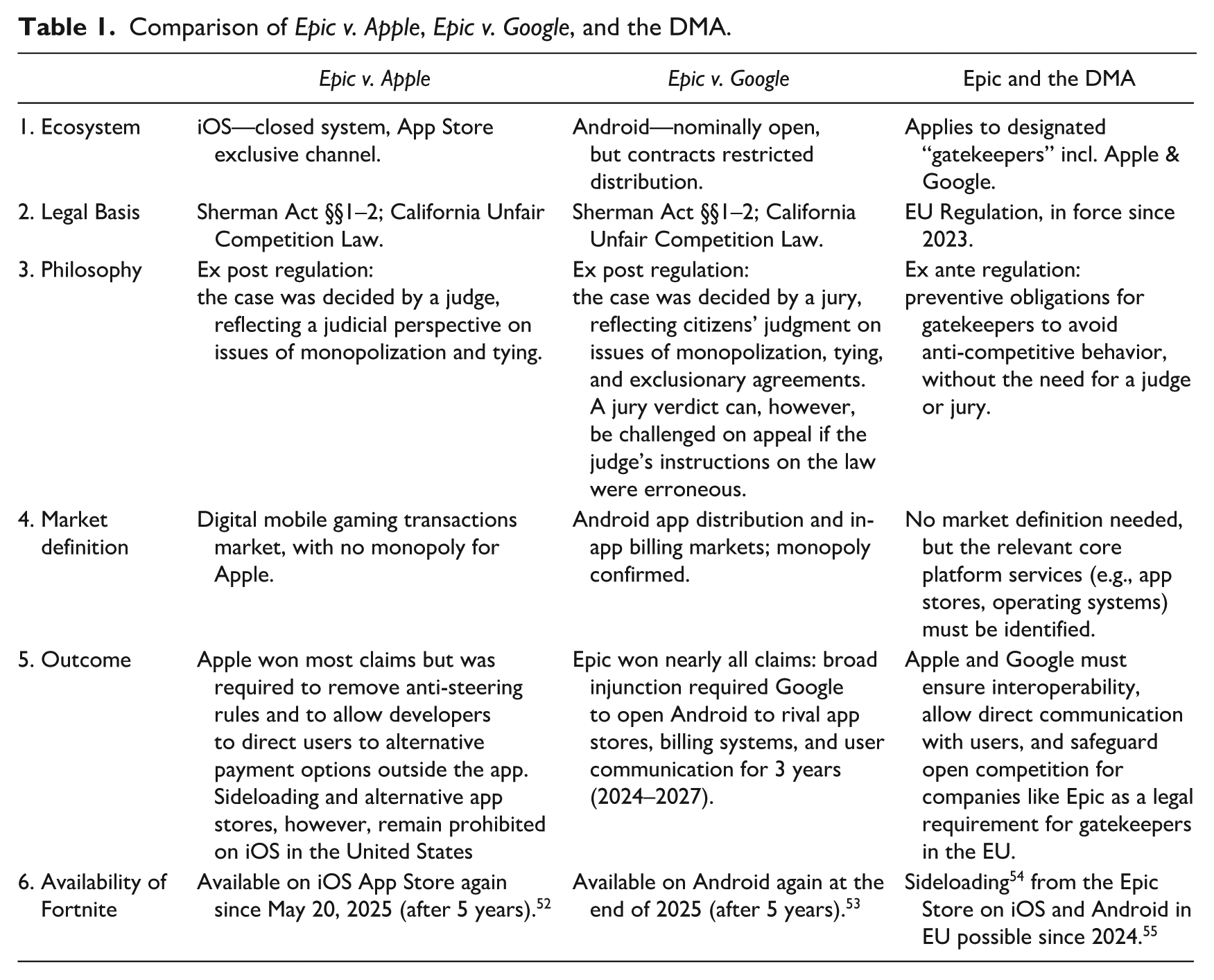
Finally, Fortnite’s availability illustrates the impact of these regulatory approaches, being reintroduced to the iOS App Store in May 2025 in the United States and to the Android system probably at the end of 2025 56 after five years, while remaining accessible via sideloading on Android and iOS in Europe.
Table 2 compares the U.S. ex post antitrust approach under the Sherman Act with the EU’s ex ante regime established by the DMA. The U.S. system relies on case-by-case litigation after alleged harm occurs, with courts or juries interpreting the law. Outcomes are often uncertain, remedies are tailored and narrow, and the business model of platforms largely remains intact unless a court orders changes to be made.
Comparison of U.S. Antitrust Enforcement (Ex Post) and the EU Digital Markets Act (Ex Ante).
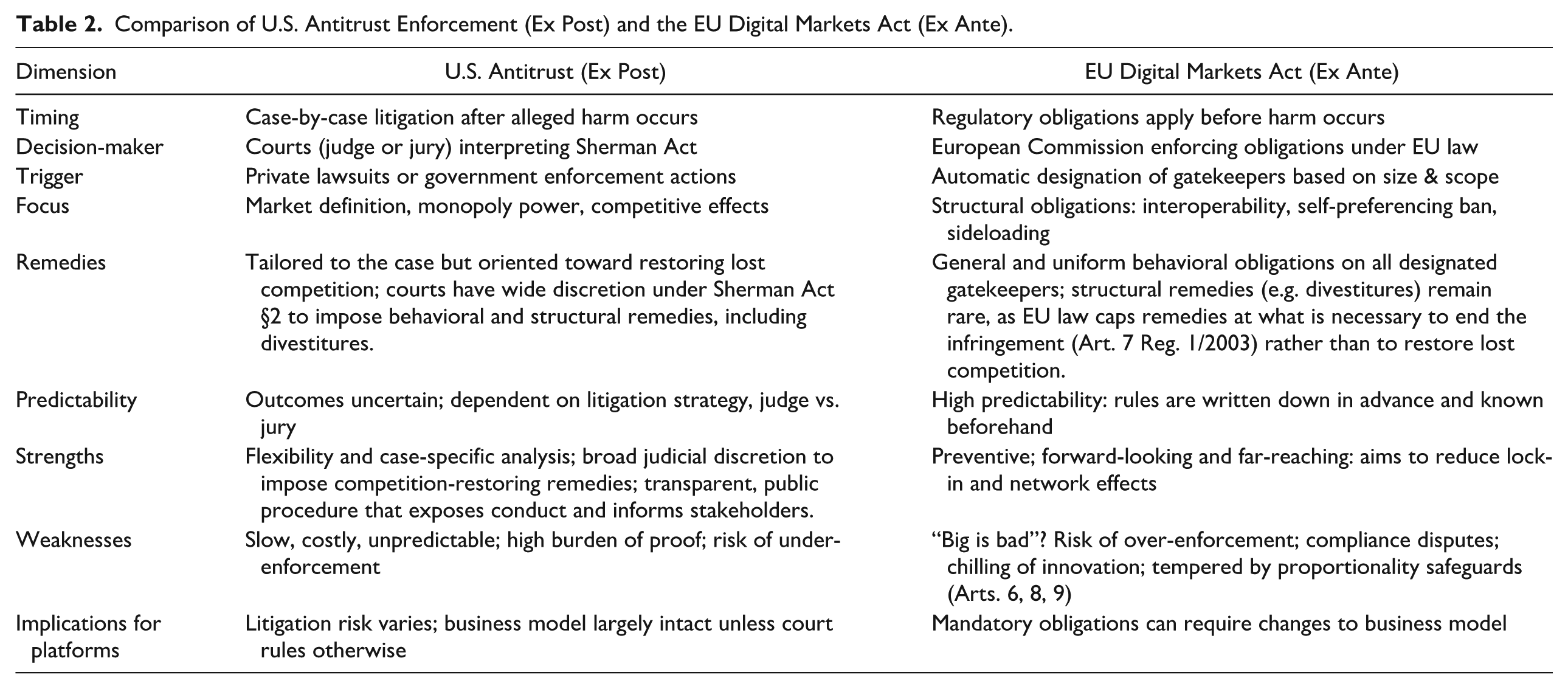
In contrast, the EU imposes preventive obligations in advance, with the European Commission acting as the decision-maker. Remedies are broad and uniform across designated gatekeepers, predictability is higher since obligations are codified, and mandatory rules can require structural changes to platforms’ business models. The EU approach treats both Apple and Google alike as gatekeepers, reflecting a policy choice to generalize obligations rather than focus on case-specific wrongdoing. While the U.S. system offers flexibility and avoids overreach, it is slow, costly, and unpredictable. The EU system, on the other hand, is forward-looking and aims to reduce lock-in and network effects but carries the risk of over-enforcement, compliance disputes, and chilling effects on innovation.
In sum, Table 2 illustrates how these structural differences play out in practice. In the United States, Epic only achieved limited changes through litigation against Apple, while Google faced a far-reaching jury verdict that forced it to open Android to rival app stores, billing systems, and user communication. However, these remedies are limited to a three-year period (2024–2027).
In Europe, regulators introduced similar—and in some respects broader—obligations directly through legislation that applies permanently to all designated gatekeepers. As a result, Apple and Google face broader and more permanent obligations in the EU under the DMA, while in the United States, their obligations depend on the litigation outcomes, which are limited in Apple’s case, but far-reaching in Google’s.
B. Scholarly Debate on Epic, Apple, Google, and the DMA
The findings of the comparative analysis reveal surprising contrasts between the U.S. and the EU approaches: while the U.S. rulings produced different results for Apple and Google, the DMA imposes a uniform regulatory framework on both. These contrasts are not only legally relevant but have also attracted considerable attention in academic research. This section therefore examines how these issues are discussed in the academic literature, organized around four themes: market definition in platform cases, the role of security justifications, alternative indicators of market power, and the paradigm shift from ex post enforcement to ex ante regulation. Even before the California district court’s 2021 ruling, Geradin and Katsifis had argued that “Apple is a monopolist in the market for app distribution on iOS, as it is not subject to any meaningful competitive constraint from alternative distribution channels, such as Android app stores.” 57 In their view, Apple’s bottleneck position allowed it to exploit developers through excessive fees and unfair trading conditions and to engage in exclusionary conduct against rival apps, ultimately harming consumers through higher prices, reduced choice, and poorer user experience. 58
Alderman and Blair take issue with the California district court’s definition of the relevant market in Epic v. Apple as “digital mobile gaming transactions” covering both iPhone- and Android-compatible apps. In their view, this definition is inconsistent with economic reality and is far too expansive, as it treats transactions within different app stores as reasonably substitutable even though they are not; they call this “a clearly erroneous market definition.” 59 They conclude, in respect of this mischaracterization combined with the rejection of monopoly claims, that, “together, these two findings by the District Court made it impossible for Epic to carry its burden. For the reasons that we have presented in this article, we think that the District Court has blundered.” Their critique indicates that U.S. courts, by misapplying economic principles in two-sided markets, fail to fully understand the exclusionary power of digital platforms (i.e., their ability to block rivals and restrict developer access). 60
A key difference between the U.S. and the European approaches concerns the role of security arguments. In Epic v. Apple (2021), the California district court largely accepted Apple’s claim that restrictive App Store policies were necessary to protect users from malware and privacy risks. This reasoning proved decisive: while the court acknowledged the anti-competitive effects, it considered them justified by Apple’s security interests. The DMA, by contrast, adopts a more balanced approach. It explicitly recognizes the legitimacy of security measures but requires that they be necessary, proportionate, and strictly justified. As Meyers emphasizes, security cannot serve as a “trump card” to undermine the DMA’s objectives of contestability and fairness. Instead, the DMA framework obliges gatekeepers such as Apple and Google to align their security safeguards with pro-competitive goals. In this sense, the DMA does not weaken security; rather, it ensures that protective measures are preserved while preventing their misuse as a pretext for maintaining closed ecosystems. 61
This balance is not merely conceptual but is anchored in three operative provisions of the DMA. First, Article 6(4) and Article 6(7) contain the substantive security carve-outs: gatekeepers remain free to take measures to protect the integrity of their hardware or operating system against third-party applications, app stores, and interoperability requests, but only “to the extent that they are strictly necessary and proportionate” and where such measures are “duly justified by the gatekeeper.” 62 This wording imposes both a necessity test (no less-restrictive alternative available) and a proportionality test (no excessive burden on contestability) and places the burden of justification squarely on the gatekeeper. Second, Article 8(7) extends this logic to the procedural level: when the Commission specifies compliance measures, it must ensure that they are “effective in achieving the objectives of this Regulation and the relevant obligation, and proportionate in the specific circumstances of the gatekeeper and the relevant service.” 63 Third, Article 9 provides a narrow safety valve by allowing the suspension of a specific obligation, but only where compliance would “endanger, due to exceptional circumstances beyond the gatekeeper’s control, the economic viability of its operation in the Union”—a deliberately high threshold that excludes ordinary business or reputational concerns. 64 Taken together, these provisions demonstrate that the DMA is not a rigid per se regime: it accommodates legitimate security and viability concerns but channels them through defined tests of necessity and proportionality rather than allowing them to function as a general trump card. This explains why Apple’s broad security-based objections to sideloading under iOS 17.4 (see Section II.C.2) have limited legal traction under the DMA framework: the relevant question is no longer whether security matters, but whether a specific restriction is strictly necessary, proportionate, and duly justified.
The conduct challenged in Epic v. Google fits into a broader pattern: Google has been sanctioned in multiple EU proceedings for self-preferencing (Google Shopping), exclusive agreements (AdSense), and tying (Google Android). The Epic allegations therefore form part of a recurring strategy rather than an isolated incident.
To avoid the problem of an erroneous market definition, as highlighted by Alderman and Blair and illustrated by the differing court definitions in Epic v. Apple and Epic v. Google, Steinbaum suggests relying on alternative criteria to assess market power. 65 One such criterion is the low elasticity of users, meaning that they remain tied to a platform despite adverse events (e.g. after the Cambridge Analytica revelations, many users continued to use Facebook). Another indicator is the persistence of high profitability, which may signal the exercise of market power even in the absence of clear substitutes. Steinbaum further emphasizes that traditional models for defining market power are ill-suited to two-sided markets such as app stores or social media platforms, where services are often provided free of charge to users and monetization occurs indirectly through developers, advertisers, or other industry actors. In this sense, residual demand elasticity provides a more direct and reliable indicator of market power: if users or business partners cannot easily switch to alternatives, the platform effectively operates as a monopoly, regardless of its formally defined market share. 66
Steinbaum focuses on alternative economic indicators of market power. Deutscher places these concerns in a broader paradigm shift, showing that the DMA and similar regulations move beyond traditional U.S. antitrust principles by redefining the goals, error-cost framework, and standards of proof for digital markets. Instead of focusing solely on consumer welfare, the DMA also emphasizes fairness, contestability, and even privacy. It recalibrates the error-cost framework by accepting the possibility of some over-enforcement in order to avoid the risks posed by entrenched gatekeepers. Moreover, it replaces detailed, case-by-case effects analysis with clear ex ante rules and presumptions that apply automatically once gatekeeper status is established. 67
Finally, the standard of proof is lowered, since a regulatory intervention is already justified when there is a risk of significant harm, even if this harm cannot yet be demonstrated conclusively. This perspective highlights that the DMA is about not just faster or more efficient enforcement, but a deeper rethinking of how competition in digital markets should be safeguarded.
A complementary perspective is offered by Scott Morton and van den Boom, who show through the Google cases that U.S. courts enjoy broad discretion to impose remedies aimed at restoring lost competition, including divestitures. A key conceptual difference is that the U.S. antitrust law explicitly seeks to terminate the monopoly itself, whereas EU competition law under Article 102 TFEU is limited to ending the specific infringement. 68 A further difference concerns transparency: U.S. proceedings are public, with discovery documents largely accessible, whereas the European Commission—both under Article 102 TFEU and under the DMA—operates as an administrative authority and discloses only non-confidential versions of its decisions. This “sunshine” effect deters harmful conduct and facilitates follow-on damages claims. The U.S. system combines broad judicial discretion in the choice of remedies with public proceedings that expose gatekeeper conduct, while the DMA secures speed, predictability, and uniform obligations through ex ante rule-setting. Each model thus offers strengths the other lacks—a complementarity revisited in Section IV.D.
Borgogno and Colangelo (2022) emphasize that app stores are the ideal testing ground for evaluating whether regulatory interventions or antitrust enforcement is better at addressing the challenges of digital gatekeepers. They argue that competition law still provides a flexible “toolbox” capable of dealing with exclusionary practices in app ecosystems, particularly when interim measures are used effectively. At the same time, they acknowledge that certain aspects of app store governance, such as product design and interoperability, may require regulatory intervention beyond the reach of a traditional antitrust law. It is surprising to note that the earliest and strongest regulatory initiative was launched in Europe despite the fact that the European antitrust framework already provides enforcers with more flexibility than its U.S. counterpart. However, Borgogno and Colangelo also warn that broad regulatory measures risk overreach by questioning the very business models of platforms and by neglecting the differences between Apple’s and Google’s app store strategies. 69 On a comparable note, Bostoen concludes that the DMA’s gatekeeper concept is “fixated on size,” and therefore open to the criticism that it assumes “big is bad.” 70
These perspectives add nuances to the debate, showing that the DMA’s neutrality rules need to balance keeping markets open against protecting innovation.
IV. Discussion and Conclusion
A. Limits of Market Definition and Lock-in
The Epic litigation highlights the fragility of market definition as the cornerstone of U.S. antitrust enforcement in digital-platform markets. In Epic v. Apple, the district court defined the relevant market broadly as “mobile gaming transactions.” This choice effectively insulated Apple from Sherman Act liability, even though the App Store functions as the exclusive distribution channel on iOS. The outcome demonstrates how the framing of a market can predetermine the results, with legal doctrine outpacing the economic realities of platform dependence.
By contrast, Epic v. Google shifted attention away from contested market boundaries and toward concrete exclusionary practices. The jury evaluated Google’s restrictive contracts and financial inducements directly, without first resolving abstract questions of market scope. This suggests that fact-finders may be more receptive to evidence of foreclosure than to debates over precise definitions.
The divergent outcomes, however, cannot be attributed solely to the decision-maker. iOS is a technically closed system, forcing the Apple case to turn on abstract questions of market definition—a terrain on which bench trials are typically decisive. Android’s restrictions, by contrast, work through contracts and financial incentives—visible business conduct that a jury can readily assess. The “judge versus jury” contrast therefore matters, but it cannot be separated from the underlying ecosystem architecture. An ecosystem marketed as open should also remain open in practice—a standard Google’s contractual restraints arguably failed to meet, and one that the jury’s verdict ultimately enforced.
The broader lesson is that market definition, long central to antitrust analysis, may be increasingly ill-suited to digital ecosystems characterized by network effects and interdependent services. Static boundaries fail to capture the dynamic ways in which platforms consolidate power. In contrast, the DMA sidesteps this difficulty entirely: by designating gatekeepers based on structural criteria such as scale and entrenched position, it imposes obligations without requiring detailed market definition.
B. Developer, Platform, and Consumer Perspectives
1. Apple’s iOS Ecosystem in the United States and the EU
From the perspective of developers, the outcome of Epic v. Apple in the United States has yielded only marginal improvements. While the verdict requires Apple to permit developers to direct users toward alternative payment options, the structural characteristics of iOS remain unchanged: the App Store continues to function as the sole authorized distribution channel for iOS applications, and developers remain subject to Apple’s 30-percent commission. Tim Sweeney, CEO of Epic Games, has criticized the App Store not only for its exclusivity but also for its ranking and discovery mechanisms, which he argues prioritize revenue-maximizing titles rather than consumer choice. 71
From the platform perspective, Apple justifies these restrictions as necessary to ensure security, privacy, and a consistent user experience, framing its role not as an anti-competitive bottleneck but as a trusted intermediary. Apple also retains exclusive control over app review and update approval, which it can use to accelerate, delay, or withhold support for a developer’s features—directly affecting competitive positioning. Developers cannot introduce competing app stores or specialized distribution channels despite calls for such pluralism from scholars like Crémer et al. 72
From the consumer perspective, the picture is mixed. Users benefit from Apple’s curated ecosystem, which reduces malware risk and provides an integrated payment system. At the same time, the absence of alternative stores sustains higher prices, since developers tend to pass on Apple’s commission. Consumers had to wait from 2020 until 2024 in Europe and until 2025 in the United States before Fortnite became playable again on iOS—illustrating the real consequences of a closed ecosystem. 73 As the 2025 contempt proceedings demonstrate, Apple remains willing to undermine even these limited concessions. 74
In contrast, in the EU, the DMA is enabling many of the features that are criticized in the United States, including competing stores. Epic Games’ Tim Sweeney calls this a “Soviet ‘defense in depth’ strategy,” since Apple has constructed a massive series of barriers, each of which must be surmounted in any attempt to compete, so that even if one barrier is overcome, others remain in place and prevent the whole scheme. Apple has made it very difficult and uncompetitive for Epic Games and their clients, even after the launch of the EGS, to do business. He suggests that the EU should impose harsh and serious penalties on Apple in order to force compliance. 75
2. Google Android’s Ecosystem in the United States and the EU
In July 2025, the Ninth Circuit upheld the 2023 jury verdict that Google’s Play Store policies and in-app payment system were illegal monopolies. 76 The broad injunction that followed now compels Google to open its Android ecosystem: rival app marketplaces must be offered through the Play Store, and apps must be permitted to steer users toward alternative payment methods.
From the developer perspective, this legal shift is transformative. Epic Games can now reintroduce Fortnite to Google Play by offering the EGS app on the platform, a move Tim Sweeney confirmed following the court victory. 77 More broadly, developers can bypass Google Play’s mandatory billing either through third-party payment processors or by linking to external purchase options—reducing their reliance on Google’s proprietary tools and fees.
From the consumer perspective, popular titles like Fortnite, previously obtainable on Android only via sideloading or preinstallation deals, will now be accessible through Google Play itself. This expanded access lowers barriers for users and, in principle, may drive improvements in app choice and pricing as alternative stores compete. As noted in Section IV.B.1, no gamer is likely to choose a four- or five-year wait for a 20-percent saving over immediate access to a desired title.
From the platform perspective, Google strongly opposes these orders. Although the injunction runs for only three years, the company argues that even this temporary opening will “significantly harm user safety” and “undermine the innovation” of the platform. Google has petitioned to delay implementation and has signaled its intent to appeal further, seeking a stay while higher courts consider the case. 78
The EU achieves analogous outcomes through regulation rather than litigation: the DMA obliges gatekeeper operating systems to allow third-party app stores and alternative in-app payment mechanisms. 79 While the legal bases differ—ex post antitrust enforcement in the United States versus ex ante regulation in the EU—both jurisdictions move toward loosening Google’s control over app distribution and payments. Developers and consumers stand to gain, while Google faces structural challenges to its traditional business model.
C. Epic’s Distribution Strategy and Consumer Welfare
The launch of Epic’s own Games Store can be seen as another “David versus Goliath” story in digital markets. In 2018, Epic set out to challenge Steam, the overwhelmingly dominant PC game distribution platform with an estimated 95-percent market share. To enter such a concentrated market, Epic adopted an aggressive strategy: offering exclusive titles, providing a steady stream of free games to build a user base quickly, and charging developers only a 12-percent revenue share compared to Steam’s 30 percent.
As Hanspach demonstrates, exclusive dealing in two-sided markets is not inherently anti-competitive. In Epic’s case, exclusivity was a rational entry strategy: unable to compete with Steam on price alone, Epic invested roughly a billion dollars in securing exclusive deals to build a differentiated user base. 80 The result was pro-competitive: Epic’s market entry forced the incumbent valve to lower its commissions as well, and despite some fragmentation—users on Steam lost access to Epic-exclusive titles—the welfare effects in terms of lower fees outweighed these downsides. 81
This creates an apparent tension with Epic’s broader strategy. Epic sued Google over exclusionary contracts in Android distribution while itself relying on exclusivity to establish its own store. The contradiction resolves once context is taken into account, as Hanspach’s analysis implies: exclusivity deployed by an entrant challenging an incumbent produces different effects than exclusivity deployed by a dominant gatekeeper—it should not be judged in absolute terms but evaluated contextually, depending on market structure and the position of the firm.
Seen in this light, Epic’s distribution strategy becomes coherent. The company aims to build distribution power as the key driver of platform competition, implementing a multi-platform approach that extends its store presence to consoles and mobile devices. 82 Fortnite plays a central role: while it generates substantial direct revenue, its larger strategic value lies in opening rival ecosystems such as Apple’s iOS and Google’s Android to the EGS. As Bostoen observes, the slogan “Content is King → Distribution is King” 83 captures the underlying logic: content attracts users in the short run, but sustainable market power arises from controlling the distribution channel. Epic’s long-term ambition extends even further toward an open “metaverse”—a persistent social virtual space in 3D, where players meet with their friends, with its own economy—which presupposes the dismantling of current gatekeeper control over mobile platforms (see also Section IV.F). 84
Epic’s own experience on iOS illustrates the stakes. Within just two years on the platform, the company generated around $750 million in revenue from Apple’s App Store. 85 This helps explain why Epic was willing to risk hundreds of millions, if not billions, to establish a two-sided marketplace on iPhones. The DMA directly supports this ambition by obliging gatekeepers to allow alternative app stores, enabling entrants like Epic to compete not only on content but also on distribution. Crémer et al. go further, arguing that gatekeepers should not be permitted to charge access fees for rival app stores but only strictly cost-related review fees, and highlighting the value of specialized stores curated for particular user groups such as children. 86
For regulators, two implications follow. First, exclusive dealing should not be dismissed as inherently harmful; depending on market position and structure, it can stimulate competition and generate consumer benefits. Second, distribution—not content—is the central battleground in digital-platform markets.
D. Epic, the DMA, and Transatlantic Lessons
Epic’s legal battles and the DMA share a common ambition: to rebalance the relationship between platform gatekeepers and those dependent on their gateways, whether they be app developers or end users. Epic Games framed its campaign as a fight for freedom and fairness in digital ecosystems, most prominently through the “Free Fortnite” 87 campaign. While Epic did not achieve a complete victory in the U.S. courts, its actions, combined with parallel efforts by regulators and other developers, have undeniably accelerated change in platform governance.
The App Store paradigm of the 2010s—an indisputable 30-percent cut with no outside alternatives—is now being dismantled. This shift is occurring more rapidly in Europe under the DMA’s ex ante regime, and also, albeit more slowly, in the United States through ex post antitrust enforcement and litigation. This transatlantic divide effectively creates a natural experiment: the EU will test whether clear, up-front obligations for gatekeepers deliver more competitive outcomes in app distribution, while the United States will observe whether case-by-case enforcement can keep pace with market dynamics.
Moreover, the transatlantic axis no longer captures the full picture. The United Kingdom’s Digital Markets, Competition and Consumers Act 2024 (DMCC Act), 88 in force since January 2025, empowers the Competition and Markets Authority (CMA) to designate firms as having “Strategic Market Status” and to impose tailored conduct requirements—a more flexible model than the DMA’s uniform obligations. Apple and Google were designated in respect of their mobile platforms in October 2025. 89 Japan’s Mobile Software Competition Act (MSCA), fully in force since December 2025, follows a third path: narrower in scope than the DMA (limited to smartphone software) but replicating its core obligations on self-preferencing, third-party app stores, and proprietary billing. 90
Australia offers a further variant, this time through the courts rather than through ex ante regulation. In August 2025, the Federal Court of Australia (Beach J) found that both Apple and Google had contravened section 46 of the Competition and Consumer Act 2010 by restricting alternative app distribution and in-app payment mechanisms. Crucially, Justice Beach accepted Epic’s characterization of the relevant markets—iOS app distribution and iOS in-app payment solutions—precisely the market definition that had been rejected in the U.S. Epic v. Apple ruling. This divergence illustrates that the U.S. outcome was not inevitable but shaped by specific doctrinal choices about market definition under the Sherman Act. In March 2026, Epic and Google reached a global settlement covering Australia, while the Apple proceedings entered a relief phase in April 2026, with the Australian Competition and Consumer Commission (ACCC) granted leave to intervene on public-interest grounds. 91
Taken together, these developments—regulatory in the United Kingdom and Japan, judicial in Australia—suggest that the reach of digital-platform accountability is no longer a distinctively European phenomenon but an emerging international trend, with the United States increasingly the outlier for reasons of legal doctrine rather than necessity.
The potential remedy may lie in a hybrid approach combining the predictability of ex ante rules with mechanisms for case-by-case calibration. The United Kingdom and Japan illustrate two variants of such hybridity: the DMCC Act through bespoke conduct requirements that the CMA can adjust to each platform’s specific market position, 92 and the MSCA through which the Japan Fair Trade Commission has called a “policy mix of ex ante regulations and co-regulation” relying on “continuous communication” with gatekeepers and developers to improve business models in real time rather than merely sanctioning ex post. 93 While the United States remains tied to slow, case-by-case litigation and the EU to a broad uniform rulebook, the United Kingdom and Japan occupy an intermediate position—relying on the legal authority of ex ante rules while retaining the flexibility to adjust them to specific circumstances and new technological challenges.
A still broader variant—combining ex ante rules with a residual ex post enforcement track—could in principle integrate elements of both regulatory and litigation models, though no jurisdiction has yet adopted such a comprehensive hybrid.
Epic v. Apple and Epic v. Google, together with the DMA, have ushered in a new era of accountability for digital platforms. What is already clear is that the status quo is no longer taken for granted—and that platform regulation will profoundly shape the legal and economic landscape in the years to come, providing businesses with greater legal certainty and planning security, better conditions for developers through stronger platform competition, and increased consumer welfare.
E. Conclusion
The comparison of Epic v. Apple, Epic v. Google, and the EU DMA shows that outcomes in digital-platform regulation depend heavily on the interaction between procedural choice and ecosystem architecture. In Apple’s case, iOS is a technically closed system, which forced the dispute onto an abstract terrain of market definition—where the broad “digital mobile gaming transactions” framing insulated Apple from Sherman Act liability.
In Google’s case, Android is nominally open but contractually restricted, which allowed a jury to focus directly on observable exclusionary practices and find the company liable. An open ecosystem should remain open in practice, not only in marketing—a standard Google’s contractual restraints failed to meet. The DMA, by contrast, imposes obligations on both companies regardless of litigation and regardless of ecosystem architecture, reflecting a fundamentally different regulatory philosophy.
These results answer the paper’s central research question. The Epic cases expose the structural limitations of the U.S. antitrust law: its ex post, litigation-driven enforcement struggles to provide timely or coherent remedies in fast-moving digital markets. In both Epic v. Apple and Epic v. Google, meaningful remedies did not begin to materialize for four or five years—a delay incompatible with the dynamics of digital ecosystems. The DMA takes the opposite approach, preventing disputes through ex ante obligations on designated gatekeepers and thereby ensuring predictability and immediate contestability. But as Section IV.B.1 shows, its implementation has proven challenging in practice, and its uniform rulebook lacks the flexibility to account for case-specific circumstances.
Neither model is categorically superior. U.S. litigation allows case-specific nuance but is slow and inconsistent; EU regulation secures openness and legal certainty but risks rigidity and compliance disputes. The Epic cases and the DMA show that the way rules are made and enforced—whether by a judge, a jury, or a regulator—strongly influences both the legal outcomes and the beneficiaries (gatekeepers, developers, or end users), although the underlying ecosystem architecture co-determined which legal arguments proved decisive. The choice between judge and jury, however, is not freely strategic but follows the Seventh Amendment and FRCP 38: Epic v. Apple proceeded as a bench trial by joint agreement of the parties, while Epic v. Google went to a jury after Google filed damages counterclaims and demanded one under Rule 38(b). 94
A hybrid approach, as already emerging in the United Kingdom and Japan, may offer a more balanced path forward. As ex ante platform regulation spreads beyond the EU, the United States increasingly appears as the outlier in its reliance on ex post case-by-case enforcement.
Viewed from the perspective of gamers, however, the fact that access to Fortnite on mobile devices was blocked for so many years is the central problem. Despite the entire debate being framed around consumer welfare, the millions of gamers themselves are not really part of the battle royale between the judge, the jury, and the regulator—they are left in the lobby without a chance to drop from the Battle Bus, and ultimately cannot win a Victory Royale.
F. Outlook
Looking forward, the transatlantic divergence in platform regulation creates both challenges and opportunities. For the United States, the Epic cases illustrate the need to move beyond rigid reliance on market definition and to develop tools that better capture lock-in, exclusionary practices, and dynamic competition, thereby producing more coherent outcomes. For the EU, the first wave of DMA enforcement will test whether ex ante obligations can be implemented effectively without undermining product quality, security, or innovation. Initial feedback from both sides already indicates that there remains potential for improvement in the practical application of both approaches.95,96
Beyond the legal debate, it is also important to take into account the underlying vision that drives actors like Tim Sweeney from Epic Games. He frames his fight not merely as a battle over platform fees and distribution terms, but as a step toward realizing the vision of a metaverse—a real-time, 3D social ecosystem with over a billion interacting users, integrating major games into an open economy in which developers participate as peers, compete to offer the best deals, and interact directly with their users, in which players spend a significant part of their daily lives.
With large-scale live events like Travis Scott’s Astronomical concert—which drew over 12.3 million concurrent participants in 2020, two million of them on iOS devices alone—and Fortnite’s Remix: The Finale in 2024, which broke new records with over 14 million viewers, 97 Fortnite has effectively become one of the largest concert venues in the world and is arguably already on the path toward building this metaverse. Indeed, as the Epic v. Apple court noted, Epic Games itself considers Fortnite to compete not only with gaming companies but also with other social media companies such as Facebook and Netflix. 98
At this scale, the millions of Fortnite users effectively function as “digital citizens” of an emerging virtual society—a status that platform regulation has not yet begun to address.
Such a vision, however, can only materialize if the gatekeeping monopolies of Apple and Google are dismantled. 99
Whether through ex ante regulation or hybrid models of the kind discussed earlier, dismantling these monopolies would translate into concrete benefits for both sides of the platform: for developers, greater legal certainty about what gatekeepers can and cannot do, combined with faster regulatory responses when platforms develop new evasive practices; for consumers, greater choice among app stores and stronger competitive pressure on prices and contractual terms.
Epic’s litigation strategy and the DMA’s regulatory experiment thus provide complementary lessons in how digital markets can be governed. Together, they mark the beginning of a new phase in platform regulation, one in which the rules of the game are no longer set solely by the gatekeepers but are increasingly shaped by courts, regulators, developers like Epic who challenge gatekeeper practices, and a growing global demand for fairer digital markets.
The storm has fully closed. With the playing field shrunk to its final circle, Apple, Google, and Epic—playing their own battle royale—now stand face to face with a judge, a jury, and a regulator. Meanwhile, the millions of gamers have been stuck in the lobby for years.
The Island is theirs. It’s time to hand it back—and let them play for their Victory Royale.
Footnotes
Declaration of Conflicting Interests
The author declared no potential conflicts of interest with respect to the research, authorship, and/or publication of this article.
Funding
The author received no financial support for the research, authorship, and/or publication of this article.
1.
3.
Brianna L. Alderman & Roger D. Blair, Epic Battles in Two-Sided Markets, 68
5.
6.
Sweeney, supra note 1, at 3:30:35.
7.
8.
Sweeney, supra note 1, at 3:36:19.
9.
10.
Alderman and Blair, supra note 3, at 530.
11.
Id.
12.
Marshall Steinbaum, Establishing Market and Monopoly Power in Tech Platform Antitrust Cases, 67
13.
Elias Deutscher, Reshaping Digital Competition: The New Platform Regulations and the Future of Modern Antitrust, 67
15.
Sweeney, supra note 1, at 3:54:20.
16.
Andrew Limbong, Fortnite Uses Apple’s Own ‘1984’ Ad Against It in Dispute Over Payments, NPR (Aug. 13, 2020), https://www.npr.org/2020/08/13/902328255/fortnite-uses-apples-own-1984-ad-against-it-in-dispute-over-payments; Igor Bonifacic, Epic’s Parody of Apple’s 1984 Ad Ends with #FreeFortnite, Engadget (Aug. 13, 2020),  ; Sweeney, supra note 1, at 3:30:35.
17.
Epic Games, Proposed Findings of Fact and Conclusions of Law, supra note 9.
18.
Id., at 74.
19.
Id., at 118.
20.
Id., at 152.
21.
Id., at 137.
22.
Epic Games, Inc. v. Apple Inc., 4:20-cv-05640-YGR (United States District Court, Northern District of California, Oakland Division Apr. 8, 2021), at 1.
23.
24.
Id., at 218.
25.
26.
Id., at 129–35.
27.
Id., at 2, 42, 139.
28.
Id., at 160–69; Epic Games, Inc. v. Apple Inc., 67 F.4th 946 (9th Cir. 2023).
29.
Id.
30.
Epic Games, Inc. v. Apple Inc., 4:20-cv-05640-YGR (United States District Court, Northern District of California, Oakland Division Apr. 30, 2025), at 57.
31.
32.
Id., at 2.
33.
34.
Id., at 78.
36.
Sweeney, supra note 1, at 4:04:40.
38.
39.
40.
41.
42.
Friso Bostoen, Understanding the Digital Markets Act, 68
46.
48.
49.
50.
Id.
53.
56.
Lawler, supra note 53.
57.
Damien Geradin & Dimitrios Katsifis, The Antitrust Case Against the Apple App Store, 17
58.
Id.
59.
Alderman and Blair, supra note 3, at 529.
60.
Id.
61.
Zach Meyers, Balancing Security and Contestability in the DMA: The Case of App Stores, 20
62.
63.
Id., art 8.
64.
Id., art 9.
65.
Steinbaum, supra note 12.
66.
Id.
67.
Deutscher, supra note 13.
68.
69.
Oscar Borgogno and Giuseppe Colangelo, Platform and Device Neutrality Regime: The New Competition Rulebook for App Stores?, 67
70.
Bostoen, at 263–307, 278.
71.
Sweeney, supra note 1, at 3:33:00.
72.
Jacques Crémer et al., Access Pricing for App Stores under the DMA, 21
73.
Fortnite Returns to iOS in the European Union! supra note 55.
74.
Contempt Order, supra note 31.
75.
Sweeney, supra note 1, at 3:33:40.
76.
Lawler, supra note 53.
77.
Id.
78.
80.
Sweeney, supra note 1, at 3:57:56.
81.
Philip Hanspach, Analysing Exclusive Dealing in Two-Sided Markets: Marketplaces for Video Games, 14 J.
82.
Sweeney, supra note 1, at 3:48:28.
83.
Friso Bostoen, Blog - Epic v Apple : Antitrust’s Latest Big Tech Battle Royale, 5
84.
Sweeney, supra note 1, at 2:22:57.
85.
Epic Games, Proposed Findings of Fact and Conclusions of Law, supra note 9, at 137.
86.
Crémer et al., supra note 72, at 4.
87.
Andrew Limbong, Fortnite Uses Apple’s Own ‘1984’ Ad Against It in Dispute Over Payments, NPR (Aug. 13, 2020), https://www.npr.org/2020/08/13/902328255/fortnite-uses-apples-own-1984-ad-against-it-in-dispute-over-payments; Nick Summers, ‘Nineteen Eighty-Fortnite’ and the legal battle for the future of the App Store, Engadget (Aug. 13, 2020), ; Sweeney, supra note 1, at 3:30:35.
88.
90.
91.
92.
93.
Id.
94.
95.
Apple Newsroom (Ivory Coast), supra note 51.
96.
Sweeney, supra note 1, at 3:40:00.
99.
Sweeney, supra note 1, at 3:38:00.