







Abstract
The microbial world forms a huge family of organisms that exhibit the greatest phylogenetic diversity on Earth and thus colonize virtually our entire planet. Due to this diversity and subsequent complex interactions, the vast majority of microorganisms are involved in innumerable natural bioprocesses and contribute an absolutely vital role toward the maintenance of life on Earth, whilst a small minority cause various infectious diseases. The ever-increasing demand for environmental monitoring, sustainable ecosystems, food security, and improved healthcare systems drives the continuous search for inexpensive but reproducible, automated and portable techniques for detection of microbial isolates and understanding their interactions for clinical, environmental, and industrial applications and benefits. Surface-enhanced Raman scattering (SERS) is attracting significant attention for the accurate identification, discrimination and characterization and functional assessment of microbial cells at the single cell level. In this review, we briefly discuss the technological advances in Raman and Fourier transform infrared (FT-IR) instrumentation and their application for the analysis of clinically and industrially relevant microorganisms, biofilms, and biological warfare agents. In addition, we summarize the current trends and future prospects of integrating Raman/SERS-isotopic labeling and cell sorting technologies in parallel, to link genotype-to-phenotype in order to define community function of unculturable microbial cells in mixed microbial communities which possess admirable traits such as detoxification of pollutants and recycling of essential metals.
Keywords
Introduction
Microorganisms are ubiquitous in the environment and found in and on mammalian hosts in a complex systematic relationship; 1 in these environments these organisms occur predominantly as complex multi-organism biofilms. The microbial world forms a huge family of organisms that exhibit the greatest phylogenetic diversity on Earth and thus colonize virtually our entire planet.2,3 Due to this diversity and subsequent complex interactions, the vast majority of microorganisms such as Pseudomonas putida and Azotobacter chroococcum are directly involved in a huge number of natural bioprocesses which contribute a central role toward the homeostasis of life on Earth, 4 whilst a small and important minority which includes Vibrio cholerae, Campylobacter, and Mycobacterium tuberculosis is responsible for various infectious diseases.5,6 The ever-increasing demand for environmental monitoring, sustainable ecosystems, food security, and improved healthcare systems drives the continuous search for inexpensive but rapid, sensitive, reproducible, automated, and portable techniques for the detection of microbial isolates and understand their interactions for clinical, environmental, and industrial applications and benefits.7–9
During the early experimentation and exploration of the microbial world, simple light microscopes were largely used to identify and classify microbes based on their morphological dynamics which demanded extensive understanding of taxonomy. 10 Since then, the science of microbiology has rapidly evolved to such an extent that scientists have now gained deeper insights and understanding of the genetic make-up and corresponding phenotypes of these organisms, and how they interact within their own diverse communities.11,12 This is mainly due to the advances in instrumentation and data analysis software which generate a great deal of information from DNA, RNA, proteins, metabolites, and lipid biomarkers giving rise to the genomics, transcriptomics, proteomics, metabolomics, and lipidomics scientific fields, respectively.13–15 In the so-called post-genomics era, complementary investigations for high-throughput analyses at the level of gene expression, protein translation as well as post-translational modifications and metabolic networks analysis are desirable. These integrated analyses play a central role in understanding complex biochemical and biological mechanisms to facilitate comprehensive identification, discrimination and more interestingly, functional analysis of microbes.16–18 To achieve this challenging task, many researchers have successfully demonstrated the application of various analytical platforms, including molecular techniques, 17 matrix-assisted laser desorption ionization time-of-flight (MALDI-TOF) mass spectrometry,19,20 and whole-organism metabolic fingerprinting techniques, 21 for extensive microbial analysis. Here, we discuss the technological advancements, limitations, and current and potential future applications of vibrational spectroscopy, with particular emphasis on surface-enhanced Raman scattering (SERS), as a global biochemical fingerprinting technique to complement existing knowledge in microbial characterization.
Classical and Vibrational Spectroscopy Platforms for Bacterial Analysis
Until relatively recently culture-based methods have been routinely used to assess cellular phenotypes, despite being excessively time-consuming and mainly limited to studies involving microbial populations.22,23 In times of emergency due to the breakout of highly contagious life-threatening bacterial diseases, such a delay would lead to huge increases in morbidity and mortality rates. Additionally, only a small fraction of microorganisms (<1%) can be cultivated to suitable biomass level under normal laboratory conditions which is universally recognized as a key limitation in contemporary microbial analysis.24–27 Previous research has demonstrated the development and applications of molecular bio-sensing techniques based on polymerase chain reaction (PCR) for investigating microbe-specific DNA sequences and enzyme-linked immunosorbent assays (ELISA).8,28–30 These tools, which permit more rapid and simultaneous detection of several bacterial cells than culture-based methods, have greatly improved our understanding of bacterial diversity and physiology in complex communities. While obviously sensitive and specific for studying culturable and unculturable organisms of clinical and environmental importance, these techniques are relatively costly, for example PCR and ELISA require large libraries of specific primers and antibodies respectively, to detect a wide range of different bacterial species under investigations.31,32 Additionally, they are labor-intensive, prone to contamination, difficult to employ for low-level microbial detection, cannot differentiate between live and dead cells, do not provide information on spatial localization of cells and if not carefully optimized the temperature profile in PCR can potentially alter microbial components of a mixed community.
33
Ideally, efficient and effective environmental monitoring, infection control and epidemiological assessments primarily require user-friendly, sensitive, reproducible and rapid with minimal sample preparation experimental procedures for routine microbial identification. Within the last decade, vibrational spectroscopy has gained huge popularity as a metabolic fingerprinting tool for rapid, label-free and high-throughput screening of a wide range of microbial cells and biological agents.34–36 Vibrational spectroscopy based on Fourier transform infrared (FT-IR) and Raman provide specific “whole-organism molecular fingerprints” (spectra) comprising of distinct vibrational modes which are qualitatively (peak position) and quantitatively (peak height or area) measurable. Thus, FT-IR and Raman offer a wealth of exciting and practicable information for studying comprehensive intrinsic biochemical composition and variations which are representative of genetic changes modified by the environment (phenotype).
37
This information is exploited to identify and characterize bacterial species even of closely related cell biochemistry,21,38 and to assess microbial cell functionality.
39
Due to the nondestructive nature of FT-IR and Raman measurements, samples can be recovered following an analysis and used for further downstream studies.
40
Compared to classical methods of typing bacteria, FT-IR and Raman have superior spatial resolution, sensitivity, and require little or no sample preparation as well as minimal background training.41,42 Fig. 1 illustrates the general sample preparation scheme for vibrational spectroscopic techniques in microbial analysis. Notably, sample preparation for FT-IR includes a drying step usually at 55 ℃ to dehydrate the sample completely to avoid interference from water.
General flow diagram for sample preparation for FT-IR and Raman–SERS fingerprinting analysis of microbial cells. Prior to FT-IR measurements, microbial samples are dried at 55 ℃ to evaporate water molecules that may otherwise interfere with spectral interpretation.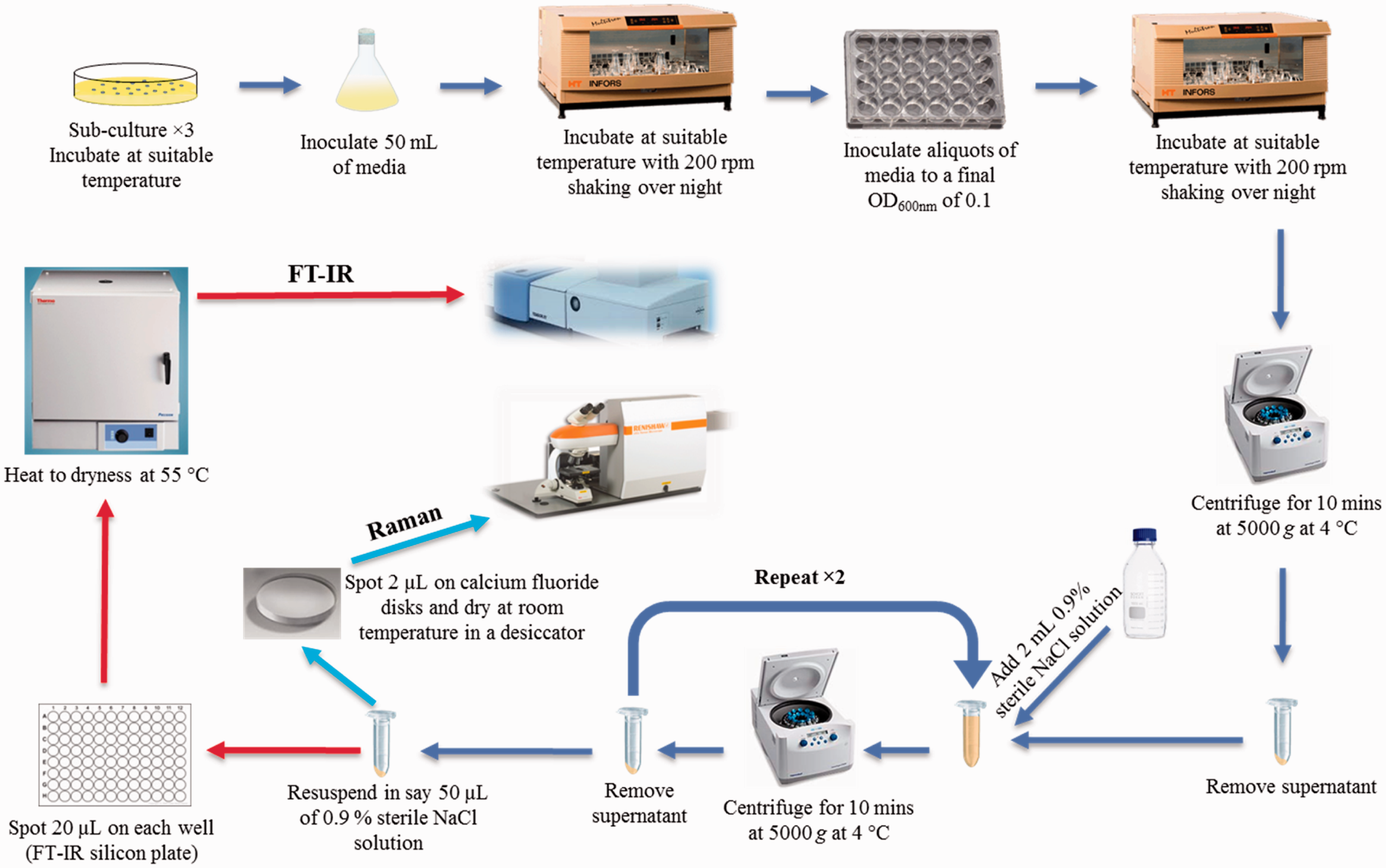
Fourier transform infrared spectroscopy is based on the principle that when sample molecules interact with infrared radiation, the electric dipole moment of IR-active molecular bonds changes through atomic displacement, and begin to vibrate at higher frequencies (Fig. 2).
7
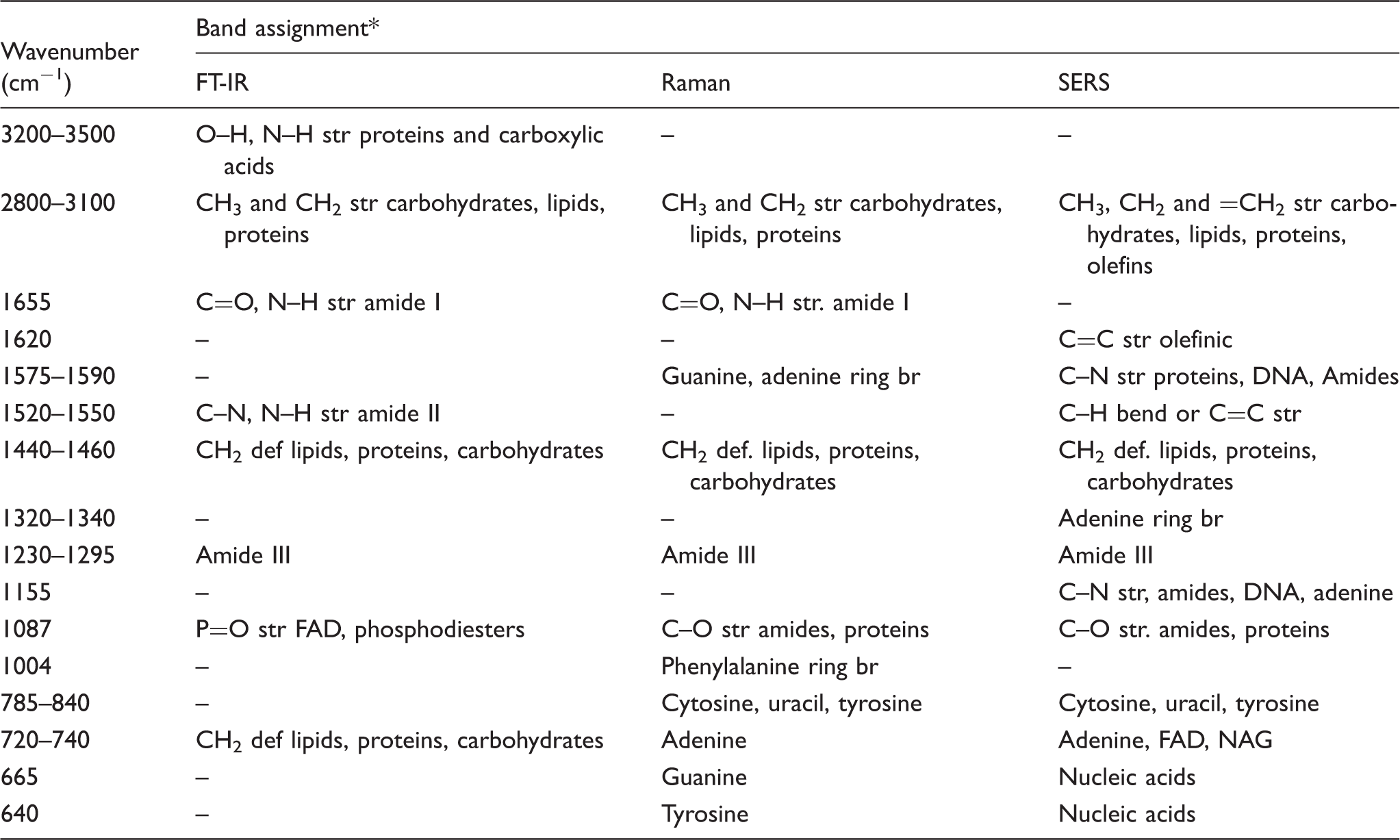
The vibrational modes of a multitude of biologically relevant molecules such as carbohydrates, proteins, nucleic acids and lipids in bacterial cells contain one or more chemical bonds (viz. C=O, C–N, N–H, O–H etc.) and thus they are frequently detected in the mid-IR (Table 1) as distinct fundamental characteristic bands and used to characterize microbes.43,44 Fourier transform infrared spectroscopy is a very versatile tool with many applications in food quality control and environmental monitoring due to its powerful screening ability. As shown by Helm and colleagues, FT-IR combined with chemometrics provides accurate means to classify and identify various infectious bacteria including Streptococcus, Staphylococcus, and Legionella species.
45
Similarly, the results obtained by Maquelin et al. reveal that FT-IR exhibits similar accuracy and reliability level (∼98%) as traditional “gold standard” tools in the identification of soil bacterial and fungal species such as Escherichia coli, Enterococcus faecium, Candida albicans, and Candida glabrata recovered from blood culture.
46
With the resurgence of surface-enhanced infrared absorption (SEIRA), which improves the sensitivity of absorption bands through plasmonic materials, and the development of nanoscale infrared microscopy which permits accurate analysis and high resolution (∼2 µm) imaging of single microbial cells, FT-IR spectroscopy will potentially offer valuable information to allow extensive biochemical structure elucidation and highly accurate classification of novel uncultivated prokaryotic microbial systems.47–50 However, one drawback of FT-IR is that it registers intense broad bands due to the strong absorption of infrared radiation by water molecules, which may mask other spectral features and interfere with spectral interpretation. Nonetheless, this problem is usually overcome by the dehydration of a sample, application of attenuated total reflectance (ATR), use of heavy water (D2O) as the solvent, or subtraction of water peaks.51–53
Schematic illustration of the three vibrational spectroscopic processes based on (a) IR absorption and (b) Stokes Raman scattering: (i) conventional Raman or SERS; (ii) resonance Raman. The Morse curves show the molecular energy transitions, which occur when an investigated sample interacts with radiation of appropriate wavelength. str = stretching, def = deformation, br = breathing.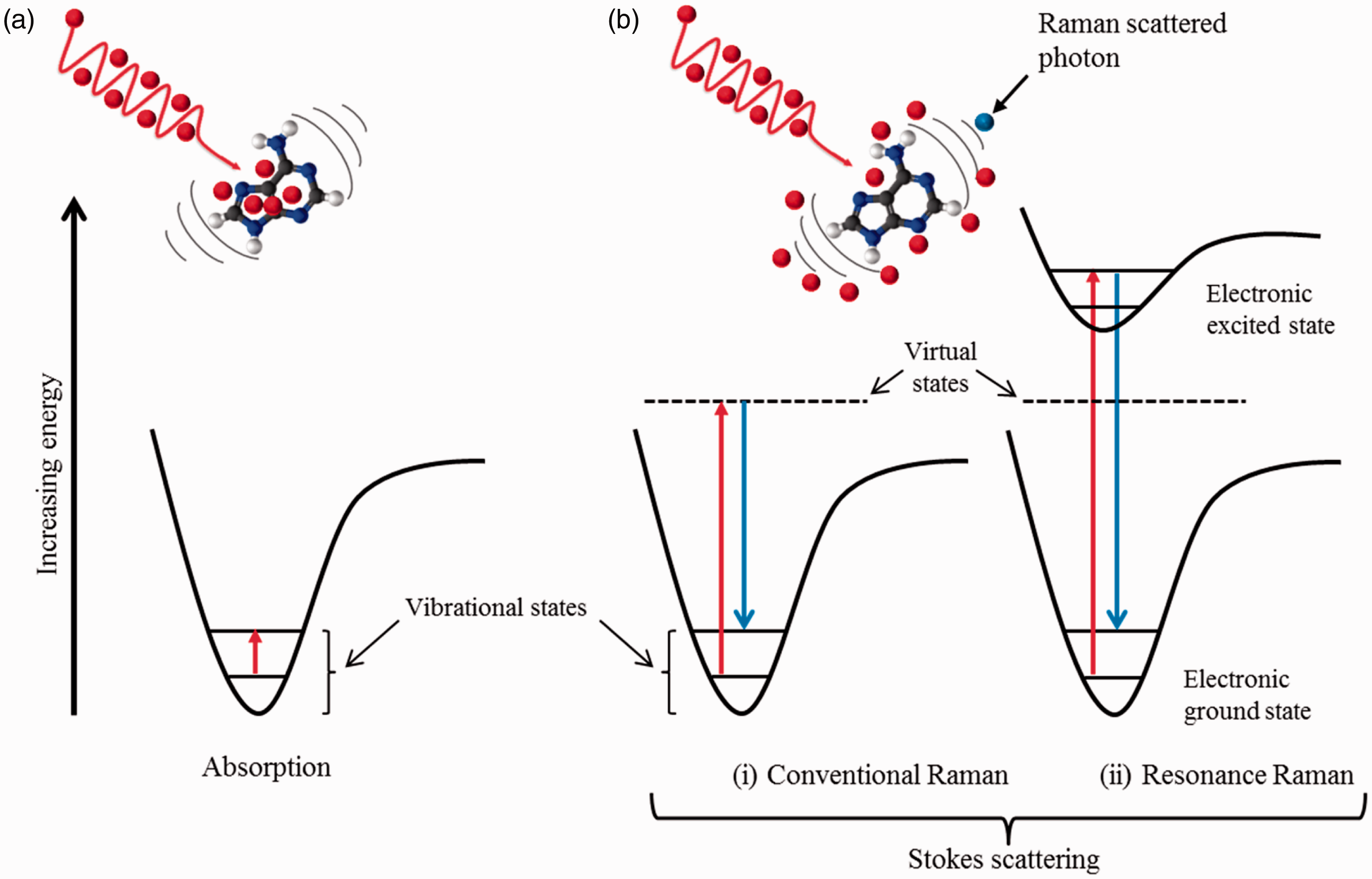
By contrast, Raman spectroscopy provides chemical information through Stokes (as well as anti-Stokes but this is less efficient) scattered photons (Fig. 2) from Raman-active symmetrical molecular vibrations (e.g., C=C, S–S, N=N, C–H, etc.), whose electron densities shift unsymmetrically (anisotropically) to induce polarizability when a sample is irradiated with light in the visible to mid-IR range. 54 Therefore, Raman offers complementary biochemical and structural information to FT-IR absorption measurements due to different selection rules, except in centrosymmetric biochemical molecules in which case the rule of mutual exclusion applies.21,53,55 Interestingly, Raman exhibits exceptional advantages over FT-IR in microbial analysis, as water is a weak scatterer of light and thus does not cause any interference with spectral interpretation. This makes Raman more appropriate for in vivo analysis of microbial systems that occur naturally in aqueous environments. 26
Within recent years Raman microspectroscopy has been increasingly attracting considerable attention for bacterial analysis, particularly due to advancements in technology which includes optical fibers for in situ online analysis, strong monochromatic lasers, whose radiation wavelength is within the diffraction limit (
Although the non-resonance Raman instrumentation has been greatly improved both mechanically and optically, its scattering efficiency is still intrinsically poor. Typically only ∼1 in 106–108 photons undergo inelastic Raman scattering resulting in limited sensitivity and long spectral collection times. 62 Additionally, many biological samples tend to fluoresce in the visible to near-IR in which case Raman spectral features are obscured making it difficult for qualitative and quantitative analysis. 63 The quest for techniques which exhibit ultra-high sensitivity to low concentrations of biomass has been showing much promise in recent years. Resonance Raman spectroscopy (RRS), where laser excitation matches the electronic transition states of the investigated sample molecules (Fig. 2), is frequently used to increase the Raman signal by 102–104 orders of magnitude. 64 Resonance Raman spectroscopy selectively enhances Raman signals of chromophoric segments of metabolites and biopolymers which exhibit large Raman cross-sections, and in the deep ultraviolet (e.g., 244 nm), preferentially from conjugated aromatic molecular moieties such as nucleic acids and aromatic amino acids.65–67 This means that an RRS spectrum has fewer highly intense and well resolved vibrational modes which are easier to interpret than conventional Raman.66,68 Thus, in addition to simplifying spectral interpretation, RRS provide higher sensitivity, allowing for quicker bacterial analysis, and can reduce the fluorescence background if the laser wavelength is below the absorption range (usually < 290 nm).69,70 Many researchers have reported the application of RRS to identify and discriminate a wide range of bacteria and to probe microbial functions, largely due to the variability in peak intensity ratios and absolute intensities within a cell.70–73 However, poor selectivity makes it less suitable for whole-organism bacterial typing since it is biased towards a limited range of chromophoric groups which are essentially present in all bacterial species as illustrated by Lopez-Diez and Goodacre's work on Gram-positive Bacillus and Brevibacillus genera. 70 As a result, RRS spectra may not provide large discriminatory variations in biochemical composition and capabilities, and hence the general metabolic activity required for the accurate identification and clear-cut differentiation of bacteria at species and strain level. Furthermore, the photochemical effects involved as a consequence of the absorption of strongly energetic UV-Vis radiation focused to sample area of ∼1 µm2 resulting in 104–106 W m−2 power density range may cause sample degradation.37,41 However, as demonstrated by Gaus et al. sample degradation can be minimized by reducing the spectral acquisition time and spinning the sample on a microscope stand to avoid continuous and prolonged exposure of microbial cells to the high-power laser beam. 68
Alternatively, the intensity of the Raman effect can be amplified when sample molecules adsorb onto, or are in immediate proximity to a roughened metal surface, colloidal suspension or thin metal film via SERS.74,75 Ideally, stable plasmonic metals predominantly Ag- and Au-based nanoparticles (NPs) with negatively charged surfaces derived from the reducing agent used in NP production or small positive dielectric constants are commonly used, as they exhibit high absorptivity and large enhancement factors (EF) when they are exposed to the electric field of radiation. 76 The SERS approach provides unique favorable benefits including fluorescence quenching effects due to fluorescence resonance energy transfer (FRET) from biomolecules in close proximity to metal NPs (which does not depreciate the Raman emission process),77,78 reduced band overlap, shorter spectral acquisition times and the ability to eliminate photodegradation. 54 Historically, the SERS effect was first observed and reported by Martin Fleischmann and co-workers for pyridine adsorbed onto the surface of roughened silver electrodes. 79 However, SERS as we know it today was to a large degree interpreted by Jeanmaire and Van Duyne in 1977, 80 and later confirmed by Albrecht and Creighton in the same year. 81 These two reports proposed two separate theories, the long range (nanometer scale) electromagnetic (EM) and the short range (atomic scale) charge transfer (CT) mechanisms, respectively, as the two potential factors contributing to the dramatic increase in Raman signal intensity. According to the EM theory, conventionally accepted to be the major contribution to the SERS effect, a spectral signal is significantly enhanced when incident radiation excites localized surface plasmon oscillations on the surface of NPs resulting in typical EF of ∼106–108.82,83 This interaction generates regions of amplified electric fields around NP surfaces generally called “hot spots” within which sample molecules with enhanced signals reside or are in close proximity to.84,85 In contrast, the CT mechanism is assumed to involve electronic coupling between the Raman-active components of the sample molecules and NPs surface which results in an increase in the Raman cross-section. 86 It is postulated that highly electronegative atoms and ionizable functional groups such as –CO2H, –NH2, and –N≡N– in sample molecules form chemical bonds with NP surfaces. 87 Due to the migration of electron densities across molecule–NP chemical bonds, polarizability is enhanced which eventually amplifies the Raman signal by ∼10–102 fold if the excitation laser wavelength is resonant with NP-molecule charge transfer electronic states. 88 Although EM and CT enhancements have improved our understanding of SERS substantially there is currently no fully elaborated and conclusive explanation for signal enhancement to date, that is to say, it is still very hard to generate computer simulations of SERS spectra and thus this topic is still the subject of intense debate. 89
Surface-enhanced Raman scattering exhibits virtually all the advantages of conventional Raman but adds quantitative ultra-sensitivity up to single molecule detection,90–92 to enhance its robust discriminatory ability. Moreover, since inexpensive and easily prepared NPs are used as the Raman signal enhancing media for sample molecules of low concentrations, stable, and information-rich SERS signals can be achieved with low cost spectrometers. When combined with molecular techniques such as immunoassays and robust chemometrics, SERS is a viable alternative candidate that can compete fairly well with traditional gold-standard techniques in terms of cost but with the additional advantages of portability, rapidity, multiplexing, high specificity, and selectivity. Thus, it is perhaps not surprising that SERS has proliferated into diverse scientific fields for various applications such as clinical,93,94 discovery of biological and chemical warfare markers,
95
antimicrobial resistance,96,97 environmental studies,4,98 and microbial ecology,
99
as shown by the results of a bibliometric analysis of SERS related reports within the last decade (Fig. 3).
Bar charts illustrating increasing number of publications on SERS per year from 2006 to 2016 listed in Web of Science Core collection search engine using the search term (a) “surface enhanced Raman” or SERS bacteria and (b) surface enhanced Raman or SERS (accessed on 9 October, 2017).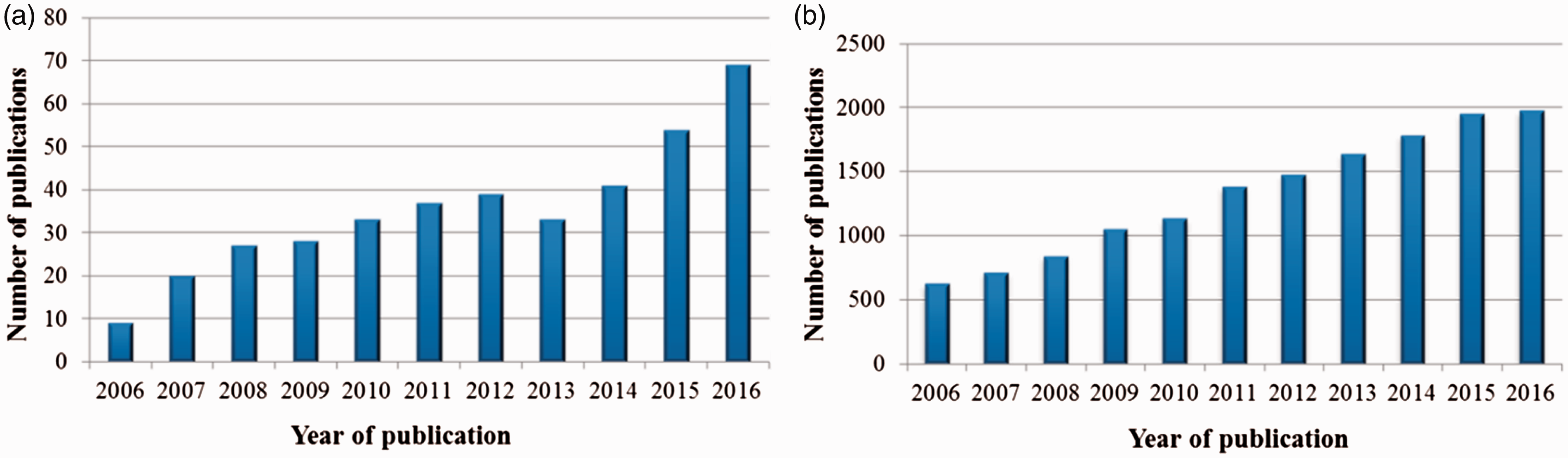
Applications of SERS in Microbial Analysis
Identification of Bacteria in Clinical Biochemistry
As already stated above, whilst the vast majority of microbes play an absolutely vital role to the maintenance of life on Earth, opportunistic and pathogenic bacteria and fungi cause a plethora of well-known infections and diseases in humans, such as urinary tract infections (UTIs), pneumonia, waterborne diarrheal diseases, sepsis, and tuberculosis, as indicated by annual global health reports. 100 For example, invasive fungal infections especially those which are caused by Aspergillus and Candida species are common causes of morbidity and deaths in immunocompromised patients. 101 The most common way of tackling microbial infections is the use of antibiotics or antifungal agents which are prescribed to patients based on the clinical signs and symptoms they exhibit. 102 Although these therapeutic strategies that target surrogate indicators or symptoms of the presence and progression of microbial infections may succeed at times, there is still a high probability of missing the target etiological agents, in which case infections are then likely to persist or recur. Therefore, there is a requirement for the identification of pathogenic bacteria or fungi linked to disease-specific symptoms accurately and reliably, for the early intervention of improved, accelerated, and targeted treatments.98,103,104 This approach would certainly prevent a mismatch between therapeutic strategies and target pathogen, facilitate desirable prognosis and reduce antibiotic/antifungal resistance. 105
Within the last few years, SERS has been shown to be effective in detection and identification of specific pathogenic microorganisms associated with UTIs,97,106 pneumonia,
107
and anthrax,95,108 in order to guide personalized clinical intervention.
109
The research reported by Shanmukh et al. indicated the potential of using SERS in clinical medicine to study the molecular biochemistry of highly pathogenic viruses in blood.
110
This SERS method identified and differentiated between adenovirus type 6, rhinovirus type 4, and human immunodeficiency virus (HIV) correctly based on variations in spectral features and intensities of SERS signals ascribed to the nucleic acids guanine and adenine. This interesting study highlights the ability of SERS to detect trace concentrations of deadly viruses making it a potentially suitable candidate to reveal subclinical and/or asymptomatic infections such as candidemia.
94
With the continuous development of portable Raman spectrometers, SERS can be employed for rapid point-of-care (POC) diagnosis in healthcare especially in rural and remote areas where such infections are highly prevalent. Fig. 4 illustrates how SERS fingerprints and principal component analysis (PCA) can be used to differentiate among microbes of clinical and environmental importance. Using PC1 and PC2, all the three strains namely Bacillus cereus (Gram-positive), Pseudomonas putida, and E. coli cells (both Gram-negative) were clearly discriminated. The tentative assignment of the SERS spectral bands in Fig. 4 is summarized in Table 1.
(a) SERS spectra employed to identify and differentiate among E. coli (black), P. putida (blue), and B. cereus (red). (b) PCA scores plot of the SERS spectra demonstrating the high reproducibility and discriminatory power of the SERS approach.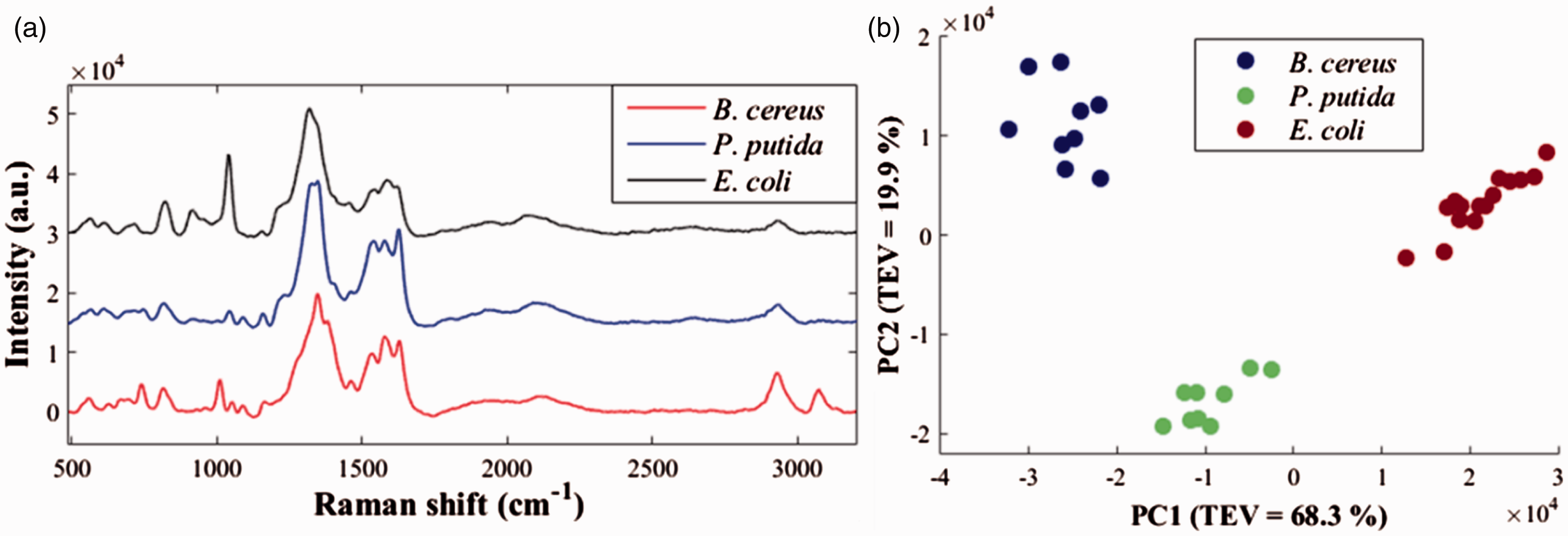
Characterization of Biofilms
Biofilms represent an interfacial collection (community) of multispecies pathogenic and non-pathogenic microorganisms (e.g., bacteria, fungi, protozoa) embedded within complex matrix of extracellular polymeric substances (EPS) of, predominantly, microbial origin. 111 The growth of microbes and the maintenance of biofilm integrity are largely sustained by biopolymers such as carbohydrates, lipids, proteins, humic-like materials, and nucleic acids abundantly found in the EPS. Thus, EPS acts as a supply of energy sources and water reservoir, protection against environmental and physical stress and as a communication medium among microbial cells (quorum sensing). 12 For this reason, microbial cells in biofilms can live longer and subsequently predate mammals and plants. Due to this fact, pathogenic biofilms have the potential to be used as agents of bioterrorism. In clinical medicine, biofilms are associated with the majority (80%) of human microbial infections in healthcare centers. As noted by Donlan and colleagues, biofilms comprising predominantly pseudomonads, staphylococci and Enterobacter species are commonly formed on the surfaces of in-dwelling medical devices and instruments.12,112 When used on especially hospitalized immunocompromised patients (e.g., during an operation and/or organ transplant) pathogen-infested medical devices can deposit biofilms into human body where they cause various infections which can lead to substantial healthcare costs and increased mortality rates. 113 In light of this, there is a need to develop a deeper understanding of microbial diversity and the chemical composition of biofilms in order to identify and develop appropriate biocides and workable antifouling strategies. 114 In industrial wastewater treatment, more in-depth knowledge of biofilms would allow for effective bioremediation strategies. 115
Ideally, analytical platforms that combine rapidity, portability and simplicity are desirable to understand biofilms and combat biofilm infections. 114 Confocal laser scanning microscopy (CLSM) and staining strategies have been successfully used to investigate the molecular constituents and characterize the three-dimensional structures of biofilms at microscopic scale. 116 However, CLSM lacks the desired specificity and penetration depth demanded by the analysis of diverse molecular composition of biofilms. Neu et al. characterized glycoconjugates within EPS matrix in environmental biofilms in situ using fluor-conjugated lectins staining strategy. 117 Their results revealed heterogeneity in molecular composition of the biofilms with high spatial resolution. Despite being useful, the staining method is difficult to employ for comprehensive elucidation of diverse polymeric materials with multiple binding sites present in a complex EPS matrix. By contrast, Raman and FT-IR spectroscopy provide noninvasive, rapid, and holistic qualitative and quantitative means of measuring accurate and characteristic vibrational modes arising from carbohydrates, proteins, lipids, nucleic acids, etc., present in the EPS matrix at ∼1 µm spatial resolution in real time.118,119 Recently, Ivleva and colleagues demonstrated that when Raman is complemented by SERS, highly reproducible, characteristic and integrated spectral information, free of water signals and background fluorescence could be achieved. This method exhibited huge potential for on-site unequivocal interpretation of results which are attainable from various constituents of the aqueous multispecies biofilms in situ. 120 Most importantly, label-free SERS enhances the Raman signal to improve sensitivity to trace amounts of biopolymers in EPS at different stages of biofilm formation, and reduces spectral collection times from minutes to a few seconds.121–123 However, for future investigations of biofilms, a combination of CLSM, Raman, SERS and stable isotopic labeling is envisaged for a comprehensive elucidation of the molecular composition and their spatial distribution in complex EPS matrices during developmental and maturation stages of biofilm formation. 119
Detection of Dipicolinic Acid (DPA), a Biological Warfare Marker
The development and applications of SERS as a highly sensitive and specific fingerprinting technique to detect and quantify biological warfare markers has focused on causative agents of anthrax. Anthrax is a well known and highly transmissible disease caused by Bacillus anthracis, gaining further notoriety when it was used for bioterrorism purposes in the United States of America in 2001. 124 B. anthracis spores were circulated in letters and other mail packages in Florida and New Jersey to their intended targets. Since B. anthracis forms a spore by developing a hard protective proteinaceous coat around the cellular genetic material, 125 it can survive harsh conditions like UV, heat, droughts, pH fluctuations, and harsh chemicals for significant periods.126,127 If inhaled, the spores germinate into active vegetative states and produce toxic chemicals associated with swelling of the lungs and internal bleeding as the reactivated cells multiply rapidly. 128 To accelerate response strategies with respect to the bioterrorism attacks and threats using inhalation anthrax, it has become increasingly important to detect and identify specific anthrax spores rapidly for quick intervention of therapeutic strategies. Techniques such as traditional culturing and PCR have been commonly used as the gold standard to identify and characterize Bacillus spores including those of virulent subspecies.129,130 Nonetheless, the time required to complete bacterial analysis using these techniques is typically in the range of several hours to days. 131 A viable alternative is to detect dipicolinic acid (DPA; pyridine-2,6-dicarboxylic acid), a unique characteristic chemical marker produced in late sporulation, and which comprises about 1–14% of the dry weight of a spore. 126 Dipicolinic acid has been detected by many research groups using ultraviolet RR, 132 mass spectrometry,133,134 chromatography, 135 potentiometric sensors, 136 and FT-IR.134,137
Qualitative and quantitative analytical approaches utilizing SERS with lower limits of detection (LOD) have shown considerable promise in the last two decades. The direct quantitative detection of trace levels of DPA down to 29.9 nM (well below the infective dose of B. anthracis ∼104 cells) and 10 µM using inexpensive silver colloids has been reported.95,138 Jarvis et al. demonstrated a clear qualitative correlation between the SERS spectral profile of DPA extracted from Bacillus spores and that of their vegetative cells,
139
and subsequent studies exploiting super-hydrophobic copper wires showed that the DPA signal allowed for the detection of just 18 spores.
108
There are other chemical compounds produced by Bacillus spores that have been detected as anthrax biomarkers. The study by Gao and colleagues provides a recent example of the potential to detect and quantify poly-γ-
Functional Analysis of Microorganisms Using Stable Isotopic Labeling Technique
Within the recent two decades, stable isotope probing (SIP) has emerged to be the state-of-the-art means of studying functional properties and substrate degradation pathways of individual unculturable members of a mixed microbial community directly.61,142–144 Stable isotope probing employs the “you are what you eat” concept, 145 which involves the incubation of cells with stable isotopes. This is followed by detection of the isotopic content in cellular biomarkers such as polar-lipid-derived fatty acids (PLFA), 146 nucleic acids (DNA/RNA),147–149 and simultaneous identification of distinct microbes actively metabolizing the labeled substrate. Substrates labeled with stable atoms of carbon (13C) and nitrogen (15N) are commonly employed as single or dual labels in microbial cells, which can use them to maintain their normal life. In terms of vibrational spectroscopy, spectral bands of the cells metabolizing isotopically enriched substrates shift to lower wavenumbers (red shift) and are clearly distinguished from those that do not incorporate the labeled isotopes, whose peaks remain on the same wavenumbers before and after the labeling process. Very recently, we demonstrated the feasibility of using FT-IR, Raman spectroscopy, and multivariate analysis to detect E. coli cells labeled with varying ratios of 12C/13C-glucose and/or 14N/15N-ammonium chloride at population and single cell levels. 39 The results showed that cells enriched with varying amounts of 13C and/or 15N labeled substrates could be differentiated from each other based on their Raman and FT-IR spectral band shifts. This illustrated the exciting prospects of using FT-IR and Raman-SIP as complementary tools to identify microbial cells at different levels of substrate incorporation in a complex microbial community.
Similarly, Huang et al. successfully identified citrate degrading microbes using reverse isotopic labeling with unlabeled citrate. 99 Initially, cells were grown on 13C-glucose and their Raman bands shifted to lower wavenumbers showing full incorporation of 13C to cells followed by incubation of the same cells on 12C-citrate as a single carbon source. The red shifted Raman bands of Acinetobacter baylyi ADP1 due to 13C-glucose incorporation reverted back to their initial wavenumbers after growth on 12C-citrate. There were no spectral shifts observed for E. coli DH5α-GFP cells under the same conditions as they could not utilize citrate compound. Interestingly, D2O was also used to sort metabolically active cells grown on 12C-citrate as a carbon source. The Raman spectrum of A. baylyi ADP1 shows a broad peak in 2050–2300 cm−1 region ascribed to C–D stretch which was absent in the spectrum of E. coli DH5α-GFP, confirming the general metabolic activity of A. baylyi ADP1 in the presence of 12C-citrate. This technique, termed reverse isotopic labeling, illustrates the viability of employing unlabeled substrates as sorting criteria of microbial cells that degrade organic pollutants whose labeled analogues are either too expensive or not commercially available.
The application of SERS to observe functional activities of bacterial communities is showing considerable promise, and SERS-SIP applied in this vein was first reported by Kubryk et al. in 2015,
73
and three other reports have emerged to date.4,150,151 Recently SERS-SIP revealed the possibility of applying SERS imaging to detect and identify 13C and 15N labeled cells in a community from very low concentration of biomass using in situ synthesis of Ag NPs (Fig. 5).
151
Fig. 5 shows clear shifts of SERS bands to lower wavenumbers for 13C and 15N incorporated cells due to protein (C–N) vibrations and corresponding images highlighting differentiation of bacteria at the single-cell level. Although Raman and SERS-SIP is showing increasing potential in microbial ecology, spectral features measured from bacteria which are at different stages of cell growth show significant variation.
71
Furthermore, the variations in environmental conditions (e.g., pH) can alter the composition of bacterial cells resulting in changes in Raman or SERS spectral fingerprints. This may complicate spectral interpretation and the identification of microbes may be very difficult, though spectral shifts could be detected when heavy atoms are incorporated. In modern integrated analysis, these problems could be overcome by employing genomics-based tools, e.g., fluorescence in situ hybridization (FISH) and RACE,152,153 to screen cells in order to confirm Raman or SERS fingerprints as demonstrated previously.61,153,154
SERS image of isotopically labeled intact single E. coli cells. (a) SERS and corresponding white light image of three single E. coli cells, and representative spectra of each single bacterium (indicated by the arrows). The gray shading represents peak intensity at 1588 cm−1. (b) PCA scores images reconstruction of the SERS spectral data collected between 500–1800 cm−1, and their corresponding loadings plot; the first PC score is not shown as this only differentiates between bacterial biomass and CaF2 background. (Reproduced from Chisanga et al.,
151
with permission from The Royal Society of Chemistry.)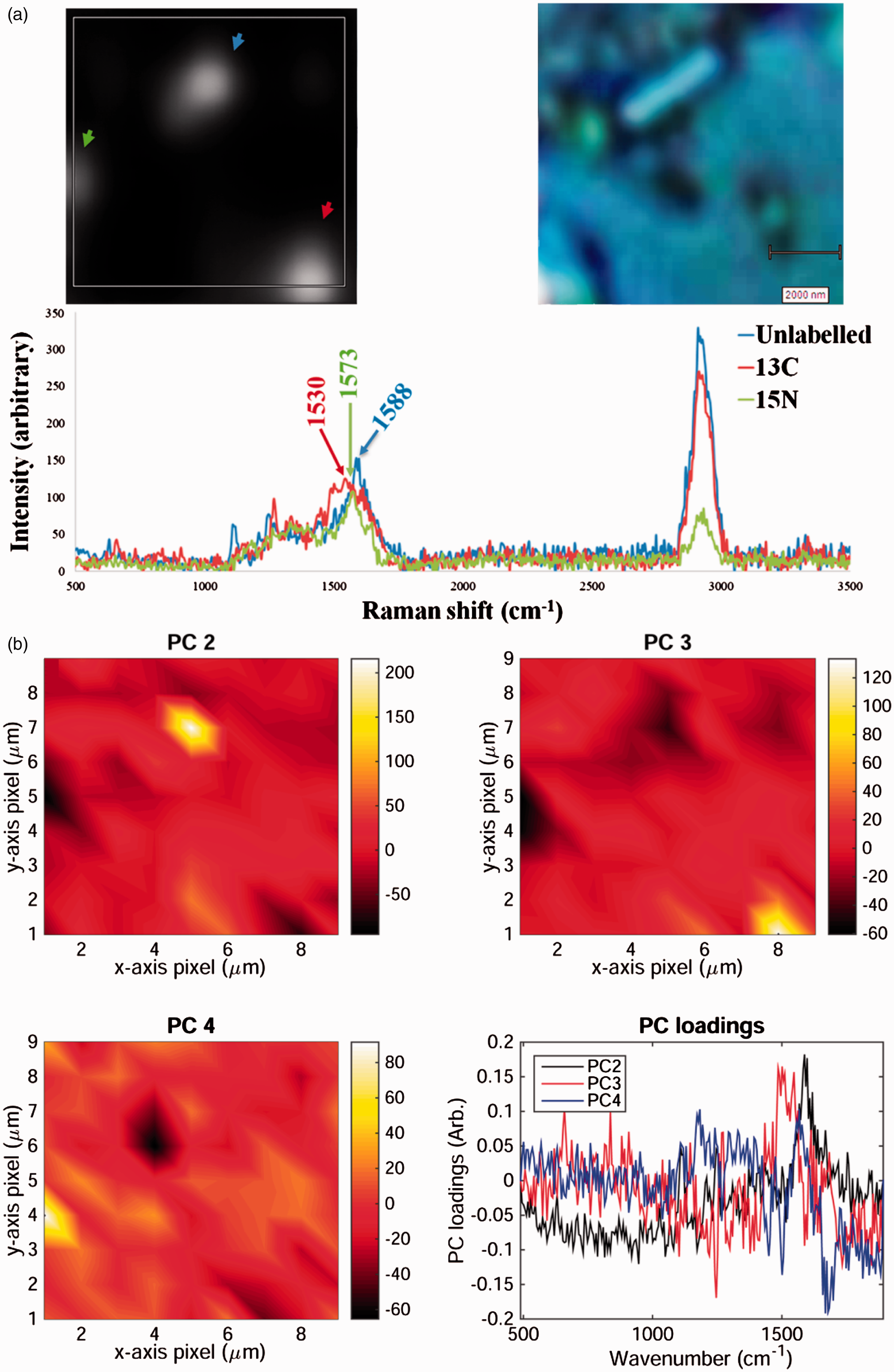
Conclusion
In this review article, we have discussed the applications of SERS spectroscopic methods and techniques for the identification, differentiation, and discrimination of a range of microbes in several areas of topical interest. Much emphasis has been placed on the current and future potential applications of SERS in diverse microbial studies, taking advantage of the continuous technological advances in Raman instrumentation which employs relatively inexpensive materials to increase their sensitivity further in order to detect extremely low concentrations of analytes. This is particularly important in addressing high rising food poisoning cases for example, as well as dealing with potential bioterrorism threats involving deadly microbial pathogens and biowarfare agents, where minute concentrations would cause serious harm to human communities be they military or civilian. Additionally, we believe that when FT-IR, Raman, and SERS are integrated with other tools such as CLSM, genomics-based analytics, and multivariate chemometrics, they will increasingly present an interesting and innovative platform for the comprehensive characterization of infectious microbes and biofilms, significantly expanding on current knowledge. Additionally, it is believed that the development of on/at/in-line Raman techniques would provide rapid, efficient and cost-effective analysis for monitoring microbial infections as well as environmental pollution in real time on-site without the need to transport the samples to the laboratory. In contemporary microbial ecology, these complementary tools, coupled with robust cell sorting techniques including robust MNPs and RACE, and metabolomics, may elucidate the link between uncultivated microbial cells (gene) and various observable microbially mediated environmental bioprocesses (functions) they are associated with. This knowledge will be vital in improving bioremediation processes, for instance in community wastewater treatment plants (as well as those located in the increasing number of nuclear power plants) where the identity of pollutant-degrading microbes is absolutely essential in helping to degrade and maintain the levels of a wide range of pollutants with less or non-intoxicating limits.
Footnotes
Acknowledgments
We would like to thank The Royal Society of Chemistry for giving us permission to reproduce  from Chisanga et al.
151
RG would like to sincerely thank Applied Spectroscopy for their kind invitation to write this Focal Point Review article.
from Chisanga et al.
151
RG would like to sincerely thank Applied Spectroscopy for their kind invitation to write this Focal Point Review article.
Conflict of Interest
None declared.
Funding
This work was supported by the Commonwealth Scholarship Commission, UK, the European Commission's Seventh Framework Program (STREPSYNTH; project number 613877), and UK BBSRC (grant number BB/L014823/1).