







Abstract
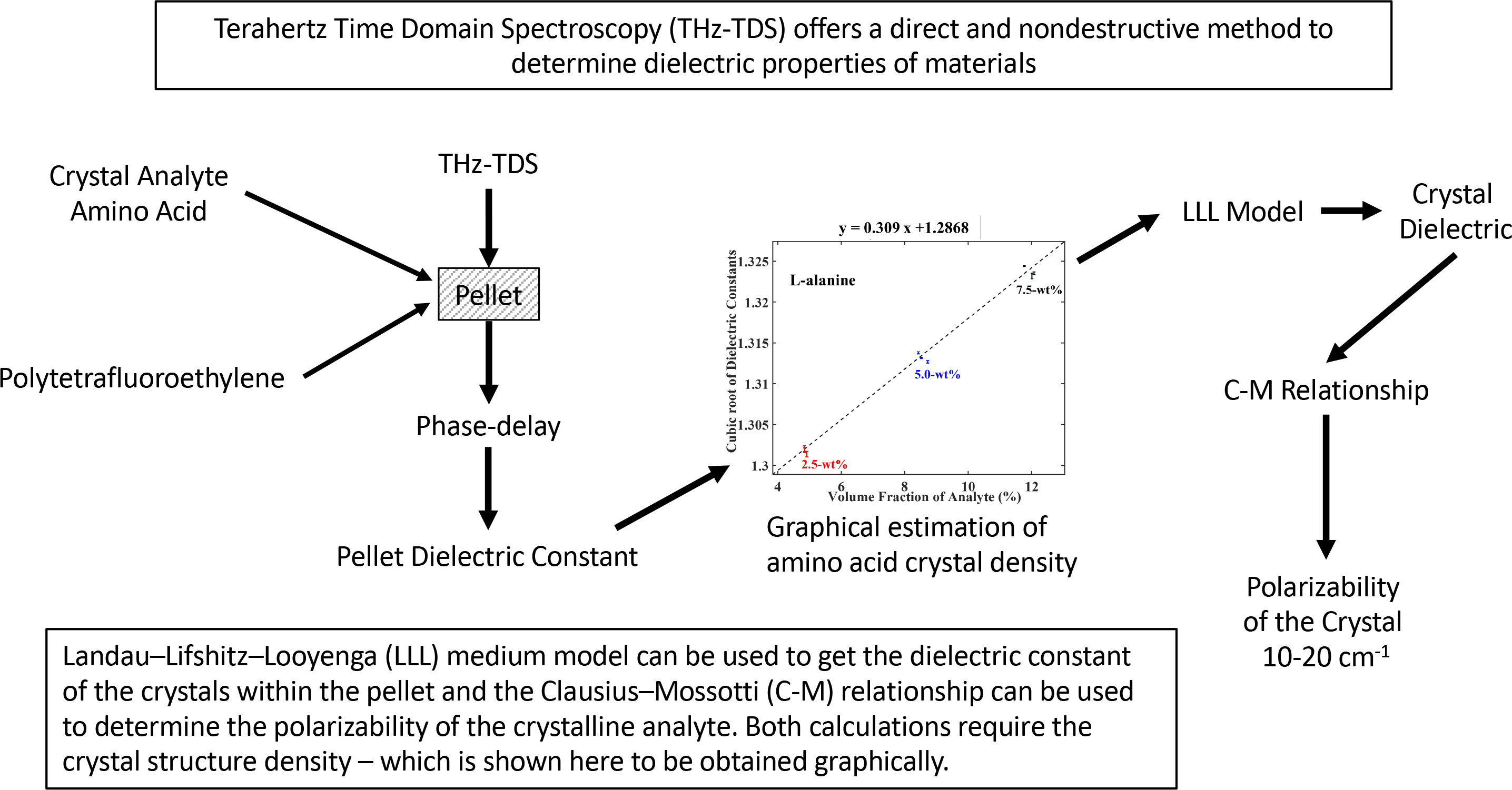
Terahertz (THz) time-domain spectroscopy provides a direct and nondestructive method for measuring the dielectric properties of materials directly from the phase delay of coherent electromagnetic radiation propagating through the sample. In cases when crystals are embedded within an inert polymeric pellet, the Landau, Lifshitz, and Looyenga (LLL) effective medium model can be used to extract the intrinsic dielectric constant of the crystalline sample. Subsequently, polarizability can be obtained from the Clausius–Mossotti (CM) relationship. Knowledge of the crystal structure density is required for an analytical solution to the LLL and CM relationships. A novel crystal structure-free graphical method is presented as a way to estimate both dielectric constants and polarizability values for the situation when the crystal structure density is unknown, and the crystals are embedded within a pellet composed of a non-porous polymer. The utility of this crystal structure-free method is demonstrated by analyzing THz time-domain spectra collected for a set of amino acids (L-alanine, L-threonine, and L-glutamine) embedded within pellets composed of polytetrafluoroethylene. Crystal structures are known for each amino acid, thereby enabling a direct comparison of results using the analytical solution and the proposed crystal structure-free graphical method. For each amino acid, the intrinsic dielectric constant is extracted through the LLL effective medium model without using information of their crystal structure densities. THz polarizabilities are then calculated with the CM relationship by using the determined intrinsic dielectric constant for each amino acid coupled with its crystal density as determined graphically. Comparison between the analytical and graphical solutions reveal relative differences between dielectric constants of 3.7, 5.1, and 13.6% for threonine, alanine, and glutamine, respectively, and relative differences between polarizability of 0.6, 0.9, and 5.4%, respectively. These values were determined over the 10–20 cm−1 THz frequency range. The proposed method requires no prior knowledge of crystal structure information.
Keywords
Introduction
Polarizability describes the distribution of electron density within a material in response to an external electric field.1,2 Intrinsic properties of solid-state materials, such as melting point, solubility, electronic susceptibility, and others, are related to polarizability making it an important design criterion for novel materials engineered for specific applications, such as active pharmaceutical ingredients and nonlinear optical crystals.3−5 The Clausius–Mossotti (CM) relationship is commonly used to derive polarizability values from the dielectric properties of a material. 6 Frequency of the oscillating electric field impacts the measured polarizability and different mechanisms of charge oscillations can be probed by examining the frequency dependence of polarizability measurements. Experimentally, dynamic polarizability has been examined over a wide range of frequencies, including those over kHz, MHz, GHz, and optical frequencies.7−10
Terahertz (THz) frequencies probe long-range intermolecular interactions within crystalline materials, which makes the measurement of polarizability at THz frequencies uniquely advantageous for characterizing polymorphism of organic crystals as well as long-range intermolecular interactions within organic cocrystals.11,12 The coherent detection of terahertz time-domain spectroscopy (THz-TDS) provides a straightforward method for directly measuring both refractive index and dielectric properties of materials from which polarizability can be derived. Examples include THz polarizabilities of liquid crystals, branched alkanes, and glasses where the dielectric constants are measured from pure bulk substances.13−18 Such measurements require the material of interest to be available in a purified state with sufficient mass and volume to enable measuring differences in the phase of the THz wave after propagating through the sample. Sample sizes must be large enough in surface area as well as thickness in order to ensure a sufficient interaction between the THz wave and sample molecules.
For crystals only available in small dimensions, such as sub-millimeter crystalline forms, THz polarizability measurements have been demonstrated by embedding a population of crystals within an inert amorphous polymer matrix. 12 The Landau, Lifshitz, and Looyenga (LLL) effective medium model can be used to separate the dielectric properties of the crystals and the polymer matrix, thereby enabling determination of the polarizability properties of the crystalline solutes. An analytical solution is available for such polarizability measurements when the crystal structure is known. 12 Prior knowledge of the density of the crystal (taken from its crystal structure) coupled with both the LLL effective medium model and the CM relationship widens the breadth of samples for which THz polarizability measurements are possible.
This work extends the scope of THz-TDS further by demonstrating the ability to extract both dielectric and polarizability information when the crystal density is unknown. When known, the crystal density can be used to establish the volume fraction of crystals within sample pellets, thereby enabling an analytical solution. When a measure of the crystal density is unavailable, we propose that the fraction of the pellet volume occupied by sample crystals can be estimated adequately by a graphical method. This estimation is possible when the porosity of the polymer matrix is essentially zero, which enables the sample pellets to be modeled as two components (polymer and analyte) versus the more general ternary model consisting of polymer, analyte, and air. 12 As reported elsewhere, compressed polytetrafluoroethylene (PTFE) offers a matrix essentially free of trapped air. 19 Polytetrafluoroethylene pellets are also physically and chemically stable over time while being nearly transparent over THz frequencies. 19
The feasibility of the proposed graphical approach is illustrated here by analysis of THz-TDS data collected for a group of three amino acids: L-alanine, L-threonine, and L-glutamine. In this work, THz time-domain spectra were collected over the 10–100 cm−1 frequency range for pellets composed of PTFE and crystals of the individual amino acids. Crystal structure density is known for each amino acid which enables a direct comparison of dielectric and polarizability values calculated by both the conventional analytical method and the proposed graphical method. The consistency between results demonstrates the effectiveness of the proposed approach.
Experimental
Sample Preparation
The amino acids L-alanine, L-threonine, and L-glutamine were purchased from Sigma Aldrich with purities ≥ 99.0%. Polytetrafluoroethylene was obtained from Micro Powders as a powder (FLUO 625F) with a particle size distribution of 9–13 µm.
Pellets were prepared from mixtures of PTFE and the amino acid. Each amino acid was ground to a fine powder with a mortar and pestle, and this powder was dried in an oven at 60 ℃ for 24 h. The dried amino acid powders were cooled and stored in a desiccator before use. For each amino acid, three mixtures were prepared by co-grinding powders of the amino acid and PTFE to give weight-percent values of 2.5, 5.0, and 7.5 wt%. Pellets were prepared in triplicate from each mixture, resulting in nine pellets for each amino acid. Pellets were prepared in a 13 mm diameter stainless steel die in conjunction with a Specac hydraulic press (GS15011). Before compression, a vacuum was applied to the mixture within the die for two minutes to remove trapped air and moisture. While maintaining this vacuum, a pressure of five tons was applied to the powder for five minutes. Each pellet was removed from the die and transferred immediately to a desiccator where it was permitted to relax for three days before collecting spectral measurements. 19 Dimensions for the resulting disk-shaped pellets were nominally 13 mm in diameter and 1.5 mm thick.
Polystyrene is an alternative to PTFE as the polymer matrix. Polystyrene is highly transparency over THz frequencies and possesses essentially zero porosity when used to press pellets of organic crystals. 19
Instrumentation
The THz-TDS was carried out with a TeraView TPS Spectra 1000D THz time-domain spectrometer (TeraView Limited, UK). A detailed description of this instrument is provided elsewhere. 20 Each THz frequency-domain spectrum was derived from 1800 co-added time-domain spectra collected over one minute. Each time-domain spectrum was converted to the frequency-domain using typical Fourier processing and the resulting frequency-domain spectra had a spectral resolution of 1.2 cm−1. The standard transmission configuration was used throughout and measurements were made in a purged sample chamber maintained at ambient temperature (≈23 ℃).
The following protocol was used to collect the THz spectra for each pellet. First, the sample chamber was purged with dried air for five minutes followed by collecting an air background spectrum. After placing the pellet in the optical path, the chamber was again purged for five minutes and then triplicate spectra were collected back-to-back-to-back. This protocol was completed three separate times for each pellet, resulting in nine spectral replicates for each pellet.
Data Processing
Spectral analysis was performed over a frequency range from 10–100 cm−1 (0.3–3.0 THz). The phase delay


Results and Analysis
Frequency-dependent dielectric and absorption spectra are presented in Fig. 1 for each amino acid. Absorption features are highlighted by a set of vertical bars with the central frequency denoted above each bar. These amino acid absorption bands match those reported previously.21−23
Dielectric spectra (upper curves) and absorption spectra (lower curves) of amino acids embedded in PTFE pellets at three mass concentrations: 2.5%, 5.0%, and 7.5 wt%. Each of the three measurements is provided for each tested concentration. Vertical bars indicate the corresponding positions of absorption features with specified central wavenumbers and frequencies.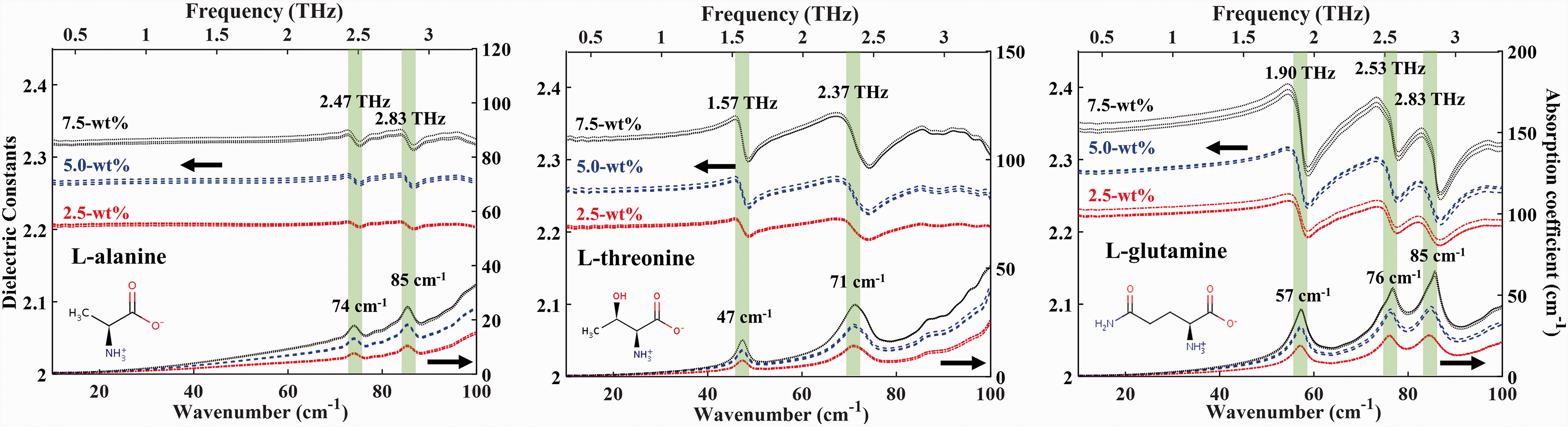
Three sets of dielectric spectra are presented for each amino acid corresponding to the different amino acid concentrations. It is important to keep in mind that these spectra correspond to the entire pellet composed of a mixture of PTFE and the amino acid. Although PTFE is nearly transparent over THz frequencies, it still acts as a dielectric substance and contributes to the delay of the THz wave while propagating through the PTFE/amino acid pellet. As a result, dielectric values are similar for pellets with the different amino acids present at the same concentration. This observation underscores how PTFE dominates the phase delay and dielectric response when amino acid concentrations are ≤ 7.5 wt%.
Extraction of Intrinsic Dielectric Properties
Several effective medium theories have been investigated over THz frequencies, including the Maxwell and Garnet model, Polder and van Santen model, Bruggeman model, and the LLL model. 24 Of these theories, the LLL model is preferred in the current study because it can be applied without considering the shape of the particles and the dielectric contrast between amino acids and PTFE is sufficiently low to satisfy this constraint of the LLL model. Finally, the relative simplicity of the LLL model lends itself to the proposed graphical approach.
According to the LLL model, the dielectric properties of the pellet can be treated as the sum of three cube root terms corresponding to the analyte, polymer, and any trapped air within the pellet matrix. Equation 3 provides the general expression for a ternary mixture

The following sections describe the analytical and graphical solutions for the intrinsic dielectric constants of analyte,
Analytical Solution
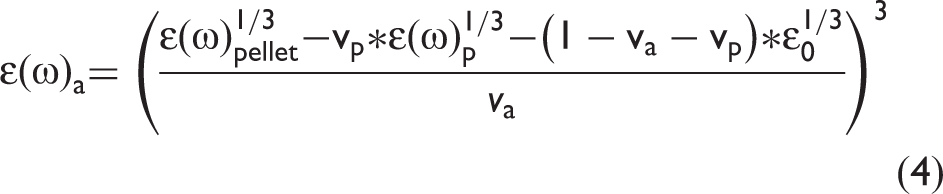
The intrinsic dielectric property of the amino acid can be obtained by rearranging Eq. 3 to give Eq. 4 and knowing: (i) the dielectric properties of both the polymer and air as well as (ii) the volume fraction of each component in the pellet matrix. The dielectric properties of PTFE were determined previously over the 10–100 cm−1 spectral range from measurements on pellets composed only of PTFE and the dielectric value for air
Volume fractions for the analyte (amino acid) and polymer (PTFE) require knowledge of the mass of each component within the pellet, the density of each component, and the geometric volume of the pellet. Equations 5 and 6 show the calculation for these volume fractions, where VPTFE, Vanalyte, and Vpellet are the volumes of the polymer, analyte, and pellet, respectively, mPTFE and manalyte are masses of polymer and analyte in each pellet, and r and d correspond to the radius and thickness of the disk-shaped pellet, respectively.


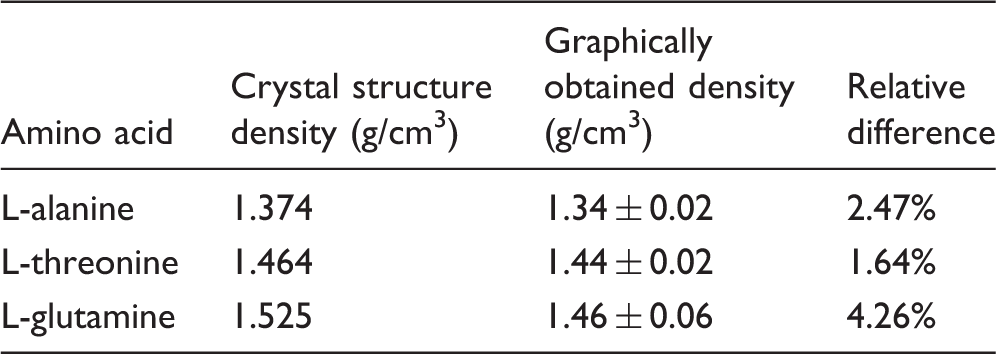
The density of PTFE in Eq. 5 was taken as 2.2634 ± 0.0006 g/cm 3 as reported before from analysis of compressed blank PTFE pellets prepared from Micro Powders FLUO 625 F. 12 Densities of the amino acids were taken from literature reports of single crystal X-ray diffraction experiments. These values are 1.374 g/cm 3 for L-alanine, 25 1.464 g/cm 3 for L-threonine, 26 and 1.525 g/cm 3 for L-glutamine. 27
Dielectric spectra were determined for each amino acid by using the sample spectra presented in Fig. 1 and applying the relationships given in Eqs. 4 to 6. The resulting amino acid dielectric spectra are presented in Fig. 2. As expected, the measured dielectric values are independent of concentration within the pellet. The similarity in magnitude and shape across multiple pellets and with different concentrations of amino acids demonstrates the effectiveness of this method. The differences in shape and magnitude observed for L-threonine and L-glutamine are likely caused by heterogeneities created within the pellets during fabrication. These deviations are also reflected in the larger measurement uncertainties reported for the analytical solutions listed below in Table II.
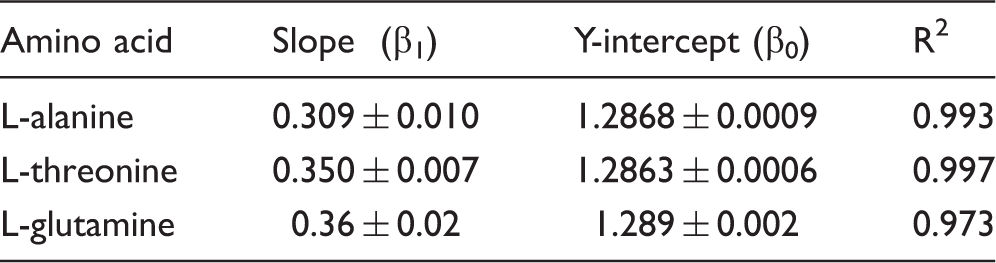
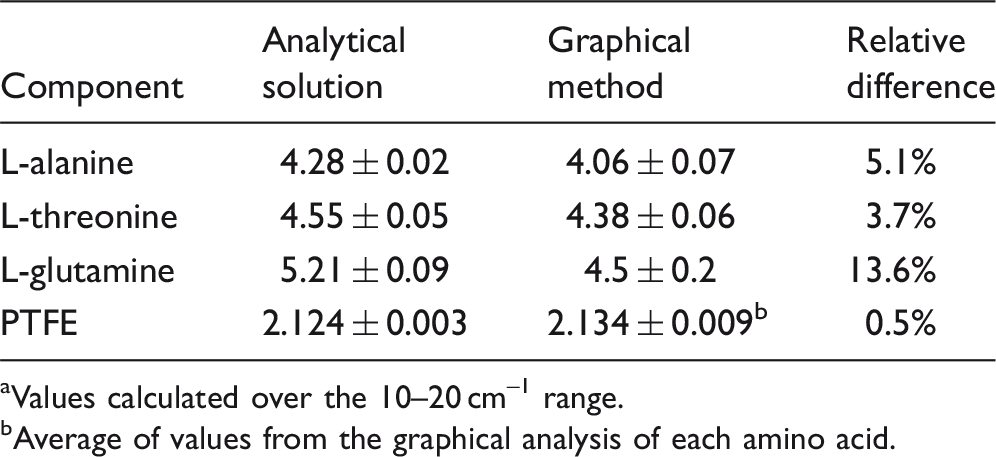
Intrinsic dielectric spectra for each amino acid extracted by the LLL-model from mixture pellets at different mass concentrations of 2.5%, 5.0%, and 7.5 wt%. Linear regression coefficients for plots in Figure 3. Intrinsic dielectric constants determined with the analytical solution and crystal structure-free graphical method.
a
Values calculated over the 10–20 cm–1 range. Average of values from the graphical analysis of each amino acid.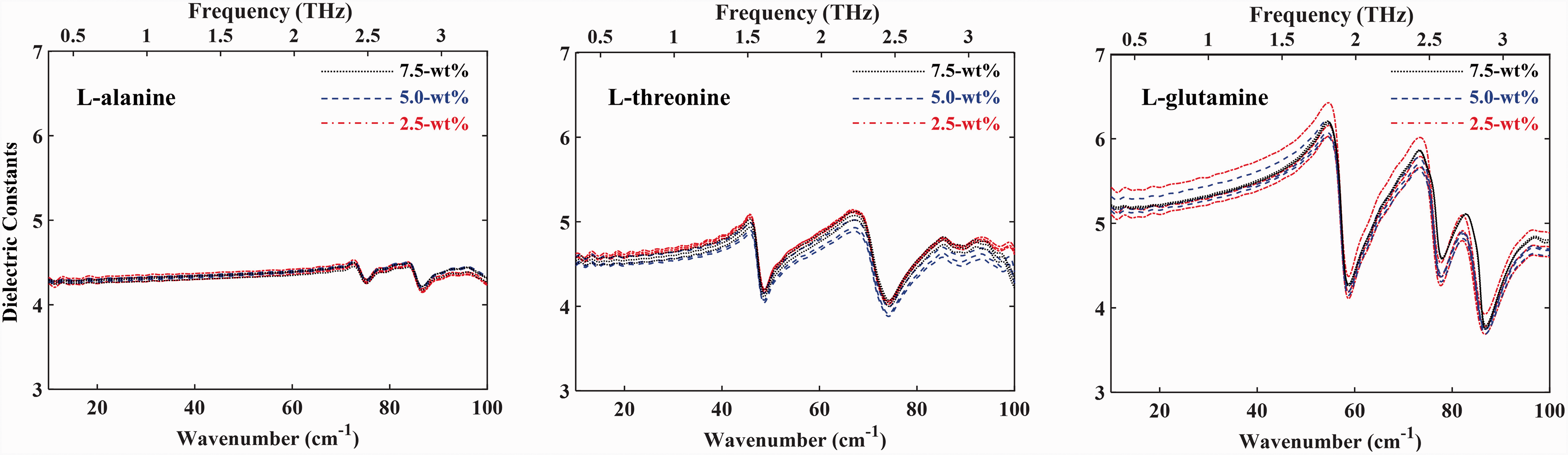
Crystal Structure-Free Method
The aforementioned analytical solution of the LLL model is straightforward as long as the crystal density is known. For situations where the crystal structure density is unknown, the volume fraction of the crystal analyte must be estimated to proceed with the calculation.
For PTFE, the volume fraction of trapped air (1 – να – νp) is negligible for compressed pellets.
19
Volume fractions of air can be obtained for the above analytical solution and are found to be 0.4 ± 0.4%, 0.2 ± 0.2%, and 0.2 ± 0.1% for the pellets of L-glutamine, L-alanine, and L-histidine, respectively. Equation 3 simplifies to the binary model shown in Eq. 7 under the assumption that the porosity of the pellet is zero, meaning the pellets contain no trapped air.

A linear relationship between Correlation plots between cube roots of dielectric values of mixture pellets and estimated analyte volume fractions for each amino acid.
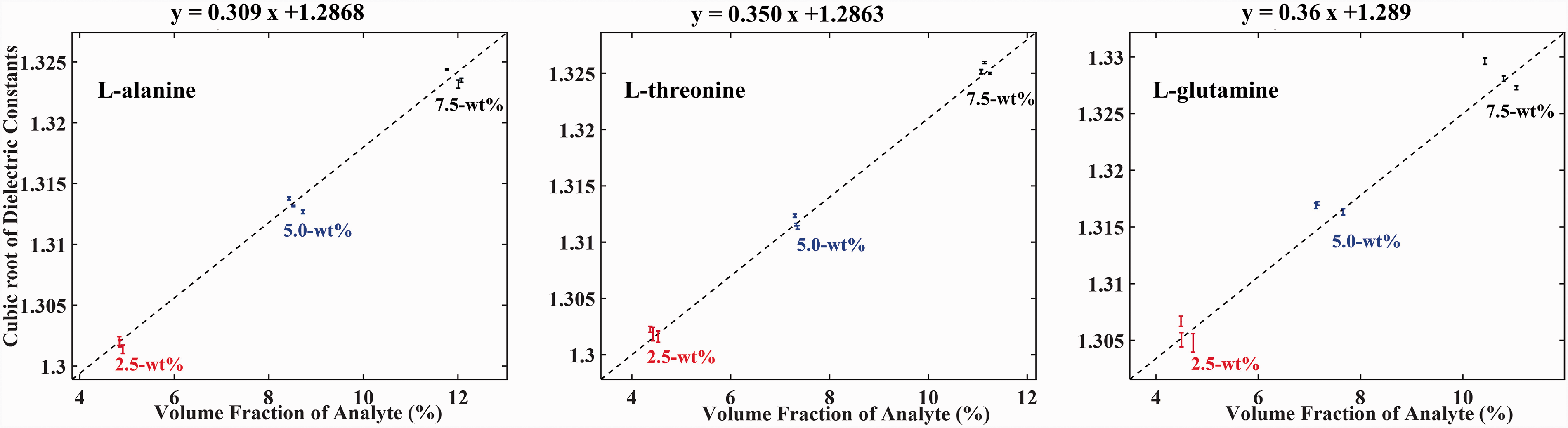
The intrinsic dielectric properties of the polymer and amino acids can be obtained from the regression coefficients. As indicated in Eq. 8,
Table II summarizes the measured dielectric constants over the 10–20 cm−1 frequency range for each amino acid (
For values in Table II determined by the crystal structure-free approach, uncertainties in
Results from the crystal structure-free graphical method are comparable to those from the analytical solution with relative differences ranging from 3.7 to 13.6%. In each case, the estimated value of
THz Polarizability of Amino Acids


Crystal structure densities and graphically determined densities.
Polarizability values from the analytical and graphical methods. a
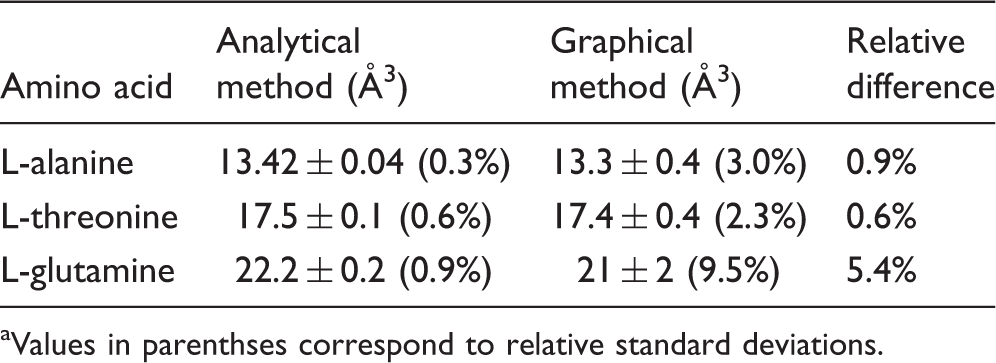
Values in parenthses correspond to relative standard deviations.
Conclusion
Complete characterization of novel organic crystals and cocrystals demands determination of both dielectric and polarizability properties. THz-TDS offers a convenient method to determine these properties in a nondestructive manner. The direct measure of phase delay from the time-domain THz spectrum affords a direct measure of refractive index and dielectric properties of samples. The LLL effective medium model allows dielectric measurements on small crystalline samples embedded within inert polymeric matrixes and the CM relationship enables polarizability values for such crystalline samples.
Crystal density is a critical parameter required for determinations derived from the LLL model and CM relationship. In many cases, the crystal structure is known for the organic crystal or cocrystal material from which the crystal structure density can be used to achieve an analytical solution to obtain both dielectric and polarizability values. In the absence of crystal structure information, however, the approach demonstrated here can be used to obtain a reasonable estimate of both dielectric and polarizability for crystals embedded within an inert polymeric matrix. Although crystal structures are generally known for active pharmaceutical ingredients and other valuable solid-state materials, the proposed method offers a way to characterize short-lived polymorphic states and, potentially, amorphous materials.
Robustness of the crystal structure-free graphical method depends on the accuracy of the LLL model to describe the effective medium properties of crystalline samples embedded within a non-porous polymeric matrix. The fact the LLL model is independent of particle shape bodes well for the general application of the proposed method, at least for cases where the dielectric contrast within the sample pellet is below 6.65, as demonstrated by previous studies 24 with calcium carbonate crystals embedded within a polypropylene matrix.
Footnotes
Declaration of Conflicting Interests
The author(s) declared no potential conflicts of interest with respect to the research, authorship, and/or publication of this article.
Funding
This work was partially supported by funds associated with the Edwin B. Green Chair Professorship in Laser Chemistry as administered by the College of Liberal Arts and Sciences at the University of Iowa. This work was also supported by the National Natural Science Foundation of China (No. 62005014) and the Fundamental Research Funds for the Central Universities (FRF-TP-20-015A1) at the University of Science and Technology Beijing. In addition, the financial support provided by the China Scholarship Council (No. 201506460064) during a visit of Tianyao Zhang to the University of Iowa is gratefully acknowledged.
