






Abstract
Recent advances in spectroscopic techniques have provided molecular insights into the supramolecular structures of ethanol–water clusters (EWC) in alcoholic beverages. Sensory quality of these beverages is not only governed by trace flavor compounds but is fundamentally influenced by the dynamic, hydrogen-bonded networks formed between ethanol and water molecules. This review summarizes progress in elucidating the structural characteristics, stability, and transformation mechanisms of EWC across different alcoholic matrices, with a particular emphasis on contributions from multiscale spectroscopic methods including infrared (IR), Raman, nuclear magnetic resonance (NMR), and fluorescence spectroscopy, often coupled with two-dimensional correlation analysis. We further examine how external factors (temperature, electric fields) and endogenous components (acids, esters) modulate EWC architecture and, consequently, perceived taste and mouthfeel. By integrating spectroscopy with computational modeling and artificial intelligence, a more predictive understanding of EWC behavior is emerging, offering a robust scientific foundation for real-time quality monitoring, process optimization, and tailored sensory design in the beverage industry.
This is a visual representation of the abstract.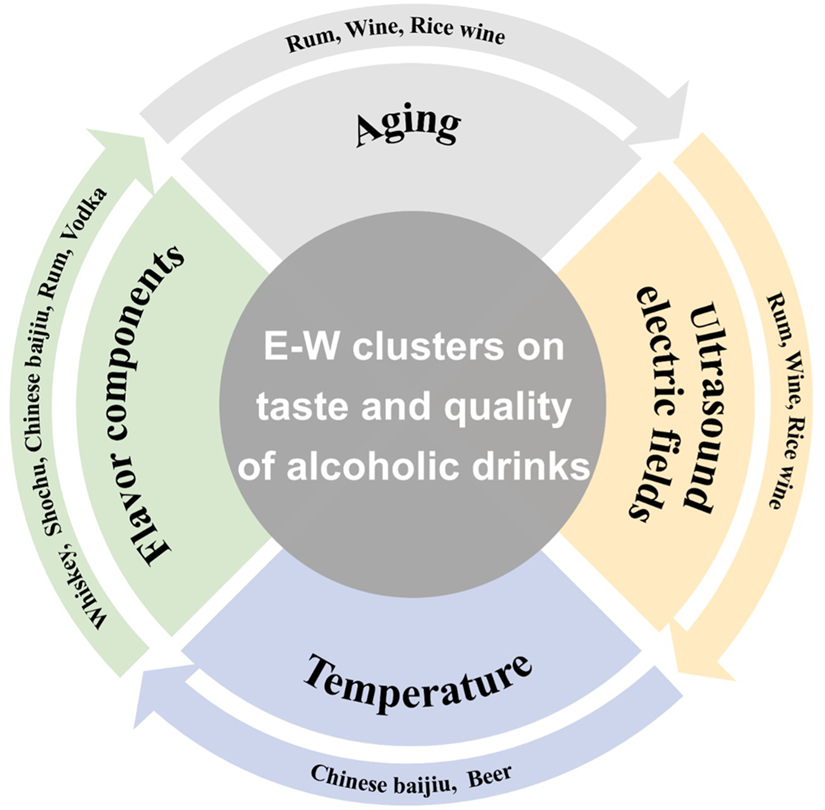
Keywords
Introduction
Unlike ideal solutions, ethanol–water mixtures exhibit many anomalous physicochemical properties, such as negative partial molar volumes and negative excess entropy.1–5 These anomalous characteristics are typically attributed to the non-ideal mixing of ethanol–water solutions at the molecular level and the hydrogen-bonding network they form. Alcoholic beverages are complex multicomponent systems in which ethanol and water account for more than 98% of the total mass. While trace aroma compounds have long been regarded as key factors influencing the quality and flavor of alcoholic beverages.6–8 A growing body of evidence indicates that the supramolecular organization of ethanol and water mediated by hydrogen bonding plays an equally critical role in defining sensory attributes such as smoothness, pungency, and overall mouthfeel of the beverage.9–11
Traditional analytical methods, such as high-performance liquid chromatography, mainly focus on quantifying trace compounds,12–14 but fall short of capturing these non-covalent, structurally labile assemblies. By contrast, spectroscopy is capable of resolving hydrogen-bonding networks, molecular motions, and cluster dynamics at relevant time and length scales. 15 Over the past decade, techniques such as Raman,9,16–18 infrared (IR),18,19 nuclear magnetic resonance (NMR),18,20–22 fluorescence spectroscopy9,23,24 and terahertz spectroscopy25,26 have been increasingly deployed to decode the elusive structures of ethanol–water clusters (EWC) in both model solutions and authentic beverages.
This review highlights how spectroscopic methods have advanced our understanding of EWC formation, stability, and transformation under varying compositional and environmental conditions. Spectral signatures from OH-stretching bands to chemical shift perturbations reveal clustering patterns associated with ethanol concentration, 27 temperature,27,28 applied fields,19,29 and the presence of minor constituents.22,23,30,31 Furthermore, this review outlines emerging synergies among spectroscopy, molecular dynamics simulations, and machine learning, which integration promise to transform cluster analysis from a descriptive endeavor into a predictive tool for quality control and innovative product development.
Spectroscopic Arsenal: Key Techniques for Probing Ethanol–Water Clusters
Due to the dynamic nature, 32 non-covalent interactions,5,33,34 and micro-heterogeneity 35 of EWC, elucidating their structure, dynamics, and stability presents a significant analytical challenge. Spectroscopic techniques, with their ability to probe specific molecular interactions and environments, have become indispensable tools in this research field. Different spectroscopic techniques can provide distinct molecular information, and their synergistic application collectively constructs a multifaceted view of EWC behavior in alcoholic beverages.
Vibrational Spectroscopy: Fingerprinting the Hydrogen-Bond Network
Vibrational spectroscopy, including IR and Raman spectroscopy techniques, can directly reflect changes in hydrogen bonding. Among these, the O−H stretching region (∼3000–3600 cm−1) serves as a key spectral range for revealing information about hydrogen bonds. IR spectroscopy can directly reflect changes in the dipole moment during molecular vibrations. In ethanol–water mixtures, the broad O−H stretching band is formed by the superposition of contributions from water–water, ethanol–water, and ethanol–ethanol hydrogen bonds of varying strengths. A shift of this band to lower wavenumbers indicates an increase in the number or strength of hydrogen bonds. For instance, in the rice wine sample treated with a high-voltage electric field (5 kV/cm, 120 min), the νOH peak position significantly redshifted from 3340 cm−1 in the fresh wine to 3311 cm−1. This redshift was even more pronounced than that observed in the naturally aged mature rice wine (3324 cm−1). This IR spectral feature directly reveals the enhancement of hydrogen bonding between ethanol and water, providing a molecular-level explanation for the smoother and softer taste of the treated rice wine. 19
In addition, Raman spectroscopy, as a complementary technique sensitive to changes in polarizability, is well suited for aqueous systems.36,37 It not only provides analogous information on O−H stretching vibrations, but also reflects vibrational modes of hydrogen bonds between ethanol and water molecules.38,39 For instance, variations in the I3200/I3400 intensity ratio reveal differences in hydrogen bond strength between Japanese sake 17 and shochu, 16 thereby enabling distinction between different types of alcoholic beverages. Raman spectroscopy is crucial for identifying structural transitions in EWC, revealing differences in hydrogen bond energy under varying ethanol–water ratios.5,40 Similarly, Hu et al. 18 employed Fourier transform infrared (FT-IR) spectroscopy and Raman spectroscopy, combined with multivariate curve resolution-alternating least squares analysis, to systematically investigate differences in the ethanol–water hydrogen bond network among various vodka brands. Their study demonstrated that the clathrate E(5.3 ± 0.1)H2O and its relative content are clearly correlated with perceived mouthfeel.
Beyond static peak position analysis, vibrational spectroscopy captures dynamic changes of molecular systems. Jia et al. 9 integrated two-dimensional correlation spectroscopy (2D-COS) with Raman spectroscopy to reveal the temporal evolution of ethanol–water hydrogen bond strength during Fenjiu dilution, providing insights into supramolecular interactions between clusters.
In summary, IR and Raman spectroscopy complement each other in probing the hydrogen bond network of EWC. IR spectroscopy detects changes in the molecular dipole moment, reflecting hydrogen bond strength, while Raman spectroscopy is sensitive to molecular polarizability, primarily providing information on the molecular arrangement within clusters. The combination of these two techniques offers a complete vibrational fingerprint for the hydrogen bond network of EWC.
Nuclear Magnetic Resonance Spectroscopy: Probing the Local Electronic Environment and Dynamics
The dynamic formation and dissociation of EWC are intrinsically linked to the chemical exchange of hydroxyl protons. NMR spectroscopy, due to its unique sensitivity to such exchange processes, serves as a key tool for probing intermolecular interactions in alcoholic beverages. 41 As the hydroxyl protons of ethanol and water molecules are highly sensitive to subtle changes in their hydrogen-bonding environment, their chemical shift (Δδ) and peak multiplicity can serve as effective probes for investigating EWC dynamics and proton exchange rates, thereby providing a molecular-level explanation for the sensory properties of alcoholic drinks. 42
Under fast exchange conditions, the hydroxyl proton signals of ethanol and water coalesce into a single resonance. The extent to which chemical shift of this peak moves downfield directly reflects enhancement of the average hydrogen bond strength in the system. Conversely, when the exchange rate slows down or molecules exist in different microenvironments, the hydroxyl proton signal may split into multiple peaks, reflecting differences in microscopic distribution states of ethanol and water molecules. For instance, 1H NMR analysis of distilled spirits including vodka revealed differences in EWC structures among different brands, where variations in chemical shift and peak shape reflect differences in hydrogen bond strength and proton exchange dynamics. 18 A coalesced and downfield-shifted OH signal indicates a reinforced water–ethanol hydrogen-bond network, which may attenuate perception of alcoholic harshness. When baijiu is heated, the hydroxyl peak of ethanol splits from a singlet into multiple peaks. 28 This phenomenon reveals a transition of ethanol molecules from a relatively uniform binding state to a more heterogeneous distribution across different microenvironments (such as free and weakly bound states). Such changes in distribution further influence the taste experience of baijiu, meaning that the release of free ethanol molecules alters its mouthfeel. Simultaneously, changes in full width at half maximum of 1H NMR peaks can be correlated with proton exchange rates during the aging process. 43
Unlike vibrational techniques that reflect overall behavior of the hydrogen bond network, NMR reveals local electronic environment and proton exchange dynamics, enabling direct observation of molecular-level heterogeneity and migration rates within EWC. The combination of these approaches holds promise for comprehensively depicting the complete picture of EWC, from structure to dynamics.
Fluorescence Spectroscopy: Structural Morphology of Fluorescent Molecules
Fluorescence spectroscopy utilizes the emission characteristics of excited-state molecules, effectively reflecting molecular structure and providing a unique perspective distinct from vibrational spectroscopy and NMR spectroscopy. Unlike pure ethanol or pure water, which exhibit weak or even no fluorescence, ethanol–water mixtures generate significant fluorescence signals upon ultraviolet light excitation. 44 For example, Liu and colleagues systematically investigated the fluorescence phenomenon of this mixed solution.44,45 By analyzing steady-state and time-resolved fluorescence spectra, 44 they found that after mixing, ethanol and water can absorb longer-wavelength ultraviolet light and exhibit multiple fluorescence peaks in the 300–400 nm range, located at 290 nm, 305 nm, and 330 nm, respectively. This confirmed that ethanol and water molecules form various cluster structures through hydrogen bonding, with the fluorescence intensity at 330 nm being maximal when the ethanol volume fraction is 60%. Further analysis using polarized fluorescence spectroscopy 45 on the ethanol–water mixture (with a volume ratio of 6:4) showed that the emitted fluorescence has a high degree of polarization, further illustrating the regulatory effect of hydrogen bonding on the spatial structure of molecular clusters. Additionally, Qiao et al. 23 further reported that a 60% ethanol–water mixture exhibits a characteristic fluorescence peak at excitation/emission wavelengths of 225, 335 nm, and that the fluorescence intensity is positively correlated with the strength of ethanol–water hydrogen bonds. It is well known that water and ethanol molecules themselves do not emit fluorescence. In liquid water, non-radiative transitions dominate, making fluorescence emission difficult to observe. A pure ethanol solution exhibits only weak emission upon excitation at 236 nm, 24 which is attributed to the self-association of ethanol molecules through hydrogen bonding, leading to some changes in the electron cloud distribution; however, such structures possess high flexibility and low rigidity, which is unfavorable for radiative transitions.24,46 Upon mixing, ethanol and water interact to form new cluster structures and energy levels.44,47 The introduction of water molecules enhances the structural rigidity of the hydrogen-bonding network,24,48 resulting in ultraviolet absorption in the 220–310 nm range and distinct fluorescence emission upon excitation. Currently, the interpretation of the structure of EWC and the microscopic mechanism underlying the fluorescence emission of ethanol–water mixtures still requires further refinement and deeper investigation. Future research should incorporate theoretical calculations to better validate and complement experimental findings.
Since the fluorescence emission peaks of ethanol–water mixtures reflect information about EWC structures, which are closely related to the quality of alcoholic beverages, fluorescence spectroscopy holds promise as an objective and rapid analytical tool for assessing the quality of alcoholic beverages. In recent years, Gu et al. 49 analyzed changes in fluorescence peak positions and intensities during the aging process of Chinese baijiu using three-dimensional fluorescence spectroscopy, indicating that the transformation of ethanol molecules into cluster structures contributes to the improvement of baijiu mouthfeel. Jia et al. 9 further employed two-dimensional correlation fluorescence spectroscopy to reveal differences in EWC structures among different qualities of light-flavor baijiu, establishing correspondences between the main fluorescence emission peaks and EWC structures. For instance, light-flavor baijiu of higher quality exhibits a stable fluorescence peak at 330 nm, corresponding to (H2O)m(EtOH)n clusters; light-flavor baijiu (b) displays an emission peak near 310 nm; lower-quality light-flavor baijiu (c) shows fluorescence peaks at 310 nm and 373 nm, attributed to (H2O)(EtOH)n and (H2O)m(EtOH) clusters, respectively.
In conclusion, IR, Raman, NMR, and fluorescence spectroscopy techniques provide complementary and interrelated molecular information on the structure and dynamics of EWC, enabling a multi-dimensional understanding of EWC from bond-level interactions to supramolecular organization. This lays a solid molecular foundation for understanding the intrinsic relationship between EWC structure and the sensory properties of alcoholic beverages. However, current characterization approaches for EWC in alcoholic beverages are relatively simplistic, with most studies relying on only one or two techniques to analyze cluster structures in complex systems. Such single-dimensional evidence is often insufficient to support in-depth scientific conclusions. Therefore, there is an urgent need to integrate and expand diversified characterization techniques. Combining multiple techniques and cross-validating data establishes a complete evidence chain from molecular interactions to macroscopic sensory quality.
Spectroscopic Insights into Key Factors Governing Ethanol–Water Clusters Structure and Stability
The structure of EWC in alcoholic beverages is not static but exists in a dynamic equilibrium, which is highly sensitive to changes in both intrinsic components and external conditions. For instance, ethanol concentration, flavor compounds such as acids, esters, and phenols, as well as temperature, all play critical roles in modulating the EWC structure (Figure 1). As a key tool for in situ monitoring, spectroscopic techniques can quantify how this hydrogen-bonding network evolves in response to different factors and directly correlate the structural changes of these clusters with macro-scale sensory properties.
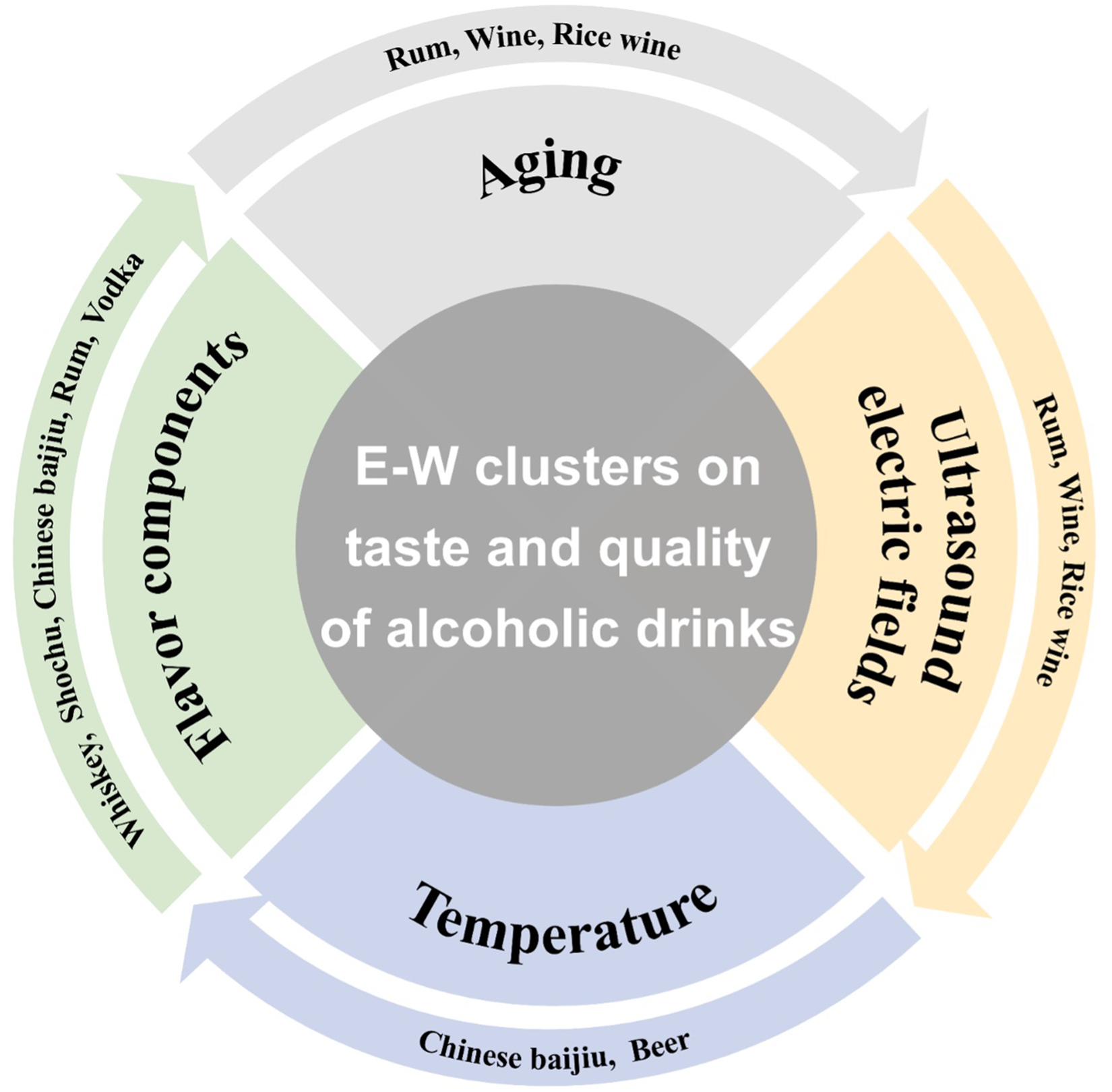
Schematic illustration of the induced EWC changes in different alcoholic drinks.
Concentration Effects: Spectroscopic Demarcation of Structural Transitions
Changes in the relative content of ethanol and water can significantly affect flavor release and mouthfeel perception in alcoholic beverages,50–52 with different proportions forming distinct cluster structures.5,27 As ethanol content increases, the predominant cluster type gradually shifts from water-rich to ethanol-rich clusters. Spectroscopic techniques can convert the process of structural change in EWC with concentration into observable spectral signals. Qin et al. 33 studied intermolecular interactions in ethanol–water solutions using near-infrared (NIR) spectroscopy. The introduction of excess spectra and two-dimensional correlation spectroscopy (2D-COS) provided new molecular-level insights into the changing mechanisms of 10–100% ethanol–water mixtures. The results indicate that below 40% ethanol concentration, ethanol preferentially binds with water molecules, while above 40%, the self-association tendency of ethanol molecules increases, leading to the dissociation of water–ethanol clusters. Jia et al. 48 further categorized cluster morphologies in different concentration ranges using fluorescence spectroscopy. In the low ethanol concentration range of 10–45%, interactions between water molecules are stronger, mainly forming clusters of the type (H2O)m(EtOH). In the 50–75% concentration range, stable ethanol–water clusters (H2O)m(EtOH)n are formed, while in the high ethanol concentration range of 80–100%, structures dominated by ethanol, such as (H2O)(EtOH)n, prevail.
In addition, Yang et al. 27 used 1H NMR combined with contact angle measurements to further support the existence of different types of molecular cluster structures in ethanol–water mixtures of varying concentrations, while also explaining why certain alcohol concentrations are preferred for specific beverage types. The 1H NMR results showed that the chemical shift of hydroxyl proton peaks in ethanol–water mixtures with different volume ratios exhibited stepwise changes, consistent with the trend in contact angle variations. This indicates that hydrogen bond networks undergo reorganization at critical concentration points. Spectral identification of these critical points contributes to a molecular-level understanding of how different alcohol concentrations influence sensory properties and provides a structural basis for determining specific alcohol levels.
Temperature Effects: Probing the Thermal Modulation of Cluster Equilibrium
Temperature alters the dynamics and stability of hydrogen bonds,53,54 thereby shifting the dynamic equilibrium between EWC, which in turn affects the flavor and quality of alcoholic beverages (Figure 2). The work by Yang et al. 27 provides a molecular-level explanation for long-standing drinking traditions such as “warm baijiu, cold beer”.
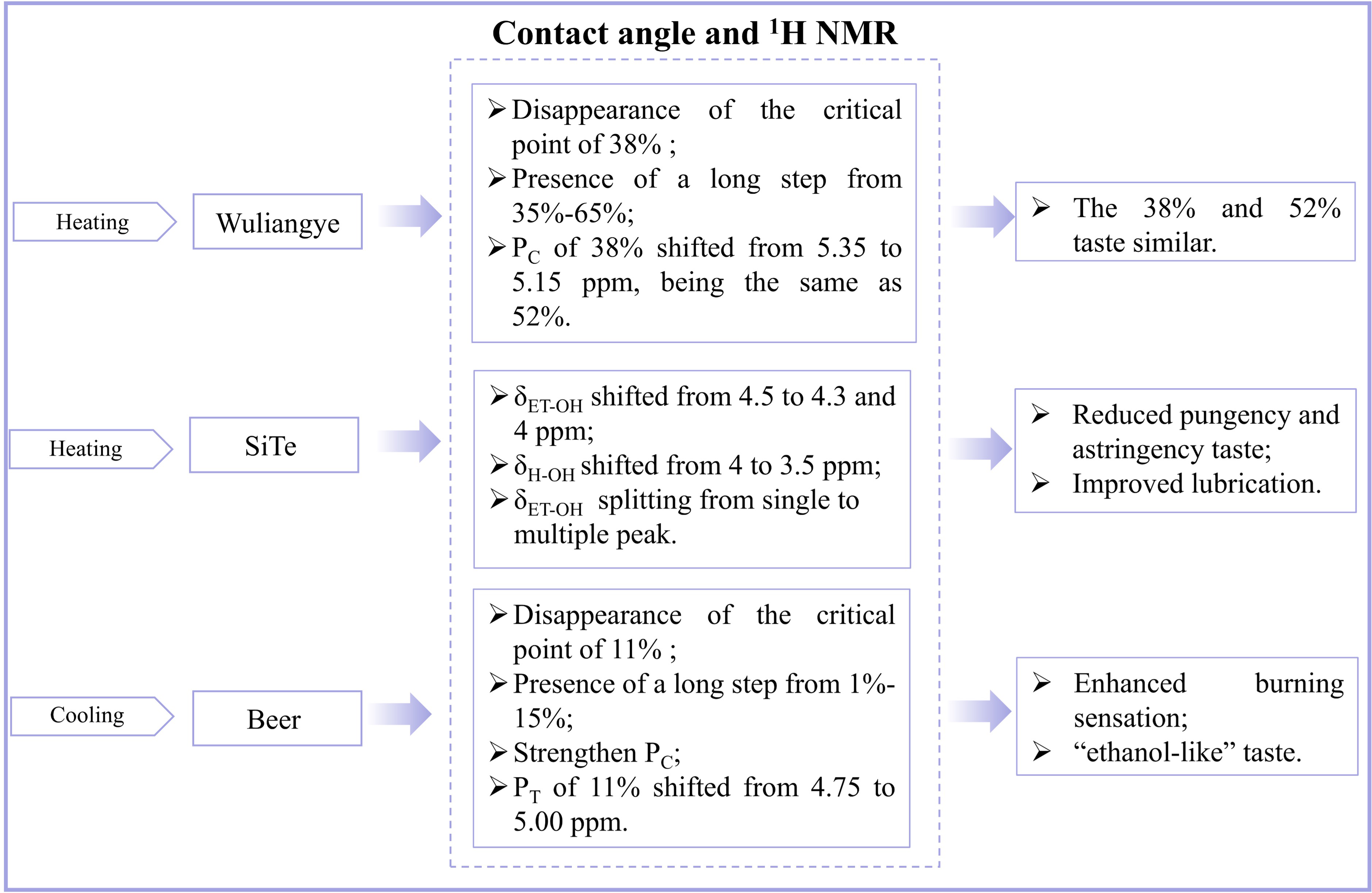
Illustrations of temperature effects on structural changes and tastes of several alcoholic drinks.
For convenience, Yang et al. denoted the hydroxyl peaks near 4.790 parts per million (ppm) as the tetrahedral hydrogen-bonding structure (PT),55,56 and the hydroxyl peaks near 5.290 ppm as a chain-like hydrogen-bonding structure (PC).3,57 Based on this assignment, the study found that compared to room temperature, at 40 °C, the chemical shift of PC in 38% EWC shifted downfield more than that of the PT, and its chemical shift becomes closer to that of PC in 52% EWC. The above results indicate that the chain-like cluster structures in 38% EWC gradually approach those of 52% EWC. Thus heated, 38% and 52% Chinese baijiu develop a similar taste. Similarly, after being chilled, beer exhibits a stronger “ethanol-like” taste and a burning sensation. At low temperatures, 1H NMR studies show that in 5% and 11% EWC, the intensity of ethanol-related PC peaks increases significantly, indicating that cooling enhances the proportion of chain-like clusters dominated by ethanol. Meanwhile, the PT shifts upfield, strengthening the stability of tetrahedral water cluster structures. Sensory experiments further confirm that chilled beer displays a more pronounced “ethanol taste” and burning sensation. The traditional practice of “warm baijiu, cold beer” is not merely subjective, it is based on scientific principles involving changes in cluster structures.
Furthermore, the influence of drinking temperature on the flavor of alcoholic beverages is further supported by the research of Zhong et al. 28 1H NMR spectra indicate that when temperature rises, the hydroxyl proton peaks of both ethanol and water in SiTe baijiu shift upfield, reflecting a weakening of intermolecular hydrogen bond strength. Besides changes in chemical shift, the shape of the ethanol hydroxyl proton peak also changes noticeably: it appears as a single peak at 5 °C and 15 °C, but splits into multiple peaks at 25 °C. This suggests that some ethanol molecules are released from the hydrogen-bond network, becoming “free-state” molecules that adsorb onto the oral surface, forming a uniform adsorption film and resulting in a smoother mouthfeel. Rheological measurements show decreased viscosity, further supporting this result.
External Field Interventions: Accelerated Aging Monitored by Spectroscopy
The natural aging process of alcoholic beverages typically requires a considerable amount of time. However, interventions using external energy fields such as electric fields or ultrasound can accelerate the frequency of molecular collisions (Figure 3), promote the interaction between ethanol and water molecules in alcoholic beverages, enhance hydrogen bond coupling, and thus speed up the aging process of these beverages.58,59 As early as 2000, Matsushita et al. studied the mechanism of ethanol–water cluster formation in wine under ultrasonic treatment and its impact on quality. 60 They found that subjecting spirits or wine to ultrasound for a certain period could achieve effects similar to those of natural aging. Similarly, Zeng et al. obtained comparable results by treating rice wine with a high-voltage electric field. 19
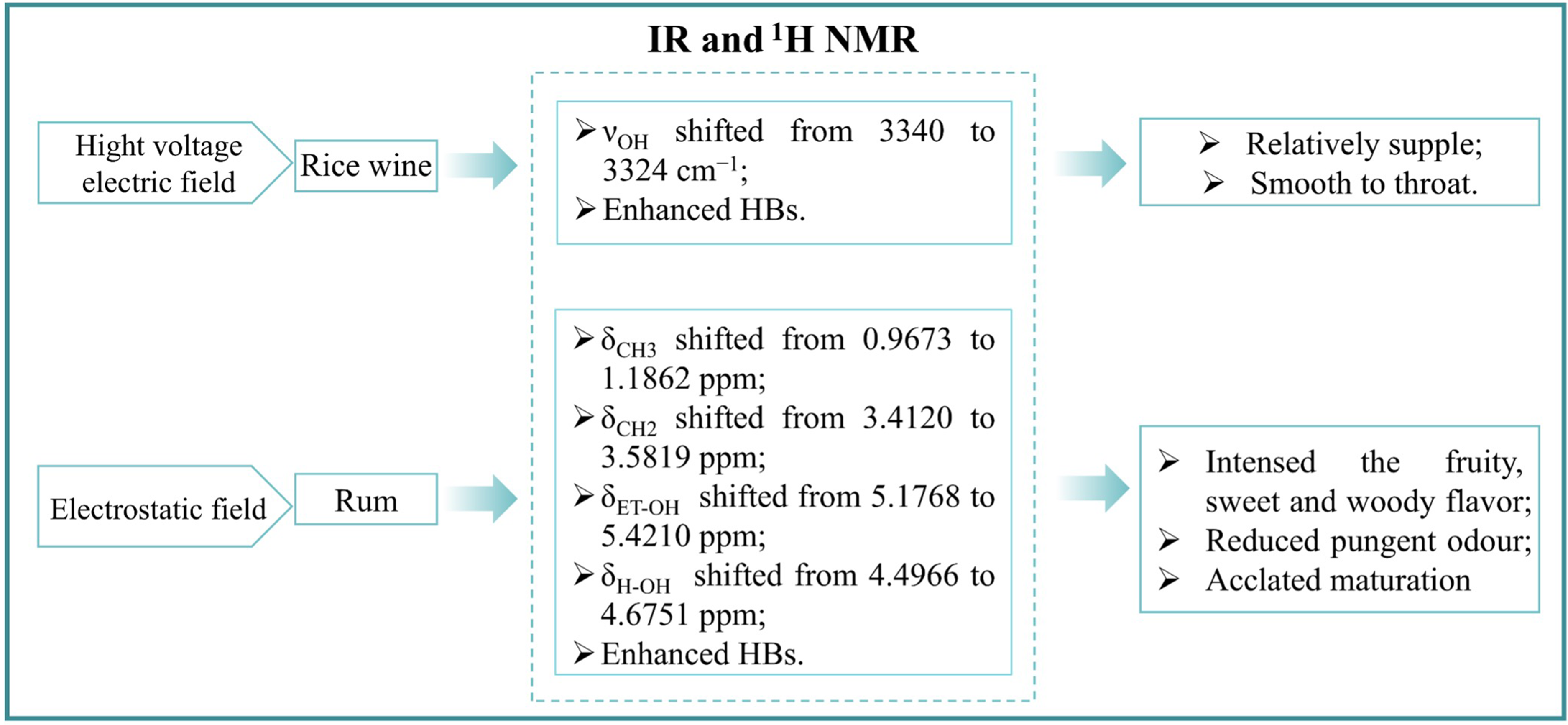
Illustrations of external electric fields improved structural changes and aging processes of alcoholic drinks.
Based on a model system of rum, 29 1H NMR studies showed that after treatment with a static electric field, the chemical shifts of methyl, methylene, and hydroxyl hydrogens in ethanol molecules, as well as the hydroxyl hydrogens in water, all shifted toward lower fields. As a result, the hydrogen bonds between ethanol and water molecules were strengthened, achieving flavor effects similar to those of slow natural aging. Future research could further explore the structural changes in EWC under the influence of a static electric field and their intrinsic relationship with the actual maturation of rum.
Modulation by Trace Components: The Indirect Flavor Contribution
Research reports 61 indicate that in matured whiskey, components from the wooden barrel can promote the tight binding of water and ethanol molecules. This structural change in EWC helps enhance the mellowness of whiskey’s mouthfeel and reduces the pungency of alcohol. Nose et al.16,17,22,30,31,62,63 used NMR to study the intrinsic relationship between the reduction of harsh taste in alcoholic beverages and the hydrogen-bond structure between ethanol and water molecules. 1H NMR results showed that trace flavor compounds such as acids (acetic acid),16,17,31,62 amino acids, 17 phenols,16,31,62 conjugate-base anions,31,62 and salts (magnesium chloride)22,31 can promote proton exchange between water and ethanol, leading to the merging of their originally separate hydroxyl proton peaks into a single peak, which shifts downfield. This peak merging reflects enhanced connectivity and strength of the hydrogen-bond network. Further sensory analysis demonstrated that strengthening the ethanol–water hydrogen-bond structure suppresses the pungent odor of alcohol. This phenomenon has been observed in various alcoholic beverages such as vodka, whiskey, Japanese sake and shochu, and cocktails. Qiao et al. investigated the binding behavior and overall hydrogen-bond properties of ethanol and water in Fenjiu using fluorescence and viscosity analyses. 23 The results showed that in aged Fenjiu, the strength of ethanol–water hydrogen bonds and the total hydrogen-bond strength are directly influenced by the loss of total esters and the increase in sodium ions within ceramic containers, which ultimately determine the beverage’s taste and quality.
Additionally, Cao et al. systematically investigated the relationship between ethanol–water hydrogen bond strength and flavor components using 1H NMR and viscosity measurements. 20 The study found that the increase in viscosity during the aging of rice wine is directly related to the enhancement of hydrogen bonding in the ethanol–water system. In a simulated rice wine system, the presence of citric acid and malic acid accelerated the proton exchange reaction between ethanol and water molecules, transitioning the system from a relatively slow exchange regime to a fast exchange regime. Consequently, the hydroxyl proton peaks of water and ethanol, initially observed as two separate signals, coalesced into a single peak. Meanwhile, the chemical shift of the coalesced peak moved downfield, indicating an overall strengthening of the hydrogen bond network. Therefore, trace flavor components can significantly influence the proton exchange rate and the structure of the hydrogen bond network, thereby modulating the sensory properties of alcoholic beverages.
Moreover, rice wine is prone to acidification during storage. Studies have found that spoiled rice wine exhibits significantly enhanced polarization characteristics under specific high-frequency (60–70 GHz, E-band) microwaves. 64 At 69 GHz, the microwave radar cross-section (RCS) value of spoiled rice wine is approximately 10% higher than that of unspoiled rice wine. Research indicates that in rice wine, ethanol and water originally form clusters through hydrogen bonds, with their polarity primarily determined by water. During the spoilage process, acidic components (such as lactic acid and acetic acid) produced may form new highly polar molecular clusters with water molecules. These clusters have significantly higher polarity than the original EWC, leading to enhanced dielectric constant and RCS at high frequencies. Quantum chemical calculations support the existence of a six-membered hydrogen-bonded ring structure formed by a single acetic acid molecule with multiple water molecules. In summary, trace flavor components in alcoholic beverages can modulate the mouthfeel by altering the hydrogen-bond structure in EWC.
In conclusion, structural changes in EWC induced by variables such as ethanol concentration, temperature, external fields, and trace components can be analyzed through spectroscopic techniques, providing crucial evidence for understanding the intrinsic molecular mechanisms underlying the sensory qualities of alcoholic beverages.
Conclusion
Compared with the traditional focus on flavor components, exploring EWC represents an effective and promising strategy for quality evaluation and improvement. The sensory characteristics of alcoholic beverages, such as pungency and smoothness, are profoundly regulated by EWC structure, and spectroscopic analysis provides molecular-level evidence to reveal this association.
This review systematically summarizes the advances in the application of various spectroscopic techniques (such as IR, Raman, NMR, and fluorescence spectroscopy) to analyze the hydrogen bond network structure in alcoholic beverages. Among these, the hydroxyl vibration peaks in IR and Raman spectra serve as environmentally sensitive probes, enabling rapid, non-destructive assessment of alcoholic beverage quality based on variations in hydrogen bond strength, thereby distinguishing high-quality from low-quality beverages. Since the fluorescence emission peak positions vary depending on EWC structure, they can be used to distinguish water-rich clusters, ethanol–water clusters, and ethanol-rich clusters. Meanwhile, 1H NMR spectroscopy provides a powerful window into the dynamic chemical exchange processes involved in the formation and dissociation of EWC. Changes in chemical shift reflect alterations in the hydrogen-bonding environment of the hydroxyl protons, while variations in peak multiplicity convey information about the exchange rate and the distribution of ethanol and water molecules across different microenvironments. Together, these spectral features characterize the dynamic association and dissociation of the hydrogen bond network in alcoholic beverages. Moreover, changes in external conditions (such as temperature, external energy fields, trace flavor components) can affect the hydrogen bond structure of ethanol–water mixtures. These structural changes can be captured by spectroscopic techniques and converted into observable data signals, thereby directly reflecting variations of EWC. Such structural changes constitute the key molecular basis that ultimately determines the flavor and quality of alcoholic beverages.
However, the process of developing basic spectroscopy into a practical tool for quality monitoring in the alcoholic beverage industry is full of challenges. Current research is largely focused on ethanol–water model systems or beverages with relatively simple compositions, such as light-aroma Fenjiu, vodka, and sake. In contrast, the understanding of EWC in complex systems like sauce-aroma baijiu remains quite limited. This necessitates more advanced methods to extract characteristic signals of clusters from complex spectral backgrounds. Additionally, there is an urgent need to advance spectroscopic techniques toward higher spatial resolution to capture the dynamic formation and micro-heterogeneity of clusters, which would also lay the foundation for studying EWC in beverages with complex compositions.
Particularly crucial is that, with the continuous development of artificial intelligence (AI), the integration of spectroscopy and AI is poised to become a transformative force. AI can mine hidden patterns from high-dimensional data and accelerate the deciphering of spectroscopy-sensory correlations by establishing models between specific spectral features and sensory attribute parameters. For example, IR spectroscopy combined with chemometrics has been successfully applied to the quantitative analysis of flavor compounds in strong-aroma baijiu,65,66 while Ding et al. used fluorescence spectroscopy integrated with machine learning to achieve quality identification of baijiu. 67 Currently, the integration of spectroscopic techniques and machine learning has enabled accurate determination of the vintage, 68 brand,69,70 quality grade,71,72 trace compound content,13,66,73 and alcohol strength 74 of alcoholic beverages. Nevertheless, directly revealing EWC in alcoholic beverages remains relatively rare and challenging, and there is potential for the application of AI technology in this area.
In summary, with the continuous advancement of spectroscopic technology and its convergence with computational science and artificial intelligence, the mysteries of EWC are gradually being unveiled. This progress holds promise for revealing the intrinsic relationship between the quality and taste of alcoholic beverages and EWC at the molecular level. Moreover, it will establish a solid scientific foundation for data driven quality control and objective design of alcoholic beverages.
Footnotes
Acknowledgements
This work was financially supported by the Jilin Province Science and Technology Development Plan Project (No. 20230204040YY), project of NSFC (No. 21875085), and the Innovation & Opening Program of the State Key Laboratory of Supramolecular Structure and Materials, Jilin University.
Not applicable.
Cheng-Feng Zhang: Methodology, Investigation, Data curation, Writing-original draft preparation; Yi Li: Data curation, Validation; Yuqing Wu: Writing-review & editing, Supervision, Methodology, Funding acquisition.
Declaration of Conflicting Interests
The authors declared no potential conflicts of interest with respect to the research, authorship, and/or publication of this article.
Funding
The author(s) received no financial support for the research, authorship, and/or publication of this article.
